AEN 202
Practical # 1
Identification, morphology
and structural adaptations
of honey bee
SYSTEMATIC POSITION
Order : Hymenoptera
Suborder : Apocrita
Family : Apidae
HONEY BEE
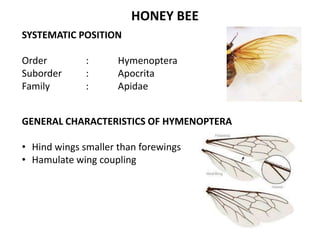
GENERAL CHARACTERISTICS OF HYMENOPTERA
• Hind wings smaller than forewings
• Hamulate wing coupling
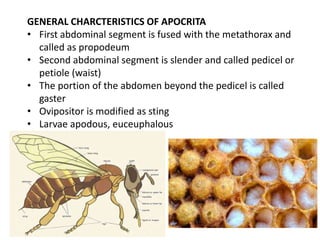
GENERAL CHARCTERISTICS OF APOCRITA
• First abdominal segment is fused with the metathorax and
called as propodeum
• Second abdominal segment is slender and called pedicel or
petiole (waist)
• The portion of the abdomen beyond the pedicel is called
gaster
• Ovipositor is modified as sting
• Larvae apodous, euceuphalous
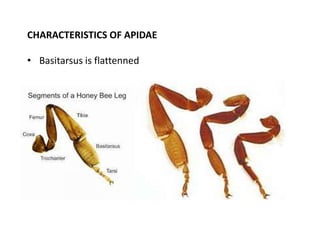
CHARACTERISTICS OF APIDAE
• Basitarsus is flattenned
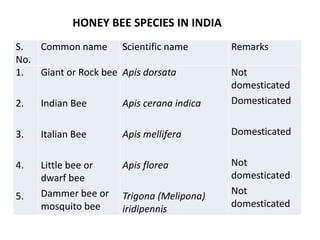
S.
No.
Common name Scientific name Remarks
1.
2.
3.
4.
5.
Giant or Rock bee
Indian Bee
Italian Bee
Little bee or
dwarf bee
Dammer bee or
mosquito bee
Apis dorsata
Apis cerana indica
Apis mellifera
Apis florea
Trigona (Melipona)
iridipennis
Not
domesticated
Domesticated
Domesticated
Not
domesticated
Not
domesticated
HONEY BEE SPECIES IN INDIA
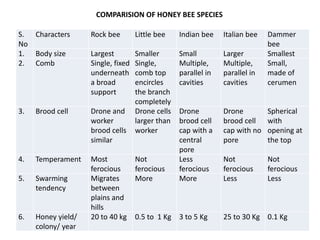
S.
No
Characters Rock bee Little bee Indian bee Italian bee Dammer
bee
1. Body size Largest Smaller Small Larger Smallest
2. Comb Single, fixed
underneath
a broad
support
Single,
comb top
encircles
the branch
completely
Multiple,
parallel in
cavities
Multiple,
parallel in
cavities
Small,
made of
cerumen
3. Brood cell Drone and
worker
brood cells
similar
Drone cells
larger than
worker
Drone
brood cell
cap with a
central
pore
Drone
brood cell
cap with no
pore
Spherical
with
opening at
the top
4. Temperament Most
ferocious
Not
ferocious
Less
ferocious
Not
ferocious
Not
ferocious
5. Swarming
tendency
Migrates
between
plains and
hills
More More Less Less
6. Honey yield/
colony/ year
20 to 40 kg 0.5 to 1 Kg 3 to 5 Kg 25 to 30 Kg 0.1 Kg
COMPARISION OF HONEY BEE SPECIES
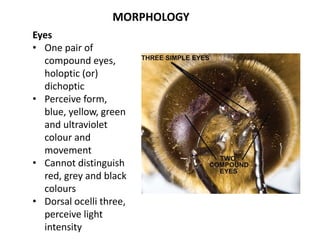
Eyes
• One pair of
compound eyes,
holoptic (or)
dichoptic
• Perceive form,
blue, yellow, green
and ultraviolet
colour and
movement
• Cannot distinguish
red, grey and black
colours
• Dorsal ocelli three,
perceive light
intensity
MORPHOLOGY
MORPHOLOGY
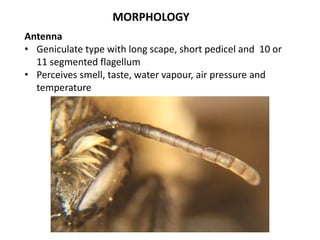
Antenna
• Geniculate type with long scape, short pedicel and 10 or
11 segmented flagellum
• Perceives smell, taste, water vapour, air pressure and
temperature
MORPHOLOGY
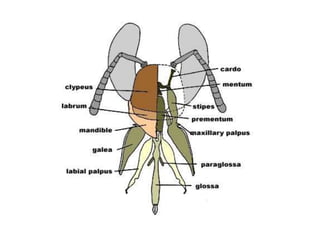
Chewing and lapping type of mouth parts
Chewing Unit:
• Consists of plate like labrum and blunt mandibles
• Mandibles not toothed, stumpy (short and thick) and
protrude near the base of the lapping tongue
• Mandibles are helpful in pollen ingestion, wax moulding,
carrying things and supporting the lapping unit while feeding
and maintaining the flexed lapping tongue in position when
not in use
MORPHOLOGY
Chewing and lapping type of mouth parts
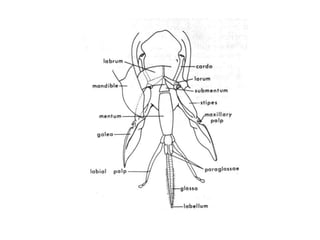
Lapping Unit:
• Galeae of maxillae, labial palpi and glossa of labium forms
the lapping unit
• Galea is large, blade like and tapering towards the apex with
concave inner surface
• Labial palp is four segmented
• Glossa is greatly elongated, flexible extensible with a spoon
shaped tip called flabellun (or) bouton useful to lick the
nectar
MORPHOLOGY
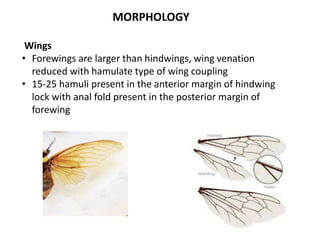
Wings
• Forewings are larger than hindwings, wing venation
reduced with hamulate type of wing coupling
• 15-25 hamuli present in the anterior margin of hindwing
lock with anal fold present in the posterior margin of
forewing
MORPHOLOGY
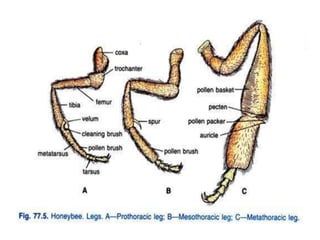
Legs
3 pairs of foragial legs adapted for different functions
Foreleg
i) Eyebrush : Hairs on tibia used to clean the pollen
from eyes
ii) Antenna cleaner : Consists of velum and antennal
comb, used to clean antenna
Velum - Clasp present at distal end of tibia
Antennal comb - Notch lined with spines at the
basal end of basitarsus
iii)Pollen brush : Bristles at the basitarsus useful
to collect pollen from anterior part of body
MORPHOLOGY
Middle leg
i) Pollen brush : Bristles on basitarsus, used
to collect pollen from the middle part of the body and from
fore leg
ii) Spur : Present at the distal end of tibia,
used to clean spiracles and wings and to loosen pollen
packets from the pollen basket.
MORPHOLOGY
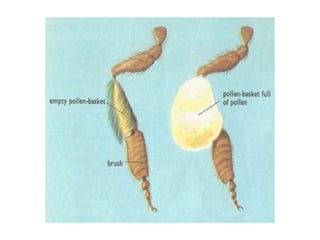
Hind leg
i) Pollen basket (Corbiculum)
Concavity on the outer surface of tibia lined with curved hairs,
used to carry the pollens
ii) Pollen packer (Pollen press)
Consists of pecten and auricle
• Pecten is a row of stout bristles present at the distal end of
the tibia
• Auricle is a smalll plate fringed with hairs along the margin
• Pack pollen inside the pollen packet
iii)Pollen comb
Ten transverse rows of stiff spines on the innerside of basitarsus
Used in pollen collection from middle leg, removal of wax mirror
MORPHOLOGY
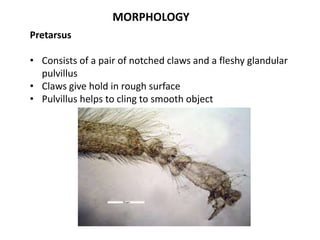
Pretarsus
• Consists of a pair of notched claws and a fleshy glandular
pulvillus
• Claws give hold in rough surface
• Pulvillus helps to cling to smooth object
MORPHOLOGY
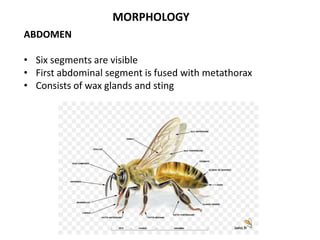
ABDOMEN
• Six segments are visible
• First abdominal segment is fused with metathorax
• Consists of wax glands and sting
MORPHOLOGY
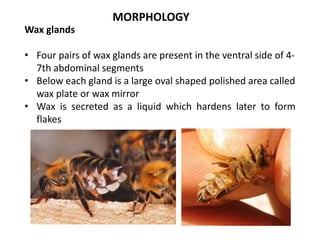
Wax glands
• Four pairs of wax glands are present in the ventral side of 4-
7th abdominal segments
• Below each gland is a large oval shaped polished area called
wax plate or wax mirror
• Wax is secreted as a liquid which hardens later to form
flakes
MORPHOLOGY
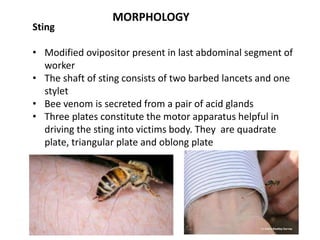
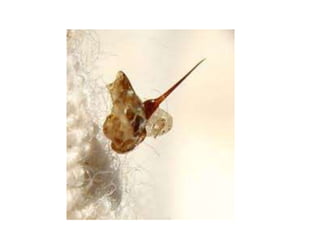
Sting
• Modified ovipositor present in last abdominal segment of
worker
• The shaft of sting consists of two barbed lancets and one
stylet
• Bee venom is secreted from a pair of acid glands
• Three plates constitute the motor apparatus helpful in
driving the sting into victims body. They are quadrate
plate, triangular plate and oblong plate
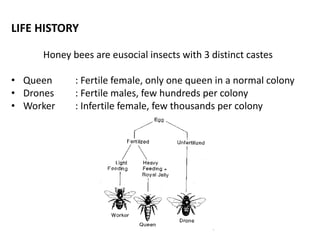
LIFE HISTORY
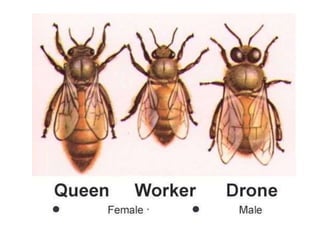
Honey bees are eusocial insects with 3 distinct castes
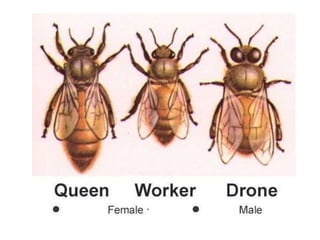
• Queen : Fertile female, only one queen in a normal colony
• Drones : Fertile males, few hundreds per colony
• Worker : Infertile female, few thousands per colony
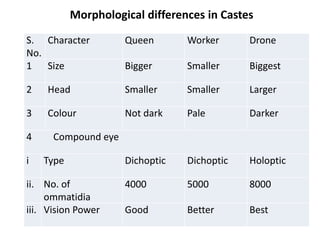
S.
No.
Character Queen Worker Drone
1 Size Bigger Smaller Biggest
2 Head Smaller Smaller Larger
3 Colour Not dark Pale Darker
4 Compound eye
i Type Dichoptic Dichoptic Holoptic
ii. No. of
ommatidia
4000 5000 8000
iii. Vision Power Good Better Best
Morphological differences in Castes
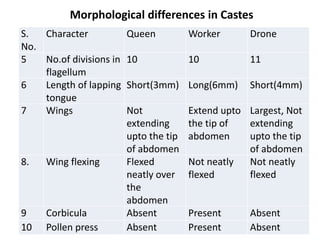
S.
No.
Character Queen Worker Drone
5 No.of divisions in
flagellum
10 10 11
6 Length of lapping
tongue
Short(3mm) Long(6mm) Short(4mm)
7 Wings Not
extending
upto the tip
of abdomen
Extend upto
the tip of
abdomen
Largest, Not
extending
upto the tip
of abdomen
8. Wing flexing Flexed
neatly over
the
abdomen
Not neatly
flexed
Not neatly
flexed
9 Corbicula Absent Present Absent
10 Pollen press Absent Present Absent
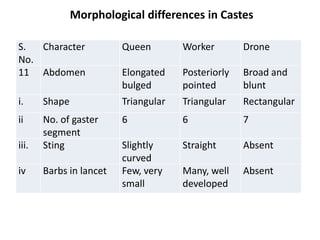
Morphological differences in Castes
S.
No.
Character Queen Worker Drone
11 Abdomen Elongated
bulged
Posteriorly
pointed
Broad and
blunt
i. Shape Triangular Triangular Rectangular
ii No. of gaster
segment
6 6 7
iii. Sting Slightly
curved
Straight Absent
iv Barbs in lancet Few, very
small
Many, well
developed
Absent
Morphological differences in Castes
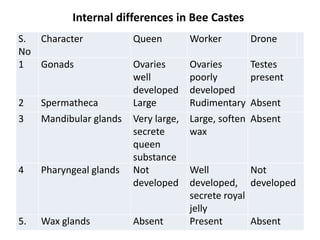
S.
No
Character Queen Worker Drone
1 Gonads Ovaries
well
developed
Ovaries
poorly
developed
Testes
present
2 Spermatheca Large Rudimentary Absent
3 Mandibular glands Very large,
secrete
queen
substance
Large, soften
wax
Absent
4 Pharyngeal glands Not
developed
Well
developed,
secrete royal
jelly
Not
developed
5. Wax glands Absent Present Absent
Internal differences in Bee Castes
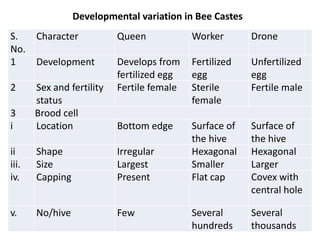
S.
No.
Character Queen Worker Drone
1 Development Develops from
fertilized egg
Fertilized
egg
Unfertilized
egg
2 Sex and fertility
status
Fertile female Sterile
female
Fertile male
3 Brood cell
i Location Bottom edge Surface of
the hive
Surface of
the hive
ii Shape Irregular Hexagonal Hexagonal
iii. Size Largest Smaller Larger
iv. Capping Present Flat cap Covex with
central hole
v. No/hive Few Several
hundreds
Several
thousands
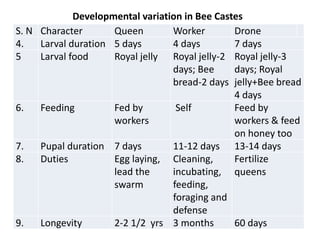
Developmental variation in Bee Castes
S. N Character Queen Worker Drone
4. Larval duration 5 days 4 days 7 days
5 Larval food Royal jelly Royal jelly-2
days; Bee
bread-2 days
Royal jelly-3
days; Royal
jelly+Bee bread
4 days
6. Feeding Fed by
workers
Self Feed by
workers & feed
on honey too
7. Pupal duration 7 days 11-12 days 13-14 days
8. Duties Egg laying,
lead the
swarm
Cleaning,
incubating,
feeding,
foraging and
defense
Fertilize
queens
9. Longevity 2-2 1/2 yrs 3 months 60 days
Developmental variation in Bee Castes
AEN 202
Practical # 1
?

P 01 Bee Morphology. pptx

  • 1.
    AEN 202 Practical #1 Identification, morphology and structural adaptations of honey bee
  • 2.
    SYSTEMATIC POSITION Order :Hymenoptera Suborder : Apocrita Family : Apidae HONEY BEE GENERAL CHARACTERISTICS OF HYMENOPTERA • Hind wings smaller than forewings • Hamulate wing coupling
  • 3.
    GENERAL CHARCTERISTICS OFAPOCRITA • First abdominal segment is fused with the metathorax and called as propodeum • Second abdominal segment is slender and called pedicel or petiole (waist) • The portion of the abdomen beyond the pedicel is called gaster • Ovipositor is modified as sting • Larvae apodous, euceuphalous
  • 4.
    CHARACTERISTICS OF APIDAE •Basitarsus is flattenned
  • 5.
    S. No. Common name Scientificname Remarks 1. 2. 3. 4. 5. Giant or Rock bee Indian Bee Italian Bee Little bee or dwarf bee Dammer bee or mosquito bee Apis dorsata Apis cerana indica Apis mellifera Apis florea Trigona (Melipona) iridipennis Not domesticated Domesticated Domesticated Not domesticated Not domesticated HONEY BEE SPECIES IN INDIA
  • 6.
    S. No Characters Rock beeLittle bee Indian bee Italian bee Dammer bee 1. Body size Largest Smaller Small Larger Smallest 2. Comb Single, fixed underneath a broad support Single, comb top encircles the branch completely Multiple, parallel in cavities Multiple, parallel in cavities Small, made of cerumen 3. Brood cell Drone and worker brood cells similar Drone cells larger than worker Drone brood cell cap with a central pore Drone brood cell cap with no pore Spherical with opening at the top 4. Temperament Most ferocious Not ferocious Less ferocious Not ferocious Not ferocious 5. Swarming tendency Migrates between plains and hills More More Less Less 6. Honey yield/ colony/ year 20 to 40 kg 0.5 to 1 Kg 3 to 5 Kg 25 to 30 Kg 0.1 Kg COMPARISION OF HONEY BEE SPECIES
  • 9.
    Eyes • One pairof compound eyes, holoptic (or) dichoptic • Perceive form, blue, yellow, green and ultraviolet colour and movement • Cannot distinguish red, grey and black colours • Dorsal ocelli three, perceive light intensity MORPHOLOGY
  • 10.
    MORPHOLOGY Antenna • Geniculate typewith long scape, short pedicel and 10 or 11 segmented flagellum • Perceives smell, taste, water vapour, air pressure and temperature
  • 11.
    MORPHOLOGY Chewing and lappingtype of mouth parts Chewing Unit: • Consists of plate like labrum and blunt mandibles • Mandibles not toothed, stumpy (short and thick) and protrude near the base of the lapping tongue • Mandibles are helpful in pollen ingestion, wax moulding, carrying things and supporting the lapping unit while feeding and maintaining the flexed lapping tongue in position when not in use
  • 13.
    MORPHOLOGY Chewing and lappingtype of mouth parts Lapping Unit: • Galeae of maxillae, labial palpi and glossa of labium forms the lapping unit • Galea is large, blade like and tapering towards the apex with concave inner surface • Labial palp is four segmented • Glossa is greatly elongated, flexible extensible with a spoon shaped tip called flabellun (or) bouton useful to lick the nectar
  • 15.
    MORPHOLOGY Wings • Forewings arelarger than hindwings, wing venation reduced with hamulate type of wing coupling • 15-25 hamuli present in the anterior margin of hindwing lock with anal fold present in the posterior margin of forewing
  • 16.
    MORPHOLOGY Legs 3 pairs offoragial legs adapted for different functions Foreleg i) Eyebrush : Hairs on tibia used to clean the pollen from eyes ii) Antenna cleaner : Consists of velum and antennal comb, used to clean antenna Velum - Clasp present at distal end of tibia Antennal comb - Notch lined with spines at the basal end of basitarsus iii)Pollen brush : Bristles at the basitarsus useful to collect pollen from anterior part of body
  • 17.
    MORPHOLOGY Middle leg i) Pollenbrush : Bristles on basitarsus, used to collect pollen from the middle part of the body and from fore leg ii) Spur : Present at the distal end of tibia, used to clean spiracles and wings and to loosen pollen packets from the pollen basket.
  • 18.
    MORPHOLOGY Hind leg i) Pollenbasket (Corbiculum) Concavity on the outer surface of tibia lined with curved hairs, used to carry the pollens ii) Pollen packer (Pollen press) Consists of pecten and auricle • Pecten is a row of stout bristles present at the distal end of the tibia • Auricle is a smalll plate fringed with hairs along the margin • Pack pollen inside the pollen packet iii)Pollen comb Ten transverse rows of stiff spines on the innerside of basitarsus Used in pollen collection from middle leg, removal of wax mirror
  • 21.
    MORPHOLOGY Pretarsus • Consists ofa pair of notched claws and a fleshy glandular pulvillus • Claws give hold in rough surface • Pulvillus helps to cling to smooth object
  • 22.
    MORPHOLOGY ABDOMEN • Six segmentsare visible • First abdominal segment is fused with metathorax • Consists of wax glands and sting
  • 23.
    MORPHOLOGY Wax glands • Fourpairs of wax glands are present in the ventral side of 4- 7th abdominal segments • Below each gland is a large oval shaped polished area called wax plate or wax mirror • Wax is secreted as a liquid which hardens later to form flakes
  • 24.
    MORPHOLOGY Sting • Modified ovipositorpresent in last abdominal segment of worker • The shaft of sting consists of two barbed lancets and one stylet • Bee venom is secreted from a pair of acid glands • Three plates constitute the motor apparatus helpful in driving the sting into victims body. They are quadrate plate, triangular plate and oblong plate
  • 26.
    LIFE HISTORY Honey beesare eusocial insects with 3 distinct castes • Queen : Fertile female, only one queen in a normal colony • Drones : Fertile males, few hundreds per colony • Worker : Infertile female, few thousands per colony
  • 27.
    S. No. Character Queen WorkerDrone 1 Size Bigger Smaller Biggest 2 Head Smaller Smaller Larger 3 Colour Not dark Pale Darker 4 Compound eye i Type Dichoptic Dichoptic Holoptic ii. No. of ommatidia 4000 5000 8000 iii. Vision Power Good Better Best Morphological differences in Castes
  • 29.
    S. No. Character Queen WorkerDrone 5 No.of divisions in flagellum 10 10 11 6 Length of lapping tongue Short(3mm) Long(6mm) Short(4mm) 7 Wings Not extending upto the tip of abdomen Extend upto the tip of abdomen Largest, Not extending upto the tip of abdomen 8. Wing flexing Flexed neatly over the abdomen Not neatly flexed Not neatly flexed 9 Corbicula Absent Present Absent 10 Pollen press Absent Present Absent Morphological differences in Castes
  • 30.
    S. No. Character Queen WorkerDrone 11 Abdomen Elongated bulged Posteriorly pointed Broad and blunt i. Shape Triangular Triangular Rectangular ii No. of gaster segment 6 6 7 iii. Sting Slightly curved Straight Absent iv Barbs in lancet Few, very small Many, well developed Absent Morphological differences in Castes
  • 32.
    S. No Character Queen WorkerDrone 1 Gonads Ovaries well developed Ovaries poorly developed Testes present 2 Spermatheca Large Rudimentary Absent 3 Mandibular glands Very large, secrete queen substance Large, soften wax Absent 4 Pharyngeal glands Not developed Well developed, secrete royal jelly Not developed 5. Wax glands Absent Present Absent Internal differences in Bee Castes
  • 33.
    S. No. Character Queen WorkerDrone 1 Development Develops from fertilized egg Fertilized egg Unfertilized egg 2 Sex and fertility status Fertile female Sterile female Fertile male 3 Brood cell i Location Bottom edge Surface of the hive Surface of the hive ii Shape Irregular Hexagonal Hexagonal iii. Size Largest Smaller Larger iv. Capping Present Flat cap Covex with central hole v. No/hive Few Several hundreds Several thousands Developmental variation in Bee Castes
  • 34.
    S. N CharacterQueen Worker Drone 4. Larval duration 5 days 4 days 7 days 5 Larval food Royal jelly Royal jelly-2 days; Bee bread-2 days Royal jelly-3 days; Royal jelly+Bee bread 4 days 6. Feeding Fed by workers Self Feed by workers & feed on honey too 7. Pupal duration 7 days 11-12 days 13-14 days 8. Duties Egg laying, lead the swarm Cleaning, incubating, feeding, foraging and defense Fertilize queens 9. Longevity 2-2 1/2 yrs 3 months 60 days Developmental variation in Bee Castes
  • 36.