MicroLoan Workshop Junction City, September 23rd eDev
About eDev  (formerly Lane MicroBusiness) 501(c) (3) non-profit organization, based in Eugene, Oregon -  www.edev.org.  Primary mission is to help income-qualified individuals start or build businesses and to help rural communities with economic development We offer classes, technical assistance, and access to capital through grants and loans.
Agenda  Introductions – upcoming Junction City classes What is a microloan Why eDev is offering microloans Elements of a microloan application Five C’s of business loans How a microloan is evaluated Examples of requests for loans that will rank poorly. Importance of assembling a good loan application
What is a microloan? Most start-up businesses can not obtain business loans from banks Start-up business owners typically use personal savings, family and friends, and credit cards to fund their start up as well as existing operations Existing small businesses are having trouble obtaining capital Microloans range from $500 up to a maximum of $35,000 Number of hoops to jump through
Why eDev is offering microloans SBA primarily acts as guarantor on loans originating from banks and credit unions eDev was designated an SBA microloan lender in August 2009. eDev will initially have $150,000 in microloan funds eDev can apply for more loan funds as needed  eDev is responsible for the successful management and operations of the loan portfolio. Importance of understanding that we are offering business loans that need to be paid back.
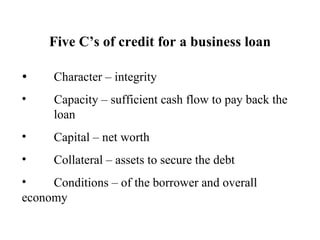
Five C’s of credit for a business loan Character – integrity Capacity – sufficient cash flow to pay back the  loan Capital – net worth Collateral – assets to secure the debt Conditions – of the borrower and overall  economy
Character Banks want to put their money with clients who have the best credentials and references. The way you treat your employees and customers, the way you take responsibility, your timeliness in fulfilling obligations - that's character.
Capacity What is your company's borrowing history and track record of repayment. How much debt can your company handle? Will you be able to honor the obligation and repay the debt? There are numerous financial benchmarks such as debt and liquidity ratios that banks use before advancing funds.
Capital How well capitalized is your company? How much money have you invested in the business? Banks want to see that you have a financial commitment; that you have put yourself at risk in the company.
Collateral Collateral represents assets that the company pledges as an alternate repayment source for the loan. Hard assets. Most collateral is in the form of real estate and office or manufacturing equipment. Your accounts receivable and inventory can also be pledged as collateral. Unless you're a business with a proven payments track record, you will almost always be required to pledge collateral.
Conditions What are the current economic conditions and how does your company fit in? If your business is sensitive to economic downturns, the bank wants to know that you are good at managing productivity and expenses.
Elements of a business plan Executive Summary Description of company Description of products and/or services Marketing plan SWOT analysis Cash flow and income projections
Key question to ask yourself What is the compelling reason why a business or an individual would purchase your product or service.  What key benefit(s) are you providing to that business or individual that nobody else is providing?
Types of loans that we prefer Service type businesses such as janitorial cleaning, landscape maintenance, elderly care services, etc.  These types of businesses have a demonstrated targeted need in which people are willing to pay money for those services. Purchase of equipment for expansion where there is a demonstrated need.
Examples of requests for loans  that will rank poorly Request for loans to pay back taxes Request for loans to pay for back salaries and wages Request for loans to pay for current and upcoming salaries and wages Request for loans to pay for existing credit card debt unless you can show a compelling reason
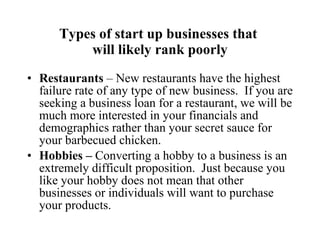
Types of start up businesses that  will likely rank poorly Restaurants  – New restaurants have the highest failure rate of any type of new business.  If you are seeking a business loan for a restaurant, we will be much more interested in your financials and demographics rather than your secret sauce for your barbecued chicken. Hobbies –  Converting a hobby to a business is an extremely difficult proposition.  Just because you like your hobby does not mean that other businesses or individuals will want to purchase your products.
Interest rates Introductory rate of 4.9% up to $8,500 for business owners with excellent credit scores (above 780), solid business plans, and solid collateral. Individuals who do not have excellent credit scores, solid business plans and solid collateral will be reviewed on a case by case basis.  For those individuals who do qualify for microloans, the maximum interest rate will be less than 10%.
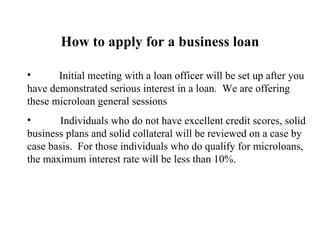
How to apply for a business loan Initial meeting with a loan officer will be set up after you have demonstrated serious interest in a loan.  We are offering these microloan general sessions Individuals who do not have excellent credit scores, solid business plans and solid collateral will be reviewed on a case by case basis.  For those individuals who do qualify for microloans, the maximum interest rate will be less than 10%.
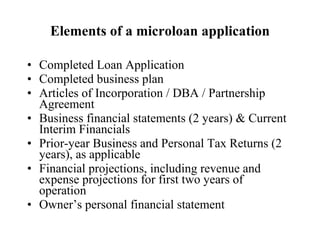
Elements of a microloan application Completed Loan Application Completed business plan   Articles of Incorporation / DBA / Partnership Agreement Business financial statements (2 years) & Current Interim Financials Prior-year Business and Personal Tax Returns (2 years), as applicable Financial projections, including revenue and expense projections for first two years of operation Owner’s personal financial statement
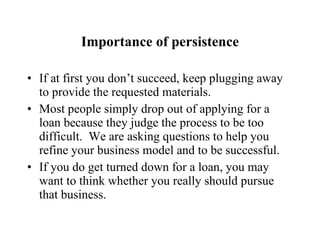
Importance of persistence If at first you don’t succeed, keep plugging away to provide the requested materials. Most people simply drop out of applying for a loan because they judge the process to be too difficult.  We are asking questions to help you refine your business model and to be successful. If you do get turned down for a loan, you may want to think whether you really should pursue that business.
Contact information Martin Desmond 1445 Willamette Street, Suite 120 Eugene, Oregon 97401 541-463-4616 [email_address] www.edev.org

Microloan PowerPoint Presentation

  • 1.
    MicroLoan Workshop JunctionCity, September 23rd eDev
  • 2.
    About eDev (formerly Lane MicroBusiness) 501(c) (3) non-profit organization, based in Eugene, Oregon - www.edev.org. Primary mission is to help income-qualified individuals start or build businesses and to help rural communities with economic development We offer classes, technical assistance, and access to capital through grants and loans.
  • 3.
    Agenda Introductions– upcoming Junction City classes What is a microloan Why eDev is offering microloans Elements of a microloan application Five C’s of business loans How a microloan is evaluated Examples of requests for loans that will rank poorly. Importance of assembling a good loan application
  • 4.
    What is amicroloan? Most start-up businesses can not obtain business loans from banks Start-up business owners typically use personal savings, family and friends, and credit cards to fund their start up as well as existing operations Existing small businesses are having trouble obtaining capital Microloans range from $500 up to a maximum of $35,000 Number of hoops to jump through
  • 5.
    Why eDev isoffering microloans SBA primarily acts as guarantor on loans originating from banks and credit unions eDev was designated an SBA microloan lender in August 2009. eDev will initially have $150,000 in microloan funds eDev can apply for more loan funds as needed eDev is responsible for the successful management and operations of the loan portfolio. Importance of understanding that we are offering business loans that need to be paid back.
  • 6.
    Five C’s ofcredit for a business loan Character – integrity Capacity – sufficient cash flow to pay back the loan Capital – net worth Collateral – assets to secure the debt Conditions – of the borrower and overall economy
  • 7.
    Character Banks wantto put their money with clients who have the best credentials and references. The way you treat your employees and customers, the way you take responsibility, your timeliness in fulfilling obligations - that's character.
  • 8.
    Capacity What isyour company's borrowing history and track record of repayment. How much debt can your company handle? Will you be able to honor the obligation and repay the debt? There are numerous financial benchmarks such as debt and liquidity ratios that banks use before advancing funds.
  • 9.
    Capital How wellcapitalized is your company? How much money have you invested in the business? Banks want to see that you have a financial commitment; that you have put yourself at risk in the company.
  • 10.
    Collateral Collateral representsassets that the company pledges as an alternate repayment source for the loan. Hard assets. Most collateral is in the form of real estate and office or manufacturing equipment. Your accounts receivable and inventory can also be pledged as collateral. Unless you're a business with a proven payments track record, you will almost always be required to pledge collateral.
  • 11.
    Conditions What arethe current economic conditions and how does your company fit in? If your business is sensitive to economic downturns, the bank wants to know that you are good at managing productivity and expenses.
  • 12.
    Elements of abusiness plan Executive Summary Description of company Description of products and/or services Marketing plan SWOT analysis Cash flow and income projections
  • 13.
    Key question toask yourself What is the compelling reason why a business or an individual would purchase your product or service. What key benefit(s) are you providing to that business or individual that nobody else is providing?
  • 14.
    Types of loansthat we prefer Service type businesses such as janitorial cleaning, landscape maintenance, elderly care services, etc. These types of businesses have a demonstrated targeted need in which people are willing to pay money for those services. Purchase of equipment for expansion where there is a demonstrated need.
  • 15.
    Examples of requestsfor loans that will rank poorly Request for loans to pay back taxes Request for loans to pay for back salaries and wages Request for loans to pay for current and upcoming salaries and wages Request for loans to pay for existing credit card debt unless you can show a compelling reason
  • 16.
    Types of startup businesses that will likely rank poorly Restaurants – New restaurants have the highest failure rate of any type of new business. If you are seeking a business loan for a restaurant, we will be much more interested in your financials and demographics rather than your secret sauce for your barbecued chicken. Hobbies – Converting a hobby to a business is an extremely difficult proposition. Just because you like your hobby does not mean that other businesses or individuals will want to purchase your products.
  • 17.
    Interest rates Introductoryrate of 4.9% up to $8,500 for business owners with excellent credit scores (above 780), solid business plans, and solid collateral. Individuals who do not have excellent credit scores, solid business plans and solid collateral will be reviewed on a case by case basis. For those individuals who do qualify for microloans, the maximum interest rate will be less than 10%.
  • 18.
    How to applyfor a business loan Initial meeting with a loan officer will be set up after you have demonstrated serious interest in a loan. We are offering these microloan general sessions Individuals who do not have excellent credit scores, solid business plans and solid collateral will be reviewed on a case by case basis. For those individuals who do qualify for microloans, the maximum interest rate will be less than 10%.
  • 19.
    Elements of amicroloan application Completed Loan Application Completed business plan Articles of Incorporation / DBA / Partnership Agreement Business financial statements (2 years) & Current Interim Financials Prior-year Business and Personal Tax Returns (2 years), as applicable Financial projections, including revenue and expense projections for first two years of operation Owner’s personal financial statement
  • 20.
    Importance of persistenceIf at first you don’t succeed, keep plugging away to provide the requested materials. Most people simply drop out of applying for a loan because they judge the process to be too difficult. We are asking questions to help you refine your business model and to be successful. If you do get turned down for a loan, you may want to think whether you really should pursue that business.
  • 21.
    Contact information MartinDesmond 1445 Willamette Street, Suite 120 Eugene, Oregon 97401 541-463-4616 [email_address] www.edev.org