1
14/5/2018
2
14/5/2018
College of Horticulture, KOLAR
3
Name of the Student : NAGAMANI G V
ID No. : UHS16PGM843
Degree Programme and Subject : Sr. M.Sc., (Hort.)
Vegetable Science
College : College of Horticulture, Kolar.
2nd SEMINAR
14/5/2018
Outline of Seminar
Introduction
Microgreens: What are they?
Nutritional Importance
Microgreens: The Growing Process
Homestead and Commercial utility
Review of Literature
Conclusion
4
14/5/2018
• The spectrum of life in terms of income, life style are
changing rapidly with economic development leading to
major challenge of numerous diseases related to
nutritional deficiencies.
• Non-availability of fresh and pesticide residue free
vegetables for consumption.
• Diet-related diseases -obesity, diabetes, cardiovascular
disease, hypertension.
Introduction
5
14/5/2018
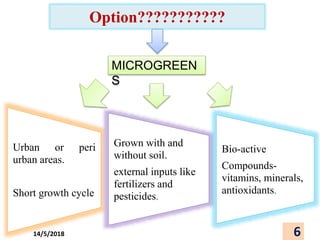
Option???????????
MICROGREEN
S
Urban or peri
urban areas.
Short growth cycle
Grown with and
without soil.
external inputs like
fertilizers and
pesticides.
Bio-active
Compounds-
vitamins, minerals,
antioxidants.
6
14/5/2018
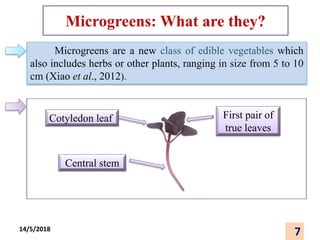
Microgreens: What are they?
Microgreens are a new class of edible vegetables which
also includes herbs or other plants, ranging in size from 5 to 10
cm (Xiao et al., 2012).
Central stem
Cotyledon leaf First pair of
true leaves
7
14/5/2018
Sprouts
Microgreens
Babygreens
Different Stages of Plant
8
14/5/2018
HISTORY
• In the 1960s sunflower and radish were frequently
grown in sunny windows as winter “Greens”.
• In the 1980s, chefs started growing “Cresses” and
“Seedlings” for garnishing
• The first documented use of the word
"MICROGREENS" in USA 1998
--Pinto et al., (2015)
9
14/5/2018
Nutritional Importance
 Phytonutrient levels differ according to the growth stages of the
plant and often decrease from the seedling to the fully developed
stage.
-Barillari et al. (2005); Ebert (2014)
 7 days after germination, young lettuce seedlings had the highest
total phenolic concentration and antioxidant capacity in
comparison to the older leaves. Oh et al.(2011)
 Microgreens are 4-6 times more nutrient dense than their adult
counterparts. Xiao et al., (2012)
10
14/5/2018
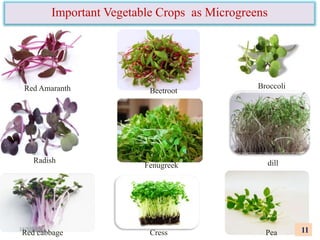
Important Vegetable Crops as Microgreens
Red Amaranth
Red cabbage Pea
Cress
dill
Radish
Broccoli
Beetroot
11
Fenugreek
14/5/2018
12
14/5/2018
Benefits of growing Microgreens
• Quick to grow
• High yield to space ratio
• Minimal cost, time and effort required
• Perfect solution for urban living
• Simple requirements
• Suitable for all climates
• Indoor edible garden
• Nutrient dense food
• No loss of nutrient value.
13
14/5/2018
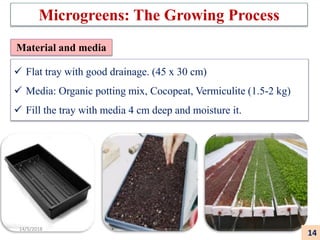
 Flat tray with good drainage. (45 x 30 cm)
 Media: Organic potting mix, Cocopeat, Vermiculite (1.5-2 kg)
 Fill the tray with media 4 cm deep and moisture it.
Material and media
Microgreens: The Growing Process
14
14/5/2018
Micro-
greens
Seed (g)/Tray
(45 x 30 cm )
Soaking Time
(h)
Depth of media
Mix (cm)
Temperature
(oC)
Amaranth 2.5 - 2 >22
Purple Basil 2.5 - 1 >24
Beet root 12.5 24 2 16-25
Cress 8 - 1 16-25
Dill 5 - 1 15-23
Kale 5 4-8 2 16-28
Linseed 36 - 2 16-25
Mustard 2.5 8 2 16-25
Pea shoots 100-150 8-12 3 15-25
Radish 5 6-12 3 16-28
Cabbage 5 4-8 2 16-25
Arugula 3 6-8 4 16-25
Some Requirements for Growing Microgreens
15
Xiao et al., 2016
14/5/2018
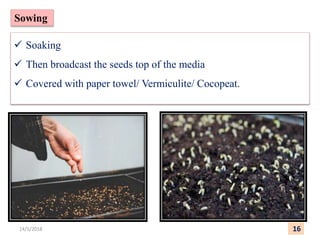
 Soaking
 Then broadcast the seeds top of the media
 Covered with paper towel/ Vermiculite/ Cocopeat.
Sowing
16
14/5/2018
 Watering by fine spray.
 High light conditions with low humidity and good air circulation.
 Requires 12 hours of light.
Practices
17
14/5/2018
Nutritional requirement
 No need much fertilizer.
 Diluted 15:15:15 @ 1-2 g/l
 Germination paper dipping into fertilizer if grown without media.
18
14/5/2018
 Appearance of 1st set of true leaves.
 Cutting above from media surface.
 Packing without roots.
Harvesting
19
14/5/2018
Microgreen Troubleshooting
Weak, skinny microgreens
Over crowding
Wrong sowing time
Dead seeds
20
14/5/2018
Microgreens have a short shelf life.
Hence, require better methods of storing and
transporting.
Commercial microgreens are most often stored
in plastic clamshell containers @ 2.5-3.50 C up
to 7 days.
Clamshell container: Good for transportation
of microgreens.
Post Harvest Management
21
14/5/2018
22
14/5/2018
23
14/5/2018
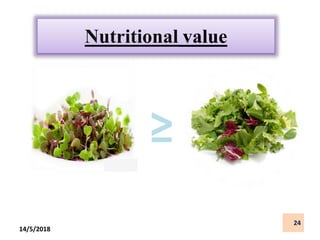
Nutritional value
≥
24
14/5/2018
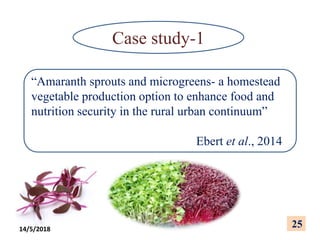
Case study-1
“Amaranth sprouts and microgreens- a homestead
vegetable production option to enhance food and
nutrition security in the rural urban continuum”
Ebert et al., 2014
25
14/5/2018
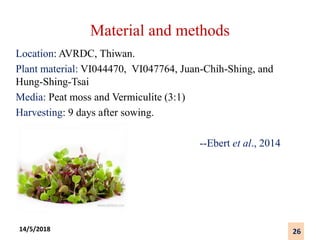
Material and methods
Location: AVRDC, Thiwan.
Plant material: VI044470, VI047764, Juan-Chih-Shing, and
Hung-Shing-Tsai
Media: Peat moss and Vermiculite (3:1)
Harvesting: 9 days after sowing.
--Ebert et al., 2014
26
14/5/2018
Cultivar Chlorogenic
acid (µmol)
Neoxanthin
(mg)
Lutein
(mg)
α-carotene
(mg)
β-carotene
(mg)
1. VI044470 0.00b 1.00a 2.66a 0.35a 2.34a
2. VI047764 0.35a 0.75b 1.95b 0.13c 1.87b
3. Juan-Chih-Shing 0.00b 0.62b 1.64b 0.10c 1.37c
4. Hung-Shing-Tsai 0.00b 0.98a 2.66a 0.27b 1.91b
Mean 0.09 0.84 2.18 0.21 1.87
Table 1: Nutritional analysis of different cultivars of amaranths as microgreens (100 g).
Table 2: Nutritional analysis of different cultivars of amaranths as fully grown.
Cultivar Chlorogenic
acid (µmol)
Neoxanthin
(mg)
Lutein
(mg)
α-carotene
(mg)
β-carotene
(mg)
1. VI044470 0.00 0.99ab 2.61a 0.21a 1.16b
2. VI047764 0.00 0.1a 4.14a 0.29a 4.45a
3. Juan-Chih-Shing 0.00 0.72b 2.21a 0.12a 2.21ab
4. Hung-Shing-Tsai 0.00 0.42ab 3.03a 0.22a 2.23ab
Mean 0.00 0.09 3 0.21 2.11
Ebert et al. (2014)
AVRDC, Taiwan 27
14/5/2018
0
0.5
1
1.5
2
2.5
3
3.5
4
4.5
cv. 1 cv. 2 cv. 3 cv. 4
0
0.5
1
1.5
2
2.5
3
3.5
4
4.5
General
acceptibility
Appearance Texture Taste
cv. 1 cv. 2 cv. 3 cv. 4 P>0.05
Appearance Texture Taste
General
acceptability
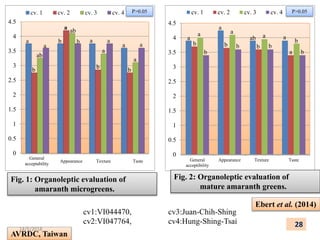
Fig. 1: Organoleptic evaluation of
amaranth microgreens.
P>0.05
Ebert et al. (2014)
AVRDC, Taiwan
a
ab
a
b
a ab
a
b b a
a
a
b b
a
a
a
a
b
b
a
b
a
b
ab
b
a
b
a
a b
b
Fig. 2: Organoleptic evaluation of
mature amaranth greens.
28
14/5/2018
cv1:VI044470,
cv2:VI047764,
cv3:Juan-Chih-Shing
cv4:Hung-Shing-Tsai
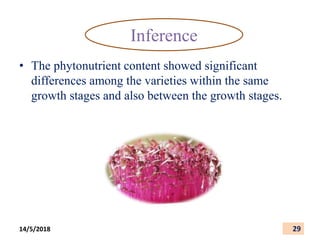
• The phytonutrient content showed significant
differences among the varieties within the same
growth stages and also between the growth stages.
Inference
29
14/5/2018
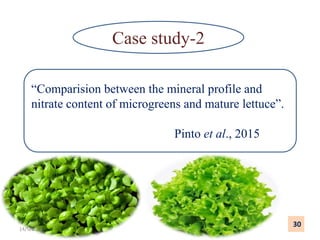
Case study-2
“Comparision between the mineral profile and
nitrate content of microgreens and mature lettuce”.
Pinto et al., 2015
30
14/5/2018
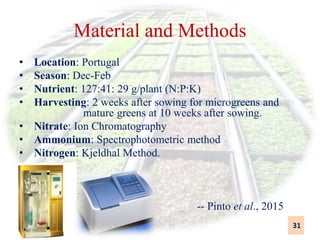
Material and Methods
• Location: Portugal
• Season: Dec-Feb
• Nutrient: 127:41: 29 g/plant (N:P:K)
• Harvesting: 2 weeks after sowing for microgreens and
mature greens at 10 weeks after sowing.
• Nitrate: Ion Chromatography
• Ammonium: Spectrophotometric method
• Nitrogen: Kjeldhal Method.
-- Pinto et al., 2015
31
14/5/2018
Table 5: Estimated daily intake of nutrients resulting from
Microgreens and mature lettuce consumption (22.5 g/person).
Element
(EDI mg/day)
Microgreens
(EDI mg/day)
Matured lettuce
(EDI mg/day)
Ratio of
microgreens
/mature lettuce
Nitrogen 82.10 98.10 0.80
Potassium 82.10 98.10 0.80
Phosphorous 21.70 41.50 0.50
Calcium 34.80 17.20 2.00
Magnesium 6.50 4.50 1.40
Copper 9.6 8.5 1.1
Iron 0.32 0.17 1.90
Manganese 0.28 0.03 9.30
Zinc 0.13 0.08 1.60
Pinto et al. (2015) 32
14/5/2018
0
1
2
3
4
5
6
N P K Ca Mg Na
Microgreens mature lattuces
0
2
4
6
8
10
12
14
Fe Mn Zn Cu
Microgreens Mature lattuces
Content
(mg
kg
-1
)
0
20
40
60
80
100
120
Mo Se
Microgreens Mature lattuces
Content
(µg
kg
-1
)
Fig. 3,4,5: Comparison of mineral contents between microgreens and mature greens of lettuce.
Pinto et al. (2015)
Universidade do Porto, Portugal
Fig. 3
Fig. 4
Fig. 5
Content
(g
kg
-1
)
a
a
a
a
b
b
b
b
a
a
a
a
a
a
a
a
a
a
b
b
b
a
b
b
33
14/5/2018
0
500
1000
1500
2000
2500
3000
Microgreens Mature lattuces
0
500
1000
1500
2000
2500
3000
3500
4000
4500
5000
Microgreens Mature lattuces
NO3
- NH4
+
Content
(mg
kg
-1
)
Content
(µg
kg
-1
)
Fig. 6, 7 : Comparison of nitrate content between microgreens and mature greens of
lettuce.
Pinto et al. (2015)
Universidade do Porto, Portugal
a
a
b
b
Fig. 6 Fig. 7
34
14/5/2018
• Microgreens of lettuce have higher content of
essential minerals compared to mature green lettuce.
• Microgreens contain very lesser amount of nitrate
content so it can be safely used in the human diet.
Inference
35
14/5/2018
Case study-3
“Microgreens of Brassicaceae: Mineral composition
and content of 30 varieties”
--Xiao et al., 2016
36
14/5/2018
Material and methods
• Location: Agricultural Research Centre, Beltsville, USA
• Season: March-May 2014
• Substrate used: peat moss
• Sample digestion: Muffle furnace at 480 0C
• Micronutrients: Atomic absorption spectroscopy
--Xiao et al., 2016
37
14/5/2018
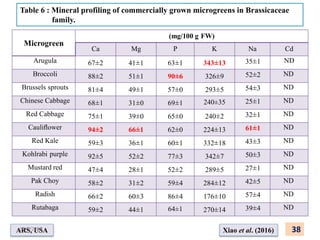
Microgreen
(mg/100 g FW)
Ca Mg P K Na Cd
Arugula 67±2 41±1 63±1 343±13 35±1 ND
Broccoli 88±2 51±1 90±6 326±9 52±2 ND
Brussels sprouts 81±4 49±1 57±0 293±5 54±3 ND
Chinese Cabbage 68±1 31±0 69±1 240±35 25±1 ND
Red Cabbage 75±1 39±0 65±0 240±2 32±1 ND
Cauliflower 94±2 66±1 62±0 224±13 61±1 ND
Red Kale 59±3 36±1 60±1 332±18 43±3 ND
Kohlrabi purple 92±5 52±2 77±3 342±7 50±3 ND
Mustard red 47±4 28±1 52±2 289±5 27±1 ND
Pak Choy 58±2 31±2 59±4 284±12 42±5 ND
Radish 66±2 60±3 86±4 176±10 57±4 ND
Rutabaga 59±2 44±1 64±1 270±14 39±4 ND
Table 6 : Mineral profiling of commercially grown microgreens in Brassicaceae
family.
Xiao et al. (2016)
ARS, USA 38
14/5/2018
Microgreen
(mg/100 g FW)
Fe Zn Cu Mn Pb
Arugula 0.71±0.01 0.35±0.01 0.07±0.00 0.29±0.01 ND
Broccoli 0.67±0.01 0.37±00 0.09±0.00 0.37±0.00 ND
Brussels sprouts 0.57±0.01 0.29±0.01 0.08±0.00 0.37±0.01 ND
Chinese Cabbage 0.66±0.01 0.36±0.01 0.04±0.00 0.30±0.01 ND
Red Cabbage 0.62±0.01 0.36±0.01 0.08±0.00 0.31±0.00 ND
Cauliflower 0.62±0.01 0.29±0.01 0.06±0.00 0.31±0.00 ND
Red Kale 0.47±0.01 0.29±0.01 0.06±0.00 0.32±0.01 ND
Kohlrabi purple 0.75±0.03 0.75±0.03 0.11±0.01 0.39±0.01 ND
Mustard red 0.62±0.07 0.22±0.01 0.06±0.00 0.24±0.00 ND
Pak Choy 0.49±0.02 0.30±0.01 0.05±0.01 0.29±0.02 ND
Radish 0.57±0.02 0.28±0.01 0.05±0.00 0.19±0.00 ND
Rutabaga 0.52±0.02 0.26±0.01 0.07±0.00 0.39±0.00 ND
Table 7 : Mineral profiling of commercially grown microgreens in Brassicaceae
family.
Xiao et al. (2016)
ARS, USA 39
14/5/2018
ND-not detected
• Mineral content in the microgreens varies with the
crop to crop.
• Accumulation of toxic substance will increases with
increase in the duration of crop.
Inference
40
14/5/2018
Case study-4
“Seed treatments to advance greenhouse
establishment of beet and chard microgreens”
--Lee et al., 2004
41
14/5/2018
Material and Methods
• Location: University of Delawre, New York
• Cultivar used: Early wonder tall top (beet) and Ruby Red
(Chard).
• Substrate: Vermiculite
• Treatments: 6
• Replications: 4 (Each replication contain 50 seed balls)
--Lee et al., 2004
42
14/5/2018
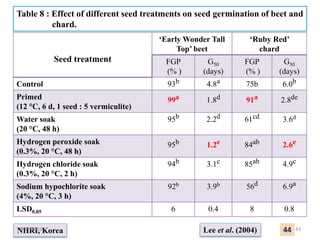
Seed treatment
‘Early Wonder Tall
Top’ beet
‘Ruby Red’
chard
FGP
(% )
G50
(days)
FGP
(% )
G50
(days)
Control 93b 4.8a 75b 6.0b
Primed
(12 °C, 6 d, 1 seed : 5 vermiculite)
99a 1.8d 91a 2.8de
Water soak
(20 °C, 48 h)
95b 2.2d 61cd 3.6d
Hydrogen peroxide soak
(0.3%, 20 °C, 48 h)
95b 1.2e 84ab 2.6e
Hydrogen chloride soak
(0.3%, 20 °C, 2 h)
94b 3.1c 85ab 4.9c
Sodium hypochlorite soak
(4%, 20 °C, 3 h)
92b 3.9b 56d 6.9a
LSD0.05 6 0.4 8 0.8
Table 8 : Effect of different seed treatments on seed germination of beet and
chard.
NHRI, Korea Lee et al. (2004) 44
14/5/2018 43
Seed treatment Vermiculite
orientation
Location
within
vermiculite
Radicle length
(mm)
Shoot fresh
weight
(gm–2)
‘Early Wonder Tall Top’ beet
Control - - - 871c
Germinated Horizontal Top 4.8 ab 1191a
Bottom 6.3a 1128ab
Germinated Vertical Top 3.3b 1250a
Bottom 2.9b 1098b
LSD0.05 2.0 148
‘Ruby Red’ chard
Control - - 310d
Horizontal Top 3.2a 909a
Bottom 3.4a 822ab
Germinated Vertical Top 1.9b 704c
Bottom 2.2b 604bc
LSD0.05 0.9 188
NHRI, Korea Lee et al. (2004)
Table 9: Influence of vermiculite orientation and location within the medium on various
parameters of microgreens.
44
14/5/2018
• Seed priming with vermiculite increases the
germination percentage.
• Sowing of germinated seeds gives higher fresh
weight of microgreens compared to control.
Inference
45
14/5/2018
Light
46
14/5/2018
Case study-5
“Light - emitting Diodes (LEDs) for higher
nutritional quality of brassicaceae microgreens”.
--Victorija and Akvile 2015
47
14/5/2018
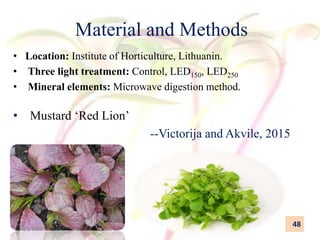
Material and Methods
• Location: Institute of Horticulture, Lithuanin.
• Three light treatment: Control, LED150, LED250
• Mineral elements: Microwave digestion method.
• Mustard ‘Red Lion’
--Victorija and Akvile, 2015
48
14/5/2018
Light
treatment
hypocotyllength (cm) Plant height(cm) Leaf area (cm2)
Mustard ‘Red Lion’
(Control) 3.39±0.22 4.71±0.24 0.91±0.10
LED150 2.56±0.11b 3.84±0.15b 0.86±0.07
LED250 2.05±0.06b 3.47±0.10b 0.85±0.13
LSD05 0.22 0.24 0.27
Table 10 : Effect of different light treatments on growth parameters
of mustard microgreens.
50
Viktorija and Akvile (2015)
14/5/2018
Light treatment
µmol m-2s-1
Ascorbic acid
(mg g-1)
Total phenols
(mg g-1)
Total
Anthocyanins
(mg g-1)
Mustard ‘Red Lion’
Control 1.47±0.02 1.41±0.06 0.38±0.02
LED150 1.58±0.03a 1.65±0.02a 0.44±0.03a
LED250 2.26±0.06a 2.10±0.05a 0.43±0.02
LSD05 0.10 0.12 0.05
Table 11: Antioxidant properties of mustard microgreens cultivated under
different light treatments.
LSD05 - Fisher’s protected least significant difference (P≤0.05)
a value is significantly(P≤0.05) higher than control(HPS)
Institute of Horticulture, Lithuanian Viktorija and Akvile (2015)
51
14/5/2018
• LED light prevented from undesirable microgreens
elongation, led to increased contents of
phytochemicals (phenols, total anthocyanin and
ascorbic acid).
Inference
51
14/5/2018
Conclusion
 Microgreens possessed higher amount of bio-active
compounds and minerals in contrast to full greens.
 Matric priming could be important for better germination
in Beta vulgaris.
 Similarly, cultivation of mustard microgreens under
LED250 increased ascorbic acid and phenol content,
whereas total anthocyanin content is found to be higher
under LED150.
 Compared to mature greens microgreens found to be
have negligible quantity of toxic substance so it can
safely used in the Human diet.
52
14/5/2018
Future line of work
• Study on effect different seed rate and fertilzer input
on yield and quality.
• Need to be study the nutrient content in the different
time interval of harvesting.
• Identification of suitability of different vegetable
varieties for production of microgreens.
53
14/5/2018
Microgreens

Microgreens

  • 1.
  • 2.
  • 3.
    College of Horticulture,KOLAR 3 Name of the Student : NAGAMANI G V ID No. : UHS16PGM843 Degree Programme and Subject : Sr. M.Sc., (Hort.) Vegetable Science College : College of Horticulture, Kolar. 2nd SEMINAR 14/5/2018
  • 4.
    Outline of Seminar Introduction Microgreens:What are they? Nutritional Importance Microgreens: The Growing Process Homestead and Commercial utility Review of Literature Conclusion 4 14/5/2018
  • 5.
    • The spectrumof life in terms of income, life style are changing rapidly with economic development leading to major challenge of numerous diseases related to nutritional deficiencies. • Non-availability of fresh and pesticide residue free vegetables for consumption. • Diet-related diseases -obesity, diabetes, cardiovascular disease, hypertension. Introduction 5 14/5/2018
  • 6.
    Option??????????? MICROGREEN S Urban or peri urbanareas. Short growth cycle Grown with and without soil. external inputs like fertilizers and pesticides. Bio-active Compounds- vitamins, minerals, antioxidants. 6 14/5/2018
  • 7.
    Microgreens: What arethey? Microgreens are a new class of edible vegetables which also includes herbs or other plants, ranging in size from 5 to 10 cm (Xiao et al., 2012). Central stem Cotyledon leaf First pair of true leaves 7 14/5/2018
  • 8.
  • 9.
    HISTORY • In the1960s sunflower and radish were frequently grown in sunny windows as winter “Greens”. • In the 1980s, chefs started growing “Cresses” and “Seedlings” for garnishing • The first documented use of the word "MICROGREENS" in USA 1998 --Pinto et al., (2015) 9 14/5/2018
  • 10.
    Nutritional Importance  Phytonutrientlevels differ according to the growth stages of the plant and often decrease from the seedling to the fully developed stage. -Barillari et al. (2005); Ebert (2014)  7 days after germination, young lettuce seedlings had the highest total phenolic concentration and antioxidant capacity in comparison to the older leaves. Oh et al.(2011)  Microgreens are 4-6 times more nutrient dense than their adult counterparts. Xiao et al., (2012) 10 14/5/2018
  • 11.
    Important Vegetable Cropsas Microgreens Red Amaranth Red cabbage Pea Cress dill Radish Broccoli Beetroot 11 Fenugreek 14/5/2018
  • 12.
  • 13.
    Benefits of growingMicrogreens • Quick to grow • High yield to space ratio • Minimal cost, time and effort required • Perfect solution for urban living • Simple requirements • Suitable for all climates • Indoor edible garden • Nutrient dense food • No loss of nutrient value. 13 14/5/2018
  • 14.
     Flat traywith good drainage. (45 x 30 cm)  Media: Organic potting mix, Cocopeat, Vermiculite (1.5-2 kg)  Fill the tray with media 4 cm deep and moisture it. Material and media Microgreens: The Growing Process 14 14/5/2018
  • 15.
    Micro- greens Seed (g)/Tray (45 x30 cm ) Soaking Time (h) Depth of media Mix (cm) Temperature (oC) Amaranth 2.5 - 2 >22 Purple Basil 2.5 - 1 >24 Beet root 12.5 24 2 16-25 Cress 8 - 1 16-25 Dill 5 - 1 15-23 Kale 5 4-8 2 16-28 Linseed 36 - 2 16-25 Mustard 2.5 8 2 16-25 Pea shoots 100-150 8-12 3 15-25 Radish 5 6-12 3 16-28 Cabbage 5 4-8 2 16-25 Arugula 3 6-8 4 16-25 Some Requirements for Growing Microgreens 15 Xiao et al., 2016 14/5/2018
  • 16.
     Soaking  Thenbroadcast the seeds top of the media  Covered with paper towel/ Vermiculite/ Cocopeat. Sowing 16 14/5/2018
  • 17.
     Watering byfine spray.  High light conditions with low humidity and good air circulation.  Requires 12 hours of light. Practices 17 14/5/2018
  • 18.
    Nutritional requirement  Noneed much fertilizer.  Diluted 15:15:15 @ 1-2 g/l  Germination paper dipping into fertilizer if grown without media. 18 14/5/2018
  • 19.
     Appearance of1st set of true leaves.  Cutting above from media surface.  Packing without roots. Harvesting 19 14/5/2018
  • 20.
    Microgreen Troubleshooting Weak, skinnymicrogreens Over crowding Wrong sowing time Dead seeds 20 14/5/2018
  • 21.
    Microgreens have ashort shelf life. Hence, require better methods of storing and transporting. Commercial microgreens are most often stored in plastic clamshell containers @ 2.5-3.50 C up to 7 days. Clamshell container: Good for transportation of microgreens. Post Harvest Management 21 14/5/2018
  • 22.
  • 23.
  • 24.
  • 25.
    Case study-1 “Amaranth sproutsand microgreens- a homestead vegetable production option to enhance food and nutrition security in the rural urban continuum” Ebert et al., 2014 25 14/5/2018
  • 26.
    Material and methods Location:AVRDC, Thiwan. Plant material: VI044470, VI047764, Juan-Chih-Shing, and Hung-Shing-Tsai Media: Peat moss and Vermiculite (3:1) Harvesting: 9 days after sowing. --Ebert et al., 2014 26 14/5/2018
  • 27.
    Cultivar Chlorogenic acid (µmol) Neoxanthin (mg) Lutein (mg) α-carotene (mg) β-carotene (mg) 1.VI044470 0.00b 1.00a 2.66a 0.35a 2.34a 2. VI047764 0.35a 0.75b 1.95b 0.13c 1.87b 3. Juan-Chih-Shing 0.00b 0.62b 1.64b 0.10c 1.37c 4. Hung-Shing-Tsai 0.00b 0.98a 2.66a 0.27b 1.91b Mean 0.09 0.84 2.18 0.21 1.87 Table 1: Nutritional analysis of different cultivars of amaranths as microgreens (100 g). Table 2: Nutritional analysis of different cultivars of amaranths as fully grown. Cultivar Chlorogenic acid (µmol) Neoxanthin (mg) Lutein (mg) α-carotene (mg) β-carotene (mg) 1. VI044470 0.00 0.99ab 2.61a 0.21a 1.16b 2. VI047764 0.00 0.1a 4.14a 0.29a 4.45a 3. Juan-Chih-Shing 0.00 0.72b 2.21a 0.12a 2.21ab 4. Hung-Shing-Tsai 0.00 0.42ab 3.03a 0.22a 2.23ab Mean 0.00 0.09 3 0.21 2.11 Ebert et al. (2014) AVRDC, Taiwan 27 14/5/2018
  • 28.
    0 0.5 1 1.5 2 2.5 3 3.5 4 4.5 cv. 1 cv.2 cv. 3 cv. 4 0 0.5 1 1.5 2 2.5 3 3.5 4 4.5 General acceptibility Appearance Texture Taste cv. 1 cv. 2 cv. 3 cv. 4 P>0.05 Appearance Texture Taste General acceptability Fig. 1: Organoleptic evaluation of amaranth microgreens. P>0.05 Ebert et al. (2014) AVRDC, Taiwan a ab a b a ab a b b a a a b b a a a a b b a b a b ab b a b a a b b Fig. 2: Organoleptic evaluation of mature amaranth greens. 28 14/5/2018 cv1:VI044470, cv2:VI047764, cv3:Juan-Chih-Shing cv4:Hung-Shing-Tsai
  • 29.
    • The phytonutrientcontent showed significant differences among the varieties within the same growth stages and also between the growth stages. Inference 29 14/5/2018
  • 30.
    Case study-2 “Comparision betweenthe mineral profile and nitrate content of microgreens and mature lettuce”. Pinto et al., 2015 30 14/5/2018
  • 31.
    Material and Methods •Location: Portugal • Season: Dec-Feb • Nutrient: 127:41: 29 g/plant (N:P:K) • Harvesting: 2 weeks after sowing for microgreens and mature greens at 10 weeks after sowing. • Nitrate: Ion Chromatography • Ammonium: Spectrophotometric method • Nitrogen: Kjeldhal Method. -- Pinto et al., 2015 31 14/5/2018
  • 32.
    Table 5: Estimateddaily intake of nutrients resulting from Microgreens and mature lettuce consumption (22.5 g/person). Element (EDI mg/day) Microgreens (EDI mg/day) Matured lettuce (EDI mg/day) Ratio of microgreens /mature lettuce Nitrogen 82.10 98.10 0.80 Potassium 82.10 98.10 0.80 Phosphorous 21.70 41.50 0.50 Calcium 34.80 17.20 2.00 Magnesium 6.50 4.50 1.40 Copper 9.6 8.5 1.1 Iron 0.32 0.17 1.90 Manganese 0.28 0.03 9.30 Zinc 0.13 0.08 1.60 Pinto et al. (2015) 32 14/5/2018
  • 33.
    0 1 2 3 4 5 6 N P KCa Mg Na Microgreens mature lattuces 0 2 4 6 8 10 12 14 Fe Mn Zn Cu Microgreens Mature lattuces Content (mg kg -1 ) 0 20 40 60 80 100 120 Mo Se Microgreens Mature lattuces Content (µg kg -1 ) Fig. 3,4,5: Comparison of mineral contents between microgreens and mature greens of lettuce. Pinto et al. (2015) Universidade do Porto, Portugal Fig. 3 Fig. 4 Fig. 5 Content (g kg -1 ) a a a a b b b b a a a a a a a a a a b b b a b b 33 14/5/2018
  • 34.
    0 500 1000 1500 2000 2500 3000 Microgreens Mature lattuces 0 500 1000 1500 2000 2500 3000 3500 4000 4500 5000 MicrogreensMature lattuces NO3 - NH4 + Content (mg kg -1 ) Content (µg kg -1 ) Fig. 6, 7 : Comparison of nitrate content between microgreens and mature greens of lettuce. Pinto et al. (2015) Universidade do Porto, Portugal a a b b Fig. 6 Fig. 7 34 14/5/2018
  • 35.
    • Microgreens oflettuce have higher content of essential minerals compared to mature green lettuce. • Microgreens contain very lesser amount of nitrate content so it can be safely used in the human diet. Inference 35 14/5/2018
  • 36.
    Case study-3 “Microgreens ofBrassicaceae: Mineral composition and content of 30 varieties” --Xiao et al., 2016 36 14/5/2018
  • 37.
    Material and methods •Location: Agricultural Research Centre, Beltsville, USA • Season: March-May 2014 • Substrate used: peat moss • Sample digestion: Muffle furnace at 480 0C • Micronutrients: Atomic absorption spectroscopy --Xiao et al., 2016 37 14/5/2018
  • 38.
    Microgreen (mg/100 g FW) CaMg P K Na Cd Arugula 67±2 41±1 63±1 343±13 35±1 ND Broccoli 88±2 51±1 90±6 326±9 52±2 ND Brussels sprouts 81±4 49±1 57±0 293±5 54±3 ND Chinese Cabbage 68±1 31±0 69±1 240±35 25±1 ND Red Cabbage 75±1 39±0 65±0 240±2 32±1 ND Cauliflower 94±2 66±1 62±0 224±13 61±1 ND Red Kale 59±3 36±1 60±1 332±18 43±3 ND Kohlrabi purple 92±5 52±2 77±3 342±7 50±3 ND Mustard red 47±4 28±1 52±2 289±5 27±1 ND Pak Choy 58±2 31±2 59±4 284±12 42±5 ND Radish 66±2 60±3 86±4 176±10 57±4 ND Rutabaga 59±2 44±1 64±1 270±14 39±4 ND Table 6 : Mineral profiling of commercially grown microgreens in Brassicaceae family. Xiao et al. (2016) ARS, USA 38 14/5/2018
  • 39.
    Microgreen (mg/100 g FW) FeZn Cu Mn Pb Arugula 0.71±0.01 0.35±0.01 0.07±0.00 0.29±0.01 ND Broccoli 0.67±0.01 0.37±00 0.09±0.00 0.37±0.00 ND Brussels sprouts 0.57±0.01 0.29±0.01 0.08±0.00 0.37±0.01 ND Chinese Cabbage 0.66±0.01 0.36±0.01 0.04±0.00 0.30±0.01 ND Red Cabbage 0.62±0.01 0.36±0.01 0.08±0.00 0.31±0.00 ND Cauliflower 0.62±0.01 0.29±0.01 0.06±0.00 0.31±0.00 ND Red Kale 0.47±0.01 0.29±0.01 0.06±0.00 0.32±0.01 ND Kohlrabi purple 0.75±0.03 0.75±0.03 0.11±0.01 0.39±0.01 ND Mustard red 0.62±0.07 0.22±0.01 0.06±0.00 0.24±0.00 ND Pak Choy 0.49±0.02 0.30±0.01 0.05±0.01 0.29±0.02 ND Radish 0.57±0.02 0.28±0.01 0.05±0.00 0.19±0.00 ND Rutabaga 0.52±0.02 0.26±0.01 0.07±0.00 0.39±0.00 ND Table 7 : Mineral profiling of commercially grown microgreens in Brassicaceae family. Xiao et al. (2016) ARS, USA 39 14/5/2018 ND-not detected
  • 40.
    • Mineral contentin the microgreens varies with the crop to crop. • Accumulation of toxic substance will increases with increase in the duration of crop. Inference 40 14/5/2018
  • 41.
    Case study-4 “Seed treatmentsto advance greenhouse establishment of beet and chard microgreens” --Lee et al., 2004 41 14/5/2018
  • 42.
    Material and Methods •Location: University of Delawre, New York • Cultivar used: Early wonder tall top (beet) and Ruby Red (Chard). • Substrate: Vermiculite • Treatments: 6 • Replications: 4 (Each replication contain 50 seed balls) --Lee et al., 2004 42 14/5/2018
  • 43.
    Seed treatment ‘Early WonderTall Top’ beet ‘Ruby Red’ chard FGP (% ) G50 (days) FGP (% ) G50 (days) Control 93b 4.8a 75b 6.0b Primed (12 °C, 6 d, 1 seed : 5 vermiculite) 99a 1.8d 91a 2.8de Water soak (20 °C, 48 h) 95b 2.2d 61cd 3.6d Hydrogen peroxide soak (0.3%, 20 °C, 48 h) 95b 1.2e 84ab 2.6e Hydrogen chloride soak (0.3%, 20 °C, 2 h) 94b 3.1c 85ab 4.9c Sodium hypochlorite soak (4%, 20 °C, 3 h) 92b 3.9b 56d 6.9a LSD0.05 6 0.4 8 0.8 Table 8 : Effect of different seed treatments on seed germination of beet and chard. NHRI, Korea Lee et al. (2004) 44 14/5/2018 43
  • 44.
    Seed treatment Vermiculite orientation Location within vermiculite Radiclelength (mm) Shoot fresh weight (gm–2) ‘Early Wonder Tall Top’ beet Control - - - 871c Germinated Horizontal Top 4.8 ab 1191a Bottom 6.3a 1128ab Germinated Vertical Top 3.3b 1250a Bottom 2.9b 1098b LSD0.05 2.0 148 ‘Ruby Red’ chard Control - - 310d Horizontal Top 3.2a 909a Bottom 3.4a 822ab Germinated Vertical Top 1.9b 704c Bottom 2.2b 604bc LSD0.05 0.9 188 NHRI, Korea Lee et al. (2004) Table 9: Influence of vermiculite orientation and location within the medium on various parameters of microgreens. 44 14/5/2018
  • 45.
    • Seed primingwith vermiculite increases the germination percentage. • Sowing of germinated seeds gives higher fresh weight of microgreens compared to control. Inference 45 14/5/2018
  • 46.
  • 47.
    Case study-5 “Light -emitting Diodes (LEDs) for higher nutritional quality of brassicaceae microgreens”. --Victorija and Akvile 2015 47 14/5/2018
  • 48.
    Material and Methods •Location: Institute of Horticulture, Lithuanin. • Three light treatment: Control, LED150, LED250 • Mineral elements: Microwave digestion method. • Mustard ‘Red Lion’ --Victorija and Akvile, 2015 48 14/5/2018
  • 49.
    Light treatment hypocotyllength (cm) Plantheight(cm) Leaf area (cm2) Mustard ‘Red Lion’ (Control) 3.39±0.22 4.71±0.24 0.91±0.10 LED150 2.56±0.11b 3.84±0.15b 0.86±0.07 LED250 2.05±0.06b 3.47±0.10b 0.85±0.13 LSD05 0.22 0.24 0.27 Table 10 : Effect of different light treatments on growth parameters of mustard microgreens. 50 Viktorija and Akvile (2015) 14/5/2018
  • 50.
    Light treatment µmol m-2s-1 Ascorbicacid (mg g-1) Total phenols (mg g-1) Total Anthocyanins (mg g-1) Mustard ‘Red Lion’ Control 1.47±0.02 1.41±0.06 0.38±0.02 LED150 1.58±0.03a 1.65±0.02a 0.44±0.03a LED250 2.26±0.06a 2.10±0.05a 0.43±0.02 LSD05 0.10 0.12 0.05 Table 11: Antioxidant properties of mustard microgreens cultivated under different light treatments. LSD05 - Fisher’s protected least significant difference (P≤0.05) a value is significantly(P≤0.05) higher than control(HPS) Institute of Horticulture, Lithuanian Viktorija and Akvile (2015) 51 14/5/2018
  • 51.
    • LED lightprevented from undesirable microgreens elongation, led to increased contents of phytochemicals (phenols, total anthocyanin and ascorbic acid). Inference 51 14/5/2018
  • 52.
    Conclusion  Microgreens possessedhigher amount of bio-active compounds and minerals in contrast to full greens.  Matric priming could be important for better germination in Beta vulgaris.  Similarly, cultivation of mustard microgreens under LED250 increased ascorbic acid and phenol content, whereas total anthocyanin content is found to be higher under LED150.  Compared to mature greens microgreens found to be have negligible quantity of toxic substance so it can safely used in the Human diet. 52 14/5/2018
  • 53.
    Future line ofwork • Study on effect different seed rate and fertilzer input on yield and quality. • Need to be study the nutrient content in the different time interval of harvesting. • Identification of suitability of different vegetable varieties for production of microgreens. 53 14/5/2018