SPROUT & MICROGREENS IN HUMAN DIET
Sprouting
It is the practice of germinating seeds (e.g., mung
beans, sunflower seeds, etc.) to be eaten raw or
or cooked, which is considered highly nutritious.
Microgreens
These are the next growth stage sprouting ,when 2-4
leaves appears.
Both are widely accepted as functional foods and
functional food ingredients.
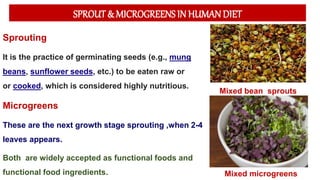
Mixed bean sprouts
Mixed microgreens
Seeds suitable for sprouts
All viable seeds can be sprouted, Bean sprouts are a common ingredient across
the world.
Common sprouts used as food include:
1-Pulses/legumes -Fenugreek, Lentil, Pea, Chickpea, Mung Bean, and Soya
Bean
2-Cereals :Oat, Wheat, Maize and Barley,
3-Oilseeds:Sesame, Sunflower, Linseed, and Peanut
4-Brassica (mustard family):Broccoli, Cabbage, Mustard, Radish, and Turnip
5-Other vegetables and herbs :Quinoa, Amaranthus ,Chia, onion, Spinach and
Lettuce,
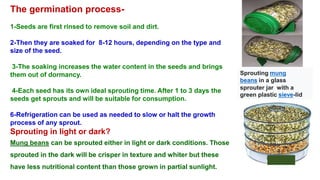
Sprouting mung
beans in a glass
sprouter jar with a
green plastic sieve-lid
The germination process-
1-Seeds are first rinsed to remove soil and dirt.
2-Then they are soaked for 8-12 hours, depending on the type and
size of the seed.
3-The soaking increases the water content in the seeds and brings
them out of dormancy.
4-Each seed has its own ideal sprouting time. After 1 to 3 days the
seeds get sprouts and will be suitable for consumption.
6-Refrigeration can be used as needed to slow or halt the growth
process of any sprout.
Sprouting in light or dark?
Mung beans can be sprouted either in light or dark conditions. Those
sprouted in the dark will be crisper in texture and whiter but these
have less nutritional content than those grown in partial sunlight.
 The sprouted beans are more nutritious than the original
beans, and they require lesser cooking time.
 Digestibility increases in pulses and cereals after
germination.
 The biochemical processes occurring during germination
generates bioactive components, like, riboflavin,
thiamine, niacin, vitamin C, etc., and increases their
availability.
 This leads to increase in fibre contents.
 Leads the reduction of anti-nutritional factors.
 Sprouts provide a good supply of Vitamins A, E , C and B
complex.
How sprouting makes the seeds more nutritious?
 Sprouts helps to lose weight as they have negligible calories.
 Heart friendly, as it helps in boosting the good cholesterol.
 May prevent pre mature aging, as they are rich in antioxidants
 Helps to regulate pH of the body and helps to reduce acidity
 Improves digestion, as they are having high contents of living enzyme
 Boost blood circulation ,because of the significant amount of iron and
copper.
 Improves eye sight , as it has high vitamin A content.
 Prevents premature greying of hairs.
 Boost the immune system as they are rich in Vit. C and antioxidants.
 Dirty equipment & contaminated water source
 Seeds are not rinsed well enough before soaking
 Seeds are left in standing water after the initial soaking
 Seeds are allowed to dry out
 Temperature is too high or too low
 Insufficient air flow
 Sprouts have been associated with multiple outbreaks of
harmful bacteria, including salmonella and toxic forms
of Escherichia coli.
Common causes for sprouts becoming inedible
Microgreen
 Microgreens are the result of the 2-4 leaves growth
stage of sprouted seed.
 Microgreens require lots of light and good air
circulation.
 They may take one to two weeks, depending on the
plant.
 Microgreens are more nutritious as it is full of
vitamins , anti oxidants and flavour than sprouts.
Microgreen can be prepared in-
1-Water(Hydroponically)
2-soil alone or with compost
3-cocopeat alone or with compost.
Microgreens are cut off at soil level
and are often 1-3 inches in length.
Raised in water
You need-
1-Perforated Plastic/steel sieve
2-Shallow trough/tray
3-Sand and seeds
METHOD-
1-Spread a layer of sand (about ¾ inch) on sieve.
2-Spread the soaked seeds on the sand.
3-Spread a layer of cocopeat (1/4th Inch on seeds.)
4-water the seeded box till water drained from bottom
holes.
5-The seed box is to be kept in a shallow trough. Filled with water.
6-Maintain Water level in the tray to keep water touching sand in the box in which
seeds were sown.
7- In 7-10 days the microgreens are ready for harvesting.
Raised in growing media
You need-
1- Soaked seeds
2-soil /cocopeat alone or with compost
3-Shallow pot.
METHOD
1.Fill Cocopeat (2/3rd)/sand + Compost (1/3rd) in
shallow pot with drain hole.
2- Sow the seeds at about 1 inch depth.
3-water the pot till water comes out from drain
hole.
4- maintain moisture in the pot.
5- allow the seeds to sprout and emerge out .
6-Harvest them ,when they grows up to 2-4 leaf
stage.
Seeds suitable for microgreens-
Seeds suitable for sprouts are also
suitable for micro greens , but some
seeds are more preferred .
Example-
Celery, Fennel, Parsley,
Onion, and garlic etc.
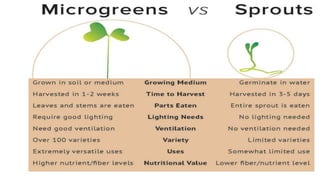
Why microgreens are more nutritive than sprouts?
 Sprouts are harvested in 3-5 days where the only energy source is
from the cotyledon.
Whereas
Microgreens are harvested in 7 – 14 days,
 Has plenty of time to absorb nutrients from the light
(photosynthesis) and growing medium,
That build up a good amount of phytonutrients ,such as
carotenoids and α-tocopherol (Vitamin E).
Carotenoids – Reduce the risk of getting cancers and eye diseases
That’s why microgreen is said to be a functional food.
How to store fresh microgreens?
Microgreens should be used on the same day for their maximum
health benefits.
They can store for a few hours in your refrigerator.
Don't put it in a sealed plastic bag.
Ensure proper aeration of the content. So, plastic or polybags are
not recommended. Instead, use damp paper towel to wrap them up
and store.
Freshen them up by soaking for 30 seconds in ice water.
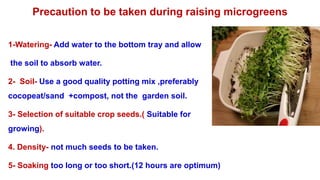
1-Watering- Add water to the bottom tray and allow
the soil to absorb water.
2- Soil- Use a good quality potting mix ,preferably
cocopeat/sand +compost, not the garden soil.
3- Selection of suitable crop seeds.( Suitable for
growing).
4. Density- not much seeds to be taken.
5- Soaking too long or too short.(12 hours are optimum)
Precaution to be taken during raising microgreens
 Take steel sieve of 12” diameter
 On the bottom a thick layer of sand (about
three fourth of an inch) was laid. On it Methi
seeds were scattered densely.
 On the seeds about quarter of an inch layer
of coco peat was laid.
 The sieve was kept in a shallow trough. In the
trough water was filled. Water level was
maintained to keep water touching sand in the
box in which methi seeds were sown.
 In 10 days only thrice the seeds were
watered. Now the Methi greens are ready for
harvesting
Growing Microgreens
 It's best to take fresh
juice from wheat
grass for energy.
 Blend few leaves of
wheat grass with little
water.
 Make this into half
cup of water adding
black pepper powder
and rock salt to taste.
 Take early morning
empty stomach drink
20- 30ml.
Preservation of wheat grass for off season
Barley can be
supplemented/
alternated with wheat
Fresh use
of
wheat grass
1-Adenium(Desert Rose)
 All about their origin and habitats.
 About different species of adenium.
 Their Maintenance , Care, Potting ,Watering, Bonsai Making And Nutrition etc.
 Propagation by Seeds, Cutting and Grafting.
 Remedies for their disease (Rotting of caudex) and fall of leaves and insects etc.
2-China Rose(Hibiscus rosa sinensis)-
 Their maintenance , care, potting ,watering and nutrition etc.
 Propagation by cutting and grafting.
 Remedies for their disease and insect & Pests.
3-Rose (Rosa spp.)
 Their maintenance, care, watering and nutrition etc.
 Special management for roses grown as cut flowers
 Propagation by Seeds , Budding Cutting and Grafting.
 Remedies for their disease and insects.
"About all Roses”
Registration Fee- Rs.100/-
Payment mode- Paytm, G pay or any UPI at 9829047737
Contact : 9829047737 (Recording will be made available
Square feet gardening inviting all of you to attend VII Webinar
Speaker Dr. G S Bhatnagar (Agriculture Scientist)
31st October
(Saturday) at
6.0PM
THANKS
The recording of this webinar will be
made available @Rs.151
Payment mode- Paytm, G pay or
any UPI at 9829047737
Contact : 9829047737
Microgreen

Microgreen

  • 1.
    SPROUT & MICROGREENSIN HUMAN DIET Sprouting It is the practice of germinating seeds (e.g., mung beans, sunflower seeds, etc.) to be eaten raw or or cooked, which is considered highly nutritious. Microgreens These are the next growth stage sprouting ,when 2-4 leaves appears. Both are widely accepted as functional foods and functional food ingredients. Mixed bean sprouts Mixed microgreens
  • 2.
    Seeds suitable forsprouts All viable seeds can be sprouted, Bean sprouts are a common ingredient across the world. Common sprouts used as food include: 1-Pulses/legumes -Fenugreek, Lentil, Pea, Chickpea, Mung Bean, and Soya Bean 2-Cereals :Oat, Wheat, Maize and Barley, 3-Oilseeds:Sesame, Sunflower, Linseed, and Peanut 4-Brassica (mustard family):Broccoli, Cabbage, Mustard, Radish, and Turnip 5-Other vegetables and herbs :Quinoa, Amaranthus ,Chia, onion, Spinach and Lettuce,
  • 3.
    Sprouting mung beans ina glass sprouter jar with a green plastic sieve-lid The germination process- 1-Seeds are first rinsed to remove soil and dirt. 2-Then they are soaked for 8-12 hours, depending on the type and size of the seed. 3-The soaking increases the water content in the seeds and brings them out of dormancy. 4-Each seed has its own ideal sprouting time. After 1 to 3 days the seeds get sprouts and will be suitable for consumption. 6-Refrigeration can be used as needed to slow or halt the growth process of any sprout. Sprouting in light or dark? Mung beans can be sprouted either in light or dark conditions. Those sprouted in the dark will be crisper in texture and whiter but these have less nutritional content than those grown in partial sunlight.
  • 4.
     The sproutedbeans are more nutritious than the original beans, and they require lesser cooking time.  Digestibility increases in pulses and cereals after germination.  The biochemical processes occurring during germination generates bioactive components, like, riboflavin, thiamine, niacin, vitamin C, etc., and increases their availability.  This leads to increase in fibre contents.  Leads the reduction of anti-nutritional factors.  Sprouts provide a good supply of Vitamins A, E , C and B complex. How sprouting makes the seeds more nutritious?
  • 5.
     Sprouts helpsto lose weight as they have negligible calories.  Heart friendly, as it helps in boosting the good cholesterol.  May prevent pre mature aging, as they are rich in antioxidants  Helps to regulate pH of the body and helps to reduce acidity  Improves digestion, as they are having high contents of living enzyme  Boost blood circulation ,because of the significant amount of iron and copper.  Improves eye sight , as it has high vitamin A content.  Prevents premature greying of hairs.  Boost the immune system as they are rich in Vit. C and antioxidants.
  • 6.
     Dirty equipment& contaminated water source  Seeds are not rinsed well enough before soaking  Seeds are left in standing water after the initial soaking  Seeds are allowed to dry out  Temperature is too high or too low  Insufficient air flow  Sprouts have been associated with multiple outbreaks of harmful bacteria, including salmonella and toxic forms of Escherichia coli. Common causes for sprouts becoming inedible
  • 7.
    Microgreen  Microgreens arethe result of the 2-4 leaves growth stage of sprouted seed.  Microgreens require lots of light and good air circulation.  They may take one to two weeks, depending on the plant.  Microgreens are more nutritious as it is full of vitamins , anti oxidants and flavour than sprouts.
  • 8.
    Microgreen can beprepared in- 1-Water(Hydroponically) 2-soil alone or with compost 3-cocopeat alone or with compost. Microgreens are cut off at soil level and are often 1-3 inches in length.
  • 9.
    Raised in water Youneed- 1-Perforated Plastic/steel sieve 2-Shallow trough/tray 3-Sand and seeds METHOD- 1-Spread a layer of sand (about ¾ inch) on sieve. 2-Spread the soaked seeds on the sand. 3-Spread a layer of cocopeat (1/4th Inch on seeds.) 4-water the seeded box till water drained from bottom holes. 5-The seed box is to be kept in a shallow trough. Filled with water. 6-Maintain Water level in the tray to keep water touching sand in the box in which seeds were sown. 7- In 7-10 days the microgreens are ready for harvesting.
  • 10.
    Raised in growingmedia You need- 1- Soaked seeds 2-soil /cocopeat alone or with compost 3-Shallow pot. METHOD 1.Fill Cocopeat (2/3rd)/sand + Compost (1/3rd) in shallow pot with drain hole. 2- Sow the seeds at about 1 inch depth. 3-water the pot till water comes out from drain hole. 4- maintain moisture in the pot. 5- allow the seeds to sprout and emerge out . 6-Harvest them ,when they grows up to 2-4 leaf stage.
  • 11.
    Seeds suitable formicrogreens- Seeds suitable for sprouts are also suitable for micro greens , but some seeds are more preferred . Example- Celery, Fennel, Parsley, Onion, and garlic etc.
  • 13.
    Why microgreens aremore nutritive than sprouts?  Sprouts are harvested in 3-5 days where the only energy source is from the cotyledon. Whereas Microgreens are harvested in 7 – 14 days,  Has plenty of time to absorb nutrients from the light (photosynthesis) and growing medium, That build up a good amount of phytonutrients ,such as carotenoids and α-tocopherol (Vitamin E). Carotenoids – Reduce the risk of getting cancers and eye diseases That’s why microgreen is said to be a functional food.
  • 14.
    How to storefresh microgreens? Microgreens should be used on the same day for their maximum health benefits. They can store for a few hours in your refrigerator. Don't put it in a sealed plastic bag. Ensure proper aeration of the content. So, plastic or polybags are not recommended. Instead, use damp paper towel to wrap them up and store. Freshen them up by soaking for 30 seconds in ice water.
  • 15.
    1-Watering- Add waterto the bottom tray and allow the soil to absorb water. 2- Soil- Use a good quality potting mix ,preferably cocopeat/sand +compost, not the garden soil. 3- Selection of suitable crop seeds.( Suitable for growing). 4. Density- not much seeds to be taken. 5- Soaking too long or too short.(12 hours are optimum) Precaution to be taken during raising microgreens
  • 16.
     Take steelsieve of 12” diameter  On the bottom a thick layer of sand (about three fourth of an inch) was laid. On it Methi seeds were scattered densely.  On the seeds about quarter of an inch layer of coco peat was laid.  The sieve was kept in a shallow trough. In the trough water was filled. Water level was maintained to keep water touching sand in the box in which methi seeds were sown.  In 10 days only thrice the seeds were watered. Now the Methi greens are ready for harvesting Growing Microgreens
  • 17.
     It's bestto take fresh juice from wheat grass for energy.  Blend few leaves of wheat grass with little water.  Make this into half cup of water adding black pepper powder and rock salt to taste.  Take early morning empty stomach drink 20- 30ml. Preservation of wheat grass for off season Barley can be supplemented/ alternated with wheat Fresh use of wheat grass
  • 18.
    1-Adenium(Desert Rose)  Allabout their origin and habitats.  About different species of adenium.  Their Maintenance , Care, Potting ,Watering, Bonsai Making And Nutrition etc.  Propagation by Seeds, Cutting and Grafting.  Remedies for their disease (Rotting of caudex) and fall of leaves and insects etc. 2-China Rose(Hibiscus rosa sinensis)-  Their maintenance , care, potting ,watering and nutrition etc.  Propagation by cutting and grafting.  Remedies for their disease and insect & Pests. 3-Rose (Rosa spp.)  Their maintenance, care, watering and nutrition etc.  Special management for roses grown as cut flowers  Propagation by Seeds , Budding Cutting and Grafting.  Remedies for their disease and insects. "About all Roses” Registration Fee- Rs.100/- Payment mode- Paytm, G pay or any UPI at 9829047737 Contact : 9829047737 (Recording will be made available Square feet gardening inviting all of you to attend VII Webinar Speaker Dr. G S Bhatnagar (Agriculture Scientist) 31st October (Saturday) at 6.0PM
  • 19.
    THANKS The recording ofthis webinar will be made available @Rs.151 Payment mode- Paytm, G pay or any UPI at 9829047737 Contact : 9829047737