
Microbiology 101
Terms and Definitions
Infection
An infection is the detrimental colonization of a host organism by a foreign species.
In infection, the infecting organism seeks to utilize the host’s resources in order to
multiply (usually at the expense of the host). The infecting organism, or pathogen,
interferes with the normal functioning of the host.
Infection can be caused by
A bacteria, a virus, a fungus, a parasite
Terms and Definitions
Microbe
A microorganism that causes disease. This term is no longer in technical use.
Antimicrobial
Capable of destroying or inhibiting the growth of microorganisms, e.g.,
antimicrobial solutions or antimicrobial drugs
Terms and Definitions
Pathogen
A pathogen or infectious agent is a biological agent that causes disease or illness to
its host. The term is most often used for agents that disrupt the normal physiology
of a multi-cellular animal or plant.
Terms and Definitions
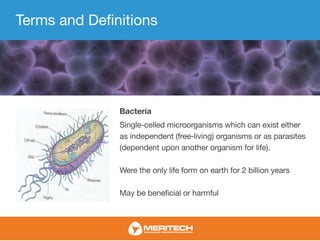
Bacteria
Single-celled microorganisms which can exist either
as independent (free-living) organisms or as parasites
(dependent upon another organism for life).
Were the only life form on earth for 2 billion years
May be beneficial or harmful
Terms and Definitions
Virus
A virus is a microscopic particle that can infect the cells of
a biological organism. Viruses can only replicate themselves
by infecting a host cell and therefore cannot reproduce on
their own.
It has been argued extensively whether viruses are living
organisms. Most virologists consider them non-living, as
they do not meet all the criteria of the generally accepted
definition of life.
Terms and Definitions
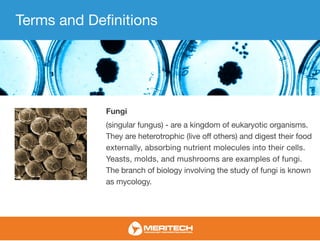
Fungi
(singular fungus) - are a kingdom of eukaryotic organisms.
They are heterotrophic (live off others) and digest their food
externally, absorbing nutrient molecules into their cells.
Yeasts, molds, and mushrooms are examples of fungi.
The branch of biology involving the study of fungi is known
as mycology.
Terms and Definitions
Parasite
Parasitism is one version of symbiosis ("living together"),
a phenomenon in which two organisms which are
phylogenetically unrelated co-exist over a prolonged
period of time, usually the lifetime of one of the individuals.
Measuring Antimicrobial Efficacy
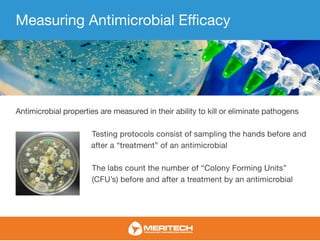
Antimicrobial properties are measured in their ability to kill or eliminate pathogens
Testing protocols consist of sampling the hands before and
after a “treatment” of an antimicrobial
The labs count the number of “Colony Forming Units”
(CFU’s) before and after a treatment by an antimicrobial
Units of Measurement
The two most common “units of measurement” for the reduction of CFU’s are:
A percent reduction, e.g., “kills 99.9% of bacteria”
A log10
reduction
Log Reductions
As mnemonic for converting log reductions into percent reductions is the number of
the log, e.g., 1, 2, 3, 4 etc. equates to the number of “nines” (9’s) in the percent reduction:
1-log = 90% reduction
2-logs = 99% reduction
3-logs = 99.9% reduction
4 logs = 99.99% reduction

Microbiology 101

  • 1.
  • 2.
    Terms and Definitions Infection Aninfection is the detrimental colonization of a host organism by a foreign species. In infection, the infecting organism seeks to utilize the host’s resources in order to multiply (usually at the expense of the host). The infecting organism, or pathogen, interferes with the normal functioning of the host. Infection can be caused by A bacteria, a virus, a fungus, a parasite
  • 3.
    Terms and Definitions Microbe Amicroorganism that causes disease. This term is no longer in technical use. Antimicrobial Capable of destroying or inhibiting the growth of microorganisms, e.g., antimicrobial solutions or antimicrobial drugs
  • 4.
    Terms and Definitions Pathogen Apathogen or infectious agent is a biological agent that causes disease or illness to its host. The term is most often used for agents that disrupt the normal physiology of a multi-cellular animal or plant.
  • 5.
    Terms and Definitions Bacteria Single-celledmicroorganisms which can exist either as independent (free-living) organisms or as parasites (dependent upon another organism for life). Were the only life form on earth for 2 billion years May be beneficial or harmful
  • 6.
    Terms and Definitions Virus Avirus is a microscopic particle that can infect the cells of a biological organism. Viruses can only replicate themselves by infecting a host cell and therefore cannot reproduce on their own. It has been argued extensively whether viruses are living organisms. Most virologists consider them non-living, as they do not meet all the criteria of the generally accepted definition of life.
  • 7.
    Terms and Definitions Fungi (singularfungus) - are a kingdom of eukaryotic organisms. They are heterotrophic (live off others) and digest their food externally, absorbing nutrient molecules into their cells. Yeasts, molds, and mushrooms are examples of fungi. The branch of biology involving the study of fungi is known as mycology.
  • 8.
    Terms and Definitions Parasite Parasitismis one version of symbiosis ("living together"), a phenomenon in which two organisms which are phylogenetically unrelated co-exist over a prolonged period of time, usually the lifetime of one of the individuals.
  • 9.
    Measuring Antimicrobial Efficacy Antimicrobialproperties are measured in their ability to kill or eliminate pathogens Testing protocols consist of sampling the hands before and after a “treatment” of an antimicrobial The labs count the number of “Colony Forming Units” (CFU’s) before and after a treatment by an antimicrobial
  • 10.
    Units of Measurement Thetwo most common “units of measurement” for the reduction of CFU’s are: A percent reduction, e.g., “kills 99.9% of bacteria” A log10 reduction
  • 11.
    Log Reductions As mnemonicfor converting log reductions into percent reductions is the number of the log, e.g., 1, 2, 3, 4 etc. equates to the number of “nines” (9’s) in the percent reduction: 1-log = 90% reduction 2-logs = 99% reduction 3-logs = 99.9% reduction 4 logs = 99.99% reduction