Unit 8034 Culture microorganisms and control microbial growth By Elysia Butler
Nutritional Requirements All living organisms require nutrients to grow.  Microorganisms get their nutrients in the form of chemical elements which exist in nature as either organic or inorganic compounds.
Nutrients Carbon – Used in the creation of proteins, carbohydrates and lipids. Nitrogen – Utilised in amino acids, which make up proteins. Hydrogen and Oxygen – Generally make up the organic compounds that are ingested or absorbed.
Nutrients Sulphur – Important with regards to amino acids. Phosphorus – Important with regards to adenosine triphosphate and nucleic acids. Other elements are also required for the nutrition of microorganisms but in smaller quantities.
Hetero / Auto - trophs Heterotrophs - Obtain the majority of their carbon as organic compounds by either directly absorbing it through the environment or by ingesting other heterotrophs or autotrophs. Autotrophs -Obtain their carbon source as inorganic elements through the environment.
Chemo / Photo - trophs Chemotrophs – Obtain their energy from chemical compounds. Phototrophs – Obtain the majority of their energy from a light source. Some organisms cant be classified solely as a chemotroph or a phototroph as they have the ability to adapt to the surrounds eg  R. rubrum
Selective Media Encourage growth of specific types of microorganisms Inhibits growth of specific microorganisms Sometimes used for both of the above purposes.
Differential Media Can grow more than one type of microorganism Can compare one type to another Varying appearance of microorganisms on the media For example one type may react with the media and turn blue while another type may appear purple
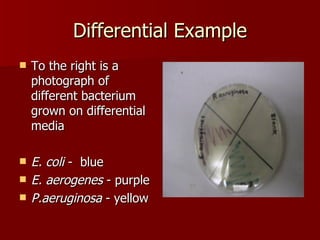
Differential Example To the right is a photograph of different bacterium grown on differential media E. coli  -  blue E. aerogenes  - purple P.aeruginosa  - yellow
Limiting Microbial Growth Physically Microbial growth can be limited by altering one or all of the following to a level that the organism will not thrive in; Temperature pH Gaseous Atmosphere Osmotic Pressure
Temperature Psychrophiles – organisms that grow best between 15C – 20C Mesophiles – organisms that grow best between 25C – 40C Thermophiles – organisms that grow best between 25C – 40C Above - Microorganisms can be classified based on the temperature at which they thrive
Gaseous Atmosphere Aerobic – Typically require oxygen at levels of 21%  Anaerobic – Don’t require oxygen  Faculative – Can grow both aerobically and anaerobically Microaerophilic – Typically require oxygen at levels of 1 – 15% Above - Classification of microorganisms based on gaseous oxygen levels at which the microorganism can grow.
Limiting Microbial Growth Chemically Adding antimicrobial agents to media will inhibit the growth of specific organisms. Example -  Media to which Colistin and Nalidixic acid have been added will inhibit gram-negative bacteria growth but promote Gram-positive cocci growth.
Iodine Kills bacteria and endospores on human skin Presence of organic material decreases effectiveness of iodine to kill endospores Eliminate organic material to increase rate at which iodine will kill endospores Mode of action: Damages metabolic compounds
Formaldehyde Gas Kills bacteria and endospores in enclosed areas Kills vegetative cells quicker To be effective temperature must be 22 °C Humidity needs to be approximately  60-80% Mode of action: Inactivates nucleic acids and proteins.
Phenolic Compounds Bacteriostatic  (Inhibits growth but does  not kill)  at low concentrations Bactericidal  (Kills)  at higher concentrations Mode of action: Damages Cytoplasmic Membrane
Antibiotic Mode of Action Can work by affecting the Peptidoglycan in the Cell Wall Inhibits crosslinks from forming in Peptidoglycan Peptidoglycan loses rigidity Causing cell to absorb water Cell splits and dies Penicillins and Cephalosporins - antibiotics that work by targeting the Cell Wall
Antibiotic mode of action Some antibiotics kill pathogens by affecting the Cytoplasmic Membrane Alters the permeability of Phospholipids in the Cytoplasmic Membrane Causes leaking of vital substances from the cell resulting in death Polymyxins – antibiotics that work by targeting the Cytoplasmic Membrane
Limiting Antibiotic Effectiveness Mutant cells that are non-responsive to the antibiotic. Wrong type of antibiotic used for the specific pathogen. Cells passing on antibiotic resistance to other cells through genes. Increased use of antibiotics increases the risk of antibiotic resistant pathogens forming.

Microbial Growth

  • 1.
    Unit 8034 Culturemicroorganisms and control microbial growth By Elysia Butler
  • 2.
    Nutritional Requirements Allliving organisms require nutrients to grow. Microorganisms get their nutrients in the form of chemical elements which exist in nature as either organic or inorganic compounds.
  • 3.
    Nutrients Carbon –Used in the creation of proteins, carbohydrates and lipids. Nitrogen – Utilised in amino acids, which make up proteins. Hydrogen and Oxygen – Generally make up the organic compounds that are ingested or absorbed.
  • 4.
    Nutrients Sulphur –Important with regards to amino acids. Phosphorus – Important with regards to adenosine triphosphate and nucleic acids. Other elements are also required for the nutrition of microorganisms but in smaller quantities.
  • 5.
    Hetero / Auto- trophs Heterotrophs - Obtain the majority of their carbon as organic compounds by either directly absorbing it through the environment or by ingesting other heterotrophs or autotrophs. Autotrophs -Obtain their carbon source as inorganic elements through the environment.
  • 6.
    Chemo / Photo- trophs Chemotrophs – Obtain their energy from chemical compounds. Phototrophs – Obtain the majority of their energy from a light source. Some organisms cant be classified solely as a chemotroph or a phototroph as they have the ability to adapt to the surrounds eg R. rubrum
  • 7.
    Selective Media Encouragegrowth of specific types of microorganisms Inhibits growth of specific microorganisms Sometimes used for both of the above purposes.
  • 8.
    Differential Media Cangrow more than one type of microorganism Can compare one type to another Varying appearance of microorganisms on the media For example one type may react with the media and turn blue while another type may appear purple
  • 9.
    Differential Example Tothe right is a photograph of different bacterium grown on differential media E. coli - blue E. aerogenes - purple P.aeruginosa - yellow
  • 10.
    Limiting Microbial GrowthPhysically Microbial growth can be limited by altering one or all of the following to a level that the organism will not thrive in; Temperature pH Gaseous Atmosphere Osmotic Pressure
  • 11.
    Temperature Psychrophiles –organisms that grow best between 15C – 20C Mesophiles – organisms that grow best between 25C – 40C Thermophiles – organisms that grow best between 25C – 40C Above - Microorganisms can be classified based on the temperature at which they thrive
  • 12.
    Gaseous Atmosphere Aerobic– Typically require oxygen at levels of 21% Anaerobic – Don’t require oxygen Faculative – Can grow both aerobically and anaerobically Microaerophilic – Typically require oxygen at levels of 1 – 15% Above - Classification of microorganisms based on gaseous oxygen levels at which the microorganism can grow.
  • 13.
    Limiting Microbial GrowthChemically Adding antimicrobial agents to media will inhibit the growth of specific organisms. Example - Media to which Colistin and Nalidixic acid have been added will inhibit gram-negative bacteria growth but promote Gram-positive cocci growth.
  • 14.
    Iodine Kills bacteriaand endospores on human skin Presence of organic material decreases effectiveness of iodine to kill endospores Eliminate organic material to increase rate at which iodine will kill endospores Mode of action: Damages metabolic compounds
  • 15.
    Formaldehyde Gas Killsbacteria and endospores in enclosed areas Kills vegetative cells quicker To be effective temperature must be 22 °C Humidity needs to be approximately 60-80% Mode of action: Inactivates nucleic acids and proteins.
  • 16.
    Phenolic Compounds Bacteriostatic (Inhibits growth but does not kill) at low concentrations Bactericidal (Kills) at higher concentrations Mode of action: Damages Cytoplasmic Membrane
  • 17.
    Antibiotic Mode ofAction Can work by affecting the Peptidoglycan in the Cell Wall Inhibits crosslinks from forming in Peptidoglycan Peptidoglycan loses rigidity Causing cell to absorb water Cell splits and dies Penicillins and Cephalosporins - antibiotics that work by targeting the Cell Wall
  • 18.
    Antibiotic mode ofaction Some antibiotics kill pathogens by affecting the Cytoplasmic Membrane Alters the permeability of Phospholipids in the Cytoplasmic Membrane Causes leaking of vital substances from the cell resulting in death Polymyxins – antibiotics that work by targeting the Cytoplasmic Membrane
  • 19.
    Limiting Antibiotic EffectivenessMutant cells that are non-responsive to the antibiotic. Wrong type of antibiotic used for the specific pathogen. Cells passing on antibiotic resistance to other cells through genes. Increased use of antibiotics increases the risk of antibiotic resistant pathogens forming.