The Effect of Flow Rate
on Heat Transfer from
a Solar Water Heater
MICHAEL CALFE, KAYLA KERNICH, EMILY SKIBENES
What is a Solar Water Heater?
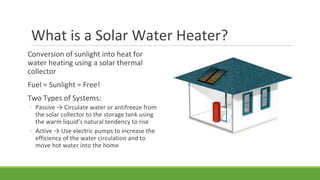
Conversion of sunlight into heat for
water heating using a solar thermal
collector
Fuel = Sunlight = Free!
Two Types of Systems:
◦ Passive → Circulate water or antifreeze from
the solar collector to the storage tank using
the warm liquid’s natural tendency to rise
◦ Active → Use electric pumps to increase the
efficiency of the water circulation and to
move hot water into the home
Importance of Solar Water Heaters
More than 1.5 million homes and businesses currently use solar water heating
in the United States
Assuming that 40 percent of existing homes in the United States have sufficient
access to sunlight, 29 million solar water-heating systems could be installed.
◦ Can operate in any climate.
◦ Performance varies depending on how much solar energy is available at the site, as well as
how cold the water coming into the system is.
Solar water heaters reduce the need for conventional water heating by about
two-thirds and pay for their installation within 4 to 8 years with electricity or
natural gas savings.
Objectives of the Experiment
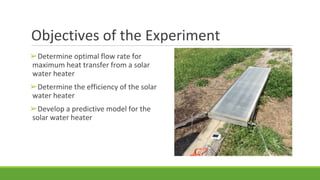
➢Determine optimal flow rate for
maximum heat transfer from a solar
water heater
➢Determine the efficiency of the solar
water heater
➢Develop a predictive model for the
solar water heater
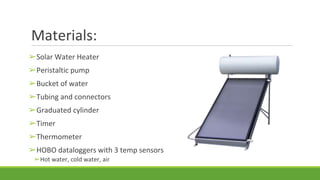
Materials:
➢Solar Water Heater
➢Peristaltic pump
➢Bucket of water
➢Tubing and connectors
➢Graduated cylinder
➢Timer
➢Thermometer
➢HOBO dataloggers with 3 temp sensors
➢Hot water, cold water, air
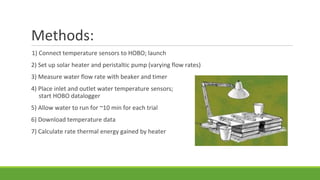
Methods:
1) Connect temperature sensors to HOBO; launch
2) Set up solar heater and peristaltic pump (varying flow rates)
3) Measure water flow rate with beaker and timer
4) Place inlet and outlet water temperature sensors;
start HOBO datalogger
5) Allow water to run for ~10 min for each trial
6) Download temperature data
7) Calculate rate thermal energy gained by heater
Steps for Thermal Energy Balance
Specifications:
Location:
Clemson, SC Sustainability
Shed
Date and time:
4/16/17 2pm-3pm
Dimensions of heater:
19.25 in x 71 in
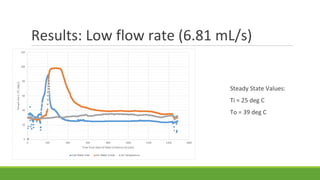
Results: Low flow rate (6.81 mL/s)
Steady State Values:
Ti = 25 deg C
To = 39 deg C
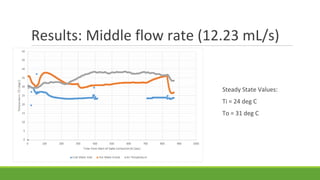
Results: Middle flow rate (12.23 mL/s)
Steady State Values:
Ti = 24 deg C
To = 31 deg C
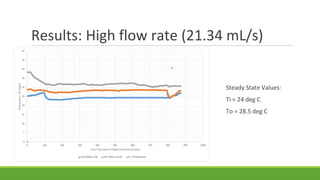
Results: High flow rate (21.34 mL/s)
Steady State Values:
Ti = 24 deg C
To = 28.5 deg C
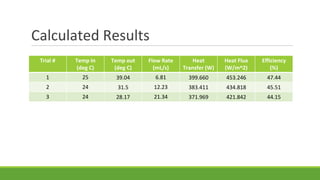
Calculated Results
Trial # Temp In
(deg C)
Temp out
(deg C)
Flow Rate
(mL/s)
Heat
Transfer (W)
Heat Flux
(W/m^2)
Efficiency
(%)
1 25 39.04 6.81 399.660 453.246 47.44
2 24 31.5 12.23 383.411 434.818 45.51
3 24 28.17 21.34 371.969 421.842 44.15
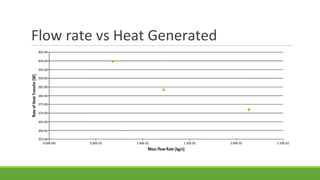
Flow rate vs Heat Generated
Conclusions
➢In this experiment, the optimal flow rate for maximum heat transfer was determined to be the
lowest flow rate of 6.81 mL/s
➢Theoretically, the results should represent a bell shaped curve. If more data was taken at
lower flow rates, this would show this trend.
➢The slower the volumetric flow rate, the higher the outlet temperature due to the elongated
retention time in the solar water heater
➢The colder the inlet temp, the greater the delta T and heat flux would be
Appendix
References
Dorsey, Inc. Piccirilli. "Fact Sheet: Solar Water Heating." EESI - Environmental and Energy Study
Institute. EESI, 1 May 2006. Web. 26 Apr. 2017. <http://www.eesi.org/papers/view/fact-sheet-
solar-water-heating?%2Fsolar_water_0506>.
Quick Solar Calculator. N.p., n.d. Web. 20 Apr. 2017. <https://barani.biz/apps/solar/>.
Chris, Ian, and Sarah’s group for using the pyranometer correctly and giving us our G value

Solar Water Heater Project

  • 1.
    The Effect ofFlow Rate on Heat Transfer from a Solar Water Heater MICHAEL CALFE, KAYLA KERNICH, EMILY SKIBENES
  • 2.
    What is aSolar Water Heater? Conversion of sunlight into heat for water heating using a solar thermal collector Fuel = Sunlight = Free! Two Types of Systems: ◦ Passive → Circulate water or antifreeze from the solar collector to the storage tank using the warm liquid’s natural tendency to rise ◦ Active → Use electric pumps to increase the efficiency of the water circulation and to move hot water into the home
  • 3.
    Importance of SolarWater Heaters More than 1.5 million homes and businesses currently use solar water heating in the United States Assuming that 40 percent of existing homes in the United States have sufficient access to sunlight, 29 million solar water-heating systems could be installed. ◦ Can operate in any climate. ◦ Performance varies depending on how much solar energy is available at the site, as well as how cold the water coming into the system is. Solar water heaters reduce the need for conventional water heating by about two-thirds and pay for their installation within 4 to 8 years with electricity or natural gas savings.
  • 4.
    Objectives of theExperiment ➢Determine optimal flow rate for maximum heat transfer from a solar water heater ➢Determine the efficiency of the solar water heater ➢Develop a predictive model for the solar water heater
  • 5.
    Materials: ➢Solar Water Heater ➢Peristalticpump ➢Bucket of water ➢Tubing and connectors ➢Graduated cylinder ➢Timer ➢Thermometer ➢HOBO dataloggers with 3 temp sensors ➢Hot water, cold water, air
  • 6.
    Methods: 1) Connect temperaturesensors to HOBO; launch 2) Set up solar heater and peristaltic pump (varying flow rates) 3) Measure water flow rate with beaker and timer 4) Place inlet and outlet water temperature sensors; start HOBO datalogger 5) Allow water to run for ~10 min for each trial 6) Download temperature data 7) Calculate rate thermal energy gained by heater
  • 7.
    Steps for ThermalEnergy Balance
  • 8.
    Specifications: Location: Clemson, SC Sustainability Shed Dateand time: 4/16/17 2pm-3pm Dimensions of heater: 19.25 in x 71 in
  • 9.
    Results: Low flowrate (6.81 mL/s) Steady State Values: Ti = 25 deg C To = 39 deg C
  • 10.
    Results: Middle flowrate (12.23 mL/s) Steady State Values: Ti = 24 deg C To = 31 deg C
  • 11.
    Results: High flowrate (21.34 mL/s) Steady State Values: Ti = 24 deg C To = 28.5 deg C
  • 12.
    Calculated Results Trial #Temp In (deg C) Temp out (deg C) Flow Rate (mL/s) Heat Transfer (W) Heat Flux (W/m^2) Efficiency (%) 1 25 39.04 6.81 399.660 453.246 47.44 2 24 31.5 12.23 383.411 434.818 45.51 3 24 28.17 21.34 371.969 421.842 44.15
  • 13.
    Flow rate vsHeat Generated
  • 14.
    Conclusions ➢In this experiment,the optimal flow rate for maximum heat transfer was determined to be the lowest flow rate of 6.81 mL/s ➢Theoretically, the results should represent a bell shaped curve. If more data was taken at lower flow rates, this would show this trend. ➢The slower the volumetric flow rate, the higher the outlet temperature due to the elongated retention time in the solar water heater ➢The colder the inlet temp, the greater the delta T and heat flux would be
  • 15.
  • 16.
    References Dorsey, Inc. Piccirilli."Fact Sheet: Solar Water Heating." EESI - Environmental and Energy Study Institute. EESI, 1 May 2006. Web. 26 Apr. 2017. <http://www.eesi.org/papers/view/fact-sheet- solar-water-heating?%2Fsolar_water_0506>. Quick Solar Calculator. N.p., n.d. Web. 20 Apr. 2017. <https://barani.biz/apps/solar/>. Chris, Ian, and Sarah’s group for using the pyranometer correctly and giving us our G value