DIMENSIONAL CONTROL
IN NANOSTRUCTURE
Tooba AYUB
ROLL NO 0291–BH-CHEM-20.
Contents.
1. introduction.
2. Nanostructure
3. Dimensional control in Nano structure.
4. Classification of nanostructure on the basis of dimensional .
5. Methods for dimensional control.
Top-down fabrication techniques (e.g., lithography, etching)
Bottom-up fabrication techniques (e.g., chemical vapour deposition, self-assembly)
Hybrid approaches (combining top-down and bottom-up methods.
6. Factors affecting dimensional control.
7. Examples of Nano structures in dimensional control.
8. Challenges ad future perspective.
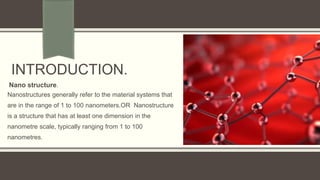
INTRODUCTION.
Nano structure.
Nanostructures generally refer to the material systems that
are in the range of 1 to 100 nanometers.OR Nanostructure
is a structure that has at least one dimension in the
nanometre scale, typically ranging from 1 to 100
nanometres.
Dimensional control in Nano structure.
 Dimensional control refers to the ability to maintain the dimensions (such as size, shape, and
orientation) of a structure or object within desired tolerances. In the context of nanostructures,
dimensional control is crucial because the physical and chemical properties of materials at the
Nano scale are highly sensitive to variations in size and shape.
 Dimensional control is essential in nanotechnology because many properties and behaviours of
materials at the Nano scale are size-dependent. For example, the optical, electronic, and
mechanical properties of nanoparticles can vary significantly depending on their size and shape.
Therefore, precise dimensional control is essential for tailoring these properties for various
applications, such as in electronics, catalysis, sensing, and medicine.
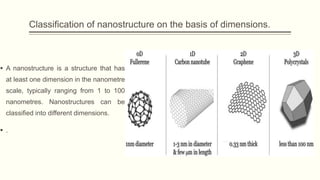
Classification of nanostructure on the basis of dimensions.
 A nanostructure is a structure that has
at least one dimension in the nanometre
scale, typically ranging from 1 to 100
nanometres. Nanostructures can be
classified into different dimensions.
 .
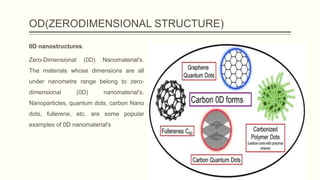
OD(ZERODIMENSIONAL STRUCTURE)
0D nanostructures.
Zero-Dimensional (0D) Nanomaterial's.
The materials whose dimensions are all
under nanometre range belong to zero-
dimensional (0D) nanomaterial's.
Nanoparticles, quantum dots, carbon Nano
dots, fullerene, etc. are some popular
examples of 0D nanomaterial's
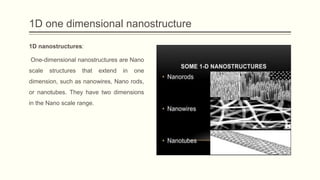
1D one dimensional nanostructure
1D nanostructures:
One-dimensional nanostructures are Nano
scale structures that extend in one
dimension, such as nanowires, Nano rods,
or nanotubes. They have two dimensions
in the Nano scale range.
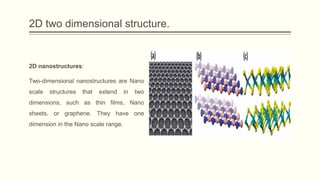
2D two dimensional structure.
2D nanostructures:
Two-dimensional nanostructures are Nano
scale structures that extend in two
dimensions, such as thin films, Nano
sheets, or graphene. They have one
dimension in the Nano scale range.
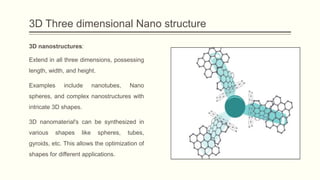
3D Three dimensional Nano structure
3D nanostructures:
Extend in all three dimensions, possessing
length, width, and height.
Examples include nanotubes, Nano
spheres, and complex nanostructures with
intricate 3D shapes.
3D nanomaterial's can be synthesized in
various shapes like spheres, tubes,
gyroids, etc. This allows the optimization of
shapes for different applications.
Methods for the dimensional control.
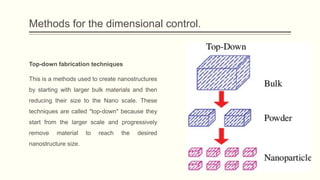
Top-down fabrication techniques
This is a methods used to create nanostructures
by starting with larger bulk materials and then
reducing their size to the Nano scale. These
techniques are called "top-down" because they
start from the larger scale and progressively
remove material to reach the desired
nanostructure size.
Some common top-down fabrication techniques include:
Lithography:
Lithography uses masks and light (or electron beams) to selectively remove or modify material on a
substrate, creating patterns with Nano scale features. There are various types of lithography, such as
photolithography, electron beam lithography, and Nano imprint lithography.
Etching:
Etching involves selectively removing material from a substrate using chemical, physical, or
electrochemical processes. Common etching techniques for nanofabrication include reactive ion
etching (RIE), deep reactive ion etching (DRIE), and wet chemical etching.
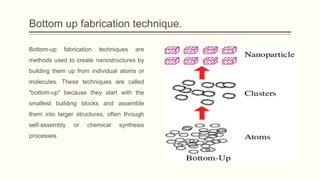
Bottom up fabrication technique.
Bottom-up fabrication techniques are
methods used to create nanostructures by
building them up from individual atoms or
molecules. These techniques are called
"bottom-up" because they start with the
smallest building blocks and assemble
them into larger structures, often through
self-assembly or chemical synthesis
processes.
Some common bottom-up fabrication techniques include:
1.Chemical Vapour Deposition (CVD):
CVD is a method where thin films of material are deposited onto a substrate by reacting gaseous
precursor molecules on the substrate surface, leading to the formation of nanostructures.
1.Self-Assembly:
Self-assembly is a process where molecules or nanoparticles spontaneously organize into ordered
structures without external manipulation. This can include processes like molecular self-assembly,
where molecules form structures based on their chemical properties.
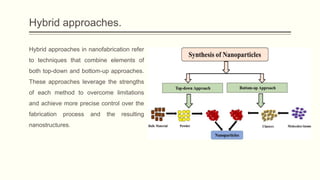
Hybrid approaches.
Hybrid approaches in nanofabrication refer
to techniques that combine elements of
both top-down and bottom-up approaches.
These approaches leverage the strengths
of each method to overcome limitations
and achieve more precise control over the
fabrication process and the resulting
nanostructures.
Directed Self-Assembly (DSA):
DSA combines the principles of self-assembly with top-down patterning techniques. A top-down
pattern is created on the substrate, which then directs the self-assembly of molecules or
nanoparticles into the desired nanostructure. This approach allows for the creation of ordered
nanostructures with precise control over placement and orientation.
Combination of Etching and Deposition:
In this approach, a top-down method such as etching is used to create patterns or features on the
substrate, which are then filled or coated with material using a bottom-up method such as chemical
vapor deposition (CVD) or atomic layer deposition (ALD). This allows for the creation of
nanostructures with controlled dimensions and compositions.
Factors affecting dimensional control.
 Several factors can affect dimensional control in the fabrication of nanostructures.
These factors can vary depending on the fabrication technique used, but some
common ones include.
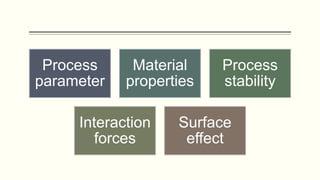
Process parameter.
Material properties.
Process stability.
Material interaction.
Surface effect
Factors affecting the dimensional control.
1.Process Parameters: Parameters such as temperature, pressure, and deposition rate
can significantly affect the growth and assembly of nanostructures. Variations in these
parameters can lead to changes in the size, shape, and structure of nanostructures.
2.Material Properties: The properties of the materials used can influence dimensional
control. Factors such as crystal structure, surface energy, and chemical composition can
affect how materials nucleate, grow, and assemble into nanostructures.
3.Process Stability: The stability and consistency of the fabrication process are crucial for
dimensional control. Variations or fluctuations in the process can lead to variations in the size, shape,
and quality of the nanostructures.
4.Interaction Forces: Forces such as van der Waals forces, electrostatic forces, and capillary forces
can influence the assembly and arrangement of nanostructures, affecting their dimensions and
properties.
5.Surface Effects: Surface interactions between the nanostructures and the substrate or surrounding
environment can affect dimensional control. Surface energy, surface roughness, and surface chemistry
can all play a role in determining the final dimensions of nanostructures.
Factors effecting dimensional control.
Process
parameter
Material
properties
Process
stability
Interaction
forces
Surface
effect
Example of dimensional control in nanostructure.
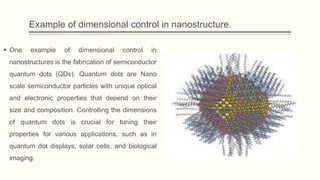
 One example of dimensional control in
nanostructures is the fabrication of semiconductor
quantum dots (QDs). Quantum dots are Nano
scale semiconductor particles with unique optical
and electronic properties that depend on their
size and composition. Controlling the dimensions
of quantum dots is crucial for tuning their
properties for various applications, such as in
quantum dot displays, solar cells, and biological
imaging.
Example of dimensional control in nanostructure
 To achieve dimensional control in quantum dots, researchers use a combination of top-down and
bottom-up fabrication techniques. For example, in a typical process:
 Bottom-up synthesis:
 Semiconductor materials are synthesized in solution-phase reactions to form Nano crystals. The
size of the quantum dots can be controlled by adjusting the reaction conditions, such as the
temperature, reaction time, and the ratio of precursor materials.
 Size selection:
 After synthesis, the quantum dots are often dispersed in a solution containing ligands that can
selectively bind to quantum dots of a specific size. This size selection step helps to isolate
quantum dots with the desired dimensions.
Example of dimensional control in Nano structure
 Surface modification:
 The surface of the quantum dots can be modified to improve their stability and optical
properties. Ligands or capping agents can be added to the surface to passivate
defects and prevent aggregation.
 Top-down patterning:
 In some cases, top-down lithographic techniques can be used to pattern the substrate
or create templates for the deposition of quantum dots. This approach can further
control the spatial arrangement and dimensions of the quantum dots.
Challenges and future perspective
 Challenges in dimensional control of nanostructures include:
 Uniformity: Achieving uniform size and shape across a large area or batch of nanostructures can
be challenging due to variations in fabrication processes.
 Resolution: Current fabrication techniques may have limitations in achieving high resolution and
precise control over dimensions, especially for complex nanostructures.
 Scalability: Some fabrication techniques may not be easily scalable to large-scale production,
limiting the practical applications of nanostructures.
 Cost: Fabrication of nanostructures using certain techniques can be expensive, which may hinder
their widespread adoption.
Challenges and future perspective
 Advanced Fabrication Techniques: Development of novel fabrication techniques
with higher resolution, better control, and scalability, such as advanced lithography,
self-assembly, and template-assisted methods.
 Multi-Dimensional Control: Achieving control over multiple dimensions (size, shape,
orientation) simultaneously to create complex nanostructures with tailored properties.
 In-situ Characterization: Integration of in-situ characterization techniques to monitor
and control the fabrication process in real-time, improving control and uniformity.
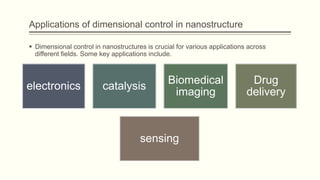
Applications of dimensional control in nanostructure
 Dimensional control in nanostructures is crucial for various applications across
different fields. Some key applications include.
electronics catalysis
Biomedical
imaging
Drug
delivery
sensing
Applications of dimensional control in nanostructure.
 Dimensional control in nanostructures is crucial for various applications across different
fields. Some key applications include:
 Electronics: In electronics, precise control over the dimensions of nanostructures is
essential for developing smaller, faster, and more energy-efficient devices. For example,
quantum dots with well-defined sizes can be used in quantum dot displays and quantum
dot solar cells.
 Catalysis: Nanostructures with controlled dimensions can exhibit enhanced catalytic
properties due to their high surface area-to-volume ratio. These nanostructures are used in
catalytic converters, fuel cells, and other environmental and energy-related applications.
Applications of dimensional control in nanostructure.
 Biomedical Imaging: Quantum dots and other nanostructures with controlled dimensions are
used as contrast agents in biomedical imaging techniques such as fluorescence imaging and
magnetic resonance imaging (MRI).
 Drug Delivery: Nanostructures with precise dimensions can be used to encapsulate drugs and
deliver them to specific targets in the body, improving the efficacy and reducing the side effects of
drug treatments.
 Sensing: Nanostructures with controlled dimensions are used in sensors for detecting various
analytes such as gases, chemicals, and biomolecules. The high surface area-to-volume ratio of
nanostructures enhances sensitivity and response times in sensing applications.
Applications od dimensional control in nanostructure
 Energy Storage and Conversion:
 Nanostructures with controlled dimensions are used in batteries, super capacitors, and fuel cells
to improve energy storage and conversion efficiency. For example, nanowires and nanotubes
are used to improve the performance of lithium-ion batteries.
 Optoelectronics:
 Nanostructures with controlled dimensions are used in optoelectronic devices such as light-
emitting diodes (LEDs), solar cells, and photo detectors. Precise control over the dimensions of
these structures is essential for optimizing their optical and electronic properties.
Conclusion.
In conclusion, dimensional control in nanostructures plays a
crucial role in tailoring their properties for specific
applications. Various fabrication techniques, including top-
down and bottom-up approaches, are used to achieve
precise control over the size, shape, and orientation of
nanostructures. Challenges such as uniformity, resolution,
scalability, and cost exist in achieving dimensional control, but
advancements in fabrication techniques and materials
science are addressing these challenges.
THANK YOU

Dimensional control in nanostructure.pdf

  • 1.
    DIMENSIONAL CONTROL IN NANOSTRUCTURE ToobaAYUB ROLL NO 0291–BH-CHEM-20.
  • 2.
    Contents. 1. introduction. 2. Nanostructure 3.Dimensional control in Nano structure. 4. Classification of nanostructure on the basis of dimensional . 5. Methods for dimensional control. Top-down fabrication techniques (e.g., lithography, etching) Bottom-up fabrication techniques (e.g., chemical vapour deposition, self-assembly) Hybrid approaches (combining top-down and bottom-up methods. 6. Factors affecting dimensional control. 7. Examples of Nano structures in dimensional control. 8. Challenges ad future perspective.
  • 3.
    INTRODUCTION. Nano structure. Nanostructures generallyrefer to the material systems that are in the range of 1 to 100 nanometers.OR Nanostructure is a structure that has at least one dimension in the nanometre scale, typically ranging from 1 to 100 nanometres.
  • 4.
    Dimensional control inNano structure.  Dimensional control refers to the ability to maintain the dimensions (such as size, shape, and orientation) of a structure or object within desired tolerances. In the context of nanostructures, dimensional control is crucial because the physical and chemical properties of materials at the Nano scale are highly sensitive to variations in size and shape.  Dimensional control is essential in nanotechnology because many properties and behaviours of materials at the Nano scale are size-dependent. For example, the optical, electronic, and mechanical properties of nanoparticles can vary significantly depending on their size and shape. Therefore, precise dimensional control is essential for tailoring these properties for various applications, such as in electronics, catalysis, sensing, and medicine.
  • 5.
    Classification of nanostructureon the basis of dimensions.  A nanostructure is a structure that has at least one dimension in the nanometre scale, typically ranging from 1 to 100 nanometres. Nanostructures can be classified into different dimensions.  .
  • 6.
    OD(ZERODIMENSIONAL STRUCTURE) 0D nanostructures. Zero-Dimensional(0D) Nanomaterial's. The materials whose dimensions are all under nanometre range belong to zero- dimensional (0D) nanomaterial's. Nanoparticles, quantum dots, carbon Nano dots, fullerene, etc. are some popular examples of 0D nanomaterial's
  • 7.
    1D one dimensionalnanostructure 1D nanostructures: One-dimensional nanostructures are Nano scale structures that extend in one dimension, such as nanowires, Nano rods, or nanotubes. They have two dimensions in the Nano scale range.
  • 8.
    2D two dimensionalstructure. 2D nanostructures: Two-dimensional nanostructures are Nano scale structures that extend in two dimensions, such as thin films, Nano sheets, or graphene. They have one dimension in the Nano scale range.
  • 9.
    3D Three dimensionalNano structure 3D nanostructures: Extend in all three dimensions, possessing length, width, and height. Examples include nanotubes, Nano spheres, and complex nanostructures with intricate 3D shapes. 3D nanomaterial's can be synthesized in various shapes like spheres, tubes, gyroids, etc. This allows the optimization of shapes for different applications.
  • 10.
    Methods for thedimensional control. Top-down fabrication techniques This is a methods used to create nanostructures by starting with larger bulk materials and then reducing their size to the Nano scale. These techniques are called "top-down" because they start from the larger scale and progressively remove material to reach the desired nanostructure size.
  • 11.
    Some common top-downfabrication techniques include: Lithography: Lithography uses masks and light (or electron beams) to selectively remove or modify material on a substrate, creating patterns with Nano scale features. There are various types of lithography, such as photolithography, electron beam lithography, and Nano imprint lithography. Etching: Etching involves selectively removing material from a substrate using chemical, physical, or electrochemical processes. Common etching techniques for nanofabrication include reactive ion etching (RIE), deep reactive ion etching (DRIE), and wet chemical etching.
  • 12.
    Bottom up fabricationtechnique. Bottom-up fabrication techniques are methods used to create nanostructures by building them up from individual atoms or molecules. These techniques are called "bottom-up" because they start with the smallest building blocks and assemble them into larger structures, often through self-assembly or chemical synthesis processes.
  • 13.
    Some common bottom-upfabrication techniques include: 1.Chemical Vapour Deposition (CVD): CVD is a method where thin films of material are deposited onto a substrate by reacting gaseous precursor molecules on the substrate surface, leading to the formation of nanostructures. 1.Self-Assembly: Self-assembly is a process where molecules or nanoparticles spontaneously organize into ordered structures without external manipulation. This can include processes like molecular self-assembly, where molecules form structures based on their chemical properties.
  • 14.
    Hybrid approaches. Hybrid approachesin nanofabrication refer to techniques that combine elements of both top-down and bottom-up approaches. These approaches leverage the strengths of each method to overcome limitations and achieve more precise control over the fabrication process and the resulting nanostructures.
  • 15.
    Directed Self-Assembly (DSA): DSAcombines the principles of self-assembly with top-down patterning techniques. A top-down pattern is created on the substrate, which then directs the self-assembly of molecules or nanoparticles into the desired nanostructure. This approach allows for the creation of ordered nanostructures with precise control over placement and orientation. Combination of Etching and Deposition: In this approach, a top-down method such as etching is used to create patterns or features on the substrate, which are then filled or coated with material using a bottom-up method such as chemical vapor deposition (CVD) or atomic layer deposition (ALD). This allows for the creation of nanostructures with controlled dimensions and compositions.
  • 16.
    Factors affecting dimensionalcontrol.  Several factors can affect dimensional control in the fabrication of nanostructures. These factors can vary depending on the fabrication technique used, but some common ones include. Process parameter. Material properties. Process stability. Material interaction. Surface effect
  • 17.
    Factors affecting thedimensional control. 1.Process Parameters: Parameters such as temperature, pressure, and deposition rate can significantly affect the growth and assembly of nanostructures. Variations in these parameters can lead to changes in the size, shape, and structure of nanostructures. 2.Material Properties: The properties of the materials used can influence dimensional control. Factors such as crystal structure, surface energy, and chemical composition can affect how materials nucleate, grow, and assemble into nanostructures.
  • 18.
    3.Process Stability: Thestability and consistency of the fabrication process are crucial for dimensional control. Variations or fluctuations in the process can lead to variations in the size, shape, and quality of the nanostructures. 4.Interaction Forces: Forces such as van der Waals forces, electrostatic forces, and capillary forces can influence the assembly and arrangement of nanostructures, affecting their dimensions and properties. 5.Surface Effects: Surface interactions between the nanostructures and the substrate or surrounding environment can affect dimensional control. Surface energy, surface roughness, and surface chemistry can all play a role in determining the final dimensions of nanostructures. Factors effecting dimensional control.
  • 19.
  • 20.
    Example of dimensionalcontrol in nanostructure.  One example of dimensional control in nanostructures is the fabrication of semiconductor quantum dots (QDs). Quantum dots are Nano scale semiconductor particles with unique optical and electronic properties that depend on their size and composition. Controlling the dimensions of quantum dots is crucial for tuning their properties for various applications, such as in quantum dot displays, solar cells, and biological imaging.
  • 21.
    Example of dimensionalcontrol in nanostructure  To achieve dimensional control in quantum dots, researchers use a combination of top-down and bottom-up fabrication techniques. For example, in a typical process:  Bottom-up synthesis:  Semiconductor materials are synthesized in solution-phase reactions to form Nano crystals. The size of the quantum dots can be controlled by adjusting the reaction conditions, such as the temperature, reaction time, and the ratio of precursor materials.  Size selection:  After synthesis, the quantum dots are often dispersed in a solution containing ligands that can selectively bind to quantum dots of a specific size. This size selection step helps to isolate quantum dots with the desired dimensions.
  • 22.
    Example of dimensionalcontrol in Nano structure  Surface modification:  The surface of the quantum dots can be modified to improve their stability and optical properties. Ligands or capping agents can be added to the surface to passivate defects and prevent aggregation.  Top-down patterning:  In some cases, top-down lithographic techniques can be used to pattern the substrate or create templates for the deposition of quantum dots. This approach can further control the spatial arrangement and dimensions of the quantum dots.
  • 23.
    Challenges and futureperspective  Challenges in dimensional control of nanostructures include:  Uniformity: Achieving uniform size and shape across a large area or batch of nanostructures can be challenging due to variations in fabrication processes.  Resolution: Current fabrication techniques may have limitations in achieving high resolution and precise control over dimensions, especially for complex nanostructures.  Scalability: Some fabrication techniques may not be easily scalable to large-scale production, limiting the practical applications of nanostructures.  Cost: Fabrication of nanostructures using certain techniques can be expensive, which may hinder their widespread adoption.
  • 24.
    Challenges and futureperspective  Advanced Fabrication Techniques: Development of novel fabrication techniques with higher resolution, better control, and scalability, such as advanced lithography, self-assembly, and template-assisted methods.  Multi-Dimensional Control: Achieving control over multiple dimensions (size, shape, orientation) simultaneously to create complex nanostructures with tailored properties.  In-situ Characterization: Integration of in-situ characterization techniques to monitor and control the fabrication process in real-time, improving control and uniformity.
  • 25.
    Applications of dimensionalcontrol in nanostructure  Dimensional control in nanostructures is crucial for various applications across different fields. Some key applications include. electronics catalysis Biomedical imaging Drug delivery sensing
  • 26.
    Applications of dimensionalcontrol in nanostructure.  Dimensional control in nanostructures is crucial for various applications across different fields. Some key applications include:  Electronics: In electronics, precise control over the dimensions of nanostructures is essential for developing smaller, faster, and more energy-efficient devices. For example, quantum dots with well-defined sizes can be used in quantum dot displays and quantum dot solar cells.  Catalysis: Nanostructures with controlled dimensions can exhibit enhanced catalytic properties due to their high surface area-to-volume ratio. These nanostructures are used in catalytic converters, fuel cells, and other environmental and energy-related applications.
  • 27.
    Applications of dimensionalcontrol in nanostructure.  Biomedical Imaging: Quantum dots and other nanostructures with controlled dimensions are used as contrast agents in biomedical imaging techniques such as fluorescence imaging and magnetic resonance imaging (MRI).  Drug Delivery: Nanostructures with precise dimensions can be used to encapsulate drugs and deliver them to specific targets in the body, improving the efficacy and reducing the side effects of drug treatments.  Sensing: Nanostructures with controlled dimensions are used in sensors for detecting various analytes such as gases, chemicals, and biomolecules. The high surface area-to-volume ratio of nanostructures enhances sensitivity and response times in sensing applications.
  • 28.
    Applications od dimensionalcontrol in nanostructure  Energy Storage and Conversion:  Nanostructures with controlled dimensions are used in batteries, super capacitors, and fuel cells to improve energy storage and conversion efficiency. For example, nanowires and nanotubes are used to improve the performance of lithium-ion batteries.  Optoelectronics:  Nanostructures with controlled dimensions are used in optoelectronic devices such as light- emitting diodes (LEDs), solar cells, and photo detectors. Precise control over the dimensions of these structures is essential for optimizing their optical and electronic properties.
  • 29.
    Conclusion. In conclusion, dimensionalcontrol in nanostructures plays a crucial role in tailoring their properties for specific applications. Various fabrication techniques, including top- down and bottom-up approaches, are used to achieve precise control over the size, shape, and orientation of nanostructures. Challenges such as uniformity, resolution, scalability, and cost exist in achieving dimensional control, but advancements in fabrication techniques and materials science are addressing these challenges.
  • 30.