MICROBES IN HUMAN WELFARE
PRIYA JHA
PGT BIOLOGY
Microbes: Household Applications
• Lactic acid bacteria (LAB): curd, Vitamin B12,
prevents infections
• Fermentation: dosa, idli, bread by yeast
• Toddy from palm sap
• Cheese: Swiss (Propionibacterium), Roquefort
(fungi)
1.Household Applications
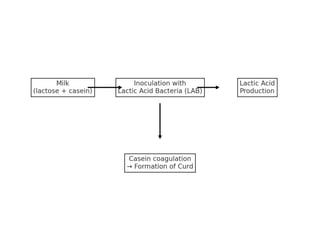
• Lactic acid bacteria (LAB) :Milk Curd - LAB
produces acids that coagulate and partially digest
milk proteins.
• Small amount of curd that is added to the milk
for curdling acts as an inoculum containing
thousands of LABS, which further multiply.
• LAB enhances the nutritional value of milk by
increasing Vitamin B12.
• LAB present in stomach prevents infections.
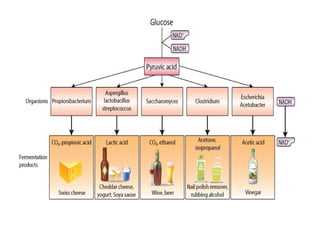
Fermentation
• Dosaand idli dough is fermented by bacteria,
which produces CO2gas and gives it a puffed-
up appearance.
• Dough used for making breads is fermented
by baker’s yeast (Saccharomyces cerevisiae)
• ā€˜Toddy’ (a traditional drink from South India
made by fermenting sap from palm trees)
Cheese making
• The bacterium Propionibacterium sharmanii
is used in ā€˜Swiss cheese’ to give it its
characteristic holes by producing large
amount of carbon dioxide.
• ā€˜Roquefort cheese’ is ripened by growing
certain fungi on them to give them their
specific flavour.
2.Industrial Applications
• Microbes grown in fermentors
• Fermented beverages: wine, beer, whisky,
brandy
• Antibiotics: Penicillin discovered by Fleming
• Chemicals & Enzymes: Citric acid (Aspergillus),
Acetic acid (Acetobacter),
• Ethanol (Yeast), Streptokinase, Cyclosporin A,
Statins
Industrial applications
• For industrial purposes, microbes are grown in large vessels
called fermentors.
• On industrial scale, fermented beverages, antibiotics, enzymes,
and other bioactive molecules are prepared using microbes.
• Fermented beverages Saccharomyces cerevisiae, also called
brewer’s yeast, is used to prepare wine, beer, whisky, brandy,
rum, etc. depending upon the type of raw material and
processing.
• If fermented broth is distilled, then brandy and rum are
produced while wine and beer are produced without
distillation.
Antibiotics
• Certain microorganisms inhibit the growth of other microorganisms
wherever they grow.
• Antibiotics are chemical substances produced by certain microbes that
kill or retard the growth of other microbes (disease-causing microbes).
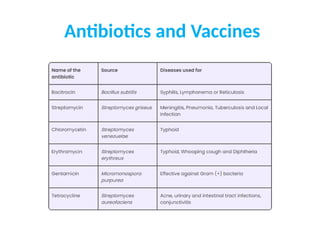
• Penicillin discovered by Alexander Fleming was the first antibiotic to
be discovered.
• Fleming discovered it by chance when he was working on the
bacterium Staphylococcus. He discovered that growth of
Staphylococcus ceases in the culture plates where Penicillium notatum
was grown.
• Later on, its use as an effective antibiotic was established by Chain and
Florey.
Antibiotics and Vaccines
Enzymes and chemicals
Various chemicals, organic acids are
produced using microorganisms. Some
examples are:
• Citric acid- Aspergillus niger
• Acetic acid- Acetobacter aceti
• Lactic acid- Lactobacillus
• Butyric acid- Clostridium butylicum
• Ethanol- Saccharomyces cerevisiae
Microbes: Applications in Sewage
Treatment
• Need for sewage treatment-
1. The municipal waste water(sewage) contains large
amount of organic waste and microbes.
2. This can invite diseases and epidemic when this water
meets community water bodies like lake pond and rivers.
3. To check this the sewage is made less polluting by passing
it through sewage treatment plants(STPs).
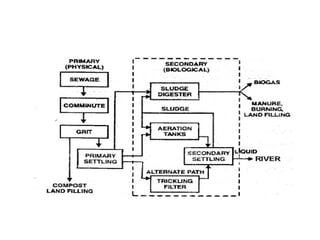
This involves two steps-
i. Primary Treatment
ii. Secondary Treatment
1. Primary treatment
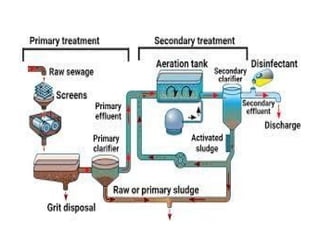
a. It is a physical process, it uses sedimentation and
filtration to filter small and large particles.
b. First the sewage is passed through mesh screens of
small pore sizes to remove floating objects like
polythene.
c. The grit is removed by sedimentation by passing
sewage into grit chamber.
d. Then it is kept in settling tanks, where the suspended
materials settle down to form the primary sludge.
e. The remaining fluid is taken for secondary treatment.
2. Secondary treatment
a. It is a biological process by heterotrophic bacteria present in the sewage.
b. The primary effluent is aerated in aeration tanks.
c. This causes rapid growth of aerobic bacteria, which then as 'flocs'
consume the organic matter to reduce the Biochemical Oxygen
Demand (BOD).
d. After this the effluent is passed to settling tanks where these 'flocs' get
sedimented. (Activated Sludge).
e. A part of this sludge is pumped back to aeration tanks for further use.
f. This sludge is pumped to anaerobic sludge digesters, where anaerobic
bacteria form gases like methane CO2 and H2S.
g. After this the effluent is released into water bodies like streams and
rivers.
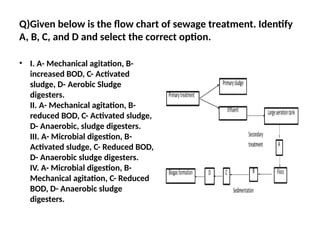
Q)Given below is the flow chart of sewage treatment. Identify
A, B, C, and D and select the correct option.
• I. A- Mechanical agitation, B-
increased BOD, C- Activated
sludge, D- Aerobic Sludge
digesters.
II. A- Mechanical agitation, B-
reduced BOD, C- Activated sludge,
D- Anaerobic, sludge digesters.
III. A- Microbial digestion, B-
Activated sludge, C- Reduced BOD,
D- Anaerobic sludge digesters.
IV. A- Microbial digestion, B-
Mechanical agitation, C- Reduced
BOD, D- Anaerobic sludge
digesters.
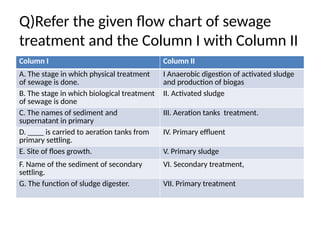
Q)Refer the given flow chart of sewage
treatment and the Column I with Column II
Column I Column II
A. The stage in which physical treatment
of sewage is done.
I Anaerobic digestion of activated sludge
and production of biogas
B. The stage in which biological treatment
of sewage is done
II. Activated sludge
C. The names of sediment and
supernatant in primary
III. Aeration tanks treatment.
D. ____ is carried to aeration tanks from
primary settling.
IV. Primary effluent
E. Site of floes growth. V. Primary sludge
F. Name of the sediment of secondary
settling.
VI. Secondary treatment,
G. The function of sludge digester. VII. Primary treatment
BIOACTIVE AGENT
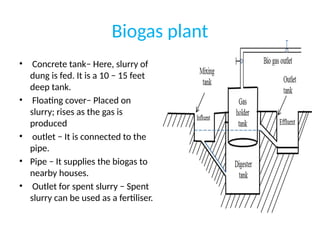
Biogas plant
• Concrete tankāˆ’ Here, slurry of
dung is fed. It is a 10 āˆ’ 15 feet
deep tank.
• Floating coverāˆ’ Placed on
slurry; rises as the gas is
produced
• outlet āˆ’ It is connected to the
pipe.
• Pipe āˆ’ It supplies the biogas to
nearby houses.
• Outlet for spent slurry āˆ’ Spent
slurry can be used as a fertiliser.
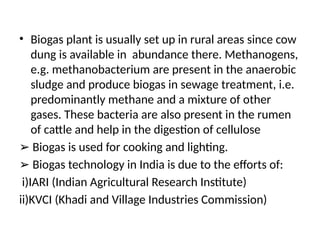
• Biogas plant is usually set up in rural areas since cow
dung is available in abundance there. Methanogens,
e.g. methanobacterium are present in the anaerobic
sludge and produce biogas in sewage treatment, i.e.
predominantly methane and a mixture of other
gases. These bacteria are also present in the rumen
of cattle and help in the digestion of cellulose
āž¢ Biogas is used for cooking and lighting.
āž¢ Biogas technology in India is due to the efforts of:
i)IARI (Indian Agricultural Research Institute)
ii)KVCI (Khadi and Village Industries Commission)
Biocontrol of pest and diseases
• Chemical pesticides and insecticides kill both harmful and
useful organisms. By understanding natural predation and
interacting webs, an appropriate method of biocontrol can be
developed.
• Dragonflies and ladybugs help in controlling mosquitoes and
aphids.
• Bacillus thuringiensis is used to control caterpillars and insect
larvae. Some plants have been genetically modified and the
gene coding for the toxin has been introduced in the plant
genome. E.g. Bt-cotton is resistant to pests.
• Trichoderma (a fungus) is used to biocontrol various plant
pathogens. The fungus is commonly present in the roots.
• Baculoviruses of the genus Nucleopolyhedrovirus are excellent
biocontrol agents. They attack arthropods but are not harmful
to plants and other animals such as birds, fish and mammals.
Biofertilizers
• Excessive use of chemical fertilizers is linked to pollution and harmful effects.
Use of microorganisms as biofertilizers is highly recommended.
• Fungi, bacteria and cyanobacteria are the main sources of biofertilizers.
• Rhizobium is present in the root nodules of leguminous plants. It fixes
atmospheric nitrogen. Growing leguminous plants alternatively helps in
increasing the nitrogen content of the soil.
• Azotobacter and Azospirillum are free-living nitrogen-fixing bacteria present in
the soil.
• Fungal association in mycorrhiza also enriches the nutrient content of the soil.
Fungi of the genus Glomus absorbs phosphorus for the plant.
• These symbiotic associations not only benefit by enriching the nutrient content
but also provide disease resistance and tolerance to drought and salinity.
• Most of the cyanobacteria can fix atmospheric nitrogen, e.g. Nostoc, Anabaena,
Oscillatoria, etc. Cyanobacteria are extensively used in paddy fields as a
biofertilizer. Blue-green algae are autotrophic and present everywhere in aquatic
and terrestrial habitats. They increase soil fertility by adding organic matter.
THANK YOU

MICROBES IN HUMAN WELFARE PRIYA JHA KVS.

  • 1.
    MICROBES IN HUMANWELFARE PRIYA JHA PGT BIOLOGY
  • 2.
    Microbes: Household Applications •Lactic acid bacteria (LAB): curd, Vitamin B12, prevents infections • Fermentation: dosa, idli, bread by yeast • Toddy from palm sap • Cheese: Swiss (Propionibacterium), Roquefort (fungi)
  • 3.
    1.Household Applications • Lacticacid bacteria (LAB) :Milk Curd - LAB produces acids that coagulate and partially digest milk proteins. • Small amount of curd that is added to the milk for curdling acts as an inoculum containing thousands of LABS, which further multiply. • LAB enhances the nutritional value of milk by increasing Vitamin B12. • LAB present in stomach prevents infections.
  • 5.
    Fermentation • Dosaand idlidough is fermented by bacteria, which produces CO2gas and gives it a puffed- up appearance. • Dough used for making breads is fermented by baker’s yeast (Saccharomyces cerevisiae) • ā€˜Toddy’ (a traditional drink from South India made by fermenting sap from palm trees)
  • 7.
    Cheese making • Thebacterium Propionibacterium sharmanii is used in ā€˜Swiss cheese’ to give it its characteristic holes by producing large amount of carbon dioxide. • ā€˜Roquefort cheese’ is ripened by growing certain fungi on them to give them their specific flavour.
  • 8.
    2.Industrial Applications • Microbesgrown in fermentors • Fermented beverages: wine, beer, whisky, brandy • Antibiotics: Penicillin discovered by Fleming • Chemicals & Enzymes: Citric acid (Aspergillus), Acetic acid (Acetobacter), • Ethanol (Yeast), Streptokinase, Cyclosporin A, Statins
  • 9.
    Industrial applications • Forindustrial purposes, microbes are grown in large vessels called fermentors. • On industrial scale, fermented beverages, antibiotics, enzymes, and other bioactive molecules are prepared using microbes. • Fermented beverages Saccharomyces cerevisiae, also called brewer’s yeast, is used to prepare wine, beer, whisky, brandy, rum, etc. depending upon the type of raw material and processing. • If fermented broth is distilled, then brandy and rum are produced while wine and beer are produced without distillation.
  • 10.
    Antibiotics • Certain microorganismsinhibit the growth of other microorganisms wherever they grow. • Antibiotics are chemical substances produced by certain microbes that kill or retard the growth of other microbes (disease-causing microbes). • Penicillin discovered by Alexander Fleming was the first antibiotic to be discovered. • Fleming discovered it by chance when he was working on the bacterium Staphylococcus. He discovered that growth of Staphylococcus ceases in the culture plates where Penicillium notatum was grown. • Later on, its use as an effective antibiotic was established by Chain and Florey.
  • 11.
  • 12.
    Enzymes and chemicals Variouschemicals, organic acids are produced using microorganisms. Some examples are: • Citric acid- Aspergillus niger • Acetic acid- Acetobacter aceti • Lactic acid- Lactobacillus • Butyric acid- Clostridium butylicum • Ethanol- Saccharomyces cerevisiae
  • 13.
    Microbes: Applications inSewage Treatment • Need for sewage treatment- 1. The municipal waste water(sewage) contains large amount of organic waste and microbes. 2. This can invite diseases and epidemic when this water meets community water bodies like lake pond and rivers. 3. To check this the sewage is made less polluting by passing it through sewage treatment plants(STPs). This involves two steps- i. Primary Treatment ii. Secondary Treatment
  • 15.
    1. Primary treatment a.It is a physical process, it uses sedimentation and filtration to filter small and large particles. b. First the sewage is passed through mesh screens of small pore sizes to remove floating objects like polythene. c. The grit is removed by sedimentation by passing sewage into grit chamber. d. Then it is kept in settling tanks, where the suspended materials settle down to form the primary sludge. e. The remaining fluid is taken for secondary treatment.
  • 16.
    2. Secondary treatment a.It is a biological process by heterotrophic bacteria present in the sewage. b. The primary effluent is aerated in aeration tanks. c. This causes rapid growth of aerobic bacteria, which then as 'flocs' consume the organic matter to reduce the Biochemical Oxygen Demand (BOD). d. After this the effluent is passed to settling tanks where these 'flocs' get sedimented. (Activated Sludge). e. A part of this sludge is pumped back to aeration tanks for further use. f. This sludge is pumped to anaerobic sludge digesters, where anaerobic bacteria form gases like methane CO2 and H2S. g. After this the effluent is released into water bodies like streams and rivers.
  • 17.
    Q)Given below isthe flow chart of sewage treatment. Identify A, B, C, and D and select the correct option. • I. A- Mechanical agitation, B- increased BOD, C- Activated sludge, D- Aerobic Sludge digesters. II. A- Mechanical agitation, B- reduced BOD, C- Activated sludge, D- Anaerobic, sludge digesters. III. A- Microbial digestion, B- Activated sludge, C- Reduced BOD, D- Anaerobic sludge digesters. IV. A- Microbial digestion, B- Mechanical agitation, C- Reduced BOD, D- Anaerobic sludge digesters.
  • 18.
    Q)Refer the givenflow chart of sewage treatment and the Column I with Column II Column I Column II A. The stage in which physical treatment of sewage is done. I Anaerobic digestion of activated sludge and production of biogas B. The stage in which biological treatment of sewage is done II. Activated sludge C. The names of sediment and supernatant in primary III. Aeration tanks treatment. D. ____ is carried to aeration tanks from primary settling. IV. Primary effluent E. Site of floes growth. V. Primary sludge F. Name of the sediment of secondary settling. VI. Secondary treatment, G. The function of sludge digester. VII. Primary treatment
  • 20.
  • 21.
    Biogas plant • Concretetankāˆ’ Here, slurry of dung is fed. It is a 10 āˆ’ 15 feet deep tank. • Floating coverāˆ’ Placed on slurry; rises as the gas is produced • outlet āˆ’ It is connected to the pipe. • Pipe āˆ’ It supplies the biogas to nearby houses. • Outlet for spent slurry āˆ’ Spent slurry can be used as a fertiliser.
  • 22.
    • Biogas plantis usually set up in rural areas since cow dung is available in abundance there. Methanogens, e.g. methanobacterium are present in the anaerobic sludge and produce biogas in sewage treatment, i.e. predominantly methane and a mixture of other gases. These bacteria are also present in the rumen of cattle and help in the digestion of cellulose āž¢ Biogas is used for cooking and lighting. āž¢ Biogas technology in India is due to the efforts of: i)IARI (Indian Agricultural Research Institute) ii)KVCI (Khadi and Village Industries Commission)
  • 23.
    Biocontrol of pestand diseases • Chemical pesticides and insecticides kill both harmful and useful organisms. By understanding natural predation and interacting webs, an appropriate method of biocontrol can be developed. • Dragonflies and ladybugs help in controlling mosquitoes and aphids. • Bacillus thuringiensis is used to control caterpillars and insect larvae. Some plants have been genetically modified and the gene coding for the toxin has been introduced in the plant genome. E.g. Bt-cotton is resistant to pests. • Trichoderma (a fungus) is used to biocontrol various plant pathogens. The fungus is commonly present in the roots. • Baculoviruses of the genus Nucleopolyhedrovirus are excellent biocontrol agents. They attack arthropods but are not harmful to plants and other animals such as birds, fish and mammals.
  • 24.
    Biofertilizers • Excessive useof chemical fertilizers is linked to pollution and harmful effects. Use of microorganisms as biofertilizers is highly recommended. • Fungi, bacteria and cyanobacteria are the main sources of biofertilizers. • Rhizobium is present in the root nodules of leguminous plants. It fixes atmospheric nitrogen. Growing leguminous plants alternatively helps in increasing the nitrogen content of the soil. • Azotobacter and Azospirillum are free-living nitrogen-fixing bacteria present in the soil. • Fungal association in mycorrhiza also enriches the nutrient content of the soil. Fungi of the genus Glomus absorbs phosphorus for the plant. • These symbiotic associations not only benefit by enriching the nutrient content but also provide disease resistance and tolerance to drought and salinity. • Most of the cyanobacteria can fix atmospheric nitrogen, e.g. Nostoc, Anabaena, Oscillatoria, etc. Cyanobacteria are extensively used in paddy fields as a biofertilizer. Blue-green algae are autotrophic and present everywhere in aquatic and terrestrial habitats. They increase soil fertility by adding organic matter.
  • 25.