Microbial
Ecology and
Molecular
Approaches
Revolutionising theStudy of Microbial Communities
A presentation for graduate students and researchers in microbiology and microbial ecology, focusing on
contemporary methods to understand the unseen majority.
2.
Navigating the UnseenWorld: Scope of Microbial
Ecology
Microbial ecology is the study of microbes in their natural environments,
focusing on their relationships with each other and their surroundings. It
explores how these ubiquitous organisms drive global biogeochemical cycles
and impact host health, agriculture, and industry.
Understanding the distribution and abundance of microorganisms across
different habitats.
Investigating the metabolic roles and functional diversity within microbial
populations.
Analysing the complex web of interactions that govern microbial
community structure.
The vast majority of life on Earth is microbial, yet our understanding of its
ecological function remains fundamentally incomplete.
3.
The Dynamic Interplay:Microbial Interactions and
Consortia
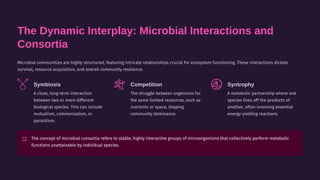
Microbial communities are highly structured, featuring intricate relationships crucial for ecosystem functioning. These interactions dictate
survival, resource acquisition, and overall community resilience.
Symbiosis
A close, long-term interaction
between two or more different
biological species. This can include
mutualism, commensalism, or
parasitism.
Competition
The struggle between organisms for
the same limited resources, such as
nutrients or space, shaping
community dominance.
Syntrophy
A metabolic partnership where one
species lives off the products of
another, often involving essential
energy-yielding reactions.
The concept of microbial consortia refers to stable, highly interactive groups of microorganisms that collectively perform metabolic
functions unattainable by individual species.
4.
The Cultivation Conundrum:Why Traditional Methods
Fall Short
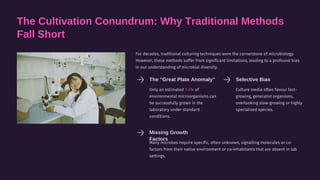
For decades, traditional culturing techniques were the cornerstone of microbiology.
However, these methods suffer from significant limitations, leading to a profound bias
in our understanding of microbial diversity.
The "Great Plate Anomaly"
Only an estimated 1-5% of
environmental microorganisms can
be successfully grown in the
laboratory under standard
conditions.
Selective Bias
Culture media often favour fast-
growing, generalist organisms,
overlooking slow-growing or highly
specialised species.
Missing Growth
Factors
Many microbes require specific, often unknown, signalling molecules or co-
factors from their native environment or co-inhabitants that are absent in lab
settings.
5.
The Molecular Revolution:Embracing Cultivation-
Independent Methods
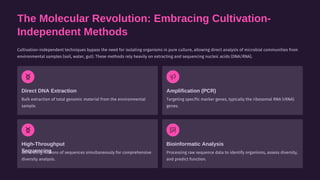
Cultivation-independent techniques bypass the need for isolating organisms in pure culture, allowing direct analysis of microbial communities from
environmental samples (soil, water, gut). These methods rely heavily on extracting and sequencing nucleic acids (DNA/RNA).
Direct DNA Extraction
Bulk extraction of total genomic material from the environmental
sample.
Amplification (PCR)
Targeting specific marker genes, typically the ribosomal RNA (rRNA)
genes.
High-Throughput
Sequencing
Generating millions of sequences simultaneously for comprehensive
diversity analysis.
Bioinformatic Analysis
Processing raw sequence data to identify organisms, assess diversity,
and predict function.
6.
The Universal Marker:Ribosomal RNA Gene
Sequencing
Ribosomal RNA (rRNA) genes are central to these molecular methods due to their conserved function and alternating regions of high conservation and high variability, which allows for universal primer binding and species-level differentiation.
16S rRNA Gene
Used almost universally for phylogenetic and taxonomic studies of Bacteria and Archaea. Its size (approx. 1,500 base pairs) and structure provide sufficient
information for classification down to the genus or species level.
18S rRNA Gene
The corresponding gene used to profile Eukaryotic microorganisms, including fungi, protists, and algae. Essential for understanding the non-bacterial
component of a microbial community.
7.
Step-by-Step: The rRNASequencing
Workflow
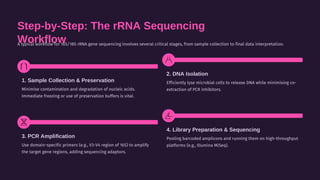
A typical workflow for 16S/18S rRNA gene sequencing involves several critical stages, from sample collection to final data interpretation.
1. Sample Collection & Preservation
Minimise contamination and degradation of nucleic acids.
Immediate freezing or use of preservation buffers is vital.
2. DNA Isolation
Efficiently lyse microbial cells to release DNA while minimising co-
extraction of PCR inhibitors.
3. PCR Amplification
Use domain-specific primers (e.g., V3-V4 region of 16S) to amplify
the target gene regions, adding sequencing adaptors.
4. Library Preparation & Sequencing
Pooling barcoded amplicons and running them on high-throughput
platforms (e.g., Illumina MiSeq).
8.
Computational Analysis: FromRaw Reads to
Ecological Insights
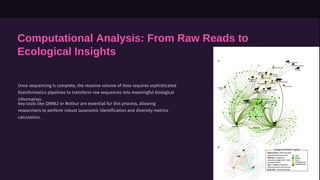
Once sequencing is complete, the massive volume of data requires sophisticated
bioinformatics pipelines to transform raw sequences into meaningful biological
information.
Key tools like QIIME2 or Mothur are essential for this process, allowing
researchers to perform robust taxonomic identification and diversity metrics
calculation.
9.
Beyond Taxonomy: AssessingDiversity and
Structure
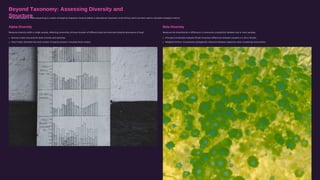
The primary output of rRNA sequencing is a matrix of Amplicon Sequence Variants (ASVs) or Operational Taxonomic Units (OTUs), which are then used to calculate ecological metrics.
Alpha Diversity
Measures diversity within a single sample, reflecting community richness (number of different taxa) and evenness (relative abundance of taxa).
Shannon Index: Accounts for both richness and evenness.
Chao1 Index: Estimates the total number of species present, including those unseen.
Beta Diversity
Measures the dissimilarity or difference in community composition between two or more samples.
Principal Coordinates Analysis (PCoA): Visualises differences between samples in a 2D or 3D plot.
Weighted UniFrac: Incorporates phylogenetic distances between organisms when comparing communities.
10.
Key Takeaways andFuture
Directions in Microbial Research
Cultivation-Independent Focus
Molecular methods, particularly rRNA
gene sequencing, are indispensable for
accurately profiling the vast and
complex majority of unculturable
microbes.
Ecological
Foundation
Understanding microbial ecology
involves grasping the roles of symbiosis,
competition, and syntrophy in forming
stable, functional consortia.
Functional Analysis
The trend is moving towards integrating
rRNA data with functional studies
(metagenomics, metatranscriptomics) to
link 'who is there' with 'what they are
doing'.