Presented by:
                            Rohit Sethi
Jagan Institute Of Management studies,
                     Rohini, New Delhi


                                          1
   To know the extent to which microfinance
    initiatives have made a enduring difference
    on the inclusive growth of a country
   To recognize the need of micro finance and
    its various dimensions on the service sector
   To analyze the critical issues associated with
    microfinance
   To come up with the elucidations of the
    troubles faced by MFIs

                                                     2
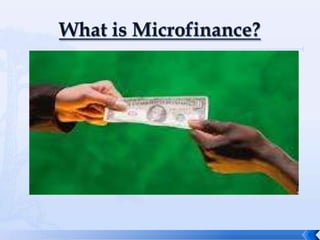
Microfinance is defined as any activity that
includes the provision of financial services
such as credit, savings and insurance to low
income folks who fall just above the
nationality defined poverty line and poor
individuals who fall below that poverty line,
with the goal of creating social value.


                                                3
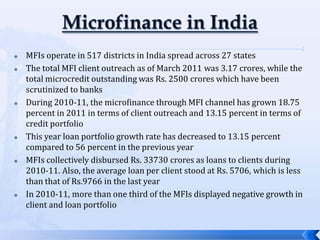
   MFIs operate in 517 districts in India spread across 27 states
   The total MFI client outreach as of March 2011 was 3.17 crores, while the
    total microcredit outstanding was Rs. 2500 crores which have been
    scrutinized to banks
   During 2010-11, the microfinance through MFI channel has grown 18.75
    percent in 2011 in terms of client outreach and 13.15 percent in terms of
    credit portfolio
   This year loan portfolio growth rate has decreased to 13.15 percent
    compared to 56 percent in the previous year
   MFIs collectively disbursed Rs. 33730 crores as loans to clients during
    2010-11. Also, the average loan per client stood at Rs. 5706, which is less
    than that of Rs.9766 in the last year
   In 2010-11, more than one third of the MFIs displayed negative growth in
    client and loan portfolio


                                                                                  4
The committee headed by Sh. Y.H.Malegam was to
  review the scope and objectives of regulations
  governing MFIs with regard to :
 Interest rates

 Lending and recovery practices

 Applicability of existing money lending legislations

 Need for grievance redressed machinery

 And other issues concerning this sector


                                                         5
    The NBFC-MFI to hold not less than 90% of its total assets (other
    than cash and bank balances and money market instruments) in the
    form of qualifying assets. The sub-committee also mentions that a
    non NBFC-MFI cannot have loans to the microfinance sector
    exceeding 10% of its total assets.
    Individual ceilings to loans to a single borrower of Rs.25, 000 is
    applicable.
    Not less than 75% of the loans given by the MFI should be for
    income-generating purposes.
    There is a restriction on the other services to be provided by the
    MFI which has to be in accordance with the type of service and the
    maximum percentage of total income as may be prescribed.
   All NBFC-MFIs to have a minimum net worth of Rs. 15 crores.

                                                                          6
   Ethical problems
   Managerial problems
   Legal problems
   Portfolio problems
   High staff turnover ratio
   Consistency problems


                                7
   The desire for very rapid (burgeoning) growth
    driven by the need to scale up outreach and
    enhance financial access through full blown
    commercialization has resulted in many MFIs
    allowing these (not-so-good) practices (use of
    agents to source and target clients, etc) to
    creep into their organizations
   The desire for rapid growth and complete
    commercialization thus appears to have led
    many MFIs to cut corners and provide lower
    quality services to its clients

                                                     8
   Maintain proper MIS
   Internal Control System
   Managing financial risk
   Managing portfolio risk


                              9
   Report “status of microfinance in India”, NABARD
   Dr. C.Rangarajan, chairman advisory council to the Prime Minister,
    ”Microfinance and its future directions”
   ‘de Aghion, Beatriz armetariz and Jonathan Mourduch. The economic of
    microfinance, The MIT Press, Cambridge,Massachusetts
   The Changing Face Of Microfinance In India by Raven Smith
   Dicher, Thomas and Malcolm Harper. What’s Wrong With Microfinance
    Institutions: Practical action
   Ledgerwood, Joana and Victor White. Transforming Microfinance
    Institutions: Providing Full Financial Services To The Poor. World bank
   Mas, Ignacio and Kabir Kumar. Banking On Moblies: why, how and for
    whom: CGAP Focus Note #48, july, 2008
   Churchil, Craig. Forthcoming. Individual Micro Lending Case Studies.
    Toronto. Calmeadow.
                                                                              10
   Strategies for poverty alleviation through dovetailing the potential of
    microfinance practices with non-timber forest products from
    dipterocarps: Lesson from India by B.P.pethiya
   Indian Microfinance Investment Environment Profile by slavea
    Chakova, Nathenael Goldberg, Genevieve Meltford, Hind Tazi and Shane
    Tomlonson.
   Anil k Khandelwal,”Microfinance Development Strategy For India”’
    Economic and Political Weekly
   Vikram Akula,” Business basics At the base of the pyramid” Harvard
    Business Review, June 2008
   R Srinivas and M.S Sriram” Microfinance In India- Discussion”
   Piyush tiwari and S M Fahad, HDFC, “ Concept paper- Microfinance
    Institutions In India”
   Annie Duflo, Research Co-ordinator, Centre For Micro Finance
    Research, “ICICI banks The Poor in India”, Microfinance matters
   Whitepaper on Microfinance: Issues and Analysis by Sarvagya
    Upadhyaya, Eric Mitchell, Srinath Reddy and Aaditeshwar Seth
   SIDBI microfinance reports accessed at
    www.sidbi.com/micro/COCAUjjivan.pdf
   RBI official website accesses at www.rbi.org.in


                                                                              11
Thank you all for being such
     a wonderful audience


                               12

micro finance institution analysis in india

  • 1.
    Presented by: Rohit Sethi Jagan Institute Of Management studies, Rohini, New Delhi 1
  • 2.
    To know the extent to which microfinance initiatives have made a enduring difference on the inclusive growth of a country  To recognize the need of micro finance and its various dimensions on the service sector  To analyze the critical issues associated with microfinance  To come up with the elucidations of the troubles faced by MFIs 2
  • 3.
    Microfinance is definedas any activity that includes the provision of financial services such as credit, savings and insurance to low income folks who fall just above the nationality defined poverty line and poor individuals who fall below that poverty line, with the goal of creating social value. 3
  • 4.
    MFIs operate in 517 districts in India spread across 27 states  The total MFI client outreach as of March 2011 was 3.17 crores, while the total microcredit outstanding was Rs. 2500 crores which have been scrutinized to banks  During 2010-11, the microfinance through MFI channel has grown 18.75 percent in 2011 in terms of client outreach and 13.15 percent in terms of credit portfolio  This year loan portfolio growth rate has decreased to 13.15 percent compared to 56 percent in the previous year  MFIs collectively disbursed Rs. 33730 crores as loans to clients during 2010-11. Also, the average loan per client stood at Rs. 5706, which is less than that of Rs.9766 in the last year  In 2010-11, more than one third of the MFIs displayed negative growth in client and loan portfolio 4
  • 5.
    The committee headedby Sh. Y.H.Malegam was to review the scope and objectives of regulations governing MFIs with regard to :  Interest rates  Lending and recovery practices  Applicability of existing money lending legislations  Need for grievance redressed machinery  And other issues concerning this sector 5
  • 6.
    The NBFC-MFI to hold not less than 90% of its total assets (other than cash and bank balances and money market instruments) in the form of qualifying assets. The sub-committee also mentions that a non NBFC-MFI cannot have loans to the microfinance sector exceeding 10% of its total assets.  Individual ceilings to loans to a single borrower of Rs.25, 000 is applicable.  Not less than 75% of the loans given by the MFI should be for income-generating purposes.  There is a restriction on the other services to be provided by the MFI which has to be in accordance with the type of service and the maximum percentage of total income as may be prescribed.  All NBFC-MFIs to have a minimum net worth of Rs. 15 crores. 6
  • 7.
    Ethical problems  Managerial problems  Legal problems  Portfolio problems  High staff turnover ratio  Consistency problems 7
  • 8.
    The desire for very rapid (burgeoning) growth driven by the need to scale up outreach and enhance financial access through full blown commercialization has resulted in many MFIs allowing these (not-so-good) practices (use of agents to source and target clients, etc) to creep into their organizations  The desire for rapid growth and complete commercialization thus appears to have led many MFIs to cut corners and provide lower quality services to its clients 8
  • 9.
    Maintain proper MIS  Internal Control System  Managing financial risk  Managing portfolio risk 9
  • 10.
    Report “status of microfinance in India”, NABARD  Dr. C.Rangarajan, chairman advisory council to the Prime Minister, ”Microfinance and its future directions”  ‘de Aghion, Beatriz armetariz and Jonathan Mourduch. The economic of microfinance, The MIT Press, Cambridge,Massachusetts  The Changing Face Of Microfinance In India by Raven Smith  Dicher, Thomas and Malcolm Harper. What’s Wrong With Microfinance Institutions: Practical action  Ledgerwood, Joana and Victor White. Transforming Microfinance Institutions: Providing Full Financial Services To The Poor. World bank  Mas, Ignacio and Kabir Kumar. Banking On Moblies: why, how and for whom: CGAP Focus Note #48, july, 2008  Churchil, Craig. Forthcoming. Individual Micro Lending Case Studies. Toronto. Calmeadow. 10
  • 11.
    Strategies for poverty alleviation through dovetailing the potential of microfinance practices with non-timber forest products from dipterocarps: Lesson from India by B.P.pethiya  Indian Microfinance Investment Environment Profile by slavea Chakova, Nathenael Goldberg, Genevieve Meltford, Hind Tazi and Shane Tomlonson.  Anil k Khandelwal,”Microfinance Development Strategy For India”’ Economic and Political Weekly  Vikram Akula,” Business basics At the base of the pyramid” Harvard Business Review, June 2008  R Srinivas and M.S Sriram” Microfinance In India- Discussion”  Piyush tiwari and S M Fahad, HDFC, “ Concept paper- Microfinance Institutions In India”  Annie Duflo, Research Co-ordinator, Centre For Micro Finance Research, “ICICI banks The Poor in India”, Microfinance matters  Whitepaper on Microfinance: Issues and Analysis by Sarvagya Upadhyaya, Eric Mitchell, Srinath Reddy and Aaditeshwar Seth  SIDBI microfinance reports accessed at www.sidbi.com/micro/COCAUjjivan.pdf  RBI official website accesses at www.rbi.org.in 11
  • 12.
    Thank you allfor being such a wonderful audience 12