MICROBIOLOGY
NAME:Rathod vijay B.
GROUP :31
2nd year,2nd sem.
KURSK -2013-14
1
HEPATITIS E
INFECTION
What is Viral Hepatitis
E
2
 Hepatitis E is a viral hepatitis caused by
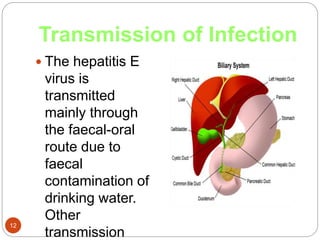
infection with a virus called hepatitis E
virus (HEV). HEV is a positive-sense
single-stranded RNA icosahedral virus
with a 7.5 kilobase genome. HEV has a
fecal-oral transmission route. It is one of
five known hepatitis viruses: A, B, C, D,
and E. Infection with this virus was first
documented in 1955 during an outbreak
in New Delhi, India
A true story of hepatitis e
infection
3
 In 1983, Dr. Balayan was investigating an outbreak of
non-A, non-B hepatitis in a central Asian part of the
Soviet Union. Though he wanted to bring samples
back to his Moscow laboratory, he lacked
refrigeration. So he made a shake of yogurt and an
infected patient’s stool, drank it, went back to
Moscow, and waited. When he became seriously ill a
few weeks later, he started collecting and analysing
his own samples. In these he found a new virus that
produced liver injury in laboratory animals and could
be seen by electron microscopy. It looked a lot like
hepatitis A virus, but he could show that it was not,
because he already had antibodies against the
hepatitis A virus and these did not react with the new
Robert Purcell, Albert Kapikian, and Stephen Feinstone with an
electron microscope. (Credit: NIAID)
Dr.T.V.Rao MD4
Hepatitis E - Genome
5
 The genome is approximately 7200 bases in
length, is a polyadenylated single-strand RNA
molecule that contains three discontinuous and
partially overlapping open reading frames
(ORFs) along with 5' and 3' cis-acting elements,
which have important roles in HEV replication
and transcription. ORF1 encode a
methyltransferase, protease, helicase and
replicase; ORF2 encode the capsid protein and
ORF3 encodes a protein of undefined function. A
three-dimensional, atomic-resolution structure of
the capsid protein in the context of a virus-like
 Incubation period: Average 40 days
Range 15-60 days
 Case-fatality rate: Overall, 1%-3%
Pregnant women,
15%-25%
 Illness severity: Increased with
age
 Chronic sequelae: None identified
Hepatitis E - Clinical Features
6
 Most outbreaks associated with faecally contaminated
drinking water.
 Several other large epidemics have occurred since in
the Indian subcontinent and the USSR, China, Africa
and Mexico.
 In the United States and other nonendemic areas,
where outbreaks of hepatitis E have not been
documented to occur, a low prevalence of anti-HEV
(<2%) has been found in healthy populations. The
source of infection for these persons is unknown.
 Minimal person-to-person transmission.
Hepatitis E
Epidemiologic Features
7
Geographical distribution
8
 Hepatitis E is found worldwide and
different genotypes of the hepatitis E
virus determine differences in
epidemiology. For example, genotype 1
is usually seen in developing countries
and causes community level outbreaks
while genotype 3 is usually seen in the
developed countries and does not cause
outbreaks
Dr.T.V.Rao MD9
Distribution of hepatitis E infection,
2010
Dr.T.V.Rao MD10
Morbidity and Mortality
11
 Globally, 70 000
deaths and 3.4
million cases of
acute hepatitis
E are
attributable to
infection with
hepatitis E virus
genotypes 1 and
2.
Transmission of Infection
12
 The hepatitis E
virus is
transmitted
mainly through
the faecal-oral
route due to
faecal
contamination of
drinking water.
Other
transmission
13
 Avoid drinking water (and beverages with ice)
of unknown purity, uncooked shellfish, and
uncooked fruit/vegetables not peeled or
prepared by traveler.
 IG prepared from donors in Western countries
does not prevent infection.
 Unknown efficacy of IG prepared from donors
in endemic areas.
 Vaccine?
Prevention and Control Measures for
Travelers to HEV-Endemic Regions
14
Transmission
15
 Foodborne transmission from ingestion
of products derived from infected
animals;
 Zoonotic transmission from animals to
humans;
 Transfusion of infected blood products;
 Vertical transmission from a pregnant
woman to her foetus.
Incubation Period
16
The incubation period
following exposure to the
hepatitis E virus ranges
from three to eight weeks,
with a mean of 40 days.
The period of
communicability is
Symptoms
17
 The hepatitis E virus causes acute
sporadic and epidemic viral
hepatitis. Symptomatic infection is
most common in young adults aged
15–40 years. Although infection is
frequent in children, the disease is
mostly asymptomatic or causes a
very mild illness without jaundice
(anicteric) that goes undiagnosed
Clinical Presentation
18
Jaundice
 anorexia (loss of appetite);
 an enlarged, tender liver
(hepatomegaly);
 abdominal pain and tenderness;
 nausea and vomiting;
 fever.
Hepatitis E infection and
Pregnancy
19
 In rare cases, acute hepatitis E can
result in fulminant hepatitis (acute liver
failure) and death. Overall population
mortality rates from hepatitis E range
from 0.5% to 4.0%. Fulminant hepatitis
occurs more frequently during
pregnancy. Pregnant women are at
greater risk of obstetrical complications
and mortality from hepatitis E, which can
induce a mortality rate of 20% among
pregnant women in their third trimester.
Chronic Hepatitis E
Infection
20
 Cases of chronic
hepatitis E infection
have been reported
in
immunosuppressed
people. Reactivation
of hepatitis E
infection has also
been reported in
immunocompromise
d people.
Diagnosis by detection of antibodies
21
 Diagnosis of
hepatitis E
infection is
therefore
usually based
on the detection
of specific
antibodies to
the virus in the
Newer methods in diagnosis
22
 Reverse
transcriptase
polymerase chain
reaction (RT-
PCR) to detect
the hepatitis E
virus RNA;
 Immune electron
microscopy to
detect the
hepatitis E virus.
Treatment
23
 There is no available treatment capable
of altering the course of acute hepatitis.
Prevention is the most effective
approach against the disease.
 As hepatitis E is usually self-limiting,
hospitalization is generally not required.
However, hospitalization is required for
people with fulminant hepatitis and
should also be considered for infected
pregnant women.
Prevention
24
Maintaining
quality standards
for public water
supplies ;
Establishing
proper disposal
systems to
eliminate sanitary
Prevention
25
 Maintaining hygienic practices such as
hand washing with safe water,
particularly before handling food;
 Avoiding drinking water and/or ice of
unknown purity;
 Avoiding eating uncooked shellfish, and
uncooked fruits or vegetables that are
not peeled or that are prepared by
people living in or travelling in highly
endemic countries
Vaccination - Update
26
 China has
produced and
licensed the
first vaccine to
prevent
hepatitis E virus
infection,
although it is
not yet
27

Micro bio(hepatitis-e)

  • 1.
    MICROBIOLOGY NAME:Rathod vijay B. GROUP:31 2nd year,2nd sem. KURSK -2013-14 1 HEPATITIS E INFECTION
  • 2.
    What is ViralHepatitis E 2  Hepatitis E is a viral hepatitis caused by infection with a virus called hepatitis E virus (HEV). HEV is a positive-sense single-stranded RNA icosahedral virus with a 7.5 kilobase genome. HEV has a fecal-oral transmission route. It is one of five known hepatitis viruses: A, B, C, D, and E. Infection with this virus was first documented in 1955 during an outbreak in New Delhi, India
  • 3.
    A true storyof hepatitis e infection 3  In 1983, Dr. Balayan was investigating an outbreak of non-A, non-B hepatitis in a central Asian part of the Soviet Union. Though he wanted to bring samples back to his Moscow laboratory, he lacked refrigeration. So he made a shake of yogurt and an infected patient’s stool, drank it, went back to Moscow, and waited. When he became seriously ill a few weeks later, he started collecting and analysing his own samples. In these he found a new virus that produced liver injury in laboratory animals and could be seen by electron microscopy. It looked a lot like hepatitis A virus, but he could show that it was not, because he already had antibodies against the hepatitis A virus and these did not react with the new
  • 4.
    Robert Purcell, AlbertKapikian, and Stephen Feinstone with an electron microscope. (Credit: NIAID) Dr.T.V.Rao MD4
  • 5.
    Hepatitis E -Genome 5  The genome is approximately 7200 bases in length, is a polyadenylated single-strand RNA molecule that contains three discontinuous and partially overlapping open reading frames (ORFs) along with 5' and 3' cis-acting elements, which have important roles in HEV replication and transcription. ORF1 encode a methyltransferase, protease, helicase and replicase; ORF2 encode the capsid protein and ORF3 encodes a protein of undefined function. A three-dimensional, atomic-resolution structure of the capsid protein in the context of a virus-like
  • 6.
     Incubation period:Average 40 days Range 15-60 days  Case-fatality rate: Overall, 1%-3% Pregnant women, 15%-25%  Illness severity: Increased with age  Chronic sequelae: None identified Hepatitis E - Clinical Features 6
  • 7.
     Most outbreaksassociated with faecally contaminated drinking water.  Several other large epidemics have occurred since in the Indian subcontinent and the USSR, China, Africa and Mexico.  In the United States and other nonendemic areas, where outbreaks of hepatitis E have not been documented to occur, a low prevalence of anti-HEV (<2%) has been found in healthy populations. The source of infection for these persons is unknown.  Minimal person-to-person transmission. Hepatitis E Epidemiologic Features 7
  • 8.
    Geographical distribution 8  HepatitisE is found worldwide and different genotypes of the hepatitis E virus determine differences in epidemiology. For example, genotype 1 is usually seen in developing countries and causes community level outbreaks while genotype 3 is usually seen in the developed countries and does not cause outbreaks
  • 9.
  • 10.
    Distribution of hepatitisE infection, 2010 Dr.T.V.Rao MD10
  • 11.
    Morbidity and Mortality 11 Globally, 70 000 deaths and 3.4 million cases of acute hepatitis E are attributable to infection with hepatitis E virus genotypes 1 and 2.
  • 12.
    Transmission of Infection 12 The hepatitis E virus is transmitted mainly through the faecal-oral route due to faecal contamination of drinking water. Other transmission
  • 13.
  • 14.
     Avoid drinkingwater (and beverages with ice) of unknown purity, uncooked shellfish, and uncooked fruit/vegetables not peeled or prepared by traveler.  IG prepared from donors in Western countries does not prevent infection.  Unknown efficacy of IG prepared from donors in endemic areas.  Vaccine? Prevention and Control Measures for Travelers to HEV-Endemic Regions 14
  • 15.
    Transmission 15  Foodborne transmissionfrom ingestion of products derived from infected animals;  Zoonotic transmission from animals to humans;  Transfusion of infected blood products;  Vertical transmission from a pregnant woman to her foetus.
  • 16.
    Incubation Period 16 The incubationperiod following exposure to the hepatitis E virus ranges from three to eight weeks, with a mean of 40 days. The period of communicability is
  • 17.
    Symptoms 17  The hepatitisE virus causes acute sporadic and epidemic viral hepatitis. Symptomatic infection is most common in young adults aged 15–40 years. Although infection is frequent in children, the disease is mostly asymptomatic or causes a very mild illness without jaundice (anicteric) that goes undiagnosed
  • 18.
    Clinical Presentation 18 Jaundice  anorexia(loss of appetite);  an enlarged, tender liver (hepatomegaly);  abdominal pain and tenderness;  nausea and vomiting;  fever.
  • 19.
    Hepatitis E infectionand Pregnancy 19  In rare cases, acute hepatitis E can result in fulminant hepatitis (acute liver failure) and death. Overall population mortality rates from hepatitis E range from 0.5% to 4.0%. Fulminant hepatitis occurs more frequently during pregnancy. Pregnant women are at greater risk of obstetrical complications and mortality from hepatitis E, which can induce a mortality rate of 20% among pregnant women in their third trimester.
  • 20.
    Chronic Hepatitis E Infection 20 Cases of chronic hepatitis E infection have been reported in immunosuppressed people. Reactivation of hepatitis E infection has also been reported in immunocompromise d people.
  • 21.
    Diagnosis by detectionof antibodies 21  Diagnosis of hepatitis E infection is therefore usually based on the detection of specific antibodies to the virus in the
  • 22.
    Newer methods indiagnosis 22  Reverse transcriptase polymerase chain reaction (RT- PCR) to detect the hepatitis E virus RNA;  Immune electron microscopy to detect the hepatitis E virus.
  • 23.
    Treatment 23  There isno available treatment capable of altering the course of acute hepatitis. Prevention is the most effective approach against the disease.  As hepatitis E is usually self-limiting, hospitalization is generally not required. However, hospitalization is required for people with fulminant hepatitis and should also be considered for infected pregnant women.
  • 24.
    Prevention 24 Maintaining quality standards for publicwater supplies ; Establishing proper disposal systems to eliminate sanitary
  • 25.
    Prevention 25  Maintaining hygienicpractices such as hand washing with safe water, particularly before handling food;  Avoiding drinking water and/or ice of unknown purity;  Avoiding eating uncooked shellfish, and uncooked fruits or vegetables that are not peeled or that are prepared by people living in or travelling in highly endemic countries
  • 26.
    Vaccination - Update 26 China has produced and licensed the first vaccine to prevent hepatitis E virus infection, although it is not yet
  • 27.

Editor's Notes