Hepatitis A and E
Rwanda Endoscopy Week
10/31/2023
Overview
• History
• HAV
• Epidemiology
• Transmission
• Diagnosis
• Clinical Features
• Treatment
• Prevention
Hepatitis A
History
• Epidemic jaundice first described by Hippocrates
• Outbreaks of jaundice reported in 17th
and 18th
centuries in
association with military campaigns
• “Infectious Hepatitis” was differentiated by epidemiology from
hepatitis B in the 1940s
• Serologic tests in 1970s differentiated hepatitis A from non-B hepatitis
• First isolated in 1979
• Vaccines first licensed in US in 1995
HAV
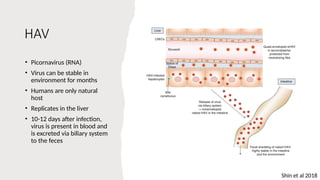
• Picornavirus (RNA)
• Virus can be stable in
environment for months
• Humans are only natural
host
• Replicates in the liver
• 10-12 days after infection,
virus is present in blood and
is excreted via biliary system
to the feces
Shin et al 2018
Transmission
• Transmission is fecal-oral
• Rare cases of confirmed transmission with blood transfusion or solid-organ
transplant
• Most infectious 1-2 weeks prior to onset of clinical illness when viral
concentration in stool is highest
• Incubation period ~28 days
Epidemiology
• 100 million HAV infections and 1.5 million symptomatic cases annually
worldwide
• 15,000 to 30,000 deaths/year
• Greater prevalence in developing and low-income regions
• Hyperendemic in sub-Saharan Africa and South Asia
• Intermediate endemicity in Latin America, Middle East, North Africa,
Eastern Europe and middle-income regions in Asia
US
Epidemiology
• Vaccine first available in
US 1996
• Over 95% reduction of
cases from 1996 to
2011
• Reemerged in 2016 with
widespread outbreaks in
people who use IV drugs
and in homeless
population
CDC
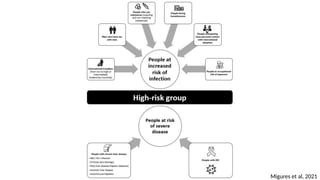
Risk Factors
• International travelers (especially those with travel to rural or hig- risk
regions)
• Adoptees or immigrants from high-risk countries
• MSM population
• Homelessness
• IVDU
Migures et al, 2021
Diagnosis
• Cannot be distinguished from other viral hepatitis based on clinical
features
• Serologic testing:
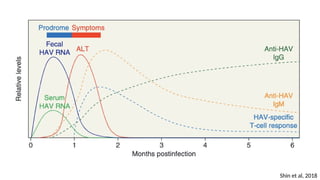
• Acute hepatitis A: detectable IgM anti-HAV in serum
• Becomes detectable 5-10 days prior to symptom onset, can persist for up to 6 months
• Convalescent/prior infection: IgG anti-HAV in serum
• IgG anti-HAV confers immunity
• PCR can be used to amplify/sequence virus, used to investigate
hepatitis A outbreaks
Shin et al, 2018
Clinical Features
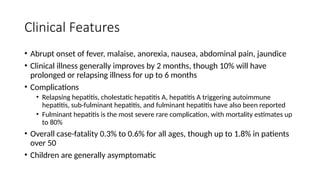
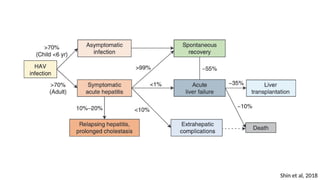
• Abrupt onset of fever, malaise, anorexia, nausea, abdominal pain, jaundice
• Clinical illness generally improves by 2 months, though 10% will have
prolonged or relapsing illness for up to 6 months
• Complications
• Relapsing hepatitis, cholestatic hepatitis A, hepatitis A triggering autoimmune
hepatitis, sub-fulminant hepatitis, and fulminant hepatitis have also been reported
• Fulminant hepatitis is the most severe rare complication, with mortality estimates up
to 80%
• Overall case-fatality 0.3% to 0.6% for all ages, though up to 1.8% in patients
over 50
• Children are generally asymptomatic
Shin et al, 2018
Treatment
• Supportive care
• Referral to transplant cater for suspected cases of HAV-associated
fulminant liver failure
Prevention
• Hepatitis A vaccination
• Hep A (Havrix, Vaqta)
• Hep A-HepB (Twinrix)
• Current recommendations:
• Vaccination of all children over the age of one in all 50 states
• Vaccination of all persons over the age of one experiencing homelessness
• Vaccination of all children and adolescents ages 2 through 18 years who have
not previously received HepA vaccine
• Vaccination of all persons with HIV age 1 year or older
• All persons with risk factors
• Patients with chronic liver disease
Post-exposure prophylaxis
• Administer vaccine ASAP within 2 weeks of exposure
• Co-administer Immune Globulin (0.1 mL/kg) in patients over 40 or if
at high risk (HIV, chronic liver disease, high risk exposure)
• Immune Globulin 0.1 mL/kg recommended for those under 1 year old
or if vaccine is contraindicated
Hepatitis E
Overview
• History
• HEV
• Epidemiology
• Transmission
• Diagnosis
• Clinical Features
• Treatment
• Vaccine Development
History
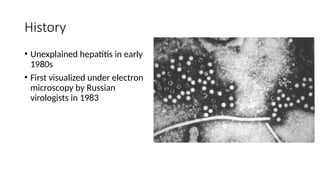
• Unexplained hepatitis in early
1980s
• First visualized under electron
microscopy by Russian
virologists in 1983
HEV
• Positive strand non-enveloped RNA virus from Hepeviridae family
• 8 genotypes
• Genotypes HEV1, HEV2, HEV3, and HEV4 most frequently cause
infections in Humans
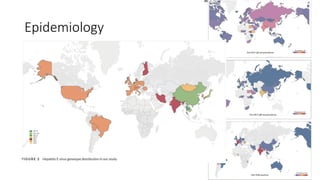
Epidemiology
Transmission
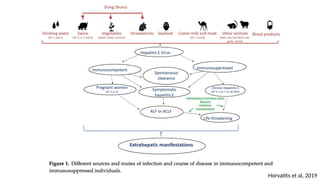
• Genotypes HEV1 and HEV2 result in large outbreaks from
contaminated water supply
• HEV3 and HEV4 are zoonotic, transmission is fecal contamination of
water and from eating meat/close contact with infected animals, with
pig the main reservoir
• Vertical transmission of HEV1 and HEV2 from mother to fetus
• HEV1 transmission through blood transfusion has been reported
Diagnosis
• Incubation period 2-6 weeks
• Diagnosis is made with HEV RNA in either blood or stool
• HEV RNA detectable in serum 3 weeks after exposure
• Viral shedding in stool for 4-6 weeks
• Anti-HEV IgM generally only detectable for 3-4 months
• Anti-HEV IgG does not confer lifelong immunity
• Chronic HEV infection: persistence of HEV RNA in blood or stool for at
least 3 months
Clinical Features-Acute
• Generally asymptomatic or mildly symptomatic
• Infection resulting in jaundice occurs in 5-30% of cases
• Prodromal phase lasting ~1 week: malaise, fever, body aches, nausea,
vomiting
• Icteric phase lasting ~1 week
• Convalescent phase: resolution of symptoms and jaundice
• HEV1 and HEV2 generally cause more severe acute hepatitis than
HEV3 and HEV4
Special populations
• Pregnant women: high morbidity and mortality, especially in 3rd
trimester
• Mortality up to 20%, due to eclampsia, hemorrhagic complications, and liver
failure
• Newborns: Risk of maternal-fetal transmission, with complications of
hypoglycemia, hepatitis, death
• Patients with chronic liver disease
Clinical Features-Chronic
• Immunosuppressed solid-organ transplant recipients: HEV clearance
not achieved
• Diagnosed by persistent HEV RNA, as anti-HEV IgM and IgG may
remain negative
• Characterized by fatigue but often asymptomatic, with mild elevation
in liver associated enzymes
• Chronic hepatitis and cirrhosis with HEV3 and HEV4
• 20-50% of patients with HEV1 developed chronic infection
• Within 2-5 years, 10% of patients with chronic HEV develop cirrhosis
• Developing chronic hepatitis associated with tacrolimus dose and low lymphocyte count
rather than viral load
Extra hepatic manifestations
• Guillain-Barre syndrome
• Neuralgic amyotrophy
• Lymphoma
• Pancreatitis
• Thrombocytopenia
• Meningitis
• Cryoglobulinemia
• Glomerulonephritis
Horvatits et al, 2019
Treatment
• No approved drugs for HEV
• HEV spontaneously cleared in most cases
• In severe cases of ACLF, treatment with ribavirin has resulted in viral
clearance and normalization of LAEs
Treatment of chronic HEV
• Dose reduction of immunosuppressive therapy
• Pegylated interferon-alpha can be considered in liver transplant
patients, however, is contraindicated in renal, pancreas, heart, and
lung transplants
• Ribavirin has been used in these cases, with no RCTs to support use
• Sofosbuvir has been used for ribavirin-resistant HEV infections
Vaccine development
• HEV vaccine based on HEV1 developed in China
• Phase 3 trial including more that 100,000 participants
• Only 60 cases of HEV identified, with 7 in the vaccine arm
• NIH is performing Phase 1 trial
References
• Shin, E.-C., Jeong, S.-H., 2018. Natural History, Clinical Manifestations, and Pathogenesis of Hepatitis A. Cold Spring Harbor
Perspectives in Medicine 8, a031708.. doi:10.1101/cshperspect.a031708
• Migueres M, Lhomme S, Izopet J. Hepatitis A: Epidemiology, High-Risk Groups, Prevention and Research on Antiviral Treatment.
Viruses. 2021 Sep 22;13(10):1900. doi: 10.3390/v13101900. PMID: 34696330; PMCID: PMC8540458.
• Abutaleb A, Kottilil S. Hepatitis A: Epidemiology, Natural History, Unusual Clinical Manifestations, and Prevention. Gastroenterol Clin
North Am. 2020 Jun;49(2):191-199. doi: 10.1016/j.gtc.2020.01.002. Epub 2020 Mar 29. PMID: 32389358; PMCID: PMC7883407.
• World Health Organization. (2019). WHO immunological basis for immunization series: module 18: hepatitis A, update 2019. World
Health Organization.
• Aslan, A.T., Balaban, H.Y., 2020. Hepatitis E virus: Epidemiology, diagnosis, clinical manifestations, and treatment. World Journal of
Gastroenterology 26, 5543–5560.. doi:10.3748/wjg.v26.i37.5543
• Li, P., Liu, J., Li, Y., Su, J., Ma, Z., Bramer, W.M., Cao, W., Man, R.A., Peppelenbosch, M.P., Pan, Q., 2020. The global epidemiology of
hepatitis E virus infection: A systematic review and meta analysis. Liver International 40, 1516–1528.. doi:10.1111/liv.14468
‐
• Horvatits T, Schulze Zur Wiesch J, Lütgehetmann M, Lohse AW, Pischke S. The Clinical Perspective on Hepatitis E. Viruses. 2019 Jul
5;11(7):617. doi: 10.3390/v11070617. PMID: 31284447; PMCID: PMC6669652.

Hepatitis A and E Virus, Clinical Aspect

  • 1.
    Hepatitis A andE Rwanda Endoscopy Week 10/31/2023
  • 2.
    Overview • History • HAV •Epidemiology • Transmission • Diagnosis • Clinical Features • Treatment • Prevention
  • 3.
  • 4.
    History • Epidemic jaundicefirst described by Hippocrates • Outbreaks of jaundice reported in 17th and 18th centuries in association with military campaigns • “Infectious Hepatitis” was differentiated by epidemiology from hepatitis B in the 1940s • Serologic tests in 1970s differentiated hepatitis A from non-B hepatitis • First isolated in 1979 • Vaccines first licensed in US in 1995
  • 5.
    HAV • Picornavirus (RNA) •Virus can be stable in environment for months • Humans are only natural host • Replicates in the liver • 10-12 days after infection, virus is present in blood and is excreted via biliary system to the feces Shin et al 2018
  • 6.
    Transmission • Transmission isfecal-oral • Rare cases of confirmed transmission with blood transfusion or solid-organ transplant • Most infectious 1-2 weeks prior to onset of clinical illness when viral concentration in stool is highest • Incubation period ~28 days
  • 7.
    Epidemiology • 100 millionHAV infections and 1.5 million symptomatic cases annually worldwide • 15,000 to 30,000 deaths/year • Greater prevalence in developing and low-income regions • Hyperendemic in sub-Saharan Africa and South Asia • Intermediate endemicity in Latin America, Middle East, North Africa, Eastern Europe and middle-income regions in Asia
  • 8.
    US Epidemiology • Vaccine firstavailable in US 1996 • Over 95% reduction of cases from 1996 to 2011 • Reemerged in 2016 with widespread outbreaks in people who use IV drugs and in homeless population CDC
  • 9.
    Risk Factors • Internationaltravelers (especially those with travel to rural or hig- risk regions) • Adoptees or immigrants from high-risk countries • MSM population • Homelessness • IVDU
  • 10.
  • 11.
    Diagnosis • Cannot bedistinguished from other viral hepatitis based on clinical features • Serologic testing: • Acute hepatitis A: detectable IgM anti-HAV in serum • Becomes detectable 5-10 days prior to symptom onset, can persist for up to 6 months • Convalescent/prior infection: IgG anti-HAV in serum • IgG anti-HAV confers immunity • PCR can be used to amplify/sequence virus, used to investigate hepatitis A outbreaks
  • 12.
  • 13.
    Clinical Features • Abruptonset of fever, malaise, anorexia, nausea, abdominal pain, jaundice • Clinical illness generally improves by 2 months, though 10% will have prolonged or relapsing illness for up to 6 months • Complications • Relapsing hepatitis, cholestatic hepatitis A, hepatitis A triggering autoimmune hepatitis, sub-fulminant hepatitis, and fulminant hepatitis have also been reported • Fulminant hepatitis is the most severe rare complication, with mortality estimates up to 80% • Overall case-fatality 0.3% to 0.6% for all ages, though up to 1.8% in patients over 50 • Children are generally asymptomatic
  • 14.
  • 15.
    Treatment • Supportive care •Referral to transplant cater for suspected cases of HAV-associated fulminant liver failure
  • 16.
    Prevention • Hepatitis Avaccination • Hep A (Havrix, Vaqta) • Hep A-HepB (Twinrix) • Current recommendations: • Vaccination of all children over the age of one in all 50 states • Vaccination of all persons over the age of one experiencing homelessness • Vaccination of all children and adolescents ages 2 through 18 years who have not previously received HepA vaccine • Vaccination of all persons with HIV age 1 year or older • All persons with risk factors • Patients with chronic liver disease
  • 17.
    Post-exposure prophylaxis • Administervaccine ASAP within 2 weeks of exposure • Co-administer Immune Globulin (0.1 mL/kg) in patients over 40 or if at high risk (HIV, chronic liver disease, high risk exposure) • Immune Globulin 0.1 mL/kg recommended for those under 1 year old or if vaccine is contraindicated
  • 18.
  • 19.
    Overview • History • HEV •Epidemiology • Transmission • Diagnosis • Clinical Features • Treatment • Vaccine Development
  • 20.
    History • Unexplained hepatitisin early 1980s • First visualized under electron microscopy by Russian virologists in 1983
  • 21.
    HEV • Positive strandnon-enveloped RNA virus from Hepeviridae family • 8 genotypes • Genotypes HEV1, HEV2, HEV3, and HEV4 most frequently cause infections in Humans
  • 22.
  • 23.
    Transmission • Genotypes HEV1and HEV2 result in large outbreaks from contaminated water supply • HEV3 and HEV4 are zoonotic, transmission is fecal contamination of water and from eating meat/close contact with infected animals, with pig the main reservoir • Vertical transmission of HEV1 and HEV2 from mother to fetus • HEV1 transmission through blood transfusion has been reported
  • 24.
    Diagnosis • Incubation period2-6 weeks • Diagnosis is made with HEV RNA in either blood or stool • HEV RNA detectable in serum 3 weeks after exposure • Viral shedding in stool for 4-6 weeks • Anti-HEV IgM generally only detectable for 3-4 months • Anti-HEV IgG does not confer lifelong immunity • Chronic HEV infection: persistence of HEV RNA in blood or stool for at least 3 months
  • 25.
    Clinical Features-Acute • Generallyasymptomatic or mildly symptomatic • Infection resulting in jaundice occurs in 5-30% of cases • Prodromal phase lasting ~1 week: malaise, fever, body aches, nausea, vomiting • Icteric phase lasting ~1 week • Convalescent phase: resolution of symptoms and jaundice • HEV1 and HEV2 generally cause more severe acute hepatitis than HEV3 and HEV4
  • 26.
    Special populations • Pregnantwomen: high morbidity and mortality, especially in 3rd trimester • Mortality up to 20%, due to eclampsia, hemorrhagic complications, and liver failure • Newborns: Risk of maternal-fetal transmission, with complications of hypoglycemia, hepatitis, death • Patients with chronic liver disease
  • 27.
    Clinical Features-Chronic • Immunosuppressedsolid-organ transplant recipients: HEV clearance not achieved • Diagnosed by persistent HEV RNA, as anti-HEV IgM and IgG may remain negative • Characterized by fatigue but often asymptomatic, with mild elevation in liver associated enzymes • Chronic hepatitis and cirrhosis with HEV3 and HEV4 • 20-50% of patients with HEV1 developed chronic infection • Within 2-5 years, 10% of patients with chronic HEV develop cirrhosis • Developing chronic hepatitis associated with tacrolimus dose and low lymphocyte count rather than viral load
  • 28.
    Extra hepatic manifestations •Guillain-Barre syndrome • Neuralgic amyotrophy • Lymphoma • Pancreatitis • Thrombocytopenia • Meningitis • Cryoglobulinemia • Glomerulonephritis
  • 29.
  • 30.
    Treatment • No approveddrugs for HEV • HEV spontaneously cleared in most cases • In severe cases of ACLF, treatment with ribavirin has resulted in viral clearance and normalization of LAEs
  • 31.
    Treatment of chronicHEV • Dose reduction of immunosuppressive therapy • Pegylated interferon-alpha can be considered in liver transplant patients, however, is contraindicated in renal, pancreas, heart, and lung transplants • Ribavirin has been used in these cases, with no RCTs to support use • Sofosbuvir has been used for ribavirin-resistant HEV infections
  • 32.
    Vaccine development • HEVvaccine based on HEV1 developed in China • Phase 3 trial including more that 100,000 participants • Only 60 cases of HEV identified, with 7 in the vaccine arm • NIH is performing Phase 1 trial
  • 33.
    References • Shin, E.-C.,Jeong, S.-H., 2018. Natural History, Clinical Manifestations, and Pathogenesis of Hepatitis A. Cold Spring Harbor Perspectives in Medicine 8, a031708.. doi:10.1101/cshperspect.a031708 • Migueres M, Lhomme S, Izopet J. Hepatitis A: Epidemiology, High-Risk Groups, Prevention and Research on Antiviral Treatment. Viruses. 2021 Sep 22;13(10):1900. doi: 10.3390/v13101900. PMID: 34696330; PMCID: PMC8540458. • Abutaleb A, Kottilil S. Hepatitis A: Epidemiology, Natural History, Unusual Clinical Manifestations, and Prevention. Gastroenterol Clin North Am. 2020 Jun;49(2):191-199. doi: 10.1016/j.gtc.2020.01.002. Epub 2020 Mar 29. PMID: 32389358; PMCID: PMC7883407. • World Health Organization. (2019). WHO immunological basis for immunization series: module 18: hepatitis A, update 2019. World Health Organization. • Aslan, A.T., Balaban, H.Y., 2020. Hepatitis E virus: Epidemiology, diagnosis, clinical manifestations, and treatment. World Journal of Gastroenterology 26, 5543–5560.. doi:10.3748/wjg.v26.i37.5543 • Li, P., Liu, J., Li, Y., Su, J., Ma, Z., Bramer, W.M., Cao, W., Man, R.A., Peppelenbosch, M.P., Pan, Q., 2020. The global epidemiology of hepatitis E virus infection: A systematic review and meta analysis. Liver International 40, 1516–1528.. doi:10.1111/liv.14468 ‐ • Horvatits T, Schulze Zur Wiesch J, Lütgehetmann M, Lohse AW, Pischke S. The Clinical Perspective on Hepatitis E. Viruses. 2019 Jul 5;11(7):617. doi: 10.3390/v11070617. PMID: 31284447; PMCID: PMC6669652.

Editor's Notes

  • #5 Primates can be infected under laboratory settings Virus may be excreted for up to 3 weeks after onset of symptoms Peak titers occur during the 2 weeks before onset of illness Incubation period averages 28 days, ranging from 15-50 days In the liver with hep-atitis A, hepatocyte degeneration and infiltrationby mononuclear inflammatory cells are ob-served. Activation of Kupffer cells and disrup-tion of bile canaliculi may also be observed. hepatitis A liver injury is not caused by virus-induced cytopathology. Instead, liver injury inhepatitis A is caused by immune-mediatedmechanisms involving both innate and adaptiveimmune responses to the virus (Shin et al.2016a). Indeed, patient studies indicate possibleroles for T cells, cytokines, and chemokines inliver injury during hepatitis A
  • #7 There are estimated to be 100 million HAV infections and 1.5 million symptomatic cases annually worldwide, and these are responsible for 15,000 to 30,000 deaths peryear
  • #11 IgM anti-HAV becomes detectable 5-10 days before onset of symptoms, can persist up to 6 months IgM
  • #12 A typical course of hepatitis A. After a 3- to 5-week incubation period following hepatitis Avirus (HAV)infection, patients develop symptoms of hepatitis with elevation of serum alanine aminotransferase (ALT) levels.Fecal virus shedding and viremia are present and peak during the incubation period. Anti-HAV antibodiesappear in serumfirst as immunoglobulin (Ig)M and subsequentlyas IgG. Virus-specific T-cell responses coincidewith the elevation of serum ALT levels.E.-C. Shin and S.-H. Jeong2Cite this article asCold Spring Harb Perspect Med2018;8:a031708www.perspectivesinmedicine.org on February 6, 2023 - Published by Cold Spring Harbor Laboratory Presshttp://perspectivesinmedicine.cshlp.org/Downloaded from
  • #13 Virus can be excreted during prolonged or relapsing illness
  • #14 The clinical outcomes of hepatitis A virus (HAV) infection. Clinical manifestations of HAV infectiondepend on the age of patients. Most adult patients develop symptomatic hepatitis, whereas most young childrendo not. Common hepatitis symptoms are fever, malaise, nausea or vomiting, abdominal discomfort, and darkurine and jaundice. Reported extrahepatic complications include acute kidney injury, acalculous cholecystitis,pancreatitis, pleural or pericardial effusion, hemolysis, hemophagocytosis, pure red-cell aplasia, acute reactivearthritis, skin rash, and neurological manifestations such as mononeuritis, Guillain–Barré syndrome, and trans-verse myelitis.
  • #17 Immune globulin (IG) provides protection against hepatitis A through passive transfer of antibody. GamaSTAN is a sterile, preservative-free solution of IG for intramuscular administration and is used for prophylaxis against diseases caused by HAV, measles, varicella, and rubella viruses. GamaSTAN is the only IG product approved by FDA for hepatitis A prophylaxis 
  • #22 (A) The global seroprevalence of anti-HEV IgG antibody (B) The global seroprevalence of anti-HEV IgM antibody (C) The global prevalence of HEV RNA positivity