Viral Hepatitis
• Hepatitis– inflammation of the liver due to any cause
• Viral hepatitis – term used for hepatitis caused by hepatotrophic
viruses
• These include HAV, HBV, HCV, HDV and HEV
• HAV and HEV are primarily transmitted by feco-oral route
• HBV, HCV and HDV are transmitted by the parenteral route
3.
Hepatitis A
• Commonestcause of viral hepatitis worldwide
• Endemicity closely related to sanitary and living conditions
• Globally, an estimated 1.5 million cases occur annually
• Known to have potential to cause large outbreaks
• India is hyperendemic for HAV with very high infection rates in first
few years of life
• Most people develop immunity by 10 years of age
4.
Epidemiology
Agent:
• HAV isa non-enveloped, single stranded RNA virus belonging to
Picornavirus family
• Relatively resistant to destruction
5.
Epidemiology
Host:
• Common inchildren
• Usually asymptomatic in children below 6 years of age, with only 10%
developing jaundice
• Usually causes clinical disease in older children and adults with
jaundice occurring in 70% of cases
6.
Epidemiology
Mode of Transmission:
•Predominantly by feco-oral route
• Others – blood borne transmission, sexual transmission and certical
transmission
• Secondary Attack Rate – 30%
Incubation period: About 4 weeks (15 – 50 days)
Period of Infectivity: 2 weeks before to 1 week after onset of jaundice
7.
Clinical features
• Clinicalcourse is indistinguishable from other types of acute viral hepatitis
• Typically include
• Fever, malaise, anorexia, nausea
• Jaundice
• Abdominal discomfort
• Dark urine
• Severity and mortality increases in older age groups
• Convalescence is slow with fatigue, nausea and lack of appetite
• No chronic infection
• Complications: Relapsing hepatitis, cholestatic hepatitis and fulminant
hepatitis
8.
Diagnosis
• Clinically indistinguishablefrom other forms of hepatitis
• Diagnosis requires serologic detection of IgM antibodies
• IgM detectable from 5 days prior to onset of symptoms and
disappears within 6 months after infection
• IgG anti-HAV used to detect previous infection as it persists lifelong
• PCR used to detect virus in faeces, blood
• Other parameters – elevated serum bilirubin and liver enzymes
Prevention and control
•Good personal hygiene
• High quality standards for public water supplies
• Proper disposal of sanitary waste
• Water supply should be safeguarded against faecal contamination
Active Immunization:
• Inactivated Hepatitis A vaccine
• 2 doses, 6 – 18 months apart for above 1 year of age
• Immune response in almost 100% of adult recipients
• Large scale immunization not recommended in high endemic countries
11.
Hepatitis E
• Firstidentified in 1955 in India
• Recognized as distinct human disease in 1990s
• Endemic in many regions esp. in regions where HAV infection is highly
endemic
• In India, HEV is responsible for the majority of epidemic and sporadic
hepatitis in adults
12.
Epidemiology
Agent:
• HEV isa non-enveloped, single stranded RNA virus
Host:
• Humans are end or inadvertent target due to its zoonotic origin
• High attack rate among young adults
• Pregnant women more frequently affected during outbreaks
• Disease is more severe with high mortality in pregnant women esp. 3rd
trimester
13.
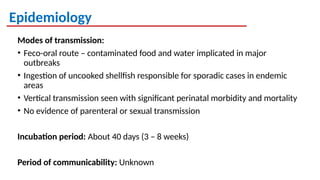
Epidemiology
Modes of transmission:
•Feco-oral route – contaminated food and water implicated in major
outbreaks
• Ingestion of uncooked shellfish responsible for sporadic cases in endemic
areas
• Vertical transmission seen with significant perinatal morbidity and mortality
• No evidence of parenteral or sexual transmission
Incubation period: About 40 days (3 – 8 weeks)
Period of communicability: Unknown
14.
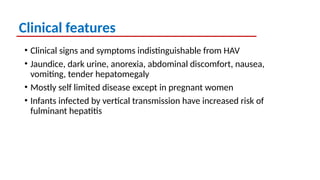
Clinical features
• Clinicalsigns and symptoms indistinguishable from HAV
• Jaundice, dark urine, anorexia, abdominal discomfort, nausea,
vomiting, tender hepatomegaly
• Mostly self limited disease except in pregnant women
• Infants infected by vertical transmission have increased risk of
fulminant hepatitis
15.
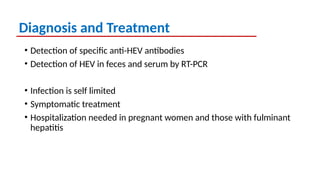
Diagnosis and Treatment
•Detection of specific anti-HEV antibodies
• Detection of HEV in feces and serum by RT-PCR
• Infection is self limited
• Symptomatic treatment
• Hospitalization needed in pregnant women and those with fulminant
hepatitis
#2 HAV and HEV cause acute but self limited infection
HBV, HCV and HDV can cause both acute and chronic infection
Other viruses like CMV, EBV, YF and rubella virus can also cause hepatitis but their site of primary infection is not in the liver, hence not listed under viral hepatitis.
#3 In areas of low endemicity, occurs as single cases.
#4 In areas of low endemicity, occurs as single cases.
#5 In areas of low endemicity, occurs as single cases.
#6 In areas of low endemicity, occurs as single cases.
#7 In areas of low endemicity, occurs as single cases.
#8 In areas of low endemicity, occurs as single cases.
#9 In areas of low endemicity, occurs as single cases.
#10 In areas of low endemicity, occurs as single cases.
#11 In areas of low endemicity, occurs as single cases.
#12 In areas of low endemicity, occurs as single cases.
#13 In areas of low endemicity, occurs as single cases.
#14 In areas of low endemicity, occurs as single cases.
#15 In areas of low endemicity, occurs as single cases.
#16 In areas of low endemicity, occurs as single cases.