
Gaming Education Reform
Starting Points for a Digital Revolution


                   Michael H. Levine
   The Joan Ganz Cooney Center at Sesame Workshop
     Games+Learning+Society, Madison, Wisconsin
                    June 17, 2011
Overview

•   Cooney Center Games and Learning initiatives
•   The Modern Family Media Ecology
•   Research Challenges: A Case for Games in Education
•   Memo to the President: 4 Planks for Reform
Cooney Center Games + Learning Initiatives
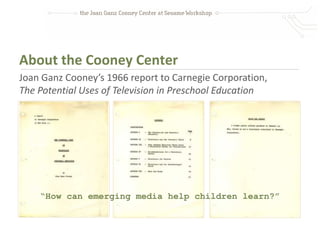
About the Cooney Center
Joan Ganz Cooney’s 1966 report to Carnegie Corporation,
The Potential Uses of Television in Preschool Education


    “How can emerging media help children learn?”
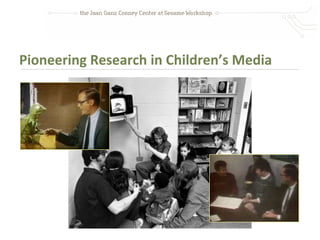
Pioneering Research in Children’s Media
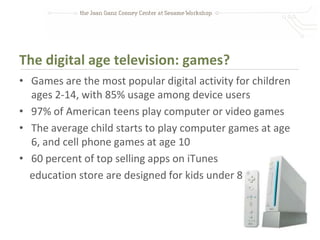
The digital age television: games?
• Games are the most popular digital activity for children
  ages 2-14, with 85% usage among device users
• 97% of American teens play computer or video games
• The average child starts to play computer games at age
  6, and cell phone games at age 10
• 60 percent of top selling apps on iTunes
  education store are designed for kids under 8
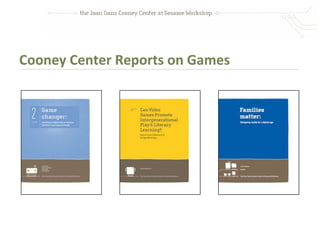
Cooney Center Reports on Games
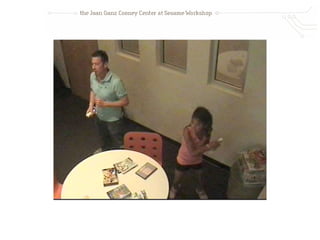
Intergenerational Game Play & Learning
Aimed to develop research-driven design principles for
creating intergenerational play mechanics that help
children learn in a variety of settings

                            Partners
                            • USC Game Innovation Lab
                            • University of Michigan School of
                              Education
                            • The Joan Ganz Cooney Center
                            • Corporation for Public Broadcasting
The New Co-Viewing: Joint Media
Engagement R&D Meeting


                                               The LIFE Center
                                            Sesame Workshop
                                           Stanford University
                                      Northwestern University
                                 The Joan Ganz Cooney Center
                    Center for Children and Technology at EDC
         Center for Technology in Learning at SRI International
Intergenerational Play & Learning
Key questions:
• How can intergenerational play be intentionally designed
  and promoted during game play?
• What behaviors are associated with intergenerational
  game play?
• Which player dynamics attract both parents and children
  to play?
• Which platforms and play mechanics best support
  intergenerational engagement?
Intergenerational Play & Learning
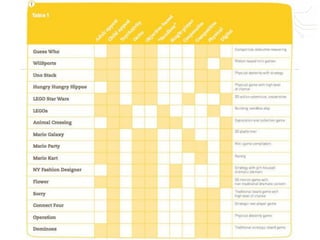
•   Game choice
•   Rules of the game
•   Competition
•   Mentoring opportunities
•   Influence of game type
•   Focus of the interaction
•   Mutual engagement
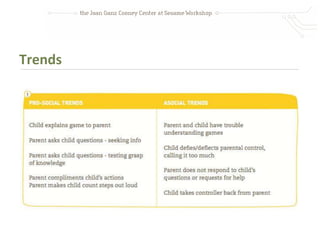
Trends
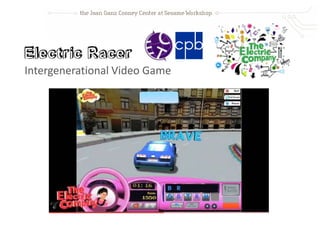
Intergenerational Video Game
Cooney Center Prizes Program
2010 Cooney Center Prizes for Innovation in Children's Media
• Breakthroughs in Mobile Learning
• Breakthroughs in Literacy Learning:
  Innovate with The Electric Company


              2011 National STEM Video Game Challenge
Cooney Center Prizes for Innovation in Children’s Media
2010 Finalists
                 Motion Math [Motion Math Games]
                 Since becoming a finalist in the Cooney Center Prizes, Motion Math Games released its first
                 product, a fractions game for the iPhone in early October 2010. The team has won all sorts of
                 accolades, including a profile in the Wall Street Journal’s Tech Blog , an Editor’s Choice Award for
                 Excellence in Design from Children’s Technology Review, and more. An iPad app, Motion Math HD,
                 was released in February 2011.

                 Toontastic [Launchpad Toys]
                 Since becoming a Prizes finalist, the team focused on completing development of Toontastic and
                 launched their iPad app on January 18th in the iTunes store. Toontastic was was called “the first
                 extradinary app of 2011” by USA Today in their Technology Live blog. They also received 5 stars
                 from Common Sense Media, awarding them with “Best Creative App.”

                 Project NOAH [Project Noah]
                 The winner of the Cooney Center Prize for Breakthroughs in Mobile Learning has garnered a
                 significant amount of press, recognition and distribution. Project Noah gained a partnership and
                 investment from National Geographic. The creator was selected as the 2010 PopTech! Social
                 Innovation Fellow and has been written about in the New York Times, Slate, and CNN. Their app is
                 now available for both the iPhone and Android.

                 The Next Electric Company Star [Dreamkid]
                 Jay Schiffman collaborated with Sesame Workshop’s Electric Company team to develop his
                 concept. The winning concept was originally an online game promoting literacy skills through role-
                 play activities. Together with The Electric Company creative team, the idea has evolved into The
                 Next Electric Company Star, a game that promotes the show’s connected text curriculum and
                 encourages kids to follow through when reading.
National STEM Video Game Challenge
2011 Winners
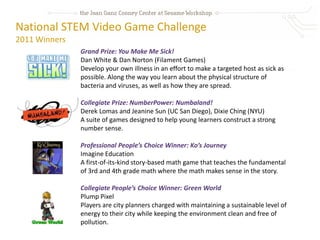
               Grand Prize: You Make Me Sick!
               Dan White & Dan Norton (Filament Games)
               Develop your own illness in an effort to make a targeted host as sick as
               possible. Along the way you learn about the physical structure of
               bacteria and viruses, as well as how they are spread.

               Collegiate Prize: NumberPower: Numbaland!
               Derek Lomas and Jeanine Sun (UC San Diego), Dixie Ching (NYU)
               A suite of games designed to help young learners construct a strong
               number sense.

               Professional People’s Choice Winner: Ko’s Journey
               Imagine Education
               A first-of-its-kind story-based math game that teaches the fundamental
               of 3rd and 4th grade math where the math makes sense in the story.

               Collegiate People’s Choice Winner: Green World
               Plump Pixel
               Players are city planners charged with maintaining a sustainable level of
               energy to their city while keeping the environment clean and free of
               pollution.
National STEM Video Game Challenge
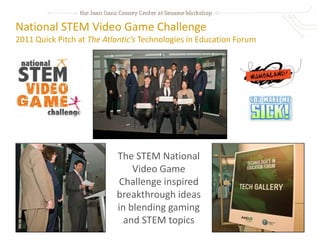
2011 Quick Pitch at The Atlantic’s Technologies in Education Forum


                           The STEM National
                               Video Game
                            Challenge inspired
                           breakthrough ideas
                           in blending gaming
                             and STEM topics
National STEM Video Game Challenge
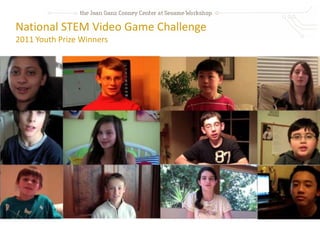
2011 Youth Prize Winners
The Modern Family Ecology
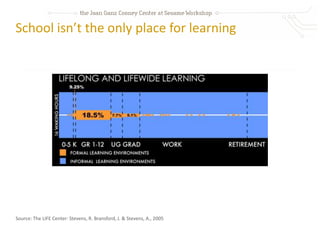
School isn’t the only place for learning


Source: The LIFE Center: Stevens, R. Bransford, J. & Stevens, A., 2005
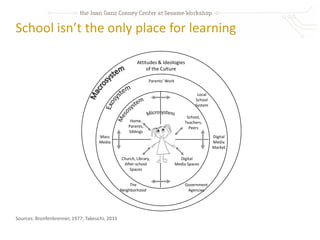
School isn’t the only place for learning

                                                        Attitudes & Ideologies
                                                             of the Culture

                                                               Parents’ Work


                                                                                          Local
                                                                                         School
                                                                                         System

                                                                                    School,
                                                    Home,                          Teachers,
                                                   Parents,                          Peers
                                                   Siblings
                                    Mass                                                          Digital
                                    Media                                                         Media
                                                                                                  Market

                                                Church, Library,                 Digital
                                                 After-school                  Media Spaces
                                                    Spaces


                                                     The                            Government
                                                Neighborhood                         Agencies


Sources: Bronfenbrenner, 1977; Takeuchi, 2011
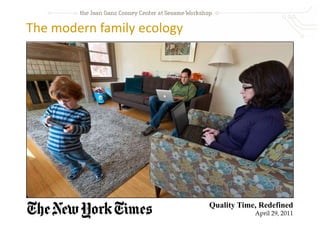
The modern family ecology


                            Quality Time, Redefined
                                        April 29, 2011
Research and Policy Challenges:
Making a Case for Games in Ed Reform
National Research Council Findings (2011)
More research is needed to increase understanding of:
• The role of simulations and games in learning
• Using them in formal and informal contexts
• Using them to assess and support individualized learning
• Scaling up simulations and games
To facilitate ongoing improvement in simulations and games for
science learning:
• Form R&D partnerships to facilitate intellectual collaboration
• Government agencies and foundations should consider potential
   benefits of providing support for such partnerships
Challenges to Creating Effective Digital Media
• Current research efforts are fragmented and lack shared
  priorities and practices
• Old models of R&D no longer apply to an evolving, multi-
  disciplinary field
• Most current investments in educational technology are spent
  on hardware and software, rather than on training to effectively
  use technologies
• Educational digital media rarely bridges home and school, or
  spans multiple grades
• The public dialogue about games is often focused on their
  negative effects, not their potential
What’s Next: Memo to the President
     Reform Planks 2011-2016
Four Planks for Reform
1.   Modernize early childhood education
2.   Disrupt common standards and new assessments
3.   Teacher Corps for a digital and global age
4.   Action research using games and digital media
         - Ed Games for responsible parenthood
         - Ed Games linked to health promotion
        -- Ed Games for girl power (STEM)
         -- Ed games for global competence and mutuality
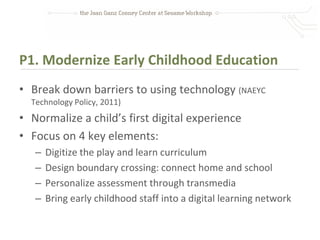
P1. Modernize Early Childhood Education
• Break down barriers to using technology (NAEYC
  Technology Policy, 2011)
• Normalize a child’s first digital experience
• Focus on 4 key elements:
   –   Digitize the play and learn curriculum
   –   Design boundary crossing: connect home and school
   –   Personalize assessment through transmedia
   –   Bring early childhood staff into a digital learning network
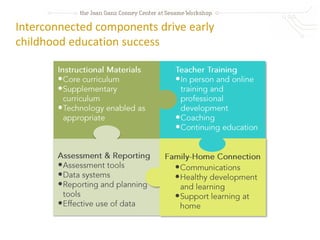
Interconnected components drive early
childhood education success
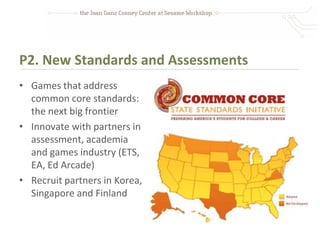
P2. New Standards and Assessments
• Games that address
  common core standards:
  the next big frontier
• Innovate with partners in
  assessment, academia
  and games industry (ETS,
  EA, Ed Arcade)
• Recruit partners in Korea,
  Singapore and Finland
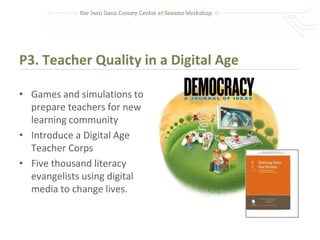
P3. Teacher Quality in a Digital Age

• Games and simulations to
  prepare teachers for new
  learning community
• Introduce a Digital Age
  Teacher Corps
• Five thousand literacy
  evangelists using digital
  media to change lives.
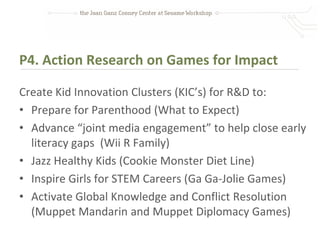
P4. Action Research on Games for Impact

Create Kid Innovation Clusters (KIC’s) for R&D to:
• Prepare for Parenthood (What to Expect)
• Advance “joint media engagement” to help close early
  literacy gaps (Wii R Family)
• Jazz Healthy Kids (Cookie Monster Diet Line)
• Inspire Girls for STEM Careers (Ga Ga-Jolie Games)
• Activate Global Knowledge and Conflict Resolution
  (Muppet Mandarin and Muppet Diplomacy Games)
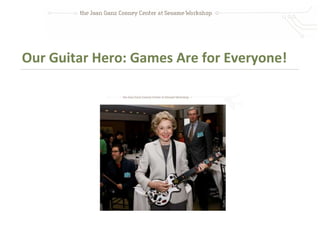
Our Guitar Hero: Games Are for Everyone!
Thank You

Michael Levine: Gaming Education Reform: Starting Points for a Digital Revolution

  • 1.
    Gaming Education Reform StartingPoints for a Digital Revolution Michael H. Levine The Joan Ganz Cooney Center at Sesame Workshop Games+Learning+Society, Madison, Wisconsin June 17, 2011
  • 3.
    Overview • Cooney Center Games and Learning initiatives • The Modern Family Media Ecology • Research Challenges: A Case for Games in Education • Memo to the President: 4 Planks for Reform
  • 4.
    Cooney Center Games+ Learning Initiatives
  • 5.
    About the CooneyCenter Joan Ganz Cooney’s 1966 report to Carnegie Corporation, The Potential Uses of Television in Preschool Education “How can emerging media help children learn?”
  • 6.
    Pioneering Research inChildren’s Media
  • 7.
    The digital agetelevision: games? • Games are the most popular digital activity for children ages 2-14, with 85% usage among device users • 97% of American teens play computer or video games • The average child starts to play computer games at age 6, and cell phone games at age 10 • 60 percent of top selling apps on iTunes education store are designed for kids under 8
  • 8.
  • 9.
    Intergenerational Game Play& Learning Aimed to develop research-driven design principles for creating intergenerational play mechanics that help children learn in a variety of settings Partners • USC Game Innovation Lab • University of Michigan School of Education • The Joan Ganz Cooney Center • Corporation for Public Broadcasting
  • 10.
    The New Co-Viewing:Joint Media Engagement R&D Meeting The LIFE Center Sesame Workshop Stanford University Northwestern University The Joan Ganz Cooney Center Center for Children and Technology at EDC Center for Technology in Learning at SRI International
  • 11.
    Intergenerational Play &Learning Key questions: • How can intergenerational play be intentionally designed and promoted during game play? • What behaviors are associated with intergenerational game play? • Which player dynamics attract both parents and children to play? • Which platforms and play mechanics best support intergenerational engagement?
  • 13.
    Intergenerational Play &Learning • Game choice • Rules of the game • Competition • Mentoring opportunities • Influence of game type • Focus of the interaction • Mutual engagement
  • 15.
  • 16.
  • 17.
    Cooney Center PrizesProgram 2010 Cooney Center Prizes for Innovation in Children's Media • Breakthroughs in Mobile Learning • Breakthroughs in Literacy Learning: Innovate with The Electric Company 2011 National STEM Video Game Challenge
  • 18.
    Cooney Center Prizesfor Innovation in Children’s Media 2010 Finalists Motion Math [Motion Math Games] Since becoming a finalist in the Cooney Center Prizes, Motion Math Games released its first product, a fractions game for the iPhone in early October 2010. The team has won all sorts of accolades, including a profile in the Wall Street Journal’s Tech Blog , an Editor’s Choice Award for Excellence in Design from Children’s Technology Review, and more. An iPad app, Motion Math HD, was released in February 2011. Toontastic [Launchpad Toys] Since becoming a Prizes finalist, the team focused on completing development of Toontastic and launched their iPad app on January 18th in the iTunes store. Toontastic was was called “the first extradinary app of 2011” by USA Today in their Technology Live blog. They also received 5 stars from Common Sense Media, awarding them with “Best Creative App.” Project NOAH [Project Noah] The winner of the Cooney Center Prize for Breakthroughs in Mobile Learning has garnered a significant amount of press, recognition and distribution. Project Noah gained a partnership and investment from National Geographic. The creator was selected as the 2010 PopTech! Social Innovation Fellow and has been written about in the New York Times, Slate, and CNN. Their app is now available for both the iPhone and Android. The Next Electric Company Star [Dreamkid] Jay Schiffman collaborated with Sesame Workshop’s Electric Company team to develop his concept. The winning concept was originally an online game promoting literacy skills through role- play activities. Together with The Electric Company creative team, the idea has evolved into The Next Electric Company Star, a game that promotes the show’s connected text curriculum and encourages kids to follow through when reading.
  • 19.
    National STEM VideoGame Challenge 2011 Winners Grand Prize: You Make Me Sick! Dan White & Dan Norton (Filament Games) Develop your own illness in an effort to make a targeted host as sick as possible. Along the way you learn about the physical structure of bacteria and viruses, as well as how they are spread. Collegiate Prize: NumberPower: Numbaland! Derek Lomas and Jeanine Sun (UC San Diego), Dixie Ching (NYU) A suite of games designed to help young learners construct a strong number sense. Professional People’s Choice Winner: Ko’s Journey Imagine Education A first-of-its-kind story-based math game that teaches the fundamental of 3rd and 4th grade math where the math makes sense in the story. Collegiate People’s Choice Winner: Green World Plump Pixel Players are city planners charged with maintaining a sustainable level of energy to their city while keeping the environment clean and free of pollution.
  • 20.
    National STEM VideoGame Challenge 2011 Quick Pitch at The Atlantic’s Technologies in Education Forum The STEM National Video Game Challenge inspired breakthrough ideas in blending gaming and STEM topics
  • 21.
    National STEM VideoGame Challenge 2011 Youth Prize Winners
  • 22.
  • 23.
    School isn’t theonly place for learning Source: The LIFE Center: Stevens, R. Bransford, J. & Stevens, A., 2005
  • 24.
    School isn’t theonly place for learning Attitudes & Ideologies of the Culture Parents’ Work Local School System School, Home, Teachers, Parents, Peers Siblings Mass Digital Media Media Market Church, Library, Digital After-school Media Spaces Spaces The Government Neighborhood Agencies Sources: Bronfenbrenner, 1977; Takeuchi, 2011
  • 25.
    The modern familyecology Quality Time, Redefined April 29, 2011
  • 26.
    Research and PolicyChallenges: Making a Case for Games in Ed Reform
  • 27.
    National Research CouncilFindings (2011) More research is needed to increase understanding of: • The role of simulations and games in learning • Using them in formal and informal contexts • Using them to assess and support individualized learning • Scaling up simulations and games To facilitate ongoing improvement in simulations and games for science learning: • Form R&D partnerships to facilitate intellectual collaboration • Government agencies and foundations should consider potential benefits of providing support for such partnerships
  • 28.
    Challenges to CreatingEffective Digital Media • Current research efforts are fragmented and lack shared priorities and practices • Old models of R&D no longer apply to an evolving, multi- disciplinary field • Most current investments in educational technology are spent on hardware and software, rather than on training to effectively use technologies • Educational digital media rarely bridges home and school, or spans multiple grades • The public dialogue about games is often focused on their negative effects, not their potential
  • 29.
    What’s Next: Memoto the President Reform Planks 2011-2016
  • 30.
    Four Planks forReform 1. Modernize early childhood education 2. Disrupt common standards and new assessments 3. Teacher Corps for a digital and global age 4. Action research using games and digital media - Ed Games for responsible parenthood - Ed Games linked to health promotion -- Ed Games for girl power (STEM) -- Ed games for global competence and mutuality
  • 31.
    P1. Modernize EarlyChildhood Education • Break down barriers to using technology (NAEYC Technology Policy, 2011) • Normalize a child’s first digital experience • Focus on 4 key elements: – Digitize the play and learn curriculum – Design boundary crossing: connect home and school – Personalize assessment through transmedia – Bring early childhood staff into a digital learning network
  • 32.
    Interconnected components driveearly childhood education success
  • 33.
    P2. New Standardsand Assessments • Games that address common core standards: the next big frontier • Innovate with partners in assessment, academia and games industry (ETS, EA, Ed Arcade) • Recruit partners in Korea, Singapore and Finland
  • 34.
    P3. Teacher Qualityin a Digital Age • Games and simulations to prepare teachers for new learning community • Introduce a Digital Age Teacher Corps • Five thousand literacy evangelists using digital media to change lives.
  • 35.
    P4. Action Researchon Games for Impact Create Kid Innovation Clusters (KIC’s) for R&D to: • Prepare for Parenthood (What to Expect) • Advance “joint media engagement” to help close early literacy gaps (Wii R Family) • Jazz Healthy Kids (Cookie Monster Diet Line) • Inspire Girls for STEM Careers (Ga Ga-Jolie Games) • Activate Global Knowledge and Conflict Resolution (Muppet Mandarin and Muppet Diplomacy Games)
  • 36.
    Our Guitar Hero:Games Are for Everyone!
  • 37.