

Zooming in:
Studying family engagement with
media at large and small scales
Lori Takeuchi & Briana Pressey | The Joan Ganz Cooney Center @ Sesame Workshop | AERA 2014
1
•  How are families with young children using media together?
–  Large-scale national survey of parents
–  Case studies of families with young children
•  The Families and Media Project
OVERVIEW
2
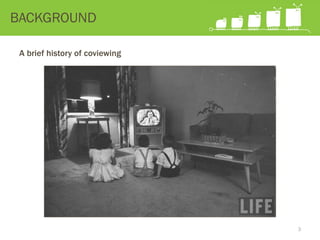
A brief history of coviewing
BACKGROUND
3
A brief history of coviewing
•  Kids who watch educational TV with their parents are more likely to learn
than those who watch alone (Ball & Bogatz, 1970; Bogatz & Ball, 1971; Salomon,
1977)
•  Specific coviewing “moves” by parent account for learning (Reiser, Tessmer,
and Phelps, 1984; Reiser, Williamson, & Suzuki, 1988)
•  Informed design of Sesame Street segments and parental outreach
BACKGROUND
4
BACKGROUND
Need to rethink coviewing for modern times
Media is changing
•  Shrinking size (portability)
•  Multiple delivery platforms
•  Convergence
•  Connectivity
•  Author-ability
Families are changing (Bianchi, 2011)
•  More mothers in the workplace
•  More parents work double-shifts
•  More single-parent households
•  Higher rates of poverty
•  More ESL households
5
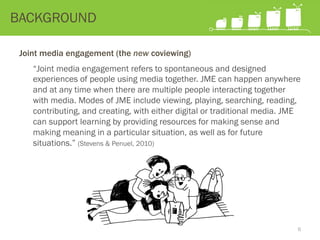
Joint media engagement (the new coviewing)
“Joint media engagement refers to spontaneous and designed
experiences of people using media together. JME can happen anywhere
and at any time when there are multiple people interacting together
with media. Modes of JME include viewing, playing, searching, reading,
contributing, and creating, with either digital or traditional media. JME
can support learning by providing resources for making sense and
making meaning in a particular situation, as well as for future
situations.” (Stevens & Penuel, 2010)
BACKGROUND
6
The studies
•  National survey of parents: To what extent is JME occurring in families
with young children across the U.S.? Who is using media together?
•  Case studies: How might particular family characteristics and
circumstances shape how parents and children engage around media?
BACKGROUND
7
THE PARENT SURVEY
8
Purpose
•  Measure how much of children’s screen media use is “educational” by
platform and by age
–  Defined educational as “content that is good for your child’s learning or
growth, or that teaches some type of lesson, such as an academic or social
skill.”
•  Explore which platforms parents think are effective
•  Discover which subjects parents think children are learning about
through media
•  Measure how much children are using media with parents and others
•  Document patterns of reading and e-reading
PARENT SURVEY
9
Purpose
•  Measure how much of children’s screen media use is “educational” by
platform and by age
–  Defined educational as “content that is good for your child’s learning or
growth, or that teaches some type of lesson, such as an academic or social
skill.”
•  Explore which platforms parents think are effective
•  Discover which subjects parents think children are learning about
through media
•  Measure how much children are using media with parents and others
•  Document patterns of reading and e-reading
•  Research led by Vicky Rideout, analyses conducted by June Lee, and
GfK administered online survey
PARENT SURVEY
10
Methods
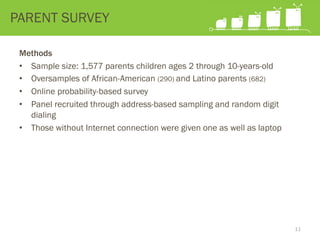
•  Sample size: 1,577 parents children ages 2 through 10-years-old
•  Oversamples of African-American (290) and Latino parents (682)
•  Online probability-based survey
•  Panel recruited through address-based sampling and random digit
dialing
•  Those without Internet connection were given one as well as laptop
PARENT SURVEY
11
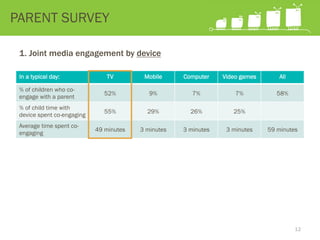
1. Joint media engagement by device
PARENT SURVEY
In a typical day: TV Mobile Computer Video games All
% of children who co-
engage with a parent
52% 9% 7% 7% 58%
% of child time with
device spent co-engaging
55% 29% 26% 25%
Average time spent co-
engaging
49 minutes 3 minutes 3 minutes 3 minutes 59 minutes
12
2. Joint media engagement by partner
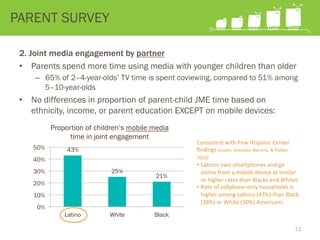
•  Parents spend more time using media with younger children than older
–  65% of 2–4-year-olds’ TV time is spent coviewing, compared to 51% among
5–10-year-olds
•  No differences in proportion of parent-child JME time based on
ethnicity, income, or parent education EXCEPT on mobile devices:
PARENT SURVEY
43%
25%
21%
0%
10%
20%
30%
40%
50%
Latino White Black
Proportion of children’s mobile media
time in joint engagement
Consistent	
  with	
  Pew	
  Hispanic	
  Center	
  
findings	
  (Lopez,	
  Gonzalez-­‐Barrera,	
  &	
  Pa=en,	
  
2013):	
  
•  LaDnos	
  own	
  smartphones	
  and	
  go	
  
online	
  from	
  a	
  mobile	
  device	
  at	
  similar	
  
or	
  higher	
  rates	
  than	
  Blacks	
  and	
  Whites	
  
•  Rate	
  of	
  cellphone-­‐only	
  households	
  is	
  
higher	
  among	
  LaDnos	
  (47%)	
  than	
  Black	
  
(38%)	
  or	
  White	
  (30%)	
  Americans.	
  
13
2. Joint media engagement by partner
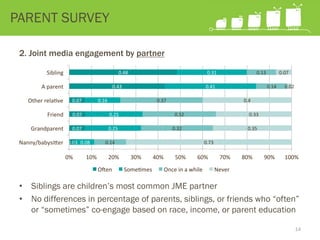
•  Siblings are children’s most common JME partner
•  No differences in percentage of parents, siblings, or friends who “often”
or “sometimes” co-engage based on race, income, or parent education
PARENT SURVEY
0.03	
  
0.07	
  
0.07	
  
0.07	
  
0.43	
  
0.48	
  
0.08	
  
0.25	
  
0.25	
  
0.16	
  
0.41	
  
0.31	
  
0.14	
  
0.32	
  
0.32	
  
0.37	
  
0.14	
  
0.13	
  
0.73	
  
0.35	
  
0.33	
  
0.4	
  
0.02	
  
0.07	
  
0%	
   10%	
   20%	
   30%	
   40%	
   50%	
   60%	
   70%	
   80%	
   90%	
   100%	
  
Nanny/babysi=er	
  
Grandparent	
  
Friend	
  
Other	
  relaDve	
  
A	
  parent	
  
Sibling	
  
Oen	
   SomeDmes	
   Once	
  in	
  a	
  while	
   Never	
  
14
3. Joint media engagement with grandparents
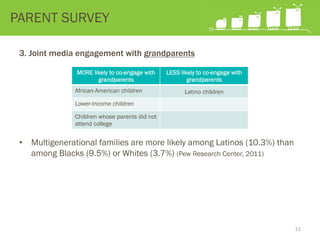
•  Multigenerational families are more likely among Latinos (10.3%) than
among Blacks (9.5%) or Whites (3.7%) (Pew Research Center, 2011)
PARENT SURVEY
MORE likely to co-engage with
grandparents
LESS likely to co-engage with
grandparents
African-American children Latino children
Lower-income children
Children whose parents did not
attend college
15
4. Purposes of using media together
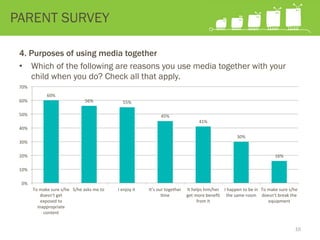
•  Which of the following are reasons you use media together with your
child when you do? Check all that apply.
PARENT SURVEY
60%	
  
56%	
   55%	
  
45%	
  
41%	
  
30%	
  
16%	
  
0%	
  
10%	
  
20%	
  
30%	
  
40%	
  
50%	
  
60%	
  
70%	
  
To	
  make	
  sure	
  s/he	
  
doesn’t	
  get	
  
exposed	
  to	
  
inappropriate	
  
content	
  	
  
S/he	
  asks	
  me	
  to	
  	
   I	
  enjoy	
  it	
  	
   It’s	
  our	
  together	
  
Dme	
  
It	
  helps	
  him/her	
  
get	
  more	
  benefit	
  
from	
  it	
  	
  
I	
  happen	
  to	
  be	
  in	
  
the	
  same	
  room	
  	
  
To	
  make	
  sure	
  s/he	
  
doesn’t	
  break	
  the	
  
equipment	
  	
  
16
5. What parents consider “educational media”
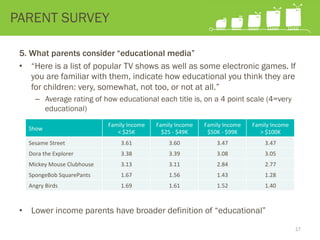
•  “Here is a list of popular TV shows as well as some electronic games. If
you are familiar with them, indicate how educational you think they are
for children: very, somewhat, not too, or not at all.”
–  Average rating of how educational each title is, on a 4 point scale (4=very
educational)
•  Lower income parents have broader definition of “educational”
PARENT SURVEY
Show	
  
Family	
  Income	
  
<	
  $25K	
  
Family	
  Income	
  
$25	
  -­‐	
  $49K	
  
Family	
  Income	
  
$50K	
  -­‐	
  $99K	
  
Family	
  Income	
  
>	
  $100K	
  
Sesame	
  Street	
   3.61	
   3.60	
   3.47	
   3.47	
  
Dora	
  the	
  Explorer	
   3.38	
   3.39	
   3.08	
   3.05	
  
Mickey	
  Mouse	
  Clubhouse	
   3.13	
   3.11	
   2.84	
   2.77	
  
SpongeBob	
  SquarePants	
   1.67	
   1.56	
   1.43	
   1.28	
  
Angry	
  Birds	
   1.69	
   1.61	
   1.52	
   1.40	
  
17
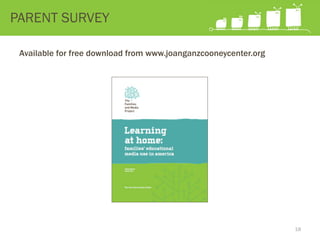
Available for free download from www.joanganzcooneycenter.org
18
PARENT SURVEY
THE CASE STUDIES
19
•  Breadth and depth are necessary to inform the work of producers,
educators, and others interested in enhancing family learning and
connection through media
•  Case studies complement quantitative data by providing insights into
why and how particular families use media together
•  Featured cases don’t represent all U.S. families, but their stories
surface phenomena that warrant investigation in future JME research
CASE STUDIES
20
CASE STUDIES
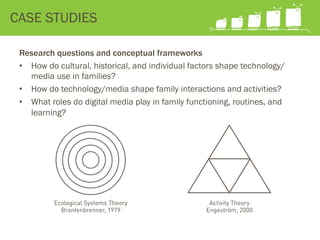
Research questions and conceptual frameworks
•  How do cultural, historical, and individual factors shape technology/
media use in families?
•  How do technology/media shape family interactions and activities?
•  What roles do digital media play in family functioning, routines, and
learning?
Ecological Systems Theory
Bronfenbrenner, 1979
Activity Theory
Engeström, 2000
CASE STUDIES
Methods
Setting
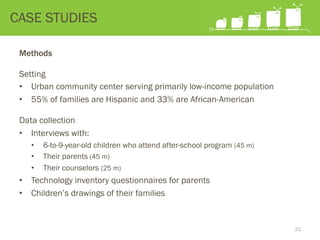
•  Urban community center serving primarily low-income population
•  55% of families are Hispanic and 33% are African-American
Data collection
•  Interviews with:
•  6-to-9-year-old children who attend after-school program (45 m)
•  Their parents (45 m)
•  Their counselors (25 m)
•  Technology inventory questionnaires for parents
•  Children’s drawings of their families
22
CASE STUDIES
Participants
Family
Focal child age
and gender Ethnicity
Language(s)
spoken at home Marital situation
Siblings,
relatives
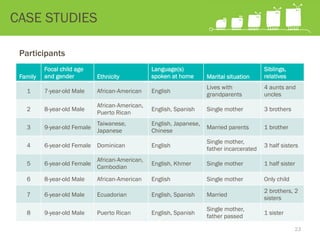
1 7-year-old Male African-American English
Lives with
grandparents
4 aunts and
uncles
2 8-year-old Male
African-American,
Puerto Rican
English, Spanish Single mother 3 brothers
3 9-year-old Female
Taiwanese,
Japanese
English, Japanese,
Chinese
Married parents 1 brother
4 6-year-old Female Dominican English
Single mother,
father incarcerated
3 half sisters
5 6-year-old Female
African-American,
Cambodian
English, Khmer Single mother 1 half sister
6 8-year-old Male African-American English Single mother Only child
7 6-year-old Male Ecuadorian English, Spanish Married
2 brothers, 2
sisters
8 9-year-old Male Puerto Rican English, Spanish
Single mother,
father passed
1 sister
23
What drives joint media engagement?
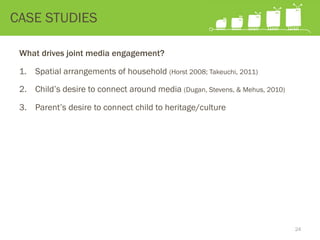
1.  Spatial arrangements of household (Horst 2008; Takeuchi, 2011)
2.  Child’s desire to connect around media (Dugan, Stevens, & Mehus, 2010)
3.  Parent’s desire to connect child to heritage/culture
CASE STUDIES
24
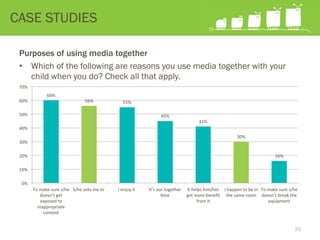
Purposes of using media together
•  Which of the following are reasons you use media together with your
child when you do? Check all that apply.
CASE STUDIES
60%	
  
56%	
   55%	
  
45%	
  
41%	
  
30%	
  
16%	
  
0%	
  
10%	
  
20%	
  
30%	
  
40%	
  
50%	
  
60%	
  
70%	
  
To	
  make	
  sure	
  s/he	
  
doesn’t	
  get	
  
exposed	
  to	
  
inappropriate	
  
content	
  	
  
S/he	
  asks	
  me	
  to	
  	
   I	
  enjoy	
  it	
  	
   It’s	
  our	
  together	
  
Dme	
  
It	
  helps	
  him/her	
  
get	
  more	
  benefit	
  
from	
  it	
  	
  
I	
  happen	
  to	
  be	
  in	
  
the	
  same	
  room	
  	
  
To	
  make	
  sure	
  s/he	
  
doesn’t	
  break	
  the	
  
equipment	
  	
  
25
CASE STUDIES
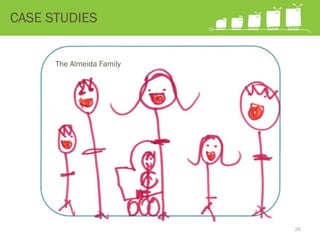
The Almeida Family
26
27
CASE STUDIES
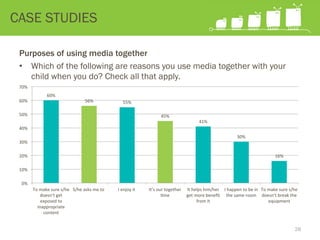
Purposes of using media together
•  Which of the following are reasons you use media together with your
child when you do? Check all that apply.
CASE STUDIES
60%	
  
56%	
   55%	
  
45%	
  
41%	
  
30%	
  
16%	
  
0%	
  
10%	
  
20%	
  
30%	
  
40%	
  
50%	
  
60%	
  
70%	
  
To	
  make	
  sure	
  s/he	
  
doesn’t	
  get	
  
exposed	
  to	
  
inappropriate	
  
content	
  	
  
S/he	
  asks	
  me	
  to	
  	
   I	
  enjoy	
  it	
  	
   It’s	
  our	
  together	
  
Dme	
  
It	
  helps	
  him/her	
  
get	
  more	
  benefit	
  
from	
  it	
  	
  
I	
  happen	
  to	
  be	
  in	
  
the	
  same	
  room	
  	
  
To	
  make	
  sure	
  s/he	
  
doesn’t	
  break	
  the	
  
equipment	
  	
  
28
Findings
•  Children’s desire to connect with parents and siblings: Challenges the
idea that new media devices isolate children.
•  Culturally themed content (e.g., Dora the Explorer, telenovelas)
–  Parents can connect child to heritage and child can spend time with parent
–  Both parties equally enjoy
–  Media that is “important” to the family as opposed to “educational”
–  Ideal content for JME
Recommendations
•  Create “ideal content” for mobile devices (expanding market across all
segments of U.S. population)
•  Rethink the value and use of the term “educational” media
IMPLICATIONS
29
Thank you!
www.joanganzcooneycenter.org
30

Zooming in: Studying family engagement with media at large and small scales

  • 1.
    Zooming in: Studying familyengagement with media at large and small scales Lori Takeuchi & Briana Pressey | The Joan Ganz Cooney Center @ Sesame Workshop | AERA 2014 1
  • 2.
    •  How arefamilies with young children using media together? –  Large-scale national survey of parents –  Case studies of families with young children •  The Families and Media Project OVERVIEW 2
  • 3.
    A brief historyof coviewing BACKGROUND 3
  • 4.
    A brief historyof coviewing •  Kids who watch educational TV with their parents are more likely to learn than those who watch alone (Ball & Bogatz, 1970; Bogatz & Ball, 1971; Salomon, 1977) •  Specific coviewing “moves” by parent account for learning (Reiser, Tessmer, and Phelps, 1984; Reiser, Williamson, & Suzuki, 1988) •  Informed design of Sesame Street segments and parental outreach BACKGROUND 4
  • 5.
    BACKGROUND Need to rethinkcoviewing for modern times Media is changing •  Shrinking size (portability) •  Multiple delivery platforms •  Convergence •  Connectivity •  Author-ability Families are changing (Bianchi, 2011) •  More mothers in the workplace •  More parents work double-shifts •  More single-parent households •  Higher rates of poverty •  More ESL households 5
  • 6.
    Joint media engagement(the new coviewing) “Joint media engagement refers to spontaneous and designed experiences of people using media together. JME can happen anywhere and at any time when there are multiple people interacting together with media. Modes of JME include viewing, playing, searching, reading, contributing, and creating, with either digital or traditional media. JME can support learning by providing resources for making sense and making meaning in a particular situation, as well as for future situations.” (Stevens & Penuel, 2010) BACKGROUND 6
  • 7.
    The studies •  Nationalsurvey of parents: To what extent is JME occurring in families with young children across the U.S.? Who is using media together? •  Case studies: How might particular family characteristics and circumstances shape how parents and children engage around media? BACKGROUND 7
  • 8.
  • 9.
    Purpose •  Measure howmuch of children’s screen media use is “educational” by platform and by age –  Defined educational as “content that is good for your child’s learning or growth, or that teaches some type of lesson, such as an academic or social skill.” •  Explore which platforms parents think are effective •  Discover which subjects parents think children are learning about through media •  Measure how much children are using media with parents and others •  Document patterns of reading and e-reading PARENT SURVEY 9
  • 10.
    Purpose •  Measure howmuch of children’s screen media use is “educational” by platform and by age –  Defined educational as “content that is good for your child’s learning or growth, or that teaches some type of lesson, such as an academic or social skill.” •  Explore which platforms parents think are effective •  Discover which subjects parents think children are learning about through media •  Measure how much children are using media with parents and others •  Document patterns of reading and e-reading •  Research led by Vicky Rideout, analyses conducted by June Lee, and GfK administered online survey PARENT SURVEY 10
  • 11.
    Methods •  Sample size:1,577 parents children ages 2 through 10-years-old •  Oversamples of African-American (290) and Latino parents (682) •  Online probability-based survey •  Panel recruited through address-based sampling and random digit dialing •  Those without Internet connection were given one as well as laptop PARENT SURVEY 11
  • 12.
    1. Joint mediaengagement by device PARENT SURVEY In a typical day: TV Mobile Computer Video games All % of children who co- engage with a parent 52% 9% 7% 7% 58% % of child time with device spent co-engaging 55% 29% 26% 25% Average time spent co- engaging 49 minutes 3 minutes 3 minutes 3 minutes 59 minutes 12
  • 13.
    2. Joint mediaengagement by partner •  Parents spend more time using media with younger children than older –  65% of 2–4-year-olds’ TV time is spent coviewing, compared to 51% among 5–10-year-olds •  No differences in proportion of parent-child JME time based on ethnicity, income, or parent education EXCEPT on mobile devices: PARENT SURVEY 43% 25% 21% 0% 10% 20% 30% 40% 50% Latino White Black Proportion of children’s mobile media time in joint engagement Consistent  with  Pew  Hispanic  Center   findings  (Lopez,  Gonzalez-­‐Barrera,  &  Pa=en,   2013):   •  LaDnos  own  smartphones  and  go   online  from  a  mobile  device  at  similar   or  higher  rates  than  Blacks  and  Whites   •  Rate  of  cellphone-­‐only  households  is   higher  among  LaDnos  (47%)  than  Black   (38%)  or  White  (30%)  Americans.   13
  • 14.
    2. Joint mediaengagement by partner •  Siblings are children’s most common JME partner •  No differences in percentage of parents, siblings, or friends who “often” or “sometimes” co-engage based on race, income, or parent education PARENT SURVEY 0.03   0.07   0.07   0.07   0.43   0.48   0.08   0.25   0.25   0.16   0.41   0.31   0.14   0.32   0.32   0.37   0.14   0.13   0.73   0.35   0.33   0.4   0.02   0.07   0%   10%   20%   30%   40%   50%   60%   70%   80%   90%   100%   Nanny/babysi=er   Grandparent   Friend   Other  relaDve   A  parent   Sibling   Oen   SomeDmes   Once  in  a  while   Never   14
  • 15.
    3. Joint mediaengagement with grandparents •  Multigenerational families are more likely among Latinos (10.3%) than among Blacks (9.5%) or Whites (3.7%) (Pew Research Center, 2011) PARENT SURVEY MORE likely to co-engage with grandparents LESS likely to co-engage with grandparents African-American children Latino children Lower-income children Children whose parents did not attend college 15
  • 16.
    4. Purposes ofusing media together •  Which of the following are reasons you use media together with your child when you do? Check all that apply. PARENT SURVEY 60%   56%   55%   45%   41%   30%   16%   0%   10%   20%   30%   40%   50%   60%   70%   To  make  sure  s/he   doesn’t  get   exposed  to   inappropriate   content     S/he  asks  me  to     I  enjoy  it     It’s  our  together   Dme   It  helps  him/her   get  more  benefit   from  it     I  happen  to  be  in   the  same  room     To  make  sure  s/he   doesn’t  break  the   equipment     16
  • 17.
    5. What parentsconsider “educational media” •  “Here is a list of popular TV shows as well as some electronic games. If you are familiar with them, indicate how educational you think they are for children: very, somewhat, not too, or not at all.” –  Average rating of how educational each title is, on a 4 point scale (4=very educational) •  Lower income parents have broader definition of “educational” PARENT SURVEY Show   Family  Income   <  $25K   Family  Income   $25  -­‐  $49K   Family  Income   $50K  -­‐  $99K   Family  Income   >  $100K   Sesame  Street   3.61   3.60   3.47   3.47   Dora  the  Explorer   3.38   3.39   3.08   3.05   Mickey  Mouse  Clubhouse   3.13   3.11   2.84   2.77   SpongeBob  SquarePants   1.67   1.56   1.43   1.28   Angry  Birds   1.69   1.61   1.52   1.40   17
  • 18.
    Available for freedownload from www.joanganzcooneycenter.org 18 PARENT SURVEY
  • 19.
  • 20.
    •  Breadth anddepth are necessary to inform the work of producers, educators, and others interested in enhancing family learning and connection through media •  Case studies complement quantitative data by providing insights into why and how particular families use media together •  Featured cases don’t represent all U.S. families, but their stories surface phenomena that warrant investigation in future JME research CASE STUDIES 20
  • 21.
    CASE STUDIES Research questionsand conceptual frameworks •  How do cultural, historical, and individual factors shape technology/ media use in families? •  How do technology/media shape family interactions and activities? •  What roles do digital media play in family functioning, routines, and learning? Ecological Systems Theory Bronfenbrenner, 1979 Activity Theory Engeström, 2000
  • 22.
    CASE STUDIES Methods Setting •  Urbancommunity center serving primarily low-income population •  55% of families are Hispanic and 33% are African-American Data collection •  Interviews with: •  6-to-9-year-old children who attend after-school program (45 m) •  Their parents (45 m) •  Their counselors (25 m) •  Technology inventory questionnaires for parents •  Children’s drawings of their families 22
  • 23.
    CASE STUDIES Participants Family Focal childage and gender Ethnicity Language(s) spoken at home Marital situation Siblings, relatives 1 7-year-old Male African-American English Lives with grandparents 4 aunts and uncles 2 8-year-old Male African-American, Puerto Rican English, Spanish Single mother 3 brothers 3 9-year-old Female Taiwanese, Japanese English, Japanese, Chinese Married parents 1 brother 4 6-year-old Female Dominican English Single mother, father incarcerated 3 half sisters 5 6-year-old Female African-American, Cambodian English, Khmer Single mother 1 half sister 6 8-year-old Male African-American English Single mother Only child 7 6-year-old Male Ecuadorian English, Spanish Married 2 brothers, 2 sisters 8 9-year-old Male Puerto Rican English, Spanish Single mother, father passed 1 sister 23
  • 24.
    What drives jointmedia engagement? 1.  Spatial arrangements of household (Horst 2008; Takeuchi, 2011) 2.  Child’s desire to connect around media (Dugan, Stevens, & Mehus, 2010) 3.  Parent’s desire to connect child to heritage/culture CASE STUDIES 24
  • 25.
    Purposes of usingmedia together •  Which of the following are reasons you use media together with your child when you do? Check all that apply. CASE STUDIES 60%   56%   55%   45%   41%   30%   16%   0%   10%   20%   30%   40%   50%   60%   70%   To  make  sure  s/he   doesn’t  get   exposed  to   inappropriate   content     S/he  asks  me  to     I  enjoy  it     It’s  our  together   Dme   It  helps  him/her   get  more  benefit   from  it     I  happen  to  be  in   the  same  room     To  make  sure  s/he   doesn’t  break  the   equipment     25
  • 26.
  • 27.
  • 28.
    Purposes of usingmedia together •  Which of the following are reasons you use media together with your child when you do? Check all that apply. CASE STUDIES 60%   56%   55%   45%   41%   30%   16%   0%   10%   20%   30%   40%   50%   60%   70%   To  make  sure  s/he   doesn’t  get   exposed  to   inappropriate   content     S/he  asks  me  to     I  enjoy  it     It’s  our  together   Dme   It  helps  him/her   get  more  benefit   from  it     I  happen  to  be  in   the  same  room     To  make  sure  s/he   doesn’t  break  the   equipment     28
  • 29.
    Findings •  Children’s desireto connect with parents and siblings: Challenges the idea that new media devices isolate children. •  Culturally themed content (e.g., Dora the Explorer, telenovelas) –  Parents can connect child to heritage and child can spend time with parent –  Both parties equally enjoy –  Media that is “important” to the family as opposed to “educational” –  Ideal content for JME Recommendations •  Create “ideal content” for mobile devices (expanding market across all segments of U.S. population) •  Rethink the value and use of the term “educational” media IMPLICATIONS 29
  • 30.