Mexico
Global Leadership Final Project.
This Photo by Unknown Author is licensed under CC BY-SA
Geography &
Topography/Time Zones
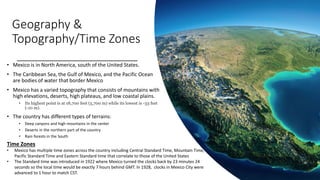
• Mexico is in North America, south of the United States.
• The Caribbean Sea, the Gulf of Mexico, and the Pacific Ocean
are bodies of water that border Mexico
• Mexico has a varied topography that consists of mountains with
high elevations, deserts, high plateaus, and low coastal plains.
• Its highest point is at 18,700 feet (5,700 m) while its lowest is -33 feet
(-10 m).
• The country has different types of terrains:
• Deep canyons and high mountains in the center
• Deserts in the northern part of the country
• Rain forests in the South
Time Zones
• Mexico has multiple time zones across the country including Central Standard Time, Mountain Time,
Pacific Standard Time and Eastern Standard time that correlate to those of the United States
• The Standard time was introduced in 1922 where Mexico turned the clocks back by 23 minutes 24
seconds so the local time would be exactly 7 hours behind GMT. In 1928, clocks in Mexico City were
advanced to 1 hour to match CST.
Historical and Leadership Influences
• Mexico has a rich history spanning over 10,000 years. Influences on its current society and
landscape directly resulted from earlier civilizations in the region.
• In 8000 B.C. The first humans begin cultivating plants in the new world. Over thousands of
years, agriculture develops and becomes the basis for the first villages of Mesoamerica.
• In 1500 B.C. The Olmecs, the first major Mesoamerican civilization grows from the earlier
villages. This period is known for its successful cultivation of corn (maize), beans, cotton,
peppers, as well as its graphic symbols used for recording its history.
• In 600 B.C. Olmec leadership and dominance can be seen in regional groups such as the
Mayans, Totonac, Zapotec, and Teotihuacan. These groups all share a common Olmec
heritage.
• México's leadership has come in several forms in the past. Today its leadership rests with its
Head of State. This person controls executive power. Previously this power belonged to the
Emperor of Mexico during monarchical rule.
Political/Governmental/legal
influences
• Mexico is a federal republic. The head of the executive is the President
of Mexico.
• The President is elected by an absolute majority of its federal districts
and 31 states.
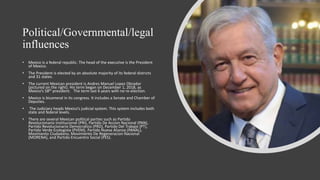
• The current Mexican president is Andres Manuel Lopez Obrador
(pictured on the right). His term began on December 1, 2018, as
Mexico’s 58th president. The term last 6 years with no re-election.
• Mexico is bicameral in its congress. It includes a Senate and Chamber of
Deputies.
• The Judiciary heads Mexico’s judicial system. This system includes both
state and federal levels.
• There are several Mexican political parties such as Partido
Revolucionario Institucional (PRI), Partido De Accion Nacional (PAN),
Partido Revolucionario Democratico (PRD), Partido Del Trabajo (PT),
Partido Verde Ecologista (PVEM), Partido Nueva Alianza (PANAL),
Movimento Ciudadano, Movimiento De Regeneracion Nacional
(MORENA), and Partido Encuentro Social (PES).
Demographic
information
• As of 2020 the population of Mexico is 128,932,753.
• The Total fertility Rate (TFR) is 2.1. This represents
replacement-level Fertility.
• Life expectancy in Mexico is 78.2 years for females and
72.6 years for males.
• The infant mortality rate is 12.5 (per 1,000 births)
• Mexico's urban population is 83.4 %
• The largest city in Mexico City, with a population of
12,294,193.
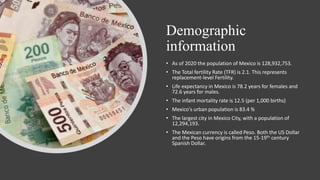
• The Mexican currency is called Peso. Both the US Dollar
and the Peso have origins from the 15-19th century
Spanish Dollar.
Language
Religion
• The primary language in Mexico is Spanish where
92.7% of the population speak Spanish
• It is not the only language in the country that is
spoken. There are also indigenous languages that
are found among the ingenious tribes. Examples
of these are Nahuatl, Totonac, Mazatec,
Mixtec, Zapotec to name a few of the 69
official Mexican languages
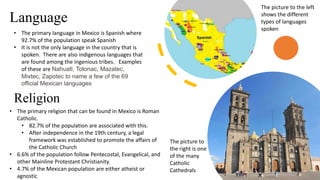
The picture to the left
shows the different
types of languages
spoken
The picture to
the right is one
of the many
Catholic
Cathedrals
• The primary religion that can be found in Mexico is Roman
Catholic.
• 82.7% of the population are associated with this.
• After independence in the 19th century, a legal
framework was established to promote the affairs of
the Catholic Church
• 6.6% of the population follow Pentecostal, Evangelical, and
other Mainline Protestant Christianity.
• 4.7% of the Mexican population are either atheist or
agnostic
Cultural values
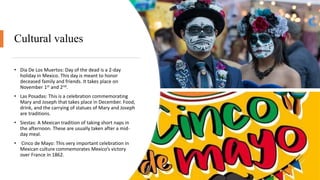
• Dia De Los Muertos: Day of the dead is a 2-day
holiday in Mexico. This day is meant to honor
deceased family and friends. It takes place on
November 1st and 2nd.
• Las Posadas: This is a celebration commemorating
Mary and Joseph that takes place in December. Food,
drink, and the carrying of statues of Mary and Joseph
are traditions.
• Siestas: A Mexican tradition of taking short naps in
the afternoon. These are usually taken after a mid-
day meal.
• Cinco de Mayo: This very important celebration in
Mexican culture commemorates Mexico’s victory
over France in 1862.
Common Business
Practices
• It is important to speak the language. This
does not just mean Spanish but also
understanding the business language.
Warmth and kindness do not necessarily
mean a deal will move forward. It is
important to look for non-verbal cues and
read body language as well.
• Family and personal relationships are very
important in Mexico. It is not uncommon for
business and personal relationships to be
mixed.
• Time is considered flexible. Do not be
surprised if meetings or lunches run late. In
many cases, relationships are being built and
business is conducted at the end.
Things you should know
before you go to Mexico
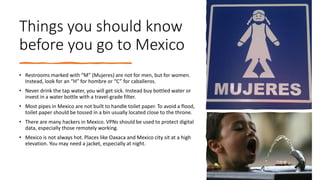
• Restrooms marked with “M” (Mujeres) are not for men, but for women.
Instead, look for an “H” for hombre or “C” for caballeros.
• Never drink the tap water, you will get sick. Instead buy bottled water or
invest in a water bottle with a travel-grade filter.
• Most pipes in Mexico are not built to handle toilet paper. To avoid a flood,
toilet paper should be tossed in a bin usually located close to the throne.
• There are many hackers in Mexico. VPNs should be used to protect digital
data, especially those remotely working.
• Mexico is not always hot. Places like Oaxaca and Mexico city sit at a high
elevation. You may need a jacket, especially at night.
Conclusion
My research has shown me that Mexico is a beautiful country, that is rich in
tradition and culture. In conclusion, below are some of the key takeaways I
learned from this project.
• The Caribbean Sea, the Gulf of Mexico, and the Pacific Ocean are bodies of water that border
Mexico.
• Mexico has a rich history spanning over 10,000 years.
• Mexico is a federal republic. The head of the executive is the President of Mexico.
• As of 2020 the population of Mexico is 128,932,753.
• The Mexican currency is called Peso. Both the US Dollar and the Peso have origins from the 15-
19th century Spanish Dollar.
• The primary language in Mexico is Spanish where 92.7% of the population speak Spanish.
• The primary religion that can be found in Mexico is Roman Catholic.
• Dia De Los Muertos: Day of the dead is a 2-day holiday in Mexico. This day is meant to honor
deceased family and friends. It takes place on November 1st and 2nd.
• Cinco de Mayo: This very important celebration in Mexican culture commemorates Mexico’s
victory over France in 1862.
• Never drink the tap water, you will get sick. Instead buy bottled water or invest in a water bottle
with a travel-grade filter.
References
6 Unique Mexican Customs To Experience Anywhere. (2021, December). Retrieved from Benitos Mexican: https://benitosmexican.com/news/6-unique-mexican-
traditions/#:~:text=1%20Dia%20De%20Los%20Muertos.%20Dia%20de%20Los,hold%20candy%2C%20small%20trinkets%2C%20or%20other%20goods.%20
Briney, A. (2019, September 4). What You Need to Know About Mexico. Retrieved from ThoughtCo.: https://www.thoughtco.com/geography-of-mexico-
1435215#:~:text=Mexico%20has%20a%20highly%20varied%20topography%20that%20consists,variable%2C%20but%20it%20is%20mainly%20tropical%20or%20desert.
Brock McDade, R. (2021). MexPro. Retrieved from Learn About the Geography of Mexico: https://www.mexpro.com/mexico/learn/mexico-geography.html
Durio, S. (2018, October 03). The Mexican Business Culture: What to Know About Doing Business in Mexico. Retrieved from Worldwide ERC:
https://www.worldwideerc.org/news/ask-the-expert/the-mexican-business-culture-what-to-know-about-doing-business-in-mexico
Editors, H. (2020, November 23). Mexico Timeline. Retrieved from History.Com: https://www.history.com/topics/mexico/mexico-timeline
Hake, N. (2021, November 25). 22 Mexico Travel Tips to Know BEFORE Travel [2022]. Retrieved from Travel Lemming: https://travellemming.com/mexico-travel-tips/
Indelicato, D. (2021, July 8). What Are the Main Languages Spoken in Mexico? Retrieved from Pickwriters: https://pickwriters.com/blog/languages-spoken-in-mexico
Mexico Demographics. (2021, December). Retrieved from Worldometer: https://www.worldometers.info/demographics/mexico-demographics/
Mexico, I. (2017, MAy 12). Mexican Currency Bills & Coins. Retrieved from Inside Mexico: https://www.inside-mexico.com/mexican-currency-bills-coins/
Mexico, I. (2018, November 25). Who is the Mexican President. Retrieved from Inside Mexico: https://www.inside-mexico.com/who-is-the-mexican-president/
Misachi, J. (2019, August 12). Religious Beliefs In Mexico. Retrieved from WorldAtlas: https://www.worldatlas.com/articles/religious-beliefs-in-mexico.html
Political Parties in Mexico. (2021, December). Retrieved from Baker Institiute: https://www.bakerinstitute.org/political-parties-mexico/
Sawe, B. E. (2019, August 19). What Type Of Government Does Mexico Have? Retrieved from World Atlas: https://www.worldatlas.com/articles/what-type-of-
government-does-mexico-
have.html#:~:text=What%20Type%20Of%20Government%20Does%20Mexico%20Have%3F%201,Of%20Mexico.%20...%205%20Administration%20Of%20Mexico.%20
timeanddate. (2021). Retrieved from Time Zones in Mexico: https://www.timeanddate.com/time/zone/mexico

Final Project - Global Leadership12.14.pptx

  • 1.
    Mexico Global Leadership FinalProject. This Photo by Unknown Author is licensed under CC BY-SA
  • 2.
    Geography & Topography/Time Zones •Mexico is in North America, south of the United States. • The Caribbean Sea, the Gulf of Mexico, and the Pacific Ocean are bodies of water that border Mexico • Mexico has a varied topography that consists of mountains with high elevations, deserts, high plateaus, and low coastal plains. • Its highest point is at 18,700 feet (5,700 m) while its lowest is -33 feet (-10 m). • The country has different types of terrains: • Deep canyons and high mountains in the center • Deserts in the northern part of the country • Rain forests in the South Time Zones • Mexico has multiple time zones across the country including Central Standard Time, Mountain Time, Pacific Standard Time and Eastern Standard time that correlate to those of the United States • The Standard time was introduced in 1922 where Mexico turned the clocks back by 23 minutes 24 seconds so the local time would be exactly 7 hours behind GMT. In 1928, clocks in Mexico City were advanced to 1 hour to match CST.
  • 3.
    Historical and LeadershipInfluences • Mexico has a rich history spanning over 10,000 years. Influences on its current society and landscape directly resulted from earlier civilizations in the region. • In 8000 B.C. The first humans begin cultivating plants in the new world. Over thousands of years, agriculture develops and becomes the basis for the first villages of Mesoamerica. • In 1500 B.C. The Olmecs, the first major Mesoamerican civilization grows from the earlier villages. This period is known for its successful cultivation of corn (maize), beans, cotton, peppers, as well as its graphic symbols used for recording its history. • In 600 B.C. Olmec leadership and dominance can be seen in regional groups such as the Mayans, Totonac, Zapotec, and Teotihuacan. These groups all share a common Olmec heritage. • México's leadership has come in several forms in the past. Today its leadership rests with its Head of State. This person controls executive power. Previously this power belonged to the Emperor of Mexico during monarchical rule.
  • 4.
    Political/Governmental/legal influences • Mexico isa federal republic. The head of the executive is the President of Mexico. • The President is elected by an absolute majority of its federal districts and 31 states. • The current Mexican president is Andres Manuel Lopez Obrador (pictured on the right). His term began on December 1, 2018, as Mexico’s 58th president. The term last 6 years with no re-election. • Mexico is bicameral in its congress. It includes a Senate and Chamber of Deputies. • The Judiciary heads Mexico’s judicial system. This system includes both state and federal levels. • There are several Mexican political parties such as Partido Revolucionario Institucional (PRI), Partido De Accion Nacional (PAN), Partido Revolucionario Democratico (PRD), Partido Del Trabajo (PT), Partido Verde Ecologista (PVEM), Partido Nueva Alianza (PANAL), Movimento Ciudadano, Movimiento De Regeneracion Nacional (MORENA), and Partido Encuentro Social (PES).
  • 5.
    Demographic information • As of2020 the population of Mexico is 128,932,753. • The Total fertility Rate (TFR) is 2.1. This represents replacement-level Fertility. • Life expectancy in Mexico is 78.2 years for females and 72.6 years for males. • The infant mortality rate is 12.5 (per 1,000 births) • Mexico's urban population is 83.4 % • The largest city in Mexico City, with a population of 12,294,193. • The Mexican currency is called Peso. Both the US Dollar and the Peso have origins from the 15-19th century Spanish Dollar.
  • 6.
    Language Religion • The primarylanguage in Mexico is Spanish where 92.7% of the population speak Spanish • It is not the only language in the country that is spoken. There are also indigenous languages that are found among the ingenious tribes. Examples of these are Nahuatl, Totonac, Mazatec, Mixtec, Zapotec to name a few of the 69 official Mexican languages The picture to the left shows the different types of languages spoken The picture to the right is one of the many Catholic Cathedrals • The primary religion that can be found in Mexico is Roman Catholic. • 82.7% of the population are associated with this. • After independence in the 19th century, a legal framework was established to promote the affairs of the Catholic Church • 6.6% of the population follow Pentecostal, Evangelical, and other Mainline Protestant Christianity. • 4.7% of the Mexican population are either atheist or agnostic
  • 7.
    Cultural values • DiaDe Los Muertos: Day of the dead is a 2-day holiday in Mexico. This day is meant to honor deceased family and friends. It takes place on November 1st and 2nd. • Las Posadas: This is a celebration commemorating Mary and Joseph that takes place in December. Food, drink, and the carrying of statues of Mary and Joseph are traditions. • Siestas: A Mexican tradition of taking short naps in the afternoon. These are usually taken after a mid- day meal. • Cinco de Mayo: This very important celebration in Mexican culture commemorates Mexico’s victory over France in 1862.
  • 8.
    Common Business Practices • Itis important to speak the language. This does not just mean Spanish but also understanding the business language. Warmth and kindness do not necessarily mean a deal will move forward. It is important to look for non-verbal cues and read body language as well. • Family and personal relationships are very important in Mexico. It is not uncommon for business and personal relationships to be mixed. • Time is considered flexible. Do not be surprised if meetings or lunches run late. In many cases, relationships are being built and business is conducted at the end.
  • 9.
    Things you shouldknow before you go to Mexico • Restrooms marked with “M” (Mujeres) are not for men, but for women. Instead, look for an “H” for hombre or “C” for caballeros. • Never drink the tap water, you will get sick. Instead buy bottled water or invest in a water bottle with a travel-grade filter. • Most pipes in Mexico are not built to handle toilet paper. To avoid a flood, toilet paper should be tossed in a bin usually located close to the throne. • There are many hackers in Mexico. VPNs should be used to protect digital data, especially those remotely working. • Mexico is not always hot. Places like Oaxaca and Mexico city sit at a high elevation. You may need a jacket, especially at night.
  • 10.
    Conclusion My research hasshown me that Mexico is a beautiful country, that is rich in tradition and culture. In conclusion, below are some of the key takeaways I learned from this project. • The Caribbean Sea, the Gulf of Mexico, and the Pacific Ocean are bodies of water that border Mexico. • Mexico has a rich history spanning over 10,000 years. • Mexico is a federal republic. The head of the executive is the President of Mexico. • As of 2020 the population of Mexico is 128,932,753. • The Mexican currency is called Peso. Both the US Dollar and the Peso have origins from the 15- 19th century Spanish Dollar. • The primary language in Mexico is Spanish where 92.7% of the population speak Spanish. • The primary religion that can be found in Mexico is Roman Catholic. • Dia De Los Muertos: Day of the dead is a 2-day holiday in Mexico. This day is meant to honor deceased family and friends. It takes place on November 1st and 2nd. • Cinco de Mayo: This very important celebration in Mexican culture commemorates Mexico’s victory over France in 1862. • Never drink the tap water, you will get sick. Instead buy bottled water or invest in a water bottle with a travel-grade filter.
  • 11.
    References 6 Unique MexicanCustoms To Experience Anywhere. (2021, December). Retrieved from Benitos Mexican: https://benitosmexican.com/news/6-unique-mexican- traditions/#:~:text=1%20Dia%20De%20Los%20Muertos.%20Dia%20de%20Los,hold%20candy%2C%20small%20trinkets%2C%20or%20other%20goods.%20 Briney, A. (2019, September 4). What You Need to Know About Mexico. Retrieved from ThoughtCo.: https://www.thoughtco.com/geography-of-mexico- 1435215#:~:text=Mexico%20has%20a%20highly%20varied%20topography%20that%20consists,variable%2C%20but%20it%20is%20mainly%20tropical%20or%20desert. Brock McDade, R. (2021). MexPro. Retrieved from Learn About the Geography of Mexico: https://www.mexpro.com/mexico/learn/mexico-geography.html Durio, S. (2018, October 03). The Mexican Business Culture: What to Know About Doing Business in Mexico. Retrieved from Worldwide ERC: https://www.worldwideerc.org/news/ask-the-expert/the-mexican-business-culture-what-to-know-about-doing-business-in-mexico Editors, H. (2020, November 23). Mexico Timeline. Retrieved from History.Com: https://www.history.com/topics/mexico/mexico-timeline Hake, N. (2021, November 25). 22 Mexico Travel Tips to Know BEFORE Travel [2022]. Retrieved from Travel Lemming: https://travellemming.com/mexico-travel-tips/ Indelicato, D. (2021, July 8). What Are the Main Languages Spoken in Mexico? Retrieved from Pickwriters: https://pickwriters.com/blog/languages-spoken-in-mexico Mexico Demographics. (2021, December). Retrieved from Worldometer: https://www.worldometers.info/demographics/mexico-demographics/ Mexico, I. (2017, MAy 12). Mexican Currency Bills & Coins. Retrieved from Inside Mexico: https://www.inside-mexico.com/mexican-currency-bills-coins/ Mexico, I. (2018, November 25). Who is the Mexican President. Retrieved from Inside Mexico: https://www.inside-mexico.com/who-is-the-mexican-president/ Misachi, J. (2019, August 12). Religious Beliefs In Mexico. Retrieved from WorldAtlas: https://www.worldatlas.com/articles/religious-beliefs-in-mexico.html Political Parties in Mexico. (2021, December). Retrieved from Baker Institiute: https://www.bakerinstitute.org/political-parties-mexico/ Sawe, B. E. (2019, August 19). What Type Of Government Does Mexico Have? Retrieved from World Atlas: https://www.worldatlas.com/articles/what-type-of- government-does-mexico- have.html#:~:text=What%20Type%20Of%20Government%20Does%20Mexico%20Have%3F%201,Of%20Mexico.%20...%205%20Administration%20Of%20Mexico.%20 timeanddate. (2021). Retrieved from Time Zones in Mexico: https://www.timeanddate.com/time/zone/mexico