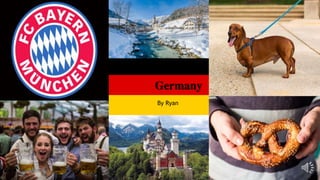
Germany
By Ryan
Location
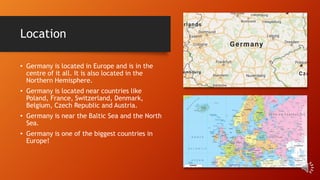
• Germany is located in Europe and is in the
centre of it all. It is also located in the
Northern Hemisphere.
• Germany is located near countries like
Poland, France, Switzerland, Denmark,
Belgium, Czech Republic and Austria.
• Germany is near the Baltic Sea and the North
Sea.
• Germany is one of the biggest countries in
Europe!
Demographics
• Economy-
• Biggest Import/Export: Machinery, Vehicles,
Chemicals and Data Processing Equipment
• Currency: Euros
• Type of Government: Federal
Parliamentary Republic
• Infant mortality rate: 3.4/1000 (Australia
is 4.3/1000)
• Poverty Rate: 16.7%
• Average Rate: 86.6%
Demographics
• Population-
• Population: 82.62 million
• Population Density: 235 per square kilometre
(Australia is 2.91)
• Religion-
• Religion: Roman Catholic 29% and Other is 36%
• Ethnicity: German 91.5% and Turkish 2.4%
• Language & Health-
• Language: German
• Literacy Rates: 99% (Australia is 99%)
• Physician Ratio: 4.13/1000 (Australia is 3.37/1000)
Physical Geography
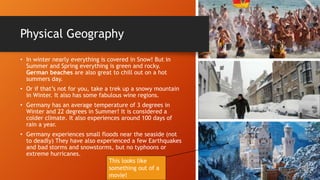
• In winter nearly everything is covered in Snow! But in
Summer and Spring everything is green and rocky.
German beaches are also great to chill out on a hot
summers day.
• Or if that’s not for you, take a trek up a snowy mountain
in Winter. It also has some fabulous wine regions.
• Germany has an average temperature of 3 degrees in
Winter and 22 degrees in Summer! It is considered a
colder climate. It also experiences around 100 days of
rain a year.
• Germany experiences small floods near the seaside (not
to deadly) They have also experienced a few Earthquakes
and bad storms and snowstorms, but no typhoons or
extreme hurricanes.
This looks like
something out of a
movie!
Top 3 Places you must visit!
1. Allianz Arena:
• Home to one of the world’s greatest soccer teams,
Bayern Munich. Allianz Arena looks like a spaceship
when lit up at night time! It is a great experience to
come and enjoy the vast space.
2. Neuschwanstein Castle:
• Take a step back in time with this marble-ous
creation. This towering castle dominates all
landscape with it’s high towers and distinctive white
walls.
• 3. The Berlin Wall
• A part of history, The Berlin Wall was a symbol of
communism, but is now known for freedom when
Germany reunified in 1990. This is a really
interesting place to visit as it talks about Germany’s
history in the war.
Festivals
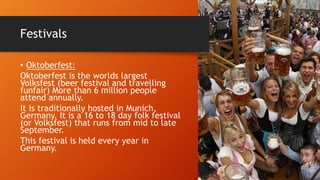
• Oktoberfest:
Oktoberfest is the worlds largest
Volksfest (beer festival and travelling
funfair) More than 6 million people
attend annually.
It is traditionally hosted in Munich,
Germany. It is a 16 to 18 day folk festival
(or Volksfest) that runs from mid to late
September.
This festival is held every year in
Germany.
Oktoberfest Origins
• This festival runs up to
German Unity Day which is
the celebration of the
reunification in 1990. The
celebration of Oktoberfest
began when King Ludwig I
married Princess Therese
of Saxe-Hilburghausen.
• The whole kingdom was
invited to celebrate this
royal wedding. They drank
beer and ate well, they
watched horse races and
many other acts and folk
dancing.
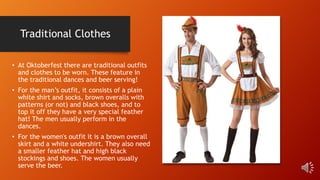
Traditional Clothes
• At Oktoberfest there are traditional outfits
and clothes to be worn. These feature in
the traditional dances and beer serving!
• For the man’s outfit, it consists of a plain
white shirt and socks, brown overalls with
patterns (or not) and black shoes, and to
top it off they have a very special feather
hat! The men usually perform in the
dances.
• For the women's outfit it is a brown overall
skirt and a white undershirt. They also need
a smaller feather hat and high black
stockings and shoes. The women usually
serve the beer.
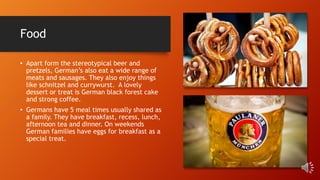
Food
• Apart form the stereotypical beer and
pretzels, German’s also eat a wide range of
meats and sausages. They also enjoy things
like schnitzel and currywurst. A lovely
dessert or treat is German black forest cake
and strong coffee.
• Germans have 5 meal times usually shared as
a family. They have breakfast, recess, lunch,
afternoon tea and dinner. On weekends
German families have eggs for breakfast as a
special treat.
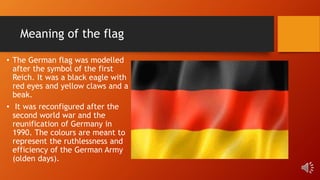
Meaning of the flag
• The German flag was modelled
after the symbol of the first
Reich. It was a black eagle with
red eyes and yellow claws and a
beak.
• It was reconfigured after the
second world war and the
reunification of Germany in
1990. The colours are meant to
represent the ruthlessness and
efficiency of the German Army
(olden days).
The 2nd World War
• During WW2, Hitler and his Nazi’s were
operating out of Berlin, Germany. Few
or none at all dared to challenge him or
his desires. After invading Poland and
Austria, German men were sent to fight
and had to leave their families.
• Many died in the war effort so when
Hitler was killed in 1945, German’s
were happy to lay down arms and find a
friendly solution. Many years later the
Berlin Wall was demolished and
Germany was reunified in 1990.
Bayern Munich
• Founded in 1900, Bayern have
been one of the biggest German
football teams. They are the
most successful German club in
German football. After winning
the European Cup 3 years in a
row (1974-76) they continued to
win their league and dominate
the competition all over Europe.
• Now in 2017 they have signed 2
new players and are currently
competing in the UEFA
Champions league, winning their
first game against Anderlecht 3-0
• They are truly one of the prides
of German football
Comparison to Australia
In Europe
GERMANY AUSTRALIA
Island
Continent
6 States
16 States
Republic Democratic
Participated
in the war
82.67 million people 24.13 million peopleMain Religion is
Catholic
It Snows
It has an
outback
Both in the UN
Australia DayOktoberfest
Both have a
soccer league!
Independent
Founded by the
UKNative Dogs
Both hosted the
Olympics
Suffered a
Civil War.
(Nazis)
Suffered
Cronulla Riots
Kangaroos!
Bibliography
• https://en.wikipedia.org/wiki/Germany
• http://www.oktoberfest.de/en/
• https://www.cia.gov/library/publications/the-world-factbook/
• https://www.currentresults.com/Weather/Germany/average-
yearly-precipitation.php
• https://www.quora.com/What-type-of-natural-disasters-have-
occured-in-Germany
• https://en.wikipedia.org/wiki/Oktoberfest
• https://en.wikipedia.org/wiki/Early_timeline_of_Nazism
Bibliography Part 2
• https://en.wikipedia.org/wiki/Death_of_Adolf_Hitler

Germany

  • 1.
  • 2.
    Location • Germany islocated in Europe and is in the centre of it all. It is also located in the Northern Hemisphere. • Germany is located near countries like Poland, France, Switzerland, Denmark, Belgium, Czech Republic and Austria. • Germany is near the Baltic Sea and the North Sea. • Germany is one of the biggest countries in Europe!
  • 3.
    Demographics • Economy- • BiggestImport/Export: Machinery, Vehicles, Chemicals and Data Processing Equipment • Currency: Euros • Type of Government: Federal Parliamentary Republic • Infant mortality rate: 3.4/1000 (Australia is 4.3/1000) • Poverty Rate: 16.7% • Average Rate: 86.6%
  • 4.
    Demographics • Population- • Population:82.62 million • Population Density: 235 per square kilometre (Australia is 2.91) • Religion- • Religion: Roman Catholic 29% and Other is 36% • Ethnicity: German 91.5% and Turkish 2.4% • Language & Health- • Language: German • Literacy Rates: 99% (Australia is 99%) • Physician Ratio: 4.13/1000 (Australia is 3.37/1000)
  • 5.
    Physical Geography • Inwinter nearly everything is covered in Snow! But in Summer and Spring everything is green and rocky. German beaches are also great to chill out on a hot summers day. • Or if that’s not for you, take a trek up a snowy mountain in Winter. It also has some fabulous wine regions. • Germany has an average temperature of 3 degrees in Winter and 22 degrees in Summer! It is considered a colder climate. It also experiences around 100 days of rain a year. • Germany experiences small floods near the seaside (not to deadly) They have also experienced a few Earthquakes and bad storms and snowstorms, but no typhoons or extreme hurricanes. This looks like something out of a movie!
  • 6.
    Top 3 Placesyou must visit! 1. Allianz Arena: • Home to one of the world’s greatest soccer teams, Bayern Munich. Allianz Arena looks like a spaceship when lit up at night time! It is a great experience to come and enjoy the vast space. 2. Neuschwanstein Castle: • Take a step back in time with this marble-ous creation. This towering castle dominates all landscape with it’s high towers and distinctive white walls. • 3. The Berlin Wall • A part of history, The Berlin Wall was a symbol of communism, but is now known for freedom when Germany reunified in 1990. This is a really interesting place to visit as it talks about Germany’s history in the war.
  • 7.
    Festivals • Oktoberfest: Oktoberfest isthe worlds largest Volksfest (beer festival and travelling funfair) More than 6 million people attend annually. It is traditionally hosted in Munich, Germany. It is a 16 to 18 day folk festival (or Volksfest) that runs from mid to late September. This festival is held every year in Germany.
  • 8.
    Oktoberfest Origins • Thisfestival runs up to German Unity Day which is the celebration of the reunification in 1990. The celebration of Oktoberfest began when King Ludwig I married Princess Therese of Saxe-Hilburghausen. • The whole kingdom was invited to celebrate this royal wedding. They drank beer and ate well, they watched horse races and many other acts and folk dancing.
  • 9.
    Traditional Clothes • AtOktoberfest there are traditional outfits and clothes to be worn. These feature in the traditional dances and beer serving! • For the man’s outfit, it consists of a plain white shirt and socks, brown overalls with patterns (or not) and black shoes, and to top it off they have a very special feather hat! The men usually perform in the dances. • For the women's outfit it is a brown overall skirt and a white undershirt. They also need a smaller feather hat and high black stockings and shoes. The women usually serve the beer.
  • 10.
    Food • Apart formthe stereotypical beer and pretzels, German’s also eat a wide range of meats and sausages. They also enjoy things like schnitzel and currywurst. A lovely dessert or treat is German black forest cake and strong coffee. • Germans have 5 meal times usually shared as a family. They have breakfast, recess, lunch, afternoon tea and dinner. On weekends German families have eggs for breakfast as a special treat.
  • 11.
    Meaning of theflag • The German flag was modelled after the symbol of the first Reich. It was a black eagle with red eyes and yellow claws and a beak. • It was reconfigured after the second world war and the reunification of Germany in 1990. The colours are meant to represent the ruthlessness and efficiency of the German Army (olden days).
  • 12.
    The 2nd WorldWar • During WW2, Hitler and his Nazi’s were operating out of Berlin, Germany. Few or none at all dared to challenge him or his desires. After invading Poland and Austria, German men were sent to fight and had to leave their families. • Many died in the war effort so when Hitler was killed in 1945, German’s were happy to lay down arms and find a friendly solution. Many years later the Berlin Wall was demolished and Germany was reunified in 1990.
  • 13.
    Bayern Munich • Foundedin 1900, Bayern have been one of the biggest German football teams. They are the most successful German club in German football. After winning the European Cup 3 years in a row (1974-76) they continued to win their league and dominate the competition all over Europe. • Now in 2017 they have signed 2 new players and are currently competing in the UEFA Champions league, winning their first game against Anderlecht 3-0 • They are truly one of the prides of German football
  • 14.
    Comparison to Australia InEurope GERMANY AUSTRALIA Island Continent 6 States 16 States Republic Democratic Participated in the war 82.67 million people 24.13 million peopleMain Religion is Catholic It Snows It has an outback Both in the UN Australia DayOktoberfest Both have a soccer league! Independent Founded by the UKNative Dogs Both hosted the Olympics Suffered a Civil War. (Nazis) Suffered Cronulla Riots Kangaroos!
  • 15.
    Bibliography • https://en.wikipedia.org/wiki/Germany • http://www.oktoberfest.de/en/ •https://www.cia.gov/library/publications/the-world-factbook/ • https://www.currentresults.com/Weather/Germany/average- yearly-precipitation.php • https://www.quora.com/What-type-of-natural-disasters-have- occured-in-Germany • https://en.wikipedia.org/wiki/Oktoberfest • https://en.wikipedia.org/wiki/Early_timeline_of_Nazism
  • 16.
    Bibliography Part 2 •https://en.wikipedia.org/wiki/Death_of_Adolf_Hitler