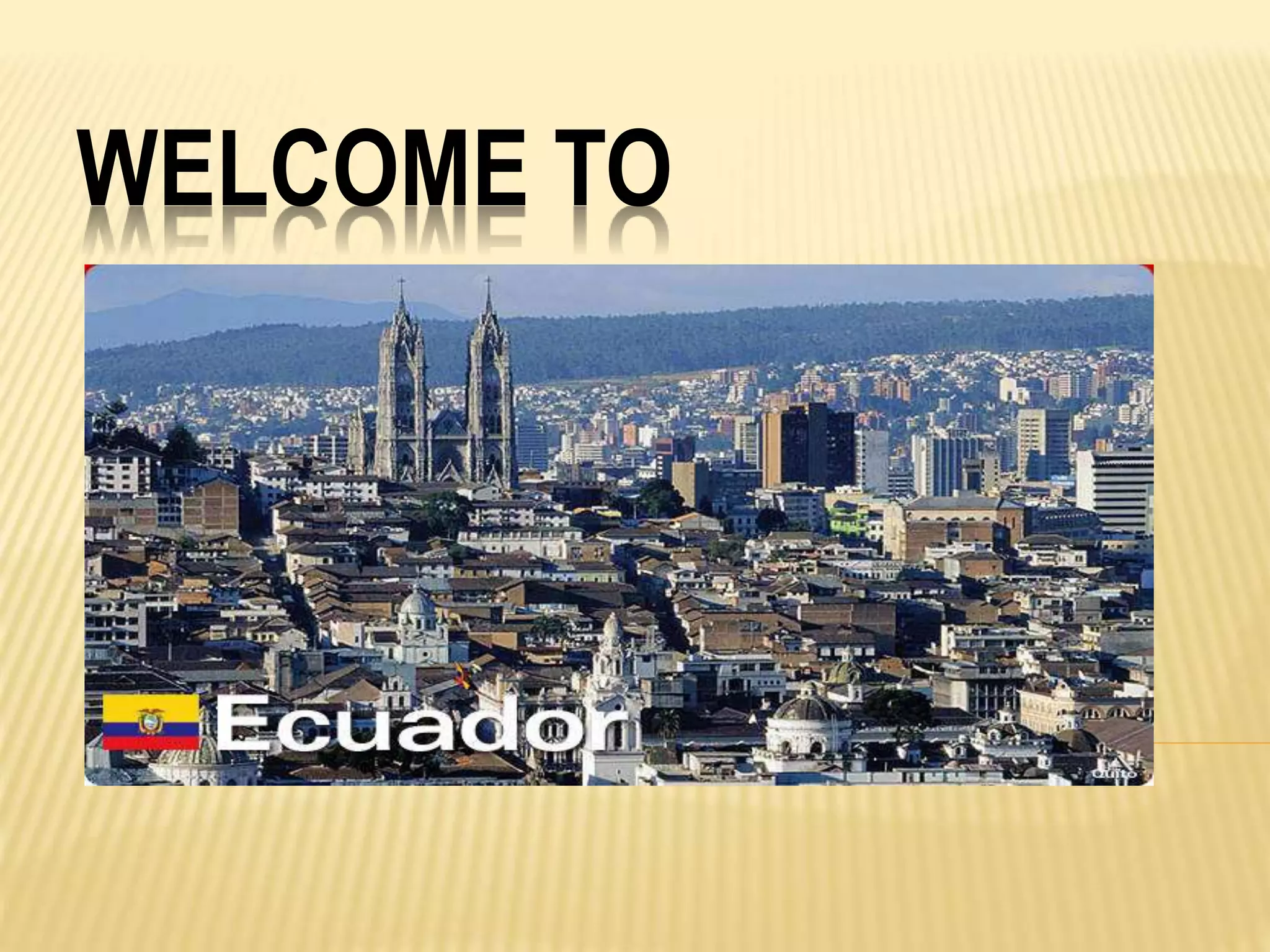
WELCOME TO
ECUADOR 
 Ecuador , officially the Republic of Ecuador (Spanish: República del Ecuador, 
which literally translates as "Republic of the Equator ") is a representative 
democratic republic in South America, bordered by Colombia on the 
north, Peru on the east and south, and by the Pacific Ocean to the west. It 
and Chile are the only two countries in South America that do not have a border 
with Brazil. Ecuador also includes the Galápagos Islands in the Pacific, about 
1,000 kilometers (620 mi) west of the mainland. 
 Ecuador is a presidential republic and became independent in 1830, after having 
been part of the Spanish colonial empire, and for a much shorter time of the 
republic of Grand Colombia.
CAPITAL : QUITO 
 Quito formally San Francisco de Quito is capital city of Ecuador, and 
at an elevation of 9,350 feet (2,800 meters above sea level), it is the 
highest capital city in the world housing the administrative, legislative and 
judicial functions. It is located in north-central Ecuador in 
the Guayllabamba river, basin the eastern slopes of Pichincha, an 
active stratovolcano in the Andes mountains. With a population of 
2,239,191 according to the last census (2010), Quito is the second most 
populous city in Ecuador, after Guayaquil . It is also the capital of the 
Pichincha province and the seat of Metropolitan District of Quito. The 
canton recorded a population of 1,842,201 residents in the 2001 national 
census. In 2008, the city was designated as the headquarters of 
the Union of South American Nations.
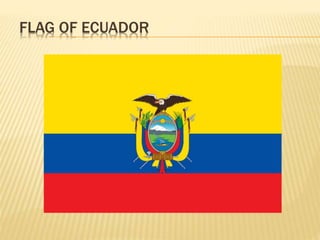
FLAG OF ECUADOR
ECUADOR FLAG COLORS MEANING 
 The flag of Ecuador, which consists of horizontal bands of yellow 
(double width), blue and red, was first adopted on 1835 and later on 
September 26, 1860. The design of the current flag was finalized in 
1900 with the addition of the coat of arms in the center of the flag. 
Before using the yellow, blue and red tricolor, Ecuador used white 
and blue flags that contained stars for each province of the country. 
The design of the flag is very similar to Colombia and Venezuela, 
which are also former constituent territories of Gran Colombia. 
 Ecuadorian flag evolved from those of the flag of the nation of Gran 
Colombia, which encompassed the territories of modern-day 
Ecuador, Colombia and Venezuela. The colors have the following 
meanings: 
 Yellow: The Sun and the Gold of the ancestors. 
 Blue: The ocean and the clear skies 
 Red: The blood spilled by the heroes who died in the name of their 
countrymen's Fatherland and Freedom.
FLAG CARRIER 
 TAME (TAME EP Linea Aerea del Ecuador), is the flag 
carrier of Ecuador (Aerolinea Bandera) with its headquarters 
located in Quito, Pichincha. Its largest hub is Mariscal 
Sucre International Airport. It is the largest airline 
in Ecuador.
MONETARY UNIT AND LANGUAGE OF 
ECUADOR 
 The present currency of Ecuador is the United 
States Dollar. 
 The predominant and official language is Spanish, 
in addition to Quechua and other pre-colonial 
American languages. 2,300,000 speakers of 
American Indian languages .
CULTURE OF ECUADOR 
 The population is a mix of Mestizo (mixed Amerindian and white), 
Amerindian, Spanish and Blacks. 3%. There are more than 14 indigenous 
groups on the mainland each with their own identities and nuances. 
 Ecuador can be split up into four parts, geographically; the Costa (coast), 
the Sierra (highlands), and El Oriente (the east; which includes the 
Amazonic region). The Galápagos Islands, or Archipiélago de Colón, also 
belong to Ecuador. 
 Ecuadorians place great importance on the family, 
both nuclear and extended. Unlike in much of the west, where the elderly 
are often placed in care facilities, elderly Ecuadorians will often live with one 
of their children.. 
 Godparents are also far more important in Ecuador than in other western 
countries, and they are expected to provide both financial and psychological 
support to their godchildren. Precisely for that reason, Ecuadorians with 
marital troubles will often ask their godparents for advice.
 Families are formed in at least one of the following two ways: Civil Marriage (which 
is the legal form of formalizing a bond between a man and woman, which all married 
couples are required to undergo) and the Free Union (where a man and woman 
decide to form a family, without undergoing any official ceremony). The Ecuadorian 
Constitution accords the members of a Free Union family, the same rights and 
duties as any other legally constituted family. 
 Women, are generally responsible for the upbringing and care of children, and of 
husbands in Ecuador, and traditionally, men have taken a completely inactive role in 
this area. Recently, this has begun to change, due to the fact that more and more 
women are joining the workforce, which has resulted in men doing a little 
housework, and becoming slightly involved in the care of their children. 
 Carnivals and festivals, usually featuring many traditional games and fun, are also 
varied through the country, and are highly anticipated by the population. Some 
regions celebrate mask carnivals, while others have no official customs, yet all of 
them are related to a mixture of Amerindian and Catholic beliefs.
RELIGION 
 Since the Spanish colonization, Ecuador became 
a Roman Catholic country. The Catholic Church had 
and still has an important place in the Ecuadorian 
government and society. After the Constitution of 
1869, the official religion became Catholicism and 
only Catholics could obtain citizenship. 
 Roman Catholic 95%, others 5%
FACTS! 
 Football is the most popular sport in Ecuador. 
 The main industries in Ecuador are petroleum, food 
processing and textiles. 
 Ecuador was the first nation in 2008 to declare that nature 
has constitutional rights. 
 Ecuador’s Independence Day is on August 10th. 
 That Ecuador was one of three countries that emerged from 
the collapse of The Gran Colombia in 1829 (the others 
are Colombia and Venezuela). 
 Close to 95% of Ecuadorians are Roman Catholic, although 
the indigenous population blend Christian beliefs with ancient 
indigenous customs.
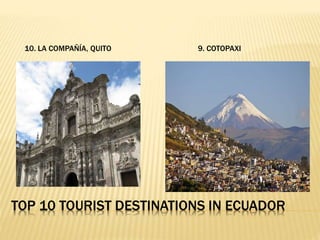
10. LA COMPAÑÍA, QUITO 9. COTOPAXI 
TOP 10 TOURIST DESTINATIONS IN ECUADOR
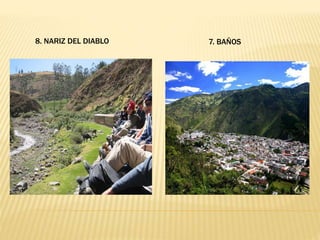
8. NARIZ DEL DIABLO 7. BAÑOS
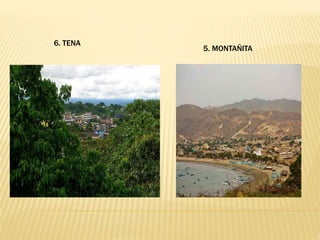
6. TENA 
5. MONTAÑITA
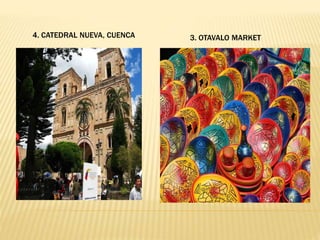
4. CATEDRAL NUEVA, CUENCA 3. OTAVALO MARKET
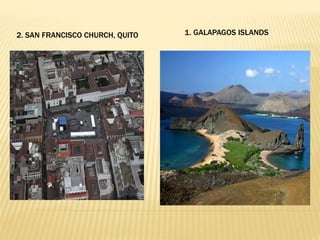
2. SAN FRANCISCO CHURCH, QUITO 1. GALAPAGOS ISLANDS
FAMOUS PEOPLE BORN IN ECUADOR 
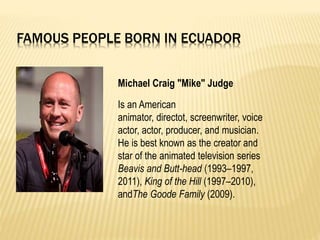
Michael Craig "Mike" Judge 
Is an American 
animator, directot, screenwriter, voice 
actor, actor, producer, and musician. 
He is best known as the creator and 
star of the animated television series 
Beavis and Butt-head (1993–1997, 
2011), King of the Hill (1997–2010), 
andThe Goode Family (2009).
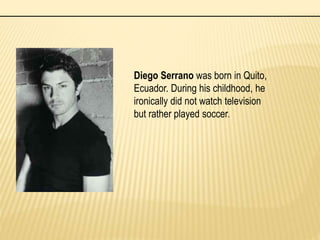
Diego Serrano was born in Quito, 
Ecuador. During his childhood, he 
ironically did not watch television 
but rather played soccer.
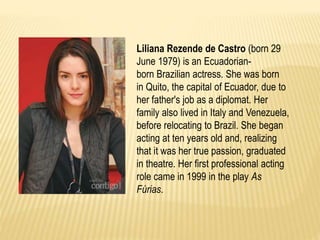
Liliana Rezende de Castro (born 29 
June 1979) is an Ecuadorian-born 
Brazilian actress. She was born 
in Quito, the capital of Ecuador, due to 
her father's job as a diplomat. Her 
family also lived in Italy and Venezuela, 
before relocating to Brazil. She began 
acting at ten years old and, realizing 
that it was her true passion, graduated 
in theatre. Her first professional acting 
role came in 1999 in the play As 
Fúrias.
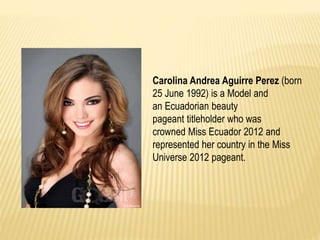
Carolina Andrea Aguirre Perez (born 
25 June 1992) is a Model and 
an Ecuadorian beauty 
pageant titleholder who was 
crowned Miss Ecuador 2012 and 
represented her country in the Miss 
Universe 2012 pageant.
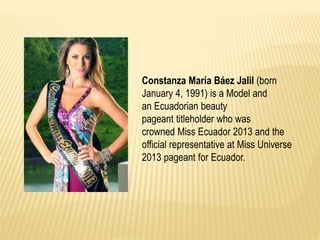
Constanza María Báez Jalil (born 
January 4, 1991) is a Model and 
an Ecuadorian beauty 
pageant titleholder who was 
crowned Miss Ecuador 2013 and the 
official representative at Miss Universe 
2013 pageant for Ecuador.
ECUADORIAN CUISINE 
 Ecuadorian cuisine is diverse, varying with altitude, and associated 
agricultural conditions. Pork, chicken, beef, and cuy (guinea pig) are 
popular in the mountainous regions, and are served with a variety of 
carbohydrate-rich foods, especially rice, corn, and potatoes. A 
popular street food in mountainous regions is hornado, consisting of 
potatoes served with roasted pig. 
 (Typical Meal) Ecuadorian cuisine traditionally consists of two dishes, a 
soup and a rice platter. For the most part, Ecuador is known not only for 
its bananas, and all the dishes made from them, but for its starch 
consumption of products like potato, bread, rice, and yuca. Traditionally 
any of these factors can be found in either the soup or the rice platter that 
may be served.
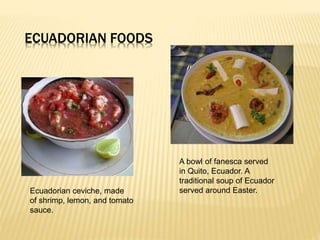
ECUADORIAN FOODS 
Ecuadorian ceviche, made 
of shrimp, lemon, and tomato 
sauce. 
A bowl of fanesca served 
in Quito, Ecuador. A 
traditional soup of Ecuador 
served around Easter.
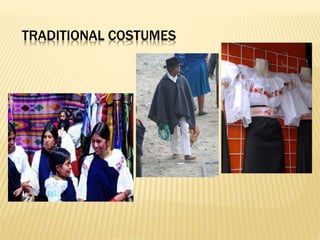
TRADITIONAL DRESS AND CLOTHING OF 
ECUADOR 
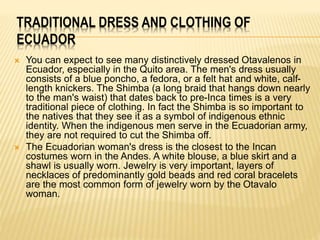
 You can expect to see many distinctively dressed Otavalenos in 
Ecuador, especially in the Quito area. The men's dress usually 
consists of a blue poncho, a fedora, or a felt hat and white, calf-length 
knickers. The Shimba (a long braid that hangs down nearly 
to the man's waist) that dates back to pre-Inca times is a very 
traditional piece of clothing. In fact the Shimba is so important to 
the natives that they see it as a symbol of indigenous ethnic 
identity. When the indigenous men serve in the Ecuadorian army, 
they are not required to cut the Shimba off. 
 The Ecuadorian woman's dress is the closest to the Incan 
costumes worn in the Andes. A white blouse, a blue skirt and a 
shawl is usually worn. Jewelry is very important, layers of 
necklaces of predominantly gold beads and red coral bracelets 
are the most common form of jewelry worn by the Otavalo 
woman.
TRADITIONAL COSTUMES
Prepared by : Kristine Anne Fe S. Garcia 
BS Tourism 2 
THANK YOU FOR LISTENING 

Welcome to ECUADOR!

  • 1.
  • 2.
    ECUADOR  Ecuador, officially the Republic of Ecuador (Spanish: República del Ecuador, which literally translates as "Republic of the Equator ") is a representative democratic republic in South America, bordered by Colombia on the north, Peru on the east and south, and by the Pacific Ocean to the west. It and Chile are the only two countries in South America that do not have a border with Brazil. Ecuador also includes the Galápagos Islands in the Pacific, about 1,000 kilometers (620 mi) west of the mainland.  Ecuador is a presidential republic and became independent in 1830, after having been part of the Spanish colonial empire, and for a much shorter time of the republic of Grand Colombia.
  • 3.
    CAPITAL : QUITO  Quito formally San Francisco de Quito is capital city of Ecuador, and at an elevation of 9,350 feet (2,800 meters above sea level), it is the highest capital city in the world housing the administrative, legislative and judicial functions. It is located in north-central Ecuador in the Guayllabamba river, basin the eastern slopes of Pichincha, an active stratovolcano in the Andes mountains. With a population of 2,239,191 according to the last census (2010), Quito is the second most populous city in Ecuador, after Guayaquil . It is also the capital of the Pichincha province and the seat of Metropolitan District of Quito. The canton recorded a population of 1,842,201 residents in the 2001 national census. In 2008, the city was designated as the headquarters of the Union of South American Nations.
  • 4.
  • 5.
    ECUADOR FLAG COLORSMEANING  The flag of Ecuador, which consists of horizontal bands of yellow (double width), blue and red, was first adopted on 1835 and later on September 26, 1860. The design of the current flag was finalized in 1900 with the addition of the coat of arms in the center of the flag. Before using the yellow, blue and red tricolor, Ecuador used white and blue flags that contained stars for each province of the country. The design of the flag is very similar to Colombia and Venezuela, which are also former constituent territories of Gran Colombia.  Ecuadorian flag evolved from those of the flag of the nation of Gran Colombia, which encompassed the territories of modern-day Ecuador, Colombia and Venezuela. The colors have the following meanings:  Yellow: The Sun and the Gold of the ancestors.  Blue: The ocean and the clear skies  Red: The blood spilled by the heroes who died in the name of their countrymen's Fatherland and Freedom.
  • 6.
    FLAG CARRIER TAME (TAME EP Linea Aerea del Ecuador), is the flag carrier of Ecuador (Aerolinea Bandera) with its headquarters located in Quito, Pichincha. Its largest hub is Mariscal Sucre International Airport. It is the largest airline in Ecuador.
  • 7.
    MONETARY UNIT ANDLANGUAGE OF ECUADOR  The present currency of Ecuador is the United States Dollar.  The predominant and official language is Spanish, in addition to Quechua and other pre-colonial American languages. 2,300,000 speakers of American Indian languages .
  • 8.
    CULTURE OF ECUADOR  The population is a mix of Mestizo (mixed Amerindian and white), Amerindian, Spanish and Blacks. 3%. There are more than 14 indigenous groups on the mainland each with their own identities and nuances.  Ecuador can be split up into four parts, geographically; the Costa (coast), the Sierra (highlands), and El Oriente (the east; which includes the Amazonic region). The Galápagos Islands, or Archipiélago de Colón, also belong to Ecuador.  Ecuadorians place great importance on the family, both nuclear and extended. Unlike in much of the west, where the elderly are often placed in care facilities, elderly Ecuadorians will often live with one of their children..  Godparents are also far more important in Ecuador than in other western countries, and they are expected to provide both financial and psychological support to their godchildren. Precisely for that reason, Ecuadorians with marital troubles will often ask their godparents for advice.
  • 9.
     Families areformed in at least one of the following two ways: Civil Marriage (which is the legal form of formalizing a bond between a man and woman, which all married couples are required to undergo) and the Free Union (where a man and woman decide to form a family, without undergoing any official ceremony). The Ecuadorian Constitution accords the members of a Free Union family, the same rights and duties as any other legally constituted family.  Women, are generally responsible for the upbringing and care of children, and of husbands in Ecuador, and traditionally, men have taken a completely inactive role in this area. Recently, this has begun to change, due to the fact that more and more women are joining the workforce, which has resulted in men doing a little housework, and becoming slightly involved in the care of their children.  Carnivals and festivals, usually featuring many traditional games and fun, are also varied through the country, and are highly anticipated by the population. Some regions celebrate mask carnivals, while others have no official customs, yet all of them are related to a mixture of Amerindian and Catholic beliefs.
  • 10.
    RELIGION  Sincethe Spanish colonization, Ecuador became a Roman Catholic country. The Catholic Church had and still has an important place in the Ecuadorian government and society. After the Constitution of 1869, the official religion became Catholicism and only Catholics could obtain citizenship.  Roman Catholic 95%, others 5%
  • 11.
    FACTS!  Footballis the most popular sport in Ecuador.  The main industries in Ecuador are petroleum, food processing and textiles.  Ecuador was the first nation in 2008 to declare that nature has constitutional rights.  Ecuador’s Independence Day is on August 10th.  That Ecuador was one of three countries that emerged from the collapse of The Gran Colombia in 1829 (the others are Colombia and Venezuela).  Close to 95% of Ecuadorians are Roman Catholic, although the indigenous population blend Christian beliefs with ancient indigenous customs.
  • 12.
    10. LA COMPAÑÍA,QUITO 9. COTOPAXI TOP 10 TOURIST DESTINATIONS IN ECUADOR
  • 13.
    8. NARIZ DELDIABLO 7. BAÑOS
  • 14.
    6. TENA 5.MONTAÑITA
  • 15.
    4. CATEDRAL NUEVA,CUENCA 3. OTAVALO MARKET
  • 16.
    2. SAN FRANCISCOCHURCH, QUITO 1. GALAPAGOS ISLANDS
  • 17.
    FAMOUS PEOPLE BORNIN ECUADOR Michael Craig "Mike" Judge Is an American animator, directot, screenwriter, voice actor, actor, producer, and musician. He is best known as the creator and star of the animated television series Beavis and Butt-head (1993–1997, 2011), King of the Hill (1997–2010), andThe Goode Family (2009).
  • 18.
    Diego Serrano wasborn in Quito, Ecuador. During his childhood, he ironically did not watch television but rather played soccer.
  • 19.
    Liliana Rezende deCastro (born 29 June 1979) is an Ecuadorian-born Brazilian actress. She was born in Quito, the capital of Ecuador, due to her father's job as a diplomat. Her family also lived in Italy and Venezuela, before relocating to Brazil. She began acting at ten years old and, realizing that it was her true passion, graduated in theatre. Her first professional acting role came in 1999 in the play As Fúrias.
  • 20.
    Carolina Andrea AguirrePerez (born 25 June 1992) is a Model and an Ecuadorian beauty pageant titleholder who was crowned Miss Ecuador 2012 and represented her country in the Miss Universe 2012 pageant.
  • 21.
    Constanza María BáezJalil (born January 4, 1991) is a Model and an Ecuadorian beauty pageant titleholder who was crowned Miss Ecuador 2013 and the official representative at Miss Universe 2013 pageant for Ecuador.
  • 22.
    ECUADORIAN CUISINE Ecuadorian cuisine is diverse, varying with altitude, and associated agricultural conditions. Pork, chicken, beef, and cuy (guinea pig) are popular in the mountainous regions, and are served with a variety of carbohydrate-rich foods, especially rice, corn, and potatoes. A popular street food in mountainous regions is hornado, consisting of potatoes served with roasted pig.  (Typical Meal) Ecuadorian cuisine traditionally consists of two dishes, a soup and a rice platter. For the most part, Ecuador is known not only for its bananas, and all the dishes made from them, but for its starch consumption of products like potato, bread, rice, and yuca. Traditionally any of these factors can be found in either the soup or the rice platter that may be served.
  • 23.
    ECUADORIAN FOODS Ecuadorianceviche, made of shrimp, lemon, and tomato sauce. A bowl of fanesca served in Quito, Ecuador. A traditional soup of Ecuador served around Easter.
  • 24.
    TRADITIONAL DRESS ANDCLOTHING OF ECUADOR  You can expect to see many distinctively dressed Otavalenos in Ecuador, especially in the Quito area. The men's dress usually consists of a blue poncho, a fedora, or a felt hat and white, calf-length knickers. The Shimba (a long braid that hangs down nearly to the man's waist) that dates back to pre-Inca times is a very traditional piece of clothing. In fact the Shimba is so important to the natives that they see it as a symbol of indigenous ethnic identity. When the indigenous men serve in the Ecuadorian army, they are not required to cut the Shimba off.  The Ecuadorian woman's dress is the closest to the Incan costumes worn in the Andes. A white blouse, a blue skirt and a shawl is usually worn. Jewelry is very important, layers of necklaces of predominantly gold beads and red coral bracelets are the most common form of jewelry worn by the Otavalo woman.
  • 25.
  • 26.
    Prepared by :Kristine Anne Fe S. Garcia BS Tourism 2 THANK YOU FOR LISTENING 