MEXICO Jim Fondriest  Jeff Sferro  Josie Berson  Bertha Soto-Rodriguez
History and Geography
General Background Approx Population 108 million 33% under age of 15 7% over 60 Life expectancy Men 70.4  Women 76.4 There are about 96 men for every 100 women Adult literacy rate = 90.5% Approx 89%-94% of children attend school Average of about 7.5-8 years of school
Miscellaneous Economic Variables Workforce breakdown Agriculture:  4% Industry:  26% (mining/manufacturing) Services:  70% (banks, retail, educ, hosp) Trade breakdown Exports:  77% to U.S 5% to Canada Imports: 63.3% from U.S. 3.3% from Germany 2.5% from Japan
Per capita GDP:  $6,000-$7,000 Average minimum wage:  about 46 pesos/day Broken down into 3 different zones across country Zone A: 48.67 pesos/day Zone B: 47.16 pesos/day Zone C: 45.81 pesos/day Large disparity in pay by region State of Nuevo Leon enjoys the highest wage at about 35 pesos/hour Municipality of San Pedro (suburb of Monterrey) has the highest per capita income in Mexico Miscellaneous Economic Variables
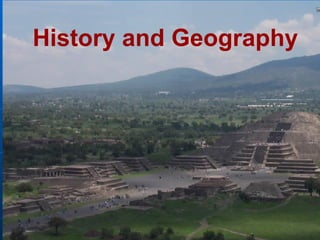
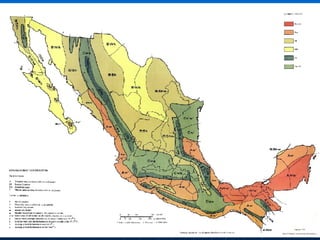
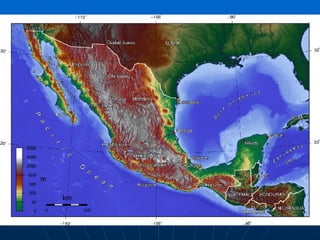
Geography Borders North by the U.S Southeast by Guatemala and Belize Land Area:  1,972,544 sq. km. US about 9.8 million sq km About 3X the size of Texas Natural Resources petroleum, silver, copper, gold, lead, zinc, natural gas, timber   Natural Disaster Concerns Hurricanes along the Pacific, Gulf of Mexico, and Caribbean Earthquakes and volcanoes extending through central and southern Mexico
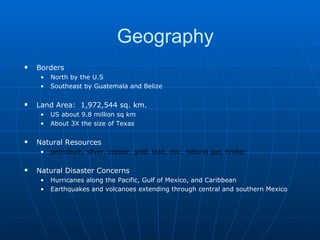
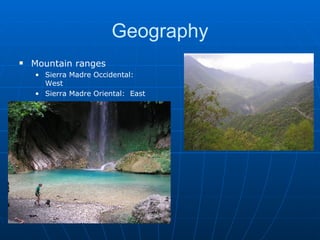
Geography Mountain ranges Sierra Madre Occidental:  West  Sierra Madre Oriental:  East
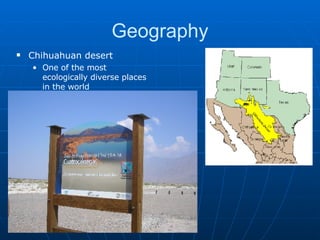
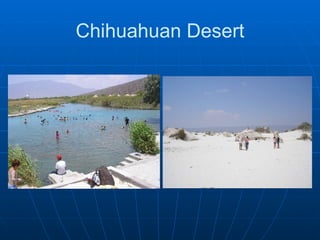
Geography Chihuahuan desert One of the most ecologically diverse places in the world
Chihuahuan Desert
 
 
History 2000 election of historical importance First time in 70 years the PRI loses power ( Partido Revolucionario Institucional ) Vincente Fox of PAN takes over ( Partido Acción Nacional) In 2006 Felipe Calderon, also of PAN takes over for Fox Candidates in MX can serve twice as President, but cannot run for consecutive terms
Pre-Classical Period 3500 BC-300 AD First settlers arrive about 50,000 year ago via Bering Straight Fist human corpse found 12,000 years ago, El Hombre de Tepexpan Agriculture begins about 7,000 years ago, ending nomadic lifestyle Civilizations advanced southward about 27 km every generation Cultures included Olmeca, Mixteco-Zapoteca, Maya, Teohtihuacan, Tulteca, Azteca
The Classical Period 300-900 AD Teotihuacan culture First great civilization in Mexico Advanced 100,000+ metropolis just north of where Mexico City would emerge. Reading and writing, numbering system, 260 day calendar Society based on agriculture, very influential throughout mesoamerica Mayan Culture throughout the Yucatan Mixteco-Zapoteca in Oaxaca
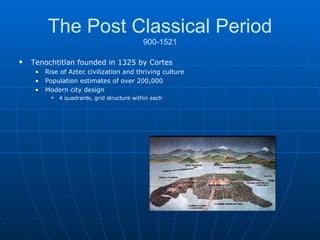
The Post Classical Period 900-1521 Tenochtitlan founded in 1325 by Cortes Rise of Aztec civilization and thriving culture  Population estimates of over 200,000 Modern city design 4 quadrants, grid structure within each
Timeline Tenochtitlan conquered in 1521 by Cortes Including religious conquest, forcing their way of life upon the natives Mexico under Spanish rule for almost 300 years In 1810 the Mexican War for Independence begins Spearheaded by Miguel Hidalgo Iturbide and his armies become victorious August 24, 1821 the Treaty of Cordoba signed acknowledging Mexico’s independence Mexican Revolution in 1910 Civil war of political, social, and military turmoil Estimated that 1/15 th  of the population died during the war Pancho Villa emerged as one of the leaders of the revolution against Porfirio Diaz
Present Day Mexico 2000 election of historical importance First time in 70 years the PRI loses power ( Partido Revolucionario Institucional ) Vincente Fox of PAN takes over ( Partido Acción Nacional) In 2006 Felipe Calderon, also of PAN takes over for Fox Candidates in MX can serve twice as President, but cannot run for consecutive terms NAFTA, effective in 1994, opened up Mexico to trade among the United States and Canada.   NAFTA’s effect felt the most by the Zapatistas in the south Some of the poorest people in the world who suffer from the deal  Cannot compete with mass-produced US agricultural products Symbolizes struggle of indigenous and oppressed people of Mexico
Slide of Interest
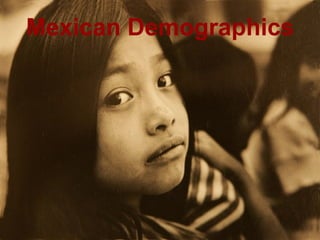
Mexican Demographics
Population 108,700,891 (July 2007 est.) Age Structure  (July 2007 est.) 0-14 years: 30.1% (male 16,696,089/female 16,011,563) 15-64 years: 64% (male 33,624,812/female 35,925,372) 65years and over: 5.9% (male 2,917,563/female 3,525,492) Median age 25.6 years
Population Continued  Population Growth Rate : 1.153% (2007 est.) Birth Rate : 20.36 births/1,000 population Death Rate:  4.76 deaths/1,000 population Infant Mortality rate:  19.63 deaths/1,000 live births Life Expectancy:  75.63 years Fertility Rate:  2.39 children born/woman
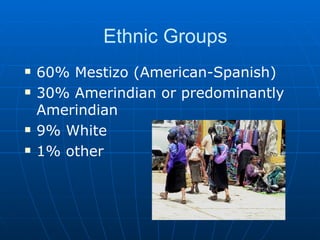
Ethnic Groups 60% Mestizo (American-Spanish)  30% Amerindian or predominantly Amerindian 9% White 1% other
Religions 76.5% Roman Catholic 6.3% Protestant  1.4% Pentecostal 1.1% Jehovah’s Witnesses 0.3% other 13.8% unspecified 3.1% none
Languages Official Language is Spanish About 50 different languages spoken by indigenous people  Nahuatl, Zopotec, Otomi, Mayan etc.
Literacy 91% of people 15 and over can read and write 92.4% are male 89.6% are female
Government Country name:  Estados Unidos Mexicanos Government Type:  Federal Republic Capital:  Mexico (Distrito Federal) Flag Description:  three equal vertical bands of green, white, and red; the coat of arms (an eagle perched on a cactus with a snake in its beak) is centered in the white band
Mexican States 31 states and 1 Federal District   Aguascalientes, Baja California, Baja California Sur, Campeche, Chiapas, Chihuahua, Coahuila de Zaragoza, Colima, Distrito Federal*, Durango, Guanajuato, Guerrero, Hidalgo, Jalisco, Mexico, Michoacan de Ocampo, Morelos, Nayarit, Nuevo Leon, Oaxaca, Puebla, Queretaro de Arteaga, Quintana Roo, San Luis Potosi, Sinaloa, Sonora, Tabasco, Tamaulipas, Tlaxcala, Veracruz-Llave, Yucatan, Zacatecas
Independence Independence was declared Sept. 16 th  1810 Independence was recognized by Spain Sept. 27 th  1821 Independence Day celebrated on Sept. 16 th  (1810)
Executive Branch Chief of State, Head of Government and President:  Felipe de Jesus Calderon Hinojosa Cabinet:  appointed by the President Elections:  presidential   elections by popular vote, for a single six year term Election results for 2006:  Felipe  Calderon  35.89%, Andres Manuel Lopez  Obrador  35.31%, Roberto  Madrazo  22.26%, other 6.54%
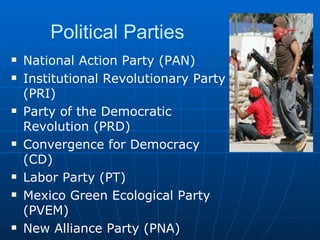
Political Parties National Action Party (PAN) Institutional Revolutionary Party (PRI) Party of the Democratic Revolution (PRD) Convergence for Democracy (CD) Labor Party (PT) Mexico Green Ecological Party (PVEM) New Alliance Party (PNA)
Economy Free Market Economy Recently entered the trillion dollar class Contains a mixture of modern and outmoded industry and agriculture, dominated by private sector Per capita income is one-fourth that of the US NAFTA has tripled trade with US and Canada since 1994 Has 12 free trade agreements with over 40 countries
Challenges Need to upgrade infrastructure Modernize the tax system Modernize labor laws Allow private investment in energy sector Calderon’s Priorities: Reduce poverty Creating jobs
Labor Force Labor force:  38.09 million Labor force by-occupation:  18% agriculture, 24% industry, 58% services Unemployment rate:  3.2% Underemployment:  25% Population below poverty line:  40%
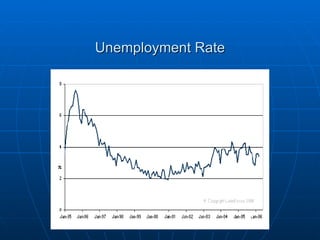
Unemployment Rate
Communication  Main Line Telephones:  19.861 million Cellular Telephones:  57.016 million Internet users:  22 million
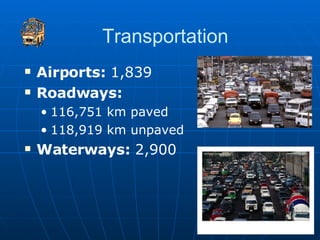
Transportation Airports:  1,839 Roadways:   116,751 km paved  118,919 km unpaved Waterways:  2,900
Military Branches Secretariat of National Defense Army Mexican Air Force Secretariat of the Navy Mexican Navy
Mexican Culture
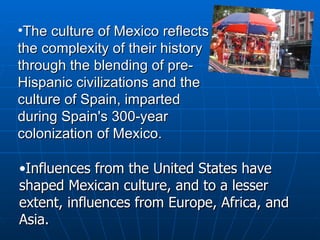
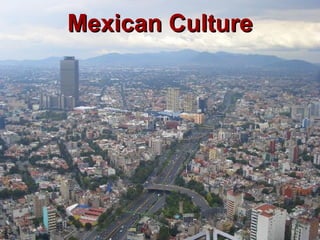
The culture of Mexico reflects the complexity of their history through the blending of pre-Hispanic civilizations and the culture of Spain, imparted during Spain's 300-year colonization of Mexico.    Influences from the United States have shaped Mexican culture, and to a lesser extent, influences from Europe, Africa, and Asia.
Community  Citizens take pride in their lifestyle and economic independence. In Mexican culture the expectation of working and socializing together is a key component of society, and has a basis in the strong ties formed within the family.
Religion   With the Spanish conquest and colonization of Mexico, Catholicism was established as the dominant religion of Mexico. Weekly church attendance is forty-six percent of the Mexican population.
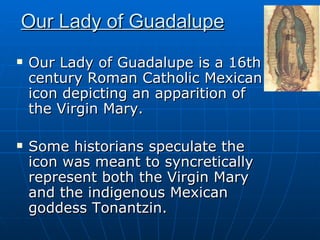
Our Lady of Guadalupe   Our Lady of Guadalupe is a 16th century Roman Catholic Mexican icon depicting an apparition of the Virgin Mary.  Some historians speculate the icon was meant to syncretically represent both the Virgin Mary and the indigenous Mexican goddess Tonantzin.
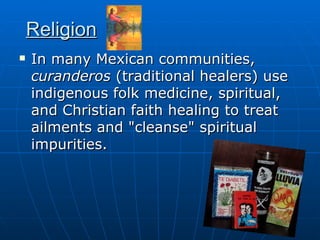
Religion In many Mexican communities,  curanderos  (traditional healers) use indigenous folk medicine, spiritual, and Christian faith healing to treat ailments and "cleanse" spiritual impurities.
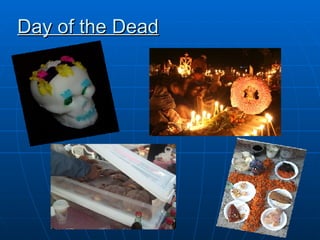
Day of the Dead The origins of Day of the Dead celebrations in Mexico can be traced back to the indigenous peoples such as the Aztec, Maya, P'urhépecha, Nahua, and Totonac.  Some Mexicans feel that death is a special occasion, but with elements of celebration
Day of the Dead
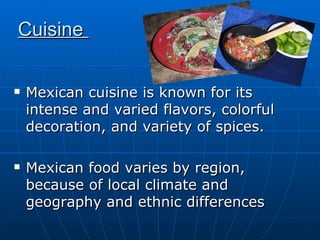
Mexican cuisine is known for its intense and varied flavors, colorful decoration, and variety of spices.  Mexican food varies by region, because of local climate and geography and ethnic differences  Cuisine
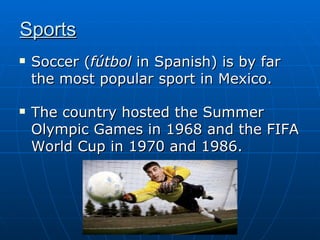
Sports   Soccer ( fútbol  in Spanish) is by far the most popular sport in Mexico.  The country hosted the Summer Olympic Games in 1968 and the FIFA World Cup in 1970 and 1986.
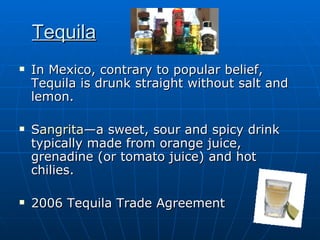
Tequila In Mexico, contrary to popular belief, Tequila is drunk straight without salt and lemon.  S angrita —a sweet, sour and spicy drink typically made from orange juice, grenadine (or tomato juice) and hot chilies.  2006 Tequila Trade Agreement
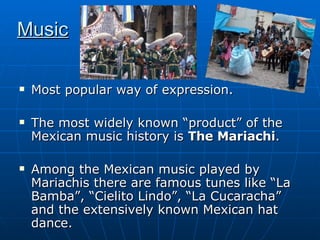
Music Most popular way of expression. The most widely known “product” of the Mexican music history is  The Mariachi .  Among the Mexican music played by Mariachis there are famous tunes like “La Bamba”, “Cielito Lindo”, “La Cucaracha” and the extensively known Mexican hat dance.
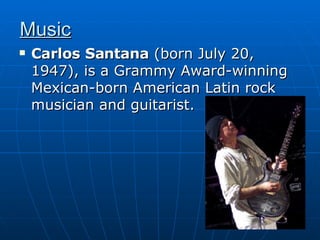
Music Carlos Santana  (born July 20, 1947), is a Grammy Award-winning Mexican-born American Latin rock musician and guitarist.
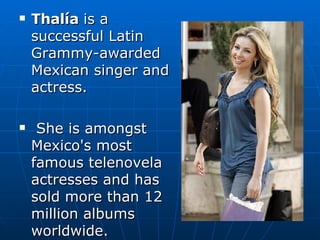
Thalía  is a successful Latin Grammy-awarded Mexican singer and actress.  She is amongst Mexico's most famous telenovela actresses and has sold more than 12 million albums worldwide.
Television Televisa   is the largest media company in the Spanish-speaking world  La Academia  ( The Academy ) is a Mexican reality television show shown on TV Azteca.  14-21 people are selected to live together in a house isolated from the rest of the world, spending their days taking classes in singing, dancing, acting. http://samuel-castelan.net/pagina/
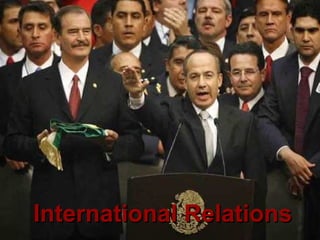
International Relations
European Union and Mexico In Brussels on December 8 th , 1997, the European Union and Mexico signed an agreement made up of three pillars: an Economic Partnership, Political Cooperation and Cooperation Agreement which laid the basis for the negotiation of a free trade agreement between Mexico and the European Union. It is known as the "Global Agreement“ and governs relations between these two entities. This Agreement is based on democratic principles and on the respect for human rights  With respect to trade, the Agreement sets out the objective of establishing a free trade area in goods and services, the mutual opening of the procurement markets, the liberalization of capital movements and payments, as well as the adoption of disciplines in the fields of competition and intellectual property rights.
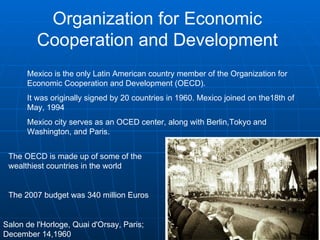
Organization for Economic Cooperation and Development Mexico is the only Latin American country member of the Organization for Economic Cooperation and Development (OECD).  It was originally signed by 20 countries in 1960. Mexico joined on the18th of May, 1994  Mexico city serves as an OCED center, along with Berlin,Tokyo and Washington, and Paris. Salon de l'Horloge, Quai d'Orsay, Paris;  December 14,1960  The OECD is made up of some of the wealthiest countries in the world The 2007 budget was 340 million Euros
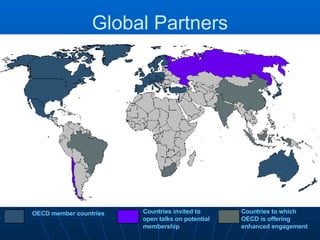
Global Partners OECD member countries Countries invited to open talks on potential membership  Countries to which  OECD is offering  enhanced engagement
Organization for Economic Cooperation and Development The  mission of OECD is to: support economic growth boost employment  raise living standards  maintain financial stability assist other countries’ economic development and contribute to growth in world trade
Economic Survey of Mexico Every 1 ½ to 2 years an economic survey is published for each OECD country.  The 2007 survey for Mexico was released October 4 th . The survey found the following: Mexico’s per capita has increased and broad macroeconomic stability has been achieved. Although its fiscal GDP position is good, Mexico has to reduce the heavy reliance of the budget on oil revenue  The new government is planning a large scale public finance reforms. Currently Mexico relies heavily on world oil prices, which are not stable. There is also a large demand on the budget for things such as basic infrastructure, education, health and poverty alleviation. A tax reform is needed to increase revenues. Mexico has made significant progress in reducing barriers to trade and foreign direct investment (FDI), and this has boosted GDP per capita growth. Barriers to FDI remain high, particularly in some services and infrastructure sectors, such as telecommunications and domestic land transport. Transport infrastructure efficiency has a direct effect on domestic and international trade flows and overall growth by lowering delivery times and transport costs, while efficiency in telecommunications and energy influences the cost competitiveness of Mexican firms.
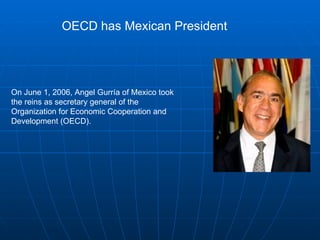
On June 1, 2006, Angel Gurría of Mexico took the reins as secretary general of the Organization for Economic Cooperation and Development (OECD).  OECD has Mexican President
Facts The EU is Mexico’s second trading partner after the USA.  According to EUROSTAT, bilateral trade between the EU and Mexico in 2005 totaled € 25.8 billion. This represents a 20% growth in comparison to 2004 with an even higher increase for Mexican exports.  The Free Trade Agreement (FTA) covers a broad spectrum of economic aspects. It includes: a full liberalization of industrial products by 2003, for the EC, and by 2007 - with a maximum 5% tariff applied by 2003 - for Mexico; substantial liberalization for agricultural and fisheries products; and, as regards rules of origin, a satisfactory balance between EU policy of harmonization and market access considerations. The FTA will also provide EU operators with access to the Mexican procurement and services markets substantially equivalent to NAFTA. In the 6 years following the entry into force of the FTA, bilateral trade between the EU and Mexico grew by nearly 90 %. This in accordance with both parties' imports data. EU foreign direct investment flows have increased by 120%. The EU is now the second major investor in Mexico behind United States.
Free Trade Agreement Mexico and the European Union The EU-Mexico FTA also covers agriculture, services, public procurement, investment, competition and intellectual property rules, and dispute settlement. On both services and procurement, the terms agreed upon by the EU and Mexico will grant the EU treatment similar to NAFTA partners.  On July 1, 2000, the EU-Mexico FTA eliminated duties on an additional 22% of Mexican industrial goods, bringing duty-free coverage to 82% of all industrial products. EU tariffs on the remaining 18% of Mexico’s industrial products was eliminated by January 1, 2003.  While EU tariffs are generally low, there are areas of tariff peaks where the EU-Mexico FTA could affect U.S. sales to Europe by making Mexican products more competitive.
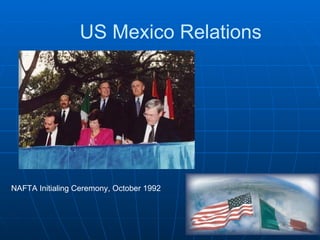
US Mexico Relations NAFTA Initialing Ceremony, October 1992
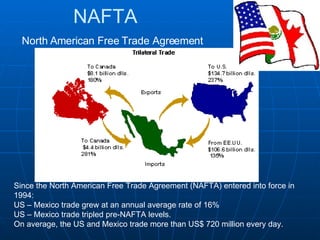
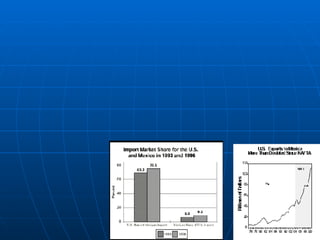
NAFTA North American Free Trade Agreement Since the North American Free Trade Agreement (NAFTA) entered into force in 1994: US – Mexico trade grew at an annual average rate of 16% US – Mexico trade tripled pre-NAFTA levels. On average, the US and Mexico trade more than US$ 720 million every day.
 
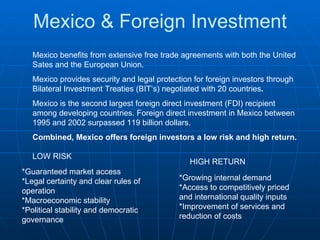
Mexico & Foreign Investment Mexico benefits from extensive free trade agreements with both the United Sates and the European Union. Mexico provides security and legal protection for foreign investors through Bilateral Investment Treaties (BIT’s) negotiated with 20 countries . Mexico is the second largest foreign direct investment (FDI) recipient among developing countries. Foreign direct investment in Mexico between 1995 and 2002 surpassed 119 billion dollars. Combined, Mexico offers foreign investors a low risk and high return. *Guaranteed market access  *Legal certainty and clear rules of operation  *Macroeconomic stability  *Political stability and democratic governance  *Growing internal demand  *Access to competitively priced and international quality inputs  *Improvement of services and reduction of costs  LOW RISK HIGH RETURN
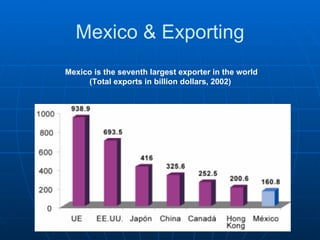
Mexico & Exporting Mexico is the seventh largest exporter in the world (Total exports in billion dollars, 2002)
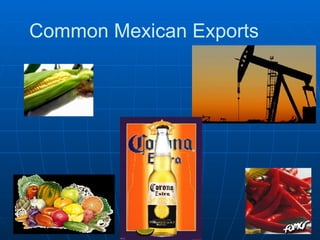
Common Mexican Exports
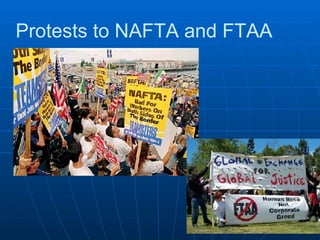
Protests to NAFTA and FTAA
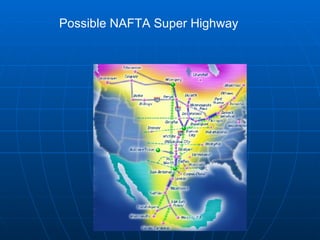
Possible NAFTA Super Highway
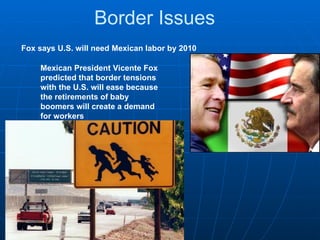
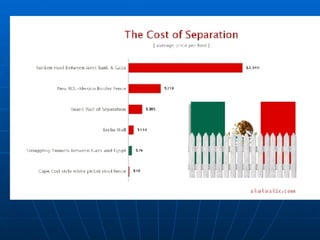
Border Issues Fox says U.S. will need Mexican labor by 2010   Mexican President Vicente Fox predicted that border tensions with the U.S. will ease because the retirements of baby boomers will create a demand for workers


Mexico Presentation

  • 1.
    MEXICO Jim Fondriest Jeff Sferro Josie Berson Bertha Soto-Rodriguez
  • 2.
  • 3.
    General Background ApproxPopulation 108 million 33% under age of 15 7% over 60 Life expectancy Men 70.4 Women 76.4 There are about 96 men for every 100 women Adult literacy rate = 90.5% Approx 89%-94% of children attend school Average of about 7.5-8 years of school
  • 4.
    Miscellaneous Economic VariablesWorkforce breakdown Agriculture: 4% Industry: 26% (mining/manufacturing) Services: 70% (banks, retail, educ, hosp) Trade breakdown Exports: 77% to U.S 5% to Canada Imports: 63.3% from U.S. 3.3% from Germany 2.5% from Japan
  • 5.
    Per capita GDP: $6,000-$7,000 Average minimum wage: about 46 pesos/day Broken down into 3 different zones across country Zone A: 48.67 pesos/day Zone B: 47.16 pesos/day Zone C: 45.81 pesos/day Large disparity in pay by region State of Nuevo Leon enjoys the highest wage at about 35 pesos/hour Municipality of San Pedro (suburb of Monterrey) has the highest per capita income in Mexico Miscellaneous Economic Variables
  • 6.
    Geography Borders Northby the U.S Southeast by Guatemala and Belize Land Area: 1,972,544 sq. km. US about 9.8 million sq km About 3X the size of Texas Natural Resources petroleum, silver, copper, gold, lead, zinc, natural gas, timber Natural Disaster Concerns Hurricanes along the Pacific, Gulf of Mexico, and Caribbean Earthquakes and volcanoes extending through central and southern Mexico
  • 7.
    Geography Mountain rangesSierra Madre Occidental: West Sierra Madre Oriental: East
  • 8.
    Geography Chihuahuan desertOne of the most ecologically diverse places in the world
  • 9.
  • 10.
  • 11.
  • 12.
    History 2000 electionof historical importance First time in 70 years the PRI loses power ( Partido Revolucionario Institucional ) Vincente Fox of PAN takes over ( Partido Acción Nacional) In 2006 Felipe Calderon, also of PAN takes over for Fox Candidates in MX can serve twice as President, but cannot run for consecutive terms
  • 13.
    Pre-Classical Period 3500BC-300 AD First settlers arrive about 50,000 year ago via Bering Straight Fist human corpse found 12,000 years ago, El Hombre de Tepexpan Agriculture begins about 7,000 years ago, ending nomadic lifestyle Civilizations advanced southward about 27 km every generation Cultures included Olmeca, Mixteco-Zapoteca, Maya, Teohtihuacan, Tulteca, Azteca
  • 14.
    The Classical Period300-900 AD Teotihuacan culture First great civilization in Mexico Advanced 100,000+ metropolis just north of where Mexico City would emerge. Reading and writing, numbering system, 260 day calendar Society based on agriculture, very influential throughout mesoamerica Mayan Culture throughout the Yucatan Mixteco-Zapoteca in Oaxaca
  • 15.
    The Post ClassicalPeriod 900-1521 Tenochtitlan founded in 1325 by Cortes Rise of Aztec civilization and thriving culture Population estimates of over 200,000 Modern city design 4 quadrants, grid structure within each
  • 16.
    Timeline Tenochtitlan conqueredin 1521 by Cortes Including religious conquest, forcing their way of life upon the natives Mexico under Spanish rule for almost 300 years In 1810 the Mexican War for Independence begins Spearheaded by Miguel Hidalgo Iturbide and his armies become victorious August 24, 1821 the Treaty of Cordoba signed acknowledging Mexico’s independence Mexican Revolution in 1910 Civil war of political, social, and military turmoil Estimated that 1/15 th of the population died during the war Pancho Villa emerged as one of the leaders of the revolution against Porfirio Diaz
  • 17.
    Present Day Mexico2000 election of historical importance First time in 70 years the PRI loses power ( Partido Revolucionario Institucional ) Vincente Fox of PAN takes over ( Partido Acción Nacional) In 2006 Felipe Calderon, also of PAN takes over for Fox Candidates in MX can serve twice as President, but cannot run for consecutive terms NAFTA, effective in 1994, opened up Mexico to trade among the United States and Canada. NAFTA’s effect felt the most by the Zapatistas in the south Some of the poorest people in the world who suffer from the deal Cannot compete with mass-produced US agricultural products Symbolizes struggle of indigenous and oppressed people of Mexico
  • 18.
  • 19.
  • 20.
    Population 108,700,891 (July2007 est.) Age Structure (July 2007 est.) 0-14 years: 30.1% (male 16,696,089/female 16,011,563) 15-64 years: 64% (male 33,624,812/female 35,925,372) 65years and over: 5.9% (male 2,917,563/female 3,525,492) Median age 25.6 years
  • 21.
    Population Continued Population Growth Rate : 1.153% (2007 est.) Birth Rate : 20.36 births/1,000 population Death Rate: 4.76 deaths/1,000 population Infant Mortality rate: 19.63 deaths/1,000 live births Life Expectancy: 75.63 years Fertility Rate: 2.39 children born/woman
  • 22.
    Ethnic Groups 60%Mestizo (American-Spanish) 30% Amerindian or predominantly Amerindian 9% White 1% other
  • 23.
    Religions 76.5% RomanCatholic 6.3% Protestant 1.4% Pentecostal 1.1% Jehovah’s Witnesses 0.3% other 13.8% unspecified 3.1% none
  • 24.
    Languages Official Languageis Spanish About 50 different languages spoken by indigenous people Nahuatl, Zopotec, Otomi, Mayan etc.
  • 25.
    Literacy 91% ofpeople 15 and over can read and write 92.4% are male 89.6% are female
  • 26.
    Government Country name: Estados Unidos Mexicanos Government Type: Federal Republic Capital: Mexico (Distrito Federal) Flag Description: three equal vertical bands of green, white, and red; the coat of arms (an eagle perched on a cactus with a snake in its beak) is centered in the white band
  • 27.
    Mexican States 31states and 1 Federal District Aguascalientes, Baja California, Baja California Sur, Campeche, Chiapas, Chihuahua, Coahuila de Zaragoza, Colima, Distrito Federal*, Durango, Guanajuato, Guerrero, Hidalgo, Jalisco, Mexico, Michoacan de Ocampo, Morelos, Nayarit, Nuevo Leon, Oaxaca, Puebla, Queretaro de Arteaga, Quintana Roo, San Luis Potosi, Sinaloa, Sonora, Tabasco, Tamaulipas, Tlaxcala, Veracruz-Llave, Yucatan, Zacatecas
  • 28.
    Independence Independence wasdeclared Sept. 16 th 1810 Independence was recognized by Spain Sept. 27 th 1821 Independence Day celebrated on Sept. 16 th (1810)
  • 29.
    Executive Branch Chiefof State, Head of Government and President: Felipe de Jesus Calderon Hinojosa Cabinet: appointed by the President Elections: presidential elections by popular vote, for a single six year term Election results for 2006: Felipe Calderon 35.89%, Andres Manuel Lopez Obrador 35.31%, Roberto Madrazo 22.26%, other 6.54%
  • 30.
    Political Parties NationalAction Party (PAN) Institutional Revolutionary Party (PRI) Party of the Democratic Revolution (PRD) Convergence for Democracy (CD) Labor Party (PT) Mexico Green Ecological Party (PVEM) New Alliance Party (PNA)
  • 31.
    Economy Free MarketEconomy Recently entered the trillion dollar class Contains a mixture of modern and outmoded industry and agriculture, dominated by private sector Per capita income is one-fourth that of the US NAFTA has tripled trade with US and Canada since 1994 Has 12 free trade agreements with over 40 countries
  • 32.
    Challenges Need toupgrade infrastructure Modernize the tax system Modernize labor laws Allow private investment in energy sector Calderon’s Priorities: Reduce poverty Creating jobs
  • 33.
    Labor Force Laborforce: 38.09 million Labor force by-occupation: 18% agriculture, 24% industry, 58% services Unemployment rate: 3.2% Underemployment: 25% Population below poverty line: 40%
  • 34.
  • 35.
    Communication MainLine Telephones: 19.861 million Cellular Telephones: 57.016 million Internet users: 22 million
  • 36.
    Transportation Airports: 1,839 Roadways: 116,751 km paved 118,919 km unpaved Waterways: 2,900
  • 37.
    Military Branches Secretariatof National Defense Army Mexican Air Force Secretariat of the Navy Mexican Navy
  • 38.
  • 39.
    The culture ofMexico reflects the complexity of their history through the blending of pre-Hispanic civilizations and the culture of Spain, imparted during Spain's 300-year colonization of Mexico. Influences from the United States have shaped Mexican culture, and to a lesser extent, influences from Europe, Africa, and Asia.
  • 40.
    Community Citizenstake pride in their lifestyle and economic independence. In Mexican culture the expectation of working and socializing together is a key component of society, and has a basis in the strong ties formed within the family.
  • 41.
    Religion With the Spanish conquest and colonization of Mexico, Catholicism was established as the dominant religion of Mexico. Weekly church attendance is forty-six percent of the Mexican population.
  • 42.
    Our Lady ofGuadalupe Our Lady of Guadalupe is a 16th century Roman Catholic Mexican icon depicting an apparition of the Virgin Mary. Some historians speculate the icon was meant to syncretically represent both the Virgin Mary and the indigenous Mexican goddess Tonantzin.
  • 43.
    Religion In manyMexican communities, curanderos (traditional healers) use indigenous folk medicine, spiritual, and Christian faith healing to treat ailments and "cleanse" spiritual impurities.
  • 44.
    Day of theDead The origins of Day of the Dead celebrations in Mexico can be traced back to the indigenous peoples such as the Aztec, Maya, P'urhépecha, Nahua, and Totonac. Some Mexicans feel that death is a special occasion, but with elements of celebration
  • 45.
  • 46.
    Mexican cuisine isknown for its intense and varied flavors, colorful decoration, and variety of spices. Mexican food varies by region, because of local climate and geography and ethnic differences Cuisine
  • 47.
    Sports Soccer ( fútbol in Spanish) is by far the most popular sport in Mexico. The country hosted the Summer Olympic Games in 1968 and the FIFA World Cup in 1970 and 1986.
  • 48.
    Tequila In Mexico,contrary to popular belief, Tequila is drunk straight without salt and lemon. S angrita —a sweet, sour and spicy drink typically made from orange juice, grenadine (or tomato juice) and hot chilies. 2006 Tequila Trade Agreement
  • 49.
    Music Most popularway of expression. The most widely known “product” of the Mexican music history is The Mariachi . Among the Mexican music played by Mariachis there are famous tunes like “La Bamba”, “Cielito Lindo”, “La Cucaracha” and the extensively known Mexican hat dance.
  • 50.
    Music Carlos Santana (born July 20, 1947), is a Grammy Award-winning Mexican-born American Latin rock musician and guitarist.
  • 51.
    Thalía isa successful Latin Grammy-awarded Mexican singer and actress. She is amongst Mexico's most famous telenovela actresses and has sold more than 12 million albums worldwide.
  • 52.
    Television Televisa is the largest media company in the Spanish-speaking world La Academia ( The Academy ) is a Mexican reality television show shown on TV Azteca. 14-21 people are selected to live together in a house isolated from the rest of the world, spending their days taking classes in singing, dancing, acting. http://samuel-castelan.net/pagina/
  • 53.
  • 54.
    European Union andMexico In Brussels on December 8 th , 1997, the European Union and Mexico signed an agreement made up of three pillars: an Economic Partnership, Political Cooperation and Cooperation Agreement which laid the basis for the negotiation of a free trade agreement between Mexico and the European Union. It is known as the "Global Agreement“ and governs relations between these two entities. This Agreement is based on democratic principles and on the respect for human rights With respect to trade, the Agreement sets out the objective of establishing a free trade area in goods and services, the mutual opening of the procurement markets, the liberalization of capital movements and payments, as well as the adoption of disciplines in the fields of competition and intellectual property rights.
  • 55.
    Organization for EconomicCooperation and Development Mexico is the only Latin American country member of the Organization for Economic Cooperation and Development (OECD). It was originally signed by 20 countries in 1960. Mexico joined on the18th of May, 1994 Mexico city serves as an OCED center, along with Berlin,Tokyo and Washington, and Paris. Salon de l'Horloge, Quai d'Orsay, Paris; December 14,1960 The OECD is made up of some of the wealthiest countries in the world The 2007 budget was 340 million Euros
  • 56.
    Global Partners OECDmember countries Countries invited to open talks on potential membership Countries to which OECD is offering enhanced engagement
  • 57.
    Organization for EconomicCooperation and Development The mission of OECD is to: support economic growth boost employment raise living standards maintain financial stability assist other countries’ economic development and contribute to growth in world trade
  • 58.
    Economic Survey ofMexico Every 1 ½ to 2 years an economic survey is published for each OECD country. The 2007 survey for Mexico was released October 4 th . The survey found the following: Mexico’s per capita has increased and broad macroeconomic stability has been achieved. Although its fiscal GDP position is good, Mexico has to reduce the heavy reliance of the budget on oil revenue The new government is planning a large scale public finance reforms. Currently Mexico relies heavily on world oil prices, which are not stable. There is also a large demand on the budget for things such as basic infrastructure, education, health and poverty alleviation. A tax reform is needed to increase revenues. Mexico has made significant progress in reducing barriers to trade and foreign direct investment (FDI), and this has boosted GDP per capita growth. Barriers to FDI remain high, particularly in some services and infrastructure sectors, such as telecommunications and domestic land transport. Transport infrastructure efficiency has a direct effect on domestic and international trade flows and overall growth by lowering delivery times and transport costs, while efficiency in telecommunications and energy influences the cost competitiveness of Mexican firms.
  • 59.
    On June 1,2006, Angel Gurría of Mexico took the reins as secretary general of the Organization for Economic Cooperation and Development (OECD). OECD has Mexican President
  • 60.
    Facts The EUis Mexico’s second trading partner after the USA. According to EUROSTAT, bilateral trade between the EU and Mexico in 2005 totaled € 25.8 billion. This represents a 20% growth in comparison to 2004 with an even higher increase for Mexican exports. The Free Trade Agreement (FTA) covers a broad spectrum of economic aspects. It includes: a full liberalization of industrial products by 2003, for the EC, and by 2007 - with a maximum 5% tariff applied by 2003 - for Mexico; substantial liberalization for agricultural and fisheries products; and, as regards rules of origin, a satisfactory balance between EU policy of harmonization and market access considerations. The FTA will also provide EU operators with access to the Mexican procurement and services markets substantially equivalent to NAFTA. In the 6 years following the entry into force of the FTA, bilateral trade between the EU and Mexico grew by nearly 90 %. This in accordance with both parties' imports data. EU foreign direct investment flows have increased by 120%. The EU is now the second major investor in Mexico behind United States.
  • 61.
    Free Trade AgreementMexico and the European Union The EU-Mexico FTA also covers agriculture, services, public procurement, investment, competition and intellectual property rules, and dispute settlement. On both services and procurement, the terms agreed upon by the EU and Mexico will grant the EU treatment similar to NAFTA partners. On July 1, 2000, the EU-Mexico FTA eliminated duties on an additional 22% of Mexican industrial goods, bringing duty-free coverage to 82% of all industrial products. EU tariffs on the remaining 18% of Mexico’s industrial products was eliminated by January 1, 2003. While EU tariffs are generally low, there are areas of tariff peaks where the EU-Mexico FTA could affect U.S. sales to Europe by making Mexican products more competitive.
  • 62.
    US Mexico RelationsNAFTA Initialing Ceremony, October 1992
  • 63.
    NAFTA North AmericanFree Trade Agreement Since the North American Free Trade Agreement (NAFTA) entered into force in 1994: US – Mexico trade grew at an annual average rate of 16% US – Mexico trade tripled pre-NAFTA levels. On average, the US and Mexico trade more than US$ 720 million every day.
  • 64.
  • 65.
    Mexico & ForeignInvestment Mexico benefits from extensive free trade agreements with both the United Sates and the European Union. Mexico provides security and legal protection for foreign investors through Bilateral Investment Treaties (BIT’s) negotiated with 20 countries . Mexico is the second largest foreign direct investment (FDI) recipient among developing countries. Foreign direct investment in Mexico between 1995 and 2002 surpassed 119 billion dollars. Combined, Mexico offers foreign investors a low risk and high return. *Guaranteed market access *Legal certainty and clear rules of operation *Macroeconomic stability *Political stability and democratic governance *Growing internal demand *Access to competitively priced and international quality inputs *Improvement of services and reduction of costs LOW RISK HIGH RETURN
  • 66.
    Mexico & ExportingMexico is the seventh largest exporter in the world (Total exports in billion dollars, 2002)
  • 67.
  • 68.
  • 69.
  • 70.
    Border Issues Foxsays U.S. will need Mexican labor by 2010 Mexican President Vicente Fox predicted that border tensions with the U.S. will ease because the retirements of baby boomers will create a demand for workers
  • 71.
  • 72.