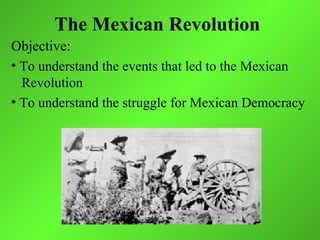
The Mexican Revolution
Objective:
• To understand the events that led to the Mexican
  Revolution
• To understand the struggle for Mexican Democracy
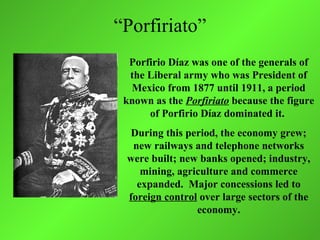
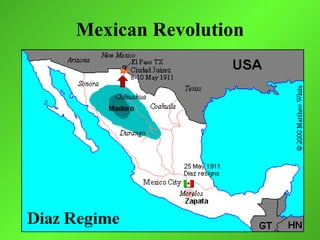
“Porfiriato”
  Porfirio Díaz was one of the generals of
  the Liberal army who was President of
  Mexico from 1877 until 1911, a period
 known as the Porfiriato because the figure
      of Porfirio Díaz dominated it.
  During this period, the economy grew;
  new railways and telephone networks
 were built; new banks opened; industry,
    mining, agriculture and commerce
   expanded. Major concessions led to
 foreign control over large sectors of the
                economy.
Although President Díaz brought many benefits to
Mexico, he was a dictator - a President who abused his
 power. Under Díaz, a few land owners became very
wealthy, but the majority of Mexicans remained poor.


  David Siquieros Mural: "Don Porfirio [Diaz] and his Courtesans". 1957-65
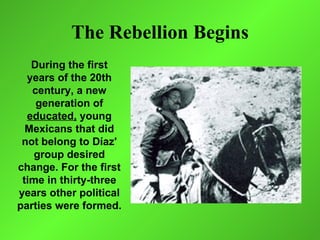
The Rebellion Begins
   During the first
  years of the 20th
   century, a new
    generation of
  educated, young
  Mexicans that did
 not belong to Díaz'
    group desired
change. For the first
 time in thirty-three
years other political
parties were formed.
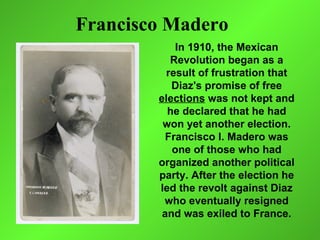
Francisco Madero
            In 1910, the Mexican
           Revolution began as a
          result of frustration that
           Diaz's promise of free
        elections was not kept and
          he declared that he had
         won yet another election.
         Francisco I. Madero was
           one of those who had
        organized another political
        party. After the election he
        led the revolt against Diaz
         who eventually resigned
         and was exiled to France.
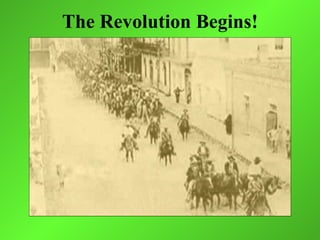
The Revolution Begins!
Mexican Revolution
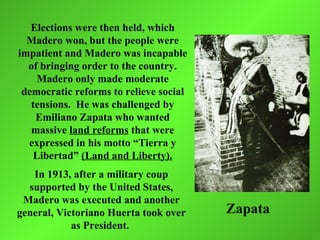
Elections were then held, which
  Madero won, but the people were
impatient and Madero was incapable
  of bringing order to the country.
     Madero only made moderate
 democratic reforms to relieve social
   tensions. He was challenged by
    Emiliano Zapata who wanted
   massive land reforms that were
  expressed in his motto “Tierra y
    Libertad” (Land and Liberty).
   In 1913, after a military coup
  supported by the United States,
 Madero was executed and another
general, Victoriano Huerta took over    Zapata
            as President.
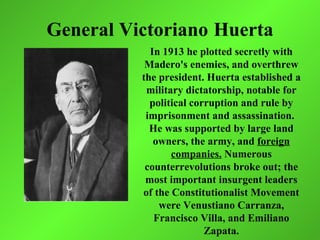
General Victoriano Huerta
            In 1913 he plotted secretly with
           Madero's enemies, and overthrew
          the president. Huerta established a
           military dictatorship, notable for
            political corruption and rule by
           imprisonment and assassination.
            He was supported by large land
             owners, the army, and foreign
                 companies. Numerous
           counterrevolutions broke out; the
           most important insurgent leaders
          of the Constitutionalist Movement
              were Venustiano Carranza,
             Francisco Villa, and Emiliano
                         Zapata.
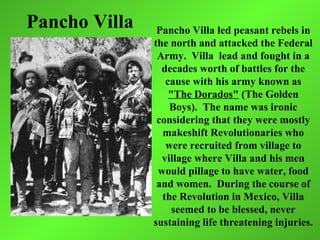
Pancho Villa    Pancho Villa led peasant rebels in
               the north and attacked the Federal
                Army. Villa lead and fought in a
                 decades worth of battles for the
                  cause with his army known as
                   "The Dorados" (The Golden
                   Boys). The name was ironic
                considering that they were mostly
                 makeshift Revolutionaries who
                  were recruited from village to
                 village where Villa and his men
                would pillage to have water, food
                and women. During the course of
                 the Revolution in Mexico, Villa
                    seemed to be blessed, never
               sustaining life threatening injuries.
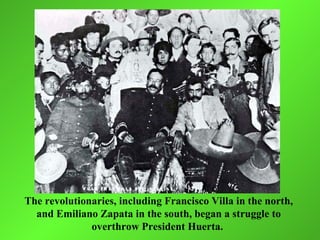
The revolutionaries, including Francisco Villa in the north,
  and Emiliano Zapata in the south, began a struggle to
              overthrow President Huerta.
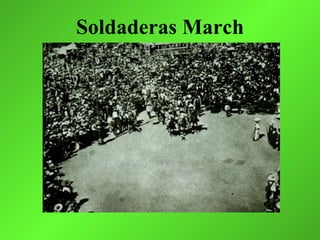
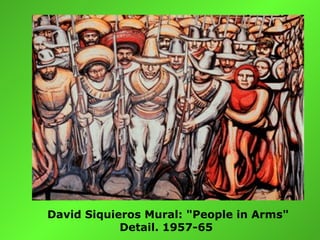
Soldaderas March
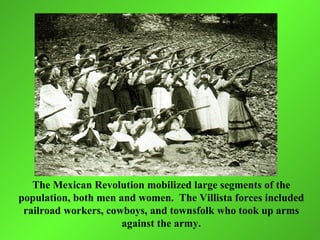
The Mexican Revolution mobilized large segments of the
population, both men and women. The Villista forces included
 railroad workers, cowboys, and townsfolk who took up arms
                      against the army.
David Siquieros Mural: "People in Arms"
            Detail. 1957-65
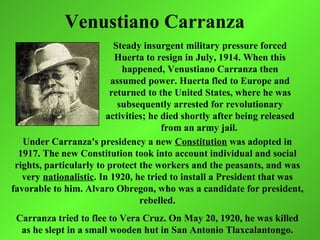
Venustiano Carranza
                           Steady insurgent military pressure forced
                           Huerta to resign in July, 1914. When this
                             happened, Venustiano Carranza then
                          assumed power. Huerta fled to Europe and
                          returned to the United States, where he was
                            subsequently arrested for revolutionary
                         activities; he died shortly after being released
                                        from an army jail.
   Under Carranza's presidency a new Constitution was adopted in
  1917. The new Constitution took into account individual and social
 rights, particularly to protect the workers and the peasants, and was
   very nationalistic. In 1920, he tried to install a President that was
favorable to him. Alvaro Obregon, who was a candidate for president,
                                  rebelled.
 Carranza tried to flee to Vera Cruz. On May 20, 1920, he was killed
  as he slept in a small wooden hut in San Antonio Tlaxcalantongo.
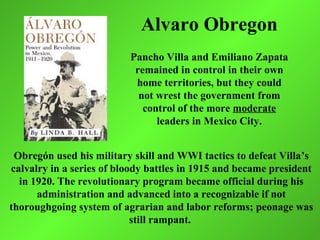
Alvaro Obregon
                          Pancho Villa and Emiliano Zapata
                           remained in control in their own
                           home territories, but they could
                            not wrest the government from
                             control of the more moderate
                                leaders in Mexico City.


 Obregón used his military skill and WWI tactics to defeat Villa’s
calvalry in a series of bloody battles in 1915 and became president
  in 1920. The revolutionary program became official during his
      administration and advanced into a recognizable if not
thoroughgoing system of agrarian and labor reforms; peonage was
                            still rampant.
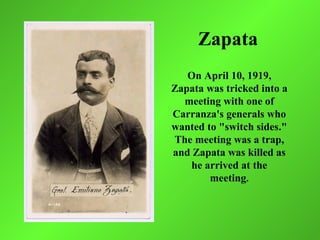
Zapata
   On April 10, 1919,
Zapata was tricked into a
  meeting with one of
Carranza's generals who
wanted to "switch sides."
The meeting was a trap,
and Zapata was killed as
   he arrived at the
        meeting.
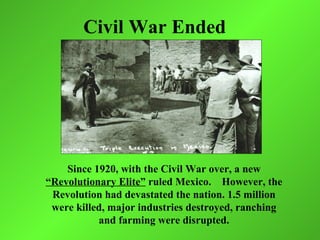
Civil War Ended


    Since 1920, with the Civil War over, a new
“Revolutionary Elite” ruled Mexico. However, the
 Revolution had devastated the nation. 1.5 million
 were killed, major industries destroyed, ranching
           and farming were disrupted.
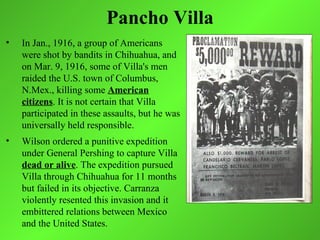
Pancho Villa
•   In Jan., 1916, a group of Americans
    were shot by bandits in Chihuahua, and
    on Mar. 9, 1916, some of Villa's men
    raided the U.S. town of Columbus,
    N.Mex., killing some American
    citizens. It is not certain that Villa
    participated in these assaults, but he was
    universally held responsible.
•   Wilson ordered a punitive expedition
    under General Pershing to capture Villa
    dead or alive. The expedition pursued
    Villa through Chihuahua for 11 months
    but failed in its objective. Carranza
    violently resented this invasion and it
    embittered relations between Mexico
    and the United States.
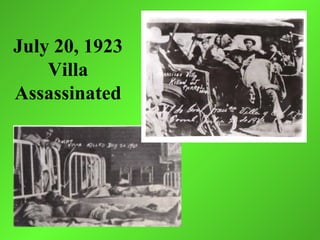
July 20, 1923
    Villa
Assassinated
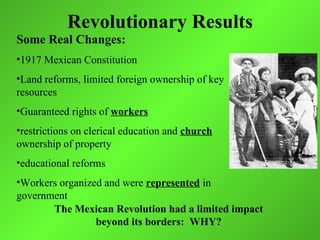
Revolutionary Results
Some Real Changes:
•1917 Mexican Constitution
•Land reforms, limited foreign ownership of key
resources
•Guaranteed rights of workers
•restrictions on clerical education and church
ownership of property
•educational reforms
•Workers organized and were represented in
government
       The Mexican Revolution had a limited impact
                 beyond its borders: WHY?
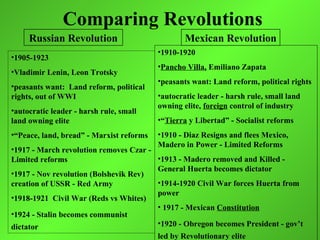
Comparing Revolutions
     Russian Revolution                           Mexican Revolution
                                          •1910-1920
•1905-1923
                                          •Pancho Villa, Emiliano Zapata
•Vladimir Lenin, Leon Trotsky
                                          •peasants want: Land reform, political rights
•peasants want: Land reform, political
rights, out of WWI                        •autocratic leader - harsh rule, small land
                                          owning elite, foreign control of industry
•autocratic leader - harsh rule, small
land owning elite                         •“Tierra y Libertad” - Socialist reforms
•“Peace, land, bread” - Marxist reforms   •1910 - Diaz Resigns and flees Mexico,
                                          Madero in Power - Limited Reforms
•1917 - March revolution removes Czar -
Limited reforms                         •1913 - Madero removed and Killed -
                                        General Huerta becomes dictator
•1917 - Nov revolution (Bolshevik Rev)
creation of USSR - Red Army             •1914-1920 Civil War forces Huerta from
                                        power
•1918-1921 Civil War (Reds vs Whites)
                                        • 1917 - Mexican Constitution
•1924 - Stalin becomes communist
dictator                                •1920 - Obregon becomes President - gov’t
                                          led by Revolutionary elite
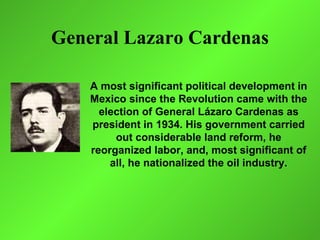
General Lazaro Cardenas

    A most significant political development in
    Mexico since the Revolution came with the
      election of General Lázaro Cardenas as
    president in 1934. His government carried
         out considerable land reform, he
    reorganized labor, and, most significant of
        all, he nationalized the oil industry.
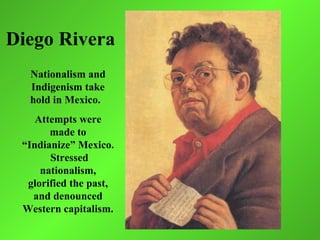
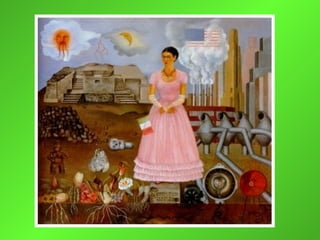
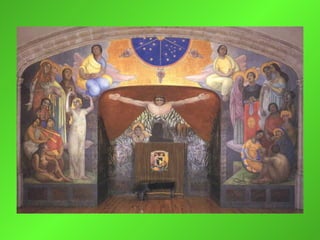
Diego Rivera
  Nationalism and
  Indigenism take
  hold in Mexico.
    Attempts were
       made to
 “Indianize” Mexico.
       Stressed
     nationalism,
  glorified the past,
   and denounced
 Western capitalism.
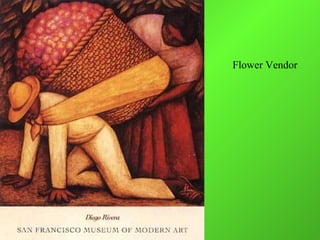
Flower Vendor
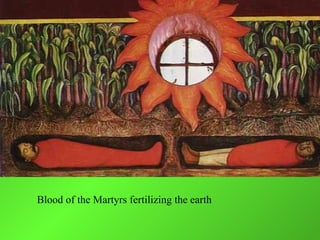
Blood of the Martyrs fertilizing the earth
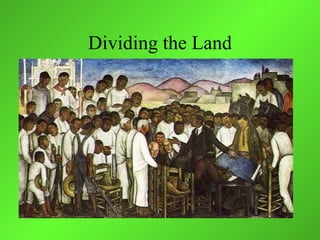
Dividing the Land
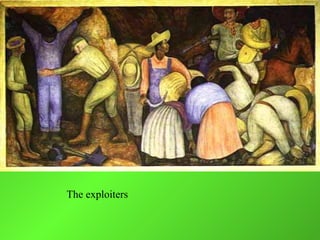
The exploiters
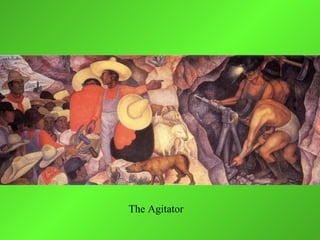
The Agitator
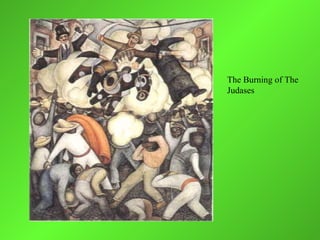
The Burning of The
Judases
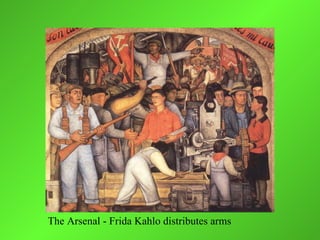
The Arsenal - Frida Kahlo distributes arms
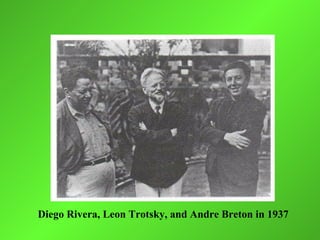
Diego Rivera, Leon Trotsky, and Andre Breton in 1937
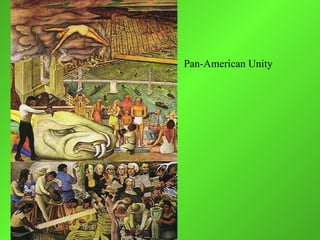
Pan-American Unity
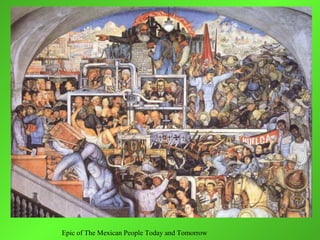
Epic of The Mexican People Today and Tomorrow
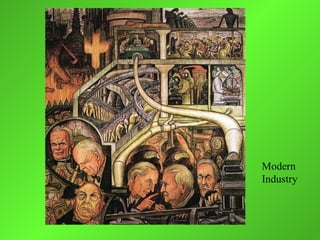
Modern
Industry
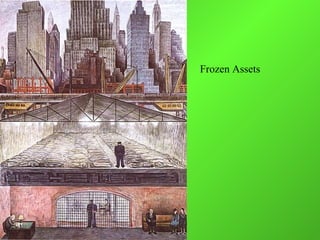
Frozen Assets
Democracy?
    After Cardenas, the pace of reform
slowed. Although Mexico is a democracy,
   one party has dominated the country
      since 1929 until very recently.
Party of the Institutionalized
             Revolution (PRI)
               Partido Revolucionario Institucional


• Revolutionary leaders wanted to institutionalize the new regime.
• Created a One-Party System known as the PRI.
• Incorporated labor, peasant, military, and middle class sectors.
• They controlled politics sometimes through the use of repressive
means.
• Limited the President to a one six-year term.
•Developed NAFTA (North Atlantic Free Trade Agreement)
Expand economy by building closer ties with U.S. and Canada.
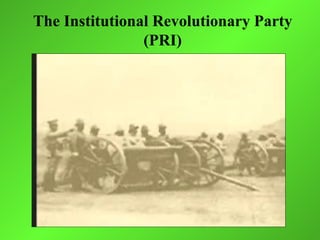
The Institutional Revolutionary Party
                (PRI)
Economy
• For many years, Mexico followed a policy of economic
  nationalism. The government imposed high tariffs to protect
  local industries. By 1974, Mexico borrowed heavily from
  foreign nations to develop its oil industries.
• By the 1980s, Mexico was in a debt crisis.
• More recently, Mexico moved toward free trade, or trade that
  had low tariffs and no restrictions.
NAFTA
• NAFTA (North Atlantic Free Trade Agreement)
                                 Mexico      Canada
• Members were the countries of _________, __________, and
  the United States
  ________________.
• NAFTA would abolish most tariffs on goods traded among
  the three member nations.
• Goal - Expand economy by building closer ties with U.S. and
  Canada.
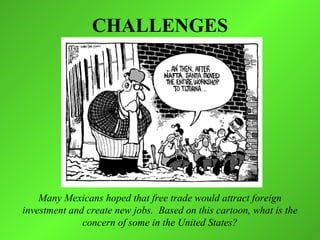
CHALLENGES


    Many Mexicans hoped that free trade would attract foreign
investment and create new jobs. Based on this cartoon, what is the
              concern of some in the United States?
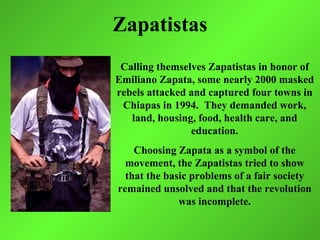
Zapatistas
 Calling themselves Zapatistas in honor of
Emiliano Zapata, some nearly 2000 masked
rebels attacked and captured four towns in
 Chiapas in 1994. They demanded work,
   land, housing, food, health care, and
                education.
    Choosing Zapata as a symbol of the
  movement, the Zapatistas tried to show
  that the basic problems of a fair society
remained unsolved and that the revolution
              was incomplete.
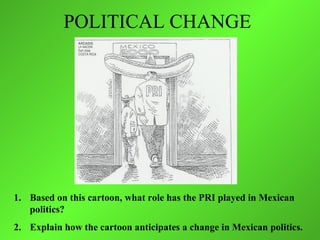
POLITICAL CHANGE


1. Based on this cartoon, what role has the PRI played in Mexican
   politics?
2. Explain how the cartoon anticipates a change in Mexican politics.
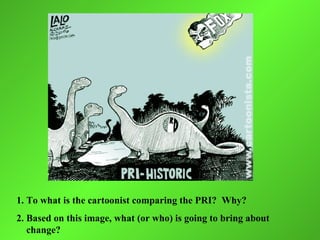
1. To what is the cartoonist comparing the PRI? Why?
2. Based on this image, what (or who) is going to bring about
   change?
Vicente Fox 2000-2006
    Member of the National Action Party (PAN) was elected
president at the end of 2000, thus ending the PRI’s dominance of
        the political system of more than half a century.
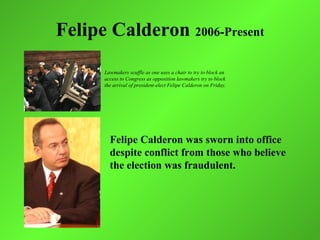
Felipe Calderon 2006-Present
      Lawmakers scuffle as one uses a chair to try to block an
      access to Congress as opposition lawmakers try to block
      the arrival of president-elect Felipe Calderon on Friday.


        Felipe Calderon was sworn into office
        despite conflict from those who believe
        the election was fraudulent.

Mex rev

  • 1.
    The Mexican Revolution Objective: •To understand the events that led to the Mexican Revolution • To understand the struggle for Mexican Democracy
  • 2.
    “Porfiriato” PorfirioDíaz was one of the generals of the Liberal army who was President of Mexico from 1877 until 1911, a period known as the Porfiriato because the figure of Porfirio Díaz dominated it. During this period, the economy grew; new railways and telephone networks were built; new banks opened; industry, mining, agriculture and commerce expanded. Major concessions led to foreign control over large sectors of the economy.
  • 3.
    Although President Díazbrought many benefits to Mexico, he was a dictator - a President who abused his power. Under Díaz, a few land owners became very wealthy, but the majority of Mexicans remained poor. David Siquieros Mural: "Don Porfirio [Diaz] and his Courtesans". 1957-65
  • 4.
    The Rebellion Begins During the first years of the 20th century, a new generation of educated, young Mexicans that did not belong to Díaz' group desired change. For the first time in thirty-three years other political parties were formed.
  • 5.
    Francisco Madero In 1910, the Mexican Revolution began as a result of frustration that Diaz's promise of free elections was not kept and he declared that he had won yet another election. Francisco I. Madero was one of those who had organized another political party. After the election he led the revolt against Diaz who eventually resigned and was exiled to France.
  • 6.
  • 7.
  • 8.
    Elections were thenheld, which Madero won, but the people were impatient and Madero was incapable of bringing order to the country. Madero only made moderate democratic reforms to relieve social tensions. He was challenged by Emiliano Zapata who wanted massive land reforms that were expressed in his motto “Tierra y Libertad” (Land and Liberty). In 1913, after a military coup supported by the United States, Madero was executed and another general, Victoriano Huerta took over Zapata as President.
  • 9.
    General Victoriano Huerta In 1913 he plotted secretly with Madero's enemies, and overthrew the president. Huerta established a military dictatorship, notable for political corruption and rule by imprisonment and assassination. He was supported by large land owners, the army, and foreign companies. Numerous counterrevolutions broke out; the most important insurgent leaders of the Constitutionalist Movement were Venustiano Carranza, Francisco Villa, and Emiliano Zapata.
  • 10.
    Pancho Villa Pancho Villa led peasant rebels in the north and attacked the Federal Army. Villa lead and fought in a decades worth of battles for the cause with his army known as "The Dorados" (The Golden Boys). The name was ironic considering that they were mostly makeshift Revolutionaries who were recruited from village to village where Villa and his men would pillage to have water, food and women. During the course of the Revolution in Mexico, Villa seemed to be blessed, never sustaining life threatening injuries.
  • 11.
    The revolutionaries, includingFrancisco Villa in the north, and Emiliano Zapata in the south, began a struggle to overthrow President Huerta.
  • 12.
  • 13.
    The Mexican Revolutionmobilized large segments of the population, both men and women. The Villista forces included railroad workers, cowboys, and townsfolk who took up arms against the army.
  • 14.
    David Siquieros Mural:"People in Arms" Detail. 1957-65
  • 15.
    Venustiano Carranza Steady insurgent military pressure forced Huerta to resign in July, 1914. When this happened, Venustiano Carranza then assumed power. Huerta fled to Europe and returned to the United States, where he was subsequently arrested for revolutionary activities; he died shortly after being released from an army jail. Under Carranza's presidency a new Constitution was adopted in 1917. The new Constitution took into account individual and social rights, particularly to protect the workers and the peasants, and was very nationalistic. In 1920, he tried to install a President that was favorable to him. Alvaro Obregon, who was a candidate for president, rebelled. Carranza tried to flee to Vera Cruz. On May 20, 1920, he was killed as he slept in a small wooden hut in San Antonio Tlaxcalantongo.
  • 16.
    Alvaro Obregon Pancho Villa and Emiliano Zapata remained in control in their own home territories, but they could not wrest the government from control of the more moderate leaders in Mexico City. Obregón used his military skill and WWI tactics to defeat Villa’s calvalry in a series of bloody battles in 1915 and became president in 1920. The revolutionary program became official during his administration and advanced into a recognizable if not thoroughgoing system of agrarian and labor reforms; peonage was still rampant.
  • 17.
    Zapata On April 10, 1919, Zapata was tricked into a meeting with one of Carranza's generals who wanted to "switch sides." The meeting was a trap, and Zapata was killed as he arrived at the meeting.
  • 18.
    Civil War Ended Since 1920, with the Civil War over, a new “Revolutionary Elite” ruled Mexico. However, the Revolution had devastated the nation. 1.5 million were killed, major industries destroyed, ranching and farming were disrupted.
  • 19.
    Pancho Villa • In Jan., 1916, a group of Americans were shot by bandits in Chihuahua, and on Mar. 9, 1916, some of Villa's men raided the U.S. town of Columbus, N.Mex., killing some American citizens. It is not certain that Villa participated in these assaults, but he was universally held responsible. • Wilson ordered a punitive expedition under General Pershing to capture Villa dead or alive. The expedition pursued Villa through Chihuahua for 11 months but failed in its objective. Carranza violently resented this invasion and it embittered relations between Mexico and the United States.
  • 20.
    July 20, 1923 Villa Assassinated
  • 21.
    Revolutionary Results Some RealChanges: •1917 Mexican Constitution •Land reforms, limited foreign ownership of key resources •Guaranteed rights of workers •restrictions on clerical education and church ownership of property •educational reforms •Workers organized and were represented in government The Mexican Revolution had a limited impact beyond its borders: WHY?
  • 22.
    Comparing Revolutions Russian Revolution Mexican Revolution •1910-1920 •1905-1923 •Pancho Villa, Emiliano Zapata •Vladimir Lenin, Leon Trotsky •peasants want: Land reform, political rights •peasants want: Land reform, political rights, out of WWI •autocratic leader - harsh rule, small land owning elite, foreign control of industry •autocratic leader - harsh rule, small land owning elite •“Tierra y Libertad” - Socialist reforms •“Peace, land, bread” - Marxist reforms •1910 - Diaz Resigns and flees Mexico, Madero in Power - Limited Reforms •1917 - March revolution removes Czar - Limited reforms •1913 - Madero removed and Killed - General Huerta becomes dictator •1917 - Nov revolution (Bolshevik Rev) creation of USSR - Red Army •1914-1920 Civil War forces Huerta from power •1918-1921 Civil War (Reds vs Whites) • 1917 - Mexican Constitution •1924 - Stalin becomes communist dictator •1920 - Obregon becomes President - gov’t led by Revolutionary elite
  • 23.
    General Lazaro Cardenas A most significant political development in Mexico since the Revolution came with the election of General Lázaro Cardenas as president in 1934. His government carried out considerable land reform, he reorganized labor, and, most significant of all, he nationalized the oil industry.
  • 24.
    Diego Rivera Nationalism and Indigenism take hold in Mexico. Attempts were made to “Indianize” Mexico. Stressed nationalism, glorified the past, and denounced Western capitalism.
  • 25.
  • 27.
    Blood of theMartyrs fertilizing the earth
  • 28.
  • 29.
  • 30.
  • 31.
    The Burning ofThe Judases
  • 32.
    The Arsenal -Frida Kahlo distributes arms
  • 33.
    Diego Rivera, LeonTrotsky, and Andre Breton in 1937
  • 36.
  • 37.
    Epic of TheMexican People Today and Tomorrow
  • 38.
  • 39.
  • 43.
    Democracy? After Cardenas, the pace of reform slowed. Although Mexico is a democracy, one party has dominated the country since 1929 until very recently.
  • 44.
    Party of theInstitutionalized Revolution (PRI) Partido Revolucionario Institucional • Revolutionary leaders wanted to institutionalize the new regime. • Created a One-Party System known as the PRI. • Incorporated labor, peasant, military, and middle class sectors. • They controlled politics sometimes through the use of repressive means. • Limited the President to a one six-year term. •Developed NAFTA (North Atlantic Free Trade Agreement) Expand economy by building closer ties with U.S. and Canada.
  • 45.
  • 46.
    Economy • For manyyears, Mexico followed a policy of economic nationalism. The government imposed high tariffs to protect local industries. By 1974, Mexico borrowed heavily from foreign nations to develop its oil industries. • By the 1980s, Mexico was in a debt crisis. • More recently, Mexico moved toward free trade, or trade that had low tariffs and no restrictions.
  • 47.
    NAFTA • NAFTA (NorthAtlantic Free Trade Agreement) Mexico Canada • Members were the countries of _________, __________, and the United States ________________. • NAFTA would abolish most tariffs on goods traded among the three member nations. • Goal - Expand economy by building closer ties with U.S. and Canada.
  • 48.
    CHALLENGES Many Mexicans hoped that free trade would attract foreign investment and create new jobs. Based on this cartoon, what is the concern of some in the United States?
  • 49.
    Zapatistas Calling themselvesZapatistas in honor of Emiliano Zapata, some nearly 2000 masked rebels attacked and captured four towns in Chiapas in 1994. They demanded work, land, housing, food, health care, and education. Choosing Zapata as a symbol of the movement, the Zapatistas tried to show that the basic problems of a fair society remained unsolved and that the revolution was incomplete.
  • 50.
    POLITICAL CHANGE 1. Basedon this cartoon, what role has the PRI played in Mexican politics? 2. Explain how the cartoon anticipates a change in Mexican politics.
  • 51.
    1. To whatis the cartoonist comparing the PRI? Why? 2. Based on this image, what (or who) is going to bring about change?
  • 52.
    Vicente Fox 2000-2006 Member of the National Action Party (PAN) was elected president at the end of 2000, thus ending the PRI’s dominance of the political system of more than half a century.
  • 53.
    Felipe Calderon 2006-Present Lawmakers scuffle as one uses a chair to try to block an access to Congress as opposition lawmakers try to block the arrival of president-elect Felipe Calderon on Friday. Felipe Calderon was sworn into office despite conflict from those who believe the election was fraudulent.