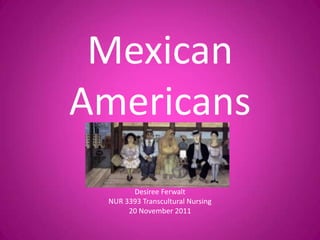
Mexican
Americans
       Desiree Ferwalt
 NUR 3393 Transcultural Nursing
      20 November 2011
Englekirk and Marín (2011) states that
  after the Mexican-American War in
1848 the U.S. annexed what is now the
   current Southwestern region from
Mexico. This would include California,
  Nevada, Utah, New Mexico, most of
  Arizona and Colorado, and parts of
     Texas, Oklahoma, Kansas, and
  Wyoming. Mexicans residing in that
 territory became members of the US.
Giger (2008) states that Mexican
  Americans living in U.S. tend to be
economically segregated working class
 group. They are often forced into low
  paying day labor jobs. This group of
 people are often discriminated in the
   US through education, jobs, and
     housing. Skin color, language
  differences, and Spanish surnames
    contribute to the discrimination
                (p. 241)
Mexican Americans are
    Americans of Mexican descent
•Language- Spanish, American English, minority speaks
Indigenous Mexican language
•Religion- Roman Catholic, minority is Protestant
•Race-Most Mexican Americans are the descendants of
the Indigenous Mexicans and/or Spaniards with
Europeans.
•Skin Color- persons with lighter skin color have more
Spanish ancestry and darker skinned person have more
Indian ancestry
•Politics-Hispanic community lean toward the Democratic
Party
•Family- traditional gender and family roles, patriarchal
head of house                (Office of Minority Health & Health
                               Disparities , 2010)
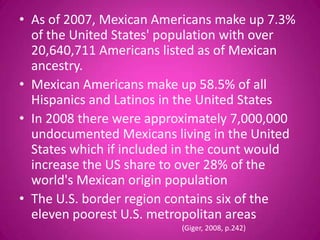
• As of 2007, Mexican Americans make up 7.3%
  of the United States' population with over
  20,640,711 Americans listed as of Mexican
  ancestry.
• Mexican Americans make up 58.5% of all
  Hispanics and Latinos in the United States
• In 2008 there were approximately 7,000,000
  undocumented Mexicans living in the United
  States which if included in the count would
  increase the US share to over 28% of the
  world's Mexican origin population
• The U.S. border region contains six of the
  eleven poorest U.S. metropolitan areas
                          (Giger, 2008, p.242)
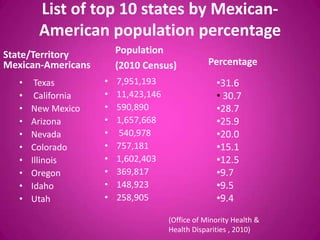
List of top 10 states by Mexican-
        American population percentage
State/Territory          Population
Mexican-Americans        (2010 Census)            Percentage
   •    Texas        •   7,951,193                  •31.6
   •    California   •   11,423,146                 • 30.7
   •   New Mexico    •   590,890                    •28.7
   •   Arizona       •   1,657,668                  •25.9
   •   Nevada        •   540,978                    •20.0
   •   Colorado      •   757,181                    •15.1
   •   Illinois      •   1,602,403                  •12.5
   •   Oregon        •   369,817                    •9.7
   •   Idaho         •   148,923                    •9.5
   •   Utah          •   258,905                    •9.4
                                      (Office of Minority Health &
                                      Health Disparities , 2010)
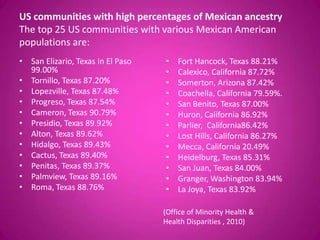
US communities with high percentages of Mexican ancestry
The top 25 US communities with various Mexican American
populations are:
• San Elizario, Texas in El Paso   •   Fort Hancock, Texas 88.21%
  99.00%                           •   Calexico, California 87.72%
• Tornillo, Texas 87.20%           •   Somerton, Arizona 87.42%
• Lopezville, Texas 87.48%         •   Coachella, California 79.59%.
• Progreso, Texas 87.54%           •   San Benito, Texas 87.00%
• Cameron, Texas 90.79%            •   Huron, California 86.92%
• Presidio, Texas 89.92%           •   Parlier, California86.42%
• Alton, Texas 89.62%              •   Lost Hills, California 86.27%
• Hidalgo, Texas 89.43%            •   Mecca, California 20.49%
• Cactus, Texas 89.40%             •   Heidelburg, Texas 85.31%
• Penitas, Texas 89.37%            •   San Juan, Texas 84.00%
• Palmview, Texas 89.16%           •   Granger, Washington 83.94%
• Roma, Texas 88.76%               •   La Joya, Texas 83.92%

                                   (Office of Minority Health &
                                   Health Disparities , 2010)
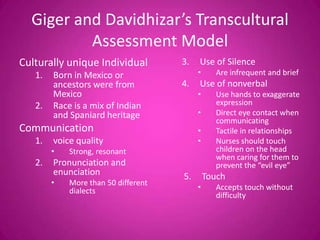
Giger and Davidhizar’s Transcultural
          Assessment Model
Culturally unique Individual         3.   Use of Silence
   1.   Born in Mexico or                 •     Are infrequent and brief
        ancestors were from          4.   Use of nonverbal
        Mexico                            •     Use hands to exaggerate
   2.   Race is a mix of Indian                 expression
        and Spaniard heritage             •     Direct eye contact when
                                                communicating
Communication                             •     Tactile in relationships
   1.   voice quality                     •     Nurses should touch
        •   Strong, resonant                    children on the head
                                                when caring for them to
   2.   Pronunciation and                       prevent the “evil eye”
        enunciation                  5.       Touch
        •   More than 50 different
            dialects                      •     Accepts touch without
                                                difficulty
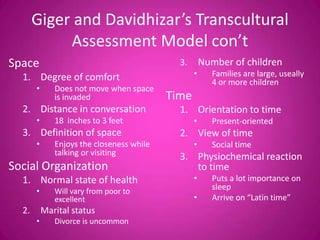
Giger and Davidhizar’s Transcultural
            Assessment Model con’t
Space                                        3.       Number of children
  1. Degree of comfort                            •     Families are large, useally
                                                        4 or more children
       •      Does not move when space
              is invaded                   Time
  2. Distance in conversation                1. Orientation to time
       •      18 inches to 3 feet                 •     Present-oriented
  3. Definition of space                     2. View of time
       •      Enjoys the closeness while          •     Social time
              talking or visiting            3. Physiochemical reaction
Social Organization                             to time
  1. Normal state of health                       •     Puts a lot importance on
       •      Will vary from poor to
                                                        sleep
              excellent                           •     Arrive on “Latin time”
  2.       Marital status
       •      Divorce is uncommon
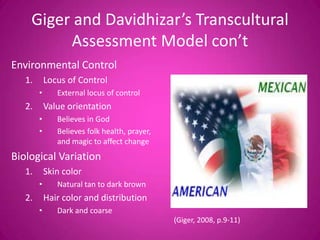
Giger and Davidhizar’s Transcultural
         Assessment Model con’t
Environmental Control
   1.       Locus of Control
        •      External locus of control
   2.       Value orientation
        •      Believes in God
        •      Believes folk health, prayer,
               and magic to affect change
Biological Variation
   1.       Skin color
        •      Natural tan to dark brown
   2.       Hair color and distribution
        •      Dark and coarse
                                               (Giger, 2008, p.9-11)
Giger (2008) states Mexican
 Americans rely frequently on
traditional medical beliefs and
 practices instead of Modern
 Western medicine to resolve
   health problems (p. 256).
cultural beliefs of health and
                 illness
•Health is seen as holistic involving mind, body, and
spirit.
•Curanderismo describes the entire Mexican Folk system
of disease and healing. Curaneros are folk healers who
use their belief in God.
•Yerberos are root and herb doctors.
•Mexican American Folk Medicines include plants
(onion, garlic, aloe vera, cactus), precious stones (silver,
gold, copper), magical perfumes
•Other healers are Sobadores (massage therapists),
Brujos (Witches), and Espiritistas (Spiritualists).
                                          (Englekirk and Marín, 2011)
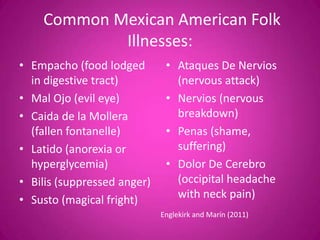
Common Mexican American Folk
            Illnesses:
• Empacho (food lodged        • Ataques De Nervios
  in digestive tract)           (nervous attack)
• Mal Ojo (evil eye)          • Nervios (nervous
• Caida de la Mollera           breakdown)
  (fallen fontanelle)         • Penas (shame,
• Latido (anorexia or           suffering)
  hyperglycemia)              • Dolor De Cerebro
• Bilis (suppressed anger)      (occipital headache
• Susto (magical fright)        with neck pain)
                             Englekirk and Marín (2011)
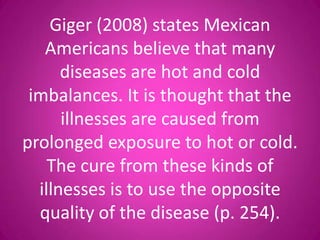
Giger (2008) states Mexican
   Americans believe that many
      diseases are hot and cold
 imbalances. It is thought that the
      illnesses are caused from
prolonged exposure to hot or cold.
    The cure from these kinds of
  illnesses is to use the opposite
  quality of the disease (p. 254).
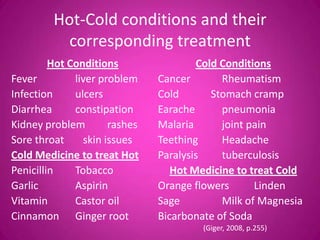
Hot-Cold conditions and their
           corresponding treatment
         Hot Conditions                Cold Conditions
Fever         liver problem    Cancer       Rheumatism
Infection     ulcers           Cold       Stomach cramp
Diarrhea      constipation     Earache      pneumonia
Kidney problem        rashes   Malaria      joint pain
Sore throat     skin issues    Teething     Headache
Cold Medicine to treat Hot     Paralysis    tuberculosis
Penicillin    Tobacco             Hot Medicine to treat Cold
Garlic        Aspirin          Orange flowers      Linden
Vitamin       Castor oil       Sage         Milk of Magnesia
Cinnamon Ginger root           Bicarbonate of Soda
                                        (Giger, 2008, p.255)
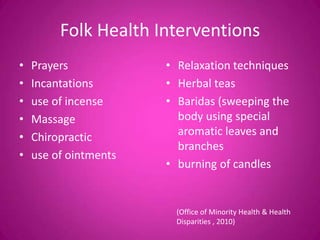
Folk Health Interventions
•   Prayers            • Relaxation techniques
•   Incantations       • Herbal teas
•   use of incense     • Baridas (sweeping the
•   Massage              body using special
•   Chiropractic         aromatic leaves and
                         branches
•   use of ointments
                       • burning of candles


                        (Office of Minority Health & Health
                        Disparities , 2010)
Health Risk Factors
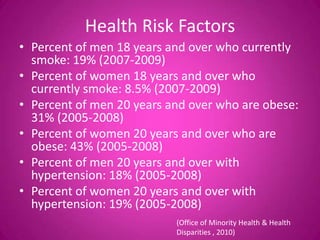
• Percent of men 18 years and over who currently
  smoke: 19% (2007-2009)
• Percent of women 18 years and over who
  currently smoke: 8.5% (2007-2009)
• Percent of men 20 years and over who are obese:
  31% (2005-2008)
• Percent of women 20 years and over who are
  obese: 43% (2005-2008)
• Percent of men 20 years and over with
  hypertension: 18% (2005-2008)
• Percent of women 20 years and over with
  hypertension: 19% (2005-2008)
                           (Office of Minority Health & Health
                           Disparities , 2010)
Factors that contribute to poor health
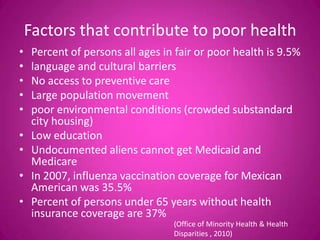
•    Percent of persons all ages in fair or poor health is 9.5%
•    language and cultural barriers
•    No access to preventive care
•    Large population movement
•    poor environmental conditions (crowded substandard
     city housing)
•    Low education
•    Undocumented aliens cannot get Medicaid and
     Medicare
•    In 2007, influenza vaccination coverage for Mexican
     American was 35.5%
•    Percent of persons under 65 years without health
     insurance coverage are 37%
                                   (Office of Minority Health & Health
                                   Disparities , 2010)
Healthcare statistics
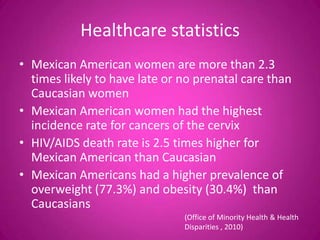
• Mexican American women are more than 2.3
  times likely to have late or no prenatal care than
  Caucasian women
• Mexican American women had the highest
  incidence rate for cancers of the cervix
• HIV/AIDS death rate is 2.5 times higher for
  Mexican American than Caucasian
• Mexican Americans had a higher prevalence of
  overweight (77.3%) and obesity (30.4%) than
  Caucasians
                               (Office of Minority Health & Health
                               Disparities , 2010)
Common Diseases that Mexican
      American are Susceptible to
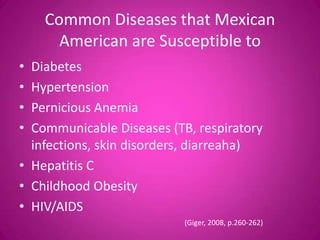
• Diabetes
• Hypertension
• Pernicious Anemia
• Communicable Diseases (TB, respiratory
  infections, skin disorders, diarreaha)
• Hepatitis C
• Childhood Obesity
• HIV/AIDS
                           (Giger, 2008, p.260-262)
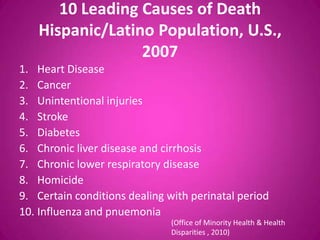
10 Leading Causes of Death
   Hispanic/Latino Population, U.S.,
                 2007
1. Heart Disease
2. Cancer
3. Unintentional injuries
4. Stroke
5. Diabetes
6. Chronic liver disease and cirrhosis
7. Chronic lower respiratory disease
8. Homicide
9. Certain conditions dealing with perinatal period
10. Influenza and pnuemonia
                               (Office of Minority Health & Health
                               Disparities , 2010)
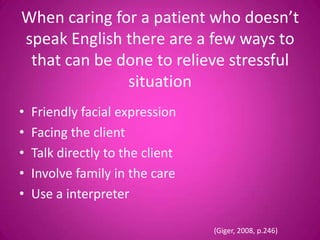
When caring for a patient who doesn’t
speak English there are a few ways to
 that can be done to relieve stressful
              situation
•   Friendly facial expression
•   Facing the client
•   Talk directly to the client
•   Involve family in the care
•   Use a interpreter

                                  (Giger, 2008, p.246)
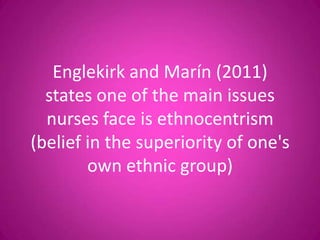
Englekirk and Marín (2011)
  states one of the main issues
  nurses face is ethnocentrism
(belief in the superiority of one's
        own ethnic group)
Giger (2008) states Nurses who do
not understand the culture of their
clients are likely to be negative and
less effective in their care (p. 266).
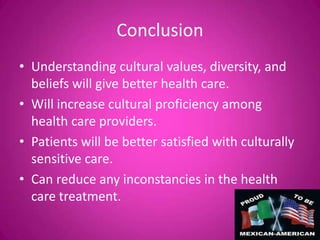
Conclusion
• Understanding cultural values, diversity, and
  beliefs will give better health care.
• Will increase cultural proficiency among
  health care providers.
• Patients will be better satisfied with culturally
  sensitive care.
• Can reduce any inconstancies in the health
  care treatment.
References
Englekirk, A., & Marín, M. (2011, March 18). Mexican
  American. In Countries and Their Cultures. Retrieved
  November 19, 2011, from
  http://www.everyculture.com/multi/Le-Pa/Mexican-
  Americans.html
Giger, J.N. & Davidhizar, R.E. (2008). Transcultural Nursing:
  Assessment & Intervention, (5th Ed). Mosby: St Louis
Office of Minority Health & Health Disparities . (2010).
  Hispanic or Latino Populations. In CDC: Office of Minority
  Health & Health Disparities . Retrieved November 17, 2011,
  from http://www.cdc.gov/omhd/Populations/HL/HL.htm

Mexican Americans

  • 1.
    Mexican Americans Desiree Ferwalt NUR 3393 Transcultural Nursing 20 November 2011
  • 2.
    Englekirk and Marín(2011) states that after the Mexican-American War in 1848 the U.S. annexed what is now the current Southwestern region from Mexico. This would include California, Nevada, Utah, New Mexico, most of Arizona and Colorado, and parts of Texas, Oklahoma, Kansas, and Wyoming. Mexicans residing in that territory became members of the US.
  • 3.
    Giger (2008) statesthat Mexican Americans living in U.S. tend to be economically segregated working class group. They are often forced into low paying day labor jobs. This group of people are often discriminated in the US through education, jobs, and housing. Skin color, language differences, and Spanish surnames contribute to the discrimination (p. 241)
  • 4.
    Mexican Americans are Americans of Mexican descent •Language- Spanish, American English, minority speaks Indigenous Mexican language •Religion- Roman Catholic, minority is Protestant •Race-Most Mexican Americans are the descendants of the Indigenous Mexicans and/or Spaniards with Europeans. •Skin Color- persons with lighter skin color have more Spanish ancestry and darker skinned person have more Indian ancestry •Politics-Hispanic community lean toward the Democratic Party •Family- traditional gender and family roles, patriarchal head of house (Office of Minority Health & Health Disparities , 2010)
  • 5.
    • As of2007, Mexican Americans make up 7.3% of the United States' population with over 20,640,711 Americans listed as of Mexican ancestry. • Mexican Americans make up 58.5% of all Hispanics and Latinos in the United States • In 2008 there were approximately 7,000,000 undocumented Mexicans living in the United States which if included in the count would increase the US share to over 28% of the world's Mexican origin population • The U.S. border region contains six of the eleven poorest U.S. metropolitan areas (Giger, 2008, p.242)
  • 6.
    List of top10 states by Mexican- American population percentage State/Territory Population Mexican-Americans (2010 Census) Percentage • Texas • 7,951,193 •31.6 • California • 11,423,146 • 30.7 • New Mexico • 590,890 •28.7 • Arizona • 1,657,668 •25.9 • Nevada • 540,978 •20.0 • Colorado • 757,181 •15.1 • Illinois • 1,602,403 •12.5 • Oregon • 369,817 •9.7 • Idaho • 148,923 •9.5 • Utah • 258,905 •9.4 (Office of Minority Health & Health Disparities , 2010)
  • 7.
    US communities withhigh percentages of Mexican ancestry The top 25 US communities with various Mexican American populations are: • San Elizario, Texas in El Paso • Fort Hancock, Texas 88.21% 99.00% • Calexico, California 87.72% • Tornillo, Texas 87.20% • Somerton, Arizona 87.42% • Lopezville, Texas 87.48% • Coachella, California 79.59%. • Progreso, Texas 87.54% • San Benito, Texas 87.00% • Cameron, Texas 90.79% • Huron, California 86.92% • Presidio, Texas 89.92% • Parlier, California86.42% • Alton, Texas 89.62% • Lost Hills, California 86.27% • Hidalgo, Texas 89.43% • Mecca, California 20.49% • Cactus, Texas 89.40% • Heidelburg, Texas 85.31% • Penitas, Texas 89.37% • San Juan, Texas 84.00% • Palmview, Texas 89.16% • Granger, Washington 83.94% • Roma, Texas 88.76% • La Joya, Texas 83.92% (Office of Minority Health & Health Disparities , 2010)
  • 8.
    Giger and Davidhizar’sTranscultural Assessment Model Culturally unique Individual 3. Use of Silence 1. Born in Mexico or • Are infrequent and brief ancestors were from 4. Use of nonverbal Mexico • Use hands to exaggerate 2. Race is a mix of Indian expression and Spaniard heritage • Direct eye contact when communicating Communication • Tactile in relationships 1. voice quality • Nurses should touch • Strong, resonant children on the head when caring for them to 2. Pronunciation and prevent the “evil eye” enunciation 5. Touch • More than 50 different dialects • Accepts touch without difficulty
  • 9.
    Giger and Davidhizar’sTranscultural Assessment Model con’t Space 3. Number of children 1. Degree of comfort • Families are large, useally 4 or more children • Does not move when space is invaded Time 2. Distance in conversation 1. Orientation to time • 18 inches to 3 feet • Present-oriented 3. Definition of space 2. View of time • Enjoys the closeness while • Social time talking or visiting 3. Physiochemical reaction Social Organization to time 1. Normal state of health • Puts a lot importance on • Will vary from poor to sleep excellent • Arrive on “Latin time” 2. Marital status • Divorce is uncommon
  • 10.
    Giger and Davidhizar’sTranscultural Assessment Model con’t Environmental Control 1. Locus of Control • External locus of control 2. Value orientation • Believes in God • Believes folk health, prayer, and magic to affect change Biological Variation 1. Skin color • Natural tan to dark brown 2. Hair color and distribution • Dark and coarse (Giger, 2008, p.9-11)
  • 11.
    Giger (2008) statesMexican Americans rely frequently on traditional medical beliefs and practices instead of Modern Western medicine to resolve health problems (p. 256).
  • 12.
    cultural beliefs ofhealth and illness •Health is seen as holistic involving mind, body, and spirit. •Curanderismo describes the entire Mexican Folk system of disease and healing. Curaneros are folk healers who use their belief in God. •Yerberos are root and herb doctors. •Mexican American Folk Medicines include plants (onion, garlic, aloe vera, cactus), precious stones (silver, gold, copper), magical perfumes •Other healers are Sobadores (massage therapists), Brujos (Witches), and Espiritistas (Spiritualists). (Englekirk and Marín, 2011)
  • 13.
    Common Mexican AmericanFolk Illnesses: • Empacho (food lodged • Ataques De Nervios in digestive tract) (nervous attack) • Mal Ojo (evil eye) • Nervios (nervous • Caida de la Mollera breakdown) (fallen fontanelle) • Penas (shame, • Latido (anorexia or suffering) hyperglycemia) • Dolor De Cerebro • Bilis (suppressed anger) (occipital headache • Susto (magical fright) with neck pain) Englekirk and Marín (2011)
  • 14.
    Giger (2008) statesMexican Americans believe that many diseases are hot and cold imbalances. It is thought that the illnesses are caused from prolonged exposure to hot or cold. The cure from these kinds of illnesses is to use the opposite quality of the disease (p. 254).
  • 15.
    Hot-Cold conditions andtheir corresponding treatment Hot Conditions Cold Conditions Fever liver problem Cancer Rheumatism Infection ulcers Cold Stomach cramp Diarrhea constipation Earache pneumonia Kidney problem rashes Malaria joint pain Sore throat skin issues Teething Headache Cold Medicine to treat Hot Paralysis tuberculosis Penicillin Tobacco Hot Medicine to treat Cold Garlic Aspirin Orange flowers Linden Vitamin Castor oil Sage Milk of Magnesia Cinnamon Ginger root Bicarbonate of Soda (Giger, 2008, p.255)
  • 16.
    Folk Health Interventions • Prayers • Relaxation techniques • Incantations • Herbal teas • use of incense • Baridas (sweeping the • Massage body using special • Chiropractic aromatic leaves and branches • use of ointments • burning of candles (Office of Minority Health & Health Disparities , 2010)
  • 17.
    Health Risk Factors •Percent of men 18 years and over who currently smoke: 19% (2007-2009) • Percent of women 18 years and over who currently smoke: 8.5% (2007-2009) • Percent of men 20 years and over who are obese: 31% (2005-2008) • Percent of women 20 years and over who are obese: 43% (2005-2008) • Percent of men 20 years and over with hypertension: 18% (2005-2008) • Percent of women 20 years and over with hypertension: 19% (2005-2008) (Office of Minority Health & Health Disparities , 2010)
  • 18.
    Factors that contributeto poor health • Percent of persons all ages in fair or poor health is 9.5% • language and cultural barriers • No access to preventive care • Large population movement • poor environmental conditions (crowded substandard city housing) • Low education • Undocumented aliens cannot get Medicaid and Medicare • In 2007, influenza vaccination coverage for Mexican American was 35.5% • Percent of persons under 65 years without health insurance coverage are 37% (Office of Minority Health & Health Disparities , 2010)
  • 19.
    Healthcare statistics • MexicanAmerican women are more than 2.3 times likely to have late or no prenatal care than Caucasian women • Mexican American women had the highest incidence rate for cancers of the cervix • HIV/AIDS death rate is 2.5 times higher for Mexican American than Caucasian • Mexican Americans had a higher prevalence of overweight (77.3%) and obesity (30.4%) than Caucasians (Office of Minority Health & Health Disparities , 2010)
  • 20.
    Common Diseases thatMexican American are Susceptible to • Diabetes • Hypertension • Pernicious Anemia • Communicable Diseases (TB, respiratory infections, skin disorders, diarreaha) • Hepatitis C • Childhood Obesity • HIV/AIDS (Giger, 2008, p.260-262)
  • 21.
    10 Leading Causesof Death Hispanic/Latino Population, U.S., 2007 1. Heart Disease 2. Cancer 3. Unintentional injuries 4. Stroke 5. Diabetes 6. Chronic liver disease and cirrhosis 7. Chronic lower respiratory disease 8. Homicide 9. Certain conditions dealing with perinatal period 10. Influenza and pnuemonia (Office of Minority Health & Health Disparities , 2010)
  • 22.
    When caring fora patient who doesn’t speak English there are a few ways to that can be done to relieve stressful situation • Friendly facial expression • Facing the client • Talk directly to the client • Involve family in the care • Use a interpreter (Giger, 2008, p.246)
  • 23.
    Englekirk and Marín(2011) states one of the main issues nurses face is ethnocentrism (belief in the superiority of one's own ethnic group)
  • 24.
    Giger (2008) statesNurses who do not understand the culture of their clients are likely to be negative and less effective in their care (p. 266).
  • 25.
    Conclusion • Understanding culturalvalues, diversity, and beliefs will give better health care. • Will increase cultural proficiency among health care providers. • Patients will be better satisfied with culturally sensitive care. • Can reduce any inconstancies in the health care treatment.
  • 26.
    References Englekirk, A., &Marín, M. (2011, March 18). Mexican American. In Countries and Their Cultures. Retrieved November 19, 2011, from http://www.everyculture.com/multi/Le-Pa/Mexican- Americans.html Giger, J.N. & Davidhizar, R.E. (2008). Transcultural Nursing: Assessment & Intervention, (5th Ed). Mosby: St Louis Office of Minority Health & Health Disparities . (2010). Hispanic or Latino Populations. In CDC: Office of Minority Health & Health Disparities . Retrieved November 17, 2011, from http://www.cdc.gov/omhd/Populations/HL/HL.htm