Metric Embeddings and Expanders

                        Grigory Yaroslavtsev
                  (based on Chapter 13 of a survey
     “Expander graphs and their applications” by Hoory, Linial and
                            Wigderson)

                             Pennsylvania State University


                               December 8, 2011


Grigory Yaroslavtsev (PSU)                                   December 8, 2011   1 / 11
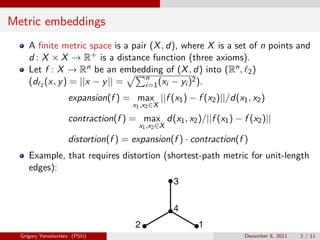
Metric embeddings
     A finite metric space is a pair (X , d), where X is a set of n points and
     d : X × X → R+ is a distance function (three axioms).
     Let f : X → Rn be an embedding of (X , d) into (Rn , 2 )
                                   n             2
     (d 2 (x, y ) = ||x − y || =   i=1 (xi − yi ) ).
                    expansion(f ) = max ||f (x1 ) − f (x2 )||/d(x1 , x2 )
                                     x1 ,x2 ∈X

                    contraction(f ) = max d(x1 , x2 )/||f (x1 ) − f (x2 )||
                                       x1 ,x2 ∈X

                    distortion(f ) = expansion(f ) · contraction(f )
     Example, that requires distortion (shortest-path metric for unit-length
     edges):


  Grigory Yaroslavtsev (PSU)                                       December 8, 2011   2 / 11
Background on                  2 -embeddings

     If (X , d) is 2 -embeddable ⇒ it is p -embeddable for 1 ≤ p ≤ ∞.
     Let c2 (X , d) denote the least possible distortion of an embedding of
     (X , d) into (Rn , 2 ) (dimension n is sufficient).
     For any n-point metric space c2 (X , d) = O(log n) [Bourgain’85].
     We will see how to compute such an embedding later (via SDP),
     together with a Ω(log n) lower bound for expanders (via dual SDP).
Theorem (Johnson-Lindenstrauss ’84)
                                                       log n
Any n-point 2 -metric can be embedded into an O          2     -dimensional
Euclidean space with distortion 1 + .

     The bound on dimension was shown to be optimal by Jayram and
     Woodruff (SODA’11), previous Ω( 2 log n ) was by Alon ’03.
                                      log 1/
     Such dimension reduction is impossible for   1   (Brinkman, Charikar
     ’03, Lee, Naor ’04, . . . ?).
  Grigory Yaroslavtsev (PSU)                                   December 8, 2011   3 / 11
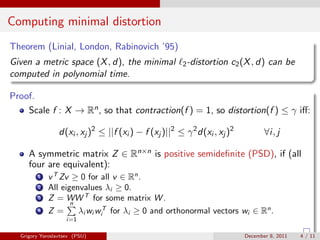
Computing minimal distortion
Theorem (Linial, London, Rabinovich ’95)
Given a metric space (X , d), the minimal               2 -distortion   c2 (X , d) can be
computed in polynomial time.

Proof.
    Scale f : X → Rn , so that contraction(f ) = 1, so distortion(f ) ≤ γ iff:

                 d(xi , xj )2 ≤ ||f (xi ) − f (xj )||2 ≤ γ 2 d(xi , xj )2          ∀i, j

     A symmetric matrix Z ∈ Rn×n is positive semidefinite (PSD), if (all
     four are equivalent):
        1   v T Zv ≥ 0 for all v ∈ Rn .
        2   All eigenvalues λi ≥ 0.
        3   Z = WW T for some matrix W .
                   n
        4   Z=       λi wi wiT for λi ≥ 0 and orthonormal vectors wi ∈ Rn .
                    i=1

  Grigory Yaroslavtsev (PSU)                                                December 8, 2011   4 / 11
Computing minimal distortion (continued)


Proof.
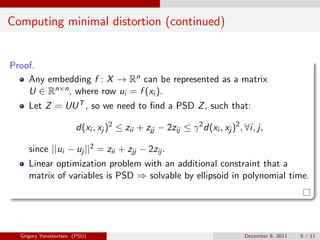
    Any embedding f : X → Rn can be represented as a matrix
    U ∈ Rn×n , where row ui = f (xi ).
     Let Z = UU T , so we need to find a PSD Z , such that:

                       d(xi , xj )2 ≤ zii + zjj − 2zij ≤ γ 2 d(xi , xj )2 , ∀i, j,

     since ||ui − uj ||2 = zii + zjj − 2zij .
     Linear optimization problem with an additional constraint that a
     matrix of variables is PSD ⇒ solvable by ellipsoid in polynomial time.


  Grigory Yaroslavtsev (PSU)                                                December 8, 2011   5 / 11
Characterization of PSD matrices


Lemma
A matrix Z is PSD if and only if    ij   qij zij ≥ 0 for all PSD matrices Q.

Proof.
    ⇐: For v ∈ Rn let Qij = vi · vj . Then Q is PSD and
    v T Zv = ij (vi · vj )zij = ij qij zij ≥ 0.
     ⇒: Let Q = k λk wk wk for λi ≥ 0, or equivalently Q = k Ak ,
                               T

     where Ak = λk wk wk .
                        T
                    kz = λ                               T
     Because ij Aij ij      k    ij wki wkj zij = λk wk Zwk ≥ 0, we have
                          k                     k
       ij qij zij = ij k Aij zij =    k     ij Aij zij ≥ 0.


  Grigory Yaroslavtsev (PSU)                                  December 8, 2011   6 / 11
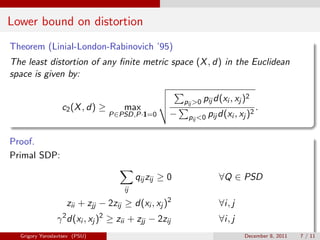
Lower bound on distortion
Theorem (Linial-London-Rabinovich ’95)
The least distortion of any finite metric space (X , d) in the Euclidean
space is given by:

                                                                                2
                                                          pij >0 pij d(xi , xj )
                  c2 (X , d) ≥         max                                          2
                                                                                        .
                                   P∈PSD,P·1=0        −    pij <0 pij d(xi , xj )


Proof.
Primal SDP:

                                            qij zij ≥ 0               ∀Q ∈ PSD
                                       ij

                      zii + zjj − 2zij ≥ d(xi , xj )2                 ∀i, j
                  2            2
                γ d(xi , xj ) ≥ zii + zjj − 2zij                      ∀i, j
  Grigory Yaroslavtsev (PSU)                                                   December 8, 2011   7 / 11
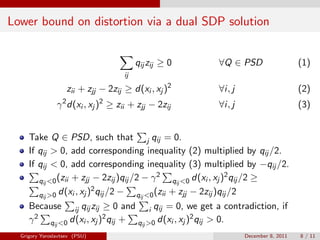
Lower bound on distortion via a dual SDP solution


                                          qij zij ≥ 0     ∀Q ∈ PSD                   (1)
                                     ij

                    zii + zjj − 2zij ≥ d(xi , xj )2       ∀i, j                      (2)
                γ 2 d(xi , xj )2 ≥ zii + zjj − 2zij       ∀i, j                      (3)


     Take Q ∈ PSD, such that j qij = 0.
     If qij > 0, add corresponding inequality (2) multiplied by qij /2.
     If qij < 0, add corresponding inequality (3) multiplied by −qij /2.
                                               2                     2
        qij <0 (zii + zjj − 2zij )qij /2 − γ       qij <0 d(xi , xj ) qij /2 ≥
                          2
        qij >0 d(xi , xj ) qij /2 −    qij <0 (zii + zjj − 2zij )qij /2
     Because ij qij zij ≥ 0 and i qij = 0, we get a contradiction, if
     γ 2 qij <0 d(xi , xj )2 qij + qij >0 d(xi , xj )2 qij > 0.
  Grigory Yaroslavtsev (PSU)                                      December 8, 2011   8 / 11
Example: Hypercube with Hamming metric
     Let’s denote r -dimensional hypercube with Hamming metric as Qr .
                                        √
     Identity embedding gives distortion r .

                                                                                       2
                                                              pij >0 pij d(xi , xj )
                       c2 (Qr ) ≥            max                                        2
                                                                                            .
                                         P∈PSD,P·1=0    −         pij <0 pij d(xi , xj )
                               r ×2r
     Define P ∈ R2                      , such that P1 = 0   as:
                                                  
                                                  −1
                                                           if d(i, j) = 1
                                                  
                                                  
                                                  r − 1    if i = j
                                       P(x, y ) =
                                                  1
                                                           if d(i, j) = r
                                                  
                                                  
                                                  0        otherwise
     P ∈ PSD: eigenvectors χI (J) = (−1)|I ∩J| for I , J ⊆ {1, . . . , n}.
     Because pij >0 pij d(xi , xj )2 = 2r · r 2 and
                                                            √
     − pij <0 pij d(xi , xj )2 = 2r · r , we have c2 (Qr ) ≥ r .
  Grigory Yaroslavtsev (PSU)                                                       December 8, 2011   9 / 11
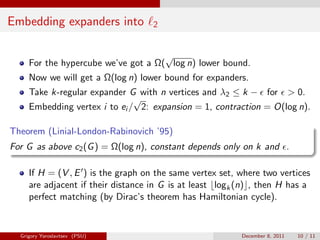
Embedding expanders into            2


                                     √
     For the hypercube we’ve got a Ω( log n) lower bound.
     Now we will get a Ω(log n) lower bound for expanders.
     Take k-regular expander G with n vertices and λ2 ≤ k − for > 0.
                               √
     Embedding vertex i to ei / 2: expansion = 1, contraction = O(log n).

Theorem (Linial-London-Rabinovich ’95)
For G as above c2 (G ) = Ω(log n), constant depends only on k and .

     If H = (V , E ) is the graph on the same vertex set, where two vertices
     are adjacent if their distance in G is at least logk (n) , then H has a
     perfect matching (by Dirac’s theorem has Hamiltonian cycle).


  Grigory Yaroslavtsev (PSU)                              December 8, 2011   10 / 11
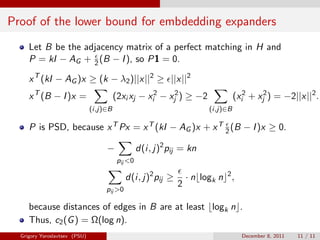
Proof of the lower bound for embdedding expanders
     Let B be the adjacency matrix of a perfect matching in H and
     P = kI − AG + 2 (B − I ), so P1 = 0.

     x T (kI − AG )x ≥ (k − λ2 )||x||2 ≥ ||x||2
     x T (B − I )x =                     (2xi xj − xi2 − xj2 ) ≥ −2               (xi2 + xj2 ) = −2||x||2 .
                               (i,j)∈B                                  (i,j)∈B

     P is PSD, because x T Px = x T (kI − AG )x + x T 2 (B − I )x ≥ 0.

                                    −              d(i, j)2 pij = kn
                                          pij <0

                                             d(i, j)2 pij ≥       · n logk n 2 ,
                                                              2
                                    pij >0

     because distances of edges in B are at least logk n .
     Thus, c2 (G ) = Ω(log n).
  Grigory Yaroslavtsev (PSU)                                                        December 8, 2011   11 / 11

Metric Embeddings and Expanders

  • 1.
    Metric Embeddings andExpanders Grigory Yaroslavtsev (based on Chapter 13 of a survey “Expander graphs and their applications” by Hoory, Linial and Wigderson) Pennsylvania State University December 8, 2011 Grigory Yaroslavtsev (PSU) December 8, 2011 1 / 11
  • 2.
    Metric embeddings A finite metric space is a pair (X , d), where X is a set of n points and d : X × X → R+ is a distance function (three axioms). Let f : X → Rn be an embedding of (X , d) into (Rn , 2 ) n 2 (d 2 (x, y ) = ||x − y || = i=1 (xi − yi ) ). expansion(f ) = max ||f (x1 ) − f (x2 )||/d(x1 , x2 ) x1 ,x2 ∈X contraction(f ) = max d(x1 , x2 )/||f (x1 ) − f (x2 )|| x1 ,x2 ∈X distortion(f ) = expansion(f ) · contraction(f ) Example, that requires distortion (shortest-path metric for unit-length edges): Grigory Yaroslavtsev (PSU) December 8, 2011 2 / 11
  • 3.
    Background on 2 -embeddings If (X , d) is 2 -embeddable ⇒ it is p -embeddable for 1 ≤ p ≤ ∞. Let c2 (X , d) denote the least possible distortion of an embedding of (X , d) into (Rn , 2 ) (dimension n is sufficient). For any n-point metric space c2 (X , d) = O(log n) [Bourgain’85]. We will see how to compute such an embedding later (via SDP), together with a Ω(log n) lower bound for expanders (via dual SDP). Theorem (Johnson-Lindenstrauss ’84) log n Any n-point 2 -metric can be embedded into an O 2 -dimensional Euclidean space with distortion 1 + . The bound on dimension was shown to be optimal by Jayram and Woodruff (SODA’11), previous Ω( 2 log n ) was by Alon ’03. log 1/ Such dimension reduction is impossible for 1 (Brinkman, Charikar ’03, Lee, Naor ’04, . . . ?). Grigory Yaroslavtsev (PSU) December 8, 2011 3 / 11
  • 4.
    Computing minimal distortion Theorem(Linial, London, Rabinovich ’95) Given a metric space (X , d), the minimal 2 -distortion c2 (X , d) can be computed in polynomial time. Proof. Scale f : X → Rn , so that contraction(f ) = 1, so distortion(f ) ≤ γ iff: d(xi , xj )2 ≤ ||f (xi ) − f (xj )||2 ≤ γ 2 d(xi , xj )2 ∀i, j A symmetric matrix Z ∈ Rn×n is positive semidefinite (PSD), if (all four are equivalent): 1 v T Zv ≥ 0 for all v ∈ Rn . 2 All eigenvalues λi ≥ 0. 3 Z = WW T for some matrix W . n 4 Z= λi wi wiT for λi ≥ 0 and orthonormal vectors wi ∈ Rn . i=1 Grigory Yaroslavtsev (PSU) December 8, 2011 4 / 11
  • 5.
    Computing minimal distortion(continued) Proof. Any embedding f : X → Rn can be represented as a matrix U ∈ Rn×n , where row ui = f (xi ). Let Z = UU T , so we need to find a PSD Z , such that: d(xi , xj )2 ≤ zii + zjj − 2zij ≤ γ 2 d(xi , xj )2 , ∀i, j, since ||ui − uj ||2 = zii + zjj − 2zij . Linear optimization problem with an additional constraint that a matrix of variables is PSD ⇒ solvable by ellipsoid in polynomial time. Grigory Yaroslavtsev (PSU) December 8, 2011 5 / 11
  • 6.
    Characterization of PSDmatrices Lemma A matrix Z is PSD if and only if ij qij zij ≥ 0 for all PSD matrices Q. Proof. ⇐: For v ∈ Rn let Qij = vi · vj . Then Q is PSD and v T Zv = ij (vi · vj )zij = ij qij zij ≥ 0. ⇒: Let Q = k λk wk wk for λi ≥ 0, or equivalently Q = k Ak , T where Ak = λk wk wk . T kz = λ T Because ij Aij ij k ij wki wkj zij = λk wk Zwk ≥ 0, we have k k ij qij zij = ij k Aij zij = k ij Aij zij ≥ 0. Grigory Yaroslavtsev (PSU) December 8, 2011 6 / 11
  • 7.
    Lower bound ondistortion Theorem (Linial-London-Rabinovich ’95) The least distortion of any finite metric space (X , d) in the Euclidean space is given by: 2 pij >0 pij d(xi , xj ) c2 (X , d) ≥ max 2 . P∈PSD,P·1=0 − pij <0 pij d(xi , xj ) Proof. Primal SDP: qij zij ≥ 0 ∀Q ∈ PSD ij zii + zjj − 2zij ≥ d(xi , xj )2 ∀i, j 2 2 γ d(xi , xj ) ≥ zii + zjj − 2zij ∀i, j Grigory Yaroslavtsev (PSU) December 8, 2011 7 / 11
  • 8.
    Lower bound ondistortion via a dual SDP solution qij zij ≥ 0 ∀Q ∈ PSD (1) ij zii + zjj − 2zij ≥ d(xi , xj )2 ∀i, j (2) γ 2 d(xi , xj )2 ≥ zii + zjj − 2zij ∀i, j (3) Take Q ∈ PSD, such that j qij = 0. If qij > 0, add corresponding inequality (2) multiplied by qij /2. If qij < 0, add corresponding inequality (3) multiplied by −qij /2. 2 2 qij <0 (zii + zjj − 2zij )qij /2 − γ qij <0 d(xi , xj ) qij /2 ≥ 2 qij >0 d(xi , xj ) qij /2 − qij <0 (zii + zjj − 2zij )qij /2 Because ij qij zij ≥ 0 and i qij = 0, we get a contradiction, if γ 2 qij <0 d(xi , xj )2 qij + qij >0 d(xi , xj )2 qij > 0. Grigory Yaroslavtsev (PSU) December 8, 2011 8 / 11
  • 9.
    Example: Hypercube withHamming metric Let’s denote r -dimensional hypercube with Hamming metric as Qr . √ Identity embedding gives distortion r . 2 pij >0 pij d(xi , xj ) c2 (Qr ) ≥ max 2 . P∈PSD,P·1=0 − pij <0 pij d(xi , xj ) r ×2r Define P ∈ R2 , such that P1 = 0 as:  −1  if d(i, j) = 1   r − 1 if i = j P(x, y ) = 1  if d(i, j) = r   0 otherwise P ∈ PSD: eigenvectors χI (J) = (−1)|I ∩J| for I , J ⊆ {1, . . . , n}. Because pij >0 pij d(xi , xj )2 = 2r · r 2 and √ − pij <0 pij d(xi , xj )2 = 2r · r , we have c2 (Qr ) ≥ r . Grigory Yaroslavtsev (PSU) December 8, 2011 9 / 11
  • 10.
    Embedding expanders into 2 √ For the hypercube we’ve got a Ω( log n) lower bound. Now we will get a Ω(log n) lower bound for expanders. Take k-regular expander G with n vertices and λ2 ≤ k − for > 0. √ Embedding vertex i to ei / 2: expansion = 1, contraction = O(log n). Theorem (Linial-London-Rabinovich ’95) For G as above c2 (G ) = Ω(log n), constant depends only on k and . If H = (V , E ) is the graph on the same vertex set, where two vertices are adjacent if their distance in G is at least logk (n) , then H has a perfect matching (by Dirac’s theorem has Hamiltonian cycle). Grigory Yaroslavtsev (PSU) December 8, 2011 10 / 11
  • 11.
    Proof of thelower bound for embdedding expanders Let B be the adjacency matrix of a perfect matching in H and P = kI − AG + 2 (B − I ), so P1 = 0. x T (kI − AG )x ≥ (k − λ2 )||x||2 ≥ ||x||2 x T (B − I )x = (2xi xj − xi2 − xj2 ) ≥ −2 (xi2 + xj2 ) = −2||x||2 . (i,j)∈B (i,j)∈B P is PSD, because x T Px = x T (kI − AG )x + x T 2 (B − I )x ≥ 0. − d(i, j)2 pij = kn pij <0 d(i, j)2 pij ≥ · n logk n 2 , 2 pij >0 because distances of edges in B are at least logk n . Thus, c2 (G ) = Ω(log n). Grigory Yaroslavtsev (PSU) December 8, 2011 11 / 11