WHAT IS STERILIZATION:
Sterilization can be defined as any process that
effectively kills or eliminates transmissible agents
(such as fungi, bacteria, viruses and prions) from a
surface, equipment, foods, medications, or
biological culture medium.
METHODS OF STERILIZATION
 The various methods of sterilization are:
 1. Physical Method
a. Thermal (Heat) methods
b. Radiation method
c. Filtration method
 2. Chemical Method
a. Gaseous method
PHYSICAL METHODS:
1. HEAT STERILIZATION:
 Heat sterilization is the most widely used and
reliable method of sterilization, involving
destruction of enzymes and other essential cell
constituents.
 This method of sterilization can be applied only to
the THERMO STABLE PRODUCTS, but it can be
used for MOISTURE-SENSITIVE MATERIALS.
i) Dry Heat (160-1800˚C) Sterilization for
thermo stable products
ii) moist heat (121-1340 ˚C) sterilization is
used for moisture- resistant materials.
 The efficiency with which heat is able to
inactivate microorganisms is dependent upon
i) the degree of heat, the exposure time and
ii) the presence of water.
 The action of heat will be due to induction of
lethal chemical events mediated through the
action of water and oxygen.
 In the presence of water much lower
temperature time exposures are required to kill
microbe than in the absence of water.
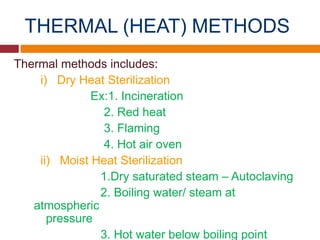
THERMAL (HEAT) METHODS
Thermal methods includes:
i) Dry Heat Sterilization
Ex:1. Incineration
2. Red heat
3. Flaming
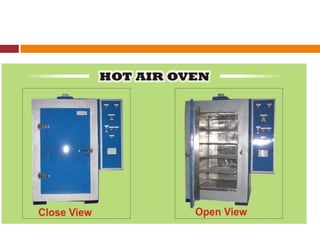
4. Hot air oven
ii) Moist Heat Sterilization
1.Dry saturated steam – Autoclaving
2. Boiling water/ steam at
atmospheric
pressure
3. Hot water below boiling point
Dry Heat Sterilization
 It employs higher temperatures in the range of
160-180˚C and requires exposures time up to
2 hours, depending upon the temperature
employed.
 The benefit of dry heat includes good
penetrability and non-corrosive nature which
makes it applicable for sterilizing glass wares
and metal surgical instruments. It is also used
for sterilizing non-aqueous thermo stable
liquids and thermo stable powders.
 Dry heat destroys bacterial endotoxins (or
pyrogens) which are difficult to eliminate by
other means and this property makes it
applicable for sterilizing glass bottles which
are to be filled aseptically
Moist Heat Sterilization
 Moist heat sterilization involves the use of
steam in the range of 121-134˚C. Steam under
pressure is used to generate high temperature
needed for sterilization. Saturated steam acts
as an effective sterilizing agent.
Autoclave
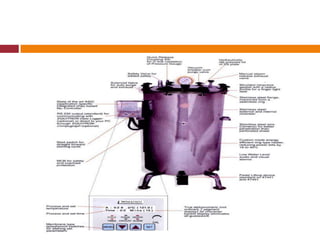
 Autoclaves use pressurized steam to destroy
microorganisms, and are the most dependable
systems available for the decontamination of
laboratory waste and the sterilization of
laboratory glassware, media, and reagents.
For efficient heat transfer, steam must flush
the air out of the autoclave chamber.
 Generally the conditions employed are
Temperature upto121-134˚C for 15-20 min under
15 lbs pressure,based on type of metiral used.
Radiation Sterilization
 Many types of radiation are used for
sterilization like electromagnetic radiation (e.g.
gamma rays and UV light), particulate
radiation (e.g. accelerated electrons).The
major target for these radiation is microbial
DNA.
 Radiation sterilization with high energy gamma
rays or accelerated electrons has proven to be
a useful method for the industrial sterilization
of heat sensitive products.
 Radiation sterilization is generally applied to
articles in the dry state; including surgical
instruments, sutures, prostheses, unit dose
ointments, plastic syringes and dry
pharmaceutical products.
 UV light, with its much lower energy, and poor
penetrability finds uses in the sterilization of
air, for surface sterilization of aseptic work
areas, for treatment of manufacturing grade
water, but is not suitable for sterilization of
pharmaceutical dosage forms.
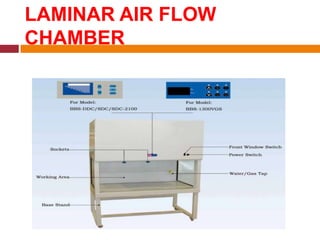
LAMINAR AIR FLOW
CHAMBER
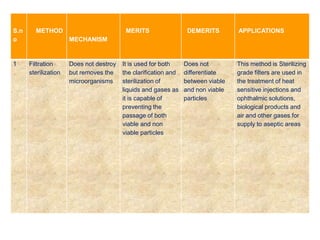
Filtration Sterilization
 Filtration process does not destroy but
removes the microorganisms. It is used for
both the clarification and sterilization of liquids
and gases as it is capable of preventing the
passage of both viable and non viable
particles.
 The major mechanisms of filtration are
sieving, adsorption and trapping within the
matrix of the filter material.
 Ex:HEPA FILTERS
 Sterilizing grade filters are used in the
treatment of heat sensitive injections and
ophthalmic solutions, biological products and
air and other gases for supply to aseptic areas.
They are also used in industry as part of the
venting systems on
fermentors, centrifuges, autoclaves and freeze
driers. Membrane filters are used for sterility
testing
 There are two types of filters used in filtration
sterilization:
(a) Depth filters:
(b) Membrane filters: These are porous
membrane about 0.1 mm thick, made of
cellulose acetate, cellulose
nitrate, polycarbonate, and polyvinylidene
fluoride, or some other synthetic material.
CHEMICAL STERILIZATION
METHOD
GASEOUS METHOD
 The chemically reactive gases such as
formaldehyde, (methanol, H.CHO) and
ethylene oxide (CH2)2O possess biocidal
activity. Ethylene oxide is a colorless,
odorless, and flammable gas.
 The mechanism of antimicrobial action of the
two gases is assumed to be through
alkylations of sulphydryl, amino, hydroxyl and
carboxyl groups on proteins and amino groups
of nucleic acids.
 The concentration ranges (weight of gas per
unit chamber volume) are usually in range of
800- 1200 mg/L for ethylene oxide and 15-100
mg/L for formaldehyde with operating
temperatures of 45-63°C and 70-75°C
respectively.
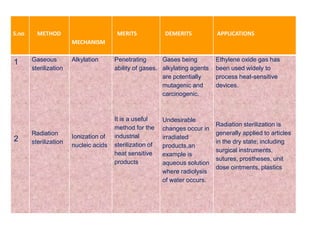
 Both of these gases being alkylating agents
are potentially mutagenic and carcinogenic.
They also produce acute toxicity including
irritation of the skin, conjunctiva and nasal
mucosa
MERITS, DEMERITS AND
APPLICATIONS OF
DIFFERENT METHODS OF
STERILIZATION
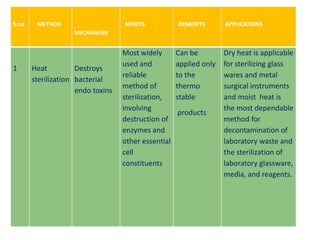
S.no METHOD
MECHANISM
MERITS DEMERITS APPLICATIONS
1 Heat
sterilization
Destroys
bacterial
endo toxins
Most widely
used and
reliable
method of
sterilization,
involving
destruction of
enzymes and
other essential
cell
constituents
Can be
applied only
to the
thermo
stable
products
Dry heat is applicable
for sterilizing glass
wares and metal
surgical instruments
and moist heat is
the most dependable
method for
decontamination of
laboratory waste and
the sterilization of
laboratory glassware,
media, and reagents.
S.no METHOD
MECHANISM
MERITS DEMERITS APPLICATIONS
1
2
Gaseous
sterilization
Radiation
sterilization
Alkylation
Ionization of
nucleic acids
Penetrating
ability of gases.
It is a useful
method for the
industrial
sterilization of
heat sensitive
products
Gases being
alkylating agents
are potentially
mutagenic and
carcinogenic.
Undesirable
changes occur in
irradiated
products,an
example is
aqueous solution
where radiolysis
of water occurs.
Ethylene oxide gas has
been used widely to
process heat-sensitive
devices.
Radiation sterilization is
generally applied to articles
in the dry state; including
surgical instruments,
sutures, prostheses, unit
dose ointments, plastics
S.n
o
METHOD
MECHANISM
MERITS DEMERITS APPLICATIONS
1 Filtration
sterilization
Does not destroy
but removes the
microorganisms
It is used for both
the clarification and
sterilization of
liquids and gases as
it is capable of
preventing the
passage of both
viable and non
viable particles
Does not
differentiate
between viable
and non viable
particles
This method is Sterilizing
grade filters are used in
the treatment of heat
sensitive injections and
ophthalmic solutions,
biological products and
air and other gases for
supply to aseptic areas
Pharmaceutical Importance of
Sterilization
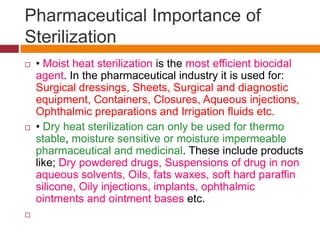
 • Moist heat sterilization is the most efficient biocidal
agent. In the pharmaceutical industry it is used for:
Surgical dressings, Sheets, Surgical and diagnostic
equipment, Containers, Closures, Aqueous injections,
Ophthalmic preparations and Irrigation fluids etc.
 • Dry heat sterilization can only be used for thermo
stable, moisture sensitive or moisture impermeable
pharmaceutical and medicinal. These include products
like; Dry powdered drugs, Suspensions of drug in non
aqueous solvents, Oils, fats waxes, soft hard paraffin
silicone, Oily injections, implants, ophthalmic
ointments and ointment bases etc.

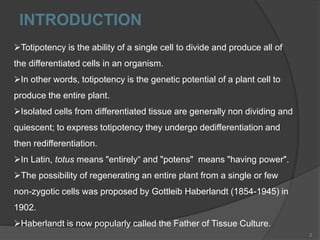
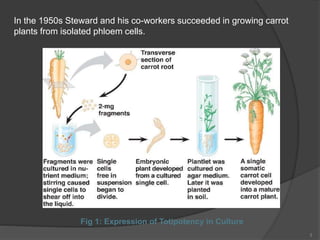
Totipotency is the ability of a single cell to divide and produce all of
the differentiated cells in an organism.
In other words, totipotency is the genetic potential of a plant cell to
produce the entire plant.
Isolated cells from differentiated tissue are generally non dividing and
quiescent; to express totipotency they undergo dedifferentiation and
then redifferentiation.
In Latin, totus means "entirely“ and "potens" means "having power".
The possibility of regenerating an entire plant from a single or few
non-zygotic cells was proposed by Gottleib Haberlandt (1854-1945) in
1902.
Haberlandt is now popularly called the Father of Tissue Culture.
INTRODUCTION
2
In the 1950s Steward and his co-workers succeeded in growing carrot
plants from isolated phloem cells.
Fig 1: Expression of Totipotency in Culture
3
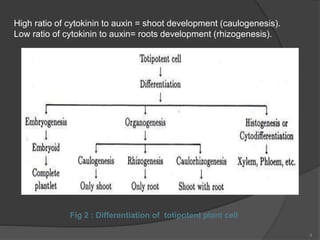
Fig 2 : Differentiation of totipotent plant cell
High ratio of cytokinin to auxin = shoot development (caulogenesis).
Low ratio of cytokinin to auxin= roots development (rhizogenesis).
4
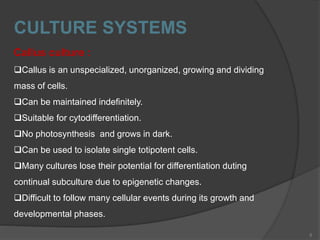
CULTURE SYSTEMS
Callus culture :
Callus is an unspecialized, unorganized, growing and dividing
mass of cells.
Can be maintained indefinitely.
Suitable for cytodifferentiation.
No photosynthesis and grows in dark.
Can be used to isolate single totipotent cells.
Many cultures lose their potential for differentiation duting
continual subculture due to epigenetic changes.
Difficult to follow many cellular events during its growth and
developmental phases.
5
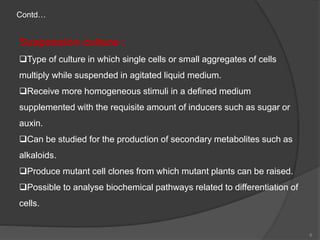
Suspension culture :
Type of culture in which single cells or small aggregates of cells
multiply while suspended in agitated liquid medium.
Receive more homogeneous stimuli in a defined medium
supplemented with the requisite amount of inducers such as sugar or
auxin.
Can be studied for the production of secondary metabolites such as
alkaloids.
Produce mutant cell clones from which mutant plants can be raised.
Possible to analyse biochemical pathways related to differentiation of
cells.
Contd…
6
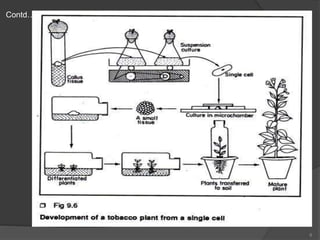
Single cell culture :
Method of growing isolated single cell aseptically on a nutrient
medium under controlled conditions.
Can be isolated from a variety of tissue and organ of green plant
as well as from callus tissue and cell suspension either
mechanically or enzymatically.
Could be used successfully to obtain single cell clones.
Plants could be regenerated from the callus tissue derived from
the single cell clones.
Isolated single cells can be handled as a microbial system for the
treatment of mutagens and for mutant selection.
Single cell culture is an ideal system for the study of
biotransformation.
Contd…
7
Contd…
8
Protoplasts culture :
Protoplasts are naked plant cells without the cell wall, but they possess
plasma membrane and all other cellular components.
Isolated most frequently from mesophyll tissue of fully expanded leaves of
young plants or new shoots, either mechanically or enzymatically.
The protoplast in culture can be regenerated into a whole plant.
Hybrids can be developed from protoplast fusion.
It is easy to perform single cell cloning with protoplasts.
Genetic transformations can be achieved through genetic engineering of
protoplast DNA.
Protoplasts are excellent materials for ultra-structural studies.
Isolation of cell organelles and chromosomes is easy from protoplasts.
Protoplasts are useful for membrane studies (transport and uptake
processes).
9
Some factors that affect cellular totipotency are :
I. Source of explant : Organ that served as tissue source, physiological
and ontogenic age of organ, season in which explant is obtained, size, overall
quality of explant.
II. Nutrient media and constituents : Inorganic macro- and micro-
nutrients, carbon/energy source, reduced nitrogen source, plant growth
regulator.
III. Culture environment (Physical form of medium) :
Presence/absence of agar, pH of medium, light quality and quantity,
temperature, relative humidity and gaseous atmosphere in the vessels.
10
12
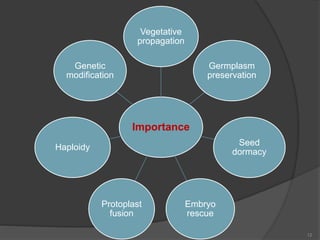
Importance
Vegetative
propagation
Germplasm
preservation
Seed
dormacy
Embryo
rescue
Protoplast
fusion
Haploidy
Genetic
modification

Methods of sterilization & totipotency.pdf

  • 1.
    WHAT IS STERILIZATION: Sterilizationcan be defined as any process that effectively kills or eliminates transmissible agents (such as fungi, bacteria, viruses and prions) from a surface, equipment, foods, medications, or biological culture medium.
  • 2.
    METHODS OF STERILIZATION The various methods of sterilization are:  1. Physical Method a. Thermal (Heat) methods b. Radiation method c. Filtration method  2. Chemical Method a. Gaseous method
  • 3.
    PHYSICAL METHODS: 1. HEATSTERILIZATION:  Heat sterilization is the most widely used and reliable method of sterilization, involving destruction of enzymes and other essential cell constituents.  This method of sterilization can be applied only to the THERMO STABLE PRODUCTS, but it can be used for MOISTURE-SENSITIVE MATERIALS. i) Dry Heat (160-1800˚C) Sterilization for thermo stable products ii) moist heat (121-1340 ˚C) sterilization is used for moisture- resistant materials.
  • 4.
     The efficiencywith which heat is able to inactivate microorganisms is dependent upon i) the degree of heat, the exposure time and ii) the presence of water.  The action of heat will be due to induction of lethal chemical events mediated through the action of water and oxygen.  In the presence of water much lower temperature time exposures are required to kill microbe than in the absence of water.
  • 5.
    THERMAL (HEAT) METHODS Thermalmethods includes: i) Dry Heat Sterilization Ex:1. Incineration 2. Red heat 3. Flaming 4. Hot air oven ii) Moist Heat Sterilization 1.Dry saturated steam – Autoclaving 2. Boiling water/ steam at atmospheric pressure 3. Hot water below boiling point
  • 6.
    Dry Heat Sterilization It employs higher temperatures in the range of 160-180˚C and requires exposures time up to 2 hours, depending upon the temperature employed.  The benefit of dry heat includes good penetrability and non-corrosive nature which makes it applicable for sterilizing glass wares and metal surgical instruments. It is also used for sterilizing non-aqueous thermo stable liquids and thermo stable powders.
  • 7.
     Dry heatdestroys bacterial endotoxins (or pyrogens) which are difficult to eliminate by other means and this property makes it applicable for sterilizing glass bottles which are to be filled aseptically
  • 8.
    Moist Heat Sterilization Moist heat sterilization involves the use of steam in the range of 121-134˚C. Steam under pressure is used to generate high temperature needed for sterilization. Saturated steam acts as an effective sterilizing agent.
  • 10.
    Autoclave  Autoclaves usepressurized steam to destroy microorganisms, and are the most dependable systems available for the decontamination of laboratory waste and the sterilization of laboratory glassware, media, and reagents. For efficient heat transfer, steam must flush the air out of the autoclave chamber.  Generally the conditions employed are Temperature upto121-134˚C for 15-20 min under 15 lbs pressure,based on type of metiral used.
  • 12.
    Radiation Sterilization  Manytypes of radiation are used for sterilization like electromagnetic radiation (e.g. gamma rays and UV light), particulate radiation (e.g. accelerated electrons).The major target for these radiation is microbial DNA.  Radiation sterilization with high energy gamma rays or accelerated electrons has proven to be a useful method for the industrial sterilization of heat sensitive products.
  • 13.
     Radiation sterilizationis generally applied to articles in the dry state; including surgical instruments, sutures, prostheses, unit dose ointments, plastic syringes and dry pharmaceutical products.  UV light, with its much lower energy, and poor penetrability finds uses in the sterilization of air, for surface sterilization of aseptic work areas, for treatment of manufacturing grade water, but is not suitable for sterilization of pharmaceutical dosage forms.
  • 14.
  • 15.
    Filtration Sterilization  Filtrationprocess does not destroy but removes the microorganisms. It is used for both the clarification and sterilization of liquids and gases as it is capable of preventing the passage of both viable and non viable particles.  The major mechanisms of filtration are sieving, adsorption and trapping within the matrix of the filter material.  Ex:HEPA FILTERS
  • 16.
     Sterilizing gradefilters are used in the treatment of heat sensitive injections and ophthalmic solutions, biological products and air and other gases for supply to aseptic areas. They are also used in industry as part of the venting systems on fermentors, centrifuges, autoclaves and freeze driers. Membrane filters are used for sterility testing
  • 17.
     There aretwo types of filters used in filtration sterilization: (a) Depth filters: (b) Membrane filters: These are porous membrane about 0.1 mm thick, made of cellulose acetate, cellulose nitrate, polycarbonate, and polyvinylidene fluoride, or some other synthetic material.
  • 18.
    CHEMICAL STERILIZATION METHOD GASEOUS METHOD The chemically reactive gases such as formaldehyde, (methanol, H.CHO) and ethylene oxide (CH2)2O possess biocidal activity. Ethylene oxide is a colorless, odorless, and flammable gas.  The mechanism of antimicrobial action of the two gases is assumed to be through alkylations of sulphydryl, amino, hydroxyl and carboxyl groups on proteins and amino groups of nucleic acids.
  • 19.
     The concentrationranges (weight of gas per unit chamber volume) are usually in range of 800- 1200 mg/L for ethylene oxide and 15-100 mg/L for formaldehyde with operating temperatures of 45-63°C and 70-75°C respectively.  Both of these gases being alkylating agents are potentially mutagenic and carcinogenic. They also produce acute toxicity including irritation of the skin, conjunctiva and nasal mucosa
  • 20.
    MERITS, DEMERITS AND APPLICATIONSOF DIFFERENT METHODS OF STERILIZATION
  • 21.
    S.no METHOD MECHANISM MERITS DEMERITSAPPLICATIONS 1 Heat sterilization Destroys bacterial endo toxins Most widely used and reliable method of sterilization, involving destruction of enzymes and other essential cell constituents Can be applied only to the thermo stable products Dry heat is applicable for sterilizing glass wares and metal surgical instruments and moist heat is the most dependable method for decontamination of laboratory waste and the sterilization of laboratory glassware, media, and reagents.
  • 22.
    S.no METHOD MECHANISM MERITS DEMERITSAPPLICATIONS 1 2 Gaseous sterilization Radiation sterilization Alkylation Ionization of nucleic acids Penetrating ability of gases. It is a useful method for the industrial sterilization of heat sensitive products Gases being alkylating agents are potentially mutagenic and carcinogenic. Undesirable changes occur in irradiated products,an example is aqueous solution where radiolysis of water occurs. Ethylene oxide gas has been used widely to process heat-sensitive devices. Radiation sterilization is generally applied to articles in the dry state; including surgical instruments, sutures, prostheses, unit dose ointments, plastics
  • 23.
    S.n o METHOD MECHANISM MERITS DEMERITS APPLICATIONS 1Filtration sterilization Does not destroy but removes the microorganisms It is used for both the clarification and sterilization of liquids and gases as it is capable of preventing the passage of both viable and non viable particles Does not differentiate between viable and non viable particles This method is Sterilizing grade filters are used in the treatment of heat sensitive injections and ophthalmic solutions, biological products and air and other gases for supply to aseptic areas
  • 24.
    Pharmaceutical Importance of Sterilization • Moist heat sterilization is the most efficient biocidal agent. In the pharmaceutical industry it is used for: Surgical dressings, Sheets, Surgical and diagnostic equipment, Containers, Closures, Aqueous injections, Ophthalmic preparations and Irrigation fluids etc.  • Dry heat sterilization can only be used for thermo stable, moisture sensitive or moisture impermeable pharmaceutical and medicinal. These include products like; Dry powdered drugs, Suspensions of drug in non aqueous solvents, Oils, fats waxes, soft hard paraffin silicone, Oily injections, implants, ophthalmic ointments and ointment bases etc. 
  • 25.
    Totipotency is theability of a single cell to divide and produce all of the differentiated cells in an organism. In other words, totipotency is the genetic potential of a plant cell to produce the entire plant. Isolated cells from differentiated tissue are generally non dividing and quiescent; to express totipotency they undergo dedifferentiation and then redifferentiation. In Latin, totus means "entirely“ and "potens" means "having power". The possibility of regenerating an entire plant from a single or few non-zygotic cells was proposed by Gottleib Haberlandt (1854-1945) in 1902. Haberlandt is now popularly called the Father of Tissue Culture. INTRODUCTION 2
  • 26.
    In the 1950sSteward and his co-workers succeeded in growing carrot plants from isolated phloem cells. Fig 1: Expression of Totipotency in Culture 3
  • 27.
    Fig 2 :Differentiation of totipotent plant cell High ratio of cytokinin to auxin = shoot development (caulogenesis). Low ratio of cytokinin to auxin= roots development (rhizogenesis). 4
  • 28.
    CULTURE SYSTEMS Callus culture: Callus is an unspecialized, unorganized, growing and dividing mass of cells. Can be maintained indefinitely. Suitable for cytodifferentiation. No photosynthesis and grows in dark. Can be used to isolate single totipotent cells. Many cultures lose their potential for differentiation duting continual subculture due to epigenetic changes. Difficult to follow many cellular events during its growth and developmental phases. 5
  • 29.
    Suspension culture : Typeof culture in which single cells or small aggregates of cells multiply while suspended in agitated liquid medium. Receive more homogeneous stimuli in a defined medium supplemented with the requisite amount of inducers such as sugar or auxin. Can be studied for the production of secondary metabolites such as alkaloids. Produce mutant cell clones from which mutant plants can be raised. Possible to analyse biochemical pathways related to differentiation of cells. Contd… 6
  • 30.
    Single cell culture: Method of growing isolated single cell aseptically on a nutrient medium under controlled conditions. Can be isolated from a variety of tissue and organ of green plant as well as from callus tissue and cell suspension either mechanically or enzymatically. Could be used successfully to obtain single cell clones. Plants could be regenerated from the callus tissue derived from the single cell clones. Isolated single cells can be handled as a microbial system for the treatment of mutagens and for mutant selection. Single cell culture is an ideal system for the study of biotransformation. Contd… 7
  • 31.
  • 32.
    Protoplasts culture : Protoplastsare naked plant cells without the cell wall, but they possess plasma membrane and all other cellular components. Isolated most frequently from mesophyll tissue of fully expanded leaves of young plants or new shoots, either mechanically or enzymatically. The protoplast in culture can be regenerated into a whole plant. Hybrids can be developed from protoplast fusion. It is easy to perform single cell cloning with protoplasts. Genetic transformations can be achieved through genetic engineering of protoplast DNA. Protoplasts are excellent materials for ultra-structural studies. Isolation of cell organelles and chromosomes is easy from protoplasts. Protoplasts are useful for membrane studies (transport and uptake processes). 9
  • 33.
    Some factors thataffect cellular totipotency are : I. Source of explant : Organ that served as tissue source, physiological and ontogenic age of organ, season in which explant is obtained, size, overall quality of explant. II. Nutrient media and constituents : Inorganic macro- and micro- nutrients, carbon/energy source, reduced nitrogen source, plant growth regulator. III. Culture environment (Physical form of medium) : Presence/absence of agar, pH of medium, light quality and quantity, temperature, relative humidity and gaseous atmosphere in the vessels. 10
  • 34.