HISTORY TAKING
MONAL PARMAR
MSc NURSING
O Most important diagnostic tools
O To obtain information to make an accurate
diagnosis
O From the time patient enters the interview
room till he/she leaves the room
Basic principles of
History taking
• Introduce yourself
• Explain the purpose and
• Ask Open Ended Questions
• Allow the patient to Explain Things In
his/her Own Words
O Encourage the patient to Elaborate and
Explain
O Guide the Interview As Necessary
O Listen and Observe For Cues
O You might need an informant
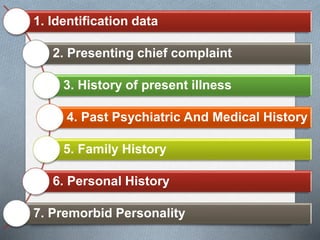
1. Identification data
2. Presenting chief complaint
3. History of present illness
4. Past Psychiatric And Medical History
5. Family History
6. Personal History
7. Premorbid Personality
1. IDENTIFICATION
DATA
• Name
• Age
• Sex
• Father I Spouse
• Address
• Education
• Occupation
• Income
• Marital status
• Religion
INFORMANT
O Informant :
O Relation with patient :
O Information relevant or not
2. PRESENTING CHIEF
COMPLAINT
Chief complaints
 Patient's problem or reason for the visit
 Recorded as the patient's own words
 Ask leading questions such as
• "What brings you here today?“
• “How can I help you?”
O Write complaints with duration in
chronological order
O E.g. sleepless 3 weeks
hearing voice 2 weeks
3. HISTORY OF PRESENT
ILLNESS
O main part of the interview
 Gather basic information of specific
symptoms
 Include both positives and negatives
 Record important life events
• Duration (weeks/months/years):
• Mode of onset: Abrupt/ Acute/
subacute/insidious (<48 hrs)/ <1 wkI
(l-2 wks)/Within a few weeks
Mode of onset : it is assessed as time
from bring asymptomatic to
symptomatic
O Course: continuousI episodicI
fluctuating Ideteriorating I improving I
unclear
O Intercity : same/ increasing/ decreasing
Deteriorating : Condition is getting
worse by time.
• Precipitating factor
A failed romance
A death in
the family
Serious
illnesses
Failure in
exams
Problems in
relationships
4. TREATMENT HISTORY
O Drugs (name of the drug, dose,
route, side-effects, if any)
O ECT
O Psychotherapy
O Family therapy
O Rehabilitation
5. Past Psychiatric And
Medical History
O Number of previous episodes/
hospitalization
O Complete or incomplete remission
3 generation Genogram
type & size of family
 Family history of Psychiatric illness
 Family history of Medical illness
 Living situation
 Interpersonal issues
6. Family History
• Perinatal history
• Childhood history
• Educational history
• Play history
• Emotional problems during
adolescence
• Occupational history
• Sexual and marital history
7.Personal History
(a) Interpersonal relationships: Extrovert/introvert
Family and social relationships
(b) Use of leisure time:
(c) Predominant mood: stability of mood, mood swings,
anxious, irritable, tense, ager, anxiety
(d) Attitude to self and others:
Self-appraisal of abilities, achievements and failures
8. PREMORBID PERSONALITY
e) Attitude to work and responsibility:
(£) Religious beliefs and moral attitudes:
(g) Fantasy life:
Daydreams ___, frequency and
content.
(h) Habits:
Eating pattern
Elimination
Sleep
Use of drugs,

1) HISTORY TAKING

  • 1.
  • 2.
    O Most importantdiagnostic tools O To obtain information to make an accurate diagnosis O From the time patient enters the interview room till he/she leaves the room
  • 3.
    Basic principles of Historytaking • Introduce yourself • Explain the purpose and • Ask Open Ended Questions • Allow the patient to Explain Things In his/her Own Words
  • 4.
    O Encourage thepatient to Elaborate and Explain O Guide the Interview As Necessary O Listen and Observe For Cues O You might need an informant
  • 5.
    1. Identification data 2.Presenting chief complaint 3. History of present illness 4. Past Psychiatric And Medical History 5. Family History 6. Personal History 7. Premorbid Personality
  • 6.
    1. IDENTIFICATION DATA • Name •Age • Sex • Father I Spouse • Address • Education • Occupation • Income • Marital status • Religion
  • 7.
    INFORMANT O Informant : ORelation with patient : O Information relevant or not
  • 8.
    2. PRESENTING CHIEF COMPLAINT Chiefcomplaints  Patient's problem or reason for the visit  Recorded as the patient's own words  Ask leading questions such as • "What brings you here today?“ • “How can I help you?”
  • 9.
    O Write complaintswith duration in chronological order O E.g. sleepless 3 weeks hearing voice 2 weeks
  • 10.
    3. HISTORY OFPRESENT ILLNESS O main part of the interview  Gather basic information of specific symptoms  Include both positives and negatives  Record important life events
  • 11.
    • Duration (weeks/months/years): •Mode of onset: Abrupt/ Acute/ subacute/insidious (<48 hrs)/ <1 wkI (l-2 wks)/Within a few weeks Mode of onset : it is assessed as time from bring asymptomatic to symptomatic
  • 12.
    O Course: continuousIepisodicI fluctuating Ideteriorating I improving I unclear O Intercity : same/ increasing/ decreasing Deteriorating : Condition is getting worse by time.
  • 13.
    • Precipitating factor Afailed romance A death in the family Serious illnesses Failure in exams Problems in relationships
  • 14.
    4. TREATMENT HISTORY ODrugs (name of the drug, dose, route, side-effects, if any) O ECT O Psychotherapy O Family therapy O Rehabilitation
  • 15.
    5. Past PsychiatricAnd Medical History O Number of previous episodes/ hospitalization O Complete or incomplete remission
  • 16.
    3 generation Genogram type& size of family  Family history of Psychiatric illness  Family history of Medical illness  Living situation  Interpersonal issues 6. Family History
  • 17.
    • Perinatal history •Childhood history • Educational history • Play history • Emotional problems during adolescence • Occupational history • Sexual and marital history 7.Personal History
  • 18.
    (a) Interpersonal relationships:Extrovert/introvert Family and social relationships (b) Use of leisure time: (c) Predominant mood: stability of mood, mood swings, anxious, irritable, tense, ager, anxiety (d) Attitude to self and others: Self-appraisal of abilities, achievements and failures 8. PREMORBID PERSONALITY
  • 19.
    e) Attitude towork and responsibility: (£) Religious beliefs and moral attitudes: (g) Fantasy life: Daydreams ___, frequency and content. (h) Habits: Eating pattern Elimination Sleep Use of drugs,