Zou Wenting
CCC. Heep Woh Primary School (CSW)
Li Xiaolei
The University of Hong Kong
Enhancing Primary School
Students’ Story-Writing by
Mobile-Assisted Collaborative
Learning: A Case Study
Writing is perceived to be one of the most stressful and
challenging tasks in Chinese language learning for
elementary school students.
Common defects in primary school students’ compositions:
 Lacking involvement,
 Limited and incorrect use of vocabulary,
 Badly structured paragraphs
……
(Huang, 2008; Wong et.al, 2011).
1. Problem Statement
Traditional writing instructions are constantly
criticized for multiple aspects:
• 1) Teacher-centered;
• 2) Exam-oriented and
• 3) Fail to involve students’ life experiences
(Shen & Nie, 2013).
Improper Instruction
1. Problem Statement
2. Previous Studies
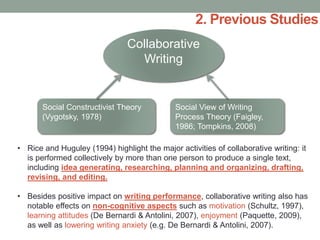
• Rice and Huguley (1994) highlight the major activities of collaborative writing: it
is performed collectively by more than one person to produce a single text,
including idea generating, researching, planning and organizing, drafting,
revising, and editing.
• Besides positive impact on writing performance, collaborative writing also has
notable effects on non-cognitive aspects such as motivation (Schultz, 1997),
learning attitudes (De Bernardi & Antolini, 2007), enjoyment (Paquette, 2009),
as well as lowering writing anxiety (e.g. De Bernardi & Antolini, 2007).
Collaborative
Writing
Social Constructivist Theory
(Vygotsky, 1978)
Social View of Writing
Process Theory (Faigley,
1986; Tompkins, 2008)
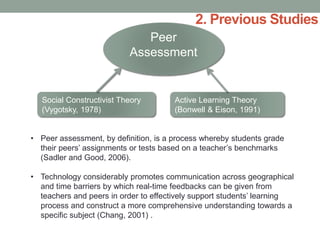
Peer
Assessment
Social Constructivist Theory
(Vygotsky, 1978)
Active Learning Theory
(Bonwell & Eison, 1991)
• Peer assessment, by definition, is a process whereby students grade
their peers’ assignments or tests based on a teacher’s benchmarks
(Sadler and Good, 2006).
• Technology considerably promotes communication across geographical
and time barriers by which real-time feedbacks can be given from
teachers and peers in order to effectively support students’ learning
process and construct a more comprehensive understanding towards a
specific subject (Chang, 2001) .
2. Previous Studies
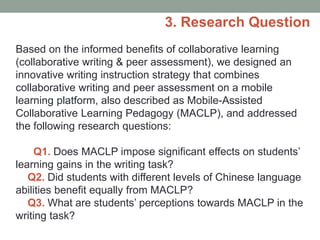
Based on the informed benefits of collaborative learning
(collaborative writing & peer assessment), we designed an
innovative writing instruction strategy that combines
collaborative writing and peer assessment on a mobile
learning platform, also described as Mobile-Assisted
Collaborative Learning Pedagogy (MACLP), and addressed
the following research questions:
Q1. Does MACLP impose significant effects on students’
learning gains in the writing task?
Q2. Did students with different levels of Chinese language
abilities benefit equally from MACLP?
Q3. What are students’ perceptions towards MACLP in the
writing task?
3. Research Question
4. Conceptual model
5. Participants
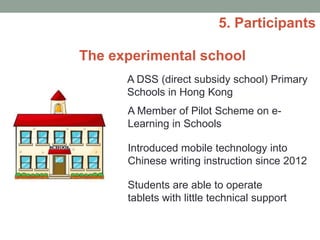
A DSS (direct subsidy school) Primary
Schools in Hong Kong
A Member of Pilot Scheme on e-
Learning in Schools
Introduced mobile technology into
Chinese writing instruction since 2012
Students are able to operate
tablets with little technical support
The experimental school
5. Participants
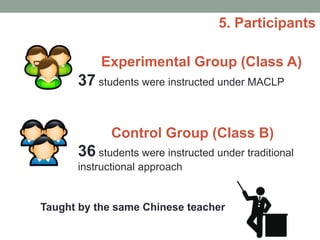
Experimental Group (Class A)
37 students were instructed under MACLP
36 students were instructed under traditional
instructional approach
Control Group (Class B)
Taught by the same Chinese teacher
5. Instructional Design
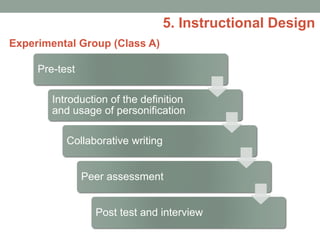
Experimental Group (Class A)
Pre-test
Introduction of the definition
and usage of personification
Collaborative writing
Peer assessment
Post test and interview
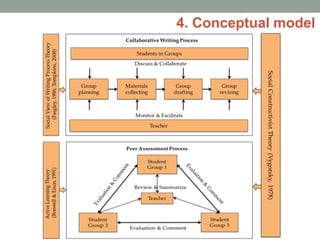
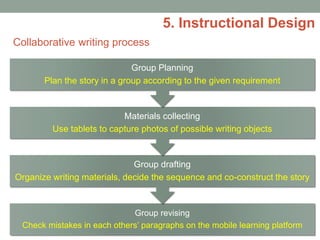
Collaborative writing process
5. Instructional Design
Group revising
Check mistakes in each others’ paragraphs on the mobile learning platform
Group drafting
Organize writing materials, decide the sequence and co-construct the story
Materials collecting
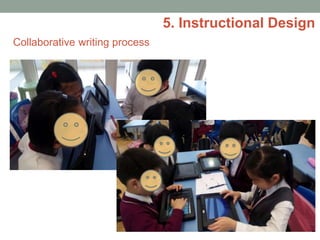
Use tablets to capture photos of possible writing objects
Group Planning
Plan the story in a group according to the given requirement
Collaborative writing process
5. Instructional Design
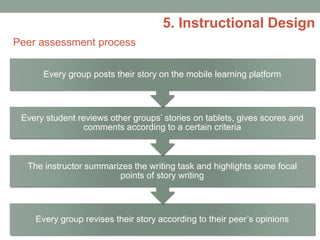
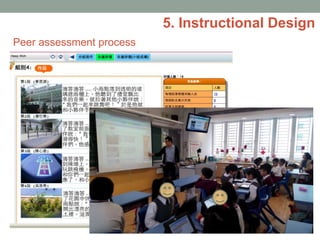
Peer assessment process
5. Instructional Design
Every group revises their story according to their peer’s opinions
The instructor summarizes the writing task and highlights some focal
points of story writing
Every student reviews other groups’ stories on tablets, gives scores and
comments according to a certain criteria
Every group posts their story on the mobile learning platform
Peer assessment process
5. Instructional Design
6. ResultsQuantitative Findings
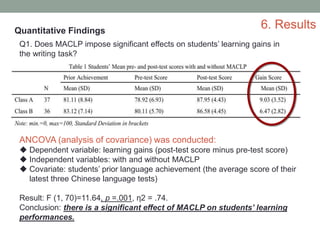
Q1. Does MACLP impose significant effects on students’ learning gains in
the writing task?
ANCOVA (analysis of covariance) was conducted:
 Dependent variable: learning gains (post-test score minus pre-test score)
 Independent variables: with and without MACLP
 Covariate: students’ prior language achievement (the average score of their
latest three Chinese language tests)
Result: F (1, 70)=11.64, p =.001, η2 = .74.
Conclusion: there is a significant effect of MACLP on students’ learning
performances.
6. ResultsQuantitative Findings
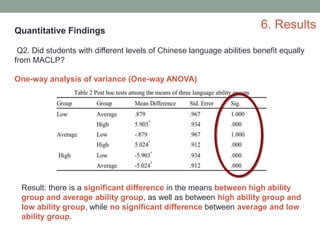
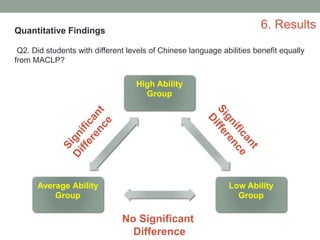
Q2. Did students with different levels of Chinese language abilities benefit equally
from MACLP?
One-way analysis of variance (One-way ANOVA)
Result: there is a significant difference in the means between high ability
group and average ability group, as well as between high ability group and
low ability group, while no significant difference between average and low
ability group.
6. ResultsQuantitative Findings
Q2. Did students with different levels of Chinese language abilities benefit equally
from MACLP?
High Ability
Group
Low Ability
Group
Average Ability
Group
No Significant
Difference
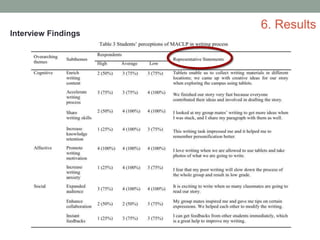
Interview Findings
6. Results
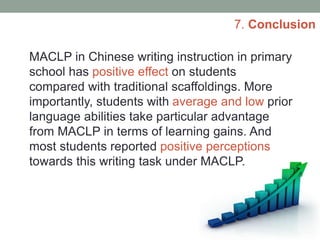
MACLP in Chinese writing instruction in primary
school has positive effect on students
compared with traditional scaffoldings. More
importantly, students with average and low prior
language abilities take particular advantage
from MACLP in terms of learning gains. And
most students reported positive perceptions
towards this writing task under MACLP.
7. Conclusion

Enhancing Primary School Students’ Story-Writing by Mobile-Assisted Collaborative Learning: A Case Study

  • 1.
    Zou Wenting CCC. HeepWoh Primary School (CSW) Li Xiaolei The University of Hong Kong Enhancing Primary School Students’ Story-Writing by Mobile-Assisted Collaborative Learning: A Case Study
  • 2.
    Writing is perceivedto be one of the most stressful and challenging tasks in Chinese language learning for elementary school students. Common defects in primary school students’ compositions:  Lacking involvement,  Limited and incorrect use of vocabulary,  Badly structured paragraphs …… (Huang, 2008; Wong et.al, 2011). 1. Problem Statement
  • 3.
    Traditional writing instructionsare constantly criticized for multiple aspects: • 1) Teacher-centered; • 2) Exam-oriented and • 3) Fail to involve students’ life experiences (Shen & Nie, 2013). Improper Instruction 1. Problem Statement
  • 4.
    2. Previous Studies •Rice and Huguley (1994) highlight the major activities of collaborative writing: it is performed collectively by more than one person to produce a single text, including idea generating, researching, planning and organizing, drafting, revising, and editing. • Besides positive impact on writing performance, collaborative writing also has notable effects on non-cognitive aspects such as motivation (Schultz, 1997), learning attitudes (De Bernardi & Antolini, 2007), enjoyment (Paquette, 2009), as well as lowering writing anxiety (e.g. De Bernardi & Antolini, 2007). Collaborative Writing Social Constructivist Theory (Vygotsky, 1978) Social View of Writing Process Theory (Faigley, 1986; Tompkins, 2008)
  • 5.
    Peer Assessment Social Constructivist Theory (Vygotsky,1978) Active Learning Theory (Bonwell & Eison, 1991) • Peer assessment, by definition, is a process whereby students grade their peers’ assignments or tests based on a teacher’s benchmarks (Sadler and Good, 2006). • Technology considerably promotes communication across geographical and time barriers by which real-time feedbacks can be given from teachers and peers in order to effectively support students’ learning process and construct a more comprehensive understanding towards a specific subject (Chang, 2001) . 2. Previous Studies
  • 6.
    Based on theinformed benefits of collaborative learning (collaborative writing & peer assessment), we designed an innovative writing instruction strategy that combines collaborative writing and peer assessment on a mobile learning platform, also described as Mobile-Assisted Collaborative Learning Pedagogy (MACLP), and addressed the following research questions: Q1. Does MACLP impose significant effects on students’ learning gains in the writing task? Q2. Did students with different levels of Chinese language abilities benefit equally from MACLP? Q3. What are students’ perceptions towards MACLP in the writing task? 3. Research Question
  • 7.
  • 8.
    5. Participants A DSS(direct subsidy school) Primary Schools in Hong Kong A Member of Pilot Scheme on e- Learning in Schools Introduced mobile technology into Chinese writing instruction since 2012 Students are able to operate tablets with little technical support The experimental school
  • 9.
    5. Participants Experimental Group(Class A) 37 students were instructed under MACLP 36 students were instructed under traditional instructional approach Control Group (Class B) Taught by the same Chinese teacher
  • 10.
    5. Instructional Design ExperimentalGroup (Class A) Pre-test Introduction of the definition and usage of personification Collaborative writing Peer assessment Post test and interview
  • 11.
    Collaborative writing process 5.Instructional Design Group revising Check mistakes in each others’ paragraphs on the mobile learning platform Group drafting Organize writing materials, decide the sequence and co-construct the story Materials collecting Use tablets to capture photos of possible writing objects Group Planning Plan the story in a group according to the given requirement
  • 12.
  • 13.
    Peer assessment process 5.Instructional Design Every group revises their story according to their peer’s opinions The instructor summarizes the writing task and highlights some focal points of story writing Every student reviews other groups’ stories on tablets, gives scores and comments according to a certain criteria Every group posts their story on the mobile learning platform
  • 14.
    Peer assessment process 5.Instructional Design
  • 15.
    6. ResultsQuantitative Findings Q1.Does MACLP impose significant effects on students’ learning gains in the writing task? ANCOVA (analysis of covariance) was conducted:  Dependent variable: learning gains (post-test score minus pre-test score)  Independent variables: with and without MACLP  Covariate: students’ prior language achievement (the average score of their latest three Chinese language tests) Result: F (1, 70)=11.64, p =.001, η2 = .74. Conclusion: there is a significant effect of MACLP on students’ learning performances.
  • 16.
    6. ResultsQuantitative Findings Q2.Did students with different levels of Chinese language abilities benefit equally from MACLP? One-way analysis of variance (One-way ANOVA) Result: there is a significant difference in the means between high ability group and average ability group, as well as between high ability group and low ability group, while no significant difference between average and low ability group.
  • 17.
    6. ResultsQuantitative Findings Q2.Did students with different levels of Chinese language abilities benefit equally from MACLP? High Ability Group Low Ability Group Average Ability Group No Significant Difference
  • 18.
  • 19.
    MACLP in Chinesewriting instruction in primary school has positive effect on students compared with traditional scaffoldings. More importantly, students with average and low prior language abilities take particular advantage from MACLP in terms of learning gains. And most students reported positive perceptions towards this writing task under MACLP. 7. Conclusion