METASTASIS
Done By : NOEL CHRISTIAN
METASTASIS
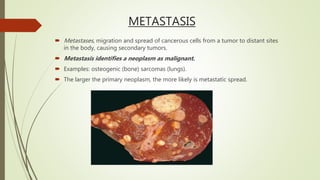
 Metastases, migration and spread of cancerous cells from a tumor to distant sites
in the body, causing secondary tumors.
 Metastasis identifies a neoplasm as malignant.
 Examples: osteogenic (bone) sarcomas (lungs).
 The larger the primary neoplasm, the more likely is metastatic spread.
SIGNS AND SYMPTOMS
 At first, nearby lymph nodes are struck early.
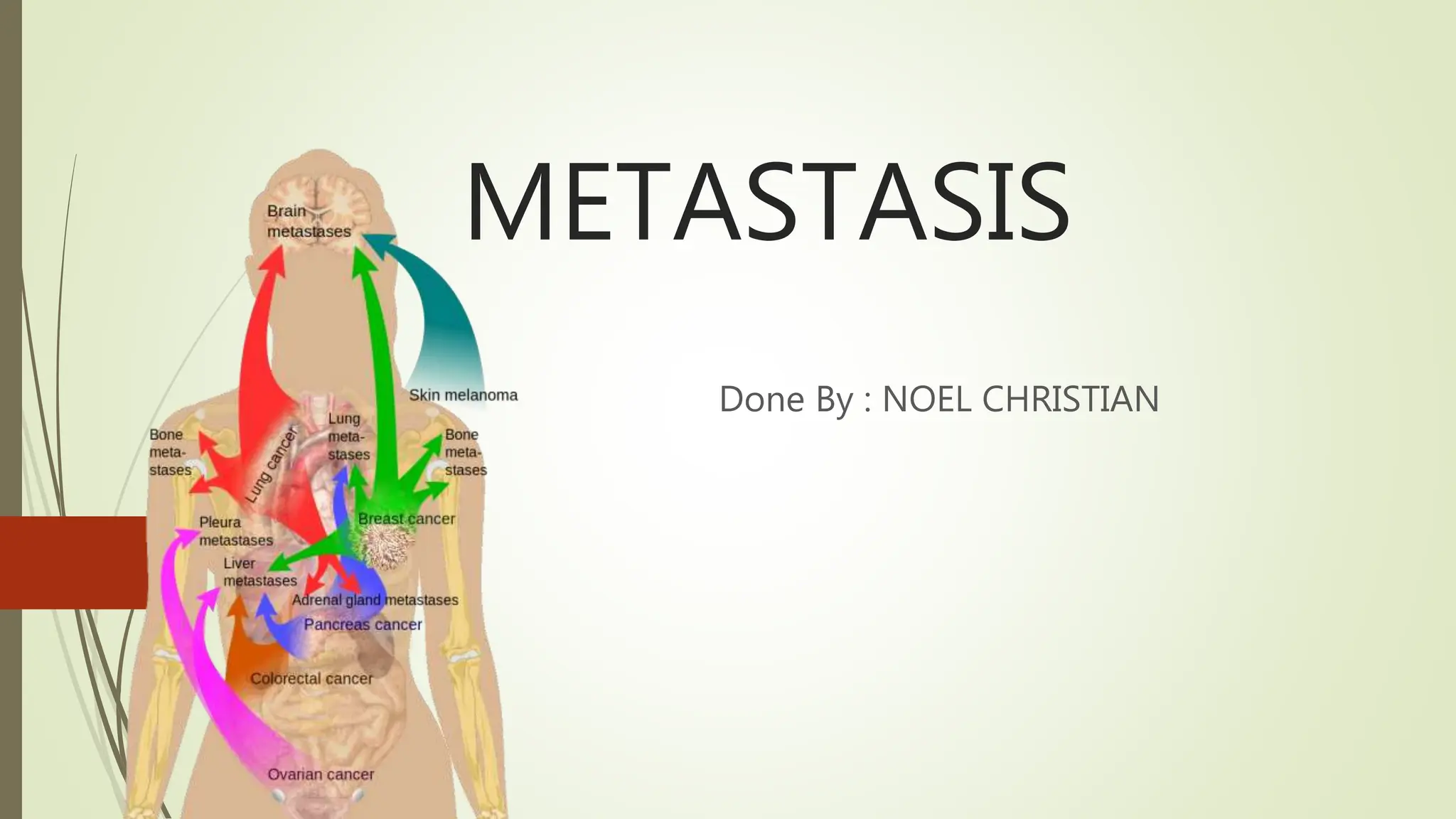
 The lungs, liver, brain, and bones are the most common metastasis locations from
solid tumors.
 In lymph nodes, a common symptom is lymphadenopathy
 Lungs: cough, and dyspnea
 Liver: hepatomegaly (enlarged liver), nausea and jaundice
 Bones: bone pain, fracture of affected bones
 Brain: neurological symptoms - headaches, seizures, and vertigo.
 Some patients, do not show any symptoms. When the organ gets a metastatic
disease it begins to shrink until its lymph nodes burst, or undergo lysis.
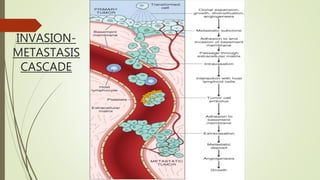
INVASION-
METASTASIS
CASCADE
MECHANISM OF METASTASIS
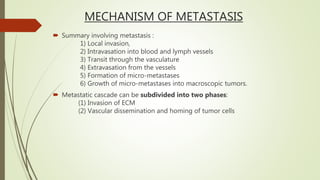
 Summary involving metastasis :
1) Local invasion,
2) Intravasation into blood and lymph vessels
3) Transit through the vasculature
4) Extravasation from the vessels
5) Formation of micro-metastases
6) Growth of micro-metastases into macroscopic tumors.
 Metastatic cascade can be subdivided into two phases:
(1) Invasion of ECM
(2) Vascular dissemination and homing of tumor cells
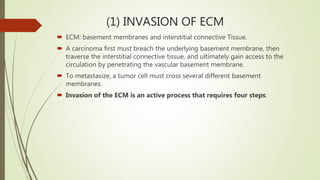
(1) INVASION OF ECM
 ECM: basement membranes and interstitial connective Tissue.
 A carcinoma first must breach the underlying basement membrane, then
traverse the interstitial connective tissue, and ultimately gain access to the
circulation by penetrating the vascular basement membrane.
 To metastasize, a tumor cell must cross several different basement
membranes.
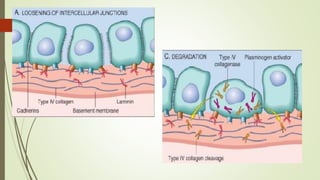
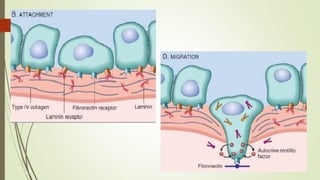
 Invasion of the ECM is an active process that requires four steps:
(2) Vascular Dissemination and Homing of
Tumor Cells
 In the bloodstream, some tumor cells form emboli by aggregating and
adhering to circulating leukocytes (platelets) ; aggregated tumor cells
are thus afforded some protection from the antitumor host effector cells.
 Free tumor cells or tumor emboli involves adhesion to the vascular
endothelium, followed by egress through the basement membrane into
the organ parenchyma by mechanisms similar to those involved in
invasion.
 Many tumors metastasize to the organ that presents the first capillary
bed they encounter after entering the circulation.
 Organ tropism may be related to the following mechanisms:
1) Expression of adhesion molecules by tumor cells.
2) Expression of chemokines(chemotaxis) and their receptors.
3) Once they reach a target, the tumor cells must be able to
colonize the site.
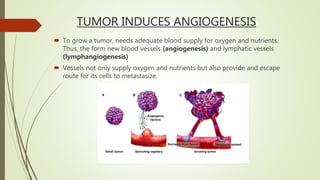
TUMOR INDUCES ANGIOGENESIS
 To grow a tumor, needs adequate blood supply for oxygen and nutrients.
Thus, the form new blood vessels (angiogenesis) and lymphatic vessels
(lymphangiogenesis)
 Vessels not only supply oxygen and nutrients but also provide and escape
route for its cells to metastasize.
 Malignant neoplasms disseminate (spread) by one of three pathways:
(1) Spread by seeding within body cavities,
(2) Lymphatic spread, (carcinomas) or
(3) Hematogenous spread (sarcoma)
(1) SPREAD BY SEEDING
 Within body cavities
 Cancers of the ovary
 Neoplasms of the central nervous system (medulloblastoma
or ependymom)
(2) LYMPHATIC SPREAD
 Carcinomas
 Lung carcinomas
 Carcinoma of the breast
Skip-Metastasis
 The cancer cells seem to traverse the lymphatic channels within the
immediately proximate nodes to be trapped in subsequent lymph nodes,
producing so-called skip metastases.
 The cells may traverse all of the lymph nodes ultimately to reach the
vascular compartment by way of the thoracic duct.
(3) HEMATOGENOUS SPREAD
 Sarcomas, but carcinomas use it as well.
 Arteries are penetrated less readily than are veins.
 The liver and lungs are the most frequently involved secondary sites
in hematogenous dissemination.
 Renal cell carcinoma (renal vein)
 Hepatocellular carcinomas (portal and hepatic)
ORGAN-SPECIFIC TARGET
 “Seed and Soil" theory, Stephen Paget, in 1889 -
It is difficult for cancer cells to survive outside their region of origin, so in
order to metastasize they must find a location with similar characteristics.
 For example,
Breast tumor cells, which gather calcium from breast milk, metastasize to
bone tissue, where they can gather calcium from bone.
IN RELATION WITH PRIMARY CANCER
 Approximately 30% of patients with newly diagnosed solid tumors present
with clinically evident metastases.
 An additional 20% have occult (hidden or unknown) metastases at the
time of diagnosis.
COMMON SITES OF ORIGIN
 Lung
 Breast
 Skin: melanoma (other skin tumors rarely metastasize)
 Colon
 Kidney
 Prostate
 Pancreas
 Liver
 Cervix
MANAGEMENT
 Once a cancer has metastasized it may still be treated
-- Radiosurgery
-- Chemotherapy
-- Radiation therapy
-- Biological therapy
-- Hormone therapy
-- Surgery or
-- Combination of these interventions ("multimodal therapy").
 The choice of treatment depends on a large number of factors :
-- Type of primary cancer
-- The size and
-- Location of the metastases
REFERENCES
 Zlotnik A., Burkhardt A. M., Homey B., Homeostatic chemokine receptors and
organ-specific metastasis, Nature reviews, 2007
 Jump up^ Yvette Drabsch, Peter ten Dijke, TGF-β Signaling in Breast Cancer Cell
Invasion and Bone Metastasis, J Mammary Gland Biol Neoplasia (2011) 16:97–108
 Jump up^ Yoshida BA, Sokoloff MM, Welch DR, Rinker-Schaeffer CW (Nov 2000).
 Syn, Nicholas; Wang, Lingzhi; Sethi, Gautam; Thiery, Jean-Paul; Goh, Boon-Cher
(2016-05-03). "Exosome-Mediated Metastasis: From Epithelial-Mesenchymal
Transition to Escape from Immunosurveillance". Trends in Pharmacological
Sciences. 37 (7): 606–17
 Lujambio, A; Esteller, M (Feb 1, 2009). "How epigenetics can explain human
metastasis: a new role for microRNAs.". Cell cycle (Georgetown, Tex.). 8 (3): 377–82.
metastasis-200519200328.pdftdjtydtfktfghcgh

metastasis-200519200328.pdftdjtydtfktfghcgh

  • 1.
    METASTASIS Done By :NOEL CHRISTIAN
  • 2.
    METASTASIS  Metastases, migrationand spread of cancerous cells from a tumor to distant sites in the body, causing secondary tumors.  Metastasis identifies a neoplasm as malignant.  Examples: osteogenic (bone) sarcomas (lungs).  The larger the primary neoplasm, the more likely is metastatic spread.
  • 3.
    SIGNS AND SYMPTOMS At first, nearby lymph nodes are struck early.  The lungs, liver, brain, and bones are the most common metastasis locations from solid tumors.  In lymph nodes, a common symptom is lymphadenopathy  Lungs: cough, and dyspnea  Liver: hepatomegaly (enlarged liver), nausea and jaundice  Bones: bone pain, fracture of affected bones  Brain: neurological symptoms - headaches, seizures, and vertigo.  Some patients, do not show any symptoms. When the organ gets a metastatic disease it begins to shrink until its lymph nodes burst, or undergo lysis.
  • 4.
  • 5.
    MECHANISM OF METASTASIS Summary involving metastasis : 1) Local invasion, 2) Intravasation into blood and lymph vessels 3) Transit through the vasculature 4) Extravasation from the vessels 5) Formation of micro-metastases 6) Growth of micro-metastases into macroscopic tumors.  Metastatic cascade can be subdivided into two phases: (1) Invasion of ECM (2) Vascular dissemination and homing of tumor cells
  • 6.
    (1) INVASION OFECM  ECM: basement membranes and interstitial connective Tissue.  A carcinoma first must breach the underlying basement membrane, then traverse the interstitial connective tissue, and ultimately gain access to the circulation by penetrating the vascular basement membrane.  To metastasize, a tumor cell must cross several different basement membranes.  Invasion of the ECM is an active process that requires four steps:
  • 9.
    (2) Vascular Disseminationand Homing of Tumor Cells  In the bloodstream, some tumor cells form emboli by aggregating and adhering to circulating leukocytes (platelets) ; aggregated tumor cells are thus afforded some protection from the antitumor host effector cells.  Free tumor cells or tumor emboli involves adhesion to the vascular endothelium, followed by egress through the basement membrane into the organ parenchyma by mechanisms similar to those involved in invasion.  Many tumors metastasize to the organ that presents the first capillary bed they encounter after entering the circulation.  Organ tropism may be related to the following mechanisms: 1) Expression of adhesion molecules by tumor cells. 2) Expression of chemokines(chemotaxis) and their receptors. 3) Once they reach a target, the tumor cells must be able to colonize the site.
  • 10.
    TUMOR INDUCES ANGIOGENESIS To grow a tumor, needs adequate blood supply for oxygen and nutrients. Thus, the form new blood vessels (angiogenesis) and lymphatic vessels (lymphangiogenesis)  Vessels not only supply oxygen and nutrients but also provide and escape route for its cells to metastasize.
  • 11.
     Malignant neoplasmsdisseminate (spread) by one of three pathways: (1) Spread by seeding within body cavities, (2) Lymphatic spread, (carcinomas) or (3) Hematogenous spread (sarcoma)
  • 12.
    (1) SPREAD BYSEEDING  Within body cavities  Cancers of the ovary  Neoplasms of the central nervous system (medulloblastoma or ependymom)
  • 13.
    (2) LYMPHATIC SPREAD Carcinomas  Lung carcinomas  Carcinoma of the breast Skip-Metastasis  The cancer cells seem to traverse the lymphatic channels within the immediately proximate nodes to be trapped in subsequent lymph nodes, producing so-called skip metastases.  The cells may traverse all of the lymph nodes ultimately to reach the vascular compartment by way of the thoracic duct.
  • 14.
    (3) HEMATOGENOUS SPREAD Sarcomas, but carcinomas use it as well.  Arteries are penetrated less readily than are veins.  The liver and lungs are the most frequently involved secondary sites in hematogenous dissemination.  Renal cell carcinoma (renal vein)  Hepatocellular carcinomas (portal and hepatic)
  • 15.
    ORGAN-SPECIFIC TARGET  “Seedand Soil" theory, Stephen Paget, in 1889 - It is difficult for cancer cells to survive outside their region of origin, so in order to metastasize they must find a location with similar characteristics.  For example, Breast tumor cells, which gather calcium from breast milk, metastasize to bone tissue, where they can gather calcium from bone.
  • 16.
    IN RELATION WITHPRIMARY CANCER  Approximately 30% of patients with newly diagnosed solid tumors present with clinically evident metastases.  An additional 20% have occult (hidden or unknown) metastases at the time of diagnosis.
  • 17.
    COMMON SITES OFORIGIN  Lung  Breast  Skin: melanoma (other skin tumors rarely metastasize)  Colon  Kidney  Prostate  Pancreas  Liver  Cervix
  • 18.
    MANAGEMENT  Once acancer has metastasized it may still be treated -- Radiosurgery -- Chemotherapy -- Radiation therapy -- Biological therapy -- Hormone therapy -- Surgery or -- Combination of these interventions ("multimodal therapy").  The choice of treatment depends on a large number of factors : -- Type of primary cancer -- The size and -- Location of the metastases
  • 19.
    REFERENCES  Zlotnik A.,Burkhardt A. M., Homey B., Homeostatic chemokine receptors and organ-specific metastasis, Nature reviews, 2007  Jump up^ Yvette Drabsch, Peter ten Dijke, TGF-β Signaling in Breast Cancer Cell Invasion and Bone Metastasis, J Mammary Gland Biol Neoplasia (2011) 16:97–108  Jump up^ Yoshida BA, Sokoloff MM, Welch DR, Rinker-Schaeffer CW (Nov 2000).  Syn, Nicholas; Wang, Lingzhi; Sethi, Gautam; Thiery, Jean-Paul; Goh, Boon-Cher (2016-05-03). "Exosome-Mediated Metastasis: From Epithelial-Mesenchymal Transition to Escape from Immunosurveillance". Trends in Pharmacological Sciences. 37 (7): 606–17  Lujambio, A; Esteller, M (Feb 1, 2009). "How epigenetics can explain human metastasis: a new role for microRNAs.". Cell cycle (Georgetown, Tex.). 8 (3): 377–82.