•Part QG: Contains General Requirements for all material – joining processes
(viz. Welding, Brazing and Plastic Fusing)
•Part QW: Contains requirements for Welding
•Part QB: Contains requirements for Brazing
•Part QF: Contains requirements for Plastic Fusing
Note: Part QG General Requirements and Part QF Plastic Fusing were added
in the 2013 Edition of ASME Section IX.
The ASME BPVC Section IX is divided into four parts,
Namely;
Part QW is further divided into five articles, these are;
Article 1. Welding – General requirements for
welding
Article 2. Procedure qualification for welding
Article 3. Performance qualifications for welders
and welding operators
Article 4. Welding data
Article 5. Standard welding procedure
specifications (SWPS)
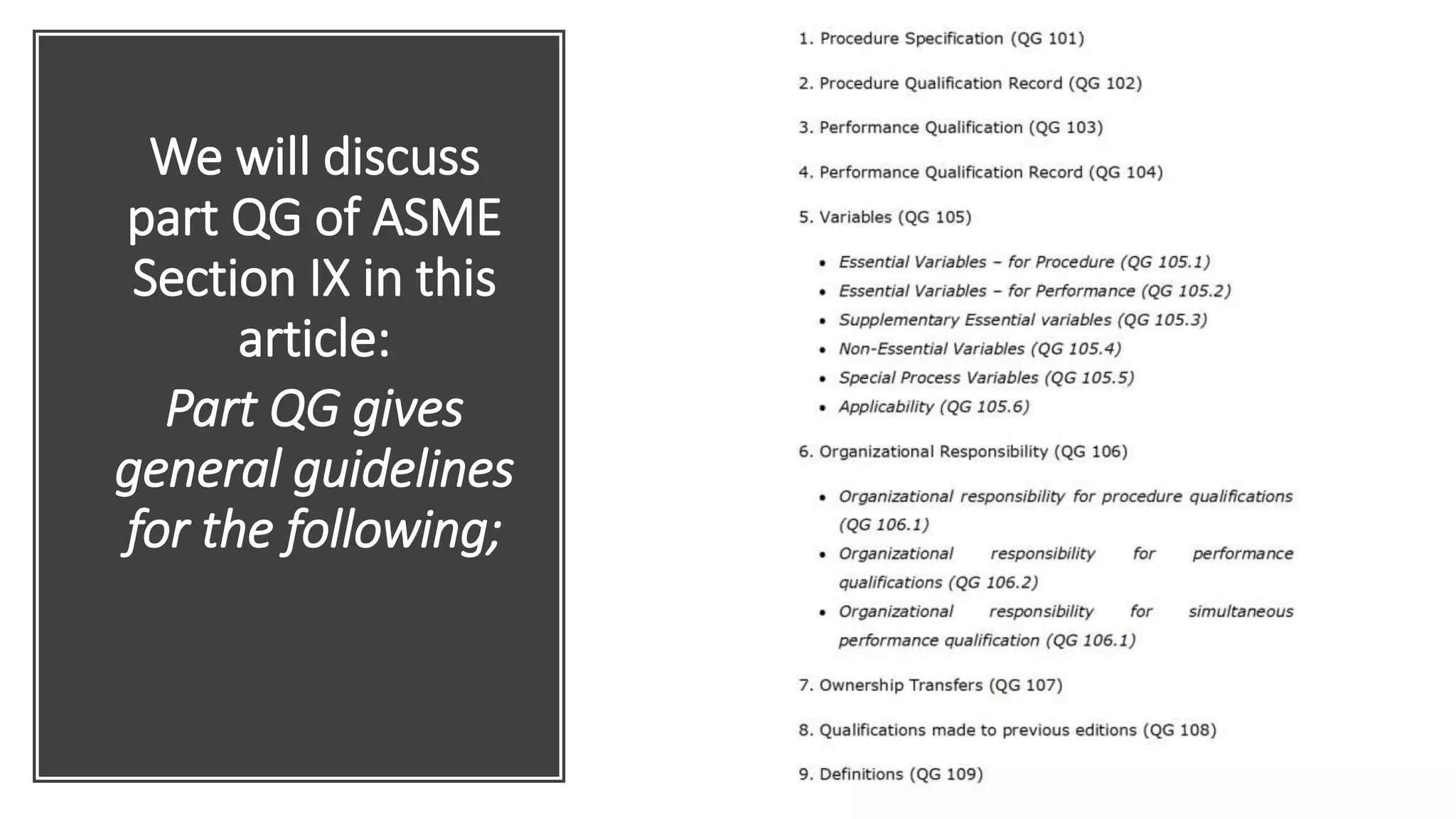
We will discuss
part QG of ASME
Section IX in this
article:
Part QG gives
general guidelines
for the following;
QG 101: Procedure specification: For each material joining process there should be a procedure specification, these
procedure specifications are termed as
Welding Procedure Specification – WPS (for Welding)
Brazing Procedure Specification – BPS (for Brazing)
Fusing Procedure Specification – FPS (for Fusing)
Contents of a Procedure specification: The procedure specification i.e. A Welding Procedure Specification (for
Welding) contains parameters related to the welding process along with the values or range (as applicable) required to
produce a sound weld. These parameters have been termed as variables by ASME. Variables are of three types;
Essential Variables
Non-Essential variables
Supplementary Essential Variables
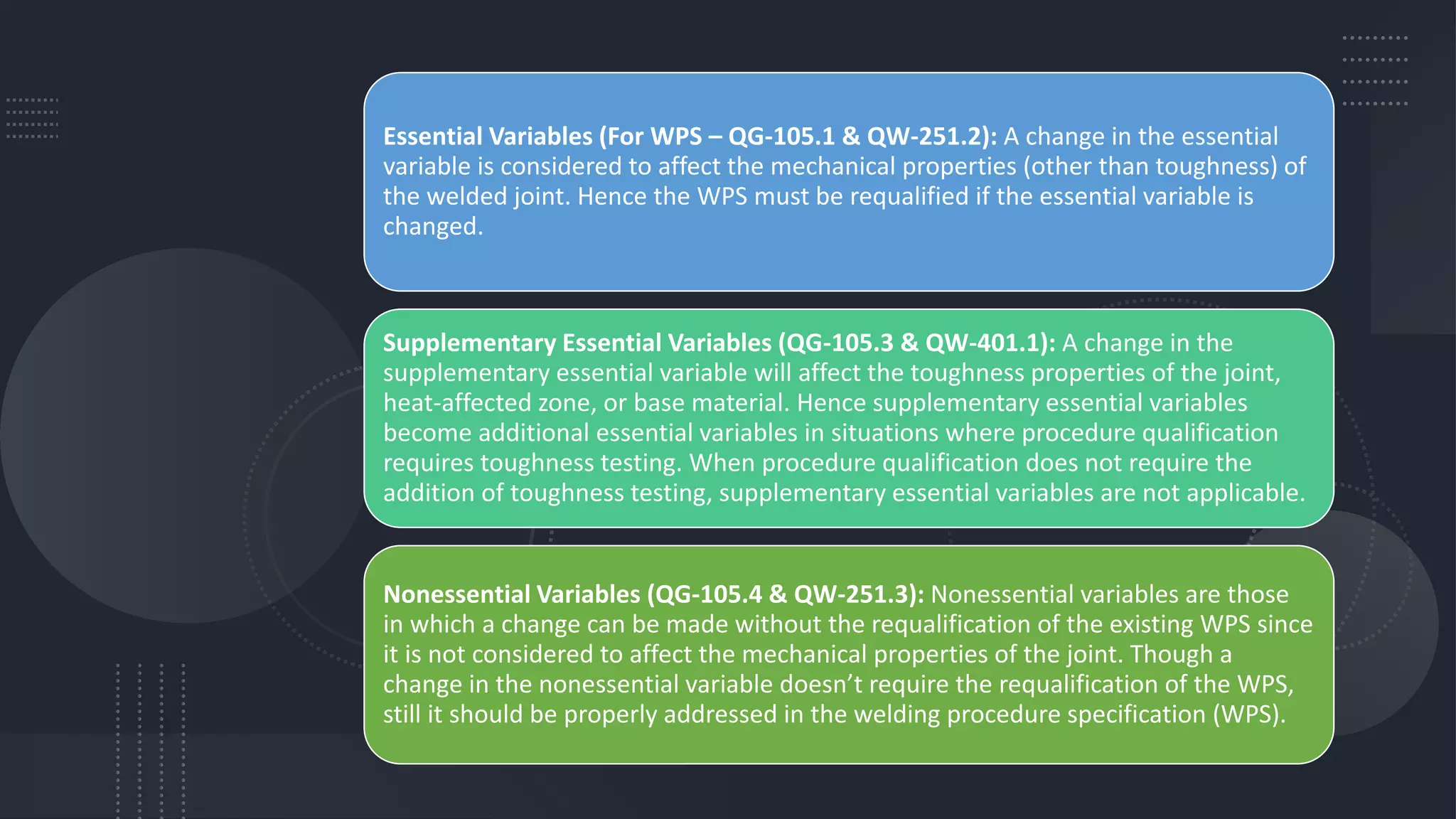
Essential Variables (For WPS – QG-105.1 & QW-251.2): A change in the essential
variable is considered to affect the mechanical properties (other than toughness) of
the welded joint. Hence the WPS must be requalified if the essential variable is
changed.
Supplementary Essential Variables (QG-105.3 & QW-401.1): A change in the
supplementary essential variable will affect the toughness properties of the joint,
heat-affected zone, or base material. Hence supplementary essential variables
become additional essential variables in situations where procedure qualification
requires toughness testing. When procedure qualification does not require the
addition of toughness testing, supplementary essential variables are not applicable.
Nonessential Variables (QG-105.4 & QW-251.3): Nonessential variables are those
in which a change can be made without the requalification of the existing WPS since
it is not considered to affect the mechanical properties of the joint. Though a
change in the nonessential variable doesn’t require the requalification of the WPS,
still it should be properly addressed in the welding procedure specification (WPS).
QG 102: Procedure Qualification Record:
A Test coupon is welded based on the variables given in the proposed welding procedure
specification (PWPS), then that test coupon is sent to the lab for destructive tests. After a
satisfactory report of the destructive test, we say that the proposed welding procedure
specification (PWPS) is qualified. This entire process of qualifying the proposed WPS is
known as procedure qualification and the entire data i.e. the real-time data (or variables)
recorded during the welding of test coupon along with the lab report of destructive test is
known as Procedure Qualification Record (PQR).
Why procedure qualification is required?
The purpose of qualifying the procedure specification is to prove that the proposed
welding procedure is capable of producing weld joints having the required mechanical
properties for the intended application.
Qualification of the proposed welding procedure specification (PWPS) demonstrates the
mechanical properties of the welded joint, and not the skill of the welder or welding
operator.
The PQR shall be produced to the Authorized Inspector whenever required. One welding
procedure specification (WPS) may be supported by one or more PQR(s), and one
procedure qualification record (PQR) may be used to support one or more welding
procedure specification(s).
Contents of a procedure qualification record (PQR)
The procedure qualification record (PQR) shall contain:
•All the real-time values (or range) of all essential variables (Mandatory)
recorded during welding of the test coupon,
•Values of all non-essential variables (as required) recorded during welding of
the test coupon
•Values of supplementary essential variables (if toughness test is required)
recorded during welding of the test coupon
•Lab test report of the welded test coupon
QG 103: Performance Qualification:
Since, Part QG is focused on general requirements for
welding, brazing, and plastic fusing. Hence, it talks about
the performance qualifications for all material joining
processes viz. welding, brazing, and plastic fusing. But
since, our area of interest is welding only hence this
discussion is restricted to welding only.
Performance qualification for welders (or welding
operators) is carried out for checking the capability of that
person to produce a sound weld.
QG 104: Performance Qualification Record:
All the real-time data observed during the welding of test
coupons along with the mechanical test/Non-destructive
test report is documented and is known as the
performance qualification record. The performance
qualification record shall be produced to the Authorized
inspector whenever needed.
QG 105: Variables:
The following variables have been explained under this
topic
QG 105.1: Essential Variables for procedure specification
QG 105.2: Essential Variables for performance
qualification
QG 105.3: Supplementary Essential Variables
QG 105.4: Non-Essential Variables
QG 105.5: Special Process Variables
QG 105.6: Applicability
QG 106: Organizational Responsibility:
Three broad terms have been discussed under this topic.
1.Organizational responsibility for procedure qualifications (QG
106.1)
2.Organizational responsibility for performance qualification (QG
106.2)
3.Simultaneous performance qualifications (QG 106.3)
QG 106.1: Organizational responsibility for procedure qualifications:
The Organization shall be fully responsible for the qualification of their procedure
specification. Welding of test coupons shall be done under the full supervision and control of
the qualifying organization and the person involved in this qualification process shall be a
direct employee of that organization or shall be from an organization hired on contract for the
welding services.
The following activities can be subcontracted, provided the organization accepts the full
responsibility, these are;
•Preparation of test coupon
•preparation of test specimens (after complete welding)
•Mechanical test or destructive test of those specimens
Two or more companies with different names but working under the same corporate
ownership can use a single Welding Procedure Specification (WPS), provided all the criteria
of ASME section IX has been fulfilled.
The performance qualification test shall be carried out only after the qualification of Welding procedure
specification (WPS).
The person involved in welding of test coupons for the qualification of welding procedure specification
(WPS) shall be qualified for welding within the ranges specified for performance qualification for that
particular welding process.
The performance qualification test shall be carried out under the full supervision and control of the
organization. However, the following activities may be subcontracted;
•Preparation of test coupon
•preparation of test specimens (after complete welding)
•Mechanical test or destructive test of those specimens
The successfully qualified welders (or welding operators) shall be issued a number/letter or Symbol by
the organization, for identification purposes.
QG 106.2: Organizational responsibility for performance qualifications:
QG 106.3: Simultaneous performance qualifications:
Two or more different organizations can participate in association to collectively qualify
one or more welders and may share the information among themselves. During
simultaneous performance qualifications, each participating organization shall be
represented by an employee of that organization designated responsibility for that
purpose.
QG 107: Ownership Transfers:
When a new owner acquires an Organization, then the Welding procedure specification
(WPS), procedure qualification record (PQR), and the welder’s performance record of that
organization remain valid for the new owner (with some conditions). Hence separate
requalification is not required.
QG 108: Qualifications Made to Previous Editions:
The welding procedure specification (WPS), procedure qualification record
(PQR), and welder’s performance qualifications made with respect to any
previous version of ASME Section IX shall remain valid and do not require any
revision except as specified by QW 420. However, qualification for a new
welding procedure specification and performance qualification shall be
carried out in accordance with the latest edition of ASME Section IX.
QG 109:
Definitions:
Several definitions related to
welding have been given in part
QG 109. These definitions can be
found on page no. 4 through page
no. 14.

ASME Section IX Presentation.pptx

  • 2.
    •Part QG: ContainsGeneral Requirements for all material – joining processes (viz. Welding, Brazing and Plastic Fusing) •Part QW: Contains requirements for Welding •Part QB: Contains requirements for Brazing •Part QF: Contains requirements for Plastic Fusing Note: Part QG General Requirements and Part QF Plastic Fusing were added in the 2013 Edition of ASME Section IX. The ASME BPVC Section IX is divided into four parts, Namely;
  • 3.
    Part QW isfurther divided into five articles, these are; Article 1. Welding – General requirements for welding Article 2. Procedure qualification for welding Article 3. Performance qualifications for welders and welding operators Article 4. Welding data Article 5. Standard welding procedure specifications (SWPS)
  • 4.
    We will discuss partQG of ASME Section IX in this article: Part QG gives general guidelines for the following;
  • 5.
    QG 101: Procedurespecification: For each material joining process there should be a procedure specification, these procedure specifications are termed as Welding Procedure Specification – WPS (for Welding) Brazing Procedure Specification – BPS (for Brazing) Fusing Procedure Specification – FPS (for Fusing) Contents of a Procedure specification: The procedure specification i.e. A Welding Procedure Specification (for Welding) contains parameters related to the welding process along with the values or range (as applicable) required to produce a sound weld. These parameters have been termed as variables by ASME. Variables are of three types; Essential Variables Non-Essential variables Supplementary Essential Variables
  • 6.
    Essential Variables (ForWPS – QG-105.1 & QW-251.2): A change in the essential variable is considered to affect the mechanical properties (other than toughness) of the welded joint. Hence the WPS must be requalified if the essential variable is changed. Supplementary Essential Variables (QG-105.3 & QW-401.1): A change in the supplementary essential variable will affect the toughness properties of the joint, heat-affected zone, or base material. Hence supplementary essential variables become additional essential variables in situations where procedure qualification requires toughness testing. When procedure qualification does not require the addition of toughness testing, supplementary essential variables are not applicable. Nonessential Variables (QG-105.4 & QW-251.3): Nonessential variables are those in which a change can be made without the requalification of the existing WPS since it is not considered to affect the mechanical properties of the joint. Though a change in the nonessential variable doesn’t require the requalification of the WPS, still it should be properly addressed in the welding procedure specification (WPS).
  • 7.
    QG 102: ProcedureQualification Record: A Test coupon is welded based on the variables given in the proposed welding procedure specification (PWPS), then that test coupon is sent to the lab for destructive tests. After a satisfactory report of the destructive test, we say that the proposed welding procedure specification (PWPS) is qualified. This entire process of qualifying the proposed WPS is known as procedure qualification and the entire data i.e. the real-time data (or variables) recorded during the welding of test coupon along with the lab report of destructive test is known as Procedure Qualification Record (PQR).
  • 8.
    Why procedure qualificationis required? The purpose of qualifying the procedure specification is to prove that the proposed welding procedure is capable of producing weld joints having the required mechanical properties for the intended application. Qualification of the proposed welding procedure specification (PWPS) demonstrates the mechanical properties of the welded joint, and not the skill of the welder or welding operator. The PQR shall be produced to the Authorized Inspector whenever required. One welding procedure specification (WPS) may be supported by one or more PQR(s), and one procedure qualification record (PQR) may be used to support one or more welding procedure specification(s).
  • 9.
    Contents of aprocedure qualification record (PQR) The procedure qualification record (PQR) shall contain: •All the real-time values (or range) of all essential variables (Mandatory) recorded during welding of the test coupon, •Values of all non-essential variables (as required) recorded during welding of the test coupon •Values of supplementary essential variables (if toughness test is required) recorded during welding of the test coupon •Lab test report of the welded test coupon
  • 10.
    QG 103: PerformanceQualification: Since, Part QG is focused on general requirements for welding, brazing, and plastic fusing. Hence, it talks about the performance qualifications for all material joining processes viz. welding, brazing, and plastic fusing. But since, our area of interest is welding only hence this discussion is restricted to welding only. Performance qualification for welders (or welding operators) is carried out for checking the capability of that person to produce a sound weld.
  • 11.
    QG 104: PerformanceQualification Record: All the real-time data observed during the welding of test coupons along with the mechanical test/Non-destructive test report is documented and is known as the performance qualification record. The performance qualification record shall be produced to the Authorized inspector whenever needed.
  • 12.
    QG 105: Variables: Thefollowing variables have been explained under this topic QG 105.1: Essential Variables for procedure specification QG 105.2: Essential Variables for performance qualification QG 105.3: Supplementary Essential Variables QG 105.4: Non-Essential Variables QG 105.5: Special Process Variables QG 105.6: Applicability
  • 13.
    QG 106: OrganizationalResponsibility: Three broad terms have been discussed under this topic. 1.Organizational responsibility for procedure qualifications (QG 106.1) 2.Organizational responsibility for performance qualification (QG 106.2) 3.Simultaneous performance qualifications (QG 106.3)
  • 14.
    QG 106.1: Organizationalresponsibility for procedure qualifications: The Organization shall be fully responsible for the qualification of their procedure specification. Welding of test coupons shall be done under the full supervision and control of the qualifying organization and the person involved in this qualification process shall be a direct employee of that organization or shall be from an organization hired on contract for the welding services. The following activities can be subcontracted, provided the organization accepts the full responsibility, these are; •Preparation of test coupon •preparation of test specimens (after complete welding) •Mechanical test or destructive test of those specimens Two or more companies with different names but working under the same corporate ownership can use a single Welding Procedure Specification (WPS), provided all the criteria of ASME section IX has been fulfilled.
  • 15.
    The performance qualificationtest shall be carried out only after the qualification of Welding procedure specification (WPS). The person involved in welding of test coupons for the qualification of welding procedure specification (WPS) shall be qualified for welding within the ranges specified for performance qualification for that particular welding process. The performance qualification test shall be carried out under the full supervision and control of the organization. However, the following activities may be subcontracted; •Preparation of test coupon •preparation of test specimens (after complete welding) •Mechanical test or destructive test of those specimens The successfully qualified welders (or welding operators) shall be issued a number/letter or Symbol by the organization, for identification purposes. QG 106.2: Organizational responsibility for performance qualifications:
  • 16.
    QG 106.3: Simultaneousperformance qualifications: Two or more different organizations can participate in association to collectively qualify one or more welders and may share the information among themselves. During simultaneous performance qualifications, each participating organization shall be represented by an employee of that organization designated responsibility for that purpose.
  • 17.
    QG 107: OwnershipTransfers: When a new owner acquires an Organization, then the Welding procedure specification (WPS), procedure qualification record (PQR), and the welder’s performance record of that organization remain valid for the new owner (with some conditions). Hence separate requalification is not required.
  • 18.
    QG 108: QualificationsMade to Previous Editions: The welding procedure specification (WPS), procedure qualification record (PQR), and welder’s performance qualifications made with respect to any previous version of ASME Section IX shall remain valid and do not require any revision except as specified by QW 420. However, qualification for a new welding procedure specification and performance qualification shall be carried out in accordance with the latest edition of ASME Section IX.
  • 19.
    QG 109: Definitions: Several definitionsrelated to welding have been given in part QG 109. These definitions can be found on page no. 4 through page no. 14.