METADYNAMICS
VISHAL KUMAR
Reg no-16MSCSCC01
MSc Computational Chemistry
Department of Computational Sciences
What can we do if we only know the
starting point but not the end point of a
reaction?
METADYNAMICS
It was first suggested by Alessandro Laio and Michele Parrinello in 2002
Source-http://people.sissa.it/~laio/ Source-https://www.hpc-ch.org/marcel-benoist-prize-for-michele-parrinello/
TK
ek
Bmol



1
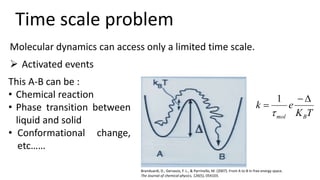
Time scale problem
 Activated events
This A-B can be :
• Chemical reaction
• Phase transition between
liquid and solid
• Conformational change,
etc……
Molecular dynamics can access only a limited time scale.
Branduardi, D., Gervasio, F. L., & Parrinello, M. (2007). From A to B in free energy space.
The Journal of chemical physics, 126(5), 054103.
Potential energy surface is rough
Bolhuis, P. G., Dellago, C., & Chandler, D. (2000). Reaction coordinates of biomolecular
isomerization. Proceedings of the National Academy of Sciences, 97(11), 5877-5882.
Source: Geology, mountains, peaks, alps – Fürstentum LiechtensteinFürstentum
Liechtenstein1140 × 410Search by imageMountains Liechtenstein
Proposed solutions to the sampling problem
 Enhanced sampling- Parallel sampling, replica exchange,
simulated tempering.
Trajectory based schemes- NEB, Transition path sampling,
Forward flux finite temperature string method.
Bias potential- Umbrella sampling, Local elevation,
Conformational flooding, Adaptive bias force, Self-healing
umbrella sampling, Multicanonical MD, Wang-Landau,
Metadynamics.
Objectives of Meta dynamics
The philosophy of meta dynamics , it is two fold in which
we want one end to solve taking a problem going from one
medium to another by simulation method, start from one
conformer to another from A to B gives right statistical
distribution of this conformer.
To bring down the complexity of the system which is made
up of ‘N’ degree of freedom bring down to a level which
we can understand the system why system go from A to B,
that will enhance the understanding of the problem.
METADYNAMICS
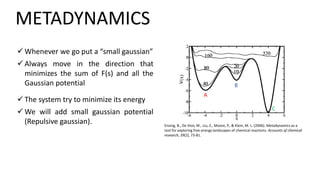
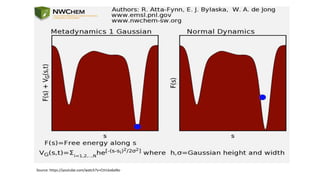
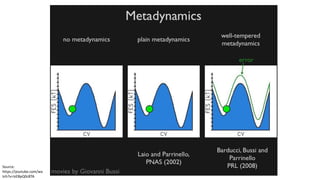
 Whenever we go put a “small gaussian”
 Always move in the direction that
minimizes the sum of F(s) and all the
Gaussian potential
 The system try to minimize its energy
 We will add small gaussian potential
(Repulsive gaussian). Ensing, B., De Vivo, M., Liu, Z., Moore, P., & Klein, M. L. (2006). Metadynamics as a
tool for exploring free energy landscapes of chemical reactions. Accounts of chemical
research, 39(2), 73-81.
B
A
C
Source: https://youtube.com/watch?v=CtIrLkx6aNo
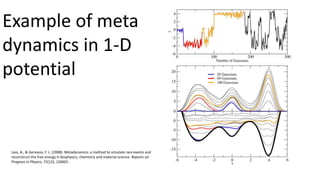
Example of meta
dynamics in 1-D
potential
Laio, A., & Gervasio, F. L. (2008). Metadynamics: a method to simulate rare events and
reconstruct the free energy in biophysics, chemistry and material science. Reports on
Progress in Physics, 71(12), 126601.
Applications of Meta dynamics
Chemical reactions
Protein folding
Molecular docking
Phase transitions
Encapsulation of DNA onto hydrophobic and hydrophilic single-walled
carbon nanotubes
METHOD
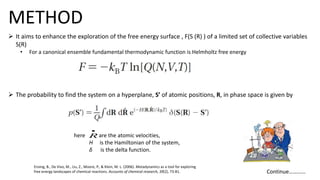
 It aims to enhance the exploration of the free energy surface , F(S (R) ) of a limited set of collective variables
S(R)
• For a canonical ensemble fundamental thermodynamic function is Helmholtz free energy
 The probability to find the system on a hyperplane, S’ of atomic positions, R, in phase space is given by
here are the atomic velocities,
H is the Hamiltonian of the system,
δ is the delta function.

R
Continue…………
Ensing, B., De Vivo, M., Liu, Z., Moore, P., & Klein, M. L. (2006). Metadynamics as a tool for exploring
free energy landscapes of chemical reactions. Accounts of chemical research, 39(2), 73-81.
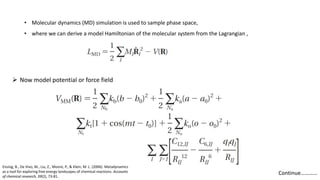
• Molecular dynamics (MD) simulation is used to sample phase space,
• where we can derive a model Hamiltonian of the molecular system from the Lagrangian ,
 Now model potential or force field
Continue…………
Ensing, B., De Vivo, M., Liu, Z., Moore, P., & Klein, M. L. (2006). Metadynamics
as a tool for exploring free energy landscapes of chemical reactions. Accounts
of chemical research, 39(2), 73-81.
 Such complicated phenomena are modeled well when the interatomic forces are computed from the
instantaneous electronic structure via an interface with an ab initio method.
 Density functional theory (DFT) is a particularly efficient electronic structure method , where the
electronic(Kohn- Sham) energy, which is a functional of the electronic density , is
constructed from the one-electron wave function
][EEKS 
2
)()( 
i
i rr 
The DFT potential,
 Terms involved-
Electronic kinetic energy,
Electron-nuclei interaction,
Coulombic potential,
Configuration of atomic position R
Ground state wave function is obtained from wave function 
It minimize 𝑉𝐷𝐹𝑇,which are readily found from a self-consistent matrix diagonalization.
Continue…………
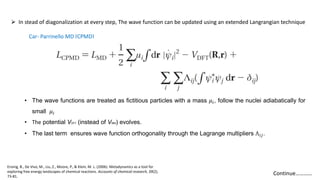
 In stead of diagonalization at every step, The wave function can be updated using an extended Langrangian technique
Car- Parrinello MD (CPMD)
• The wave functions are treated as fictitious particles with a mass 𝜇𝑖, follow the nuclei adiabatically for
small 𝜇𝑖.
• The potential VDFT (instead of VMM) evolves.
• The last term ensures wave function orthogonality through the Lagrange multipliers Λ 𝑖𝑗.
Continue…………
Ensing, B., De Vivo, M., Liu, Z., Moore, P., & Klein, M. L. (2006). Metadynamics as a tool for
exploring free energy landscapes of chemical reactions. Accounts of chemical research, 39(2),
73-81.
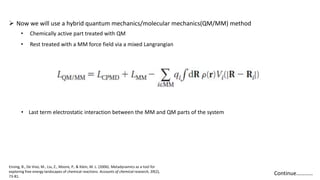
 Now we will use a hybrid quantum mechanics/molecular mechanics(QM/MM) method
• Chemically active part treated with QM
• Rest treated with a MM force field via a mixed Langrangian
• Last term electrostatic interaction between the MM and QM parts of the system
Continue…………
Ensing, B., De Vivo, M., Liu, Z., Moore, P., & Klein, M. L. (2006). Metadynamics as a tool for
exploring free energy landscapes of chemical reactions. Accounts of chemical research, 39(2),
73-81.
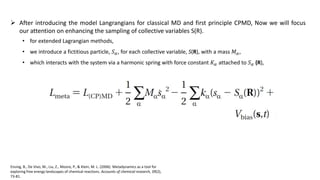
 After introducing the model Langrangians for classical MD and first principle CPMD, Now we will focus
our attention on enhancing the sampling of collective variables S(R).
• for extended Lagrangian methods,
• we introduce a fictitious particle, 𝑆 𝛼, for each collective variable, S(R), with a mass 𝑀 𝛼,
• which interacts with the system via a harmonic spring with force constant 𝐾 𝛼 attached to 𝑆 𝛼 (R),
Ensing, B., De Vivo, M., Liu, Z., Moore, P., & Klein, M. L. (2006). Metadynamics as a tool for
exploring free energy landscapes of chemical reactions. Accounts of chemical research, 39(2),
73-81.
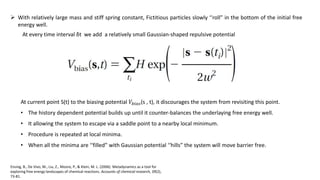
 With relatively large mass and stiff spring constant, Fictitious particles slowly ‘‘roll” in the bottom of the initial free
energy well.
At every time interval δt we add a relatively small Gaussian-shaped repulsive potential
At current point S(t) to the biasing potential 𝑉𝑏𝑖𝑎𝑠(s , t), it discourages the system from revisiting this point.
• The history dependent potential builds up until it counter-balances the underlaying free energy well.
• It allowing the system to escape via a saddle point to a nearby local minimum.
• Procedure is repeated at local minima.
• When all the minima are ‘‘filled” with Gaussian potential ‘‘hills” the system will move barrier free.
Ensing, B., De Vivo, M., Liu, Z., Moore, P., & Klein, M. L. (2006). Metadynamics as a tool for
exploring free energy landscapes of chemical reactions. Accounts of chemical research, 39(2),
73-81.
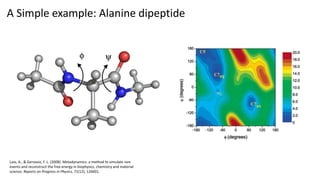
A Simple example: Alanine dipeptide
Laio, A., & Gervasio, F. L. (2008). Metadynamics: a method to simulate rare
events and reconstruct the free energy in biophysics, chemistry and material
science. Reports on Progress in Physics, 71(12), 126601.
Examples of Collective variables(CV)
Distances
Angles- bonding and torsional
Coordination number- between individual atoms or between different species
Solvation energy
Electric field
Reaction path
The choice of collective variables
 The reliability of meta dynamics is strongly influenced by the choice of the CVs.
 Ideally the CVs should satisfy three properties:
• They should clearly distinguish between the initial state , the final state and the intermediates.
• They should describe all the slow events that are relevant to the process of interest.
• Their number should not be too large, otherwise it will take a very long time to fill the free
energy surface.
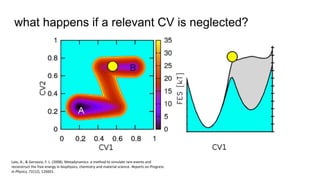
what happens if a relevant CV is neglected?
Laio, A., & Gervasio, F. L. (2008). Metadynamics: a method to simulate rare events and
reconstruct the free energy in biophysics, chemistry and material science. Reports on Progress
in Physics, 71(12), 126601.
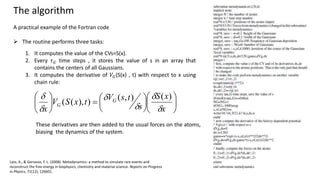
The algorithm
A practical example of the Fortran code
 The routine performs three tasks:
1. It computes the value of the CVs=S(x).
2. Every 𝜏 𝐺 time steps , it stores the value of s in an array that
contains the centers of all Gaussians.
3. It computes the derivative of 𝑉𝐺(S(x) , t) with respect to x using
chain rule:

















x
xS
s
tsV
txSV
x
G
G





 )(),(
)),((
These derivatives are then added to the usual forces on the atoms,
biasing the dynamics of the system.
Laio, A., & Gervasio, F. L. (2008). Metadynamics: a method to simulate rare events and
reconstruct the free energy in biophysics, chemistry and material science. Reports on Progress
in Physics, 71(12), 126601.
Source:
https://youtube.com/wa
tch?v=IzEBpQ0c8TA
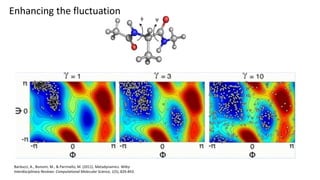
Enhancing the fluctuation
Barducci, A., Bonomi, M., & Parrinello, M. (2011). Metadynamics. Wiley
Interdisciplinary Reviews: Computational Molecular Science, 1(5), 826-843.
Conclusion
Metadynamics offers a very promising technique to study activated physical/chemical
processes!
Advantages
• Efficient exploration of reaction pathways
• Provides insights in to the mechanism
• Allows free energy estimation
Disadvantages
• Comes with little additional computational overhead.
Metadynamics

Metadynamics

  • 1.
    METADYNAMICS VISHAL KUMAR Reg no-16MSCSCC01 MScComputational Chemistry Department of Computational Sciences
  • 2.
    What can wedo if we only know the starting point but not the end point of a reaction? METADYNAMICS It was first suggested by Alessandro Laio and Michele Parrinello in 2002 Source-http://people.sissa.it/~laio/ Source-https://www.hpc-ch.org/marcel-benoist-prize-for-michele-parrinello/
  • 3.
    TK ek Bmol    1 Time scale problem Activated events This A-B can be : • Chemical reaction • Phase transition between liquid and solid • Conformational change, etc…… Molecular dynamics can access only a limited time scale. Branduardi, D., Gervasio, F. L., & Parrinello, M. (2007). From A to B in free energy space. The Journal of chemical physics, 126(5), 054103.
  • 4.
    Potential energy surfaceis rough Bolhuis, P. G., Dellago, C., & Chandler, D. (2000). Reaction coordinates of biomolecular isomerization. Proceedings of the National Academy of Sciences, 97(11), 5877-5882. Source: Geology, mountains, peaks, alps – Fürstentum LiechtensteinFürstentum Liechtenstein1140 × 410Search by imageMountains Liechtenstein
  • 5.
    Proposed solutions tothe sampling problem  Enhanced sampling- Parallel sampling, replica exchange, simulated tempering. Trajectory based schemes- NEB, Transition path sampling, Forward flux finite temperature string method. Bias potential- Umbrella sampling, Local elevation, Conformational flooding, Adaptive bias force, Self-healing umbrella sampling, Multicanonical MD, Wang-Landau, Metadynamics.
  • 6.
    Objectives of Metadynamics The philosophy of meta dynamics , it is two fold in which we want one end to solve taking a problem going from one medium to another by simulation method, start from one conformer to another from A to B gives right statistical distribution of this conformer. To bring down the complexity of the system which is made up of ‘N’ degree of freedom bring down to a level which we can understand the system why system go from A to B, that will enhance the understanding of the problem.
  • 7.
    METADYNAMICS  Whenever wego put a “small gaussian”  Always move in the direction that minimizes the sum of F(s) and all the Gaussian potential  The system try to minimize its energy  We will add small gaussian potential (Repulsive gaussian). Ensing, B., De Vivo, M., Liu, Z., Moore, P., & Klein, M. L. (2006). Metadynamics as a tool for exploring free energy landscapes of chemical reactions. Accounts of chemical research, 39(2), 73-81. B A C
  • 8.
  • 9.
    Example of meta dynamicsin 1-D potential Laio, A., & Gervasio, F. L. (2008). Metadynamics: a method to simulate rare events and reconstruct the free energy in biophysics, chemistry and material science. Reports on Progress in Physics, 71(12), 126601.
  • 10.
    Applications of Metadynamics Chemical reactions Protein folding Molecular docking Phase transitions Encapsulation of DNA onto hydrophobic and hydrophilic single-walled carbon nanotubes
  • 11.
    METHOD  It aimsto enhance the exploration of the free energy surface , F(S (R) ) of a limited set of collective variables S(R) • For a canonical ensemble fundamental thermodynamic function is Helmholtz free energy  The probability to find the system on a hyperplane, S’ of atomic positions, R, in phase space is given by here are the atomic velocities, H is the Hamiltonian of the system, δ is the delta function.  R Continue………… Ensing, B., De Vivo, M., Liu, Z., Moore, P., & Klein, M. L. (2006). Metadynamics as a tool for exploring free energy landscapes of chemical reactions. Accounts of chemical research, 39(2), 73-81.
  • 12.
    • Molecular dynamics(MD) simulation is used to sample phase space, • where we can derive a model Hamiltonian of the molecular system from the Lagrangian ,  Now model potential or force field Continue………… Ensing, B., De Vivo, M., Liu, Z., Moore, P., & Klein, M. L. (2006). Metadynamics as a tool for exploring free energy landscapes of chemical reactions. Accounts of chemical research, 39(2), 73-81.
  • 13.
     Such complicatedphenomena are modeled well when the interatomic forces are computed from the instantaneous electronic structure via an interface with an ab initio method.  Density functional theory (DFT) is a particularly efficient electronic structure method , where the electronic(Kohn- Sham) energy, which is a functional of the electronic density , is constructed from the one-electron wave function ][EEKS  2 )()(  i i rr  The DFT potential,  Terms involved- Electronic kinetic energy, Electron-nuclei interaction, Coulombic potential, Configuration of atomic position R Ground state wave function is obtained from wave function  It minimize 𝑉𝐷𝐹𝑇,which are readily found from a self-consistent matrix diagonalization. Continue…………
  • 14.
     In steadof diagonalization at every step, The wave function can be updated using an extended Langrangian technique Car- Parrinello MD (CPMD) • The wave functions are treated as fictitious particles with a mass 𝜇𝑖, follow the nuclei adiabatically for small 𝜇𝑖. • The potential VDFT (instead of VMM) evolves. • The last term ensures wave function orthogonality through the Lagrange multipliers Λ 𝑖𝑗. Continue………… Ensing, B., De Vivo, M., Liu, Z., Moore, P., & Klein, M. L. (2006). Metadynamics as a tool for exploring free energy landscapes of chemical reactions. Accounts of chemical research, 39(2), 73-81.
  • 15.
     Now wewill use a hybrid quantum mechanics/molecular mechanics(QM/MM) method • Chemically active part treated with QM • Rest treated with a MM force field via a mixed Langrangian • Last term electrostatic interaction between the MM and QM parts of the system Continue………… Ensing, B., De Vivo, M., Liu, Z., Moore, P., & Klein, M. L. (2006). Metadynamics as a tool for exploring free energy landscapes of chemical reactions. Accounts of chemical research, 39(2), 73-81.
  • 16.
     After introducingthe model Langrangians for classical MD and first principle CPMD, Now we will focus our attention on enhancing the sampling of collective variables S(R). • for extended Lagrangian methods, • we introduce a fictitious particle, 𝑆 𝛼, for each collective variable, S(R), with a mass 𝑀 𝛼, • which interacts with the system via a harmonic spring with force constant 𝐾 𝛼 attached to 𝑆 𝛼 (R), Ensing, B., De Vivo, M., Liu, Z., Moore, P., & Klein, M. L. (2006). Metadynamics as a tool for exploring free energy landscapes of chemical reactions. Accounts of chemical research, 39(2), 73-81.
  • 17.
     With relativelylarge mass and stiff spring constant, Fictitious particles slowly ‘‘roll” in the bottom of the initial free energy well. At every time interval δt we add a relatively small Gaussian-shaped repulsive potential At current point S(t) to the biasing potential 𝑉𝑏𝑖𝑎𝑠(s , t), it discourages the system from revisiting this point. • The history dependent potential builds up until it counter-balances the underlaying free energy well. • It allowing the system to escape via a saddle point to a nearby local minimum. • Procedure is repeated at local minima. • When all the minima are ‘‘filled” with Gaussian potential ‘‘hills” the system will move barrier free. Ensing, B., De Vivo, M., Liu, Z., Moore, P., & Klein, M. L. (2006). Metadynamics as a tool for exploring free energy landscapes of chemical reactions. Accounts of chemical research, 39(2), 73-81.
  • 18.
    A Simple example:Alanine dipeptide Laio, A., & Gervasio, F. L. (2008). Metadynamics: a method to simulate rare events and reconstruct the free energy in biophysics, chemistry and material science. Reports on Progress in Physics, 71(12), 126601.
  • 19.
    Examples of Collectivevariables(CV) Distances Angles- bonding and torsional Coordination number- between individual atoms or between different species Solvation energy Electric field Reaction path
  • 20.
    The choice ofcollective variables  The reliability of meta dynamics is strongly influenced by the choice of the CVs.  Ideally the CVs should satisfy three properties: • They should clearly distinguish between the initial state , the final state and the intermediates. • They should describe all the slow events that are relevant to the process of interest. • Their number should not be too large, otherwise it will take a very long time to fill the free energy surface.
  • 21.
    what happens ifa relevant CV is neglected? Laio, A., & Gervasio, F. L. (2008). Metadynamics: a method to simulate rare events and reconstruct the free energy in biophysics, chemistry and material science. Reports on Progress in Physics, 71(12), 126601.
  • 22.
    The algorithm A practicalexample of the Fortran code  The routine performs three tasks: 1. It computes the value of the CVs=S(x). 2. Every 𝜏 𝐺 time steps , it stores the value of s in an array that contains the centers of all Gaussians. 3. It computes the derivative of 𝑉𝐺(S(x) , t) with respect to x using chain rule:                  x xS s tsV txSV x G G       )(),( )),(( These derivatives are then added to the usual forces on the atoms, biasing the dynamics of the system. Laio, A., & Gervasio, F. L. (2008). Metadynamics: a method to simulate rare events and reconstruct the free energy in biophysics, chemistry and material science. Reports on Progress in Physics, 71(12), 126601.
  • 23.
  • 24.
    Enhancing the fluctuation Barducci,A., Bonomi, M., & Parrinello, M. (2011). Metadynamics. Wiley Interdisciplinary Reviews: Computational Molecular Science, 1(5), 826-843.
  • 25.
    Conclusion Metadynamics offers avery promising technique to study activated physical/chemical processes! Advantages • Efficient exploration of reaction pathways • Provides insights in to the mechanism • Allows free energy estimation Disadvantages • Comes with little additional computational overhead.