Comparison of Gastric Bypass Surgery and Diet &
Exercise in Obese Patients with Type 2 Diabetes Mellitus
Yunji Kim, Khue D. Pham, Xuerong Wu, Sandy Yi
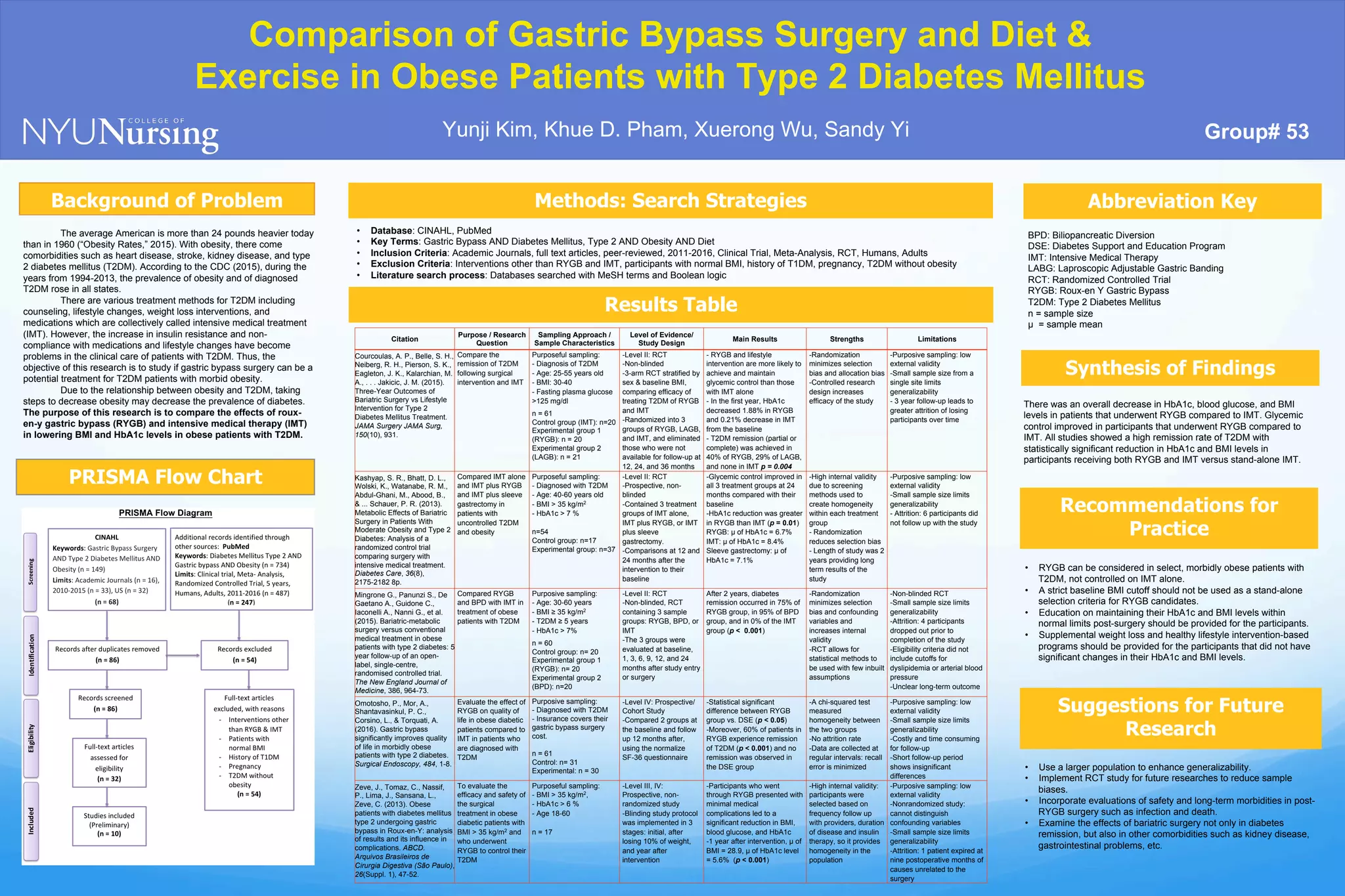
Methods: Search Strategies
Results Table
Recommendations for
Practice
Suggestions for Future
Research
Background of Problem
Group# 53
PRISMA Flow Chart
Synthesis of Findings
The average American is more than 24 pounds heavier today
than in 1960 (“Obesity Rates,” 2015). With obesity, there come
comorbidities such as heart disease, stroke, kidney disease, and type
2 diabetes mellitus (T2DM). According to the CDC (2015), during the
years from 1994-2013, the prevalence of obesity and of diagnosed
T2DM rose in all states.
There are various treatment methods for T2DM including
counseling, lifestyle changes, weight loss interventions, and
medications which are collectively called intensive medical treatment
(IMT). However, the increase in insulin resistance and non-
compliance with medications and lifestyle changes have become
problems in the clinical care of patients with T2DM. Thus, the
objective of this research is to study if gastric bypass surgery can be a
potential treatment for T2DM patients with morbid obesity.
Due to the relationship between obesity and T2DM, taking
steps to decrease obesity may decrease the prevalence of diabetes.
The purpose of this research is to compare the effects of roux-
en-y gastric bypass (RYGB) and intensive medical therapy (IMT)
in lowering BMI and HbA1c levels in obese patients with T2DM.
•  Database: CINAHL, PubMed
•  Key Terms: Gastric Bypass AND Diabetes Mellitus, Type 2 AND Obesity AND Diet
•  Inclusion Criteria: Academic Journals, full text articles, peer-reviewed, 2011-2016, Clinical Trial, Meta-Analysis, RCT, Humans, Adults
•  Exclusion Criteria: Interventions other than RYGB and IMT, participants with normal BMI, history of T1DM, pregnancy, T2DM without obesity
•  Literature search process: Databases searched with MeSH terms and Boolean logic
There was an overall decrease in HbA1c, blood glucose, and BMI
levels in patients that underwent RYGB compared to IMT. Glycemic
control improved in participants that underwent RYGB compared to
IMT. All studies showed a high remission rate of T2DM with
statistically significant reduction in HbA1c and BMI levels in
participants receiving both RYGB and IMT versus stand-alone IMT.
•  RYGB can be considered in select, morbidly obese patients with
T2DM, not controlled on IMT alone.
•  A strict baseline BMI cutoff should not be used as a stand-alone
selection criteria for RYGB candidates.
•  Education on maintaining their HbA1c and BMI levels within
normal limits post-surgery should be provided for the participants.
•  Supplemental weight loss and healthy lifestyle intervention-based
programs should be provided for the participants that did not have
significant changes in their HbA1c and BMI levels.
•  Use a larger population to enhance generalizability.
•  Implement RCT study for future researches to reduce sample
biases.
•  Incorporate evaluations of safety and long-term morbidities in post-
RYGB surgery such as infection and death.
•  Examine the effects of bariatric surgery not only in diabetes
remission, but also in other comorbidities such as kidney disease,
gastrointestinal problems, etc.
BPD: Biliopancreatic Diversion
DSE: Diabetes Support and Education Program
IMT: Intensive Medical Therapy
LABG: Laproscopic Adjustable Gastric Banding
RCT: Randomized Controlled Trial
RYGB: Roux-en Y Gastric Bypass
T2DM: Type 2 Diabetes Mellitus
n = sample size
µ = sample mean
Abbreviation Key
Citation
Purpose / Research
Question
Sampling Approach /
Sample Characteristics
Level of Evidence/
Study Design
Main Results Strengths Limitations
Courcoulas, A. P., Belle, S. H.,
Neiberg, R. H., Pierson, S. K.,
Eagleton, J. K., Kalarchian, M.
A., . . . Jakicic, J. M. (2015).
Three-Year Outcomes of
Bariatric Surgery vs Lifestyle
Intervention for Type 2
Diabetes Mellitus Treatment.
JAMA Surgery JAMA Surg,
150(10), 931.
Compare the
remission of T2DM
following surgical
intervention and IMT
Purposeful sampling:
- Diagnosis of T2DM
- Age: 25-55 years old
- BMI: 30-40
- Fasting plasma glucose
>125 mg/dl
n = 61
Control group (IMT): n=20
Experimental group 1
(RYGB): n = 20
Experimental group 2
(LAGB): n = 21
-Level II: RCT
-Non-blinded
-3-arm RCT stratified by
sex & baseline BMI,
comparing efficacy of
treating T2DM of RYGB
and IMT
-Randomized into 3
groups of RYGB, LAGB,
and IMT, and eliminated
those who were not
available for follow-up at
12, 24, and 36 months
- RYGB and lifestyle
intervention are more likely to
achieve and maintain
glycemic control than those
with IMT alone
- In the first year, HbA1c
decreased 1.88% in RYGB
and 0.21% decrease in IMT
from the baseline
- T2DM remission (partial or
complete) was achieved in
40% of RYGB, 29% of LAGB,
and none in IMT p = 0.004
-Randomization
minimizes selection
bias and allocation bias
-Controlled research
design increases
efficacy of the study
-Purposive sampling: low
external validity
-Small sample size from a
single site limits
generalizability
- 3 year follow-up leads to
greater attrition of losing
participants over time
Kashyap, S. R., Bhatt, D. L.,
Wolski, K., Watanabe, R. M.,
Abdul-Ghani, M., Abood, B.,
& ... Schauer, P. R. (2013).
Metabolic Effects of Bariatric
Surgery in Patients With
Moderate Obesity and Type 2
Diabetes: Analysis of a
randomized control trial
comparing surgery with
intensive medical treatment.
Diabetes Care, 36(8),
2175-2182 8p.
Compared IMT alone
and IMT plus RYGB
and IMT plus sleeve
gastrectomy in
patients with
uncontrolled T2DM
and obesity
Purposeful sampling:
- Diagnosed with T2DM
- Age: 40-60 years old
- BMI > 35 kg/m2
- HbA1c > 7 %
n=54
Control group: n=17
Experimental group: n=37
-Level II: RCT
-Prospective, non-
blinded
-Contained 3 treatment
groups of IMT alone,
IMT plus RYGB, or IMT
plus sleeve
gastrectomy.
-Comparisons at 12 and
24 months after the
intervention to their
baseline
-Glycemic control improved in
all 3 treatment groups at 24
months compared with their
baseline
-HbA1c reduction was greater
in RYGB than IMT (p = 0.01)
RYGB: µ of HbA1c = 6.7%
IMT: µ of HbA1c = 8.4%
Sleeve gastrectomy: µ of
HbA1c = 7.1%
-High internal validity
due to screening
methods used to
create homogeneity
within each treatment
group
- Randomization
reduces selection bias
- Length of study was 2
years providing long
term results of the
study
-Purposive sampling: low
external validity
-Small sample size limits
generalizability
- Attrition: 6 participants did
not follow up with the study
Mingrone G., Panunzi S., De
Gaetano A., Guidone C.,
Iaconelli A., Nanni G., et al.
(2015). Bariatric-metabolic
surgery versus conventional
medical treatment in obese
patients with type 2 diabetes: 5
year follow-up of an open-
label, single-centre,
randomised controlled trial.
The New England Journal of
Medicine, 386, 964-73.
Compared RYGB
and BPD with IMT in
treatment of obese
patients with T2DM
Purposive sampling:
- Age: 30-60 years
- BMI ≥ 35 kg/m2
- T2DM ≥ 5 years
- HbA1c > 7%
n = 60
Control group: n= 20
Experimental group 1
(RYGB): n= 20
Experimental group 2
(BPD): n=20
-Level II: RCT
-Non-blinded, RCT
containing 3 sample
groups: RYGB, BPD, or
IMT
-The 3 groups were
evaluated at baseline,
1, 3, 6, 9, 12, and 24
months after study entry
or surgery
After 2 years, diabetes
remission occurred in 75% of
RYGB group, in 95% of BPD
group, and in 0% of the IMT
group (p < 0.001)
-Randomization
minimizes selection
bias and confounding
variables and
increases internal
validity
-RCT allows for
statistical methods to
be used with few inbuilt
assumptions
-Non-blinded RCT
-Small sample size limits
generalizability
-Attrition: 4 participants
dropped out prior to
completion of the study
-Eligibility criteria did not
include cutoffs for
dyslipidemia or arterial blood
pressure
-Unclear long-term outcome
Omotosho, P., Mor, A.,
Shantavasinkul, P. C.,
Corsino, L., & Torquati, A.
(2016). Gastric bypass
significantly improves quality
of life in morbidly obese
patients with type 2 diabetes.
Surgical Endoscopy, 484, 1-8.
Evaluate the effect of
RYGB on quality of
life in obese diabetic
patients compared to
IMT in patients who
are diagnosed with
T2DM
Purposive sampling:
- Diagnosed with T2DM
- Insurance covers their
gastric bypass surgery
cost.
n = 61
Control: n= 31
Experimental: n = 30
-Level IV: Prospective/
Cohort Study
-Compared 2 groups at
the baseline and follow
up 12 months after,
using the normalize
SF-36 questionnaire
-Statistical significant
difference between RYGB
group vs. DSE (p < 0.05)
-Moreover, 60% of patients in
RYGB experience remission
of T2DM (p < 0.001) and no
remission was observed in
the DSE group
-A chi-squared test
measured
homogeneity between
the two groups
-No attrition rate
-Data are collected at
regular intervals: recall
error is minimized
-Purposive sampling: low
external validity
-Small sample size limits
generalizability
-Costly and time consuming
for follow-up
-Short follow-up period
shows insignificant
differences
Zeve, J., Tomaz, C., Nassif,
P., Lima, J., Sansana, L.,
Zeve, C. (2013). Obese
patients with diabetes mellitus
type 2 undergoing gastric
bypass in Roux-en-Y: analysis
of results and its influence in
complications. ABCD.
Arquivos Brasileiros de
Cirurgia Digestiva (São Paulo),
26(Suppl. 1), 47-52.
To evaluate the
efficacy and safety of
the surgical
treatment in obese
diabetic patients with
BMI > 35 kg/m2 and
who underwent
RYGB to control their
T2DM
Purposeful sampling:
- BMI > 35 kg/m2,
- HbA1c > 6 %
- Age 18-60
n = 17
-Level III, IV:
Prospective, non-
randomized study
-Blinding study protocol
was implemented in 3
stages: initial, after
losing 10% of weight,
and year after
intervention
-Participants who went
through RYGB presented with
minimal medical
complications led to a
significant reduction in BMI,
blood glucose, and HbA1c
-1 year after intervention, µ of
BMI = 28.9, µ of HbA1c level
= 5.6% (p < 0.001)
-High internal validity:
participants were
selected based on
frequency follow up
with providers, duration
of disease and insulin
therapy, so it provides
homogeneity in the
population
-Purposive sampling: low
external validity
-Nonrandomized study:
cannot distinguish
confounding variables
-Small sample size limits
generalizability
-Attrition: 1 patient expired at
nine postoperative months of
causes unrelated to the
surgery

Research Comparing Gastric Bypass Surgery and Intensive Medical Therapy in Type 2 Diabetes Patients

  • 1.
    Comparison of GastricBypass Surgery and Diet & Exercise in Obese Patients with Type 2 Diabetes Mellitus Yunji Kim, Khue D. Pham, Xuerong Wu, Sandy Yi Methods: Search Strategies Results Table Recommendations for Practice Suggestions for Future Research Background of Problem Group# 53 PRISMA Flow Chart Synthesis of Findings The average American is more than 24 pounds heavier today than in 1960 (“Obesity Rates,” 2015). With obesity, there come comorbidities such as heart disease, stroke, kidney disease, and type 2 diabetes mellitus (T2DM). According to the CDC (2015), during the years from 1994-2013, the prevalence of obesity and of diagnosed T2DM rose in all states. There are various treatment methods for T2DM including counseling, lifestyle changes, weight loss interventions, and medications which are collectively called intensive medical treatment (IMT). However, the increase in insulin resistance and non- compliance with medications and lifestyle changes have become problems in the clinical care of patients with T2DM. Thus, the objective of this research is to study if gastric bypass surgery can be a potential treatment for T2DM patients with morbid obesity. Due to the relationship between obesity and T2DM, taking steps to decrease obesity may decrease the prevalence of diabetes. The purpose of this research is to compare the effects of roux- en-y gastric bypass (RYGB) and intensive medical therapy (IMT) in lowering BMI and HbA1c levels in obese patients with T2DM. •  Database: CINAHL, PubMed •  Key Terms: Gastric Bypass AND Diabetes Mellitus, Type 2 AND Obesity AND Diet •  Inclusion Criteria: Academic Journals, full text articles, peer-reviewed, 2011-2016, Clinical Trial, Meta-Analysis, RCT, Humans, Adults •  Exclusion Criteria: Interventions other than RYGB and IMT, participants with normal BMI, history of T1DM, pregnancy, T2DM without obesity •  Literature search process: Databases searched with MeSH terms and Boolean logic There was an overall decrease in HbA1c, blood glucose, and BMI levels in patients that underwent RYGB compared to IMT. Glycemic control improved in participants that underwent RYGB compared to IMT. All studies showed a high remission rate of T2DM with statistically significant reduction in HbA1c and BMI levels in participants receiving both RYGB and IMT versus stand-alone IMT. •  RYGB can be considered in select, morbidly obese patients with T2DM, not controlled on IMT alone. •  A strict baseline BMI cutoff should not be used as a stand-alone selection criteria for RYGB candidates. •  Education on maintaining their HbA1c and BMI levels within normal limits post-surgery should be provided for the participants. •  Supplemental weight loss and healthy lifestyle intervention-based programs should be provided for the participants that did not have significant changes in their HbA1c and BMI levels. •  Use a larger population to enhance generalizability. •  Implement RCT study for future researches to reduce sample biases. •  Incorporate evaluations of safety and long-term morbidities in post- RYGB surgery such as infection and death. •  Examine the effects of bariatric surgery not only in diabetes remission, but also in other comorbidities such as kidney disease, gastrointestinal problems, etc. BPD: Biliopancreatic Diversion DSE: Diabetes Support and Education Program IMT: Intensive Medical Therapy LABG: Laproscopic Adjustable Gastric Banding RCT: Randomized Controlled Trial RYGB: Roux-en Y Gastric Bypass T2DM: Type 2 Diabetes Mellitus n = sample size µ = sample mean Abbreviation Key Citation Purpose / Research Question Sampling Approach / Sample Characteristics Level of Evidence/ Study Design Main Results Strengths Limitations Courcoulas, A. P., Belle, S. H., Neiberg, R. H., Pierson, S. K., Eagleton, J. K., Kalarchian, M. A., . . . Jakicic, J. M. (2015). Three-Year Outcomes of Bariatric Surgery vs Lifestyle Intervention for Type 2 Diabetes Mellitus Treatment. JAMA Surgery JAMA Surg, 150(10), 931. Compare the remission of T2DM following surgical intervention and IMT Purposeful sampling: - Diagnosis of T2DM - Age: 25-55 years old - BMI: 30-40 - Fasting plasma glucose >125 mg/dl n = 61 Control group (IMT): n=20 Experimental group 1 (RYGB): n = 20 Experimental group 2 (LAGB): n = 21 -Level II: RCT -Non-blinded -3-arm RCT stratified by sex & baseline BMI, comparing efficacy of treating T2DM of RYGB and IMT -Randomized into 3 groups of RYGB, LAGB, and IMT, and eliminated those who were not available for follow-up at 12, 24, and 36 months - RYGB and lifestyle intervention are more likely to achieve and maintain glycemic control than those with IMT alone - In the first year, HbA1c decreased 1.88% in RYGB and 0.21% decrease in IMT from the baseline - T2DM remission (partial or complete) was achieved in 40% of RYGB, 29% of LAGB, and none in IMT p = 0.004 -Randomization minimizes selection bias and allocation bias -Controlled research design increases efficacy of the study -Purposive sampling: low external validity -Small sample size from a single site limits generalizability - 3 year follow-up leads to greater attrition of losing participants over time Kashyap, S. R., Bhatt, D. L., Wolski, K., Watanabe, R. M., Abdul-Ghani, M., Abood, B., & ... Schauer, P. R. (2013). Metabolic Effects of Bariatric Surgery in Patients With Moderate Obesity and Type 2 Diabetes: Analysis of a randomized control trial comparing surgery with intensive medical treatment. Diabetes Care, 36(8), 2175-2182 8p. Compared IMT alone and IMT plus RYGB and IMT plus sleeve gastrectomy in patients with uncontrolled T2DM and obesity Purposeful sampling: - Diagnosed with T2DM - Age: 40-60 years old - BMI > 35 kg/m2 - HbA1c > 7 % n=54 Control group: n=17 Experimental group: n=37 -Level II: RCT -Prospective, non- blinded -Contained 3 treatment groups of IMT alone, IMT plus RYGB, or IMT plus sleeve gastrectomy. -Comparisons at 12 and 24 months after the intervention to their baseline -Glycemic control improved in all 3 treatment groups at 24 months compared with their baseline -HbA1c reduction was greater in RYGB than IMT (p = 0.01) RYGB: µ of HbA1c = 6.7% IMT: µ of HbA1c = 8.4% Sleeve gastrectomy: µ of HbA1c = 7.1% -High internal validity due to screening methods used to create homogeneity within each treatment group - Randomization reduces selection bias - Length of study was 2 years providing long term results of the study -Purposive sampling: low external validity -Small sample size limits generalizability - Attrition: 6 participants did not follow up with the study Mingrone G., Panunzi S., De Gaetano A., Guidone C., Iaconelli A., Nanni G., et al. (2015). Bariatric-metabolic surgery versus conventional medical treatment in obese patients with type 2 diabetes: 5 year follow-up of an open- label, single-centre, randomised controlled trial. The New England Journal of Medicine, 386, 964-73. Compared RYGB and BPD with IMT in treatment of obese patients with T2DM Purposive sampling: - Age: 30-60 years - BMI ≥ 35 kg/m2 - T2DM ≥ 5 years - HbA1c > 7% n = 60 Control group: n= 20 Experimental group 1 (RYGB): n= 20 Experimental group 2 (BPD): n=20 -Level II: RCT -Non-blinded, RCT containing 3 sample groups: RYGB, BPD, or IMT -The 3 groups were evaluated at baseline, 1, 3, 6, 9, 12, and 24 months after study entry or surgery After 2 years, diabetes remission occurred in 75% of RYGB group, in 95% of BPD group, and in 0% of the IMT group (p < 0.001) -Randomization minimizes selection bias and confounding variables and increases internal validity -RCT allows for statistical methods to be used with few inbuilt assumptions -Non-blinded RCT -Small sample size limits generalizability -Attrition: 4 participants dropped out prior to completion of the study -Eligibility criteria did not include cutoffs for dyslipidemia or arterial blood pressure -Unclear long-term outcome Omotosho, P., Mor, A., Shantavasinkul, P. C., Corsino, L., & Torquati, A. (2016). Gastric bypass significantly improves quality of life in morbidly obese patients with type 2 diabetes. Surgical Endoscopy, 484, 1-8. Evaluate the effect of RYGB on quality of life in obese diabetic patients compared to IMT in patients who are diagnosed with T2DM Purposive sampling: - Diagnosed with T2DM - Insurance covers their gastric bypass surgery cost. n = 61 Control: n= 31 Experimental: n = 30 -Level IV: Prospective/ Cohort Study -Compared 2 groups at the baseline and follow up 12 months after, using the normalize SF-36 questionnaire -Statistical significant difference between RYGB group vs. DSE (p < 0.05) -Moreover, 60% of patients in RYGB experience remission of T2DM (p < 0.001) and no remission was observed in the DSE group -A chi-squared test measured homogeneity between the two groups -No attrition rate -Data are collected at regular intervals: recall error is minimized -Purposive sampling: low external validity -Small sample size limits generalizability -Costly and time consuming for follow-up -Short follow-up period shows insignificant differences Zeve, J., Tomaz, C., Nassif, P., Lima, J., Sansana, L., Zeve, C. (2013). Obese patients with diabetes mellitus type 2 undergoing gastric bypass in Roux-en-Y: analysis of results and its influence in complications. ABCD. Arquivos Brasileiros de Cirurgia Digestiva (São Paulo), 26(Suppl. 1), 47-52. To evaluate the efficacy and safety of the surgical treatment in obese diabetic patients with BMI > 35 kg/m2 and who underwent RYGB to control their T2DM Purposeful sampling: - BMI > 35 kg/m2, - HbA1c > 6 % - Age 18-60 n = 17 -Level III, IV: Prospective, non- randomized study -Blinding study protocol was implemented in 3 stages: initial, after losing 10% of weight, and year after intervention -Participants who went through RYGB presented with minimal medical complications led to a significant reduction in BMI, blood glucose, and HbA1c -1 year after intervention, µ of BMI = 28.9, µ of HbA1c level = 5.6% (p < 0.001) -High internal validity: participants were selected based on frequency follow up with providers, duration of disease and insulin therapy, so it provides homogeneity in the population -Purposive sampling: low external validity -Nonrandomized study: cannot distinguish confounding variables -Small sample size limits generalizability -Attrition: 1 patient expired at nine postoperative months of causes unrelated to the surgery