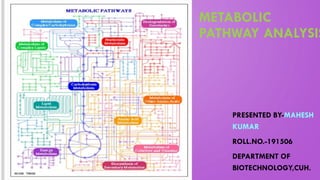
METABOLIC
PATHWAY ANALYSIS
PRESENTED BY-MAHESH
KUMAR
ROLL.NO.-191506
DEPARTMENT OF
BIOTECHNOLOGY,CUH.
• Reference-http://youtu.be/59XqehDSHfo
INTRODUCTION
•Metabolic pathway-These are the series of consecutive
enzymatic reactions that produce specific products.
•Example-
•Glycolysis.
•Citric acid cycle.
•Oxydative phosphorylation.
CHARACTERISTICS
•1.Metabolic pathways are irreversible.
•2.Catabolic and Anabolic reactions must different.
•3.Every Metabolic pathway has initially a rate limiting
step,also known as committed step.
•4.All metabolic pathways are recorded.
•5. Compartmentation allows different cycle’s to operate
in Eukaryotic organisms.
WHAT WE SHOULD FOCUS ON METABOLIC
PATHWAYS?
• 1.Starting substrate.
• 2.End products.
• 3.Rate limiting enzyme.
• 4.Inhibitor and activator.
• 5.currency.
• 6.location.
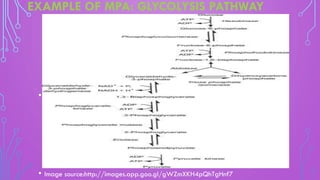
EXAMPLE OF MPA: GLYCOLYSIS PATHWAY
•
• Image source:http://images.app.goo.gl/gWZmXKH4pQhTgHnf7
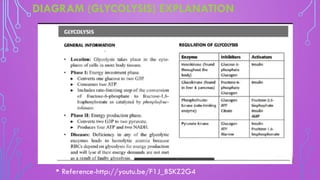
DIAGRAM (GLYCOLYSIS) EXPLANATION
• Reference-http://youtu.be/F1J_BSKZ2G4
METABOLIC PATHWAYS ANALYSIS
METHOD
•1.The isotope labeling.
•2.GSMM.
•3.Structural and stoichiometry modeling.
•4.Structural kinetic modeling (SKM).
•5.SNA.
•6.Continious discrete approach.
CONTINUOUS...
• 1.Isotope labeling: The use of stable isotopes is found to be a powerful method
for flux determination in complex biological systems.
• Metabolic conversion of isotopically labelled substrate generates molecules with
distinct labelling patterns called isotope isomers.They can be detected by mass
spectroscopy.
• 2.GSSM(Genome scale Metabolic monitoring)-This is used as a platform for the
analysis of high throughput transcriptomic, proteomics and metabolic data to
provide inside metabolism activity of an organism.
• This is also used to develop computation method.
CONTINUOUS..
• 3.Structural and computational modeling-The stoichiometric information of the metabolic
pathways, can be represented by a Matrix where underlying biological objects.
• Example-Bipartile and HyperGraphs-used for analyzing topological problem,
pathfinding, synthesis and prediction can be covered by these graph’s.
• 4.Hybrid modeling-
• SKM(structural kinetic modeling)-used for stoichiometric analysis.
• To understand about the dynamic aspects of system.
• Here ,we can make Jacobian matrix and will put all data in it and then do analysis.
CONTINUOUS..
• 5.SNA(stoichiometric network analysis)-used for understanding the function capibilities of Pathway.
• 6.kinetic modeling (paradigm)-
• Continuous approach-used for understanding the Pathway quantitatively.
• It uses equations to understand about the concentration of molecular species evolve over time.
• Disadvange-complex numerical computation.
• Method of continuous approach-
• ODE(ordinary differential equation)- this uses differential equation.
• EXAMPLE- To study about diauxic growth of ecoli.in glucose and lactose using a lac operon model.
CONTINUOUS...
• 7.Constraint based approach-This describes a metabolic pathways system by a set of constraint which characterize it’s
possible behaviour when the biological information is incomplete.
• Method-
• 1.MOMA(Minimization of metabolic adjustment)-used for flux analysis.
• This is a software tools.
• Useful in gene knock out studies.
• 2.EPA(Elementary Pathway analysis)-Extreme Pathway can be characterized by their length and reaction participation.
• Length-no.of reactions it comprises.
• Pathway reaction participation-is the % of extreme Pathway called exPa.
• It utilizes a given reaction.
• Use- used in RBC analysis.
• 3.3.Room(regulatory on/off Minimization)- useful for predicting steady state metabolic fluxes.it aims at minimizing the
no.of significant changes (on/off)with respect to the wild type.
• Used in gene knock out study.
APPLICATION
1.Find pathways of maximum yield.
2.Finding non redundant pathways that are important in drug design.
3.Testing, whether a set of enzymes can produce a desired product.
4.Deciding over the reactions to be active in the pathway.
5.To understand about cellular metabolism (EFM).
6.Used for stoichiometric information analysis.(structural and computational modeling).
7..Flux determination in metabolic pathways (isotope labeling).
8.To understand about the concentration of molecular species (ode based method).
9.To understand about the functional capabilities of pathways (SNA).
10.Used for understanding pathways quantitatively.(continuous approach).
• REFERENCE
• sciencedirect.com
• www.researchget.com
• Solution-Farmacy(You tube)
• Unacademy live –CSIR NET (By –Saranya V)
• www.frontiersin.org
Metabolic pathways analysis.

Metabolic pathways analysis.

  • 1.
  • 2.
  • 3.
    INTRODUCTION •Metabolic pathway-These arethe series of consecutive enzymatic reactions that produce specific products. •Example- •Glycolysis. •Citric acid cycle. •Oxydative phosphorylation.
  • 4.
    CHARACTERISTICS •1.Metabolic pathways areirreversible. •2.Catabolic and Anabolic reactions must different. •3.Every Metabolic pathway has initially a rate limiting step,also known as committed step. •4.All metabolic pathways are recorded. •5. Compartmentation allows different cycle’s to operate in Eukaryotic organisms.
  • 5.
    WHAT WE SHOULDFOCUS ON METABOLIC PATHWAYS? • 1.Starting substrate. • 2.End products. • 3.Rate limiting enzyme. • 4.Inhibitor and activator. • 5.currency. • 6.location.
  • 6.
    EXAMPLE OF MPA:GLYCOLYSIS PATHWAY • • Image source:http://images.app.goo.gl/gWZmXKH4pQhTgHnf7
  • 7.
    DIAGRAM (GLYCOLYSIS) EXPLANATION •Reference-http://youtu.be/F1J_BSKZ2G4
  • 8.
    METABOLIC PATHWAYS ANALYSIS METHOD •1.Theisotope labeling. •2.GSMM. •3.Structural and stoichiometry modeling. •4.Structural kinetic modeling (SKM). •5.SNA. •6.Continious discrete approach.
  • 9.
    CONTINUOUS... • 1.Isotope labeling:The use of stable isotopes is found to be a powerful method for flux determination in complex biological systems. • Metabolic conversion of isotopically labelled substrate generates molecules with distinct labelling patterns called isotope isomers.They can be detected by mass spectroscopy. • 2.GSSM(Genome scale Metabolic monitoring)-This is used as a platform for the analysis of high throughput transcriptomic, proteomics and metabolic data to provide inside metabolism activity of an organism. • This is also used to develop computation method.
  • 10.
    CONTINUOUS.. • 3.Structural andcomputational modeling-The stoichiometric information of the metabolic pathways, can be represented by a Matrix where underlying biological objects. • Example-Bipartile and HyperGraphs-used for analyzing topological problem, pathfinding, synthesis and prediction can be covered by these graph’s. • 4.Hybrid modeling- • SKM(structural kinetic modeling)-used for stoichiometric analysis. • To understand about the dynamic aspects of system. • Here ,we can make Jacobian matrix and will put all data in it and then do analysis.
  • 11.
    CONTINUOUS.. • 5.SNA(stoichiometric networkanalysis)-used for understanding the function capibilities of Pathway. • 6.kinetic modeling (paradigm)- • Continuous approach-used for understanding the Pathway quantitatively. • It uses equations to understand about the concentration of molecular species evolve over time. • Disadvange-complex numerical computation. • Method of continuous approach- • ODE(ordinary differential equation)- this uses differential equation. • EXAMPLE- To study about diauxic growth of ecoli.in glucose and lactose using a lac operon model.
  • 12.
    CONTINUOUS... • 7.Constraint basedapproach-This describes a metabolic pathways system by a set of constraint which characterize it’s possible behaviour when the biological information is incomplete. • Method- • 1.MOMA(Minimization of metabolic adjustment)-used for flux analysis. • This is a software tools. • Useful in gene knock out studies. • 2.EPA(Elementary Pathway analysis)-Extreme Pathway can be characterized by their length and reaction participation. • Length-no.of reactions it comprises. • Pathway reaction participation-is the % of extreme Pathway called exPa. • It utilizes a given reaction. • Use- used in RBC analysis. • 3.3.Room(regulatory on/off Minimization)- useful for predicting steady state metabolic fluxes.it aims at minimizing the no.of significant changes (on/off)with respect to the wild type. • Used in gene knock out study.
  • 13.
    APPLICATION 1.Find pathways ofmaximum yield. 2.Finding non redundant pathways that are important in drug design. 3.Testing, whether a set of enzymes can produce a desired product. 4.Deciding over the reactions to be active in the pathway. 5.To understand about cellular metabolism (EFM). 6.Used for stoichiometric information analysis.(structural and computational modeling). 7..Flux determination in metabolic pathways (isotope labeling). 8.To understand about the concentration of molecular species (ode based method). 9.To understand about the functional capabilities of pathways (SNA). 10.Used for understanding pathways quantitatively.(continuous approach).
  • 14.
    • REFERENCE • sciencedirect.com •www.researchget.com • Solution-Farmacy(You tube) • Unacademy live –CSIR NET (By –Saranya V) • www.frontiersin.org