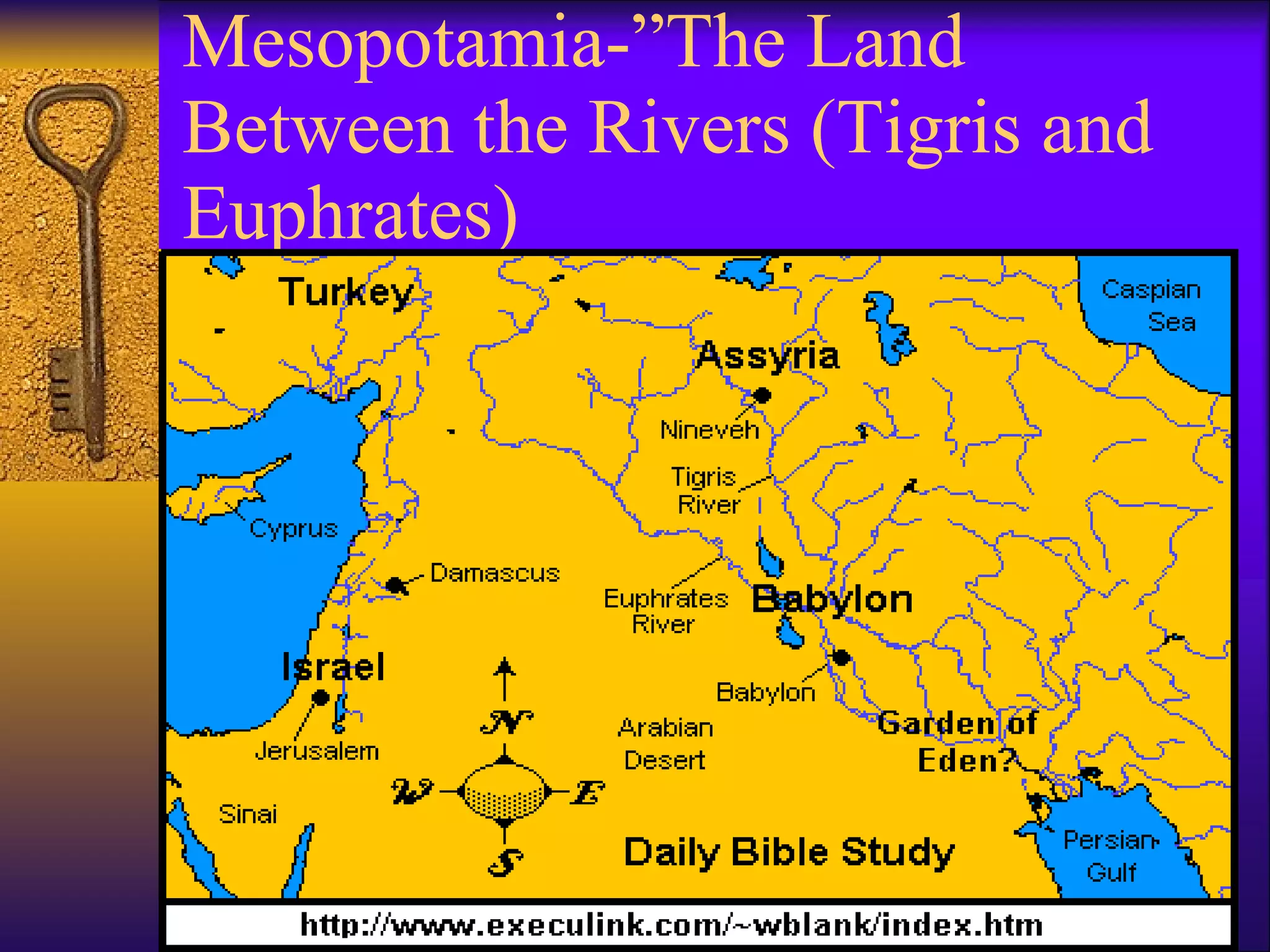
Mesopotamia-”The Land Between the Rivers (Tigris and Euphrates)
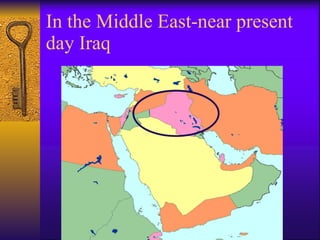
In the Middle East-near present day Iraq
Its settlers were herders from the grasslands of the Arabian Peninsula and the highlands of Turkey.
1 st  known to control their environment(irrigation)-put holes in levees to get water to crops…Canals were dug to get greater amounts farther distances
Crops #1- Barley Also, vegetables, fruits, flax, sesame, dates
City Life Ur- City State built by Sumerians from Sumer
Walls made of mud and crushed reeds for protection from enemies
Center of city life was the temple With many people, they had to make laws
Mesopotamia Unit Terms Civilization-society w/ a developed knowledge of farming, trade, government, art, and science
Mesopotamia Unit Terms Culture- way of life
Mesopotamia Unit Terms Artisans-skilled workers
Mesopotamia Unit Terms Empire-lands ruled by an emperor
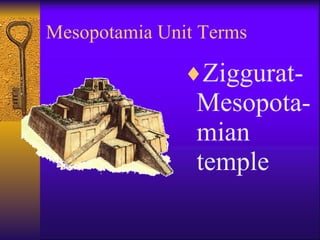
Mesopotamia Unit Terms Ziggurat-Mesopota-mian temple
Mesopotamia Unit Terms City-state- a city that is also an independent nation
Mesopotamia Unit Terms Irrigate-to supply dry land w/water
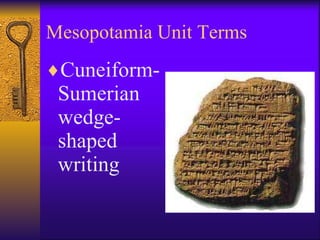
Mesopotamia Unit Terms Cuneiform-Sumerian wedge-shaped writing
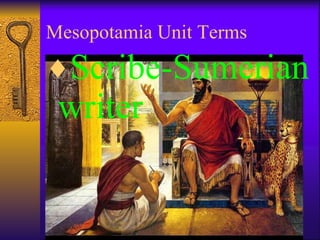
Mesopotamia Unit Terms Scribe-Sumerian writer
Sumerian Cities They were city-states Made up of cities w/farmland around it
Sumerian Cities Religion was the center of Sumerian life.They believed in 3000 gods. Most of these were involving nature.
Sumerian Learning Only rich boys went to school. Writing (cuneiform) was done w/reeds on clay tablets
Men and Women Women could buy and sell property and slaves
Men and Women Men were heads of the house. They could divorce for no reason or even sell their wives and children for up to 3 years. Men arranged marriages for children.
Children Their job was to OBEY both parents and older siblings, as well as the priest.
Priests/Kings Priests were usually kings of city-states
Priests/Kings About 3000 B.C. military leaders began being kings instead.
Priests/Kings After that, kingship was hereditary.
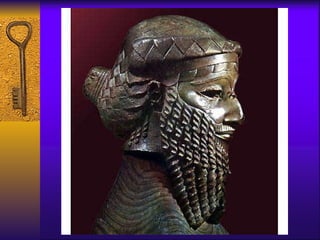
2400 B.C.-Sumer’s glory fades Sargon I created the world’s first empire by defeating Sumerian city-states.
 
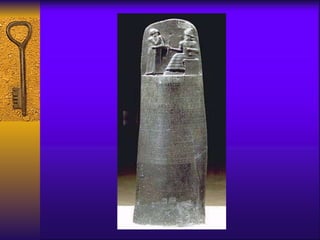
2400 B.C.-Sumer’s glory fades After Sargon I died, Hammurabi, King of Babylon and the Amorite people conquered the area all the way to the Mediterranean Sea.
Hammurabi’s Reforms Improved irrigation Babylonian gods Tax system Gov’t housing CODE OF LAWS
 
Hammurabi’s Code Innocent until proven guilty
Hammurabi’s Code Punishments- fines to death; no prisons
Hammurabi’s Code Upper class more severely punished
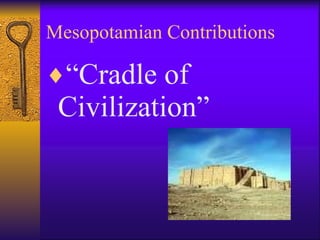
Mesopotamian Contributions “ Cradle of Civilization”
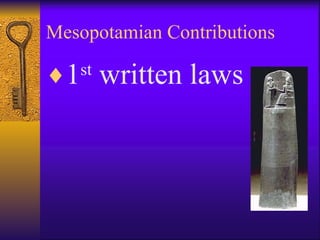
Mesopotamian Contributions 1 st  written laws
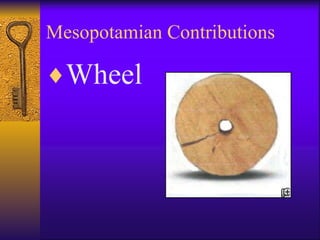
Mesopotamian Contributions Wheel
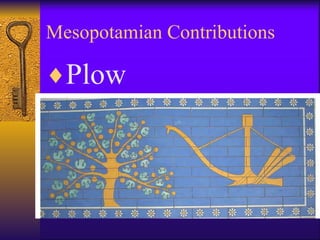
Mesopotamian Contributions Plow
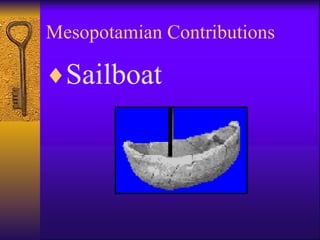
Mesopotamian Contributions Sailboat
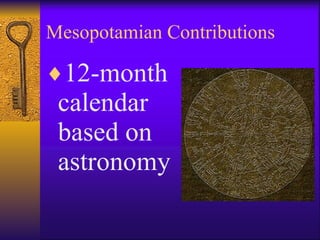
Mesopotamian Contributions 12-month calendar based on astronomy
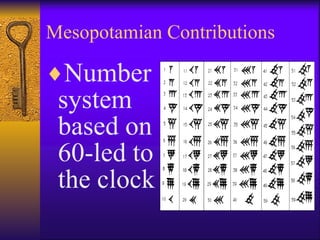
Mesopotamian Contributions Number system based on 60-led to the clock

Mesopotamia unit terms