Mergers & Acquisitions

                    ITM – SMBA Batch 1


                         Presenters:
1.) Omkar Khalap   2.) Ganesh Murthy     3.) Ashish Dhargalkar
Agenda

   Overview                                         1
   Objectives                                       2
   Background                                       3
   Generic Process of M&A                           4
   Generic Process of M&A                           5
   M&A Regulatory Environment – Indian Market       6


Institute of Technology & Management            2
Overview

    A merger is a combination of two or more businesses into one business.
    It is a merger of one or more companies with another or the merger of two or more companies to form a new company, in such
     a way that all assets and liabilities of the amalgamating companies become assets and liabilities of the amalgamated company
     and shareholders not less than nine-tenths in value of the shares in the amalgamating company or companies become
     shareholders of the amalgamated company.
    An acquisition may be defined as an act of acquiring effective control by one company over assets or management of another
     company without any combination of companies. Thus, in an acquisition two or more companies may remain
     independent, separate legal entities, but there may be a change in control of the companies.
    When an acquisition is 'forced' or 'unwilling', it is called a takeover.


   Classification of M&A

                                                               M&A


                                                           Conglomerate
      Horizontal Merger                Vertical Merger                               Acquisitions                Takeovers
                                                              Merger


Institute of Technology & Management                             3
Objectives
                               Largely refers to ideology that                A profitable company can buy a loss
      Economy of               combined companies can reduce their            maker to use the target's loss as their
                                                                                                                          Taxation
         scale                 operating costs and operate at better          advantage by reducing their tax
                               profit margins.                                liability..

                               Refers to efficiencies associated with         Resources can create value through
      Economy of               demand-side changes, e.g. increasing           either overcoming information              Resource
        scope                  or decreasing the scope of marketing           asymmetry or by combining scarce            transfer
                               and distribution for different products.       resources.

                               This assumes that the buyer will be
    Increased reve                                                            Double marginalization occurs when
                               absorbing a major competitor and thus                                                       Vertical
     nue or market                                                            both the upstream and downstream
                               increase its market power (by capturing
                                                                              firms have monopoly power.
                                                                                                                         integration
         share                 increased market share) to set prices.

                                                                              Some companies use acquisitions as
                               A manufacturer can acquire and sell
                                                                              an alternative to the normal hiring
     Cross-selling             complementary products to increase                                                          Hiring
                                                                              process. This is largely in start-up
                               sales volume.
                                                                              phase.


                               Gain better bargain power in buying                                                      Absorption of
                                                                              This could be for eliminating market
        Synergy                products from suppliers and selling                                                         similar
                                                                              competition and gain price leadership.
                               products to consumer.                                                                     businesses


Institute of Technology & Management                                      4
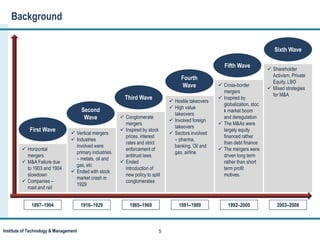
Background

                                                                                                                                 Sixth Wave

                                                                                                         Fifth Wave
                                                                                                                               Shareholder
                                                                                                                                Activism, Private
                                                                                     Fourth
                                                                                                                                Equity, LBO
                                                                                     Wave              Cross-border
                                                                                                                               Mixed strategies
                                                                                                        mergers
                                                                                                                                for M&A
                                                          Third Wave                                   Inspired by
                                                                                 Hostile takeovers
                                                                                                        globalization, stoc
                                                                                 High value
                                       Second                                                           k market boom
                                                                                  takeovers
                                        Wave             Conglomerate
                                                                                 Involved foreign
                                                                                                        and deregulation
                                                          mergers                                      The M&As were
                                                                                  takeovers
             First Wave                                  Inspired by stock                             largely equity
                                  Vertical mergers                              Sectors involved
                                                          prices, interest                              financed rather
                                  Industries                                     – pharma,
                                                          rates and strict                              than debt finance
                                   involved were                                  banking. Oil and
          Horizontal                                     enforcement of                               The mergers were
                                   primary industries                             gas, airline
           mergers                                        antitrust laws                                driven long term
                                   – metals, oil and
          M&A Failure due                               Ended                                         rather than short
                                   gas, etc
           to 1903 and 1904                               introduction of                               term profit
                                  Ended with stock
           slowdown                                       new policy to split                           motives.
                                   market crash in
          Companies –                                    conglomerates
                                   1929
           road and rail


             1897–1904                 1916–1929             1965–1969              1981–1989             1992–2000               2003–2008


Institute of Technology & Management                                        5
Generic Process of M&A                                                                      1   2


                                                                                 Unlocking Value
                                                                    Deliver on
                                                                    Targets
                                                        Execution


                                         Planning for
                                         M&A


                            Pre-Merger
                            Planning


Institute of Technology & Management                          6
Generic Process of M&A                                                                                                                1      2


   Pre-merger Planning             Planning for M&A                     Execution              Deliver on Targets            Unlocking Value

    Undertake Due                Pair IT and business            Common Vision and          Implement the post          Integrate to unlock the
     diligence and                 across merged entity to          Strategy Workshops          ‘Execution phase’ plans      true potential of the
     Assessment of                 form cross functional           Experiential Learning      Enable automatic             assets through the
     integration effort            teams to develop                 Workshops                   consolidation of Book of     synergistic
    Finalize the Insurance        detailed area wise              Creating effective         Business based on            combinations identified
     portfolio for re-             integration plan &               governance groups           Straight-Through-            from the ‘target
     alignment                     prepare for joint IT            New culture supporting       Processing                  assessment’ phase
    based on the list from        governance                       new enterprise strategy    Comprehensively             Unlock value based on
     ‘Target Assessment’          Conduct joint dry runs          Implement the new           implement IT                 optimal levels of
     Phase                         and perfect execution            organization design &       Governance plans             application and
    Identify possible             plans                            IT governance plans                                      infrastructure
     change in company            Enable communication            Implement business                                       rationalization (inline
     rating and anticipate the     to all stakeholders              processes that match                                     with business model)
     rating agency reaction       Provide BAU services             customer, cost, quality                                 Achieve strategic
    Structure the deal to         (Helpdesks, Production           and employee                                             business agility based
     best monetize the             support, System                  satisfaction goals                                       on plug and play IT and
     assets                        availability, Scalability, e                                                              Business com7ponents
    Plan for Day One and          tc)                                                                                      Stress test the strong
     conduct internal dry         Enable fulfillment of                                                                     foundation developed
     runs                          regulatory and legal                                                                      for future M&A and
                                   requirements                                                                              strengthen as
                                  Enable cross-selling                                                                      necessary
                                   and up-selling


Institute of Technology & Management                                          7
M&A Regulatory Environment – Indian Market


                                                                The Companies
                                                                   Act, 1956


                                       Competition                                        The Income Tax
                                        Act, 2002                                            Act, 1961


                                                 FEMA, 1999                      MRTPA, 1967


   The Acts mentioned above are the broad headers. There were several amendments made to this act periodically by the governing bodies.
   Hence, these acts follow a continual process of modifications as per requirement from a larger perspective.


Institute of Technology & Management                                   8
Thank You

Mergers & acquisition

  • 1.
    Mergers & Acquisitions ITM – SMBA Batch 1 Presenters: 1.) Omkar Khalap 2.) Ganesh Murthy 3.) Ashish Dhargalkar
  • 2.
    Agenda Overview 1 Objectives 2 Background 3 Generic Process of M&A 4 Generic Process of M&A 5 M&A Regulatory Environment – Indian Market 6 Institute of Technology & Management 2
  • 3.
    Overview  A merger is a combination of two or more businesses into one business.  It is a merger of one or more companies with another or the merger of two or more companies to form a new company, in such a way that all assets and liabilities of the amalgamating companies become assets and liabilities of the amalgamated company and shareholders not less than nine-tenths in value of the shares in the amalgamating company or companies become shareholders of the amalgamated company.  An acquisition may be defined as an act of acquiring effective control by one company over assets or management of another company without any combination of companies. Thus, in an acquisition two or more companies may remain independent, separate legal entities, but there may be a change in control of the companies.  When an acquisition is 'forced' or 'unwilling', it is called a takeover. Classification of M&A M&A Conglomerate Horizontal Merger Vertical Merger Acquisitions Takeovers Merger Institute of Technology & Management 3
  • 4.
    Objectives Largely refers to ideology that A profitable company can buy a loss Economy of combined companies can reduce their maker to use the target's loss as their Taxation scale operating costs and operate at better advantage by reducing their tax profit margins. liability.. Refers to efficiencies associated with Resources can create value through Economy of demand-side changes, e.g. increasing either overcoming information Resource scope or decreasing the scope of marketing asymmetry or by combining scarce transfer and distribution for different products. resources. This assumes that the buyer will be Increased reve Double marginalization occurs when absorbing a major competitor and thus Vertical nue or market both the upstream and downstream increase its market power (by capturing firms have monopoly power. integration share increased market share) to set prices. Some companies use acquisitions as A manufacturer can acquire and sell an alternative to the normal hiring Cross-selling complementary products to increase Hiring process. This is largely in start-up sales volume. phase. Gain better bargain power in buying Absorption of This could be for eliminating market Synergy products from suppliers and selling similar competition and gain price leadership. products to consumer. businesses Institute of Technology & Management 4
  • 5.
    Background Sixth Wave Fifth Wave  Shareholder Activism, Private Fourth Equity, LBO Wave  Cross-border  Mixed strategies mergers for M&A Third Wave  Inspired by  Hostile takeovers globalization, stoc  High value Second k market boom takeovers Wave  Conglomerate  Involved foreign and deregulation mergers  The M&As were takeovers First Wave  Inspired by stock largely equity  Vertical mergers  Sectors involved prices, interest financed rather  Industries – pharma, rates and strict than debt finance involved were banking. Oil and  Horizontal enforcement of  The mergers were primary industries gas, airline mergers antitrust laws driven long term – metals, oil and  M&A Failure due  Ended rather than short gas, etc to 1903 and 1904 introduction of term profit  Ended with stock slowdown new policy to split motives. market crash in  Companies – conglomerates 1929 road and rail 1897–1904 1916–1929 1965–1969 1981–1989 1992–2000 2003–2008 Institute of Technology & Management 5
  • 6.
    Generic Process ofM&A 1 2 Unlocking Value Deliver on Targets Execution Planning for M&A Pre-Merger Planning Institute of Technology & Management 6
  • 7.
    Generic Process ofM&A 1 2 Pre-merger Planning Planning for M&A Execution Deliver on Targets Unlocking Value  Undertake Due  Pair IT and business  Common Vision and  Implement the post  Integrate to unlock the diligence and across merged entity to Strategy Workshops ‘Execution phase’ plans true potential of the Assessment of form cross functional  Experiential Learning  Enable automatic assets through the integration effort teams to develop Workshops consolidation of Book of synergistic  Finalize the Insurance detailed area wise  Creating effective  Business based on combinations identified portfolio for re- integration plan & governance groups Straight-Through- from the ‘target alignment prepare for joint IT  New culture supporting Processing assessment’ phase  based on the list from governance new enterprise strategy  Comprehensively  Unlock value based on ‘Target Assessment’  Conduct joint dry runs  Implement the new implement IT optimal levels of Phase and perfect execution organization design & Governance plans application and  Identify possible plans IT governance plans infrastructure change in company  Enable communication  Implement business rationalization (inline rating and anticipate the to all stakeholders processes that match with business model) rating agency reaction  Provide BAU services customer, cost, quality  Achieve strategic  Structure the deal to (Helpdesks, Production and employee business agility based best monetize the support, System satisfaction goals on plug and play IT and assets availability, Scalability, e Business com7ponents  Plan for Day One and tc)  Stress test the strong conduct internal dry  Enable fulfillment of foundation developed runs regulatory and legal for future M&A and requirements strengthen as  Enable cross-selling necessary and up-selling Institute of Technology & Management 7
  • 8.
    M&A Regulatory Environment– Indian Market The Companies Act, 1956 Competition The Income Tax Act, 2002 Act, 1961 FEMA, 1999 MRTPA, 1967 The Acts mentioned above are the broad headers. There were several amendments made to this act periodically by the governing bodies. Hence, these acts follow a continual process of modifications as per requirement from a larger perspective. Institute of Technology & Management 8
  • 9.