Business Modeling
The Bridge business innovators
business modeling
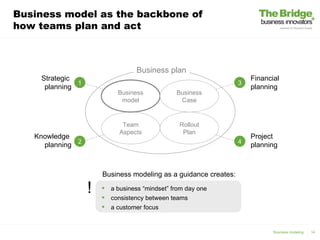
Business model as the backbone of
how teams plan and act


                                  Business plan
    Strategic                                                        Financial
              1                                                  3
     planning                                                        planning
                            Business            Business
                             model               Case


                             Team                Rollout
                            Aspects               Plan
   Knowledge                                                         Project
     planning 2                                                  4
                                                                     planning


                      Business modeling as a guidance creates:

                  !   
                      
                          a business “mindset” from day one
                          consistency between teams
                         a customer focus


                                                                            Business modeling   14
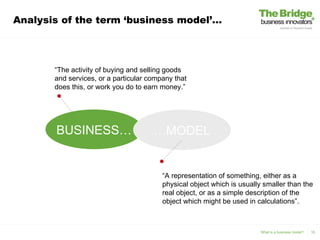
Analysis of the term ‘business model’…


       “The activity of buying and selling goods
       and services, or a particular company that
       does this, or work you do to earn money.”


       BUSINESS…                      …MODEL


                                         “A representation of something, either as a
                                         physical object which is usually smaller than the
                                         real object, or as a simple description of the
                                         object which might be used in calculations”.


                                                                         What is a business model?   15
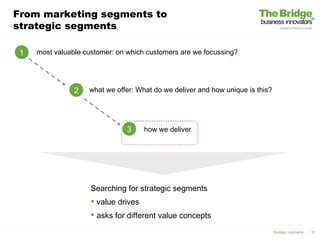
From marketing segments to
strategic segments

 1   most valuable customer: on which customers are we focussing?


                2   what we offer: What do we deliver and how unique is this?


                               3      how we deliver


                     Searching for strategic segments
                      value drives
                      asks for different value concepts
                                                                                Strategic segments   16
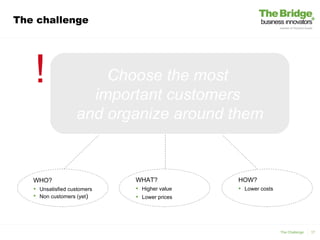
The challenge


   !                   Choose the most
                     important customers
                   and organize around them


   WHO?                      WHAT?            HOW?
    Unsatisfied customers    Higher value    Lower costs
    Non customers (yet)      Lower prices


                                                              The Challenge   17
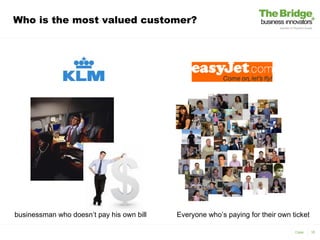
Who is the most valued customer?


businessman who doesn’t pay his own bill   Everyone who’s paying for their own ticket

                                                                                Case    18
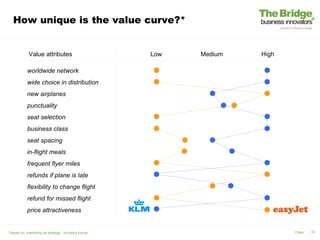
How unique is the value curve?*


            Value attributes                        Low   Medium   High

           worldwide network
           wide choice in distribution
           new airplanes
           punctuality
           seat selection
           business class
           seat spacing
           in-flight meals
           frequent flyer miles
           refunds if plane is late
           flexibility to change flight
           refund for missed flight
           price attractiveness


*based on ‘marketing as strategy’, nirmalya kumar                         Case   19
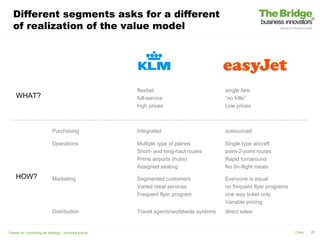
Different segments asks for a different
  of realization of the value model


                                                    flexibel                          single fare
    WHAT?                                           full-service                      “no frills”
                                                    high prices                       Low prices


                           Purchasing               Integrated                        outsourced

                           Operations               Multiple type of planes           Single type aircraft
                                                    Short- and long-haul routes       point-2-point routes
                                                    Prime airports (hubs)             Rapid turnaround
                                                    Assigned seating                  No 0n-flight meals
    HOW?                   Marketing                Segmented customers               Everyone is equal
                                                    Varied meal services              no frequent flyer programs
                                                    Frequent flyer program            one way ticket only
                                                                                      Variable pricing
                           Distribution             Travel agents/worldwide systems   direct sales


*based on ‘marketing as strategy’, nirmalya kumar                                                                  Case   20
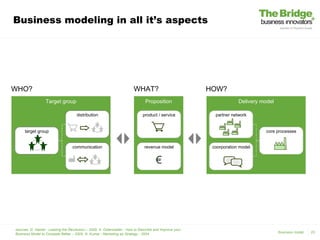
Business modeling in all it’s aspects


WHO?                                                                   WHAT?                           HOW?
                  Target group                                                Proposition                           Delivery model

                                     distribution                            product / service           partner network


     target group                                                                                                              core processes


                                  communication                               revenue model             coorporation model


                                                                                     €


sources: G. Hamel - Leading the Revolution – 2000; A. Osterwalder - How to Describe and Improve your
Business Model to Compete Better – 2005; N. Kumar - Marketing as Strategy - 2004                                                     Business model   23
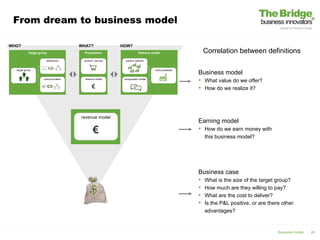
From dream to business model

   WHO?                                     WHAT?                 HOW?
                 Target group                 Proposition                     Delivery model                     Correlation between definitions
                            distribution   WHAT?
                                              product / service                   HOW?
                                                                    partner network


group   target group
                                             Proposition                                            Delivery model
                                                                                          core processes
                                                                                                             Business model
                           communication      revenue model        coorporation model
                                                                                                              What value do we offer?
    distribution                            product / service
                                                 €                                       partner network
                                                                                                              How do we realize it?

                                                                                                                 core processes


   communication                             revenue model                              coorporation model
                                                                                                             Earning model
                                                     €                                                        How do we earn money with
                                                                                                               this business model?


                                                                                                             Business case
                                                                                                                What is the size of the target group?
                                                                                                                How much are they willing to pay?
                                                                                                                What are the cost to deliver?
                                                                                                                Is the P&L positive, or are there other
                                                                                                                 advantages?


                                                                                                                                                 Business model   24
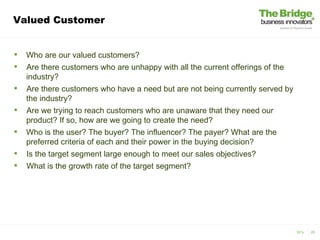
Valued Customer


   Who are our valued customers?
   Are there customers who are unhappy with all the current offerings of the
    industry?
   Are there customers who have a need but are not being currently served by
    the industry?
   Are we trying to reach customers who are unaware that they need our
    product? If so, how are we going to create the need?
   Who is the user? The buyer? The influencer? The payer? What are the
    preferred criteria of each and their power in the buying decision?
   Is the target segment large enough to meet our sales objectives?
   What is the growth rate of the target segment?


                                                                                3V’s   25
Value Proposition


   What are the core needs we are trying to address with our value proposition?
   Does the value proposition fit the needs of our valued customers?
   What benefits are we actually delivering to the customers?
   Is our value proposition differentiated from the competitors or are we
    positioning in a crowded space?
   Are our value proposition claims reinforced by underlying product and service
    features?
   Are we positioning on attributes that we can defend against competitive
    attacks?


                                                                               3 V’s   26
Value Network


   Can we serve the valued customers with the value propositions at a profit?
   Do we have the necessary capabilities to deliver the value proposition? If not,
    could we acquire or partner with them?
   Would serving the valued customers have negative consequences on our
    existing customers of businesses? If so how are we going to control for this?
   Which high-cost or low-value-added activities could be eliminated, reduced, or
    outsourced in our value network?
   Where are the advantages of scale in our value network? Can we maintain
    scale while not losing flexibility?
   How different is our value network from the rest of the industry?
   What is our break-even point? Could we lower it by slightly varying the value
    network?


                                                                                    3V’s   27
Examples of earning models


   time spent & fees
   subscription
   performance based
   spot market
   (share of) value creation
   % of revenues/profits generated
   % of cost cutting
   sales minus purchase
   web & portal related
   hardware & consumable
   software
   add on services


                                      Earning models   28
More information about innovation
          Stationsplein 1
          P.O. Box 907
          3800 AX Amersfoort

Colofon   The Netherlands

               +31 33 467 74 70
               woutervanderburg@thebridge.nl

               www.thebridge.nl


                                               colofon   34

Business modeling

  • 1.
    Business Modeling The Bridgebusiness innovators
  • 2.
  • 3.
    Business model asthe backbone of how teams plan and act Business plan Strategic Financial 1 3 planning planning Business Business model Case Team Rollout Aspects Plan Knowledge Project planning 2 4 planning Business modeling as a guidance creates: !   a business “mindset” from day one consistency between teams  a customer focus Business modeling 14
  • 4.
    Analysis of theterm ‘business model’… “The activity of buying and selling goods and services, or a particular company that does this, or work you do to earn money.” BUSINESS… …MODEL “A representation of something, either as a physical object which is usually smaller than the real object, or as a simple description of the object which might be used in calculations”. What is a business model? 15
  • 5.
    From marketing segmentsto strategic segments 1 most valuable customer: on which customers are we focussing? 2 what we offer: What do we deliver and how unique is this? 3 how we deliver Searching for strategic segments  value drives  asks for different value concepts Strategic segments 16
  • 6.
    The challenge ! Choose the most important customers and organize around them WHO? WHAT? HOW?  Unsatisfied customers  Higher value  Lower costs  Non customers (yet)  Lower prices The Challenge 17
  • 7.
    Who is themost valued customer? businessman who doesn’t pay his own bill Everyone who’s paying for their own ticket Case 18
  • 8.
    How unique isthe value curve?* Value attributes Low Medium High worldwide network wide choice in distribution new airplanes punctuality seat selection business class seat spacing in-flight meals frequent flyer miles refunds if plane is late flexibility to change flight refund for missed flight price attractiveness *based on ‘marketing as strategy’, nirmalya kumar Case 19
  • 9.
    Different segments asksfor a different of realization of the value model flexibel single fare WHAT? full-service “no frills” high prices Low prices Purchasing Integrated outsourced Operations Multiple type of planes Single type aircraft Short- and long-haul routes point-2-point routes Prime airports (hubs) Rapid turnaround Assigned seating No 0n-flight meals HOW? Marketing Segmented customers Everyone is equal Varied meal services no frequent flyer programs Frequent flyer program one way ticket only Variable pricing Distribution Travel agents/worldwide systems direct sales *based on ‘marketing as strategy’, nirmalya kumar Case 20
  • 10.
    Business modeling inall it’s aspects WHO? WHAT? HOW? Target group Proposition Delivery model distribution product / service partner network target group core processes communication revenue model coorporation model € sources: G. Hamel - Leading the Revolution – 2000; A. Osterwalder - How to Describe and Improve your Business Model to Compete Better – 2005; N. Kumar - Marketing as Strategy - 2004 Business model 23
  • 11.
    From dream tobusiness model WHO? WHAT? HOW? Target group Proposition Delivery model Correlation between definitions distribution WHAT? product / service HOW? partner network group target group Proposition Delivery model core processes Business model communication revenue model coorporation model  What value do we offer? distribution product / service € partner network  How do we realize it? core processes communication revenue model coorporation model Earning model €  How do we earn money with this business model? Business case  What is the size of the target group?  How much are they willing to pay?  What are the cost to deliver?  Is the P&L positive, or are there other advantages? Business model 24
  • 12.
    Valued Customer  Who are our valued customers?  Are there customers who are unhappy with all the current offerings of the industry?  Are there customers who have a need but are not being currently served by the industry?  Are we trying to reach customers who are unaware that they need our product? If so, how are we going to create the need?  Who is the user? The buyer? The influencer? The payer? What are the preferred criteria of each and their power in the buying decision?  Is the target segment large enough to meet our sales objectives?  What is the growth rate of the target segment? 3V’s 25
  • 13.
    Value Proposition  What are the core needs we are trying to address with our value proposition?  Does the value proposition fit the needs of our valued customers?  What benefits are we actually delivering to the customers?  Is our value proposition differentiated from the competitors or are we positioning in a crowded space?  Are our value proposition claims reinforced by underlying product and service features?  Are we positioning on attributes that we can defend against competitive attacks? 3 V’s 26
  • 14.
    Value Network  Can we serve the valued customers with the value propositions at a profit?  Do we have the necessary capabilities to deliver the value proposition? If not, could we acquire or partner with them?  Would serving the valued customers have negative consequences on our existing customers of businesses? If so how are we going to control for this?  Which high-cost or low-value-added activities could be eliminated, reduced, or outsourced in our value network?  Where are the advantages of scale in our value network? Can we maintain scale while not losing flexibility?  How different is our value network from the rest of the industry?  What is our break-even point? Could we lower it by slightly varying the value network? 3V’s 27
  • 15.
    Examples of earningmodels  time spent & fees  subscription  performance based  spot market  (share of) value creation  % of revenues/profits generated  % of cost cutting  sales minus purchase  web & portal related  hardware & consumable  software  add on services Earning models 28
  • 16.
    More information aboutinnovation Stationsplein 1 P.O. Box 907 3800 AX Amersfoort Colofon The Netherlands +31 33 467 74 70 woutervanderburg@thebridge.nl www.thebridge.nl colofon 34