PRESENTED BY:-
Jainish Patel (34)
 INTRODUCTION
 HISTORY
 COMING IN INDIA
 VISION AND MISSION STATEMENT
 CUSTOMER GROUP
 CUSTOMER FUNCTION
 ALTERNATIVE TECHNOLOGY
 SWOT ANALYSIS
 MODEL RANGE
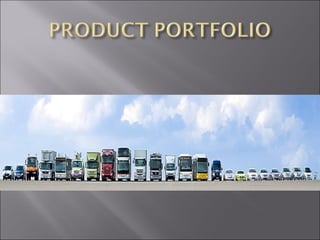
 PRODUCT PORTFOLIO
 COMPETETION
 TECHNOLOGY
 CONCLUSION
 Mercedes-Benz is a multinational division of
the German manufacturer Daimler AG, and the
brand is used for luxury automobiles, buses,
coaches, and trucks. Mercedes-Benz is
headquartered in Stuttgart, Baden-
Württemberg, Germany.
 Mercedes benz traces its origin to
1886 with Karl Benz's creation of
the first petrol-powered car.
 Mercedes Benz was formed in the
year 1926 by merger of Karl
Benz's and Gottlieb Daimler's
companies into the Daimler-Benz
company.
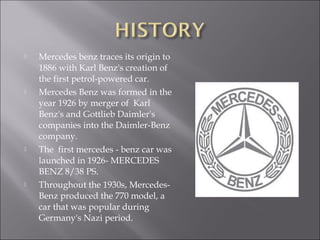
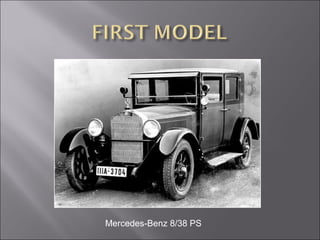
 The first mercedes - benz car was
launched in 1926- MERCEDES
BENZ 8/38 PS.
 Throughout the 1930s, Mercedes-
Benz produced the 770 model, a
car that was popular during
Germany's Nazi period.
Mercedes-Benz 8/38 PS
 Daimler entered the Indian market and set up
Mercedes-Benz India Ltd in 1994. The company was
later renamed DaimlerChrysler India Private Ltd after
the merger of parent company Daimler with Chrysler.
 The passenger cars manufacturing plant is located
in Pune, same as the headquarters and the comercial
vehicle manufacturing plant is located outside chennai.
 Mercedes-Benz India currently has 31 dealerships and
41 service stations across 31 cities in India.
VisionVision
“A pioneering spirit and power
of innovation for sustainable
mobility. As the inventors of the
automobile, we are equally
committed to protection of the
climate and the environment
and to the safety of our vehicles
and accident prevention. Our
customers - and all other road
users - throughout the world can
put their trust in this
commitment.”
Mission
Rejecting compromise
Considering every detail.
Basing their work in
competition
Being environmentally
sustainable
Being a global company.
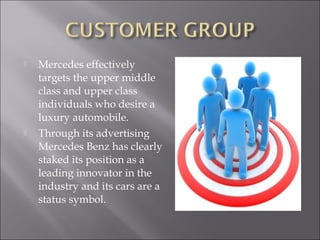
 Mercedes effectively
targets the upper middle
class and upper class
individuals who desire a
luxury automobile.
 Through its advertising
Mercedes Benz has clearly
staked its position as a
leading innovator in the
industry and its cars are a
status symbol.
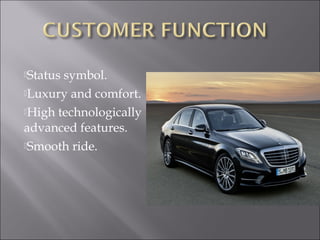
Status symbol.
Luxury and comfort.
High technologically
advanced features.
Smooth ride.
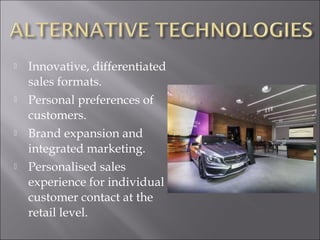
 Innovative, differentiated
sales formats.
 Personal preferences of
customers.
 Brand expansion and
integrated marketing.
 Personalised sales
experience for individual
customer contact at the
retail level.
Strength
High brand equity as one of
the finest and strongest
brands.
Drive-train technologies,
interior features, and safety
systems.
Exceptional service quality,
an industry landmark.
Mercedes Benz is one of the
most popular brand names in
the world.
Weaknesses
Mercedes Benz is an
expensive car, thus has a
limited target group.
High maintenance cost
and less mileage.
Very expensive spare
parts.
Opportunities
Developing hybrid cars
and fuel efficient cars for
the future.
Tapping emerging
market across the world
and building a global
brand.
Fast growing luxury
automobile market and
increased income.
Threats
Intense competition.
Increasing fuel prices.
Improvement in public
transport
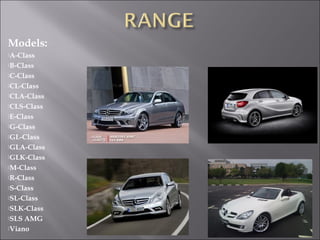
Models:
A-Class
B-Class
C-Class
CL-Class
CLA-Class
CLS-Class
E-Class
G-Class
GL-Class
GLA-Class
GLK-Class
M-Class
R-Class
S-Class
SL-Class
SLK-Class
SLS AMG
Viano
 BMW
 Audi
 Honda
 Skoda
 Volkswagen
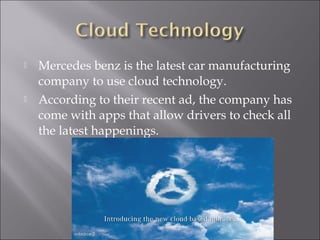
 Mercedes benz is the latest car manufacturing
company to use cloud technology.
 According to their recent ad, the company has
come with apps that allow drivers to check all
the latest happenings.
 Mercedes Benz is the oldest luxury car
manufacturing company in the world.
Although the strong competition has created
some problems for them, they continue to
maintain the strategic advantage over their
rivals.
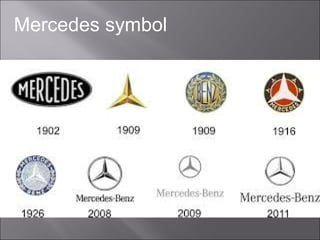
Mercedes symbol
Mercedessmppt 140222062126-phpapp01 (1)

Mercedessmppt 140222062126-phpapp01 (1)

  • 1.
  • 2.
     INTRODUCTION  HISTORY COMING IN INDIA  VISION AND MISSION STATEMENT  CUSTOMER GROUP  CUSTOMER FUNCTION  ALTERNATIVE TECHNOLOGY  SWOT ANALYSIS  MODEL RANGE  PRODUCT PORTFOLIO  COMPETETION  TECHNOLOGY  CONCLUSION
  • 3.
     Mercedes-Benz isa multinational division of the German manufacturer Daimler AG, and the brand is used for luxury automobiles, buses, coaches, and trucks. Mercedes-Benz is headquartered in Stuttgart, Baden- Württemberg, Germany.
  • 4.
     Mercedes benztraces its origin to 1886 with Karl Benz's creation of the first petrol-powered car.  Mercedes Benz was formed in the year 1926 by merger of Karl Benz's and Gottlieb Daimler's companies into the Daimler-Benz company.  The first mercedes - benz car was launched in 1926- MERCEDES BENZ 8/38 PS.  Throughout the 1930s, Mercedes- Benz produced the 770 model, a car that was popular during Germany's Nazi period.
  • 5.
  • 6.
     Daimler enteredthe Indian market and set up Mercedes-Benz India Ltd in 1994. The company was later renamed DaimlerChrysler India Private Ltd after the merger of parent company Daimler with Chrysler.  The passenger cars manufacturing plant is located in Pune, same as the headquarters and the comercial vehicle manufacturing plant is located outside chennai.  Mercedes-Benz India currently has 31 dealerships and 41 service stations across 31 cities in India.
  • 7.
    VisionVision “A pioneering spiritand power of innovation for sustainable mobility. As the inventors of the automobile, we are equally committed to protection of the climate and the environment and to the safety of our vehicles and accident prevention. Our customers - and all other road users - throughout the world can put their trust in this commitment.” Mission Rejecting compromise Considering every detail. Basing their work in competition Being environmentally sustainable Being a global company.
  • 8.
     Mercedes effectively targetsthe upper middle class and upper class individuals who desire a luxury automobile.  Through its advertising Mercedes Benz has clearly staked its position as a leading innovator in the industry and its cars are a status symbol.
  • 9.
    Status symbol. Luxury andcomfort. High technologically advanced features. Smooth ride.
  • 10.
     Innovative, differentiated salesformats.  Personal preferences of customers.  Brand expansion and integrated marketing.  Personalised sales experience for individual customer contact at the retail level.
  • 11.
    Strength High brand equityas one of the finest and strongest brands. Drive-train technologies, interior features, and safety systems. Exceptional service quality, an industry landmark. Mercedes Benz is one of the most popular brand names in the world. Weaknesses Mercedes Benz is an expensive car, thus has a limited target group. High maintenance cost and less mileage. Very expensive spare parts.
  • 12.
    Opportunities Developing hybrid cars andfuel efficient cars for the future. Tapping emerging market across the world and building a global brand. Fast growing luxury automobile market and increased income. Threats Intense competition. Increasing fuel prices. Improvement in public transport
  • 13.
  • 15.
     BMW  Audi Honda  Skoda  Volkswagen
  • 16.
     Mercedes benzis the latest car manufacturing company to use cloud technology.  According to their recent ad, the company has come with apps that allow drivers to check all the latest happenings.
  • 17.
     Mercedes Benzis the oldest luxury car manufacturing company in the world. Although the strong competition has created some problems for them, they continue to maintain the strategic advantage over their rivals.
  • 18.