PRESENTED BY
JOY SAHA -26
KANCHAN -27
ISHITA -28
MEGHA GARG-29
COMPANY
INFORMATION
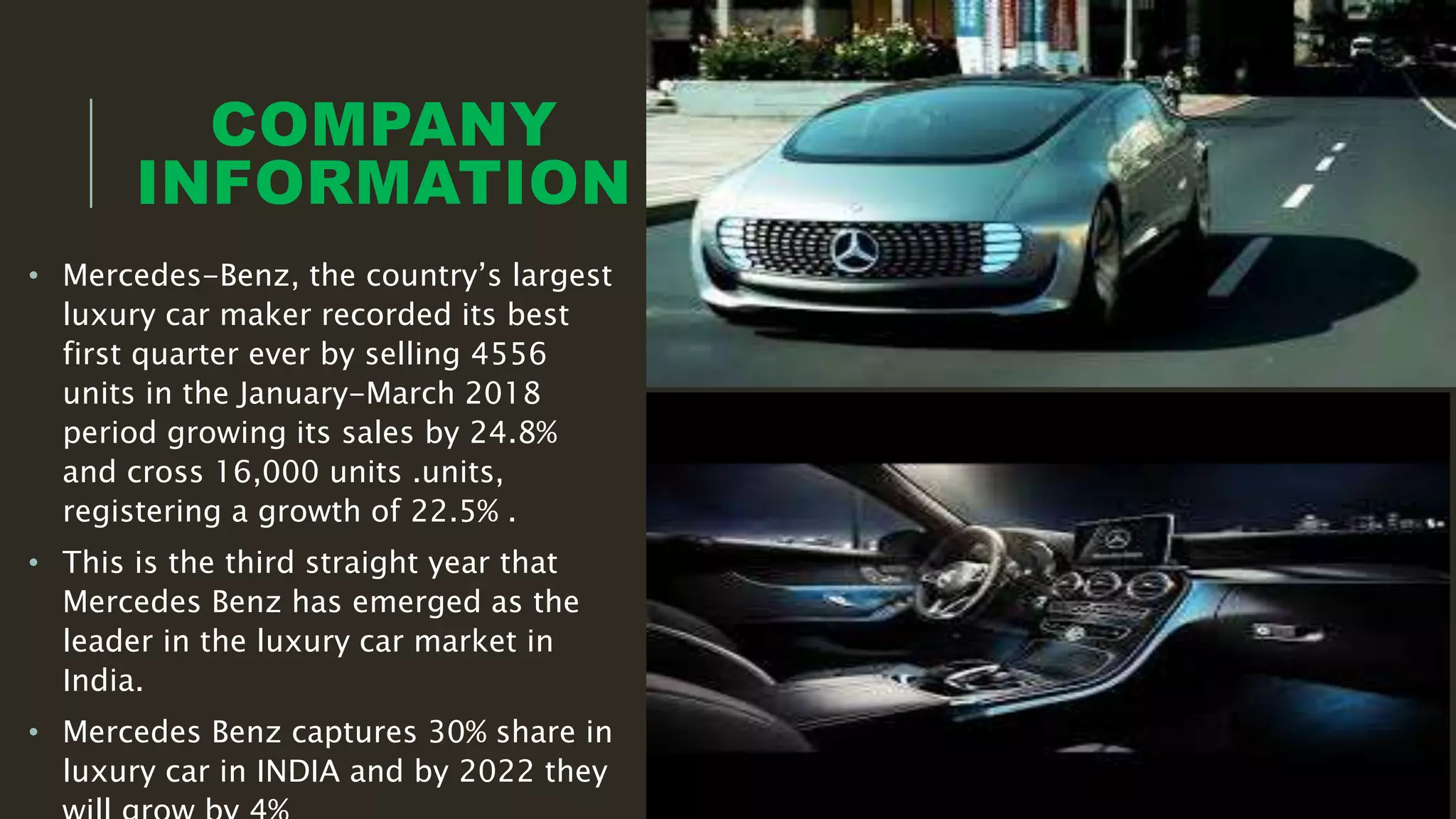
• Mercedes-Benz, the country’s largest
luxury car maker recorded its best
first quarter ever by selling 4556
units in the January-March 2018
period growing its sales by 24.8%
and cross 16,000 units .units,
registering a growth of 22.5% .
• This is the third straight year that
Mercedes Benz has emerged as the
leader in the luxury car market in
India.
• Mercedes Benz captures 30% share in
luxury car in INDIA and by 2022 they
INDUSTRY
INFORMATION
• The automotive manufacturing
industry comprises the
production of commercial
vehicles, passenger cars, three
& two-wheelers.
• World leader in 4 wheeler by
2020
• Automotive Mission Plan, the
govt and industry set a target
to triple industry revenues to
US $300 billion.
• Automobile exports from India
DEMOGRAPHIC FACTOR
 status and fashion is emerging trend among the young generation who
demands a luxury after a good job.
The rising income of the broader middle class family in India is
increasing
More bent towards the western education is creating the want of
fashionable and luxury cars in India, greatly influenced by Hollywood
movies and serials
More participation of women in the Indian economy is helping this
segment of the market to grow, as it has increased by 20% in Indian work
force by 2018
More startups and multinational company lead to more job and income
which increase the potential for this sector
Acceptance of luxury cars in rural areas like some places in Punjab and
other area also improve the market
ECONOMICAL FACTOR
Economic growth of India is 7%
Per capita Income is 1977.29 USD (March 2018)
Unemployment rate is climbed to 7% at 31 million
GDP is 2.484 trillion USD dollar
India is sixth largest economy in the world
Third largest by purchasing power parity
More multinational companies opening in India and startups
Ease of financial systems in India for luxury cars in India
Thus Indian market looks promising for luxury cars as market is
growing and developing
MACRO ENVIRONMENT:
POLITICAL FACTOR
Taxation system would be one major political factor that
affects imported car industry.
The import duty for cars will be charged from 140% to 300%
based on the engine's category and tax is calculated based on
car's cost, insurance and freight [Royal Malaysian Customs &
Excise Dept, 2000].
 government policies would be another key factor, foreign
firms can manufacture luxury cars locally on 31 December
2015 . The opportunity occurs when foreign firm can reduce
their manufacturing cost and time .
price changes in crude oil directly affect its price.
SOCIAL FACTOR
Social income can reflect different social categories. People from high income
category usually buy luxury car as the sign of prestige. This would be an
opportunity for luxury car’s manufacturers to sell their product to the high
income category.
Highest motor vehicles owning rate in the world with 641q motor vehicles per
1000 people due to the statistic research . This is opportunity for car
manufacturers to sell their product in such a high demand.
. Population growth rate of India has increasing compare to previous year. It
increases from 1.5 billion to 6 billion over the years . It would be an
opportunity as it affects the car demand in the country due to the
increasing growth rate of population.
MICRO FACTOR: SUPPLIER
Daimler and Mercedes-Benz have a network of over 100
suppliers
Some of their principal suppliers include Thyssenkrupp, Eagle
Ottawa, Inteva Products, Carcoustics, Nemak, Johnson Electric
and ZF Lenksysteme.
Like other auto manufacturers, Daimler has focused most of
its efforts at sales in emerging market economies, particularly
the BRIC countries (Brazil, Russia, India and China).
Daimler has had significant success in establishing its
Daimler Trucks division, the largest manufacturer of trucks
over 6 metric tons gross weight in India, Turkey and Indonesia
BUYER
Rewarding: status symbol “35 yrs.”
Functional: purchased based on logic than emotion
Indulgence : enjoy the money they have earned. This people
is generally of Delhi, Mumbai people
Even as urban clusters drive industry growth, consumers
and purchasing power are increasingly emerging from
beyond the metros, particularly in tier-II and III cities.
Mercedes-Benz is eyeing buyers outside of the top eight
cities. Currently, 45 per cent of the sales for the luxury
carmaker come from markets outside Delhi and Mumbai.
COMPETITORS
MAIN COMPETEITORS
BMW,AUDI,JAQUAR,VOLKSWAGEN,VOLVO,
AUDI- 7,720 units ,20%
BMW- 9,800 units,25%
Jaguar- 3,954 units,10%
Volvo-2029 units,5%
Whereas MERCEDES BENZ has 30% share
OPPORTUNITIES FOR MERCEDES
BENZ
1.Mercedes can focus on developing hybrid cars and fuel efficient cars for
the future
2. Tapping emerging markets across the world and building a global brand
3. Fast growing luxury automobile market & increased income can be an
opportunity for Mercedes Benz
4. The brand's strong presence can be leveraged to acquire more
customers
THREATS IN NEXT YEARS FOR
MECEDES
1 Government policies for the automobile sector across the world can cause
business losses for Mercedes
2. Ever increasing fuel prices
3. Intense competition from global automobile brands
THANK YOU

Mercedez benz marketing

  • 1.
    PRESENTED BY JOY SAHA-26 KANCHAN -27 ISHITA -28 MEGHA GARG-29
  • 2.
    COMPANY INFORMATION • Mercedes-Benz, thecountry’s largest luxury car maker recorded its best first quarter ever by selling 4556 units in the January-March 2018 period growing its sales by 24.8% and cross 16,000 units .units, registering a growth of 22.5% . • This is the third straight year that Mercedes Benz has emerged as the leader in the luxury car market in India. • Mercedes Benz captures 30% share in luxury car in INDIA and by 2022 they
  • 3.
    INDUSTRY INFORMATION • The automotivemanufacturing industry comprises the production of commercial vehicles, passenger cars, three & two-wheelers. • World leader in 4 wheeler by 2020 • Automotive Mission Plan, the govt and industry set a target to triple industry revenues to US $300 billion. • Automobile exports from India
  • 4.
    DEMOGRAPHIC FACTOR  statusand fashion is emerging trend among the young generation who demands a luxury after a good job. The rising income of the broader middle class family in India is increasing More bent towards the western education is creating the want of fashionable and luxury cars in India, greatly influenced by Hollywood movies and serials More participation of women in the Indian economy is helping this segment of the market to grow, as it has increased by 20% in Indian work force by 2018 More startups and multinational company lead to more job and income which increase the potential for this sector Acceptance of luxury cars in rural areas like some places in Punjab and other area also improve the market
  • 5.
    ECONOMICAL FACTOR Economic growthof India is 7% Per capita Income is 1977.29 USD (March 2018) Unemployment rate is climbed to 7% at 31 million GDP is 2.484 trillion USD dollar India is sixth largest economy in the world Third largest by purchasing power parity More multinational companies opening in India and startups Ease of financial systems in India for luxury cars in India Thus Indian market looks promising for luxury cars as market is growing and developing
  • 6.
    MACRO ENVIRONMENT: POLITICAL FACTOR Taxationsystem would be one major political factor that affects imported car industry. The import duty for cars will be charged from 140% to 300% based on the engine's category and tax is calculated based on car's cost, insurance and freight [Royal Malaysian Customs & Excise Dept, 2000].  government policies would be another key factor, foreign firms can manufacture luxury cars locally on 31 December 2015 . The opportunity occurs when foreign firm can reduce their manufacturing cost and time . price changes in crude oil directly affect its price.
  • 7.
    SOCIAL FACTOR Social incomecan reflect different social categories. People from high income category usually buy luxury car as the sign of prestige. This would be an opportunity for luxury car’s manufacturers to sell their product to the high income category. Highest motor vehicles owning rate in the world with 641q motor vehicles per 1000 people due to the statistic research . This is opportunity for car manufacturers to sell their product in such a high demand. . Population growth rate of India has increasing compare to previous year. It increases from 1.5 billion to 6 billion over the years . It would be an opportunity as it affects the car demand in the country due to the increasing growth rate of population.
  • 8.
    MICRO FACTOR: SUPPLIER Daimlerand Mercedes-Benz have a network of over 100 suppliers Some of their principal suppliers include Thyssenkrupp, Eagle Ottawa, Inteva Products, Carcoustics, Nemak, Johnson Electric and ZF Lenksysteme. Like other auto manufacturers, Daimler has focused most of its efforts at sales in emerging market economies, particularly the BRIC countries (Brazil, Russia, India and China). Daimler has had significant success in establishing its Daimler Trucks division, the largest manufacturer of trucks over 6 metric tons gross weight in India, Turkey and Indonesia
  • 9.
    BUYER Rewarding: status symbol“35 yrs.” Functional: purchased based on logic than emotion Indulgence : enjoy the money they have earned. This people is generally of Delhi, Mumbai people Even as urban clusters drive industry growth, consumers and purchasing power are increasingly emerging from beyond the metros, particularly in tier-II and III cities. Mercedes-Benz is eyeing buyers outside of the top eight cities. Currently, 45 per cent of the sales for the luxury carmaker come from markets outside Delhi and Mumbai.
  • 10.
    COMPETITORS MAIN COMPETEITORS BMW,AUDI,JAQUAR,VOLKSWAGEN,VOLVO, AUDI- 7,720units ,20% BMW- 9,800 units,25% Jaguar- 3,954 units,10% Volvo-2029 units,5% Whereas MERCEDES BENZ has 30% share
  • 11.
    OPPORTUNITIES FOR MERCEDES BENZ 1.Mercedescan focus on developing hybrid cars and fuel efficient cars for the future 2. Tapping emerging markets across the world and building a global brand 3. Fast growing luxury automobile market & increased income can be an opportunity for Mercedes Benz 4. The brand's strong presence can be leveraged to acquire more customers
  • 12.
    THREATS IN NEXTYEARS FOR MECEDES 1 Government policies for the automobile sector across the world can cause business losses for Mercedes 2. Ever increasing fuel prices 3. Intense competition from global automobile brands
  • 13.