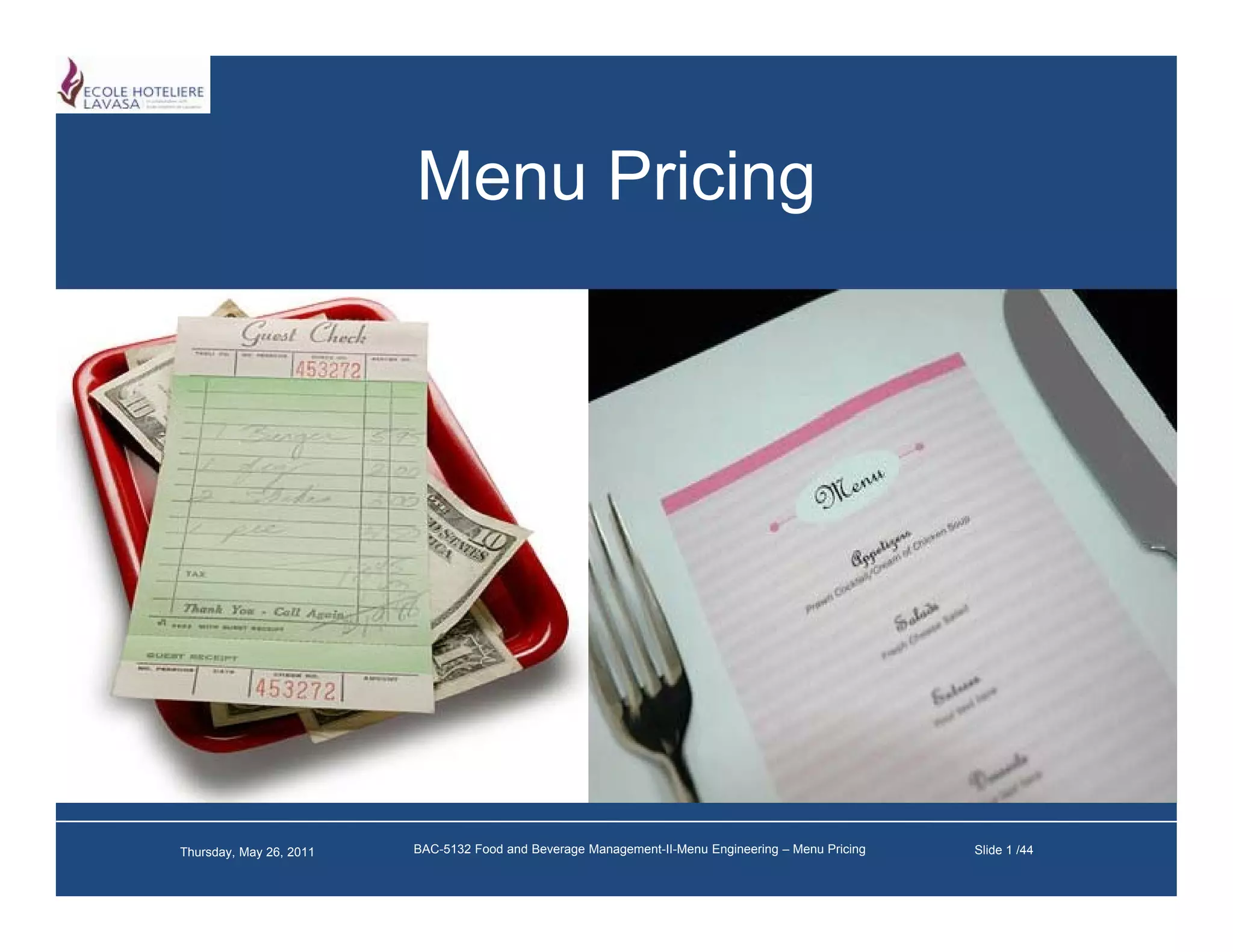
Menu Pricing


Thursday, May 26, 2011   BAC-5132 Food and Beverage Management-II-Menu Engineering – Menu Pricing   Slide 1 /44
Recap of Semester 4 last session
• Enlisting Standardization methods.
• Monitoring food and beverage operations by
  monthly food cost.
          y
• Monitoring food and beverage operations by
  daily food cost.
• Comparing actual costs by standard cost and
  variance analysis.
• Steps taken in beverage sales.
• Establishing sales price of beverages

  Thursday, May 26, 2011   BAC-5132 Food and Beverage Management-II-Menu Engineering – Menu Pricing   Slide 2 /44
KCM of the Session
• Memorize the formulas for various pricing
  methods.
• Differentiate between Subjective and
  objective pricing methods.
• D
  Describe various f t
        ib      i   factors th t i fl
                            that influence
  menu planning strategies.
• Calculate base selling prices for various
  pricing methods.
  Thursday, May 26, 2011   BAC-5132 Food and Beverage Management-II-Menu Engineering – Menu Pricing   Slide 3 /44
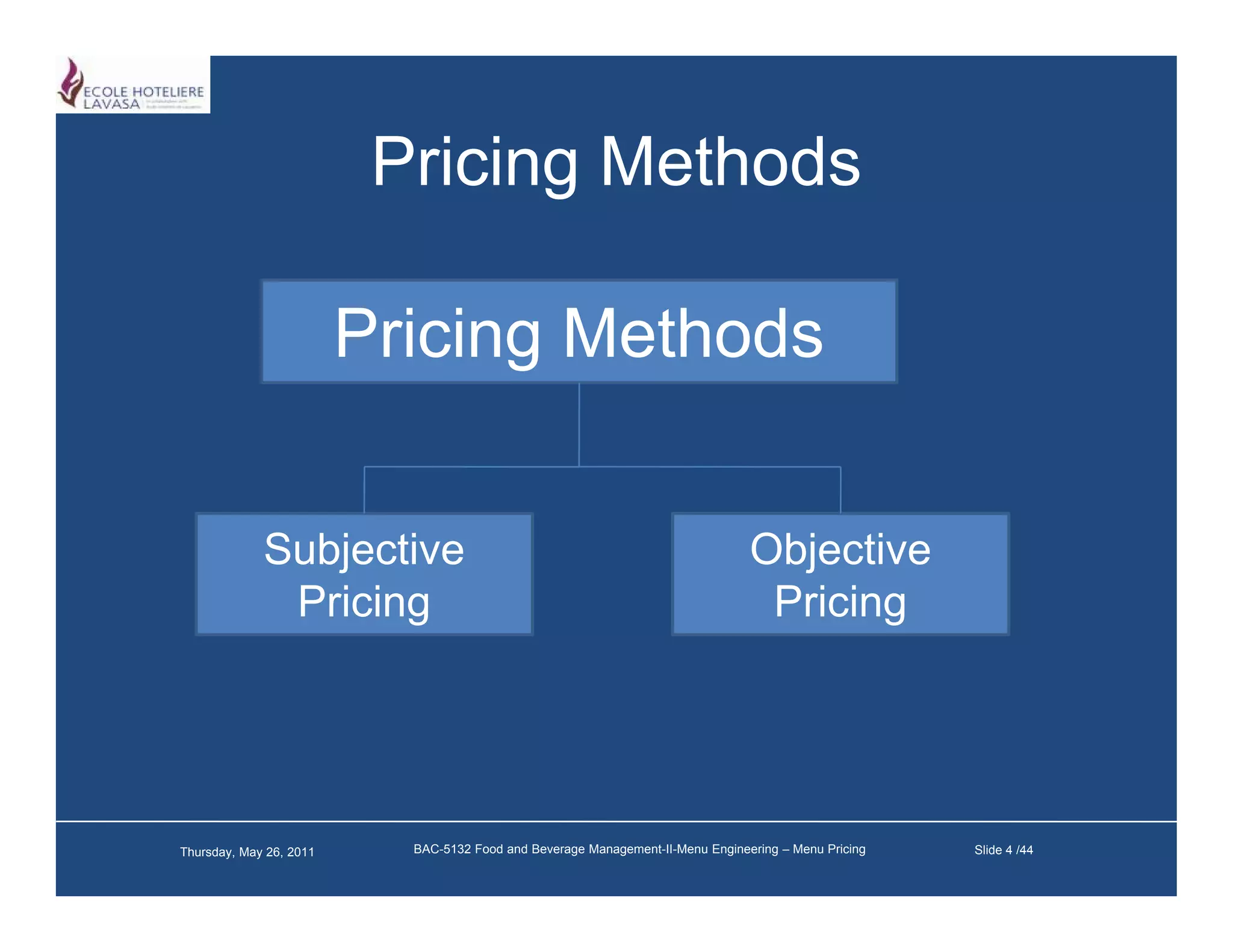
Pricing Methods

                         Pricing Methods


             Subjective
             S bj ti                                                            Objective
                                                                                Obj ti
              Pricing                                                            Pricing


Thursday, May 26, 2011     BAC-5132 Food and Beverage Management-II-Menu Engineering – Menu Pricing   Slide 4 /44
Subjective Pricing methods
• Largely based on assumptions.
• Based on results of other establishments.
• Based on personal experience
                      experience.
• Common in the food service industry.
• Usually done by people who have very little
  knowledge of product cost or profit
  requirements.
• Unfamiliarity with objective methods.
• Ineffective method of handling p
                                g pricing.
                                        g
    Thursday, May 26, 2011   BAC-5132 Food and Beverage Management-II-Menu Engineering – Menu Pricing   Slide 5 /44
Subjective Pricing methods
1.
1 The reasonable price method
                       method.

2. The highest i
2 Th hi h t price method.
                    th d

3. The loss leader price method.

4. The Intuitive price method.

  Thursday, May 26, 2011   BAC-5132 Food and Beverage Management-II-Menu Engineering – Menu Pricing   Slide 6 /44
The reasonable price method
• An estimated value/ Price of the dish set
  by the manager of the establishment
  which he feels is reasonable.
• This price is based on feeling and
  sentiment rather than an analysis of the
                                y
  content.
• However in many cases the p
                   y           price is right
                                          g
  because it has been thought from the
  guests perspective.

  Thursday, May 26, 2011   BAC-5132 Food and Beverage Management-II-Menu Engineering – Menu Pricing   Slide 7 /44
The highest price method
• Usually the manager appoints a panel of
  colleagues.
• Confers with the panel and includes his
  own opinion.
• S t th hi h t price as concluded b all.
  Sets the highest i              l d d by ll
• A margin of error is also set in so all
  contingencies are taken into consideration.


  Thursday, May 26, 2011   BAC-5132 Food and Beverage Management-II-Menu Engineering – Menu Pricing   Slide 8 /44
The Loss Leader method
• The price is based on a sales principle of
  Promotion of (RIS) Rapid increase of sale.
• An unusually low price is set for an item or
  items.
• The manager assumes that the low price
  will attract customers and will also buy
  other items.
• The method is also interpreted as
  schemes.
  Thursday, May 26, 2011   BAC-5132 Food and Beverage Management-II-Menu Engineering – Menu Pricing   Slide 9 /44
The Intuitive price method
                                 method.
• The method is based on guesswork and
  trail and error rather than an calculated
    pp
  approach.
• The method is on the basis of a pricing
  p
  plan and if one does not work the other
  plan is tried.
• The method grossly differs from others
                 g     y
  because it is based on Hunches and
  guess work.

  Thursday, May 26, 2011   BAC-5132 Food and Beverage Management-II-Menu Engineering – Menu Pricing   Slide 10 /44
Objective Pricing Methods
• They are based approved operating budgets
                                       budgets.
• Transferring and interpreting budget plans
  into selling prices
               prices.
• Mainly based on 3 cost procedures
a. C ti updated St d d R i
   Creating d t d Standard Recipes.
b. Pre-costing with current costs.
c. Using standard recipes despite changes in
   staff and curtail deviation.

  Thursday, May 26, 2011   BAC-5132 Food and Beverage Management-II-Menu Engineering – Menu Pricing   Slide 11 /44
Objective Pricing Methods
1.
1 Simple Mark up(Multiplier) pricing methods
           Mark-up(Multiplier)       methods.
a. Ingredient mark-up method.
b.
b Prime ingredient mark up method
                    mark-up method.
c. Mark up with accompaniment cost.
2. Contribution Margin pricing method.
3. Ratio Pricing method.
4. Simple prime cost method.
5. Specific p
    p       prime cost method.
  Thursday, May 26, 2011   BAC-5132 Food and Beverage Management-II-Menu Engineering – Menu Pricing   Slide 12 /44
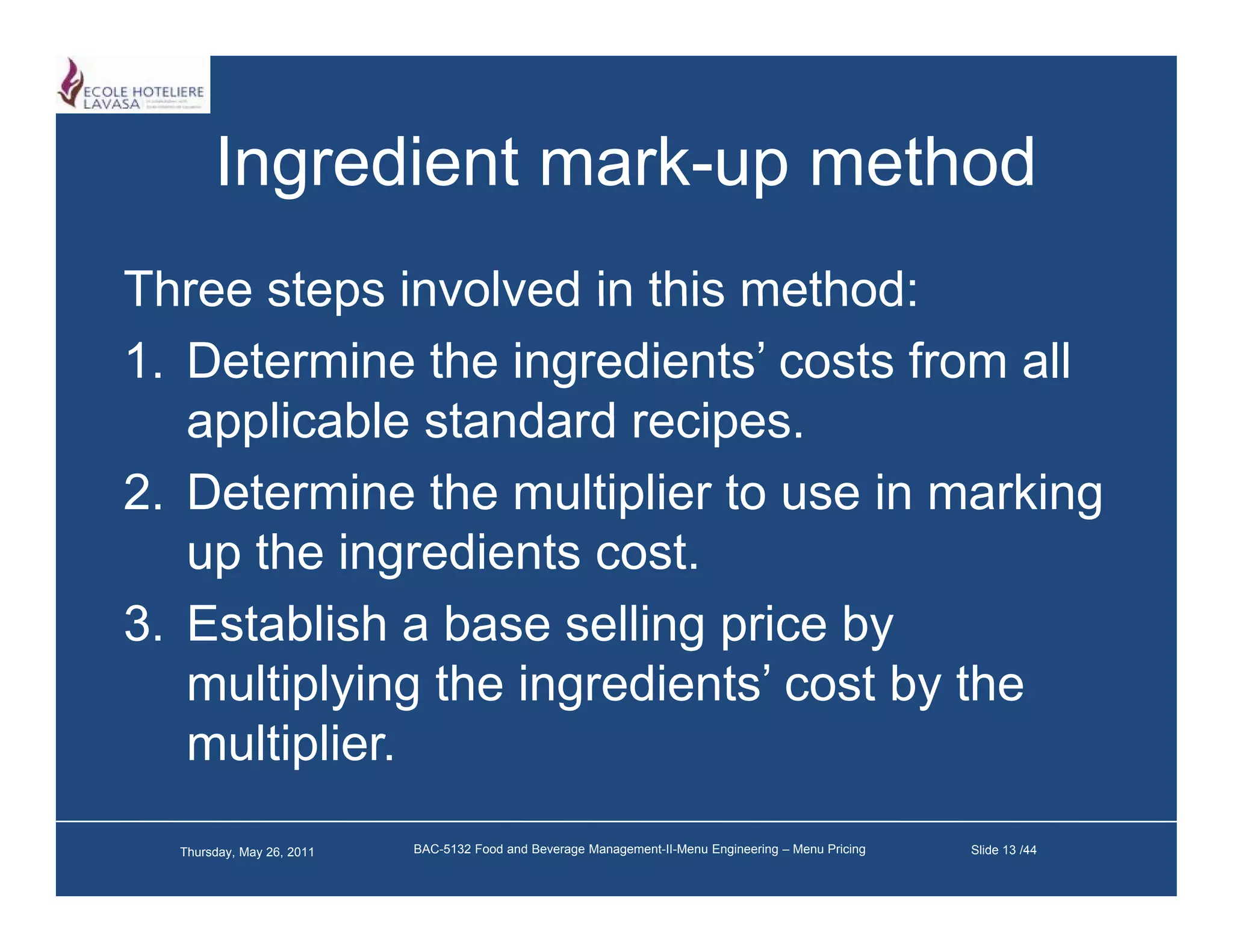
Ingredient mark-up method
                  mark up
Three steps involved in this method:
1. Determine the ingredients’ costs from all
   applicable standard recipes
                        recipes.
2. Determine the multiplier to use in marking
   up th i
      the ingredients cost.
                di t      t
3. Establish a base selling price by
   multiplying the ingredients’ cost by the
   multiplier.
  Thursday, May 26, 2011   BAC-5132 Food and Beverage Management-II-Menu Engineering – Menu Pricing   Slide 13 /44
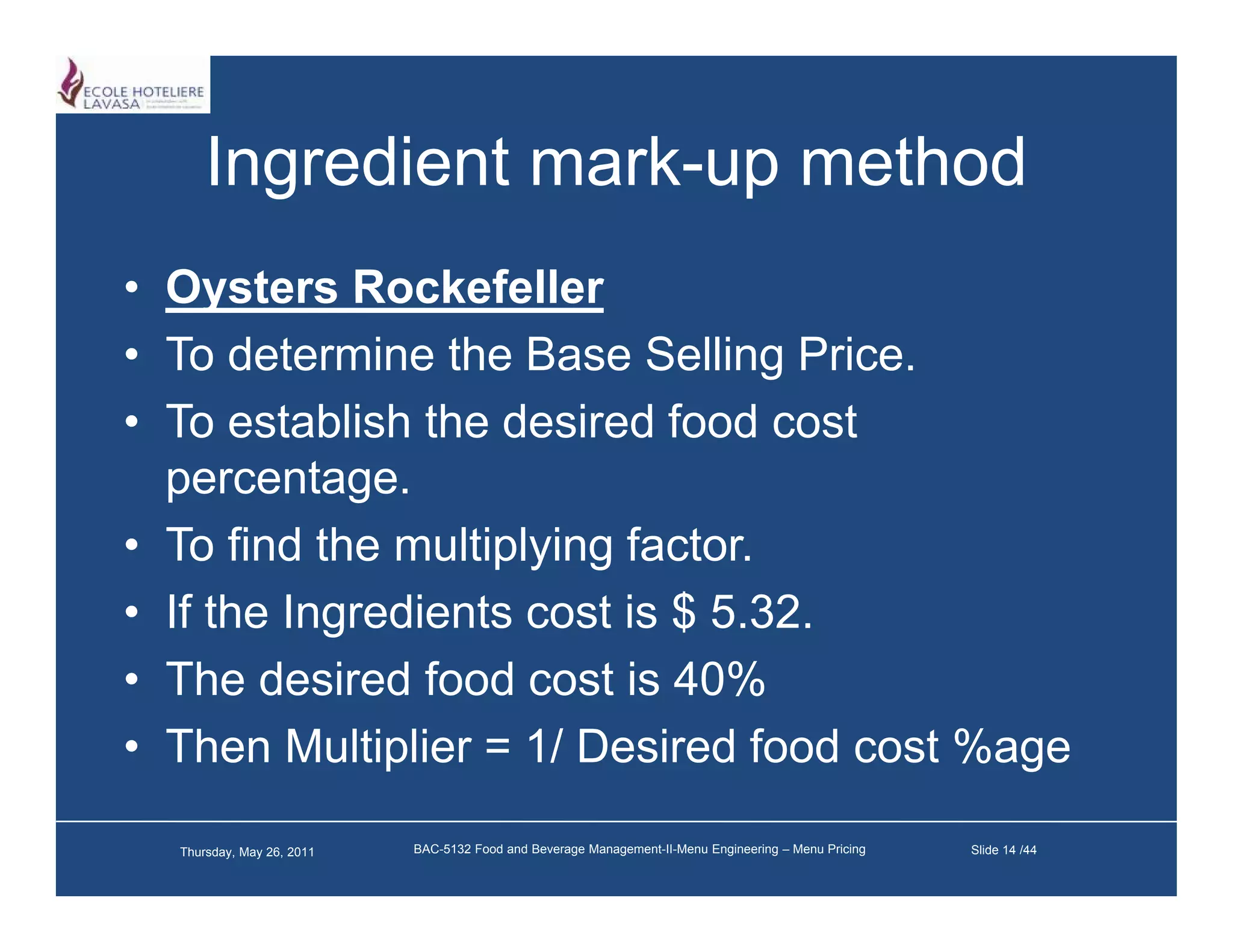
Ingredient mark-up method
                 mark up
• Oysters Rockefeller
• To determine the Base Selling Price.
• To establish the desired food cost
  percentage.
• T find th multiplying f t
  To fi d the    lti l i factor.
• If the Ingredients cost is $ 5.32.
• The desired food cost is 40%
• Then Multiplier = 1/ Desired food cost %age

  Thursday, May 26, 2011   BAC-5132 Food and Beverage Management-II-Menu Engineering – Menu Pricing   Slide 14 /44
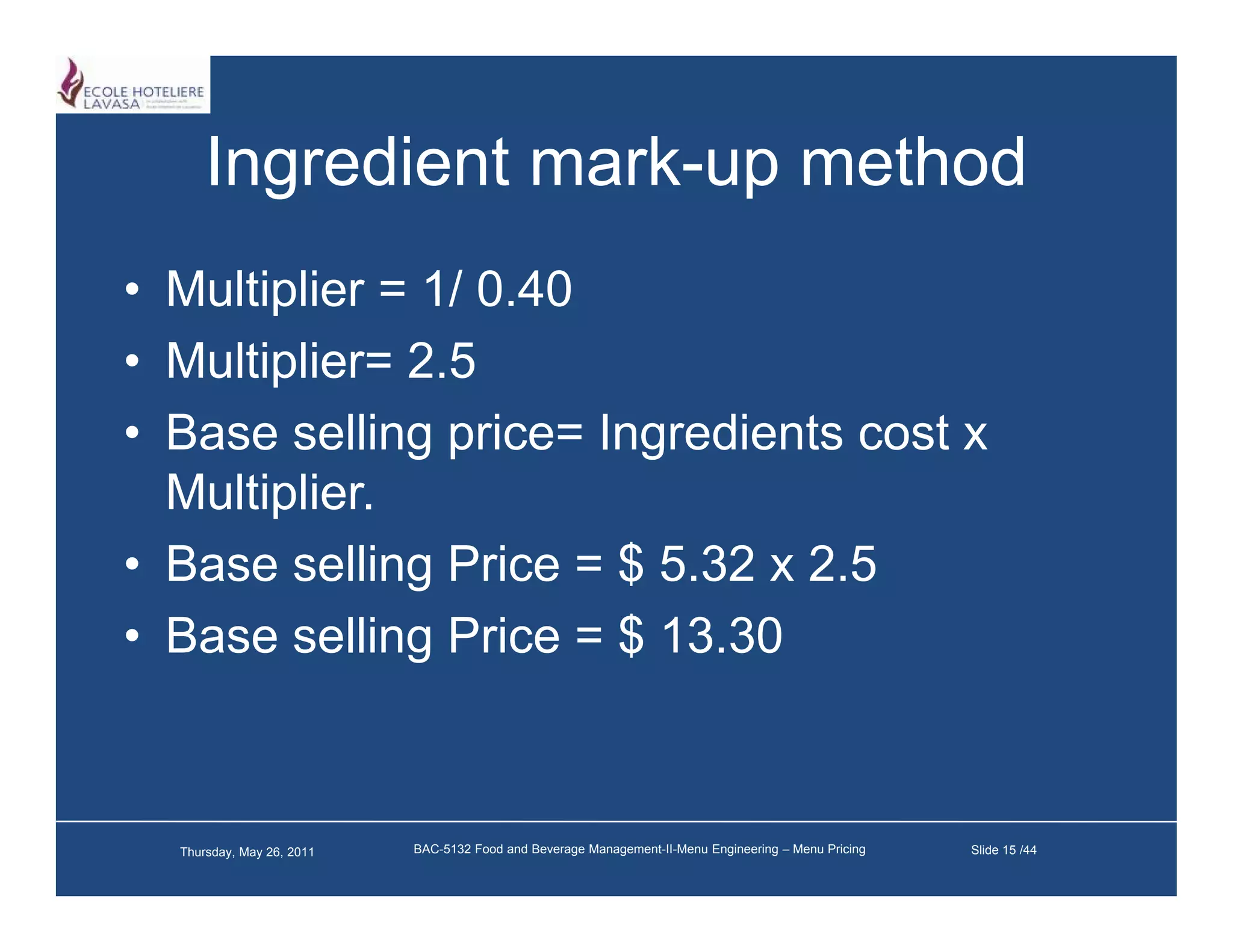
Ingredient mark-up method
                 mark up
• Multiplier = 1/ 0 40
                  0.40
• Multiplier= 2.5
• B
  Base selling price= I
           lli     i   Ingredients cost x
                            di t      t
  Multiplier.
• Base selling Price = $ 5.32 x 2.5
• Base selling Price = $ 13.30
               g


  Thursday, May 26, 2011   BAC-5132 Food and Beverage Management-II-Menu Engineering – Menu Pricing   Slide 15 /44
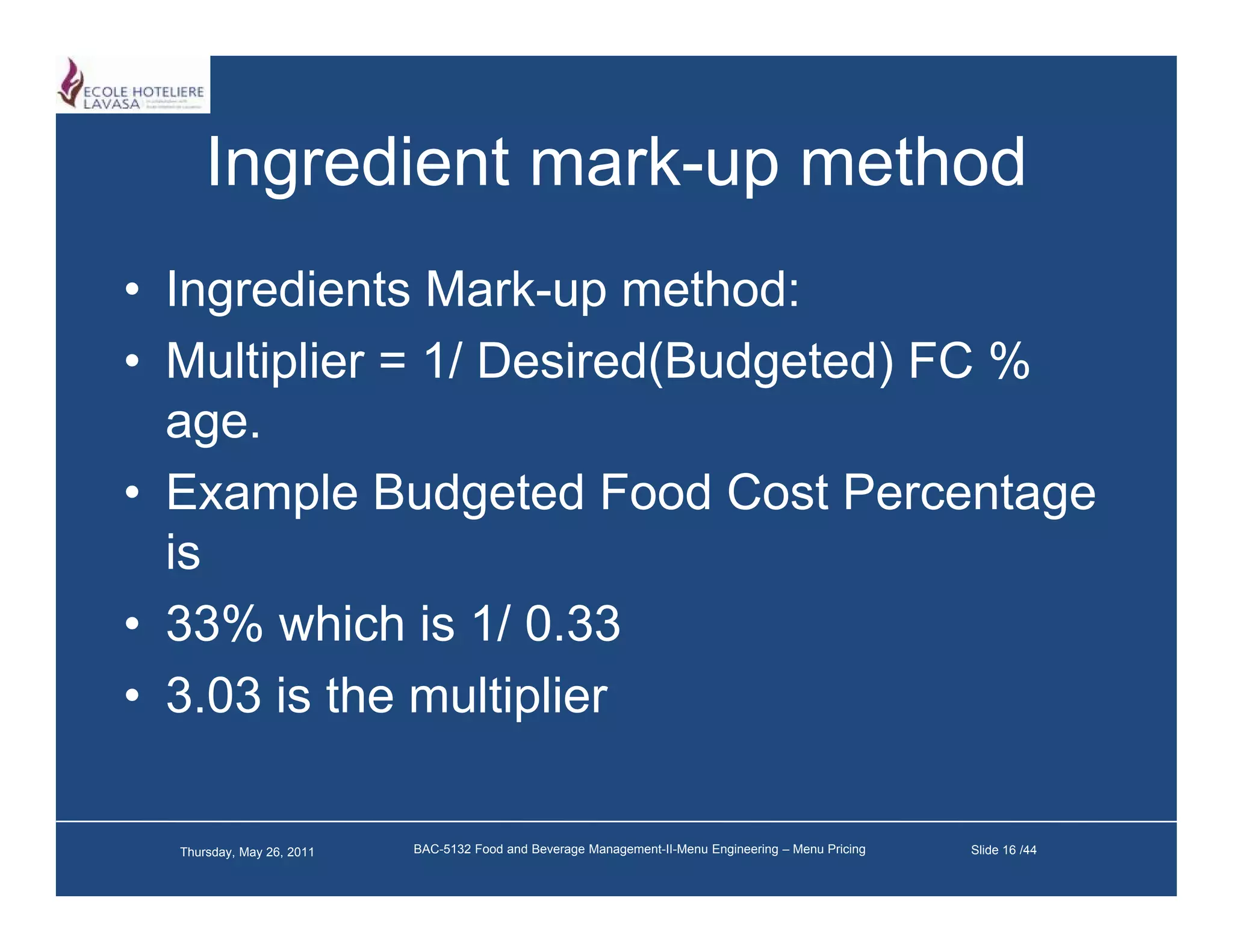
Ingredient mark-up method
                 mark up
• Ingredients Mark-up method:
               Mark up
• Multiplier = 1/ Desired(Budgeted) FC %
  age.
  age
• Example Budgeted Food Cost Percentage
  is
• 33% which is 1/ 0.33
• 3.03 is the multiplier

  Thursday, May 26, 2011   BAC-5132 Food and Beverage Management-II-Menu Engineering – Menu Pricing   Slide 16 /44
Prime Ingredient Mark-Up method
                  Mark Up
• Based on the basic cost of the main
  ingredient.
• The multiplier should be greater than the
  previous method.
• Th multiplier i established on th b i
  The      lti li is t bli h d      the basis
  of assumption.
• If the ingredients cost of the dish is $ 5.32
• The prime Ingredient cost is $ 2.65.
        p        g
  Thursday, May 26, 2011   BAC-5132 Food and Beverage Management-II-Menu Engineering – Menu Pricing   Slide 17 /44
Prime Ingredient Mark-Up method
                  Mark Up
• The multiplier is assumed to be 5 02
                                    5.02.
• Base selling Price = Prime ingredient cost
  x Multiplier
     Multiplier.
• BSP = $ 2.65 x 5.02 = $ 13.30
• If the cost of prime increases from $ 2.65
  to $ 2.75: then
• BSP = $ 2.75 x 5.02 = $ 13.81

  Thursday, May 26, 2011   BAC-5132 Food and Beverage Management-II-Menu Engineering – Menu Pricing   Slide 18 /44
Prime Ingredient Mark-Up method
                     Mark Up
• Multiplier =                       Total Food Revenue
                                     Total Entrée costs
•   Example:
    E       l
•   Total Food Costs = $ 1,000,000.00
•   Total Entrée costs = $ 350,000.00
•   Total Revenue      = $ 175 7000 00
                           175,7000.00
•   Multiplier = 1757000/350000= 5.02

     Thursday, May 26, 2011   BAC-5132 Food and Beverage Management-II-Menu Engineering – Menu Pricing   Slide 19 /44
Mark –up with accompaniment
                   cost M h d
                        Method
• The accompaniment cost is also known as
  plate cost.
• The Plate cost comprises of cost of
  condiments, salads, potatoes, vegetables,
  bread and butter and non alcoholic
                          non-alcoholic
  beverages.
• Th plate cost i added t th main entrée
  The l t        t is dd d to the     i     té
  cost before its multiplied by the factor.

  Thursday, May 26, 2011   BAC-5132 Food and Beverage Management-II-Menu Engineering – Menu Pricing   Slide 20 /44
Mark –up with accompaniment
                     cost M h d
                          Method
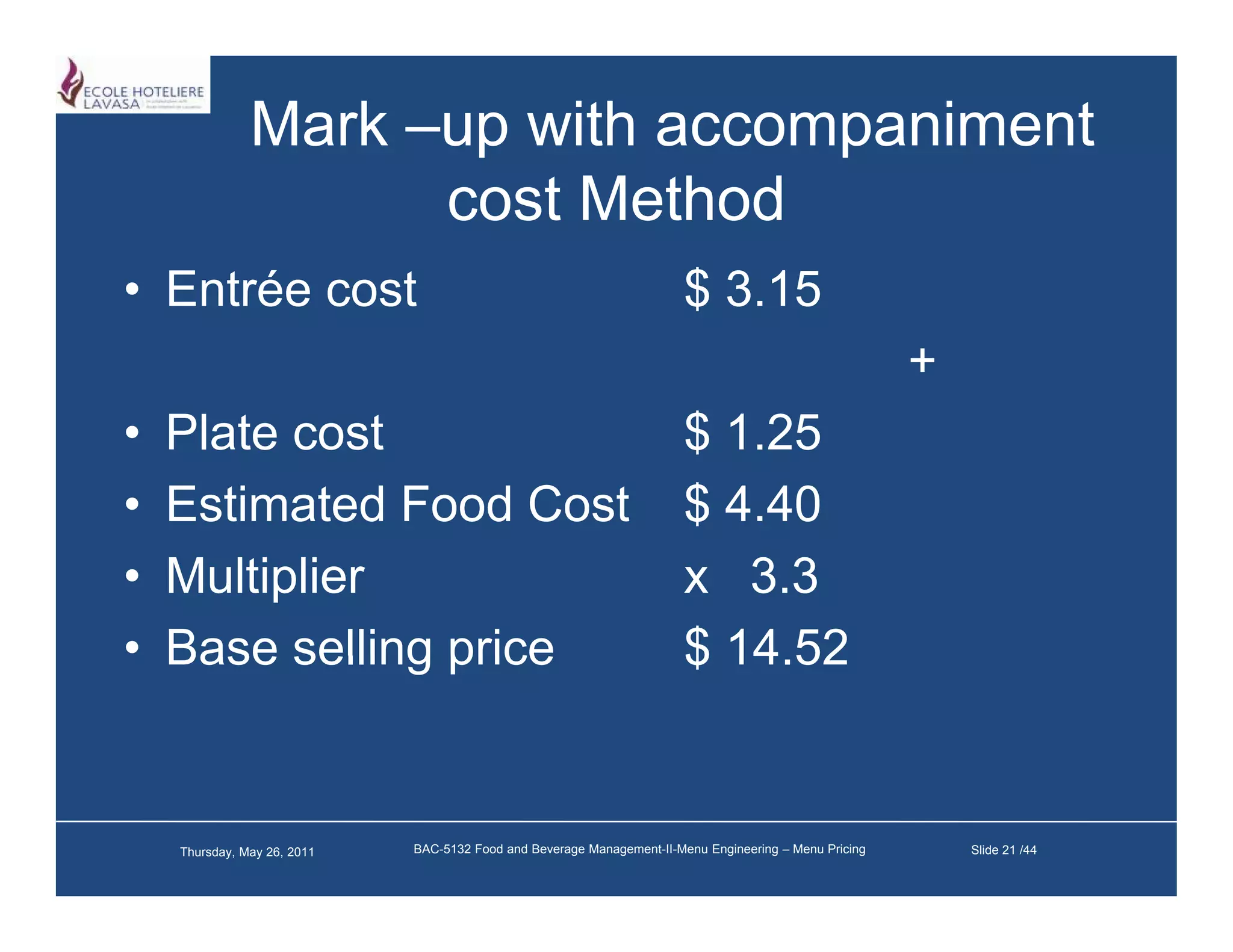
• Entrée cost                                                           $ 3.15
                                                                          3 15
                                                                                                        +
•   Plate
    Pl t cost  t                                                       $ 1.25
                                                                         1 25
•   Estimated Food Cost                                                $ 4.40
•   Multiplier                                                         x 3.3
•   Base selling price                                                 $ 14.52
                                                                         14 52


    Thursday, May 26, 2011   BAC-5132 Food and Beverage Management-II-Menu Engineering – Menu Pricing       Slide 21 /44
Mark –up with accompaniment
                   cost M h d
                        Method
• Step A:
• Calculate per meal accompaniment cost
• A
  Assume:
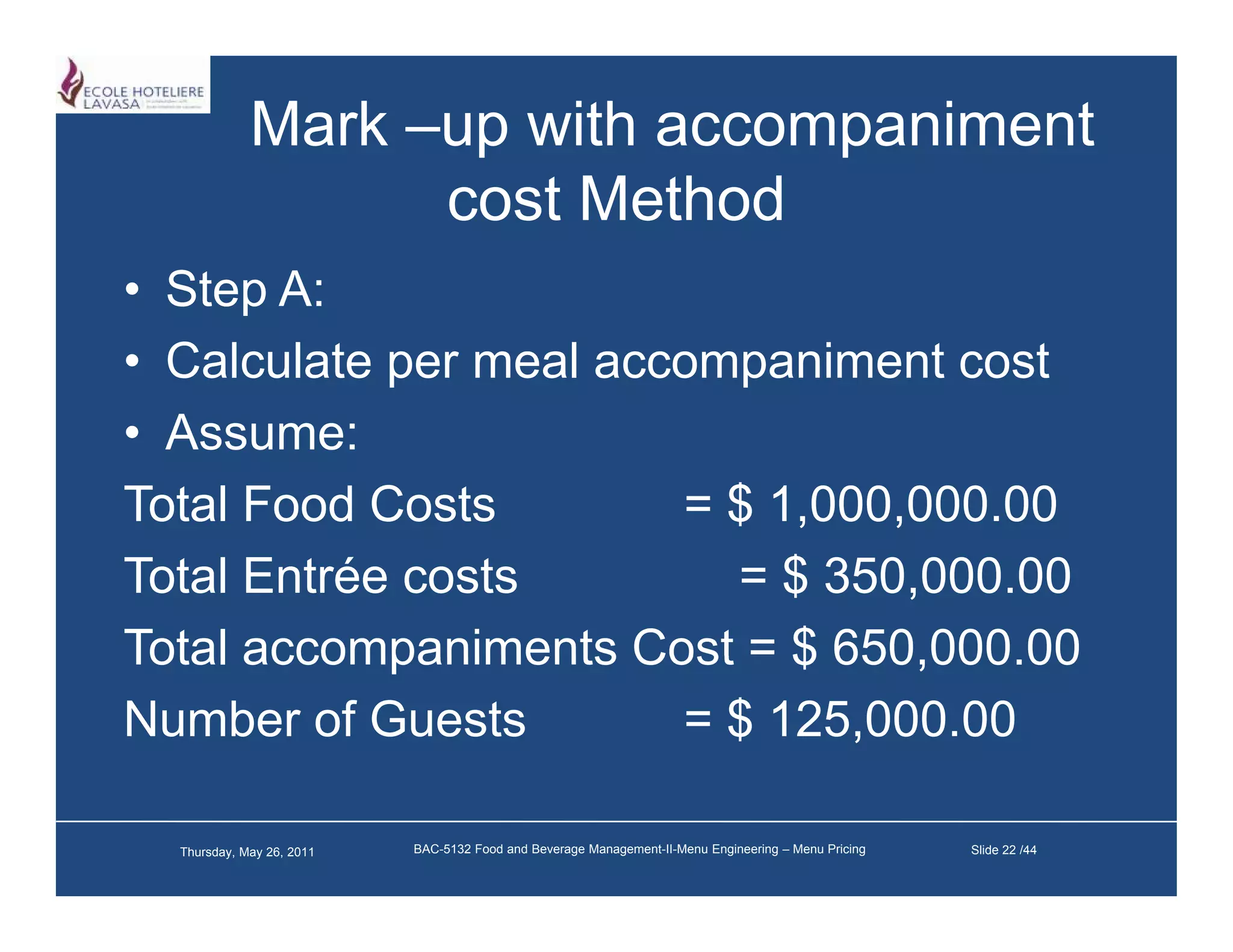
Total Food Costs        = $ 1,000,000.00
Total Entrée costs        = $ 350,000.00
Total accompaniments Cost = $ 650 000 00
                               650,000.00
Number of Guests        = $ 125,000.00

  Thursday, May 26, 2011   BAC-5132 Food and Beverage Management-II-Menu Engineering – Menu Pricing   Slide 22 /44
Mark –up with accompaniment
                     cost M h d
                          Method
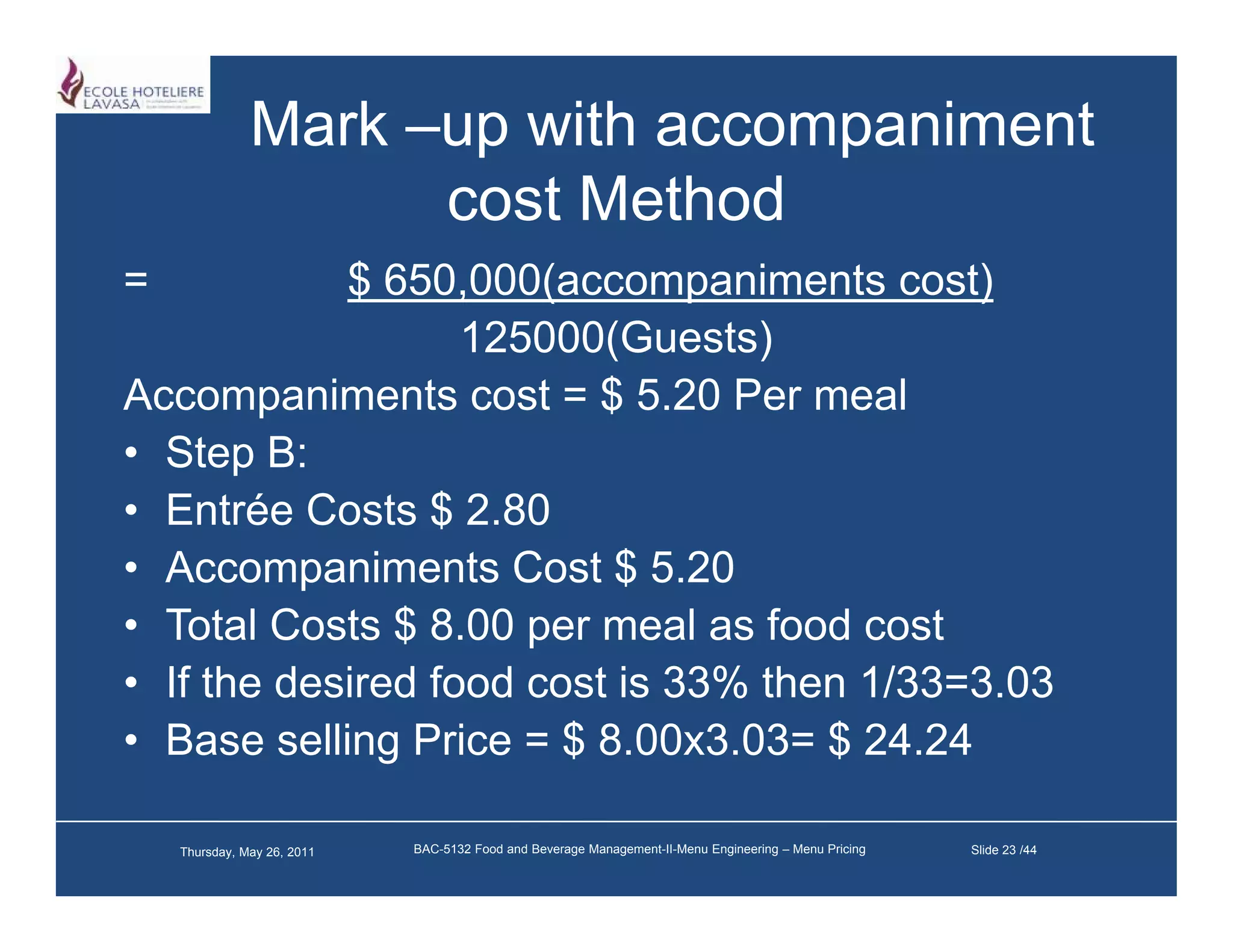
=           $ 650,000(accompaniments cost)
                   ,   (       p            )
                   125000(Guests)
Accompaniments cost = $ 5.20 Per meal
        p
• Step B:
• Entrée Costs $ 2.80
• Accompaniments Cost $ 5.20
• Total Costs $ 8.00 per meal as food cost
• If the desired food cost is 33% then 1/33=3.03
• Base selling Price = $ 8.00x3.03= $ 24.24

    Thursday, May 26, 2011   BAC-5132 Food and Beverage Management-II-Menu Engineering – Menu Pricing   Slide 23 /44
Contribution Pricing method
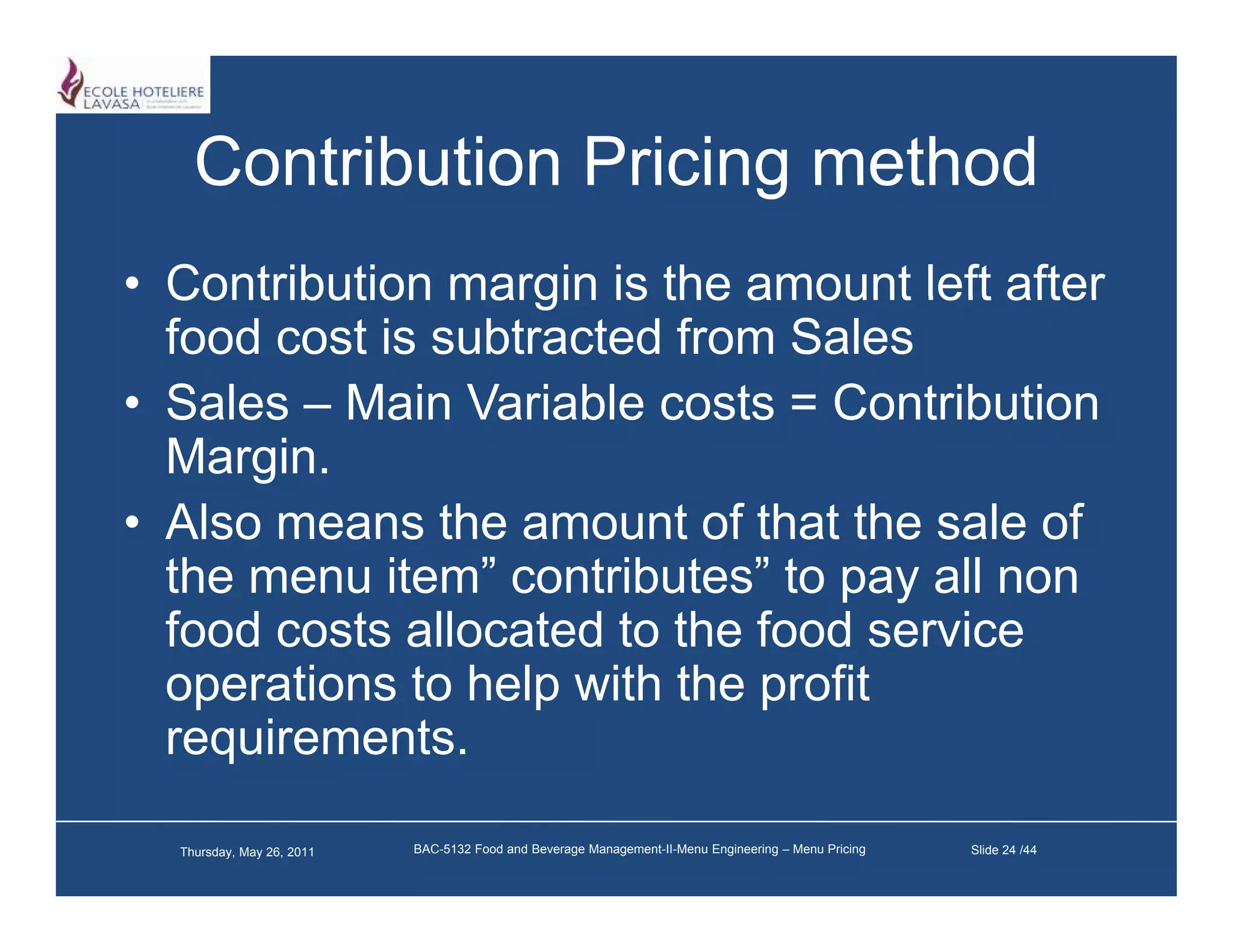
• Contribution margin is the amount left after
  food cost is subtracted from Sales
• Sales – Main Variable costs = Contribution
  Margin.
• Also means the amount of that the sale of
  the menu item” contributes” to pay all non
  food costs allocated to the food service
  operations to help with the profit
  requirements.

  Thursday, May 26, 2011   BAC-5132 Food and Beverage Management-II-Menu Engineering – Menu Pricing   Slide 24 /44
Contribution Pricing method
• To set the Base Selling price by this method
                                        method.
1. Determine the average contribution margin
   required per guest by dividing all non-food
   costs + required profit by the expected
   number of guests.
2. Determine the base selling price for the
   menu item by adding the average
   contribution margin required per guest to the
   items standard food cost.
  Thursday, May 26, 2011   BAC-5132 Food and Beverage Management-II-Menu Engineering – Menu Pricing   Slide 25 /44
Contribution Pricing method
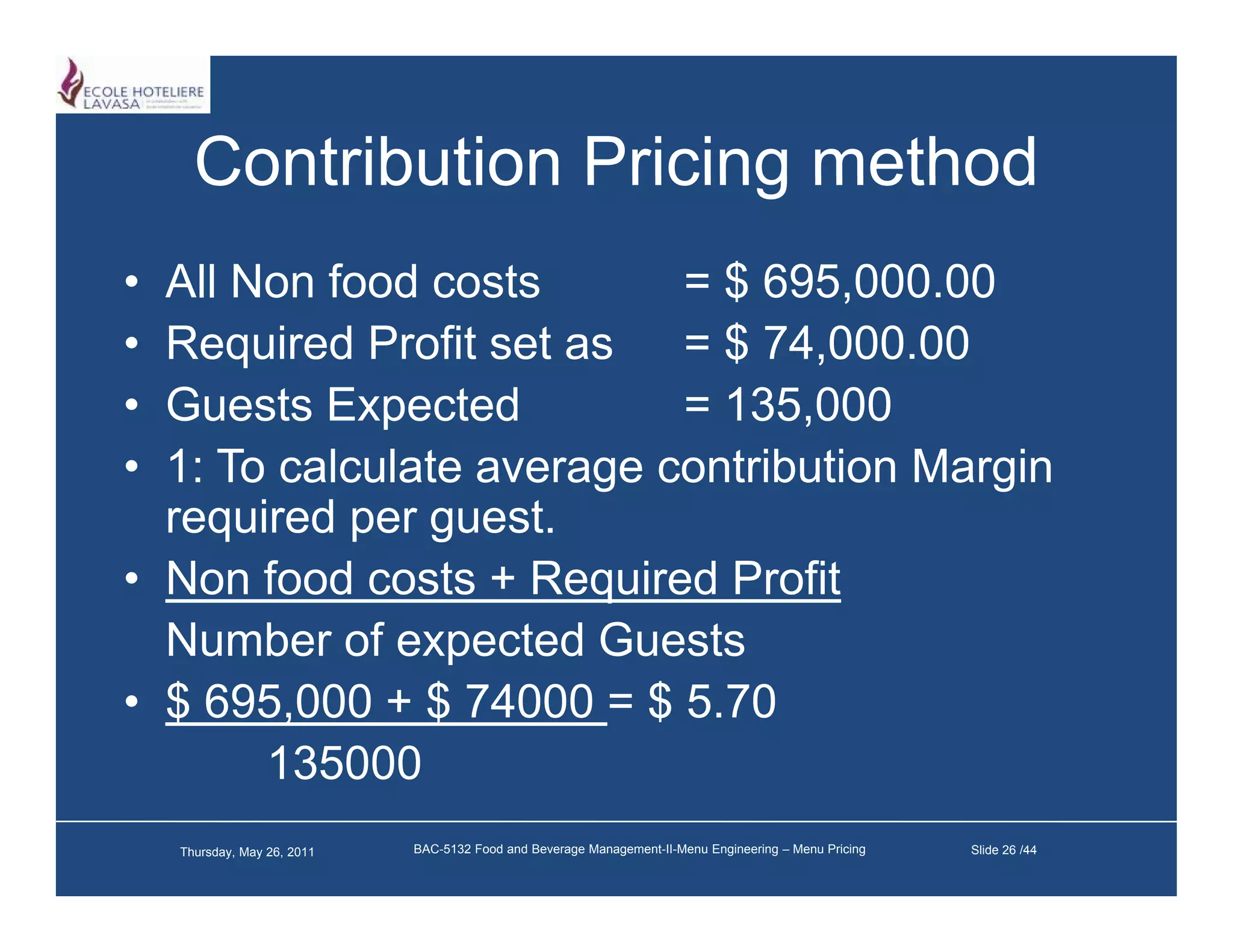
• All Non food costs       = $ 695,000.00
• Required Profit set as = $ 74,000.00
• Guests Expected          = 135 000
                             135,000
• 1: To calculate average contribution Margin
  required p g
    q      per guest.
• Non food costs + Required Profit
  Number of expected Guests
• $ 695,000 + $ 74000 = $ 5.70
       135000
    Thursday, May 26, 2011   BAC-5132 Food and Beverage Management-II-Menu Engineering – Menu Pricing   Slide 26 /44
Contribution Pricing method
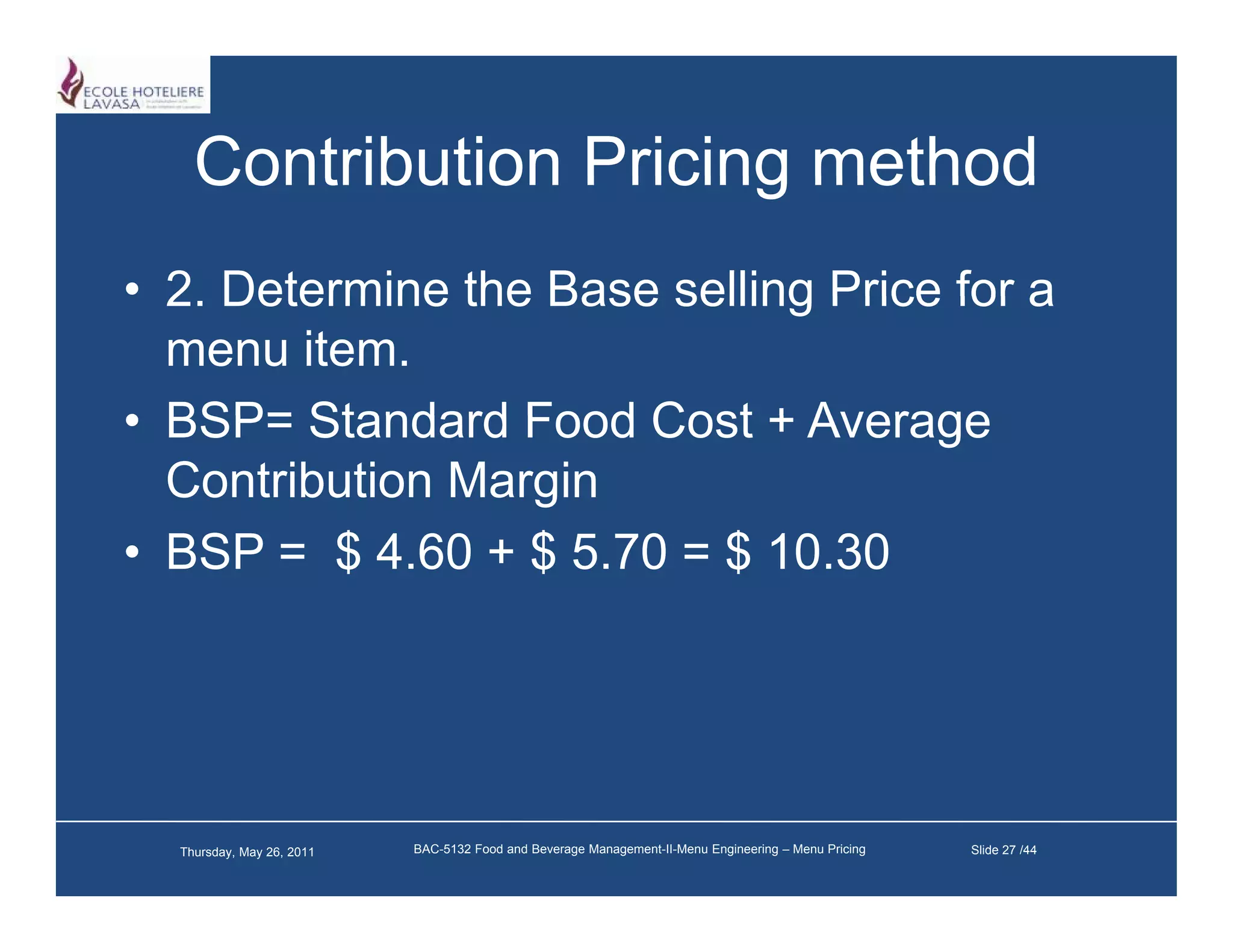
• 2 Determine the Base selling Price for a
  2.
  menu item.
• BSP= Standard Food Cost + Average
  Contribution Margin
• BSP = $ 4 60 + $ 5 70 = $ 10 30
            4.60    5.70    10.30


  Thursday, May 26, 2011   BAC-5132 Food and Beverage Management-II-Menu Engineering – Menu Pricing   Slide 27 /44
Ratio Pricing method
• This method determines the relationship
  between fixed costs and all non food costs
  plus profit requirements
              requirements.
• Usually done in three steps:
1. Determine th ratio of f d costs to all
1 D t     i the ti f food        t t ll
  non food costs plus required profit by
  dividing ll
  di idi all non f d costs plus profit b
                   food    t l        fit by
  food costs.

  Thursday, May 26, 2011   BAC-5132 Food and Beverage Management-II-Menu Engineering – Menu Pricing   Slide 28 /44
Ratio Pricing method
2.
2 Calculate the amount of non food costs
   plus profit required for a menu item by
   multiplying the standard food costs of the
   menu item by the ratio calculated in step
   1.
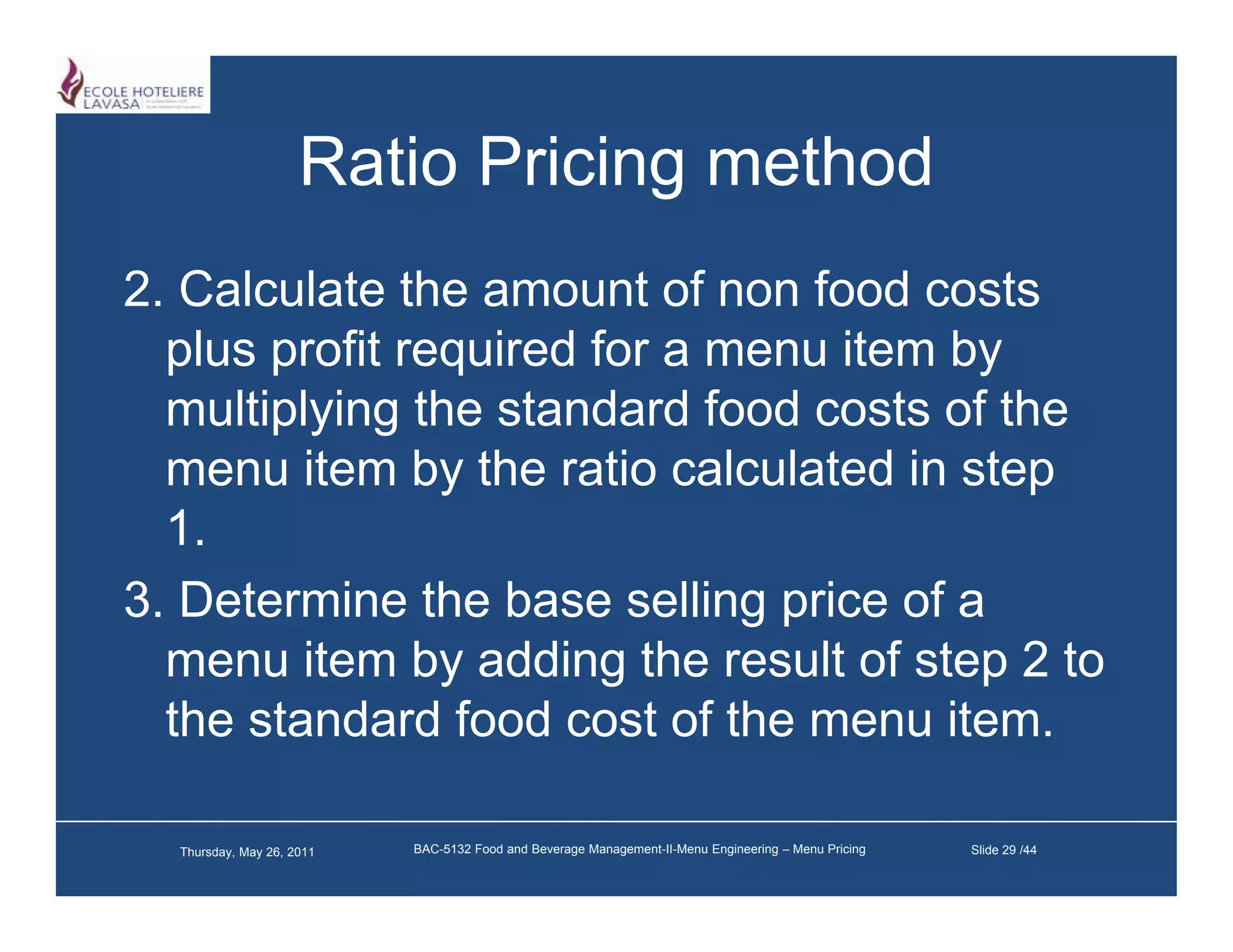
3. Determine the base selling price of a
   menu item by adding the result of step 2 to
   the standard food cost of the menu item.

  Thursday, May 26, 2011   BAC-5132 Food and Beverage Management-II-Menu Engineering – Menu Pricing   Slide 29 /44
Ratio Pricing method
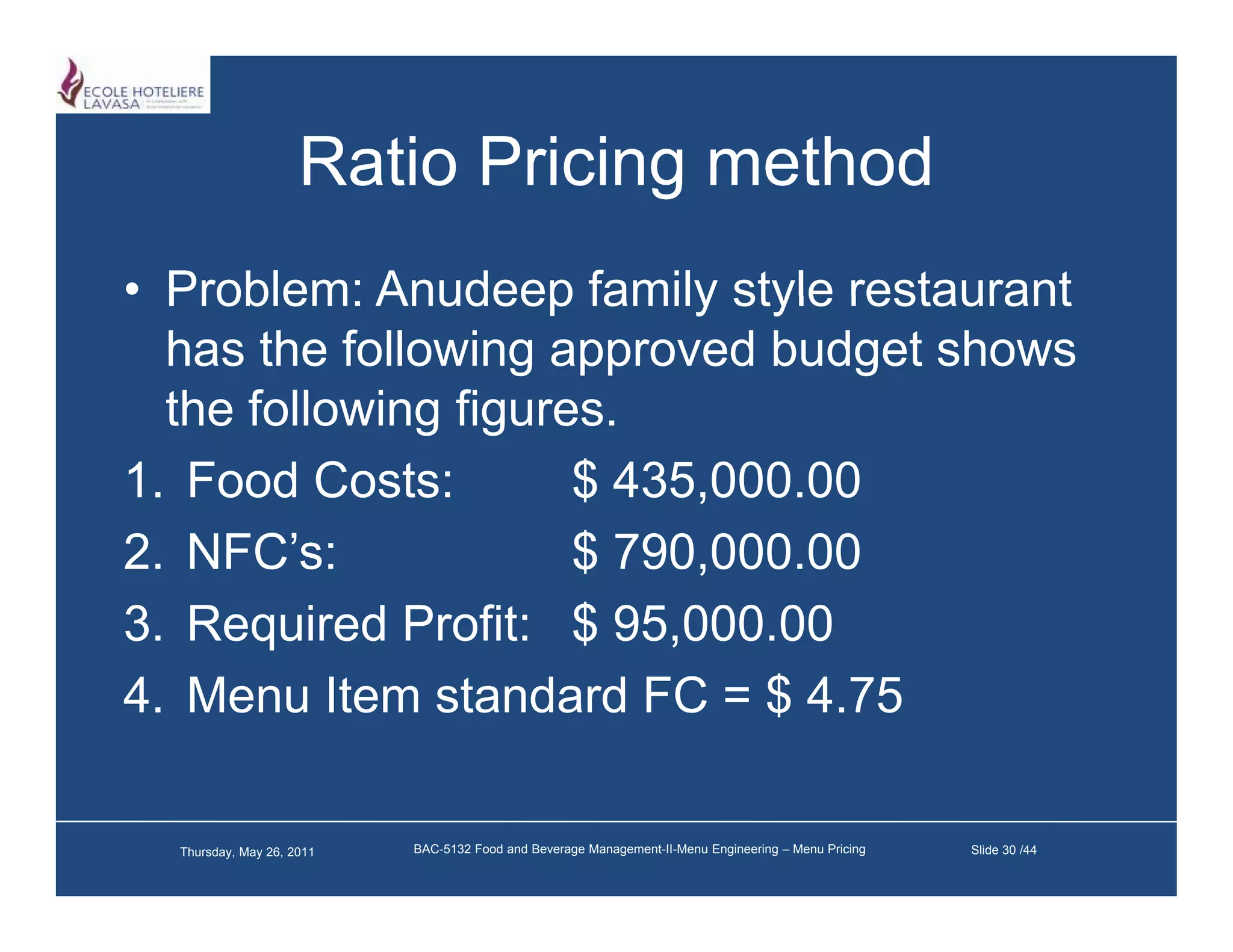
• Problem: Anudeep family style restaurant
  has the following approved budget shows
  the following figures
                figures.
1. Food Costs:        $ 435,000.00
2. NFC’s:
2 NFC’                $ 790 000 00
                        790,000.00
3. Required Profit: $ 95,000.00
4. Menu Item standard FC = $ 4.75

  Thursday, May 26, 2011   BAC-5132 Food and Beverage Management-II-Menu Engineering – Menu Pricing   Slide 30 /44
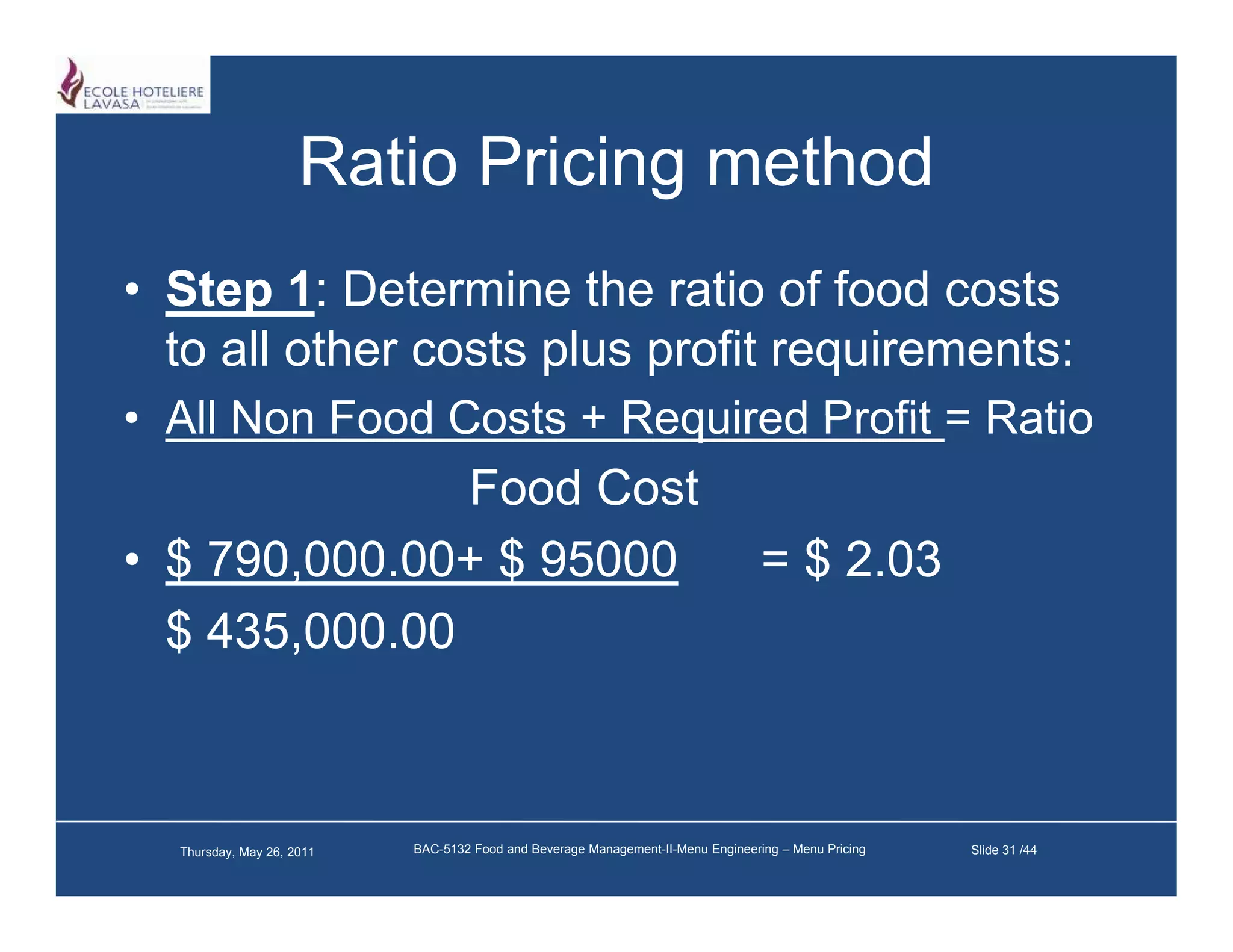
Ratio Pricing method
• Step 1: Determine the ratio of food costs
  to all other costs plus profit requirements:
• All Non Food Costs + Required Profit = Ratio
               Food Cost
• $ 790,000.00+ $ 95000                                                           = $ 2.03
  $ 435,000.00


  Thursday, May 26, 2011   BAC-5132 Food and Beverage Management-II-Menu Engineering – Menu Pricing   Slide 31 /44
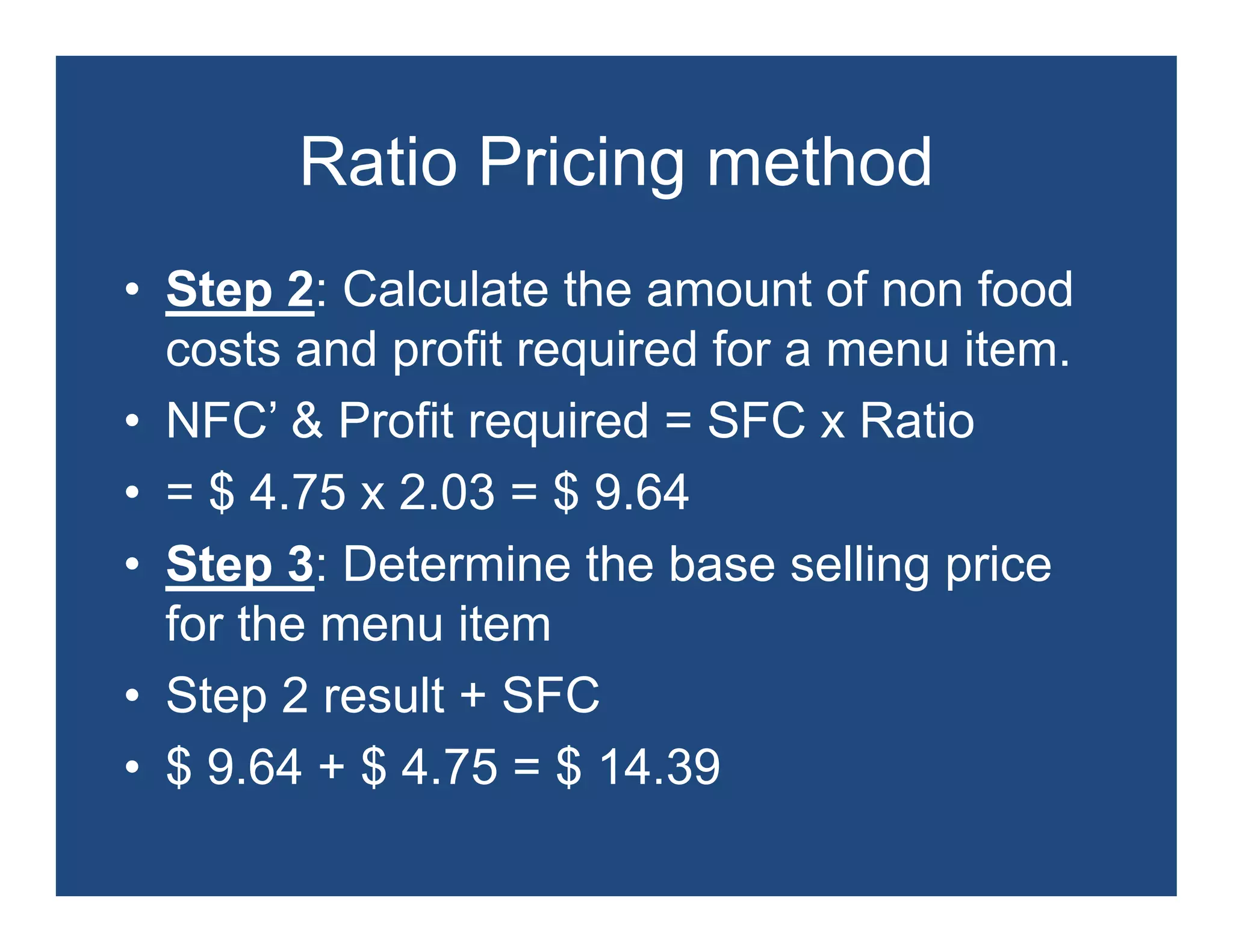
Ratio Pricing method
• Step 2: Calculate the amount of non food
  costs and profit required for a menu item.
• NFC’ & Profit required = SFC x Ratio
  NFC
• = $ 4.75 x 2.03 = $ 9.64
• Step 3: Determine the base selling price
  for the menu item
• Step 2 result + SFC
• $ 9.64 + $ 4.75 = $ 14 39
    9 64     4 75     14.39
Simple Prime costs method
• Prime costs are defined as direct material
  + direct labor+ direct expenses
• In hospitality it is Cost of Food and
  Beverage + Cost of Labor.
• Th following can b achieved i 3 steps:
  The f ll i            be hi      d in    t
1. Determine the labor cost per guest by
  dividing total of all labor costs by the
  number of expected guests.
  Thursday, May 26, 2011   BAC-5132 Food and Beverage Management-II-Menu Engineering – Menu Pricing   Slide 33 /44
Simple Prime costs method
2.
2 Determine the prime costs per guest by
   adding labor cost per guest to the menu
   items food cost.
               cost
3. Determine the menu items base selling
   price by dividing the prime costs per guest
   by the desired prime costs percentage (
   Food cost + labor cost percentage)


  Thursday, May 26, 2011   BAC-5132 Food and Beverage Management-II-Menu Engineering – Menu Pricing   Slide 34 /44
Demonstrative example
• Given:
• Menu Item Food Cost                                                                  $ 3.75
• Labor Costs                                                                          $ 210,000.00
• Number of expected guests                                                            75000
• Desired Prime costs % age                                                            62%
• To be derived:
1. Labor cost per guest.
2. Prime cost per guest
2 Pi         t         t
3. Base selling Price.

  Thursday, May 26, 2011   BAC-5132 Food and Beverage Management-II-Menu Engineering – Menu Pricing   Slide 35 /44
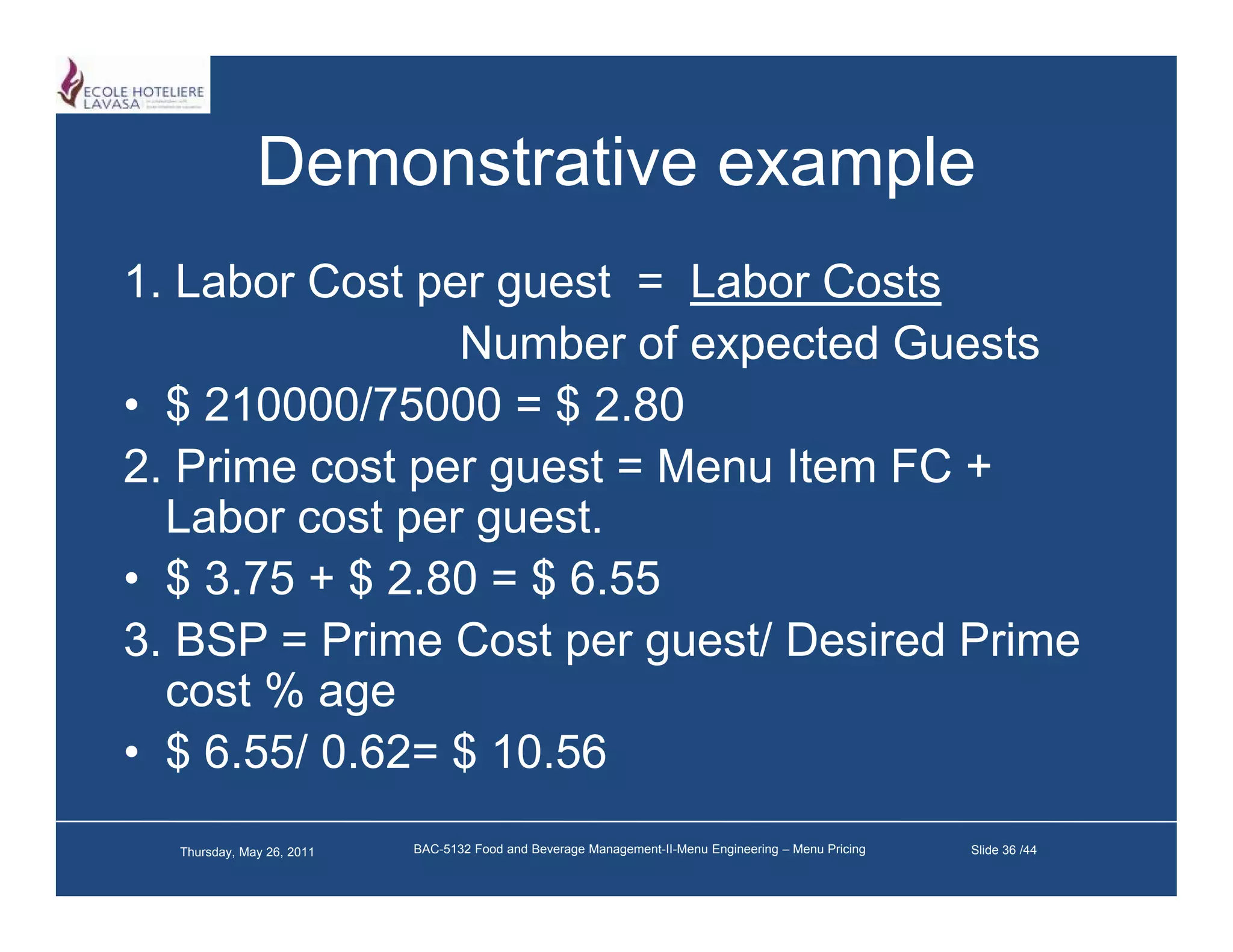
Demonstrative example
1. Labor Cost per guest = Labor Costs
                Number of expected Guests
• $ 210000/75000 = $ 2 80
                       2.80
2. Prime cost per guest = Menu Item FC +
  Labor cost per g
             p guest.
• $ 3.75 + $ 2.80 = $ 6.55
3. BSP = Prime Cost per guest/ Desired Prime
  cost % age
• $ 6.55/ 0.62= $ 10.56
  Thursday, May 26, 2011   BAC-5132 Food and Beverage Management-II-Menu Engineering – Menu Pricing   Slide 36 /44
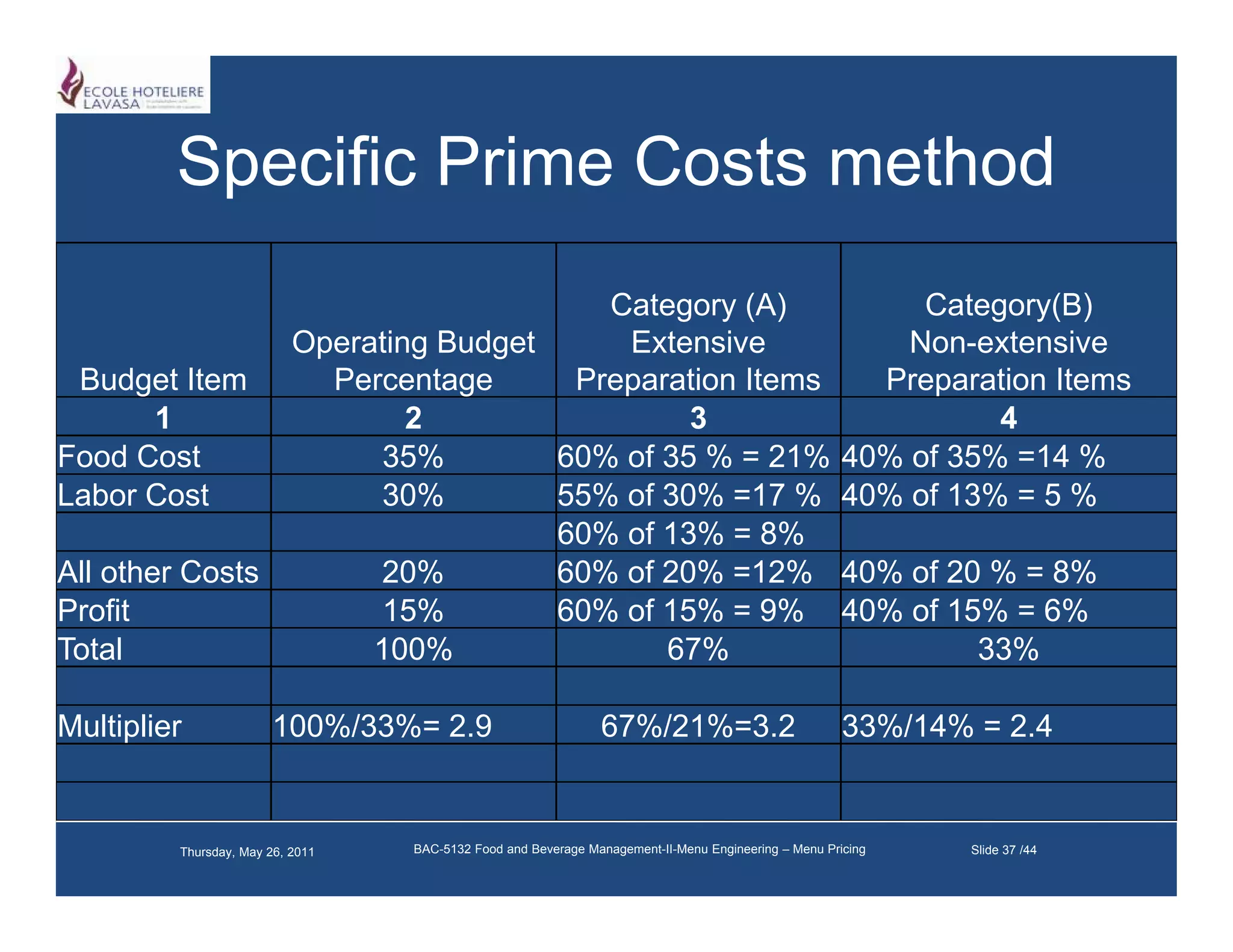
Specific Prime Costs method
                                               Category (A)
                                               C t                                                         Category(B)
                                                                                                           C t      (B)
                           Operating Budget     Extensive                                                 Non-extensive
 Budget Item                 Percentage      Preparation Items                                          Preparation Items
      1                            2                 3                                                          4
Food Cost                       35%         60% of 35 % = 21%                                         40% of 35% =14 %
Labor Cost                      30%         55% of 30% =17 %                                          40% of 13% = 5 %
                                            60% of 13% = 8%
All other Costs                 20%         60% of 20% =12%                                           40% of 20 % = 8%
Profit                          15%         60% of 15% = 9%                                           40% of 15% = 6%
Total                           100%               67%                                                         33%

Multiplier              100%/33%= 2.9                          67%/21%=3.2                            33%/14% = 2.4


         Thursday, May 26, 2011   BAC-5132 Food and Beverage Management-II-Menu Engineering – Menu Pricing    Slide 37 /44
Specific Prime Costs method
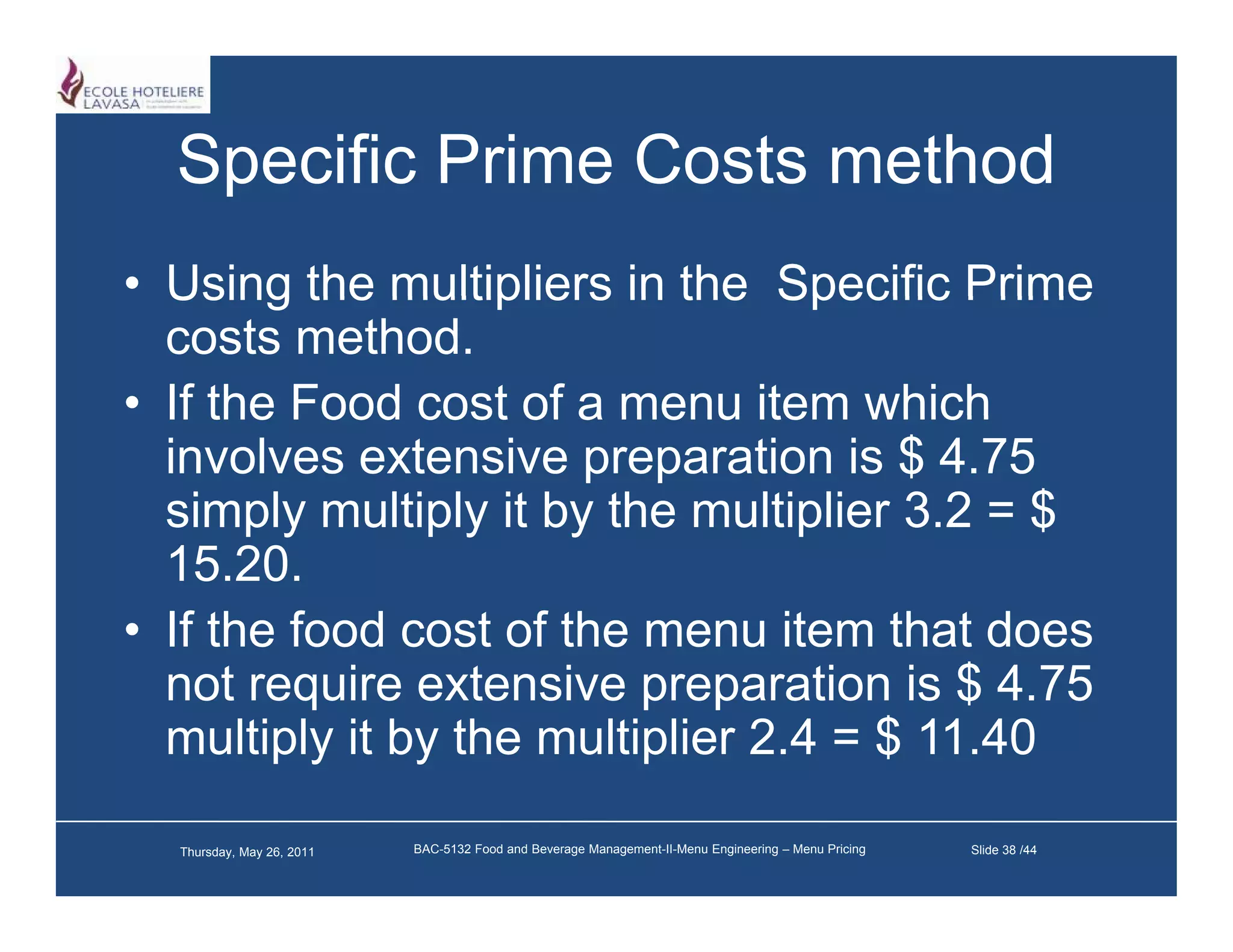
• Using the multipliers in the Specific Prime
  costs method.
• If the Food cost of a menu item which
  involves extensive preparation is $ 4.75
  simply multiply it by the multiplier 3.2 = $
       py      py      y          p
  15.20.
• If the food cost of the menu item that does
  not require extensive preparation is $ 4.75
  multiply it by the multiplier 2.4 = $ 11.40

  Thursday, May 26, 2011   BAC-5132 Food and Beverage Management-II-Menu Engineering – Menu Pricing   Slide 38 /44
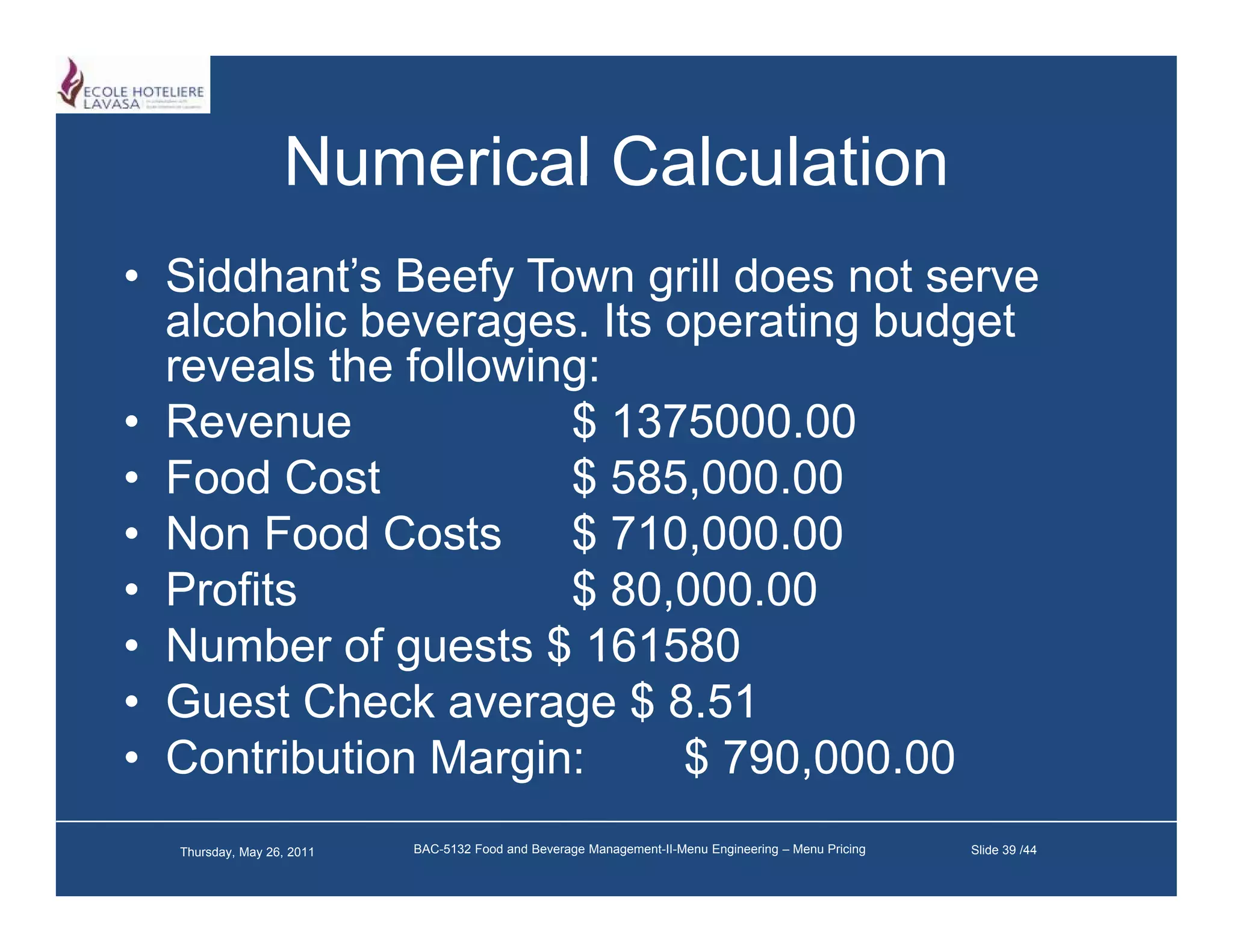
Numerical Calculation
• Siddhant’s Beefy Town g does not serve
                   y      grill
  alcoholic beverages. Its operating budget
  reveals the following:
• Revenue             $ 1375000 00
                         1375000.00
• Food Cost           $ 585,000.00
• Non Food Costs $ 710 000 00
                         710,000.00
• Profits             $ 80,000.00
• Number of guests $ 161580
• Guest Check average $ 8.51
                    g
• Contribution Margin:      $ 790,000.00
                                 ,
  Thursday, May 26, 2011   BAC-5132 Food and Beverage Management-II-Menu Engineering – Menu Pricing   Slide 39 /44
Numerical Calculation
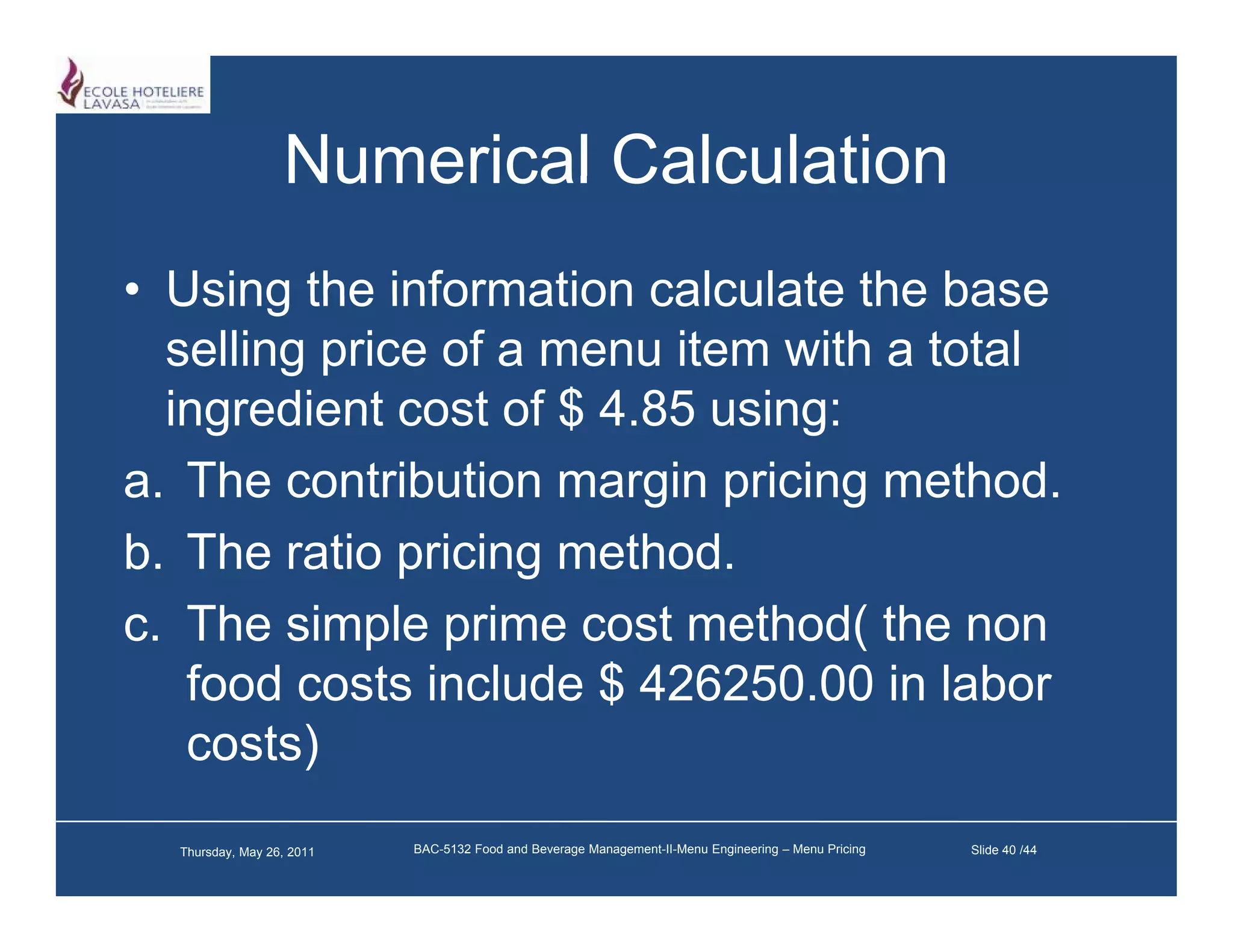
• Using the information calculate the base
  selling price of a menu item with a total
  ingredient cost of $ 4 85 using:
                       4.85
a. The contribution margin pricing method.
b. The ti
b Th ratio pricing method.
                i i     th d
c. The simple prime cost method( the non
   food costs include $ 426250.00 in labor
   costs)
  Thursday, May 26, 2011   BAC-5132 Food and Beverage Management-II-Menu Engineering – Menu Pricing   Slide 40 /44
BSP by Contribution Pricing
                  Method
                  M h d
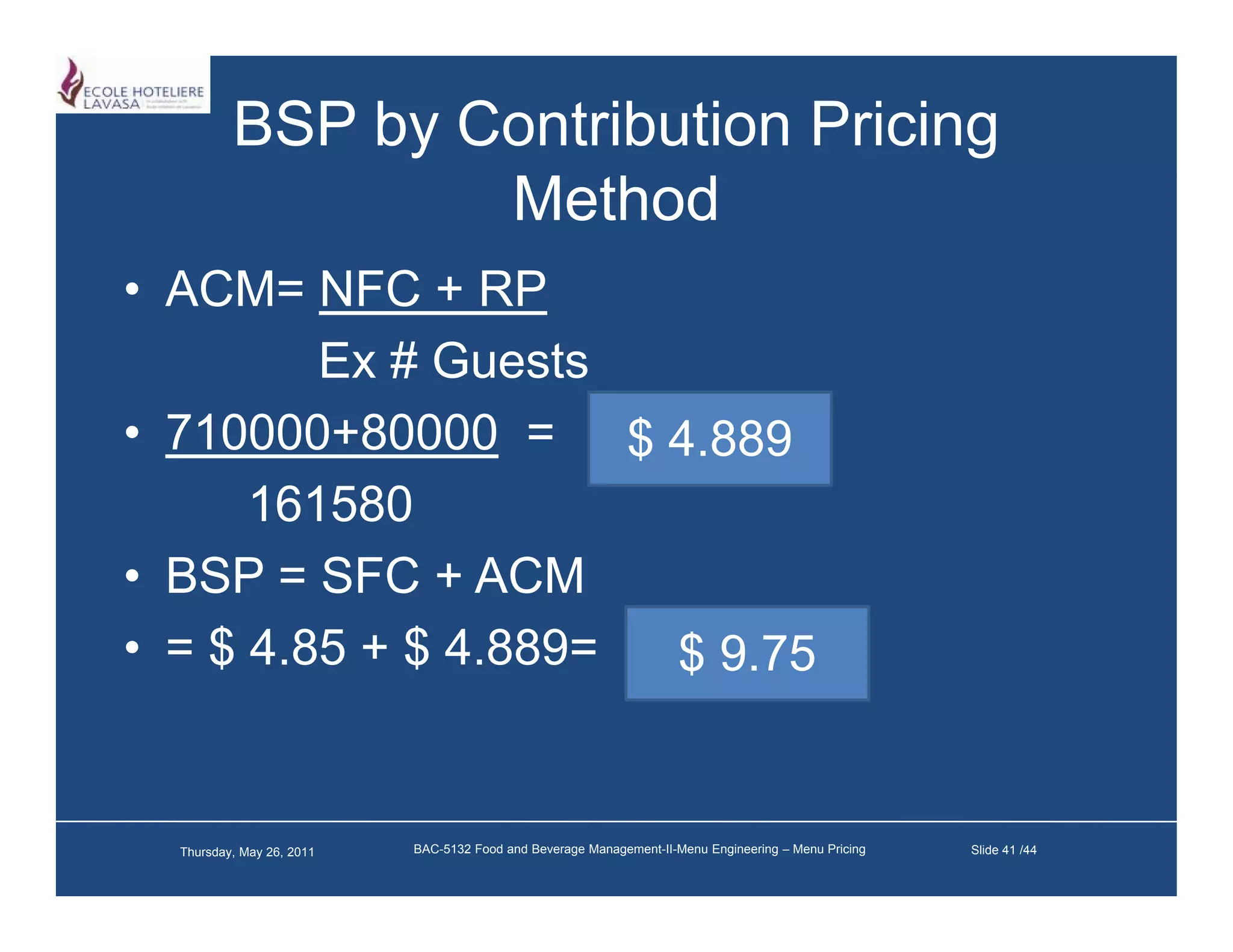
• ACM= NFC + RP
         Ex # Guests
• 710000 80000 = $ 4.889
  710000+80000
      161580
• BSP = SFC + ACM
• = $ 4.85 + $ 4 889=
      4 85     4.889  $ 9.75
                        9 75


  Thursday, May 26, 2011   BAC-5132 Food and Beverage Management-II-Menu Engineering – Menu Pricing   Slide 41 /44
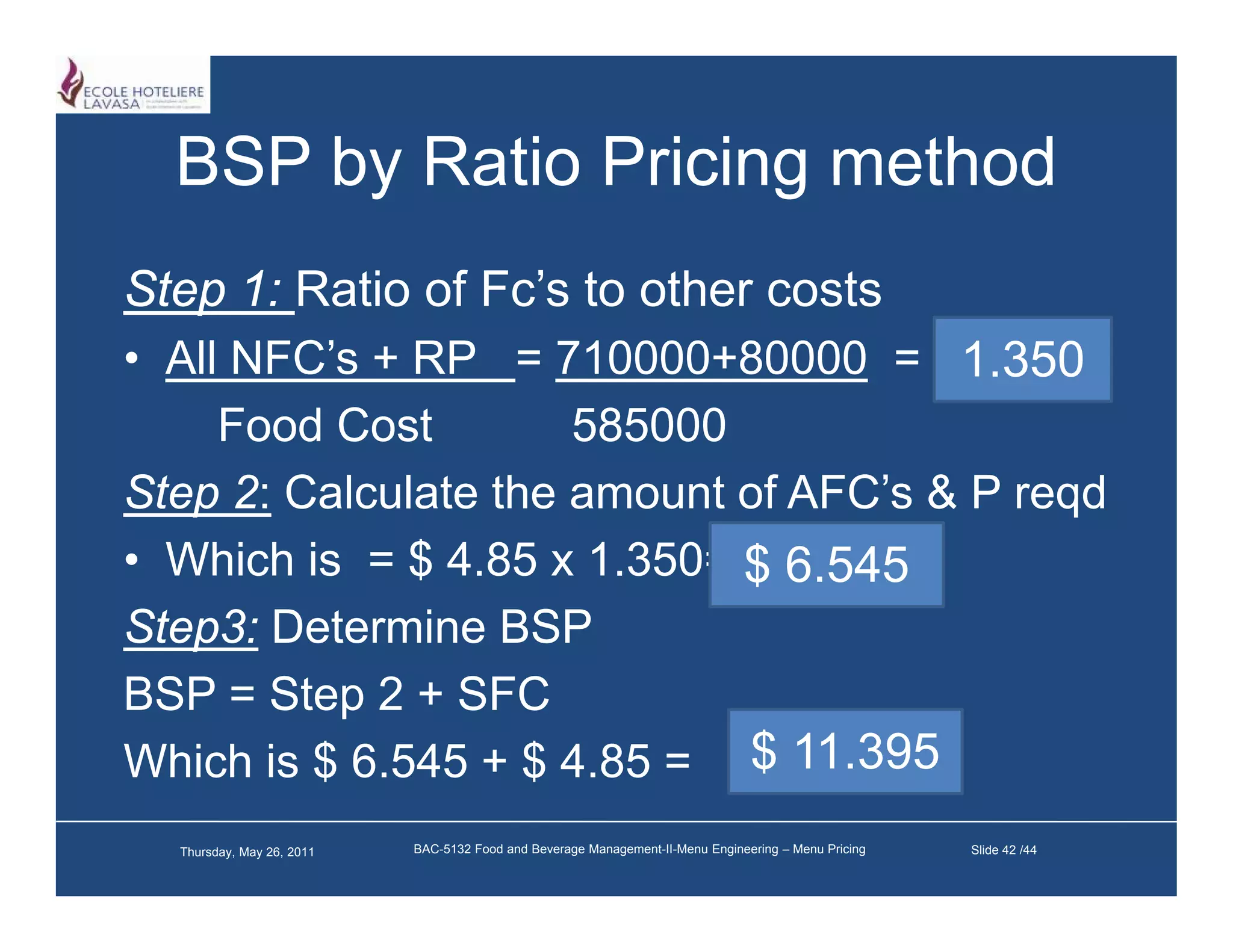
BSP by Ratio Pricing method
Step 1: Ratio of Fc’s to other costs
                 Fc s
• All NFC’s + RP = 710000+80000 = 1.350
     Food Cost
     F dC t           585000
Step 2: Calculate the amount of AFC’s & P reqd
• Which is = $ 4.85 x 1.350= $ 6.545
Step3: Determine BSP
BSP = Step 2 + SFC
Which is $ 6.545 + $ 4.85 = $ 11.395
  Thursday, May 26, 2011   BAC-5132 Food and Beverage Management-II-Menu Engineering – Menu Pricing   Slide 42 /44
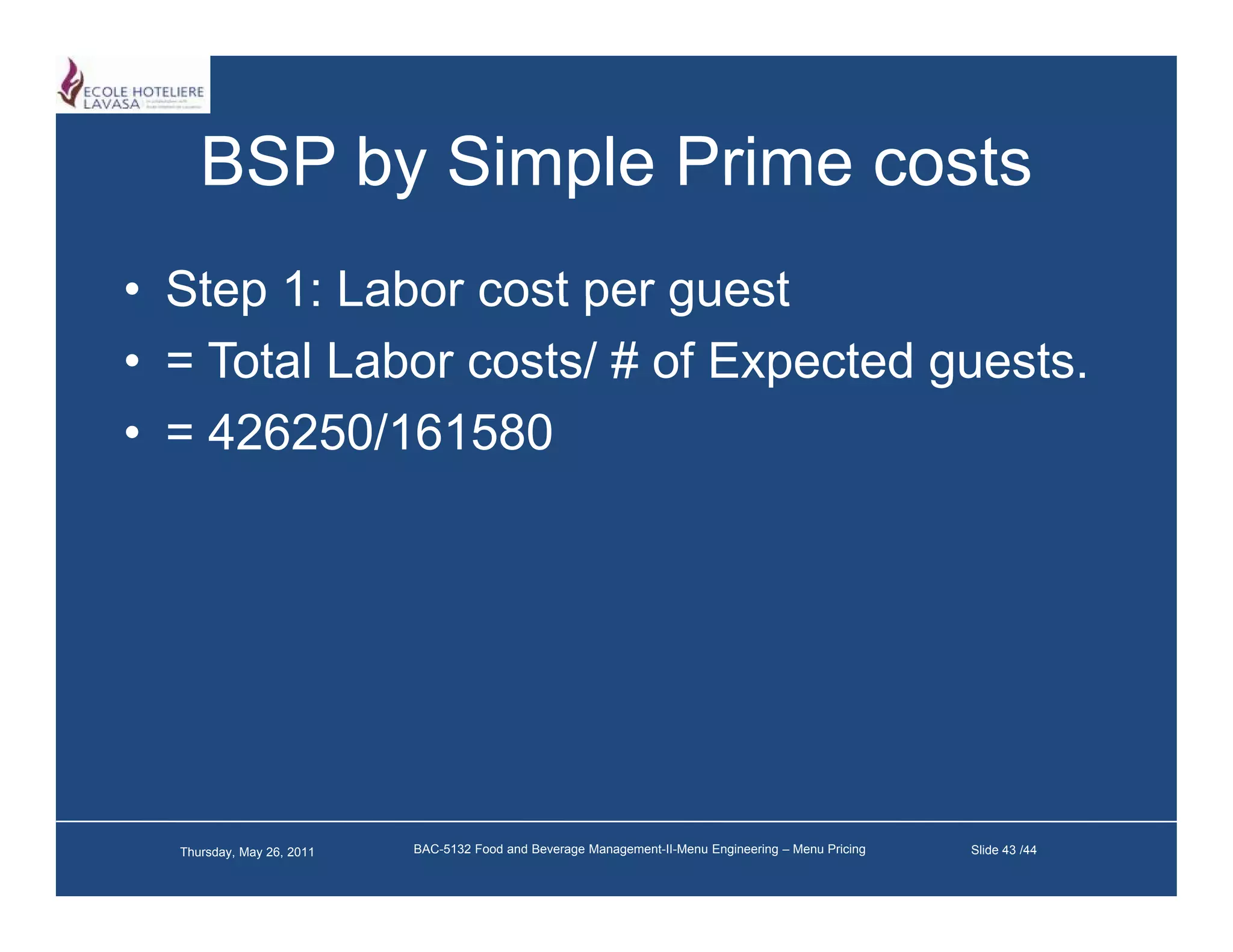
BSP by Simple Prime costs
• Step 1: Labor cost per guest
• = Total Labor costs/ # of Expected guests.
• = 426250/161580


  Thursday, May 26, 2011   BAC-5132 Food and Beverage Management-II-Menu Engineering – Menu Pricing   Slide 43 /44
Questions
                  Q   ti

                  Comments
                  C     t
Thursday, May 26, 2011   BAC-5132 Food and Beverage Management-II-Menu Engineering – Menu Pricing   Slide 44 /44

Menu pricing

  • 1.
    Menu Pricing Thursday, May26, 2011 BAC-5132 Food and Beverage Management-II-Menu Engineering – Menu Pricing Slide 1 /44
  • 2.
    Recap of Semester4 last session • Enlisting Standardization methods. • Monitoring food and beverage operations by monthly food cost. y • Monitoring food and beverage operations by daily food cost. • Comparing actual costs by standard cost and variance analysis. • Steps taken in beverage sales. • Establishing sales price of beverages Thursday, May 26, 2011 BAC-5132 Food and Beverage Management-II-Menu Engineering – Menu Pricing Slide 2 /44
  • 3.
    KCM of theSession • Memorize the formulas for various pricing methods. • Differentiate between Subjective and objective pricing methods. • D Describe various f t ib i factors th t i fl that influence menu planning strategies. • Calculate base selling prices for various pricing methods. Thursday, May 26, 2011 BAC-5132 Food and Beverage Management-II-Menu Engineering – Menu Pricing Slide 3 /44
  • 4.
    Pricing Methods Pricing Methods Subjective S bj ti Objective Obj ti Pricing Pricing Thursday, May 26, 2011 BAC-5132 Food and Beverage Management-II-Menu Engineering – Menu Pricing Slide 4 /44
  • 5.
    Subjective Pricing methods •Largely based on assumptions. • Based on results of other establishments. • Based on personal experience experience. • Common in the food service industry. • Usually done by people who have very little knowledge of product cost or profit requirements. • Unfamiliarity with objective methods. • Ineffective method of handling p g pricing. g Thursday, May 26, 2011 BAC-5132 Food and Beverage Management-II-Menu Engineering – Menu Pricing Slide 5 /44
  • 6.
    Subjective Pricing methods 1. 1The reasonable price method method. 2. The highest i 2 Th hi h t price method. th d 3. The loss leader price method. 4. The Intuitive price method. Thursday, May 26, 2011 BAC-5132 Food and Beverage Management-II-Menu Engineering – Menu Pricing Slide 6 /44
  • 7.
    The reasonable pricemethod • An estimated value/ Price of the dish set by the manager of the establishment which he feels is reasonable. • This price is based on feeling and sentiment rather than an analysis of the y content. • However in many cases the p y price is right g because it has been thought from the guests perspective. Thursday, May 26, 2011 BAC-5132 Food and Beverage Management-II-Menu Engineering – Menu Pricing Slide 7 /44
  • 8.
    The highest pricemethod • Usually the manager appoints a panel of colleagues. • Confers with the panel and includes his own opinion. • S t th hi h t price as concluded b all. Sets the highest i l d d by ll • A margin of error is also set in so all contingencies are taken into consideration. Thursday, May 26, 2011 BAC-5132 Food and Beverage Management-II-Menu Engineering – Menu Pricing Slide 8 /44
  • 9.
    The Loss Leadermethod • The price is based on a sales principle of Promotion of (RIS) Rapid increase of sale. • An unusually low price is set for an item or items. • The manager assumes that the low price will attract customers and will also buy other items. • The method is also interpreted as schemes. Thursday, May 26, 2011 BAC-5132 Food and Beverage Management-II-Menu Engineering – Menu Pricing Slide 9 /44
  • 10.
    The Intuitive pricemethod method. • The method is based on guesswork and trail and error rather than an calculated pp approach. • The method is on the basis of a pricing p plan and if one does not work the other plan is tried. • The method grossly differs from others g y because it is based on Hunches and guess work. Thursday, May 26, 2011 BAC-5132 Food and Beverage Management-II-Menu Engineering – Menu Pricing Slide 10 /44
  • 11.
    Objective Pricing Methods •They are based approved operating budgets budgets. • Transferring and interpreting budget plans into selling prices prices. • Mainly based on 3 cost procedures a. C ti updated St d d R i Creating d t d Standard Recipes. b. Pre-costing with current costs. c. Using standard recipes despite changes in staff and curtail deviation. Thursday, May 26, 2011 BAC-5132 Food and Beverage Management-II-Menu Engineering – Menu Pricing Slide 11 /44
  • 12.
    Objective Pricing Methods 1. 1Simple Mark up(Multiplier) pricing methods Mark-up(Multiplier) methods. a. Ingredient mark-up method. b. b Prime ingredient mark up method mark-up method. c. Mark up with accompaniment cost. 2. Contribution Margin pricing method. 3. Ratio Pricing method. 4. Simple prime cost method. 5. Specific p p prime cost method. Thursday, May 26, 2011 BAC-5132 Food and Beverage Management-II-Menu Engineering – Menu Pricing Slide 12 /44
  • 13.
    Ingredient mark-up method mark up Three steps involved in this method: 1. Determine the ingredients’ costs from all applicable standard recipes recipes. 2. Determine the multiplier to use in marking up th i the ingredients cost. di t t 3. Establish a base selling price by multiplying the ingredients’ cost by the multiplier. Thursday, May 26, 2011 BAC-5132 Food and Beverage Management-II-Menu Engineering – Menu Pricing Slide 13 /44
  • 14.
    Ingredient mark-up method mark up • Oysters Rockefeller • To determine the Base Selling Price. • To establish the desired food cost percentage. • T find th multiplying f t To fi d the lti l i factor. • If the Ingredients cost is $ 5.32. • The desired food cost is 40% • Then Multiplier = 1/ Desired food cost %age Thursday, May 26, 2011 BAC-5132 Food and Beverage Management-II-Menu Engineering – Menu Pricing Slide 14 /44
  • 15.
    Ingredient mark-up method mark up • Multiplier = 1/ 0 40 0.40 • Multiplier= 2.5 • B Base selling price= I lli i Ingredients cost x di t t Multiplier. • Base selling Price = $ 5.32 x 2.5 • Base selling Price = $ 13.30 g Thursday, May 26, 2011 BAC-5132 Food and Beverage Management-II-Menu Engineering – Menu Pricing Slide 15 /44
  • 16.
    Ingredient mark-up method mark up • Ingredients Mark-up method: Mark up • Multiplier = 1/ Desired(Budgeted) FC % age. age • Example Budgeted Food Cost Percentage is • 33% which is 1/ 0.33 • 3.03 is the multiplier Thursday, May 26, 2011 BAC-5132 Food and Beverage Management-II-Menu Engineering – Menu Pricing Slide 16 /44
  • 17.
    Prime Ingredient Mark-Upmethod Mark Up • Based on the basic cost of the main ingredient. • The multiplier should be greater than the previous method. • Th multiplier i established on th b i The lti li is t bli h d the basis of assumption. • If the ingredients cost of the dish is $ 5.32 • The prime Ingredient cost is $ 2.65. p g Thursday, May 26, 2011 BAC-5132 Food and Beverage Management-II-Menu Engineering – Menu Pricing Slide 17 /44
  • 18.
    Prime Ingredient Mark-Upmethod Mark Up • The multiplier is assumed to be 5 02 5.02. • Base selling Price = Prime ingredient cost x Multiplier Multiplier. • BSP = $ 2.65 x 5.02 = $ 13.30 • If the cost of prime increases from $ 2.65 to $ 2.75: then • BSP = $ 2.75 x 5.02 = $ 13.81 Thursday, May 26, 2011 BAC-5132 Food and Beverage Management-II-Menu Engineering – Menu Pricing Slide 18 /44
  • 19.
    Prime Ingredient Mark-Upmethod Mark Up • Multiplier = Total Food Revenue Total Entrée costs • Example: E l • Total Food Costs = $ 1,000,000.00 • Total Entrée costs = $ 350,000.00 • Total Revenue = $ 175 7000 00 175,7000.00 • Multiplier = 1757000/350000= 5.02 Thursday, May 26, 2011 BAC-5132 Food and Beverage Management-II-Menu Engineering – Menu Pricing Slide 19 /44
  • 20.
    Mark –up withaccompaniment cost M h d Method • The accompaniment cost is also known as plate cost. • The Plate cost comprises of cost of condiments, salads, potatoes, vegetables, bread and butter and non alcoholic non-alcoholic beverages. • Th plate cost i added t th main entrée The l t t is dd d to the i té cost before its multiplied by the factor. Thursday, May 26, 2011 BAC-5132 Food and Beverage Management-II-Menu Engineering – Menu Pricing Slide 20 /44
  • 21.
    Mark –up withaccompaniment cost M h d Method • Entrée cost $ 3.15 3 15 + • Plate Pl t cost t $ 1.25 1 25 • Estimated Food Cost $ 4.40 • Multiplier x 3.3 • Base selling price $ 14.52 14 52 Thursday, May 26, 2011 BAC-5132 Food and Beverage Management-II-Menu Engineering – Menu Pricing Slide 21 /44
  • 22.
    Mark –up withaccompaniment cost M h d Method • Step A: • Calculate per meal accompaniment cost • A Assume: Total Food Costs = $ 1,000,000.00 Total Entrée costs = $ 350,000.00 Total accompaniments Cost = $ 650 000 00 650,000.00 Number of Guests = $ 125,000.00 Thursday, May 26, 2011 BAC-5132 Food and Beverage Management-II-Menu Engineering – Menu Pricing Slide 22 /44
  • 23.
    Mark –up withaccompaniment cost M h d Method = $ 650,000(accompaniments cost) , ( p ) 125000(Guests) Accompaniments cost = $ 5.20 Per meal p • Step B: • Entrée Costs $ 2.80 • Accompaniments Cost $ 5.20 • Total Costs $ 8.00 per meal as food cost • If the desired food cost is 33% then 1/33=3.03 • Base selling Price = $ 8.00x3.03= $ 24.24 Thursday, May 26, 2011 BAC-5132 Food and Beverage Management-II-Menu Engineering – Menu Pricing Slide 23 /44
  • 24.
    Contribution Pricing method •Contribution margin is the amount left after food cost is subtracted from Sales • Sales – Main Variable costs = Contribution Margin. • Also means the amount of that the sale of the menu item” contributes” to pay all non food costs allocated to the food service operations to help with the profit requirements. Thursday, May 26, 2011 BAC-5132 Food and Beverage Management-II-Menu Engineering – Menu Pricing Slide 24 /44
  • 25.
    Contribution Pricing method •To set the Base Selling price by this method method. 1. Determine the average contribution margin required per guest by dividing all non-food costs + required profit by the expected number of guests. 2. Determine the base selling price for the menu item by adding the average contribution margin required per guest to the items standard food cost. Thursday, May 26, 2011 BAC-5132 Food and Beverage Management-II-Menu Engineering – Menu Pricing Slide 25 /44
  • 26.
    Contribution Pricing method •All Non food costs = $ 695,000.00 • Required Profit set as = $ 74,000.00 • Guests Expected = 135 000 135,000 • 1: To calculate average contribution Margin required p g q per guest. • Non food costs + Required Profit Number of expected Guests • $ 695,000 + $ 74000 = $ 5.70 135000 Thursday, May 26, 2011 BAC-5132 Food and Beverage Management-II-Menu Engineering – Menu Pricing Slide 26 /44
  • 27.
    Contribution Pricing method •2 Determine the Base selling Price for a 2. menu item. • BSP= Standard Food Cost + Average Contribution Margin • BSP = $ 4 60 + $ 5 70 = $ 10 30 4.60 5.70 10.30 Thursday, May 26, 2011 BAC-5132 Food and Beverage Management-II-Menu Engineering – Menu Pricing Slide 27 /44
  • 28.
    Ratio Pricing method •This method determines the relationship between fixed costs and all non food costs plus profit requirements requirements. • Usually done in three steps: 1. Determine th ratio of f d costs to all 1 D t i the ti f food t t ll non food costs plus required profit by dividing ll di idi all non f d costs plus profit b food t l fit by food costs. Thursday, May 26, 2011 BAC-5132 Food and Beverage Management-II-Menu Engineering – Menu Pricing Slide 28 /44
  • 29.
    Ratio Pricing method 2. 2Calculate the amount of non food costs plus profit required for a menu item by multiplying the standard food costs of the menu item by the ratio calculated in step 1. 3. Determine the base selling price of a menu item by adding the result of step 2 to the standard food cost of the menu item. Thursday, May 26, 2011 BAC-5132 Food and Beverage Management-II-Menu Engineering – Menu Pricing Slide 29 /44
  • 30.
    Ratio Pricing method •Problem: Anudeep family style restaurant has the following approved budget shows the following figures figures. 1. Food Costs: $ 435,000.00 2. NFC’s: 2 NFC’ $ 790 000 00 790,000.00 3. Required Profit: $ 95,000.00 4. Menu Item standard FC = $ 4.75 Thursday, May 26, 2011 BAC-5132 Food and Beverage Management-II-Menu Engineering – Menu Pricing Slide 30 /44
  • 31.
    Ratio Pricing method •Step 1: Determine the ratio of food costs to all other costs plus profit requirements: • All Non Food Costs + Required Profit = Ratio Food Cost • $ 790,000.00+ $ 95000 = $ 2.03 $ 435,000.00 Thursday, May 26, 2011 BAC-5132 Food and Beverage Management-II-Menu Engineering – Menu Pricing Slide 31 /44
  • 32.
    Ratio Pricing method •Step 2: Calculate the amount of non food costs and profit required for a menu item. • NFC’ & Profit required = SFC x Ratio NFC • = $ 4.75 x 2.03 = $ 9.64 • Step 3: Determine the base selling price for the menu item • Step 2 result + SFC • $ 9.64 + $ 4.75 = $ 14 39 9 64 4 75 14.39
  • 33.
    Simple Prime costsmethod • Prime costs are defined as direct material + direct labor+ direct expenses • In hospitality it is Cost of Food and Beverage + Cost of Labor. • Th following can b achieved i 3 steps: The f ll i be hi d in t 1. Determine the labor cost per guest by dividing total of all labor costs by the number of expected guests. Thursday, May 26, 2011 BAC-5132 Food and Beverage Management-II-Menu Engineering – Menu Pricing Slide 33 /44
  • 34.
    Simple Prime costsmethod 2. 2 Determine the prime costs per guest by adding labor cost per guest to the menu items food cost. cost 3. Determine the menu items base selling price by dividing the prime costs per guest by the desired prime costs percentage ( Food cost + labor cost percentage) Thursday, May 26, 2011 BAC-5132 Food and Beverage Management-II-Menu Engineering – Menu Pricing Slide 34 /44
  • 35.
    Demonstrative example • Given: •Menu Item Food Cost $ 3.75 • Labor Costs $ 210,000.00 • Number of expected guests 75000 • Desired Prime costs % age 62% • To be derived: 1. Labor cost per guest. 2. Prime cost per guest 2 Pi t t 3. Base selling Price. Thursday, May 26, 2011 BAC-5132 Food and Beverage Management-II-Menu Engineering – Menu Pricing Slide 35 /44
  • 36.
    Demonstrative example 1. LaborCost per guest = Labor Costs Number of expected Guests • $ 210000/75000 = $ 2 80 2.80 2. Prime cost per guest = Menu Item FC + Labor cost per g p guest. • $ 3.75 + $ 2.80 = $ 6.55 3. BSP = Prime Cost per guest/ Desired Prime cost % age • $ 6.55/ 0.62= $ 10.56 Thursday, May 26, 2011 BAC-5132 Food and Beverage Management-II-Menu Engineering – Menu Pricing Slide 36 /44
  • 37.
    Specific Prime Costsmethod Category (A) C t Category(B) C t (B) Operating Budget Extensive Non-extensive Budget Item Percentage Preparation Items Preparation Items 1 2 3 4 Food Cost 35% 60% of 35 % = 21% 40% of 35% =14 % Labor Cost 30% 55% of 30% =17 % 40% of 13% = 5 % 60% of 13% = 8% All other Costs 20% 60% of 20% =12% 40% of 20 % = 8% Profit 15% 60% of 15% = 9% 40% of 15% = 6% Total 100% 67% 33% Multiplier 100%/33%= 2.9 67%/21%=3.2 33%/14% = 2.4 Thursday, May 26, 2011 BAC-5132 Food and Beverage Management-II-Menu Engineering – Menu Pricing Slide 37 /44
  • 38.
    Specific Prime Costsmethod • Using the multipliers in the Specific Prime costs method. • If the Food cost of a menu item which involves extensive preparation is $ 4.75 simply multiply it by the multiplier 3.2 = $ py py y p 15.20. • If the food cost of the menu item that does not require extensive preparation is $ 4.75 multiply it by the multiplier 2.4 = $ 11.40 Thursday, May 26, 2011 BAC-5132 Food and Beverage Management-II-Menu Engineering – Menu Pricing Slide 38 /44
  • 39.
    Numerical Calculation • Siddhant’sBeefy Town g does not serve y grill alcoholic beverages. Its operating budget reveals the following: • Revenue $ 1375000 00 1375000.00 • Food Cost $ 585,000.00 • Non Food Costs $ 710 000 00 710,000.00 • Profits $ 80,000.00 • Number of guests $ 161580 • Guest Check average $ 8.51 g • Contribution Margin: $ 790,000.00 , Thursday, May 26, 2011 BAC-5132 Food and Beverage Management-II-Menu Engineering – Menu Pricing Slide 39 /44
  • 40.
    Numerical Calculation • Usingthe information calculate the base selling price of a menu item with a total ingredient cost of $ 4 85 using: 4.85 a. The contribution margin pricing method. b. The ti b Th ratio pricing method. i i th d c. The simple prime cost method( the non food costs include $ 426250.00 in labor costs) Thursday, May 26, 2011 BAC-5132 Food and Beverage Management-II-Menu Engineering – Menu Pricing Slide 40 /44
  • 41.
    BSP by ContributionPricing Method M h d • ACM= NFC + RP Ex # Guests • 710000 80000 = $ 4.889 710000+80000 161580 • BSP = SFC + ACM • = $ 4.85 + $ 4 889= 4 85 4.889 $ 9.75 9 75 Thursday, May 26, 2011 BAC-5132 Food and Beverage Management-II-Menu Engineering – Menu Pricing Slide 41 /44
  • 42.
    BSP by RatioPricing method Step 1: Ratio of Fc’s to other costs Fc s • All NFC’s + RP = 710000+80000 = 1.350 Food Cost F dC t 585000 Step 2: Calculate the amount of AFC’s & P reqd • Which is = $ 4.85 x 1.350= $ 6.545 Step3: Determine BSP BSP = Step 2 + SFC Which is $ 6.545 + $ 4.85 = $ 11.395 Thursday, May 26, 2011 BAC-5132 Food and Beverage Management-II-Menu Engineering – Menu Pricing Slide 42 /44
  • 43.
    BSP by SimplePrime costs • Step 1: Labor cost per guest • = Total Labor costs/ # of Expected guests. • = 426250/161580 Thursday, May 26, 2011 BAC-5132 Food and Beverage Management-II-Menu Engineering – Menu Pricing Slide 43 /44
  • 44.
    Questions Q ti Comments C t Thursday, May 26, 2011 BAC-5132 Food and Beverage Management-II-Menu Engineering – Menu Pricing Slide 44 /44