Menu Analysis & Engineering  HRT383 By Dr. Ben Dewald
References Mill, Robert Christie (1998)  Restaurant Management: Customers, operations, and employees / Menu Scoring & Menu Engineering, pp 114-116.  Upper Saddle River, N.J. : Prentice Hall. Drysdale, John A. & Jennifer Adams Aldrich  (2002).  Profitable menu planning / Chapter 5: Menu Analysis, pp. 101-115.  3rd ed. Upper Saddle River, N.J. : Prentice Hall, TX911.3.M45 D79 2002   CD-ROM TX911.3.M45 D79 2002  
Objectives By the completion of this presentation you should be able to: Analyze a menu for profitability Apply menu engineering to menu analysis Apply menu scoring methods to menu analysis.
Important Terms Menu engineering Plowhorses Puzzles Stars Dogs Menu scoring Placement Pricing
Introduction  This presentation explains how to evaluate a menu When measuring a menu to see if it is successful 2 criteria must be met to declare it a winner: Must be profitable in terms of individual item profitability Most profitable item must be selling the best.
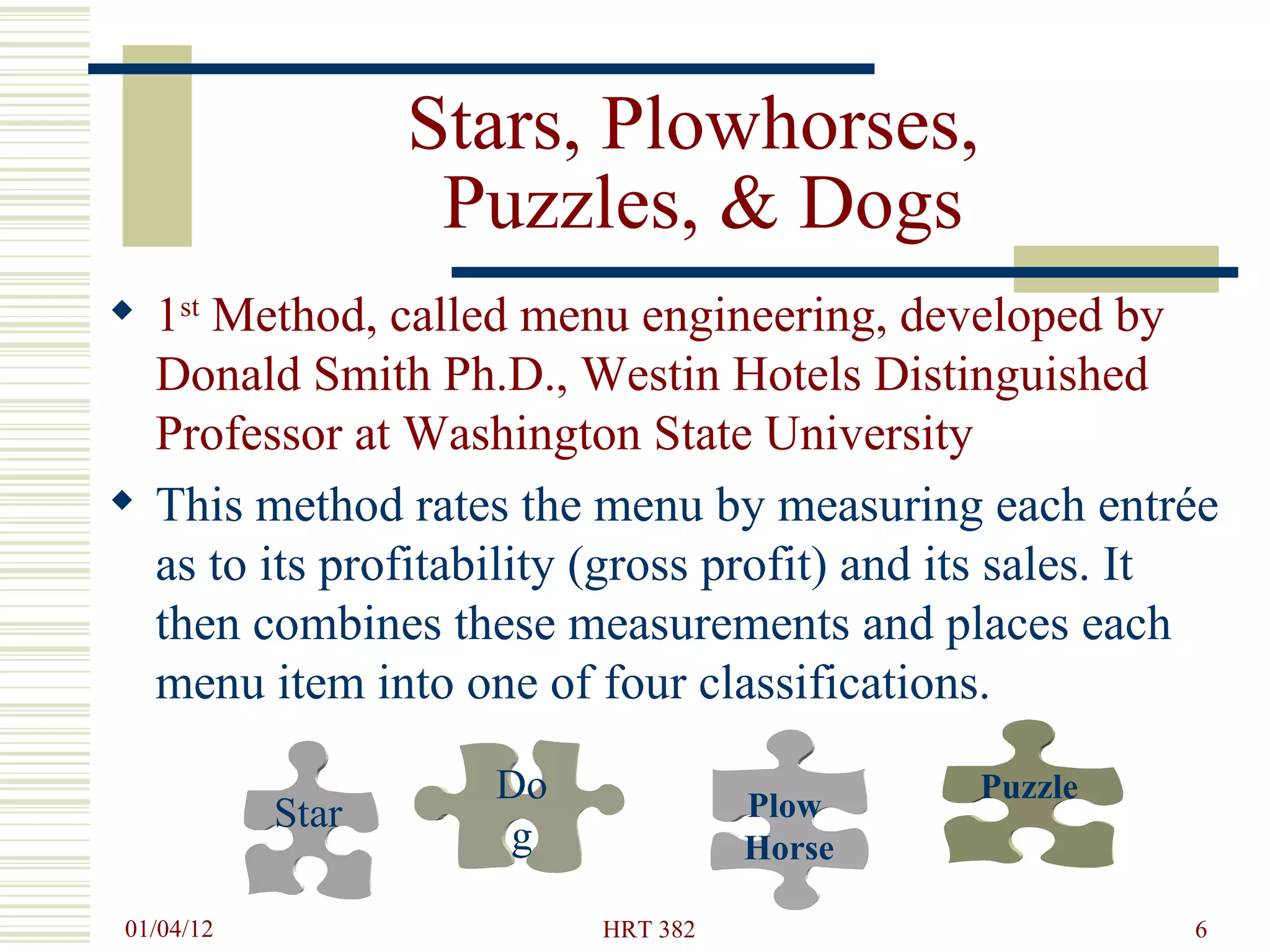
Stars, Plowhorses,  Puzzles, & Dogs 1 st  Method, called menu engineering, developed by Donald Smith Ph.D., Westin Hotels Distinguished Professor at Washington State University This method rates the menu by measuring each entrée as to its profitability (gross profit) and its sales. It then combines these measurements and places each menu item into one of four classifications. Plow  Horse Dog Puzzle Star
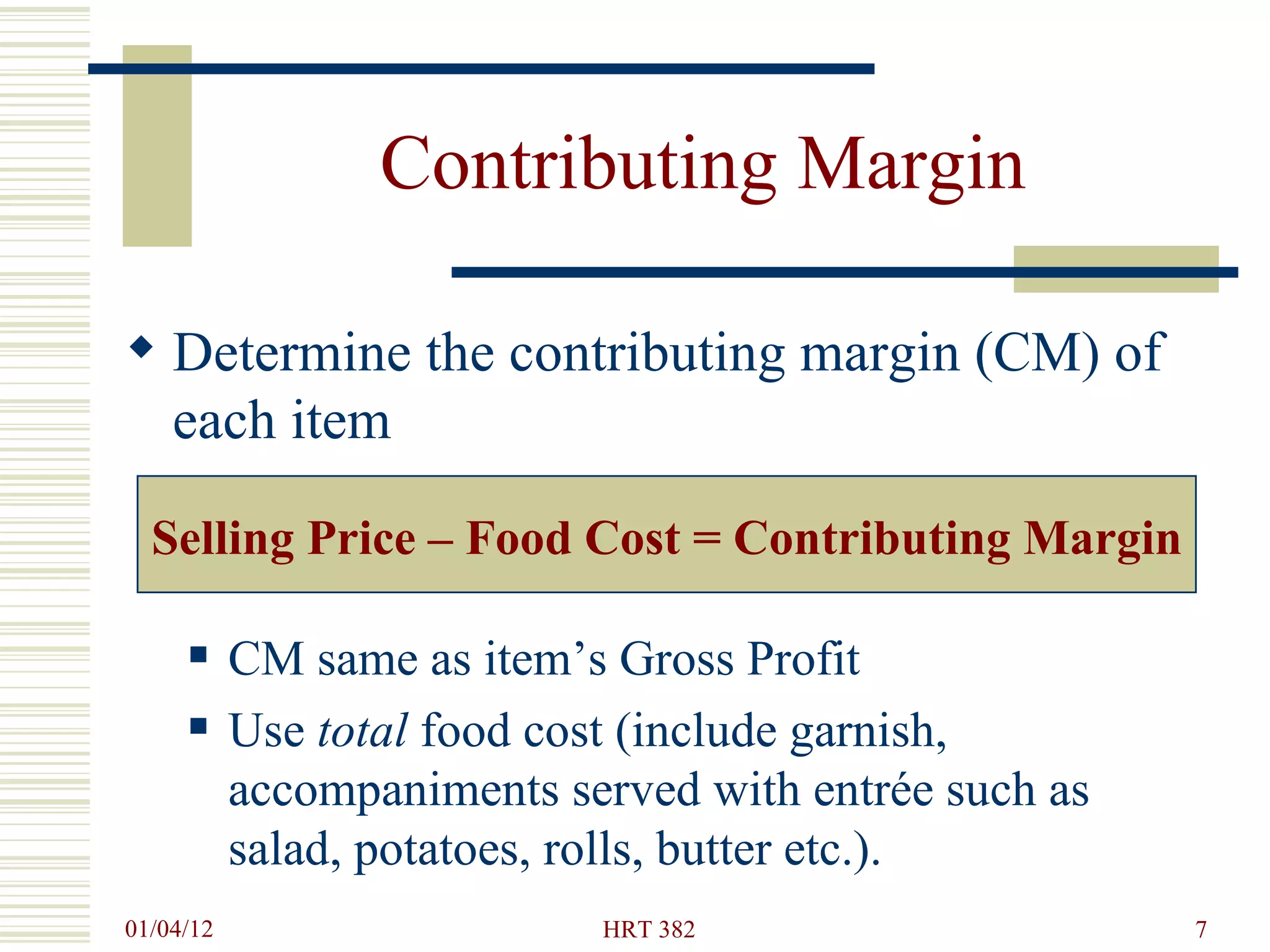
Contributing Margin Determine the contributing margin (CM) of each item CM same as item’s Gross Profit Use  total  food cost (include garnish, accompaniments served with entrée such as salad, potatoes, rolls, butter etc.). Selling Price – Food Cost = Contributing Margin
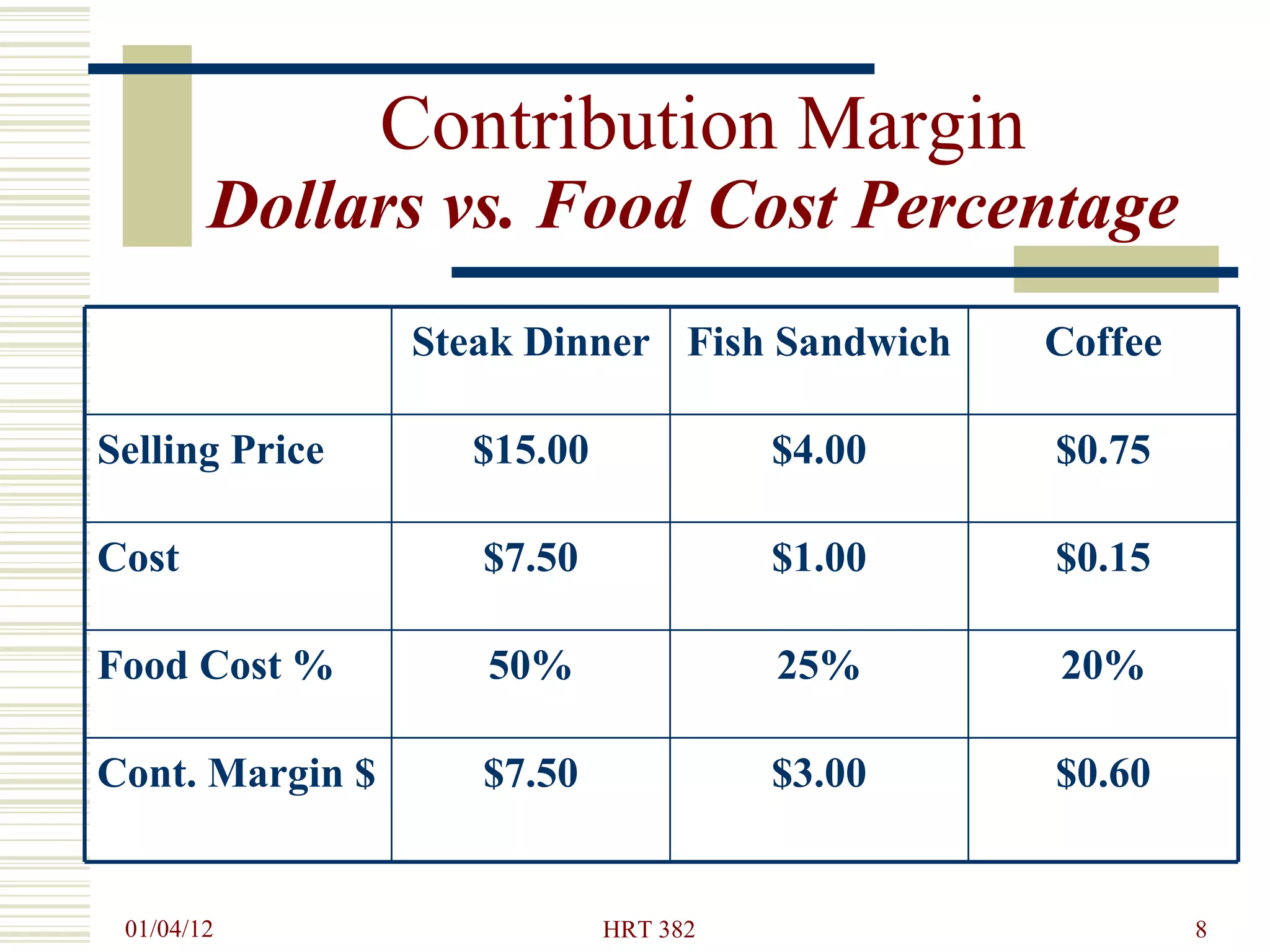
Contribution Margin Dollars vs. Food Cost Percentage   $0.60 $3.00 $7.50 Cont. Margin $ 20% 25% 50% Food Cost % $0.15 $1.00 $7.50 Cost $0.75 $4.00 $15.00 Selling Price Coffee Fish Sandwich Steak Dinner
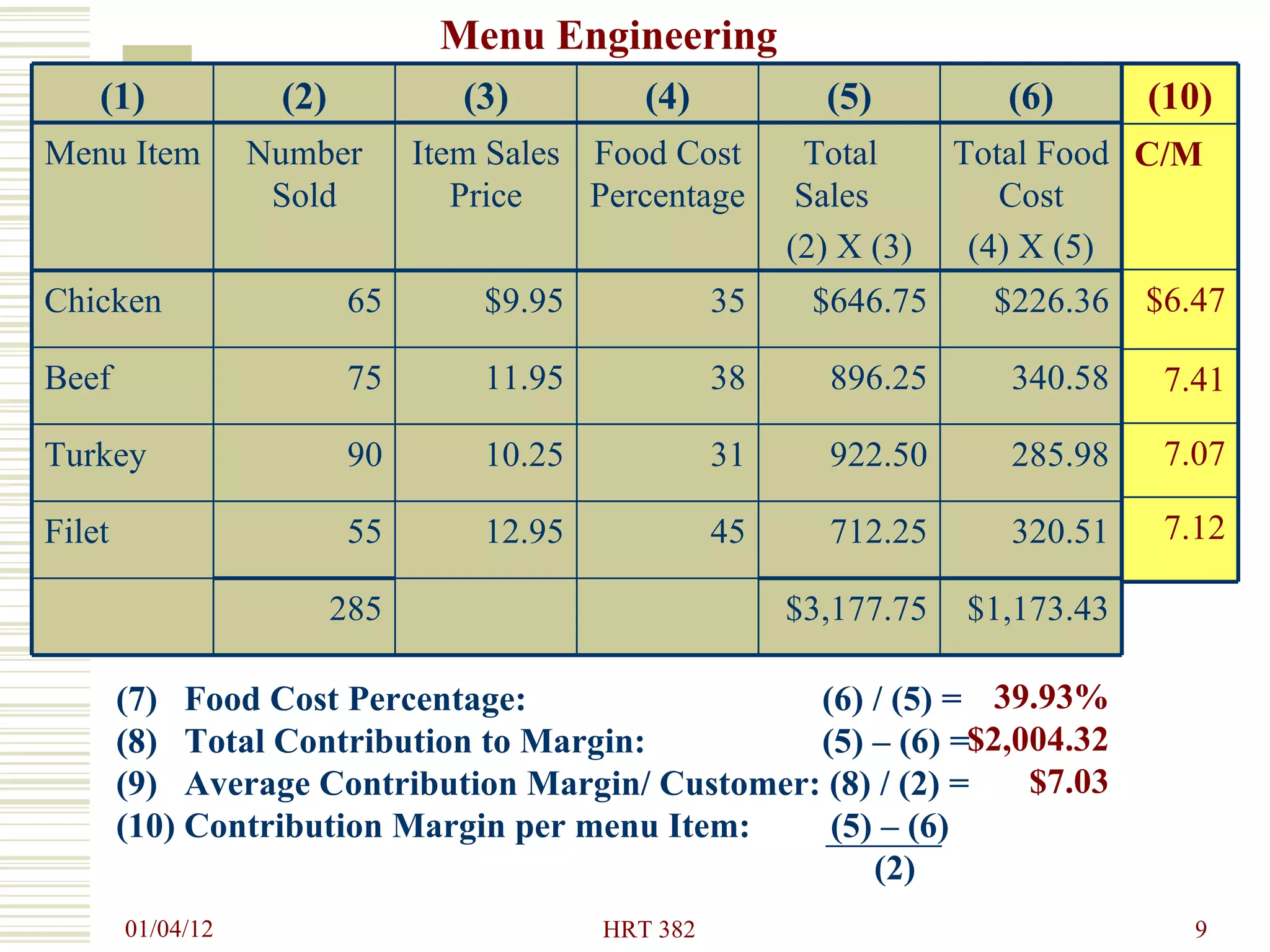
(7)  Food Cost Percentage:   (6) / (5) =  (8)  Total Contribution to Margin:   (5) – (6) = (9)  Average Contribution Margin/ Customer: (8) / (2) = (10) Contribution Margin per menu Item:  (5) – (6)    (2) Menu Engineering 39.93% $2,004.32 $7.03 $1,173.43 $3,177.75 285 320.51 712.25 45 12.95 55 Filet 285.98 922.50 31 10.25 90 Turkey 340.58 896.25 38 11.95 75 Beef $226.36 $646.75 35 $9.95 65 Chicken Total Food Cost (4) X (5) Total  Sales  (2) X (3) Food Cost Percentage Item Sales Price Number Sold Menu Item (6) (5) (4) (3) (2) (1) 7.12 7.07 7.41 $6.47 C/M (10)
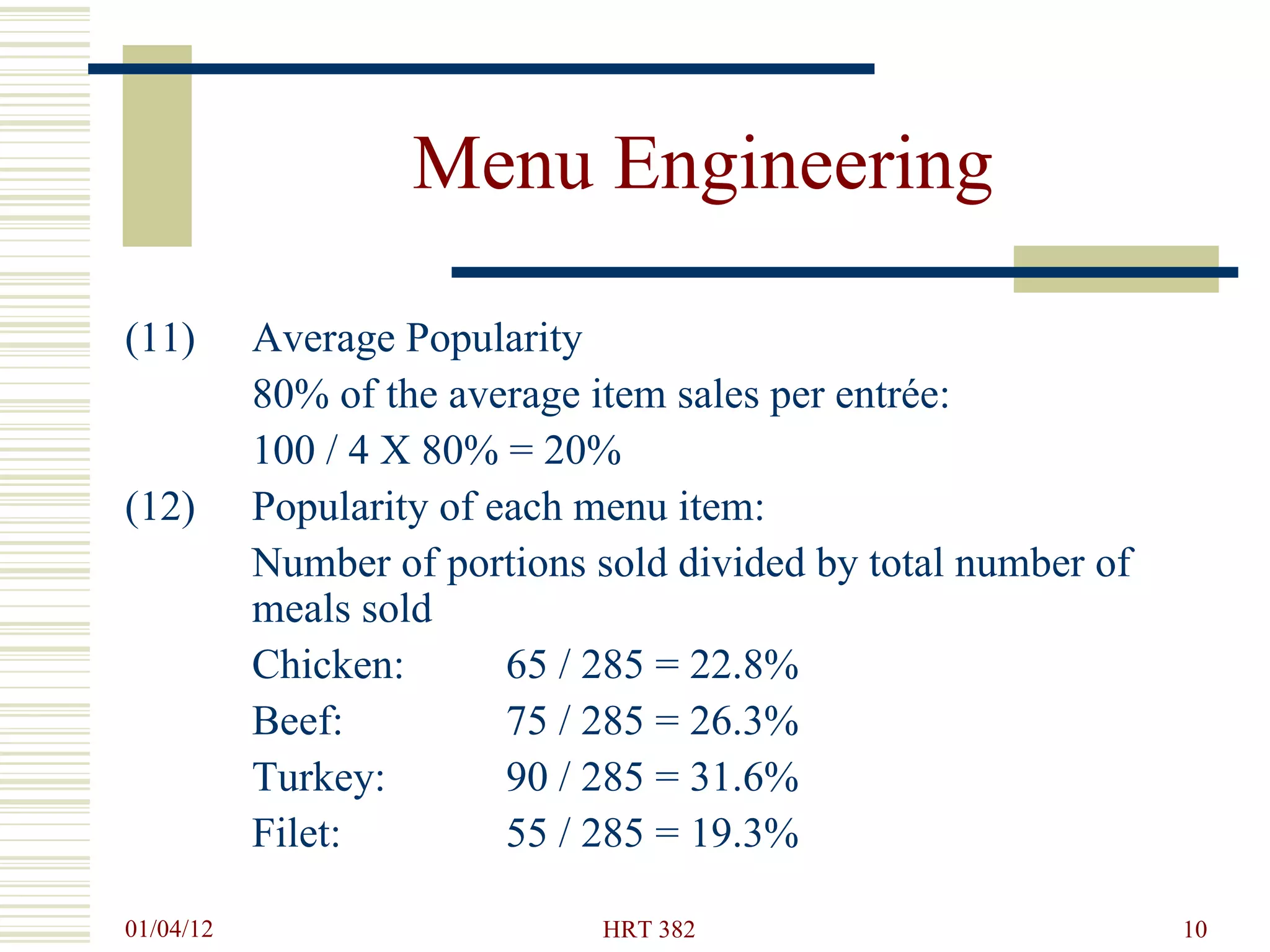
Menu Engineering (11)  Average Popularity 80% of the average item sales per entrée:    100 / 4 X 80% = 20% (12)  Popularity of each menu item: Number of portions sold divided by total number of  meals sold Chicken: 65 / 285 = 22.8% Beef: 75 / 285 = 26.3% Turkey: 90 / 285 = 31.6% Filet: 55 / 285 = 19.3%
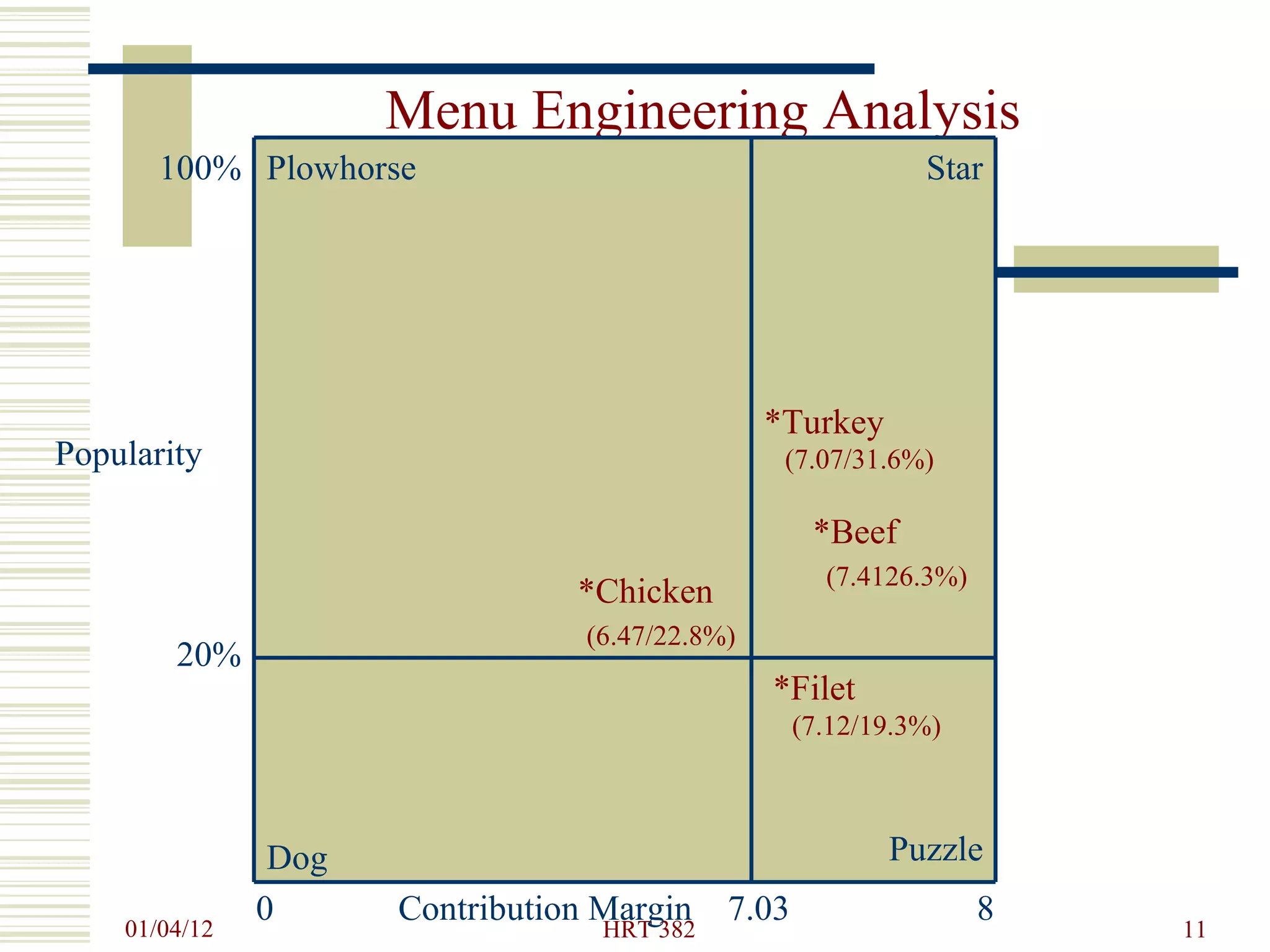
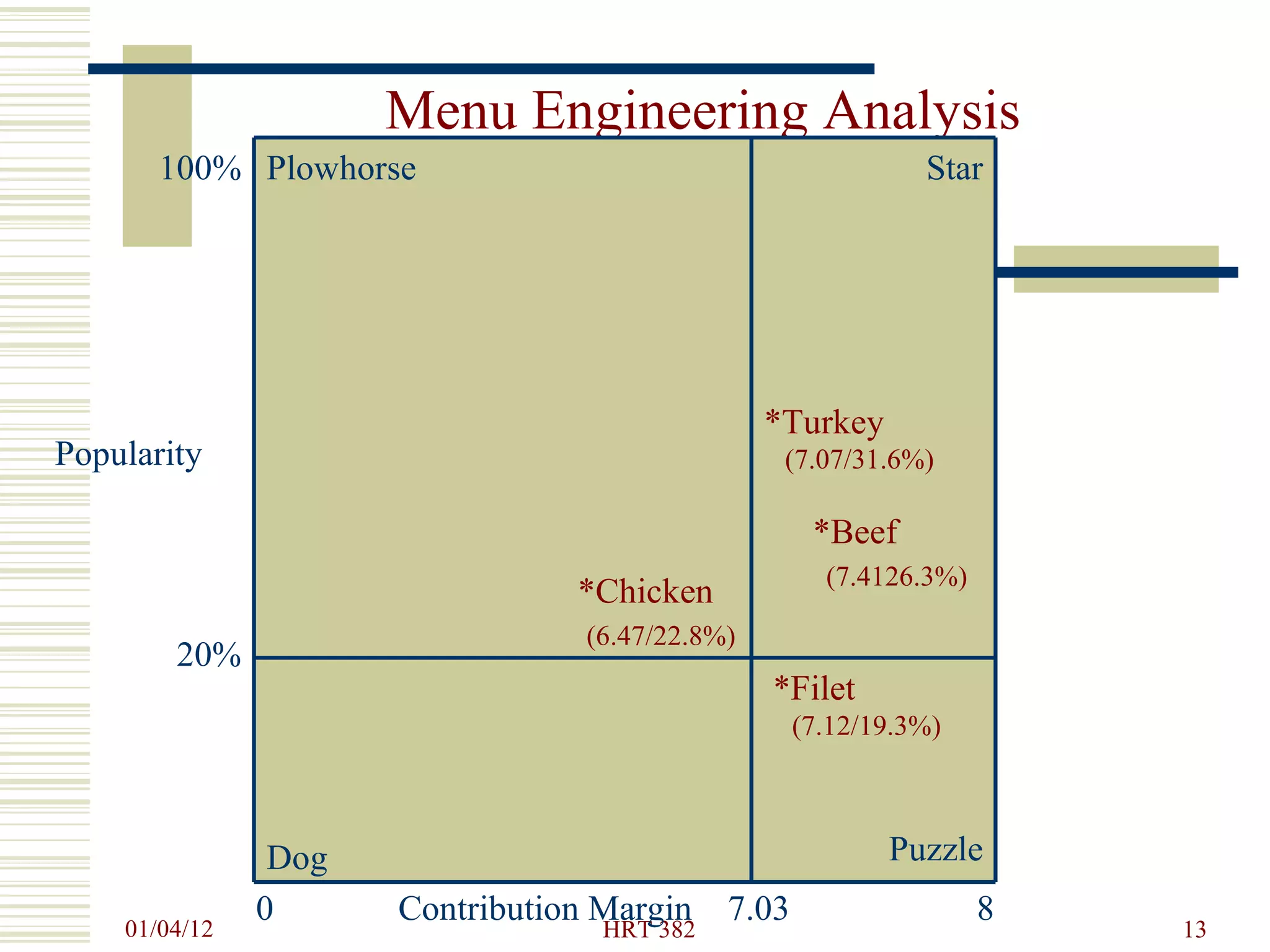
Menu Engineering Analysis 100% 20% Popularity 0  Contribution Margin  7.03  8 *Filet (7.12/19.3%) Puzzle Dog Star *Turkey (7.07/31.6%) *Beef (7.4126.3%) Plowhorse *Chicken (6.47/22.8%)
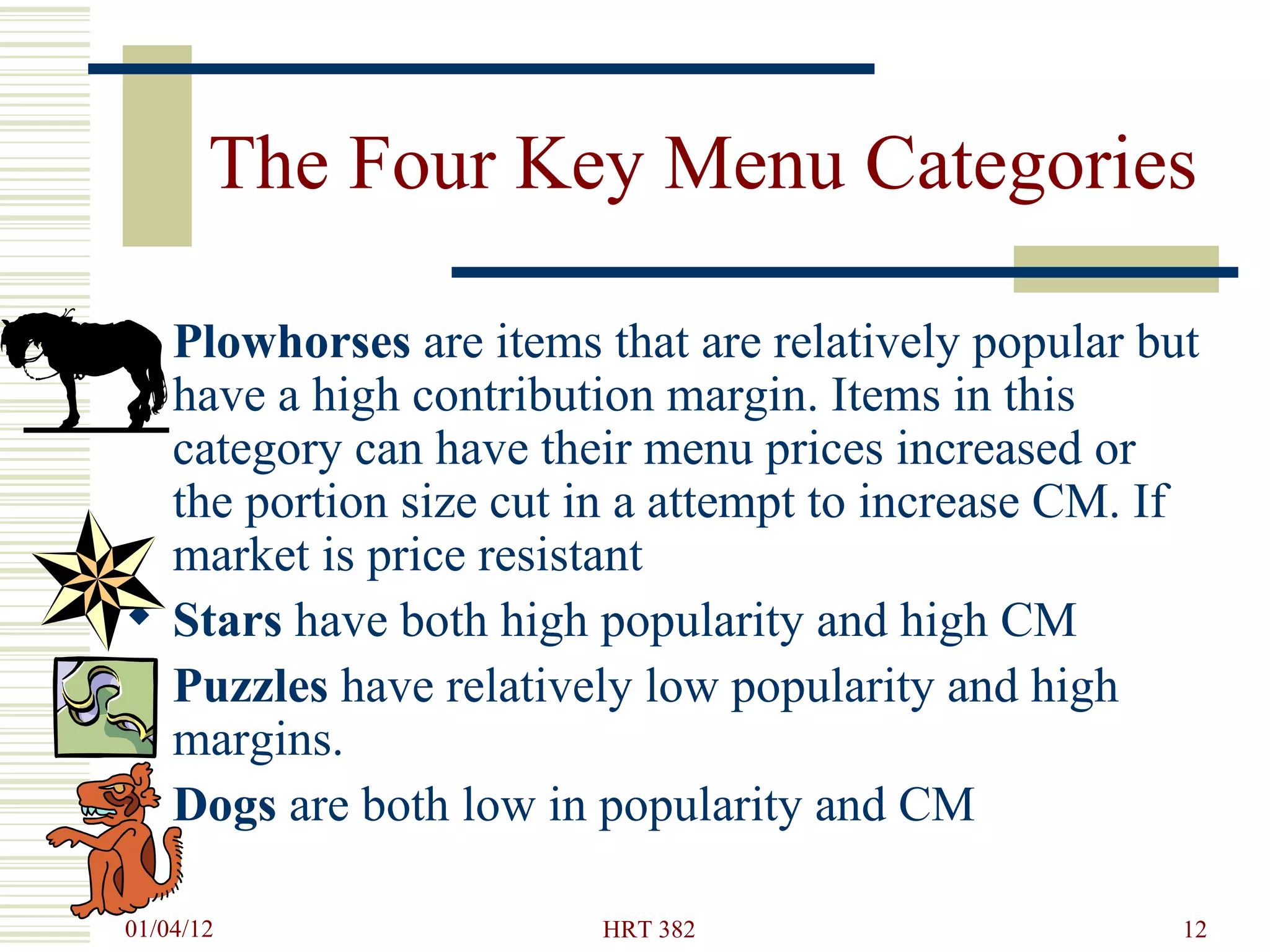
The Four Key Menu Categories Plowhorses  are items that are relatively popular but have a high contribution margin. Items in this category can have their menu prices increased or the portion size cut in a attempt to increase CM. If market is price resistant Stars  have both high popularity and high CM Puzzles  have relatively low popularity and high margins.  Dogs  are both low in popularity and CM
Menu Engineering Analysis 100% 20% Popularity 0  Contribution Margin  7.03  8 *Filet (7.12/19.3%) Puzzle Dog Star *Turkey (7.07/31.6%) *Beef (7.4126.3%) Plowhorse *Chicken (6.47/22.8%)
Menu Scoring Method developed by Michael Hurst, Professor of Restaurant Management at Florida International University, a restaurant owner and past president of the NRA. Devised to ascertain whether menu changes (additions, deletions, and price adjustments) actually improved the profitability of the menu by comparisons of a menu score. One advantage: quick to complete because it does not track every menu item.
Menu Scoring Combines profitability and popularity of menu items to arrive a a consensus score The higher the score, the better the menu An existing menu can be scored, then compared with a proposed menu, after sales for the new menu have been estimated.
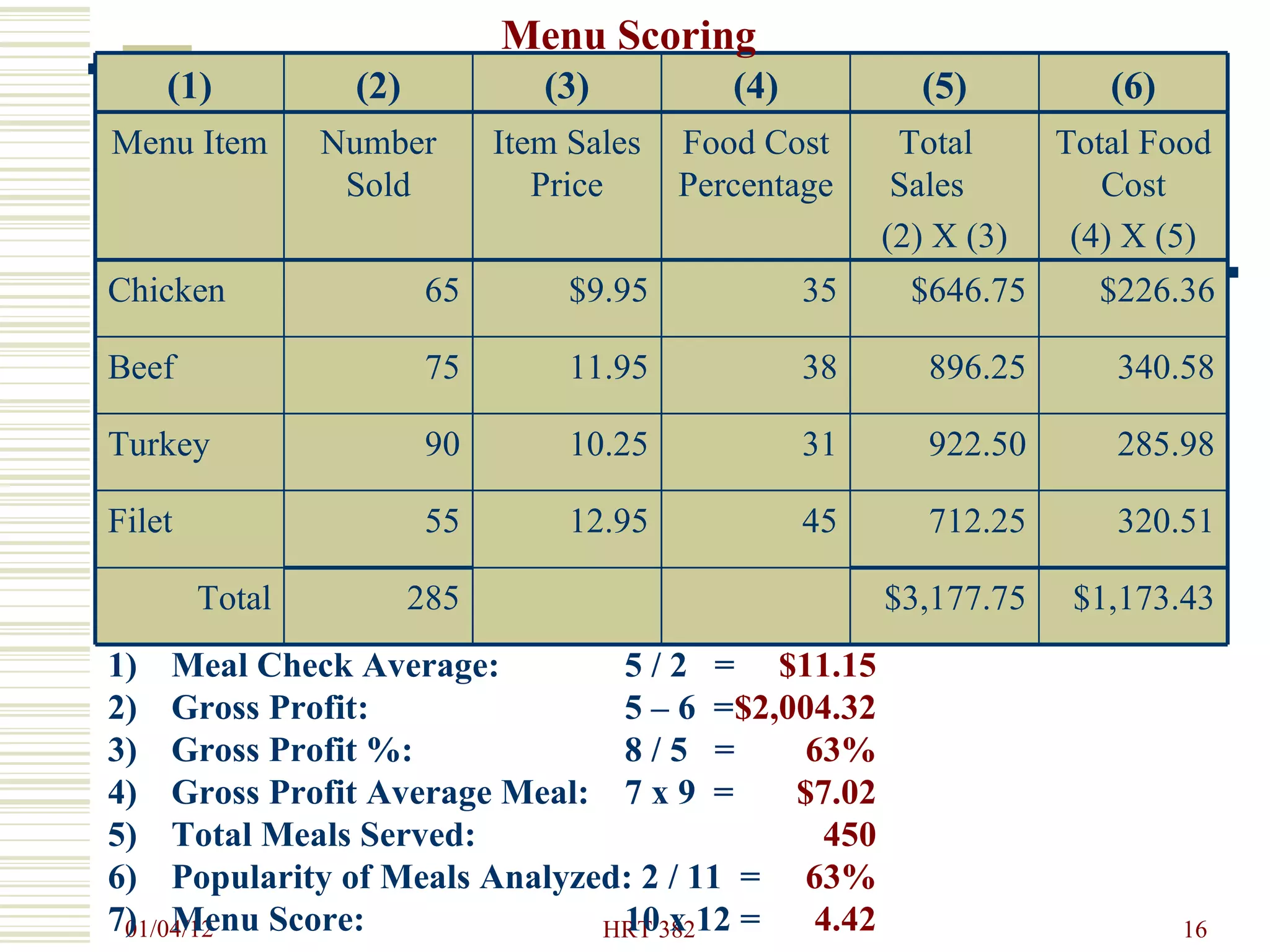
Meal Check Average:  5 / 2  =  Gross Profit:  5 – 6  = Gross Profit %:  8 / 5  = Gross Profit Average Meal:   7 x 9  = Total Meals Served: Popularity of Meals Analyzed: 2 / 11  = Menu Score:  10 x 12 = $11.15 $2,004.32 63% $7.02 450 63% 4.42 Menu Scoring $1,173.43 $3,177.75 285 Total 320.51 712.25 45 12.95 55 Filet 285.98 922.50 31 10.25 90 Turkey 340.58 896.25 38 11.95 75 Beef $226.36 $646.75 35 $9.95 65 Chicken Total Food Cost (4) X (5) Total  Sales  (2) X (3) Food Cost Percentage Item Sales Price Number Sold Menu Item (6) (5) (4) (3) (2) (1)
The Higher the Score  the More Profitable the Menu This method takes into account not only # of items sold, but also their contributing profit
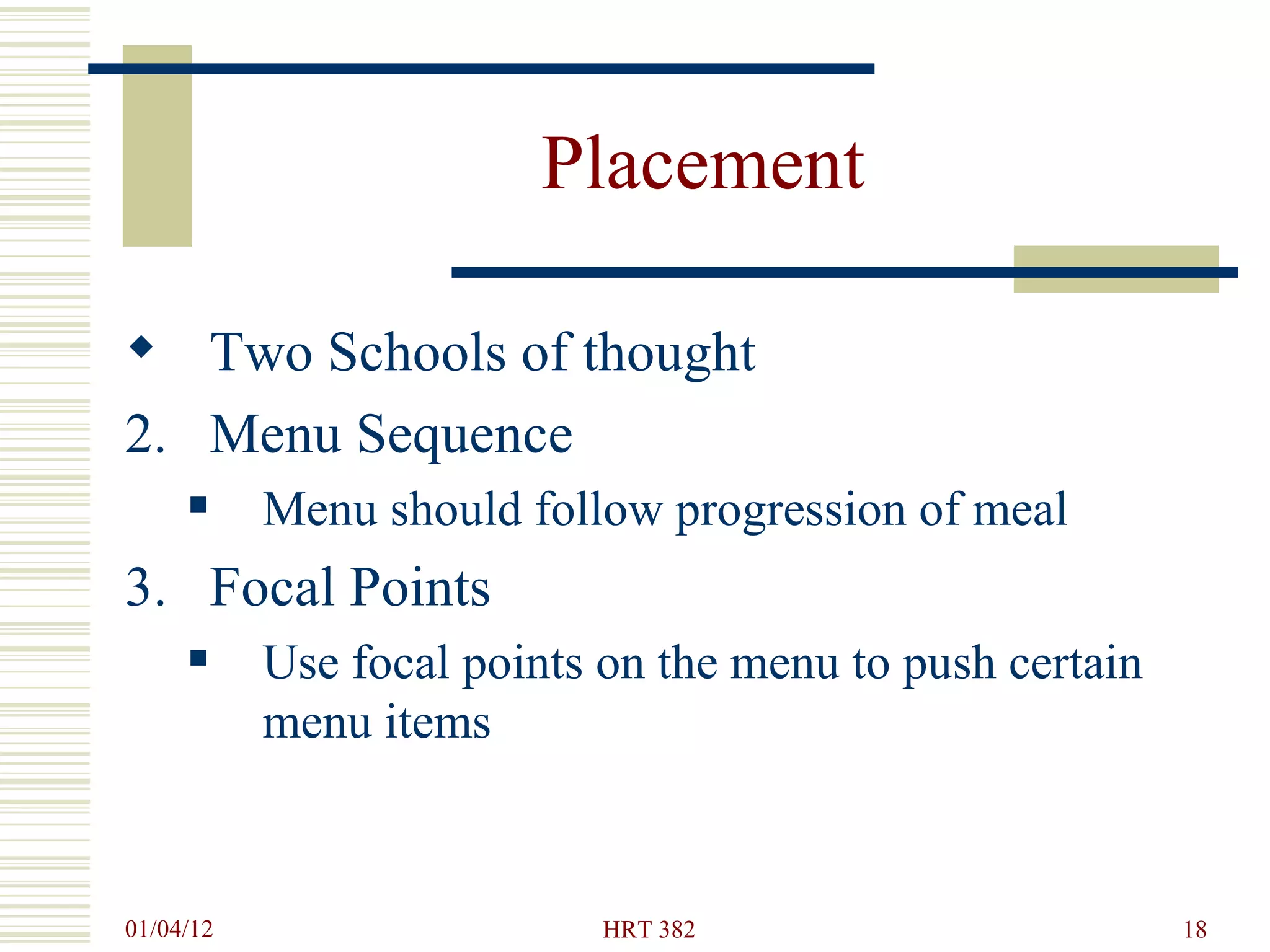
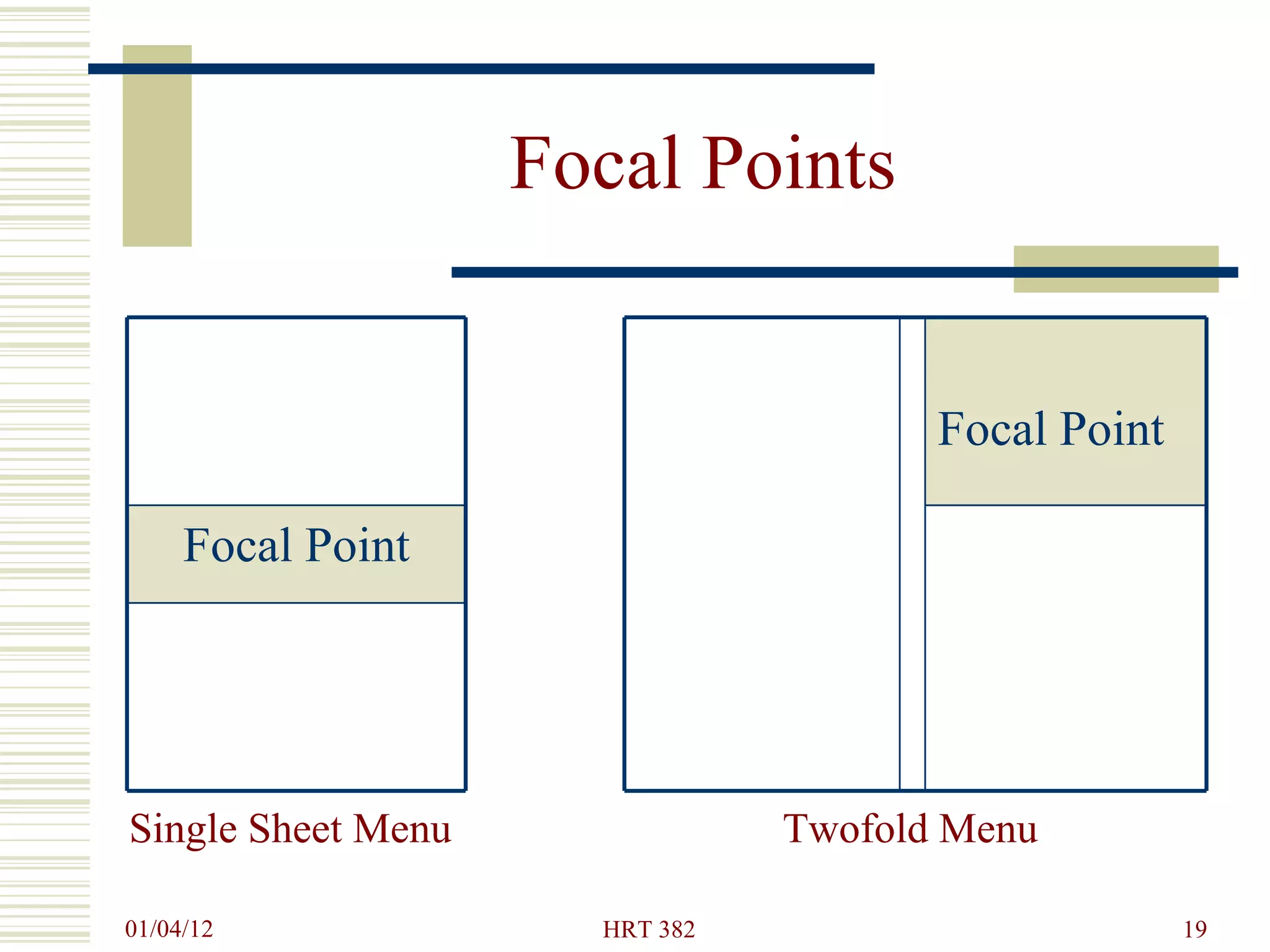
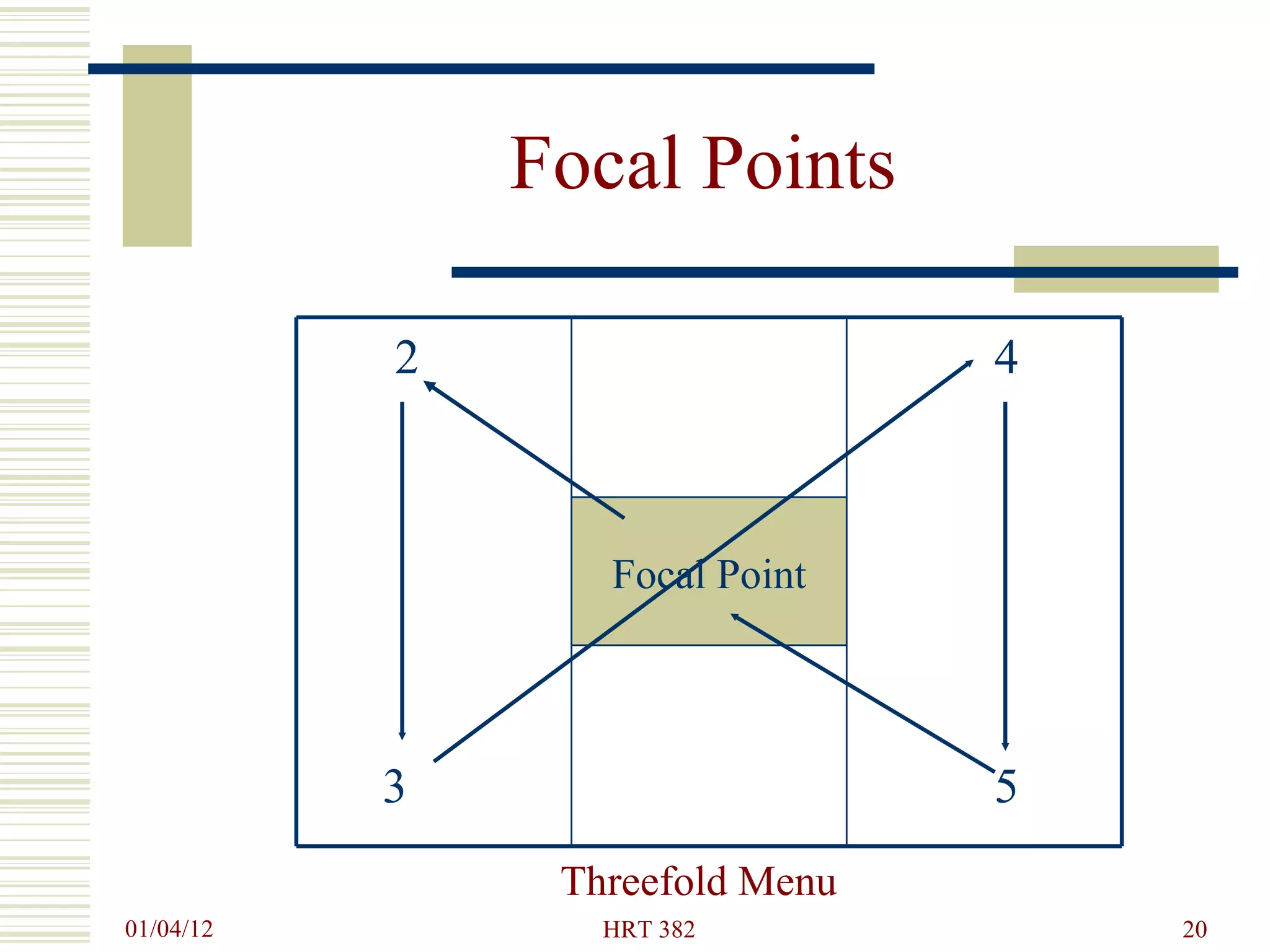
Placement Two Schools of thought Menu Sequence Menu should follow progression of meal Focal Points Use focal points on the menu to push certain menu items
Focal Points Single Sheet Menu Twofold Menu Focal Point Focal Point
Focal Points Focal Point Threefold Menu 4 5 2 3
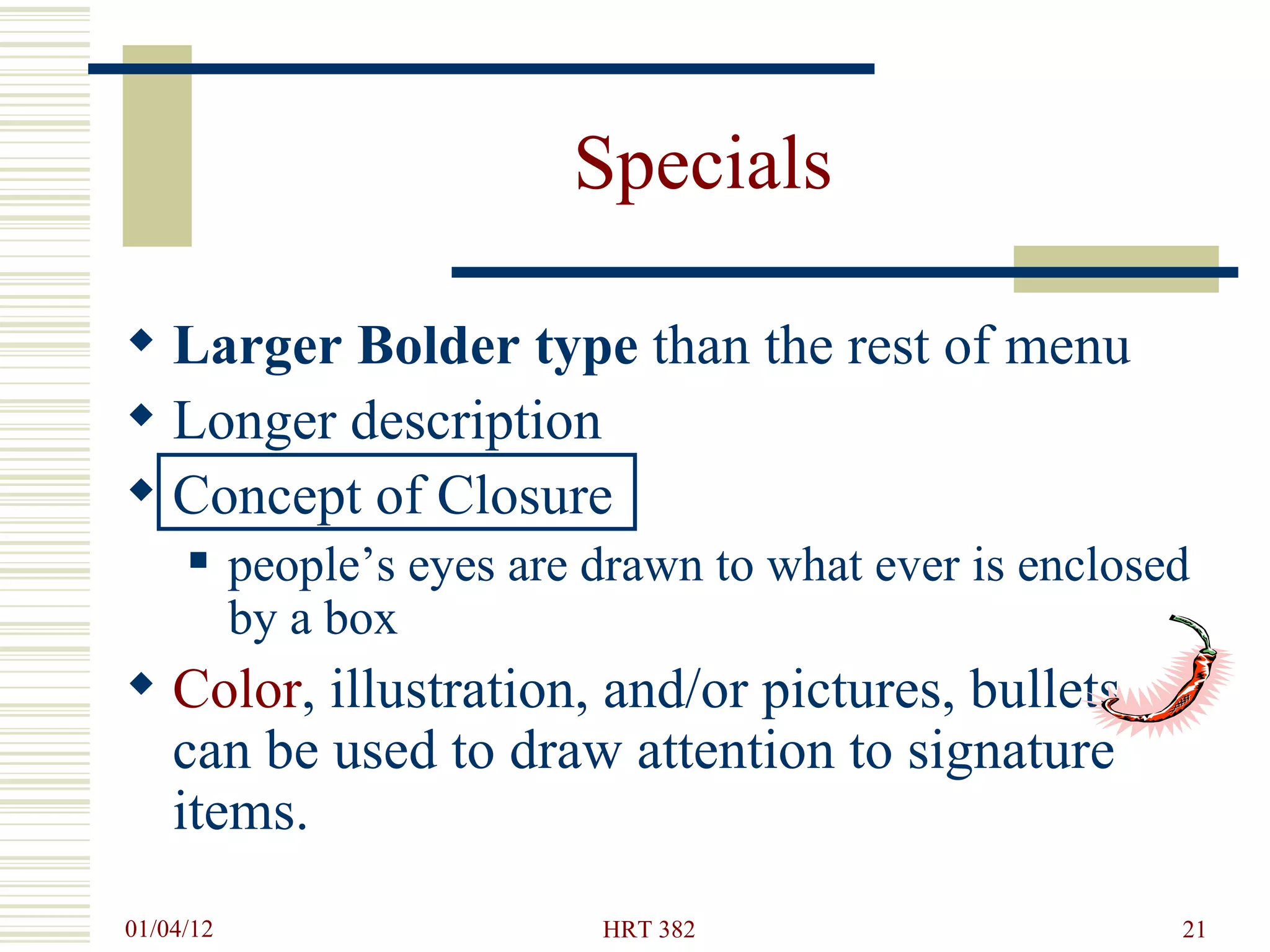
Specials Larger Bolder type  than the rest of menu Longer description Concept of Closure  people’s eyes are drawn to what ever is enclosed by a box Color , illustration, and/or pictures, bullets  can be used to draw attention to signature items.
Branding Fast food Coke / Pepsi TGIF Jack Daniels
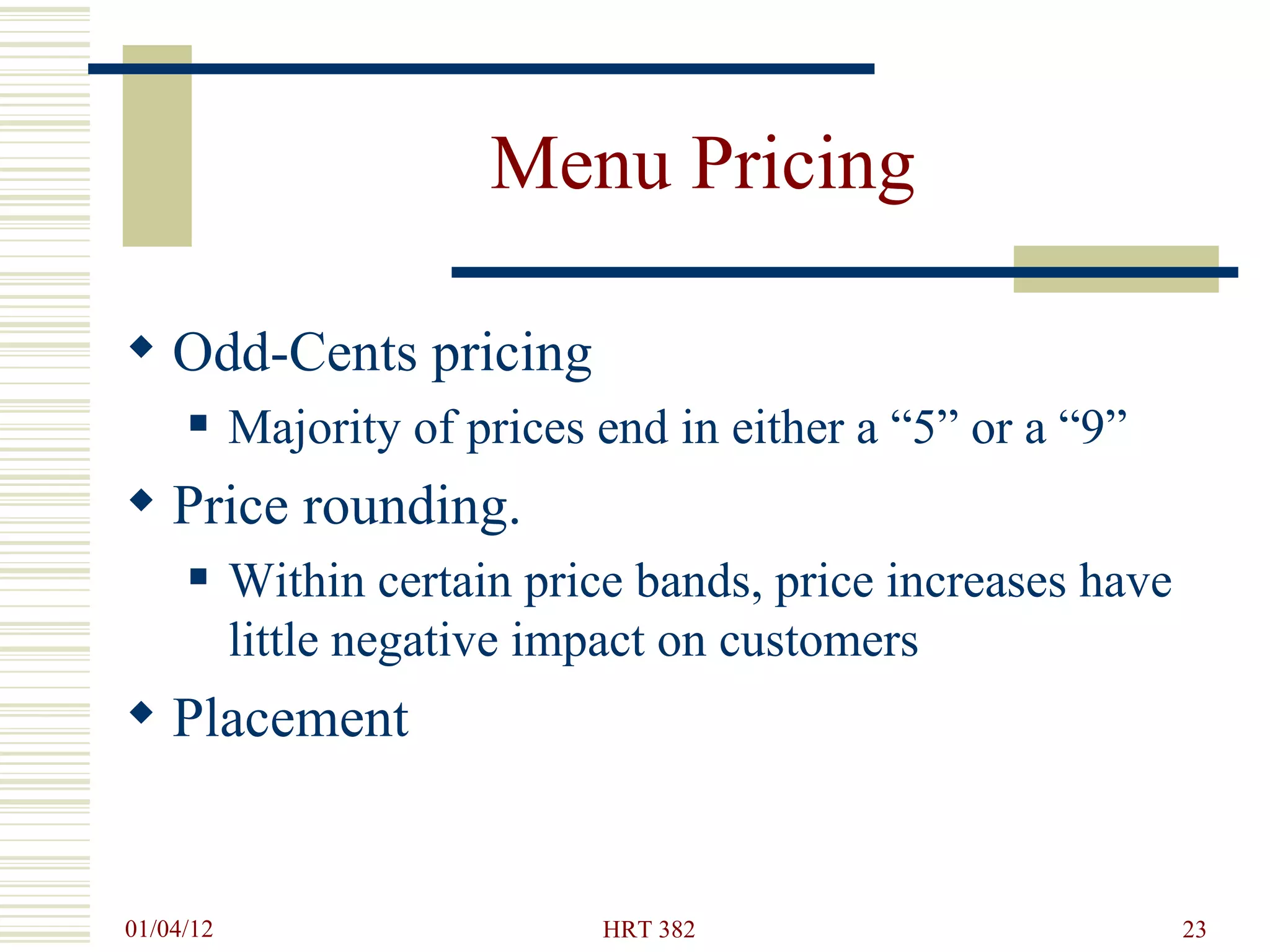
Menu Pricing Odd-Cents pricing Majority of prices end in either a “5” or a “9” Price rounding. Within certain price bands, price increases have little negative impact on customers Placement
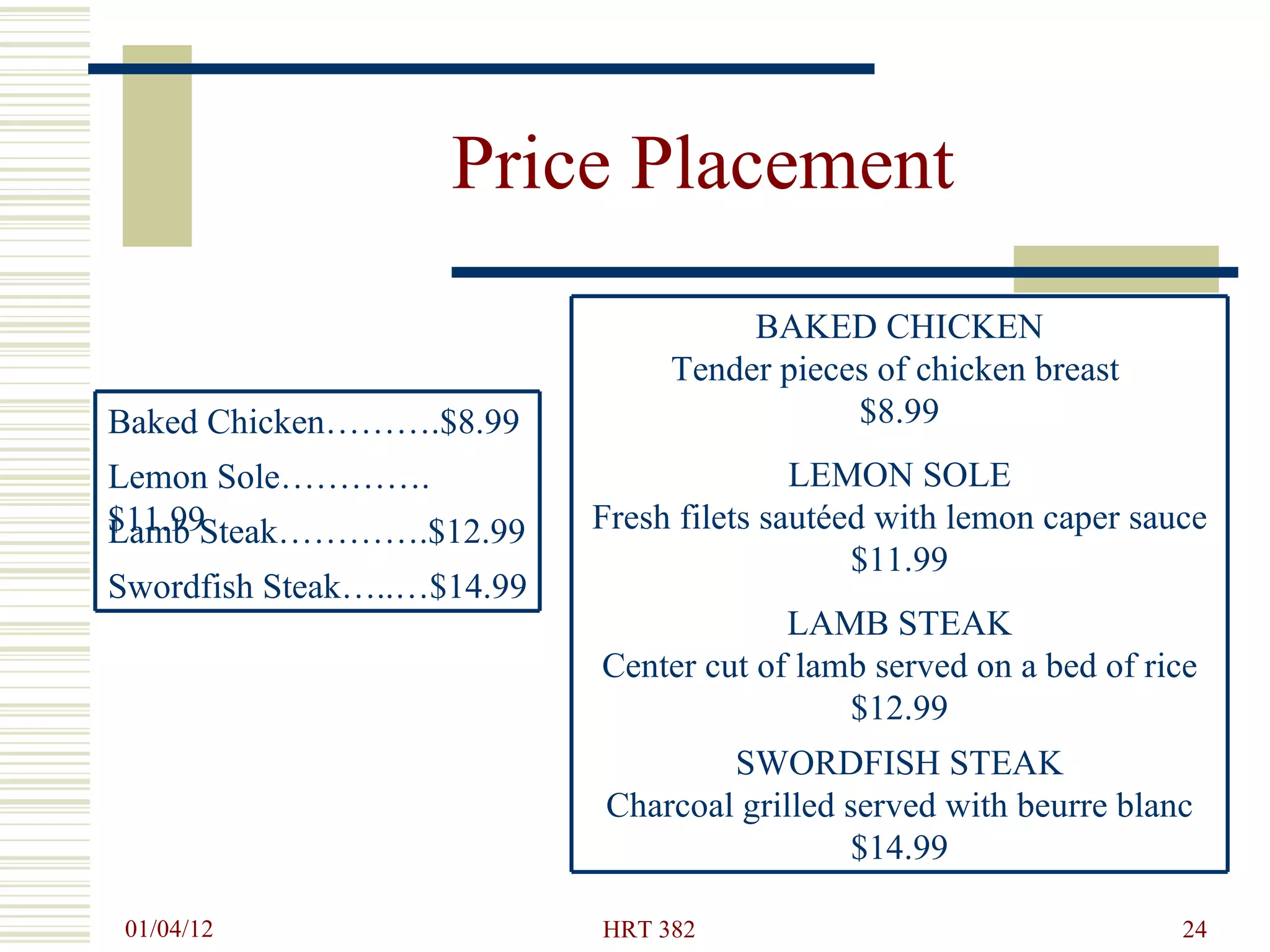
Price Placement Swordfish Steak…..…$14.99 Lamb Steak………….$12.99 Lemon Sole………….$11.99 Baked Chicken……….$8.99 SWORDFISH STEAK Charcoal grilled served with beurre blanc $14.99 LAMB STEAK Center cut of lamb served on a bed of rice  $12.99 LEMON SOLE Fresh filets sautéed with lemon caper sauce $11.99 BAKED CHICKEN Tender pieces of chicken breast  $8.99
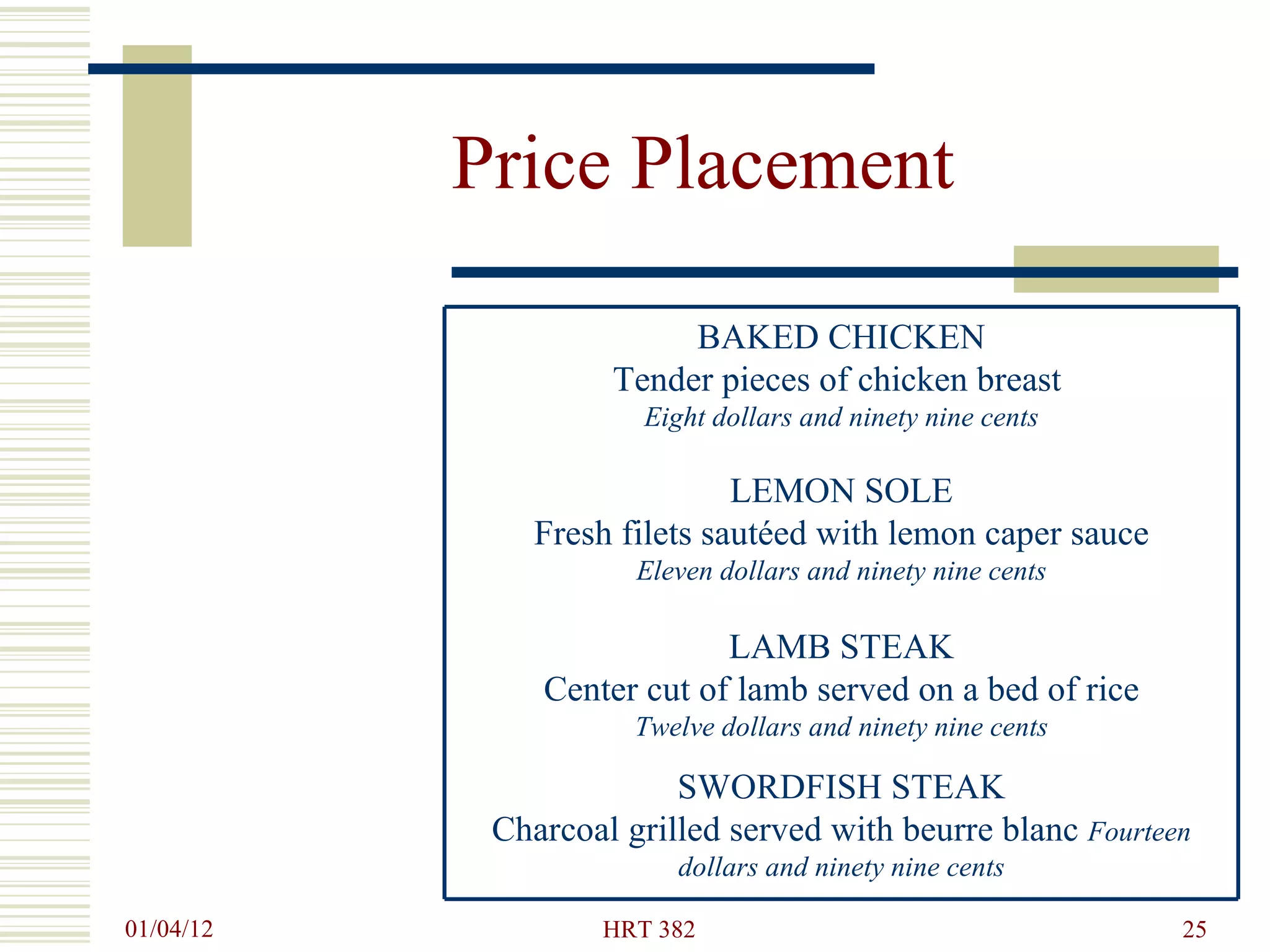
Price Placement SWORDFISH STEAK Charcoal grilled served with beurre blanc  Fourteen dollars and ninety nine cents LAMB STEAK Center cut of lamb served on a bed of rice  Twelve dollars and ninety nine cents LEMON SOLE Fresh filets sautéed with lemon caper sauce Eleven dollars and ninety nine cents BAKED CHICKEN Tender pieces of chicken breast  Eight dollars and ninety nine cents
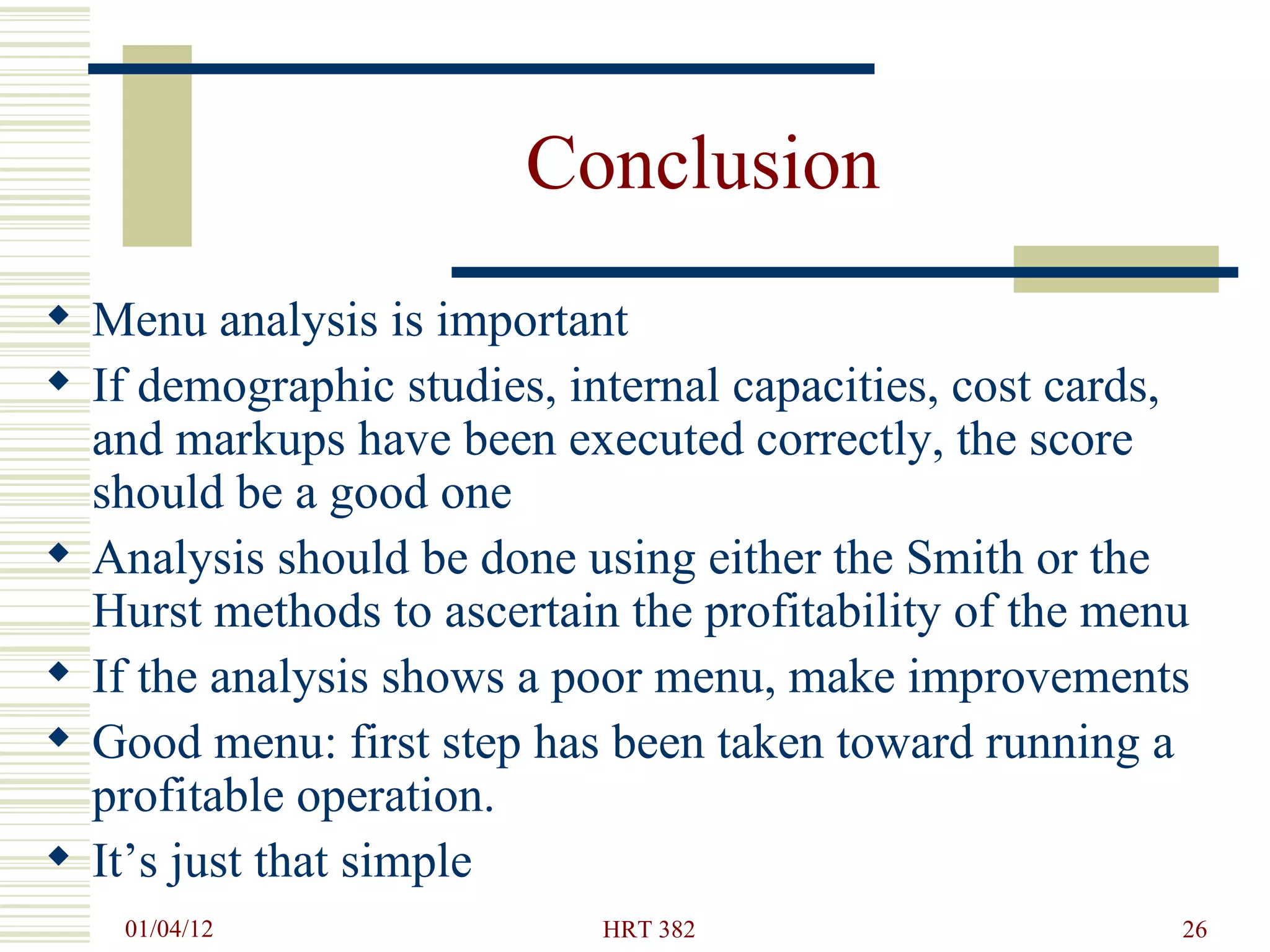
Conclusion Menu analysis is important If demographic studies, internal capacities, cost cards, and markups have been executed correctly, the score should be a good one Analysis should be done using either the Smith or the Hurst methods to ascertain the profitability of the menu If the analysis shows a poor menu, make improvements Good menu: first step has been taken toward running a profitable operation. It’s just that simple
Where to Get More Information Mill, Robert Christie (1998) Restaurant Management: Customers, operations, and employees / Menu Scoring & Menu Engineering, pp 114-116. Upper Saddle River, N.J. : Prentice Hall. Drysdale, John A. & Jennifer Adams Aldrich (2002). Profitable menu planning / Chapter 5: Menu Analysis, pp. 101-115.  3rd ed. Upper Saddle River, N.J. : Prentice Hall, TX911.3.M45 D79 2002   CD-ROM TX911.3.M45 D79 2002  Most Menu & F&B Management Books

Menu analysis engineering382

  • 1.
    Menu Analysis &Engineering HRT383 By Dr. Ben Dewald
  • 2.
    References Mill, RobertChristie (1998) Restaurant Management: Customers, operations, and employees / Menu Scoring & Menu Engineering, pp 114-116. Upper Saddle River, N.J. : Prentice Hall. Drysdale, John A. & Jennifer Adams Aldrich (2002). Profitable menu planning / Chapter 5: Menu Analysis, pp. 101-115. 3rd ed. Upper Saddle River, N.J. : Prentice Hall, TX911.3.M45 D79 2002  CD-ROM TX911.3.M45 D79 2002  
  • 3.
    Objectives By thecompletion of this presentation you should be able to: Analyze a menu for profitability Apply menu engineering to menu analysis Apply menu scoring methods to menu analysis.
  • 4.
    Important Terms Menuengineering Plowhorses Puzzles Stars Dogs Menu scoring Placement Pricing
  • 5.
    Introduction Thispresentation explains how to evaluate a menu When measuring a menu to see if it is successful 2 criteria must be met to declare it a winner: Must be profitable in terms of individual item profitability Most profitable item must be selling the best.
  • 6.
    Stars, Plowhorses, Puzzles, & Dogs 1 st Method, called menu engineering, developed by Donald Smith Ph.D., Westin Hotels Distinguished Professor at Washington State University This method rates the menu by measuring each entrée as to its profitability (gross profit) and its sales. It then combines these measurements and places each menu item into one of four classifications. Plow Horse Dog Puzzle Star
  • 7.
    Contributing Margin Determinethe contributing margin (CM) of each item CM same as item’s Gross Profit Use total food cost (include garnish, accompaniments served with entrée such as salad, potatoes, rolls, butter etc.). Selling Price – Food Cost = Contributing Margin
  • 8.
    Contribution Margin Dollarsvs. Food Cost Percentage $0.60 $3.00 $7.50 Cont. Margin $ 20% 25% 50% Food Cost % $0.15 $1.00 $7.50 Cost $0.75 $4.00 $15.00 Selling Price Coffee Fish Sandwich Steak Dinner
  • 9.
    (7) FoodCost Percentage: (6) / (5) = (8) Total Contribution to Margin: (5) – (6) = (9) Average Contribution Margin/ Customer: (8) / (2) = (10) Contribution Margin per menu Item: (5) – (6) (2) Menu Engineering 39.93% $2,004.32 $7.03 $1,173.43 $3,177.75 285 320.51 712.25 45 12.95 55 Filet 285.98 922.50 31 10.25 90 Turkey 340.58 896.25 38 11.95 75 Beef $226.36 $646.75 35 $9.95 65 Chicken Total Food Cost (4) X (5) Total Sales (2) X (3) Food Cost Percentage Item Sales Price Number Sold Menu Item (6) (5) (4) (3) (2) (1) 7.12 7.07 7.41 $6.47 C/M (10)
  • 10.
    Menu Engineering (11) Average Popularity 80% of the average item sales per entrée: 100 / 4 X 80% = 20% (12) Popularity of each menu item: Number of portions sold divided by total number of meals sold Chicken: 65 / 285 = 22.8% Beef: 75 / 285 = 26.3% Turkey: 90 / 285 = 31.6% Filet: 55 / 285 = 19.3%
  • 11.
    Menu Engineering Analysis100% 20% Popularity 0 Contribution Margin 7.03 8 *Filet (7.12/19.3%) Puzzle Dog Star *Turkey (7.07/31.6%) *Beef (7.4126.3%) Plowhorse *Chicken (6.47/22.8%)
  • 12.
    The Four KeyMenu Categories Plowhorses are items that are relatively popular but have a high contribution margin. Items in this category can have their menu prices increased or the portion size cut in a attempt to increase CM. If market is price resistant Stars have both high popularity and high CM Puzzles have relatively low popularity and high margins. Dogs are both low in popularity and CM
  • 13.
    Menu Engineering Analysis100% 20% Popularity 0 Contribution Margin 7.03 8 *Filet (7.12/19.3%) Puzzle Dog Star *Turkey (7.07/31.6%) *Beef (7.4126.3%) Plowhorse *Chicken (6.47/22.8%)
  • 14.
    Menu Scoring Methoddeveloped by Michael Hurst, Professor of Restaurant Management at Florida International University, a restaurant owner and past president of the NRA. Devised to ascertain whether menu changes (additions, deletions, and price adjustments) actually improved the profitability of the menu by comparisons of a menu score. One advantage: quick to complete because it does not track every menu item.
  • 15.
    Menu Scoring Combinesprofitability and popularity of menu items to arrive a a consensus score The higher the score, the better the menu An existing menu can be scored, then compared with a proposed menu, after sales for the new menu have been estimated.
  • 16.
    Meal Check Average: 5 / 2 = Gross Profit: 5 – 6 = Gross Profit %: 8 / 5 = Gross Profit Average Meal: 7 x 9 = Total Meals Served: Popularity of Meals Analyzed: 2 / 11 = Menu Score: 10 x 12 = $11.15 $2,004.32 63% $7.02 450 63% 4.42 Menu Scoring $1,173.43 $3,177.75 285 Total 320.51 712.25 45 12.95 55 Filet 285.98 922.50 31 10.25 90 Turkey 340.58 896.25 38 11.95 75 Beef $226.36 $646.75 35 $9.95 65 Chicken Total Food Cost (4) X (5) Total Sales (2) X (3) Food Cost Percentage Item Sales Price Number Sold Menu Item (6) (5) (4) (3) (2) (1)
  • 17.
    The Higher theScore the More Profitable the Menu This method takes into account not only # of items sold, but also their contributing profit
  • 18.
    Placement Two Schoolsof thought Menu Sequence Menu should follow progression of meal Focal Points Use focal points on the menu to push certain menu items
  • 19.
    Focal Points SingleSheet Menu Twofold Menu Focal Point Focal Point
  • 20.
    Focal Points FocalPoint Threefold Menu 4 5 2 3
  • 21.
    Specials Larger Boldertype than the rest of menu Longer description Concept of Closure people’s eyes are drawn to what ever is enclosed by a box Color , illustration, and/or pictures, bullets can be used to draw attention to signature items.
  • 22.
    Branding Fast foodCoke / Pepsi TGIF Jack Daniels
  • 23.
    Menu Pricing Odd-Centspricing Majority of prices end in either a “5” or a “9” Price rounding. Within certain price bands, price increases have little negative impact on customers Placement
  • 24.
    Price Placement SwordfishSteak…..…$14.99 Lamb Steak………….$12.99 Lemon Sole………….$11.99 Baked Chicken……….$8.99 SWORDFISH STEAK Charcoal grilled served with beurre blanc $14.99 LAMB STEAK Center cut of lamb served on a bed of rice $12.99 LEMON SOLE Fresh filets sautéed with lemon caper sauce $11.99 BAKED CHICKEN Tender pieces of chicken breast $8.99
  • 25.
    Price Placement SWORDFISHSTEAK Charcoal grilled served with beurre blanc Fourteen dollars and ninety nine cents LAMB STEAK Center cut of lamb served on a bed of rice Twelve dollars and ninety nine cents LEMON SOLE Fresh filets sautéed with lemon caper sauce Eleven dollars and ninety nine cents BAKED CHICKEN Tender pieces of chicken breast Eight dollars and ninety nine cents
  • 26.
    Conclusion Menu analysisis important If demographic studies, internal capacities, cost cards, and markups have been executed correctly, the score should be a good one Analysis should be done using either the Smith or the Hurst methods to ascertain the profitability of the menu If the analysis shows a poor menu, make improvements Good menu: first step has been taken toward running a profitable operation. It’s just that simple
  • 27.
    Where to GetMore Information Mill, Robert Christie (1998) Restaurant Management: Customers, operations, and employees / Menu Scoring & Menu Engineering, pp 114-116. Upper Saddle River, N.J. : Prentice Hall. Drysdale, John A. & Jennifer Adams Aldrich (2002). Profitable menu planning / Chapter 5: Menu Analysis, pp. 101-115. 3rd ed. Upper Saddle River, N.J. : Prentice Hall, TX911.3.M45 D79 2002  CD-ROM TX911.3.M45 D79 2002  Most Menu & F&B Management Books

Editor's Notes

  • #6 For evaluating menus, several systems are available. Two of the most widely used methods will be presented here.
  • #8 One point to understand before delving into menu engineering is the theory of contributing margins.
  • #9 Note: Relationship between food cost % and contribution margin in $ is not consistent. An item that has a high contribution margin in $ does not necessarily have a low food cost %. Too often, management is led to believe that low food cost % are the primary objective. Not so, you can’t take % to the bank, you take money.
  • #13 Plowhorses If the market does not resist the price increase, this action will move a plowhorse into the star category. If market is price resistant, the item can be buried in a inconspicuous place on the menu in the knowledge that people will find these relative bargains anyway. Stars It may be possible to increase menu price and/or cut portion size to increase profits while maintaining volume Puzzles They need to be promoted more to stimulate sales. Dogs Prime candidates to be dropped from the menu. In the example; CHICKEN would be dropped from the menu, while the FILET would be promoted more heavily. The prices on the BEEF and the TURKEY might be raised a little and featured more visibly on the menu.
  • #14 In the example; CHICKEN would be dropped from the menu, while the FILET would be promoted more heavily. The prices on the BEEF and the TURKEY might be raised a little and featured more visibly on the menu.