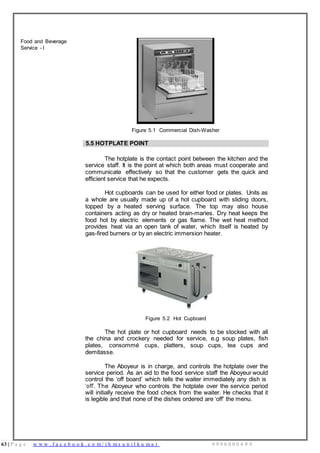
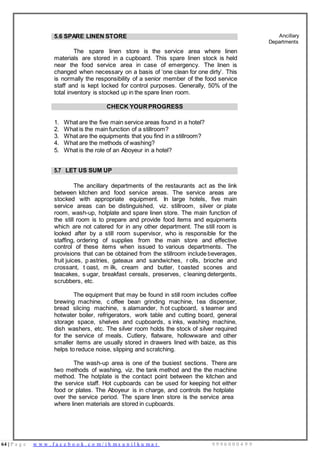
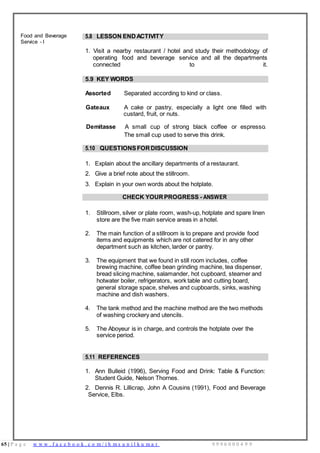
1 | P a g e w w w . f a c e b o o k . c o m / i h m s u n i l k u m a r 9 9 9 6 0 0 0 4 9 9
FOOD AND BEVERAGE SERVICE -
I
CONTENTS
Page Nos.
UNIT - I
Lesson 1 Introduction to Hotel Industry 3 - 12
Lesson 2 Restaurant 13 - 28
Lesson 3 Waiter 29 - 36
UNIT - II
Lesson 4 Restaurant Operating Equipments 39 - 62
Lesson 5 Ancillary Departments 63 - 68
Lesson 6 Preparation for Service 69 - 76
UNIT - III
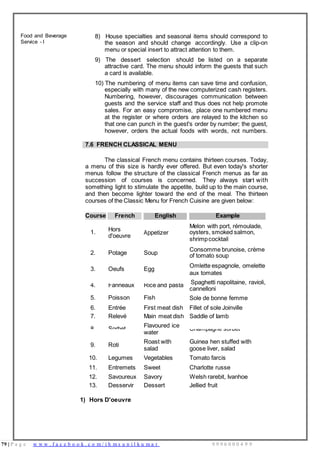
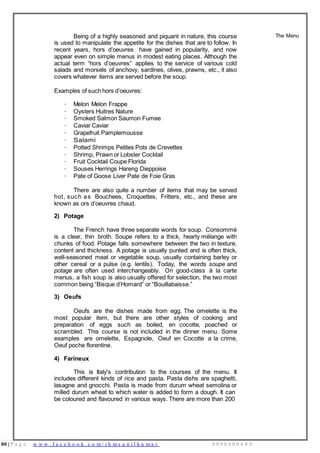
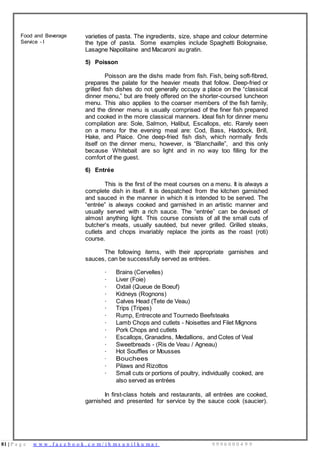
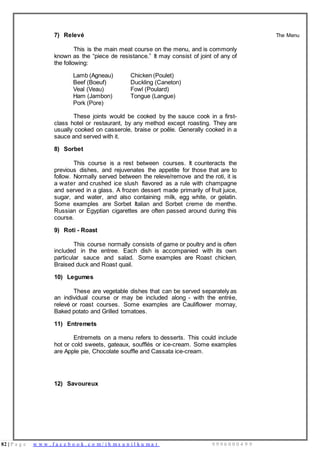
Lesson 7 The Menu 79 - 94
Lesson 8 Forms and Techniques of Service 95 - 110
UNIT - IV
Lesson 9 Breakfast 113 - 124
Lesson 10 Beverages 125 - 142
UNIT - IV
Lesson 11 Order Taking Procedures in a Restaurant 145 - 158
Lesson 12 Savoury 159 - 166
Lesson 13 Ice Cream 167 - 178
2 | P a g e w w w . f a c e b o o k . c o m / i h m s u n i l k u m a r 9 9 9 6 0 0 0 4 9 9
LESSON 1
INTRODUCTION TO CATERING
INDUSTRY
CONTENTS
1.0 Aims and Objectives
1.1 Introduction
1.2 Catering Industry
1.3 Catering Segments
1.4 Types of Catering
1.4.1 On-Premise Catering
1.4.2 Off-Premise Catering
1.5 Types of Catering Establishments
1.5.1 Restaurant
1.5.2 Transport Catering
1.5.2.1 Airline Catering
1.5.2.2 Railway Catering
1.5.2.3 Ship Catering
1.5.2.4 Surface Catering
1.5.3 Outdoor Catering
1.5.4 Retail Store Catering
1.5.5 Club Catering
1.5.6 Welfare Catering
1.5.7 Industrial Catering
1.5.8 Leisure-Linked Catering
1.6 Relationship Between Catering and All Other
Industries
1.7 Let us Sum Up
1.8 Lesson End Activity
1.9 Key Words
1.10 Questions for Discussion
1.11 References
1.0 AIMS AND OBJECTIVES
After studying this lesson, student should be able to:
Ø Discuss about the catering industry.
Ø Identify catering segments.
Ø Define on-premise and off-premise catering.
Ø Understand the relationship between catering industry
and other industries.
1.1 INTRODUCTION
3 | P a g e w w w . f a c e b o o k . c o m / i h m s u n i l k u m a r 9 9 9 6 0 0 0 4 9 9
1. Military
Functions
1. Independent
Caterers
2. Diplomatic
Functions
2. Hotel / Motel
Caterers
3. Private Clubs
4. Restaurant /
Catering Firms
Food and Beverage
Service - I
Hospitality is probably the most diverse but specialized
industry in the world. It is certainly one of the largest, employing
millions of people in a bewildering array of jobs around the globe.
Sectors range from the glamourous five-star resort to the less
fashionable, but arguably more specialised, institutional areas such
as hospitals, industrial outfits, schools and colleges. Yet of these
many different sectors, catering has to be the most challenging.
Whatever the size of the catering operation, the variety of
opportunities available is endless. “The sky is the limit with catering”.
1.2 CATERING INDUSTRY
The food service industry (catering industry in British English)
encompasses those places, institutions and companies that provide
meals eaten away from home. This industry includes restaurants,
schools and hospital cafeterias, catering operations, and many other
formats, including ‘on-premises’ and ‘off-premises’ caterings.
Catering is a multifaceted segment of the food service
industry. There is a niche for all types of catering businesses within
the segment of catering. The food service industry is divided into
three general classifications: commercial segment, noncommercial
segment, and military segment. Catering management may be
defined as the task of planning, organizing, controlling and
executing. Each activity influences the preparation and delivery of
food, beverage, and related services at a competitive, yet profitable
price. These activities work together to meet and exceed the
customer’s perception of value for his money.
1.3 CATERING SEGMENTS
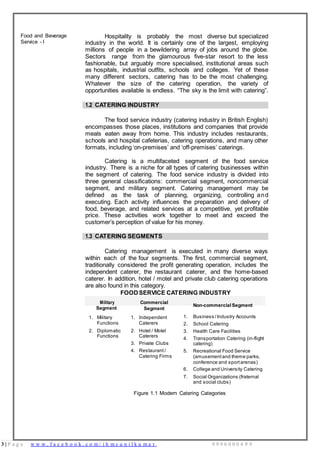
Catering management is executed in many diverse ways
within each of the four segments. The first, commercial segment,
traditionally considered the profit generating operation, includes the
independent caterer, the restaurant caterer, and the home-based
caterer. In addition, hotel / motel and private club catering operations
are also found in this category.
Military
Segment
FOOD SERVICE CATERING INDUSTRY
Commercial
Segment
Non-commercial Segment
1. Business /Industry Accounts
2. School Catering
3. Health Care Facilities
4. Transportation Catering (in-flight
catering)
5. Recreational Food Service
(amusement and theme parks,
conference and sportarenas)
6. College and University Catering
7. Social Organizations (fraternal
and social clubs)
Figure 1.1 Modern Catering Categories
4 | P a g e w w w . f a c e b o o k . c o m / i h m s u n i l k u m a r 9 9 9 6 0 0 0 4 9 9
The figure above, illustrates how the food service catering
industry is segmented. The non-commercial segment, or the ‘not-for-
profit’ operations, consists of the following types of catering activities:
business / industry accounts, school, college and university catering,
health care facilities, recreational food service catering, social
organizations and transportation food service catering. The military
segment encompasses all catering activities involved in association
with the armed forces and / or diplomatic events.
Introduction to
Catering Industry
1.4 TYPESOF CATERING
There are two main types of catering on-premises and off-
premises catering that may be a concern to a large and small
caterer. On-premise catering for any function - banquet, reception, or
event - that is held on the physical premises of the establishment or
facility that is organizing / sponsoring the function. On-premise
catering differs from off-premise catering, whereby the function takes
place in a remote location, such as a client’s home, a park, an art
gallery, or even a parking lot, and the staff, food, and decor must be
transported to that location. Off-premise catering often involves
producing food at a central kitchen, with delivery to and service
provided at the client’s location. Part or all of the production of food
may be executed or finished at the location of the event.
Catering can also be classified as social catering and
corporate (or business) catering. Social catering includes such
events as weddings, bar and mitzwahs, high school reunions,
birthday parties, and charity events. Business catering includes such
events as association conventions and meetings, civic meetings,
corporate sales or stockholder meetings, recognition banquets,
product launches, educational training sessions, seller-buyer meets,
service awards banquets, and entertaining in hospitality suites.
1.4.1 On-Premise Catering
All of the required functions and services that the caterers
execute are done exclusively at their own facility. For instance, a
caterer within a hotel or banquet hall will prepare and cater all of the
requirements without taking any service or food outside the facility.
Many restaurants have specialized rooms on-premise to cater to the
private-party niche. A restaurant may have a layout strategically
designed with three separate dining rooms attached to a centralized
commercial food production kitchen. These separate dining rooms
are available at the same time to support the restaurant’s operation
and for reservation and overflow seating. In addition, any of the three
dining rooms may be contracted out for private-event celebrations
and may require their own specialized service and menu options.
Other examples of on-premise catering include hospital catering,
school, University/ college catering.
1.4.2 Off-Premise Catering
5 | P a g e w w w . f a c e b o o k . c o m / i h m s u n i l k u m a r 9 9 9 6 0 0 0 4 9 9
Food and Beverage
Service - I
Off-premise catering is serving food at a location away from
the caterer’s food production facility. One example of a food
production facility is a freestanding commissary, which is a kitchen
facility used exclusively for the preparation of foods to be served at
other locations. Other examples of production facilities include, but
are not limited to, hotel, restaurant, and club kitchens. In most cases
there is no existing kitchen facility at the location where the food is
served. Caterers provide single-event foodservice, but not all
caterers are created equal. They generally fall into one of three
categories:
Party Food Caterers:
Party food caterers supply only the food for an event. They
drop off cold foods and leave any last-minute preparation,
plus service and cleanup, to others.
Hot Buffet Caterers:
Hot buffet caterers provide hot foods that are delivered from
their commissaries in insulated containers. They sometimes
provide serving personnel at an additional charge.
Full-Service Caterers:
Full-service caterers not only provide food, but frequently
cook it to order on-site. They also provide service personnel
at the event, plus all the necessary food-related equipment—
china, glassware, flatware, cutleries, tables and chairs, tents,
and so forth. They can arrange for other services, like décor
and music, as well. In short, a full-service caterer can plan
and execute an entire event, not just the food for it.
1.5 TYPES OF CATERING ESTABLISHMENTS
Various catering establishments are categorised by the
nature of the demands they meet. The following are some of the
catering establishements.
1.5.1 Restaurant
A restaurant is an establishment that serves the customers
with prepared food and beverages to order, to be consumed on the
premises. The term covers a multiplicity of venues and a diversity of
styles of cuisine. Restaurants are sometimes also a feature of a
larger complex, typically a hotel, where the dining amenities are
provided for the convenience of the residents and for the hotel to
maximize their potential revenue. Such restaurants are often open to
non-residents also.
1.5.2 Transport Catering
The provision of food and beverages to passengers, before,
during and after a journey on trains, aircraft and ships and in buses
or private vehicles is termed as transport catering. These services
6 | P a g e w w w . f a c e b o o k . c o m / i h m s u n i l k u m a r 9 9 9 6 0 0 0 4 9 9
may also be utilised by the general public, who are in the vicinity of a
transport catering unit. The major forms of modern day transport
catering are airline-catering, railways catering, ship catering and
surface catering in coaches or buses which operate on long distance
routes.
Introduction to
Catering Industry
1.5.2.1 Airline Catering
Catering to airline passengers on board the air craft,
as well as at restaurants situated at airport terminals is
termed as airline catering. Modern airports have a variety of
food and beverage outlets to cater to the increasing number
of air passengers. Catering to passengers en route is
normally contracted out to a flight catering unit of a reputed
hotel or to a catering contractor or to the catering unit
operated by the airline itself as an independent entity.
1.5.2.2 Railway Catering
Catering to railway passengers both during the
journey as well as during halts at different railway stations is
called railway catering. Travelling by train for long distances
can be very tiring; hence a constant supply of a variety of
refreshment choices helps to make the journey less tedious.
On-board meal services are also provided on long distance
trains.
1.5.2.3 Ship Catering
Ship catering is catering to cargo crew and passenger
ship passengers. Ships have kitchens and restaurants on
board. The quality of service and facilities offered depends on
the class of the ship and the price the passengers are willing
to pay. There are cruises to suit every pocket. They range
from room service and cocktail bars to speciality dining
restaurants.
1.5.2.4 Surface Catering
Catering to passengers traveling by surface transport
such as buses and private vehicles is called surface catering.
These eating establishments are normally located around a
bus terminus or on highways. They may be either
government run restaurants, or privately owned
establishments. Of late there has been a growing popularity
of Punjabi style eateries called dhabas on the highways.
1.5.3 Outdoor Catering
This catering includes the provision of food and drink away
from home base and suppliers. The venue is left to the peoples’
choice. Hotels, restaurants and catering contractors meet this
growing demand. The type of food and set up depends entirely on
the price agreed upon. Outdoor catering includes catering for
functions suchas marriages, parties and conventions.
7 | P a g e w w w . f a c e b o o k . c o m / i h m s u n i l k u m a r 9 9 9 6 0 0 0 4 9 9
Food and Beverage
Service - I
1.5.4 Retail Store Catering
Some retail stores, apart from carrying on their primary
activity of retailing their own wares, provide catering as an additional
facility. This type of catering evolved when large departmental stores
wished to provide food and beverages to their customers as a part of
their retailing concept. It is inconvenient and time consuming for
customers to take a break from shopping, to have some
refreshments at a different location. Thus arouse the need for some
sort of a dining facility in the retail store itself. This style of catering is
becoming more popular and varied nowadays.
1.5.5 Club Catering
Club catering refers to the provision of food and beverages to
a restricted member clientele. Some examples of clubs for people
with similar interests are turf clubs, golf clubs, cricket clubs etc. The
service and food in these clubs tend to be of a fairly good standard
and are economically priced.
Night clubs are usually situated in large cities that have an
affluent urban population. They offer entertainment with good food
and expensive drinks.
1.5.6 Welfare Catering
The provision of food and beverages to people to fulfil a
social obligation, determined by a recognised authority, is known as
welfare catering. This grew out of the welfare state concept,
prevalent in western countries. It includes catering in hospitals,
schools, colleges, the armed forces and prisons.
1.5.7 Industrial Catering
The provision of food and beverages to ‘people at work,’ in
industries and factories at highly subsidised rates is called industrial
catering. It is based on the assumption that better fed employees at
concessional rates are happy and more productive. Catering for a
large workforce may be undertaken by the management itself, or
may be contracted out to professional caterers. Depending on the
choice of the menu suggested by the management, catering
contractors undertake to feed the workforce for a fixed period of time
at a predetermined price.
1.5.8 Leisure-Linked Catering
This type of catering refers to the provision of food and
beverages to people engaged in ‘rest and recreation’ activities. This
includes sale of food and beverages through different stalls and
kiosks at exhibitions, theme parks, galleries and theatres. The
increase in the availability of leisure time and a large disposable
income for leisure activities has made it a very profitable form of
catering.
8 | P a g e w w w . f a c e b o o k . c o m / i h m s u n i l k u m a r 9 9 9 6 0 0 0 4 9 9
Introduction to
Catering Industry
1.6 RELATIONSHIP BETWEEN CATERING INDUSTRY AND ALL
OTHER INDUSTRIES
Food is the sustainer of life regardless of whether they belong
to animal kingdom or plant kingdom. All living beings consume food
as they come in nature. Subsequently they may convert the raw
natural food into usable form on their own. This transformation never
involves the art and science of coking, which is a speciality of human
beings alone.
Importance of food for the human beings is amply, accurately
and appropriately stated in the following age old sayings: “hungry
man is an angry man” and “even the army marches on stomach”
where stomach implies food Employment of largest number of
people in the world in general terms (at home) and in commercial
terms (catering) is in food preparation and servicing. Roughly half
the world population (women) is actively engaged in the art and
science of food production and then alone comes reproduction.
Food production, simply stated, is the transformation of raw
food material into palatable, appetizing and easily palatable tasty
food. Unlike all other living organisms, man has to “buy” food by
paying money. Where does the money come from? It comes only
from industries. Any industry in the world has the primary objective of
making money. Money so generated by the industrial activity is
shared between the employer and the employee, however
disproportionate it may be. Money so shared is used to take care of
the three important objectives: food, clothing and residence.
Whatever left after meeting these primary objectives may go towards
acquiring wealth.
As clearly stated above, food is the very basis of existence or
survival. To buy food, man needs money. The money comes or must
come from industries, all of which have the primary objective of
making money and share with those who help generate it. Since the
raw food needs to be transformed into palatable food fit for
consumption which is achieved, as already stated, through general
cooking (household) or commercial cooking (catering). Therefore,
there is no industry in the world which is not directly or indirectly, one
way or the other, related to the food (catering) industry. Commercial
food industry or the catering industry is the only industry that
provides food, at a price, away from home. Various types of catering
services available would include general or speciality services such
as transport catering, welfare catering, industrial catering, etc.
CHECK YOUR PROGRESS
1. True or False
(i) Food service industry is different from catering industry.
(ii) Party food caterers supply only the food for an event.
(iii) Full service caterers do not supply food.
9 | P a g e w w w . f a c e b o o k . c o m / i h m s u n i l k u m a r 9 9 9 6 0 0 0 4 9 9
Food and Beverage
Service - I
(iv) Provision of food to passengers is termed as transport
catering.
2. Classify food service industry.
3. What are the two main types of catering?
4. What is off-premises catering?
5. What is leisure catering?
6. Name five examples for the non-commercial catering segments.
7. What is transport catering?
1.7 LET US SUM UP
The catering industry encompasses those places that
provide meals to the customer at cost. Catering industry may be of
‘on-premises’ and ‘off-premises’ types. On-premises catering refers
to the preparation and serving of food at the place where the function
is held, whereas, off-premises involves producing food at a central
kitchen and service provided at the client’s location. The catering
industry is divided into three segments, viz. commercial, non-
commercial and military.
Catering management may be defined as the task of
planning, organizing, controlling and executing in food preparation
and serving. Catering can also be classified as social catering and
corporate (or business) catering.
The catering establishments are categorised by the nature of
the demands they meet. Restaurants , transport catering (airline
catering, railway catering, s hip catering, s urface catering), outdoor
catering, retail store catering, c lub catering, w elfare catering,
industrial catering and leisure c atering are some of the types of
catering establishments.
There is no industry in the world which is not directly or
indirectly, one way or the other, related to the catering industry.
Commercial catering industry is the only industry that provides food,
at a price, away from home.
1.8 LESSON END ACTIVITY
1. Visit a restaurant and take a note on the food serving method.
2. Visit a hotel that serve buffet lunch and note down the food items
served.
3. Attend a function and note down how the food is prepared and
served to the visitors at the function.
1.9 KEY WORDS
Catering Providing food and services
Niche Elite or top class or special segment
10 | P a g e w w w . f a c e b o o k . c o m / i h m s u n i l k u m a r 9 9 9 6 0 0 0 4 9 9
On-premises Food prepared and served at the place where the
function is held
Introduction to
Catering Industry
Off-premises Food prepared in a place away from the place
where it is served
Banquet Grand function including food served for the invited
dignitaries
Commissary Free standing kitchen acility used to prepare food
for off-premises catering
Cargo crew Crew or staff employed on board cargo ships
Punjabi daba Restaurant which specializes in Punjabi food
Bewildering Incomprehensible
1.10 QUESTIONSFORDISCUSSION
1. What do you mean by catering management?
2. Brifly describe about the on-premise catering.
3. Give a brief note about catering establishments.
4. Explain in your own words about the catering segments.
5. Give a brief note about the relationship between the catering
industry and all other industries.
CHECK YOUR PROGRESS - ANSWER
1. i) False
ii) True
iii) False
iv) True
2. Food service industry is divided into three general classifications,
viz. commercial segment, non-commercial segment andmilitary
segment.
3. On-premises catering and off-premises catering.
4. Off-premises catering is serving food at a location away from the
caterer’s food production facility.
5. Leisure catering refers to the provision of food to people engaged
in rest and recreation activities.
6. i) Business / Industry Accounts,
ii) School Catering,
iii) Health Care Facilities,
iv) Transportation Catering (in-flight catering),
v) Recreational Food Service (amusement and theme parks,
conference and sport arenas)
11 | P a g e w w w . f a c e b o o k . c o m / i h m s u n i l k u m a r 9 9 9 6 0 0 0 4 9 9
Food and Beverage
Service - I
7. The provision of food and beverages to passengers before,
during and after a journey on trains, aircraft, ships and in buses
or private vehicle is termed as transport catering.
1.11 REFERENCES
1. Dennis R. Lillicrap, John A Cousins (1991), Food and Beverage
Service, Elbs.
2. Vijay Dhawan (2000), Food and Beverage Service, Frank Bros. &
Co.
3. S. Medlik (1972), Profile of the Hotel and Catering Industry,
Heinemann.
12 | P a g e w w w . f a c e b o o k . c o m / i h m s u n i l k u m a r 9 9 9 6 0 0 0 4 9 9
LESSON 2
RESTAURANT
CONTENTS
2.0 Aims and Objectives
2.1 Introduction
2.2 Restaurant
2.3 Classification of Restaurants
2.4 Types of Restaurant
2.4.1 Cafeterias
2.4.2 Fast-food Restaurants
2.4.3 Casual Restaurants
2.4.4 Fast Casual-dining Restaurants
2.4.5 Other Restaurants
2.5 Staff Organisation
2.6 Duties and Responsibilities of Restaurant Staff
2.6.1 Food and Beverage Manager
2.6.2 Assistant Food and Beverage Manager
2.6.3 Restaurant Manager
2.6.4 Room Service Manager
2.6.5 Bar Manager
2.6.6 Banquet Manager
2.6.7 Other Staff Designations at Various Levels
2.7 Let us Sum Up
2.8 Lesson End Activity
2.9 Key Words
2.10 Questions for Discussion
2.11 References
2.0 AIMS AND OBJECTIVES
In this lesson we shall discuss about the restaurants. After
completion of this lesson you will be able to understand:
Ø Restaurants and their classification.
Ø Types of restaurant.
Ø Staff organisation
Ø Duties and responsibilities of restaurant staffs
2.1 INTRODUCTION
Eating is one of life’s pleasure and pride – so is cooking and
serving good food to others. A restaurant is a commercial outfit
which specializes in the preparation of quality food and to serve
them to satisy the customer’s demands. Their motto is “Customers
are our assets and satisfied customers are our source of wealth”.
Restaurants do have state of the art kitchens in their premises,
13 | P a g e w w w . f a c e b o o k . c o m / i h m s u n i l k u m a r 9 9 9 6 0 0 0 4 9 9
Food and Beverage
Service - I
where food items are prepared, following a fixed menu to serve the
customers. Most restaurants are also equipped with infrastructure
facilities, table settings, dining halls of various sizes to cater to needs
of small gatherings to grandiose banquets to suit customer demands
and above all, trained personnel to provide a satisfactory service.
The term restaurant (from the French word restaurer, to
restore) first appeared in the 16th century, meaning "a food which
restores", and referred specifically to a rich, highly flavoured soup.
The modern sense of the word was born around 1765 when a
Parisian soup-seller named Boulanger opened his establishment.
Whilst inns and taverns were known from antiquity, these were
establishments aimed at travellers, and in general locals would rarely
eat there. The modern formal style of dining, where customers are
given a plate with the food already arranged on it, is known as
service à la russe, as it is said to have been introduced to France by
the Russian Prince Kurakin in the 1810s, from where it spread
rapidly to England and beyond.
2.2 RESTAURANT
A restaurant is a retail establishment that serves prepared
food to customers. Service is generally for eating on premises,
though the term has been used to include take-out establishments
and food delivery services. The term covers many types of venues
and a diversity of styles of cuisine and service.
Restaurants are sometimes a feature of a larger complex,
typically a hotel, where the dining amenities are provided for the
convenience of the residents and, of course, for the hotel with a
singular objective to maximise their potential revenue. Such
restaurants are often also open to non-residents.
Restaurants range from unpretentious lunching or dining
places catering to people working nearby, with simple food and fixed
menu served in simple settings at low prices, to expensive
establishments serving expensive speciality food and wines in a
formal setting. In the former case, customers usually wear casual
clothing. In the latter case, depending on culture and local traditions,
customers might wear semi-casual, semi-formal, or even in rare
cases formal wear. Typically, customers sit at tables, their orders are
taken by a waiter, who brings the food when it is ready, and the
customers pay the bill before leaving. In class or porche restaurants
there will be a host or hostess or even a maître d'hôtel to welcome
customers and to seat them. Other staff’s waiting on customers
include busboys and sommeliers.
2.3 CLASSIFICATION OFRESTAURANTS
Restaurants can be classified by whether they provide places
to sit, whether they are served by wait-staff and the quality of the
service, the formal atmosphere, and the price range. Restaurants
are generally classified into three groups:
14 | P a g e w w w . f a c e b o o k . c o m / i h m s u n i l k u m a r 9 9 9 6 0 0 0 4 9 9
1. Quick Service - Also known as fast-food restaurants. They
offer limited menus that are prepared quickly. They usually
have drive-thru windows and take-out. They may also be self-
service outfits.
2. Mid scale - They offer full meals at a medium price that
customers perceive as "good value." They can be of full
service, buffets or limited service with customers ordering at
the counter and having their food brought to them or self
service.
3. Upscale - Offer high quality cuisine at a high end price. They
offer full service and have a high quality of ambience.
Restaurant
2.4 TYPES OF RESTAURANTS
Restaurants often specialize in certain types of food or
present a certain unifying, and often entertaining, theme. For
example, there are seafood restaurants, vegetarian restaurants or
ethnic restaurants. Generally speaking, restaurants selling "local"
food are simply called restaurants, while restaurants selling food of
foreign origin are called accordingly, for example, a Chinese
restaurant and a French restaurant.
Depending on local customs and the policy of the
establishment, restaurants may or may not serve alcoholic
beverages. Restaurants are often prohibited from selling alcohol
without a meal by alcohol sale laws; such sale is considered to be
activity for bars, which are meant to have more severe restrictions.
Some restaurants are licensed to serve alcohol (‘fully licensed’), and
/ or permit customers to ‘bring your own’ alcohol.
2.4.1 Cafeterias
A cafeteria is a restaurant serving mostly cooked ready to
food arranged behind a food-serving counter. There is little or no
table service. Typically, a patron takes a tray and pushes it along a
track in front of the counter. Depending on the establishment,
servings may be ordered from attendants, selected as ready-made
portions already on plates, or self-serve of food of their own choice.
In some establishments, a few items such as steaks may be ordered
specially prepared rare, medium and well done from the attendants.
The patron waits for those items to be prepared or is given a number
and they are brought to the table. Beverages may be filled from self-
service dispensers or ordered from the attendants. At the end of the
line a cashier rings up the purchases. At some self-service
cafeterias, purchases are priced by weight, rather than by individual
item.
The trays filled with selected items of food are taken to a
table to eat. Institutional cafeterias may have common tables, but
upscale cafeterias provide individual tables as in sit-down
restaurants. Upscale cafeterias have traditional cutlery and crockery,
and some have servers to carry the trays from the line to the patrons'
tables, and/ or bus the empty trays and used dishes.
15 | P a g e w w w . f a c e b o o k . c o m / i h m s u n i l k u m a r 9 9 9 6 0 0 0 4 9 9
Food and Beverage
Service - I
Cafeterias have a wider variety of prepared foods. For
example, it may have a variety of roasts (beef, ham, turkey) ready for
carving by a server, as well as other cooked entrées, rather than
simply an offering of hamburgers or fried chicken.
2.4.2 Fast-Food Restaurants
Fast-food restaurants emphasize speed of service and low
cost over all other considerations. A common feature of newer fast-
food restaurants that distinguishes them from traditional cafeteria is
a lack of cutlery or crockery; the customer is expected to eat the food
directly from the disposable container it was served in using their
fingers.
There are various types of fast-food restaurant:
· one collects food from a counter and pays, then sits
down and starts eating (as in a self-service restaurant or
cafeteria); sub-varieties:
· one collects ready portions
· one serves oneself from containers
· one is served at the counter
· a special procedure is that one first pays at the cash
desk, collects a coupon and then goes to the food
counter, where one gets the food in exchange for the
coupon.
· one orders at the counter; after preparation the food is
brought to one's table; paying may be on ordering or
after eating.
· a drive-through is a type of fast-food restaurant without
seating; diners receive their food in their cars and drive
away to eat
Most fast-food restaurants offer take-out: ready-to-eat hot
food in disposable packaging for the customer to eat off-site.
2.4.3 Casual Restaurants
A casual dining restaurant is a restaurant that serves
moderately-priced food in a casual atmosphere. Except for buffet-
style restaurants, casual dining restaurants typically provide table
service. Casual dining comprises of a market segment between fast
food establishments and fine dining restaurants.
2.4.4 Fast Casual-Dining Restaurants
A fast casual restaurant is similar to a fast-food restaurant in
that it does not offer full table service, but promises a somewhat
higher quality of food and atmosphere. Average prices charged are
higher than fast-food prices and non-disposable plates and cutlery
are usually offered. This category is a growing concept that fills the
space between fast food and casual dining.
Counter service accompanied by handmade food (often
visible via an open kitchen) is typical. Alcohol may be served. Dishes
16 | P a g e w w w . f a c e b o o k . c o m / i h m s u n i l k u m a r 9 9 9 6 0 0 0 4 9 9
like steak, which require experience on the part of the cook to get it
right, may be offered. The menu is usually limited to an extended
over-counter display, and options in the way the food is prepared are
emphasized.
Many fast casual-dining restaurants are marketed as health-
conscious: healthful items may have a larger number of items than
normal portion of the menu and high-quality ingredients such as free-
range chicken and freshly made salsas may be advertised. Overall,
the quality of the food is presented as a much higher class than
conventional factory-made fast food. An obvious ethnic theme may
or may not be present in the menu.
2.4.5 Other Restaurants
Most of these establishments can be considered subtypes of
fast casual-dining restaurants or casual-dining restaurants.
i) Café
Cafés and coffee shops are informal restaurants offering a
range of hot meals and made-to-order sandwiches. Cafés
offer table service. Many cafés are open for breakfast and
serve full hot breakfasts. In some areas, cafés offer outdoor
seating.
ii) Coffeehouse
Coffeehouses are casual restaurants without table service
that emphasize coffee and other beverages; typically a
limited selection of cold foods such as pastries and perhaps
sandwiches are offered as well. Their distinguishing feature is
that they allow patrons to relax and socialize on their
premises for long periods of time without pressure to leave
promptly after eating.
iii) Pub
A pub (short for public house) is a bar that serves simple food
fare. Traditionally, pubs were primarily drinking
establishments with food in a decidedly secondary position,
whereas the modern pub business relies on food as well, to
the point where gastropubs are known for their high-quality
pub food. A typical pub has a large selection of beers and
ales on tap.
iv) Bistros and Brasserie
A brasserie is a café doubling as a restaurant and serving
single dishes and other meals in a relaxed setting. A bistro is
a familiar name for a café serving moderately priced simple
meals in an unpretentious setting. Especially in Paris, bistros
have become increasingly popular with tourists. When used
in English, the term bistro usually indicates either a fast
Restaurant
17 | P a g e w w w . f a c e b o o k . c o m / i h m s u n i l k u m a r 9 9 9 6 0 0 0 4 9 9
Food and Beverage
Service - I
casual-dining restaurant with a European-influenced menu or
a café with a larger menu of food.
v) Family Style
"Family style restaurants" are restaurants that have a fixed
menu and fixed price, usually with diners seated at a
communal table such as on bench seats. More common in
the 19th and early 20th century, they can still be found in
rural communities, or as theme restaurants, or in vacation
lodges. There is no menu to choose from; rather food is
brought out in courses, usually with communal serving
dishes, like at a family meal. Typical examples can include
crabhouses, German-style beer halls, BBQ restaurants,
hunting lodges, e tc. Some normal restaurants will mix
elements of family style, such as a table salad or bread bowl
that is included as part of the meal.
vi) BYO Restaurant
BYO Restaurant are restaurants and bistros which do not
have a liquor license.
vii) Delicatessens Restaurant
Restaurants offering foods intended for immediate
consumption. The main product line is normally luncheon
meats and cheeses. They may offer sandwiches, soups, and
salads as well. Most foods are precooked prior to delivery.
Preparation of food products is generally simple and only
involves one or two steps.
viii) Ethnic Restaurants
They range from quick-service to upscale. Their menus
usually include ethnic dishes and / or authentic ethnic foods.
Specialize in a particular multicultural cuisine not specifically
accommodated by any other listed categories. Example:
Asian Cuisine, Chinese cuisine, Indian Cuisine, American
Cuisine etc.
ix) Destination Restaurants
A destination restaurant is one that has a strong enough
appeal to draw customers from beyond its community.
Example: Michelin Guide 3-star restaurant in Europe, which
according to the restaurant guides is "worthy of a journey”.
2.5 STAFF ORGANISATION
Staff organization is basically concerned with matters such as
the decision of tasks within the restaurant, position of responsibility
and authority and the relationship between them. It helps in
introducing the conceps of span of control, level of management and
delegation of power and responsibilities. The typical organization
18 | P a g e w w w . f a c e b o o k . c o m / i h m s u n i l k u m a r 9 9 9 6 0 0 0 4 9 9
chart of the Restaurant brigade is shown in the Figure 2.1. However
smaller organizations may combine a number of responsibilities
according to the needs of the particular facility.
Figure 2.1 Organisational Chart of Restaurant Brigade
Restaurant
19 | P a g e w w w . f a c e b o o k . c o m / i h m s u n i l k u m a r 9 9 9 6 0 0 0 4 9 9
Food and Beverage
Service - I
The various positions in the Restaurant Brigade are refered
to differently in the French, American and English hotel industry. The
list below gives the different versions.
French American British
MAÎTRE D'HÔTEL
RÉCEPTION
SENIOR CAPTAIN
RECEPTION
HEAD WAITER
RECEPTION
MAÎTRE D'HÔTEL DE SENIOR CAPTAIN HEAD WAITER
CARRÉ STATION STATION
CHEF DE RANG CAPTAIN STATION HEAD
DEMI CHEF DE RANG ASSISTANT CAPTAIN WAITER
COMMIS
DEBARSSEUR
ASSISTANT
STEWARD/ BUS BOY
ASSISTANT
WAITER
APPRENTI APPRENTICE TRAINEE
Figure 2.2 Restaurant Brigade Positions in Different Countries
2.6 DUTIESAND RESPONSIBILITIESOFRESTAURANT STAFF
All types of catering establishments require a variety of staff
positions in order to operate effectively and efficiently. The food and
beverage service department usually has the largest staff. Able
leadership and supervision is required to effectively direct the
department and guide the staff. The personnel in the food and
beverage service industry require practical knowledge of operations
as even a small error can cause displeasure to the guest.
Coordination of activities of all outlets is essential to provide the
guest with quality service at all times. Teamwork is the watchword in
any food and beverage service department. A dedicated and
committed team, with able leadership, under ideal working
conditions, helps in fulfilling the establishment's ultimate goal of
guest satisfaction
The important duties and responsibilities of the restaurant
staffs are discussed in this section.
2.6.1 Food and Beverage Manager
The food and beverage manager is the head of the food and
beverage service department, and is responsible for its
administrative and operational work. Food and Beverage Managers
direct, plan and control all aspects of food and beverage services.
Food and Beverage Managers require excellent sales and
customer service skills, proven human resource management skills,
and good communication and leadership skills. Desired knowledge
for this position includes knowledge of the products, services, sector,
industry and local area, and knowledge of relevant legislation and
regulations, as well. Hence it is said that food and beverage
20 | P a g e w w w . f a c e b o o k . c o m / i h m s u n i l k u m a r 9 9 9 6 0 0 0 4 9 9
manager is a Jack-of-all-trades, as the job covers a wide variety of
duties.
In general, food and beverage manager is responsible for:
i) Budgeting
The food and beverage manager is responsible for preparing
the budget for the department. He should ensure that each
outlet in the department achieves the estimated profit
margins.
ii) Compiling New Menus and Wine Lists
In consultation with the chef, and based on the availability of
ingredients and prevailing trends, the food and beverage
manager should update and if necessary, compile new
menus. New and updated wine lists should also be
introduced regularly.
iii) Quality Control
The food and beverage manager should ensure quality
control in terms of efficiency in all service areas, by
ascertaining that the staffs are adequately trained in keeping
with the standards of the unit.
iv) Manpower Development
The food and beverage manager is responsible for
recruitment, promotions, transfers and dismissals in the
department. He should hold regular meetings with section
heads, to ensure that both routine as well as projected
activities of the department go on as planned. He must also
give training, motivate and effectively control staff.
2.6.2 Assistant Food and Beverage Manager
The assistant food and beverage manager assists the food
and beverage manager in running the department by being more
involved in the actual day-to-day operations. This position exists only
in large organisations. An assistant food and beverage manager's
job includes:
i) Assisting section heads during busy periods.
ii) Taking charge of an outlet, when an outlet manager is on
leave.
iii) Setting duty schedules for all the outlet managers and
monitoring their performance.
iv) Running the department independently in the absence of
the food and beverage manager.
Restaurant
21 | P a g e w w w . f a c e b o o k . c o m / i h m s u n i l k u m a r 9 9 9 6 0 0 0 4 9 9
Food and Beverage
Service - I
2.6.3 Restaurant Manager
Restaurant Manager is responsible for directing and
supervising all activities pertaining to employee relation, food
production, sanitation, guest service and operating profits. The
restaurant manager is either the coffee shop manager, bar manager
or the specialist restaurant manager. The restaurant manager
reports directly to the food and beverage manager and has overall
responsibility for the organisation and administration of a particular
outlet or a section of the food and beverage service department. The
restaurant manager's job includes:
i) Setting and monitoring the standards of service in the outlets.
ii) Administrative duties such as setting duty charts, granting leave,
monitoring staff positions, recommending staff promotions and
handling issues relating to discipline.
iii) Training the staff by conducting a daily briefing in the outlet.
iv) Playing a vital role in public relations, meeting guests in the
outlets and attending to guest complaints, if any.
v) Formulating the sales and expenditure budget for the outlet.
vi) Planning food festivals to increase the revenue and organising
advertisement campaign of the outlet along with the chef and the
food and beverage manager.
2.6.4 Room Service Manager
The room service manager reports directly to the food and
beverage manager and is responsible for the room service outlet.
The room service manager checks that the service rendered to the
guests conforms to the standards set by the hotel. He also monitors
all operational aspects of the outlet such as service, billing, duty
charts, leave and absenteeism, in addition to attending to guest
complaints regarding food and service.
The room service manager is also in charge of the sales and
expenditure budget. The room service is most liable to have
problems. T he room service manager should ensure coordination
among the room service order taker, the captain and the waiter. It is
necessary for the room service manager to be present in the outlet
during peak hours to interact with other departments of the hotel and
to take regular momentums of all the equipment used In the event of
the hotel offering valet service and the room service manager takes
charge of that service as well .
2.6.5 Bar Manager
Bar Manager organises and controls a bar's operations. Abar
manager arranges the purchase and pricing of beverages according
to budget; selects, trains and supervises bar staff; maintains records
of stock levels and financial transactions; makes sure bar staff follow
liquor laws and regulations; and checks on customer satisfaction and
preferences.
22 | P a g e w w w . f a c e b o o k . c o m / i h m s u n i l k u m a r 9 9 9 6 0 0 0 4 9 9
The bar manager should have good interpersonal skills and
good memory. He must be efficient and speedy, must enjoy working
with people. He should have good cash-handling skills.
2.6.6 Banquet Manager
The banquet manager supervises the banquet operations,
sets up break-down service according to the standards established
by the hotel. He co-ordinates the banquet service in conjunction with
other departments involved and prepares weekly schedules for the
banquet personnel.
From the time the bookings are done till the guest settles the
bill, the banquet manager is in charge of all aspects of banquet and
conference operations. He supervises the work of the banquet sales
assistants, who do the banquet bookings and the captains and
waiters who perform the food and beverage service activities under
his guidance. He is responsible for organising everything right down
to the finest detail.
The banquet manager projects the budget of the banquets,
and works in close coordination with the chef in preparing menus. He
is responsible for making an inventory of all the banquet equipment
and maintaining a balance between revenue and expenditure.
Banquet managers may also be designated as assistant
managers in the food and beverage service department.
2.6.7 Other Staff Designations at Various Levels
The following are the various designations with their job
specifications in the food and beverage department.
i) Senior Captain or Maitre d’ Hotel
The senior captain has overall responsibility for operations.
He prepares the duty charts in consultation with the outlet
manager. He oversees the Mise-en-place, cleaning, setting
up of the outlet and staffing to ensure that the outlet is always
ready for service. The senior captain receives the guests and
hands them over to the captain or station holder. He takes
orders from guests if the captain is unable to do so. The
senior captain should be an able organiser and also be
prepared to take over the duties of any member of the staff
as and when required.
ii) Reception Head Waiter
This staff member is responsible for accepting any booking
and for keeping the booking diary up-to-date. He / she will
reserve tables and allocate these reservations to particular
stations. The reception head waiter greets guests on arrival
and takes them to the table and seats them.
Restaurant
23 | P a g e w w w . f a c e b o o k . c o m / i h m s u n i l k u m a r 9 9 9 6 0 0 0 4 9 9
Food and Beverage
Service - I
iii) Captain / Chef de Rang
This position exists in large restaurants, as well as in the food
and beverage service department of all major hotels. The
captain is basically a supervisor and is in charge of a
particular section. A restaurant may be divided into sections
called Sations, each consisting of 4 to 5 tables or 20 to 24
covers. A captain is responsible for the efficient performance
of the staff in his station. A captain should possess a sound
knowledge of food and beverage, and be able to discuss the
menu with the guests. He should be able to take a guest's
order and be an efficient salesperson. Specialised service
such as gueridon work involves a certain degree of skill, and
it is the captain who usually takes the responsibility to do this
work.
iv) Waiters / Commis de Rang / Server
The waiters serve the food and beverage ordered by a guest
and is part of a team under a station captain. They should be
able to perform the duties of a captain to a certain extent and
be a substitute for the captain if he is busy or not on duty.
They should; also be knowledgeable about all types of food
and beverages, so that they can effectively take an order
from a guest, execute the order and serve the correct dish
with its appropriate garnish and accompaniment. They should
be able to efficiently coordinate with the other staff in the
outlet.
v) Trainee /Commis De Barraseur
The trainees work closely with the waiters, fetching orders
from the kitchen and the bar, and clearing the side station in
a restaurant. They serve water and assist the waiter. They
are mainly responsible for the mise-en-place, and stacking
the side board with the necessary equipment for service. The
debarrasseur is the ‘learner’, having just joined the food
service staff, and possibly wishing to take up food service as
a carreer.
vi) Wine Waiter / Sommelier
Wine waiters have an important role to play in reputed
establishments. Their job is to take orders for the service of
wine and alcoholic beverages and serve them during the
meal. Hence they should be knowledgeable about wines that
accompany a particular dish and the manner in which they
should be served. They should also be aware of the licensing
laws prevalent in the city and should be efficient sales
persons.
vii) Room Service Waiters / Chef D’etage
Room service waiters work in the room service outlet,
serving food and beverage to guests in their rooms. The
order is placed by the guest on telephone, and is recorded on
24 | P a g e w w w . f a c e b o o k . c o m / i h m s u n i l k u m a r 9 9 9 6 0 0 0 4 9 9
a Kitchen Order Ticket (K.O.T). It is then passed on to the
duty captain. The duty captain in turn places the order in the
kitchen or the bar, as the case may be. The room service
waiter who has been assigned that order, sets the tray
according to the food or beverage ordered, picks up and
delivers the order when it is ready.
viii) Carver / Trancheur
The carver is responsible for the carving trolley and the
carving of joints at the table as required. The carver will plate
up each portion with the appropriate accompaniment.
ix) Floor Service Staff / Floor Waiter
The floor service staffs are often responsible for an entire
floor in an establishment or, depending on the size of the
establishment, a number of rooms or suites. Floor service of
all meals and breakfast is offered either throughout the day or
in a limited time depending on the size of the establishment.
The floor service staff would normally work from a floor pantry
or from a central kitchen with all food and drink reaching the
appropriate floor and the required room by lift and in a heated
trolley.
x) Lounge staff / Chef de sale
Lounge staff may deal with lounge service as a specific duty
only in a first class establishment. The lounge staff is
responsible for the service of morning coffee, afternoon teas,
aperitifs and liqueurs before and after both lunch and dinner,
and any coffee top ups required after meals. They would be
responsible for setting up the lounge in the morning and
maintaing its cleanliness and presentation throughout the
day.
xi) Cocktail Bar Staff
The person who works on the cocktail bar must be
responsible, well versed in the skills of shaking and stirring
cocktails and should have thorough knowledge of all alcoholic
and non-alcholic drinks, the ingredients necessary for the
making of cocktails and of the licensing laws.
xii) BuffetAssistant / Buffet Chef / Chef de buffet
The chef de buffet is in charge of the buffet in the room, its
presentation, the carving and portioning of food and its
service. This staff would normally be a member of the kitchen
team. The cashier is responsible for the takings of the food
and beverage operation. This may include making up bills
from food and drink check or, alternatively, in a cafeteria, for
example, charging customers for their selection of items on a
tray.
Restaurant
25 | P a g e w w w . f a c e b o o k . c o m / i h m s u n i l k u m a r 9 9 9 6 0 0 0 4 9 9
Food and Beverage
Service - I
xiii) Counter Assistants
Counter assistants are found in cafeterias where they would
stock the counter and sometimes serve or portion food for
customers. Duties may also include some cooking of call
order items.
xiv) Table Clearers
Table clearers are responsible for clearing tables and
trolleys, specially designed for good stacking of crockery,
glassware, cutlery, etc.
CHECK YOUR PROGRESS
1. What is a restaurant?
2. Restaurants are classified into how many groups and what are
they?
3. Differentiate between café and coffeehouse.
4. Who is the head of the the food and beverage service
department and what he / she is responsible for?
5. What are pubs?
2.7 LET US SUM UP
A restaurant is a retail establishment that serves prepared
food to customers. Service is generally for eating on premises,
though the term has been used to describe take-out establishments
and food delivery services. The term covers many types of venues
and a diversity of styles of cuisine and service.
Restaurants often specialize in certain types of food or
present a certain unifying, and often entertaining, theme. For
example, there are seafood restaurants, vegetarian restaurants or
ethnic restaurants. Generally speaking, restaurants selling "local"
food are simply called restaurants, while restaurants selling food of
foreign origin are called accordingly, for example, a Chinese
restaurant and a French restaurant.
Restaurants can be classified by whether they provide places
to sit, whether they are served by wait-staff and the quality of the
service, the formality of the atmosphere, and the price range.
Staff organization is basically concerned with matters such as
the decision of tasks within the hotel, position of responsibility and
authority and the relation between them. It helps in introducing the
conceps of span of control, level of management and delegation.
Teamwork is the watchword in any food and beverage
service department. A dedicated and committed team, with able
leadership, under ideal working conditions, helps in fulfilling the
establishment's ultimate goal of guest satisfaction
26 | P a g e w w w . f a c e b o o k . c o m / i h m s u n i l k u m a r 9 9 9 6 0 0 0 4 9 9
2.8 LESSON END ACTIVITY
1. Visit restaurants in your town and in near by metro. Note down
their kitchen facilities, infrastructure facilities and service aspects.
Restaurant
2.9 KEY WORDS
Unpretentious Not elaborate or showy, as in appearance or style
Busboys A restaurant employee who clears away dirty
dishes, sets tables, and serves as an assistant to a
waiter or waitress.
Sommeliers A restaurant employee who orders and maintains
the wines sold in the restaurant and usually has
extensive knowledge about wine and food pairings.
Dispensers One that dispenses or gives out, especially a
machine or container that allows the contents to be
removed and used in convenient or prescribed
amounts.
Buffet A counter or table from which meals or
refreshments are served.
A meal at which guests serve themselves from
various dishes displayed on a table or sideboard.
Ethnic Of, relating to, or characteristic of a sizable group
of people sharing a common and distinctive racial,
national, religious, linguistic, or cultural heritage.
Being a member of a particular ethnic group,
especially belonging to a national group by heritage
or culture but residing outside its national
boundaries
Bistros A small bar, tavern, or nightclub.
A small, informal restaurant serving wine.
Banquet A ceremonial dinner honoring a particular guest or
occasion.
Brasserie A brasserie is a café doubling as a restaurant and
serving single dishes and other meals in a relaxed
setting.
Bistro A bistro is a familiar name for a café serving
moderately priced simple meals in an unpretentious
setting.
2.10 QUESTIONSFORDISCUSSION
1. Explain in your own words about the various types of restaurants.
2. Give a brief note about the fast-food restaurants.
3. What are casual-dinning restaurants? Explain a few in detail.
27 | P a g e w w w . f a c e b o o k . c o m / i h m s u n i l k u m a r 9 9 9 6 0 0 0 4 9 9
Food and Beverage
Service - I
4. Explain in detail about the staff organization in hotel industry.
5. What are the duties and responsibilities of the restaurant staffs?
CHECK YOURPROGRESS - ANSWER
1. A restaurant is a commercial outfir which specializes in the
preparation of quality food and to serve them to satisfy the
customers’ demand.
2. Restaurants are generally classified into three groups. They are
quick service (fast-food) restaurants, mid scale restaurants and
upscale restaurants.
3. Cafés and cofeeshops are informal restaurants offering a range
of hot meals and made-to-order sandwiches. Coffeehouses are
casual restaurants without table service that emphasize coffee
and other beverages with sandwiches.
4. Food and Beverage Service Manager is the head of the the food
and beverage service department. The F&B Service Manager is
responsible for budgeting, compiling new menus, quality control
and manpower development.
5. Pubs were primarilydrinking establishments with food in a
decidedly secondary position.
2.11 REFERENCES
1. Sudan Amrik Singh (2002), Restaurant Management, Anmol
Publications.
2. Dennis R. Lillicrap, John A Cousins (1991), Food and Beverage
Service, Elbs.
3. Loftus David (2007), Restaurant Notes, Ryland Peters & Small.
4. Sudhir Andrews (1980), Food and Beverage Service Manual,
Tata McGraw Hill.
28 | P a g e w w w . f a c e b o o k . c o m / i h m s u n i l k u m a r 9 9 9 6 0 0 0 4 9 9
LESSON 3
WAITER
CONTENTS
3.0 Aims and Objectives
3.1 Introduction
3.2 Waiter
3.3 Status of a Waiter
3.4 Attributes of a Waiter
3.5 Undesirable Qualities of a Waiter
3.6 Let us Sum Up
3.7 Lesson End Activity
3.8 Key Words
3.9 Questions for Discussion
3.10 References
3.0 AIMS AND OBJECTIVES
In this lesson we shall discuss about the status and
attributes of a waiter. After completion of this lesson you will be able
to understand:
Ø Waiter and his duties
Ø Attributes of the waiter.
3.1 INTRODUCTION
A successful restaurant is one which the guests are anxious
to visit again, a place where they feel as comfortable as in their own
homes. This pleasant atmosphere is produced by courtesy; good
well-cooked food; advice in selecting from the available dishes; a
knowledge of how they are prepared; and quiet, efficient, but
unostentatious, service. It is by these amenities that both buyer and
seller are satisfied and goodwill of the business increased. At the
end of the visit the customer is made to feel that he got his money’s
worth in terms of both quality food and courteous service.
Good waiters are necessary to the success and development
of the hotel and catering industry. Waiters play an important part as,
in effect, an efficient salesman of food, one who assists materially in
merchandising and its accompanying services. Waiter is in direct
c ontac t with the guests and therefore much of catering
establishment’s success depends on the skills, interest and
personable qualities of the waiter. The waiters are prompted to
develop tact and initiative and by keeping their brains active and
reveal their personality.
29 | P a g e w w w . f a c e b o o k . c o m / i h m s u n i l k u m a r 9 9 9 6 0 0 0 4 9 9
Food and Beverage
Service - I
The English writer, Wilfred Gowers-Round, wrote a number of
‘Rules for Waiters’ that he called a ‘Manifesto.’
· A waiter's job is to serve and never to impose himself.
· The goal of waiting is inconspicuous but pleasing service.
· Waiters must be clean and smart and should never wear
cologne.
· Under no circumstances should a waiter ever touch a
diner.
· Wine glasses should never be filled too full.
· Unasked for advice should never be offered.
· If diners are content to pour the wine themselves, let
them.
· Unless asked, no plates should be removed until all have
been finished.
· Women diners should be afforded respect equal to men.
· While attending to the customer, the waiter should make
sure the diner’s coffee cup / water goblet, bread basket,
butter, sugar, cream and clean ashray are kept full at all
times.
· The bill should be placed on the table without ceremony.
· If the diner so desires, the waiter should carry the money
to the cash counter, pay the bill and return the balace to
the diner.
3.2 WAITER
Waiting staff, wait staff, or waitstaff are those who work at a
restaurant or a bar attending customers - supplying them with food
and drink as requested promptly and pleasantly.
The waiter is popularly known as a Steward or Commis-de-
Rang. A female who "waits" on tables is often called a waitress. The
gender-neutral server and collective waitstaff can also be used.
Some people prefer to use gender-neutral language, using
waiter indiscriminately for males and females, waitperson, server, or
waitron.
3.3 STATUS OF A WAITER
The duties of waiting staff include preparing tables (table
setting) for a meal, taking customers' orders, serving drinks and
food, and cleaning up before, during and after servings in a
restaurant. He must have knowledge of proper rules of etiquette in
order to furnish working service in either a formal or informal sitting.
Other task of a waiter includes:
1. Reports to Senior Captain / Captain to receive necessary
instruction for the shift and for any menu changes.
30 | P a g e w w w . f a c e b o o k . c o m / i h m s u n i l k u m a r 9 9 9 6 0 0 0 4 9 9
2. Has to attend briefings conducted by senior captain.
3. Sets the assigned tables and ensures that the services
area too is well-stocked with linen, silver, glassware,
china etc. Sets up any special displays that be used for
the meal period.
4. Greets guests and sometimes assists the host/ hostess in
seating guest. Fills water glasses, serves butter,
cocktails, answers questions about menu items and
makes suggestions about dishes and wine if the customer
requests or desires.
5. Takes orders on check, turns or gives over with
specification the order to the cooks with consideration to
the timing of the preceding courses. Picks up all food and
all other required items from various stations.
6. May carve meats, bone fish and prepare flaming dishes
or desserts at guest’s table. He may assist Senior
Captain for the same.
7. May serve guests from plates to the guest’s table.
8. Other tasks to be performed as determined by
establishment from time to time.
9. Replenishes wine, water, butter, and bread as and when
required.
10. Observes the guests in order to anticipate any additional
request and to perceive when the meal has been
completed.
11. After all the guests have finished each course and before
the next one is served, the waiter/ waitress should
remove all soiled dishes or ensure that the assistant
stewatard does it.
12. When guests have finished the meal, the table is cleared
and reset and ready for the next customer.
13. Performs other tasks as directed by the supervisor.
Depending on the restaurant, other less common duties may
be required, such as singing birthday songs to customers who are
celebrating a birthday. A theme restaurant may even require staff to
dance (e.g. Joe's Crab Shack). There are now event caterers that
outsource waiting staff to events and specific functions. Silver
service staffs are specially trained to serve at banquets or high-end
restaurants. They follow specific rules of service and it is a skilled /
specialized job. They generally wear black and white with a long,
white apron (extending from the waist to ankle).
Waiter
3.4 ATTRIBUTES OF AWAITER
The quality of service staff in any establishment reflects the
quality of the establishment itself. No matter how good the food and
ambience are, poorly trained, untidy or rude staff can antagonize
customers. On the other hand, if the staffs are well-trained and
31 | P a g e w w w . f a c e b o o k . c o m / i h m s u n i l k u m a r 9 9 9 6 0 0 0 4 9 9
Food and Beverage
Service - I
efficient, they can, to a certain extent, make up for other
shortcomings in the services provided.
1)
·
Personal Hygiene and Appearance
All members of the staff should be well-groomed and clean
at all times, as this gives them a sense of well-being and
confidence to do their job efficiently.
· The hands of the waiting staff should be given special
attention, as they are constantly under the scrutiny of the
guests. Nails should be trimmed, and kept clean. Playing
with one's hair and face should be avoided.
· Chewing gum should be avoided in all public areas of the
hotel.
· Minimum jewellery should be worn by the service staff. A
wrist watch, finger ring and plain earrings (for girls only)
should be permitted.
· If an employee has a skin problem, a doctor should be
consulted immediately
· Uniform should be clean and well-pressed. Shoes should
be properly polished and well-fitting.
2) Good Conduct
All service staff should be well-mannered and respectful to
guests, and to senior members of the staff. They should be
calm and pleasant, even in the most tiring circumstances. They
should be able to satisfactorily solve any problem that may
arise. In case of difficulty, a senior and experienced member of
the staff should be consulted. Tact, punctuality and honesty
are admirable qualities among service personnel.
3) Good Memory
A good memory helps to improve performance. It also
helps the service personnel to attend to small but important
details such as remembering a guest's name or his likes and
dislikes regarding food and beverage.
4) Observation
A keen sense of observation and an eye for detail will help
a member of the staff to be more efficient at his job. An ability
to correctly judge people is definitely an advantage. A sense of
anticipation in the service industry is an invaluable quality. The
ability to anticipate what a guest or the management needs,
even before it is asked for creates a very good impression.
5) Concentration and Skill
Waiting at a table requires concentration and skill. Service
staff should develop a sense of urgency in the performance of
32 | P a g e w w w . f a c e b o o k . c o m / i h m s u n i l k u m a r 9 9 9 6 0 0 0 4 9 9
their duties. Good service may not be commented upon, but
bad service is surely noticed and talked about. Service should
be prompt without the show of haste.
6) Salesmanship
Food and beverage service personnel are technical
salespersons; hence they should have a thorough knowledge
of the proper presentation and service of all the food and
beverages served in the establishment. Waiters should be kept
informed by their superiors of deletions or additions to the
menu.
7) Ability to Assume Responsibility
All service staff should be able to cope up with the
demands of the job and possess the ability to assume
responsibility. They should be loyal to their employers,
responsible to the guests and friendly towards their fellow
workers. They should not consider any job as menial, and
should be willing to perform all kinds of jobs efficiently. This will
help the service staff to grow in their careers and at the same
time enhance the image of the establishment in the eyes of the
guests.
8) Maximise Revenue
Cutting down on costs and maximising the revenue of the
establishment should be of prime objective to all members of
the staff, even to those in junior positions.
9) Punctuality
Punctuality is all-important. If staff is continually late for
duty, it shows a lack of interest in his work and a lack of
respect for the management and customers.
10) Local Knowledge
In the interest of customers, the staff should have a certain
knowledge of the area in which they work so that they may be
able to advise the guests on the various forms of entertainment
offered, the best means of transport to places of interest and
so on.
11) Personality
Staff must be tactful, courteous, good humoured and of an
even temper. They must converse with the customer in a
pleasing and well-spoken manner and the ability to smile at the
right time.
Waiter
33 | P a g e w w w . f a c e b o o k . c o m / i h m s u n i l k u m a r 9 9 9 6 0 0 0 4 9 9
Food and Beverage
Service - I
12) Attitude to Customers
The correct approach towards the customer is of the
utmost importance. The staff must not be servile, but should
anticipate the customer's needs and wishes. A careful watch
should be kept on customers at all times during the service
without staring. Care should always be taken when dealing
with difficult customers. (There is really no such thing as a
'difficult' customer – they are normal people whom one is
uncertain how to deal with.) Staff should never argue with
customers as this will only aggravate the situation. All
complaints should he referred to someone in authority in the
food service area.
13) Honesty
This is all-important for the staff in dealings with both the
customer and the management. If there is trust and respect in
the triangle of staff, customer and management relationships,
then there will be pleasant work atmosphere which encourages
efficiency and a good team spirit among the food and beverage
service operators.
3.5 UNDESIRABLE QUALITIES OF A WAITER
i) Forgetting to great the arriving customer pleasantly.
ii) Letting guests seat themselves, inspite of being present near
the table and not otherwise engaged.
iii) Refusing to assist a guest or seating a guest at a dirty table.
iv) Serving from the wrong side, when it is possible to serve from
the correct side
v) Not setting tables properly and placing empty sugar bowls /
cruet sets on the table.
vi) Forgetting to say 'Pardon me', or 'Excuse me, sir / madam, if a
mistake has been made.
vii) Being too familiar with guests. This could lead to embarrassing
situations.
viii) Gathering in groups in operational areas and talking loudly and
showing signs of irritability with other members of the staff.
ix) Leaving fingerprints on crockery / glassware or making a noise
by clattering the service equipment.
x) Keeping the side station dirty or using torn or stained linen.
xi) Forgetting a dish that has been ordered, or serving wrong
accompaniments.
xii) Overfilling water glasses or leaving them empty or leaving dirty
ashtrays on an occupied table.
xiii) Being inattentive to a guest's needs, for example, forgetting
special instructions from the guest, such as less chillies or no
onions in the food
34 | P a g e w w w . f a c e b o o k . c o m / i h m s u n i l k u m a r 9 9 9 6 0 0 0 4 9 9
xiv) Using cold plates for hot food and hot plates for cold food.
xv) Touching food with one's hands.
xvi) Not following the rules of quality waiting at table.
xvii) Soliciting tips or questioning the amount of tips.
Waiter
CHECK YOUR PROGRESS
1. What is a manifesto?
2. Who is called as Waiter in a hotel?
3. List any three attributes that are relevant to a Waiter.
3.6 LET US SUM UP
A successful restaurant is one which the guests are anxious
to visit again. Good waiters are necessary for the success and
development of the restaurant. Waiter is in direct contact with guests
and therefore much of restaurant’s success depends on the skills,
interest and personal qualities of the waiter.
The waiter is also known as a Steward or Commis-de-Rang.
The duties of waiter include preparing tables (table setting) for a
meal, taking customers' orders, serving drinks and food, and
cleaning up before, during and after servings in a restaurant.
The quality of service staff in any establishment reflects the
quality of the establishment itself. The important qualities of a waiter
are: p ersonal hygiene a n d appearance, g ood conduct, good
memory, observation, concentration and skill, s alesmanship, ability
to assume responsibility, m aximise revenue, p unctuality, l ocal
knowledge, personality, attitude to customers, honesty, etc.
3.7 LESSON END ACTIVITY
1. Visit a near by restaurant and take a note of the attributes of a
waiter who is serving food to a customer.
2. Visit another restaurant and take a note of the undesirable
attributes of a waiter who serve food to the customers.
3.8 KEY WORDS
Unostentatious Not elaborate or showy, as in appearance or style
Amenities Features that add to a property's desirability, such
as modern appliances and fixtures
Tact The sense of touch
Etiquette The practices and forms prescribed by social
convention or by authority.
Perceive The process, act, or faculty of perceiving
Antagonise To incur the dislike of; provoke hostility or enmity
35 | P a g e w w w . f a c e b o o k . c o m / i h m s u n i l k u m a r 9 9 9 6 0 0 0 4 9 9
Food and Beverage
Service - I
3.9 QUESTIONS FOR DISCUSSION
1. List the basic rules of the Waiters described by Wilfred Gowers-
Round.
2. Enumerate briefly about the status of a Waiter in a hotel industry.
3. Explain in detail about the attributes of a Waiter.
4. List out the undesirable qualities of a Waiter.
CHECK YOURPROGRESS - ANSWER
1. The rules formulated by Wilford Gowers-Round for Waiters are
called a manifesto.
2. A Waiter is one who waits on tables, often at a restaurant or a
bar to attend customers – supplying them with food and drink as
requested.
3. i) Personal Hygiene and Appearance
ii) Good Conduct and
iii) Good Memory
3.10 REFERENCES
1. A C Marshall, John Fuller, A J Currie (1965), The Waiter, Barrie
and Jenkins
2. Lora Arduser (2005), The Waiter & Waitress and Waitstaff
Training Handbook: A Complete Guide, Atlantic Publishing
Company.
36 | P a g e w w w . f a c e b o o k . c o m / i h m s u n i l k u m a r 9 9 9 6 0 0 0 4 9 9
LESSON 4
RESTAURANT OPERATING EQUIPMENTS
CONTENTS
4.0 Aims and Objectives
4.1 Introduction
4.2 Service Equipments
4.3 Glassware
4.3.1 Types of Glassware
4.3.2 Handling of Glassware
4.4 Chinaware
4.4.1 Chinaware Serving Items
4.4.2 Handling of Chinaware
4.5 Tableware
4.5.1 Special Tableware
4.5.2 Stainless Steel
4.5.3 Handling of Tableware
4.6 Tables and Chairs
4.7 Side Station / Dummy Waiter
4.8 Trolleys
4.9 Linen
4.9.1 Table Cloths
4.9.2 Slip Cloths or Naperones
4.9.3 Napkins or Serviettes
4.9.4 Buffet Cloths
4.9.5 Trolley Cloths and Sideboard Cloths
4.9.6 Waiter’s Cloths or Service Cloths
4.10 Equipment Handling
4.10.1 Measures to Avoid Breakages
4.10.2 Do's and Dont's of Equipment Handling
4.10.3 Sanitation Standards in Handling
Service Equipment
4.11 Let us Sum Up
4.12 Lesson End Activity
4.13 Key Words
4.14 Questions for Discussion
4.15 References
4.0 AIMS AND OBJECTIVES
In this lesson we shall discuss about the restaurant operating
equipments. After completion of this lesson you will be able to
understand:
Ø Food and beverage service equipments needed for table
setting such as glassware, chinaware and table ware
Ø Furnitures, fixtures and linen
Ø Safe handling of equipments.
37 | P a g e w w w . f a c e b o o k . c o m / i h m s u n i l k u m a r 9 9 9 6 0 0 0 4 9 9
Food and Beverage
Service - I
4.1 INTRODUCTION
The operating equipments used in hotels / restaurants play
an important role in attracting customers. The restaurant operating
equipments include service equipments, furnitures, fixtures and linen
all of which squarely reflects the standard and style of the restaurant.
The atmosphere of a restaurant is largely affected by the kind of
furniture used.
The furniture should be utilitarian and elegant to look at. Very
often by using different materials, designs and finishes and by
careful arrangement, one can change the atmosphere and
appearance of the food service area to suit different occasions.
4.2 SERVICE EQUIPMENTS
Elegant and attractive serviceware, colourful and clean
dishes, quality plates and glassware add to the decor of a restaurant.
However, several factors have to be considered while selecting the
equipment.
· Standard of the restaurant
· Types of service
· Décor and theme of the restaurant
· Type of clientele
· Durability of equipment
· Ease of maintenance
· Availability when stocks runout for replacement
· Storage
· Flexibility of use
· Price factors
· Standardization
A hotel / restaurant should be well stocked with appropriate
equipment to provide quality service. For multipurpose use and to
cut down costs, most hotels / restaurants standardise equipment in
terms of size and colour.
Food and beverage service equipment may be divided into
glassware, chinaware and tableware which are further subdivided
into flatware, cutlery and hollowware.
4.3 GLASSWARE
Glassware refers to glass and drinkware items besides
tableware, such as dishes, cutlery and flatware, used to set a table
for eating a meal. The term usually refers to the drinking vessels,
unless the dinnerware is also made of glass. The choice of the right
qulity glass is a vital element if the cocktail is to be invitingly
presented and give satisfaction to the consumer. Well designed
glassware combines elegance, strength and stability, and should be
fine and smooth rimmed and of clear glass.
38 | P a g e w w w . f a c e b o o k . c o m / i h m s u n i l k u m a r 9 9 9 6 0 0 0 4 9 9
4.3.1 Types of Glassware
Many standard patterns and sizes of glassware are available
to serve each drink. Most glass drinking vessels are either tumblers,
flat-bottomed glasses with no handle, foot, or stem; footed glasses,
which have a bowl above a flat base, but no stem; or stemware,
which have a bowl on a stem above a flat base. Neither a tumbler,
footed, nor a stem, yard (beer) is a very tall, conical beer glass, with
a round ball base, usually hung on the wall when empty.
GLASSWARE
Collins Glassware
A Collins glass is a glass tumbler, holding 240 to
350 ml, used to serve a mixed drink, named after
Tom Collins. This glass is somewhat narrower, and
holds less than the similar highball glass.
Highball Glass
A highball glass is a glass tumbler, holding
between 8 and 12 fluid ounces (240 to 350 mL),
used to serve a mixed drink, or highball. This glass
is taller than an Old-Fashioned glass, and shorter
than a Collins glass.
Shot Glass
It is a small glass used for measuring or serving up
to three ounces of liquor. Modern shot glass holds
a thicker base and sides than the whiskey glass.
Restaurant
Operating
Equipments
Pint Glass
A pint glass is a drinking vessel holding an imperial
pint (568 ml) of liquid and is usually used for beer.
Three common shapes of pint glass are found
(conical, jug, and flared top), though others are
available. Pints are considered good for serving
stouts, porters and English ales
Pilsner Glass
A pilsner glass is a glass used to serve many types
of light beers, but is intended for its namesake, the
pilsner. Pilsner glasses are generally smaller than
a pint glass, usually in 250 ml or 330 ml sizes.
They are tall, slender and tapered. Wheat beer
glasses are often mistakenly referred to as pilsner
glasses, but a true pilsner glass has an even taper
without curvature. Pilsner glasses are made to
showcase the color, effervescence, and clarity of
the pilsner, as well as to maintain a nice head.
39 | P a g e w w w . f a c e b o o k . c o m / i h m s u n i l k u m a r 9 9 9 6 0 0 0 4 9 9
Food and Beverage
Service - I
Beer Stein
A beer stein is a traditionally-German beer tankard
or mug, made of pewter, silver, wood, porcelain,
earthenware or glass; usually with a hinged lid and
levered thumblift.
Flute Glass
A flute glass is the preferred serving vessel for
Belgian lambics and fruit beers. The narrow shape
helps maintain carbonation, while providing a
strong aromatic front. Flute glasses display the
lively carbonation, sparkling color, and soft lacing
of this distinct style
Goblet or Chalice
Chalices and goblets are large, stemmed, bowl-
shaped glasses adequate for serving heavy
Belgian ales, German bocks, and other big sipping
beers. The distinction between goblet and chalice
is typically in the glass thickness. Goblets tend to
be more delicate and thin, while the chalice is
heavy and thick walled.
Snifters
Typically used for serving brandy and cognac, a
snifter is ideal for capturing the volatiles of aromatic
beers, such as Belgian ales, India pale ales,
barleywines and wheat wines. The shape helps
trap the volatiles, while allowing swirling to agitate
them and produce an intense aroma.
Wheat Beer Glass
A wheat beer glass is a glass used to serve wheat
beer, known also as Weizenbier or Weibbier. The
German glass generally holds 500 millilitres with
room for foam or "head". It is much taller than a
pint glass. It is very narrow at the bottom and
slightly wider at the top. In other countries such as
Belgium, the glass may hold 250 ml or 330 ml. The
tall glass provides room for the often thick, fluffy
heads produced by the style, which traps aromas
and is visually pleasing.
Tulip Glass
A tulip glass not only helps trap the aroma, but also
aids in maintaining large heads, creating a a visual
and olfactory sensation. The body is bulbous, but
the top flares out to form a lip which helps head
retention. It is recommended for serving Scottish
ales, barleywines, Belgian ales and other aromatic
beers.
40 | P a g e w w w . f a c e b o o k . c o m / i h m s u n i l k u m a r 9 9 9 6 0 0 0 4 9 9
Cocktail Glass
A cocktail glass, martini glass, or champagne
glass, or stem cocktail glass, is a drinking glass
with a cone-shaped bowl (the tip of the cone
forming approximately a 90 degree angle in the
cross section) on a stem above a flat base, used to
serve a cocktail or champagne. As with other
stemware, the stem allows the drinker to hold the
glass without affecting the temperature of the drink.
One variation is the double martini glass which is
taller and wider at the opening than a standard
martini glass
Restaurant
Operating
Equipments
Red Wine Glasses
Glasses for red wine are characterized by their
rounder, wider bowl, which gives the wine a chance
to breathe. Since most reds are meant to be
consumed at room temperature, the wider bowl
also allows the wine to cool more quickly after hand
contact has warmed it. Red wine glasses can have
particular styles of their own, such as:
· Bordeaux glass: Tall with a wide bowl, and is
designed for full bodied red wines like
Cabernet and Merlot as it directs wine to the
back of the mouth.
· Burgundy glass: Larger than the Bordeaux
glass, it has a larger bowl to accumulate
aromas of more delicate red wines such as
Pinot Noir. This style of glass directs wine to
the tip of the tongue.
White Wine Glass
White wine glasses are generally narrower,
although not as narrow as champagne flutes, with
somewhat straight or tulip-shaped sides. The
narrowness of the white wine glass allows the
chilled wine to retain its temperature for two
reasons;
· The reduced surface area of the glass (in
comparison to red wine glasses) means less
air circulating around the glass and warming
the wine.
· The smaller bowl of the glass means less
contact between the hand and the glass, and
so body heat does not transfer as easily or as
fast to the wine.
41 | P a g e w w w . f a c e b o o k . c o m / i h m s u n i l k u m a r 9 9 9 6 0 0 0 4 9 9
Food and Beverage
Service - I
Champagne Flutes
Champagne flutes are characterised by a long
stem with a tall, narrow bowl on top. The shape is
designed to keep sparkling wine attractive and
inviting during its consumption. The glass is
designed to be held by the stem to help prevent the
heat from the hand warming up the champagne.
The bowl itself is designed in a manner to help
retain the signature carbonation in the beverage.
This is achieved by reducing the surface area at
the opening of the bowl. Champagne flutes are
often used at formal engagements, such as award
ceremonies and weddings.
SherryGlass
A sherry glass is a drinkware generally used for
serving aromatic alcoholic beverages, such as
sherry, port, aperitifs and liqueurs, and layered
shooters. An ISO-standard sized sherry glass is
120 ml. The copita, with its aroma-enhancing
narrow taper, is a type of sherry glass.
Coupette Glass
A modified version of the cocktail glass. Used for
serving drinks where the rim of the glass is
required to be coated in either sugar or salt or any
other condiments used to make some of the more
exotic drinks such as margaritas.
Pitcher
This larger container usually has a handle and a lip
or spout for pouring the contents into several
glasses. Available in glass or plastic. Generally
used for serving beer for a beer keg for draft beer.
Old Fashioned Glass
The Old-Fashioned glass, rocks glass, or "lowball",
is a short tumbler used for serving liquor "on the
rocks", meaning over ice, or cocktails having few
ingredients. It is named after the old fashioned
cocktail, traditionally served in such a glass. A
White Russian is traditionally served in the Old
Fahioned Glass.
42 | P a g e w w w . f a c e b o o k . c o m / i h m s u n i l k u m a r 9 9 9 6 0 0 0 4 9 9
Yard Glass
A yard (or yard glass) is a very tall glass used for
drinking beer; a yard (or yard of ale) also refers to
the (variable) quantity of beer held by such a glass.
The glass is approximately 1 yard long (hence the
name), and holds 2 imperial pints (1.14 litres) of
liquid. The glass is shaped with a bulb at the
bottom, and a widening shaft which constitutes
most of the height. Because the glass is so long
and in any case does not usually have a stable flat
base, it is hung on the wall when not in use.
Restaurant
Operating
Equipments
Coffee-Mug
Almost a smaller version of the beer mug, made of
thick heavy glass and used for coffee
Irish Coffee Cup
A uniquely shaped glass with a handle that is used
to serve any hot beverage such as Spanish coffee
or cocoa.
4.3.2 Handling of Glassware
1. Glassware is highly fragile and most delicate and
expensive: hence atmost care has to be taken while
handling glass equipments.
2. Glasses are normally stored in a glass pantry and should
be placed upside down in single rows on paper-lined
shelves, to prevent dust settling in them.
3. Tumblers should not be stacked inside one another as
this may result in heavy breakages and accidents.
4. The appearance of the drink mainly depends on the glass
and therefore, the glass should be sparkling clean and
attractive in shape and style.
5. When glassware is machine or hand washed, each
individual item must be polished and dried with a glass
cloth made of linen, as water leaves stains on the
glasses.
6. Glasses whether clean or dirty have to be handled by the
base or stem, since the finger prints left on the glass
necessitates polishing.
4.4 CHINAWARE
China is a term used for crockery whether bone china
(expensive and fine), earthenware (opaque and cheaper) or vitrified
(metallised). Most catering crockery used nowadays tends to be
43 | P a g e w w w . f a c e b o o k . c o m / i h m s u n i l k u m a r 9 9 9 6 0 0 0 4 9 9
Food and Beverage
Service - I
vitrified earthenware, which is very durable and haven been
strengthened. Crockery is also usually given rolled edges to make it
more chip resistant.
Chinaware is made of silica, soda ash, and china clay, glazed
to give a fine finish. Chinaware can be found in different colours and
designs which are always coated with glaze. Chinaware is more
resistant to heat than glassware. There are various classification of
catering china. They are:
Porcelain Porcelain is a ceramic material made by heating
selected and refined materials, which often includes
clay of kaolinite clay, to high temperatures. The raw
materials for porcelain, when mixed with water, form a
plastic body that can be worked to a required shape
before firing in a kiln at temperatures between 1200°C
and 1400°C. The toughness, strength, and
translucence of porcelain arise mainly from the
formation of glas s at high temperatures and the
mineral mullite within the fired body.
Bone China Bone china is porcelain made of clay mixed with bone
ash. This is very fine, hard china that is very
expensive. The decorations are to be found under the
glaze only. The price of bone china puts it out of reach
of the majority of everyday caterers, and only a few of
the top class hotels and restaurants would use it. The
range of design, pattern and colour is very wide and
there is something to suit all occasions and situations.
Earthenware Earthenware may sometimes be as thin as bone
china and other porcelains, though it is not translucent
and is more easily chipped. Earthenware is also less
strong, less tough, and more porous than stoneware,
but its low cost and easier working compensate for
these deficiencies. Due to its higher porosity,
earthenware must usually be glazed in order to be
watertight.
Stoneware Stoneware is a hard pottery made from siliceous
paste, fired at high temperature to vitrify (make
glassy) the body. Stoneware is heavier and more
opaque than porcelain. The usual color of fired
stoneware tends to be grayish, though there may be a
wide range of colors, depending on the clay. It has
been produced in China since ancient times and is the
forerunner of Chinese porcelain.
4.4.1 Chinaware Serving Items
There are wide ranges of chinaware serving items and their
sizes vary according to the manufacturer and the design produced.
Recent developments in chinaware include the ovenproof ware
(dishes, casserole and cocotte dishes), which allow food to be
brought straight from the oven to the table.
44 | P a g e w w w . f a c e b o o k . c o m / i h m s u n i l k u m a r 9 9 9 6 0 0 0 4 9 9
Restaurant
Operating
Equipments
Figure 4.1 Chinaware
4.4.2 Handling of Chinaware
Whatever quality of china or crockery is used, the most
important thing to ensure is that it is washed, rinsed and dried
correctly to ensure that no dirt, stains or streaks appear.
1) Chinaware has a high breakage rate and, therefore,
needs careful handling.
2) They should be stored on shelves in piles or stakes of
approximately two dozen each. Any higher may result in
their toppling down.
3) They should be stored at a convenient height for placing
on, and removing from the shelves to avoid accidents.
4) Chinaware should be kept covered to prevent dust and
germs settling on it.
5) Chipped and cracked items harbor germs and should,
therefore, not be used and disposed off carefully.
4.5 TABLEWARE
Tableware includes the dishes, glassware, cutlery, and
flatware eating utensils (knives, forks, and spoons) used to set a
table for eating a meal. The nature, variety, and number of objects
varies from culture to culture, and may vary from meal to meal as
well. Tableware may be categorised as follows:
Flatware Flatware denotes all forms of spoon and fork.
Flatware, especially that used by most people when
they eat informally, is usually made of stainless steel.
Cutlery Cutlery refers to knives and other cutting instruments.
Holloware Holloware refers to table service items such as sugar
bowls, creamers, coffee pots, teapots, soup tureens,
45 | P a g e w w w . f a c e b o o k . c o m / i h m s u n i l k u m a r 9 9 9 6 0 0 0 4 9 9
Food and Beverage
Service - I
hot food covers, water pitchers, platters, butter plates
and other metal items excluding flatware and cutlery.
Figure 4.2 Flatware and Cutlery
4.5.1 Special Tableware
There is almost an unlimited range of flatwar, cutlery and
hollowware in use in the catering industry. Apart from the familiar
knife, fork, spoon, vegetable dishes and lids, entrée dishes and lids,
soup tureens, teapot, hotwater jugs, sugar basins there are a
number of specialist items of equipment available for use with
specific dishes. Some common specialist equipments are listed
below:
Special Tableware
Siver Tea Tong
The silver tea tongs (called also silver sugar
tongs or silver sugar nips) are used for lifting
sugar cubes from the sugar bowls and add
to tea cups. The basic forms in which they
were made are:
· fire tongs, of two arms joined at one end
by a pivot
· scissors tongs, of two arms pivoting at
the centre, in the form of a pair of
scissors (tea tongs or sugar nips)
Ends of tongs may be serrated.
46 | P a g e w w w . f a c e b o o k . c o m / i h m s u n i l k u m a r 9 9 9 6 0 0 0 4 9 9
Asparagus Holder
The asparagus holder is an utensil for a
diner to hold a single stalk of asparagus. It is
made of a single strip of metal, bent in the
form of U-shaped tongs, with a small square
plate at each end to grip the stalk.
Pastry Slicer
Pastry slicer is used for serving pastries
(portion of gâteau)
Pastry Fork
Pastry fork is a small fork designed for
eating pastries and other desserts while
holding a plate. It is typically designed so
that it can be used with the right hand, while
the left hand holds the plate. It therefore has
the left side widened to be used like a knife
to cut the food when pressed down on the
plate. Left-handed pastry forks have the right
side widened instead. This fork may also be
used to lift fruit pieces from the plate.
Restaurant
Operating
Equipments
Oyster Fork
A fork used for picking up shellfish cocktail
or oysters. This fork is shaped like a regular
fork, but it slightly smaller and the tines are
curved outward.
Lobster Pick
This long, narrow utensil is used to pull
every shred of meat from the hard-to-reach
cavities (such as the legs) of lobsters and
crabs. The tip of a lobster pick can either be
pointed or in the shape of a tiny, two-prong
fork.
Snail Tong and Snail Fork
Small, spring-operated tongs used to hold
hot snail shells while extracting the snail.
Unlike most tongs, these open by squeezing
the handles. When the pressure is released,
the tongs snap securely around the snail
shell.
Snail Dish
It is a round dish with two ears having six
indentations to hold portion of six snails.
47 | P a g e w w w . f a c e b o o k . c o m / i h m s u n i l k u m a r 9 9 9 6 0 0 0 4 9 9
Food and Beverage
Service - I
Skewers
A long, thin, pointed rod that comes in
various sizes. Skewers are made of metal or
wood; the former often has a ring at one
end. They're most often used to hold meat in
place during cooking/ serving, as well as to
skewer meat and vegetables to be grilled for
shish kebab. The best skewers are square
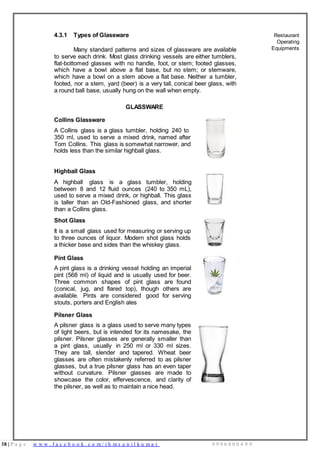
or flat-shaped that hold food securely when
moved. Usually made of stainless steel.
Ice-cream Scoop
It is used to remove ice cream from a carton
or other container while forming the ice
cream into a ball or oval shape. Ice-cream
scoops come in several styles and sizes.
The simplest is a plain metal scoop- or
spade-shaped utensil. Next comes one
shaped like a half-globe or oval with a
spring-action lever in the handle. When
squeezed, the lever moves an arc-shaped
blade across the scoop's interior and ejects
the ice-cream ball. The nonstick-style scoop
has antifreeze sealed inside.
Nutcracker
It is a tool for cracking hard nutshells,
usually consisting of two hinged metal arms
between which the nut is squeezed.
4.5.2 Stainless Steel
Stainless steel flatware and culery is available in a variety of
grades. Use of stainless steels and super stainless steels is
expanding in a variety of markets. Stainless steels have higher
resistance to oxidation ( rust) and corrosion in many natural and
man made environments; however, it is important to select the
correct type and grade of stainless steel.
Stainless steel is finished by different degrees of polishing:
high polish finish, dull polish finish and a light grey matt, non
reflective finish, etc.
Stainless steel's resistance to corrosion and staining, low
maintenance, relative inexpense and familiar luster make it an ideal
base material for tableware. Stainless steel neither tarnishes nor
stains. It resists scratching far more than other metals and may,
therefore, be said to be more hygienic.
48 | P a g e w w w . f a c e b o o k . c o m / i h m s u n i l k u m a r 9 9 9 6 0 0 0 4 9 9
4.5.3 Handling of Tableware Restaurant
Operating
i) Storage of cutlery and flatware is very important. Each item
has to be stored in the boxes or drawers lined with baize to
prevent the items being scratched
Equipments
ii) They should be stored in cupboard or room which can be
locked.
iii) Cutlery and flatware may be stored in cutlery trollies.
4.6 TABLES AND CHAIRS
The size and shape of tables depends entirely on the
availability of space and the kind of service envisaged. Normally
three types of tables are used. They are round, rectangular and
square.
Figure 4.3 Restaurant Tables
The height of the table irrespective of the shape should be 75
cm from the floor level. The diameter of a round table to seat four
people should be approximately 92 cm. The size of a square table to
seat two people should 76 cm sq and 92 cm square to seat four
people. The size of rectangular table to seat four people should be
137 cm x 76 cm. Commercial table tops come in a variety of
materials: wood, metal, stone, tile and melamine. Many restaurant
table tops are available with edged finishes to prevent scuffs and
dents.
In some expensive tables, another table top is placed with
revolving facility, on top of which the food is placed where th guests
can rotate revolving top and serve himself, if he chooses to.
Chairs
Chair are available in various shapes, colours and sizes to
suit all occasions. Because of the wide ranges of style, chairs come
in varied height and width. However the dimension of chairs should
be relative to table dimensions. The average height of the chair
should be 92 cm. The seat should be 46 cm from the floor and 23 cm
from the top of the table. This would enable guests to sit and eat
comfortably, without their legs touching the underside of the table.
49 | P a g e w w w . f a c e b o o k . c o m / i h m s u n i l k u m a r 9 9 9 6 0 0 0 4 9 9
Food and Beverage
Service - I
Figure 4.4 Restaurant Chairs
4.7 SIDE STATION / DUMMY WAITER
The side station is also called the dummy waiter or service
console. This is a very important piece of furniture in a restaurant. It
is used by the service staff for keeping all the service equipment at
one place. It is also used as a landing table for the dishes picked up
from the kitchen enroute to the table and the dirty dishes from the
guest's table to the wash-up area. For the convenience of the service
staff, the side station should be strategically located in a restaurant.
The side station should be kept clean and presentable as it can be
seen by the guests.
Figure 4.5 Side Station
station.
The following service equipment can be stored in a side
Salvers Creamers Wine chiller and stand
Coffee pots Teapots Ice buckets and tongs
Finger bowls Cruet sets Sugar bowl; and tongs
Soup ladles
Cigar cutters
Butter dishes
Bread baskets
Bottle and wine openers
Bud vases
Candle holders Wine cradle Toothpick stand
Straw stand Pot holders Drip bowls
50 | P a g e w w w . f a c e b o o k . c o m / i h m s u n i l k u m a r 9 9 9 6 0 0 0 4 9 9
The style and design of the side board varies from
establishment to establishment. It depends upon:
· The style of service and menu offered.
· The number of waiters working from one sideboard
· The number of tables to be served from one
sideboard
· The amount of equipment it is expected to hold.
Figure 4.6 Old Fashioned Side Station
It is essential that the side board is of minimum size and
portable so that it may be moved, if necessary. If the sideboard is too
large for its purpose, then it takes up space which could be used to
seat more customers. The top should be of heat resistant material
which can be easily washed down. After service, the sideboard is
either completely emptied out or restocked for the next service.
Restaurant
Operating
Equipments
4.8 TROLLEYS
The various trolleys used in the food and beverage service
outlets are:
1) Gueridon orFlambe Trolley
Figure 4.7 Flambe Trolley
51 | P a g e w w w . f a c e b o o k . c o m / i h m s u n i l k u m a r 9 9 9 6 0 0 0 4 9 9
Food and Beverage
Service - I
A gueridon or flambe trolley is a small mobile trolley that can be
placed alongside the guest's table. It consists of one or two
burners, a gas cylinder and a work and storage space for plates
and cooking equipment. Using this trolley, the food is flambed at
the guest's table. Only skilled and well rained waiters are
allowed to handle this service as there is the risk of spoiling food
by overcooking it, and of the flame causing a fire in the
premises.
2) Room Service Trolley
This trolley is known for its versatility. It is used for the service to
guests in their rooms. The waiter sets up the meal and covers
on the trolley and wheels it into the guest's room. This trolley
may also be used as a dining table in the privacy of the guest's
room. Beneath the trolley top, provision is made for mounting a
hot case to keep the food warm.
Figure 4.8 Room Service Trolley
3) DessertTrolley
This trolley serves as a visual aid to selling desserts. Guests are
more likely to order a dessert if they can see what is available,
particularly if it is well presented. Some dessert trolleys are
refrigerated. Gateaux, pastries, jellies, tarts, pies, flans and
souffles can be served from a dessert trolley.
Figure 4.9 Dessert Trolley
52 | P a g e w w w . f a c e b o o k . c o m / i h m s u n i l k u m a r 9 9 9 6 0 0 0 4 9 9
This trolley has several shelves and the bottom shelf is reserved
for plates, cutlery, linen and other service equipment. A glass or
transparent trolley top makes it easy for guests to select a
dessert of their choice.
4) Hors d'oeuvre Trolley
A hors d'oeuvre is the first course of a menu usually consisting
of a selection of small items of egg, fish, meat, fruit and
vegetables in pungent dressings. This hors d'oeuvre trolley is
used to carry variety of appetizers. This trolley is probably the
least popular in India, as a majority of guests are not too keen
on hors d'oeuvre as a starter. They prefer soups instead.
However, this trolley can be used to popularise the special
dishes that are introduced in the restaurant from time to time.
5) Carving Trolley
It is used for carving joints of meat at a guest's table. This trolley
is seldom used in India.
Restaurant
Operating
Equipments
4.9 LINEN
Linens are fabric goods, such as tablecloths, napkins and slip
cloths. Linen is a material made from the fibers of the flax plant.
Originally, many, such as bed sheets and tablecloths, were made of
linen. Today, the term "linen" has come to be applied to all related
products even though most are made of cotton, various synthetic
materials, or blends. The main items of linen normally found in a
restaurant are: tablecloths; slipcloths; buffet cloths; trolley and
sideboard cloths; and waiter’s cloths or service cloths.
4.9.1 Table Cloths
Table linens made from cotton or linen are not only more
absorbent but also last longer. The fibers don't pill or pile as easy as
with synthetic table linens and they don't become shiny when
exposed to an iron's heat. Egyptian cotton and Irish linen are
considered the finest materials for table linens because of their long,
durable fibers. White is the most popular color for table linens
because it's considered formal. Table linens in off white or ivory are
also acceptable. A damask (woven) or embroidered pattern is a
perfectly acceptable table cloth.
Types of Tables Size of Tables Size of Table Cloths
Square table
Rectangular table
76 cm sq 92 cm sq
136 x 76 cm
137 x 137 cm 183 x 183 cm
183 x 137 cm
Round table 92 cm diameter 184 cm diameter
Figure 4.10 Tables and Table Cloths
Table cloths should be large enough to cover the top as well
as a portion of the legs of a table without interfering with the guest's
53 | P a g e w w w . f a c e b o o k . c o m / i h m s u n i l k u m a r 9 9 9 6 0 0 0 4 9 9
Food and Beverage
Service - I
comfort while he is seated at the table.The size of the tablecloth
varies according to the size of the table it is required to cover.
4.9.2 Slip Cloths or Naperones
These are designed to be laid over the tablecloth to protect it
from spillage and give it a longer life. Using a slip cloth reduces the
number of tablecloths used and thus reduces the cost of inventory
and laundry. Slip cloths may measure 1 metre square approximately.
Figure 4.11 Slip Cloth
4.9.3 Napkins or Serviettes
A napkin or serviette is a rectangle cloth or paper used at the
table for wiping the mouth while eating. It is usually small and folded.
Conventionally, t he napkin is folded and placed to the left of the
place setting, outside the outermost fork. In an ambitious restaurant
setting, it may be folded into elaborate shapes and displayed on the
empty plate. A napkin may also be held together in a bundle (with
cutlery) by a napkin ring. Alternatively, paper napkins may be
contained with a napkin holder.
Figure 4.12 Napkin Fold
Napkins may be of the same colour as tablecloths, or in a
colour that blends with the decor of the restaurant. Napkins should
be spotlessly clean and well-pressed. The ideal size for a napkin is
between 46 to 50 cm sq.
54 | P a g e w w w . f a c e b o o k . c o m / i h m s u n i l k u m a r 9 9 9 6 0 0 0 4 9 9
4.9.4 Buffet Cloths
For a buffet table, the minimum size of the tablecloth required
is 2 m x 4 m.
4.9.5 TrolleyCloths and Sideboard Cloths
These are usually made from tablecloths well worn and not
suitable for use on tables, mended by the housekeeping department
and folded to fit a sideboard or trolley.
4.9.6 Waiter’s Cloths or Service Cloths
A service cloth is a very important part of service equipment
as well as being part of the food server’s uniform. It must be kept
clean and ironed at all times and only used as a service cloth for
certain activities such as:
· Carrying hot plates
· Final polishing of plates
· Wiping small spills
· Brushing crumbs onto a service plate
· Wiping the undersides of the plates before placing plates
on the table.
Service cloths are also used by every waiter as protection
against heat and to keep uniforms clean.
Restaurant
Operating
Equipments
4.10 EQUIPMENT HANDLING
Management invests substantial amount in supplies and
equipment. Service staffs are, therefore, expected that these
equipment are handled gently and carefully. Staff should be
sanitation and safety conscious. Equipment should be handled in the
right spot stemmed glass by the stem, tumblers by the base, flatware
by the handle. Bowls should never be held by the rim, use
appropriate underliners. The thumb should never show on the plate.
When setting up cutleries, as well as glasswares, avoid leaving
finger marks by using trays or by securing them inside a cloth
napkin.
To prevent breakage, be conscious of the rules of
equipment handling. Breakages are usually caused by the following
factors:
1. Mechanical Impact -- results from object-to-object
collision. This is induced by stacking of glasswares and
chinawares, picking of glasses in bouquet, overloading of
buspans and trays, putting cutleries inside glasses.
2. Thermal Shock -- result of sudden change of
temperature. This happens when hot water is placed
inside a chilled / cold glass and vice versa, abrupt use of
glasswares after coming of the dishwashing machines,
heating chilled bowl in a microwave.
55 | P a g e w w w . f a c e b o o k . c o m / i h m s u n i l k u m a r 9 9 9 6 0 0 0 4 9 9
Food and Beverage
Service - I
3. Improper Handling and Misuse of Equipment -- using
the equipment for a purpose it was not intended for such
as using a glass to scoop ice, using knives for opening
cans, etc.
4. Inattentiveness or Absent-mindedness -- accidents
often occur when service personnel are absent-minded or
are inattentive in executing services especially when they
are carrying breakable equipment.
5. Environmental Factors – greasy / wet floor, slippery
floor, broken tiles, blind doors.
4.10.1 Measures to Avoid Breakages
• Use trays when serving and bussing.
• Proper system should be followed in stacking and storing
equipment.
• Use appropriate door for entry and exit. A separate door
for entering and eiting should be installed to prevent
collision.
• Use appropriate glass racks. Make sure that the glasses
are conviniently, but not tightly inserted in each rack.
• Buss out glasses separately from chinaware.
• Avoid overloading trays and buspans.
4.10.2 Do's and Dont's of Equipment Handling
1. Dump ice out of the glass; preheat the glass before
pouring hot water. Don't pour hot drinks in chilled or cold
glasses.
2. Stack dishes according to size and kind. Never stack too
high.
3. Handle stemmed glasses by the stem and tumblers by
the base. Never handle glasses in bouquet.
4. Remove glass / china from buspan one at a time. Don't
unload china, glasses at random.
5. Use ice scooper for scooping ice. Never use the glass for
scooping ice.
6. Never put cutlery into glasses, put them in appropriate
containers.
7. Make sure of an adequate back-up supply of glassware
for rush periods.
8. Always be on the lookout for cracked or chipped
glassware and remove them.
9. Never allow glass-to-glass contact on overhead racks,
keep distant from each other.
10. Never overload the tray / buspan. Load only what it can
conveniently accommodate.
56 | P a g e w w w . f a c e b o o k . c o m / i h m s u n i l k u m a r 9 9 9 6 0 0 0 4 9 9
1. Name somerestaurant operating equipments.
2. What the factors that need to be considered while selecting
service equipments?
3. List any five glassware.
4. What ‘China’ refers to in cookery?
5. Give some examples for tableware.
6. What is the standard height of the chair used in the restaurant?
7. What are the service equipments that can be stored in a side
station?
8. List any three trolleys that are used for food and beverage
service.
9. What are linens?
x 76 cm.
11. Never buss glasses in the sink. Buss them directly onto
divider racks.
12. Never stack glasses. Use trays and avoid over crowding
them to prevent breakage.
4.10.3 Sanitation Standards in Handling Service Equipment
1. Use clean and sanitized glasses, flatware, chinaware and
other equipment for service.
2. All service equipment must be wiped dry with clean cloths
to avoid watermarks. The cloths used for this purpose
must be segregated from other wiping cloths.
3. Bowls should be underlined with appropriate underliner
and never to be served with the finger touching the rim.
4. When serving straw serve them with their wrappers or in
their respective dispensers.
5. When serving additional utensils or napkin, place them in
a small plate to avoid direct contact with hand.
6. The thumb should be kept away from the plate to avoid
touching the sauce, meat or dish.
7. When setting up flatware and glasses, avoid leaving
finger marks; carry them in trays or with a cloth napkin.
8. Never serve food using cutleries that have fallen on the
floor.
9. To avoid contamination, food must be covered when it is
not served immediately.
Never serve utensils, cups, glasses or plates that are oily,
wet or with fingermarks, spots or lipstick mark.
Restaurant
Operating
Equipments
CHECK YOUR PROGRESS
10. What is the size of the table cloth used for a table of size 136 cm
57 | P a g e w w w . f a c e b o o k . c o m / i h m s u n i l k u m a r 9 9 9 6 0 0 0 4 9 9
Food and Beverage
Service - I
4.11 LET US SUM UP
The operating equipments used in hotels / restaurants play
an important role in attracting customers. The restaurant operating
equipments include service equipments, furnitures, fixtures and linen
all of which squarely reflect the standard and style of the restaurant.
Service equipments include attractive serviceware, clean
dishes, plates and glassware. Glassware refers to glass and
drinkware items besides tableware, such as dishes, cutlery and
flatware, used to set a table for eating a meal. Many standard
patterns and sizes of glassware are available to serve each drink
which includes Collins glassware, highball glass, shot glass, pint
glass, pilsner glass, beer stein, flute glass, goblet, snifters, wheat
beer glass, tulip glass, cocktail glass, red wine glass, white wine
glass, champagne flute, sherry glass, coupette glass, coffee-mug,
Irish coffee cup, pitcher, old fashioned glass, yard glass, etc.
Chinaware is made of silica, soda ash, and china clay, glazed
to give a fine finish. Chinaware is more resistant to heat than
glassware. There are various classifications of chinaware which
include porcelain, clay mixed with bone ash, earthenware,
stoneware, etc. Tableware includes the dishes, glassware, cutlery,
and flatware eating utensils (knives, forks, and spoons) used to set a
table for eating a meal. Special table ware include asparagus holder,
pastry slicer, pastry fork, oyster fork, lobster pick, snail tong and snail
fork, snail dish, skewers, ice-cream scoop, nutcracker, etc. Stainless
steel flatware and culery are available in a variety of grades.
Many different sizes and shapes of tables are used. They are
generally round, rectangular and square. Chair are available in
various shapes, colours and sizes to suit all occasions. The side
station is also called the dummy waiter or service console. This is a
very important piece of furniture in a restaurant. Various trolleys
used in the food and beverage service outlets are: gueridon or
flambe trolley, room service trolley, dessert trolley, hors d'oeuvre
trolley, carving trolley, etc.
Linens are fabric goods, such as tablecloths, napkins and slip
cloths. Linen is a material made from the fibers of the flax plant. The
main items of linen normally found in a restaurant are: tablecloths;
slipcloths; buffet cloths; trolley and sideboard cloths; and waiter’s
cloths or service cloths.
4.12 LESSON ENDACTIVITY
1. Familiarise with various types of glasses available in the
restaurants.
2. Practice setting up table for service.
4.13 KEY WORDS
Gâteau A cake or pastry, especially a light one filled with
custard, fruit, or nuts.
58 | P a g e w w w . f a c e b o o k . c o m / i h m s u n i l k u m a r 9 9 9 6 0 0 0 4 9 9
Silica A white or colorless crystalline compound, SiO2,
occurring abundantly as quartz, sand, flint, agate,
and many other minerals and used to manufacture
a wide variety of materials, especially glass and
concrete.
Glaze A coating, as of syrup, applied to food.
Flatware Refers to spoons and forks.
Cutlery Knives and cutting equipments.
Asparagus Tender, succulent, crispy stem used as a vegetabe
which arises from underground rhizome o f
asparagus plants.
Gueridon Flambe trolly consists of one or two burners and a
gas cyclinder. Used to flambé the food near the
guest table.
Pitcher Larger ontainer with a handle and lip or spout used
to supply beer in the bar.
Restaurant
Operating
Equipments
4.14 QUESTIONS FOR DISCUSSION
1. What are glassware? Give a brief description about the types of
glasswares used in restaurants.
2. Write in your own words how you will handle glasswares and
Chinawares.
3. Enumerate about the tables and chairs used in the restaurants.
4. Give a brief description about the side station.
5. What are the main items of linen found in a restaurant?
CHECK YOUR PROGRESS - ANSWER
1. Restaurant operating equipments include service equipments,
furnitures, fixtures and linen.
2. The factors that need to be considered while selecting the
service equipment includes: standard of the restaurant, types of
service, décor and theme of the restaurant, type of clientele,
durability of equipment, ease of maintenance, availability when
stocks runout for replacement, storage, flexibility of use, price
factors and standardization.
3. i) Snifters
ii) Cocktail glass
iii) Coffee-mug
iv) Champagne flutes
v) Yard glass
4. ‘China’ is a term used for crockery whether bone China,
earthenware or vitrified.
59 | P a g e w w w . f a c e b o o k . c o m / i h m s u n i l k u m a r 9 9 9 6 0 0 0 4 9 9
Food and Beverage
Service - I 5. Dishes, glassware, cutlery, flatware and eating utencils such as
knives, forks and spoons are some of the examples of
tableware.
6. Standard height - 92 cm. Seat 46 cm from the floor and 23 cm
from the top of the table.
7. Salvers, creamers, wine chiller and stand, coffee pots, teapots,
ice buckets and tongs, finger bowls, cruet sets, sugar bowl and
tongs, soup ladles, butter dishes, bottle and wine openers, cigar
cutters,bread baskets, bud vases, candle holders, wine cradle,
toothpick stand, straw stand, pot holders and drip bowls are
some of the service equipments that can be stored in a side
statation.
8. i) Gueridon trolley
ii) Room service trolley
iii Desserttrolley
9. Linens are fabric goods, such as tablecloths, napkins and slip
cloths used in a restaurant.
10. 183 cm x 137 cm.
4.15 REFERENCES
1. Regina S. Baraban, Joseph F. Durocher (2001), Successful
Restaurant Design, John Wiley and Sons
2. Costas Katsigris, Chris Thomas, Design and Equipment for
Restaurants and Foodservice: A Management View,
3. Dennis R. Lillicrap, John A Cousins (1991), Food and Beverage
Ser vice, Elbs.
60 | P a g e w w w . f a c e b o o k . c o m / i h m s u n i l k u m a r 9 9 9 6 0 0 0 4 9 9
LESSON 5
ANCILLARY DEPARTMENTS
CONTENTS
5.0 Aims and Objectives
5.1 Introduction
5.2 Stillroom
5.2.1 Stillroom Staffs
5.2.2 Provisions Obtainable from Stillroom
5.2.3 Stillroom Equipments
5.3 Silver Room / Plate Room
5.4 Wash-Up Area
5.5 Hotplate Point
5.6 Spare Linen Store
5.7 Let us Sum Up
5.8 Lesson End Activity
5.9 Key Words
5.10 Questions for Discussion
5.11 References
5.0 AIMS AND OBJECTIVES
In this lesson we shall discuss about the food and beverage
service areas. After completion of this lesson you will be able to
understand:
Ø Stillroom, its staffs, provisions receivable and
equipments available
Ø Silver room stock-ups
Ø Wash-up of soiled items
Ø Hotplate point, use of upboards and coordination
between various units and
Ø Spare linen store
5.1 INTRODUCTION
The ancillary department of the restaurant area includes
important units in the make-up of a catering establishement, acting
as the link between kitchen or food preparation units and the
restaurant or food service units. The service areas behind the scener
can also be termed as ‘back-of-house’.
The service areas are stocked with appropriate equipment,
depending on the style of operation. The service areas themselves
are some of the busiest units of a catering establishment, especially
during the service periods. In general, especially in large hotels, five
main service areas can be distinguished:
61 | P a g e w w w . f a c e b o o k . c o m / i h m s u n i l k u m a r 9 9 9 6 0 0 0 4 9 9
Food and Beverage
Service - I 1) Stillroom
2) Silver or plate room
3) Wash-up
4) Hotplate
5) Spare linen store
A well-structured layout of these areas is most important to
ensure even flow of work by the various members of staff. However,
the layout itself may vary with different catering establishments
according to their own needs.
5.2 STILLROOM
The main function of the still room is to prepare and provide
food items and equipments which are not catered for in any other
department (such as kitchen, larder or pastry). The actual daily work
carried out in the stillroom varies from one establishment to another
according to the type of meals offered and the size of the
establishment.
5.2.1 Stillroom Staffs
The still room is looked after by a still room supervisor, who is
responsible for the staffing, ordering of supplies from the main store
and effective control of these items when issued to various
departments. In most of the restaurants, the stillroom remains open
for long hours. For the efficient running, the staffs normally work on a
straight rotating shift basis, doing an early shift one week and a late
shift the next. The stillroom staffs are also responsible for the
washing up of all their equipments.
5.2.2 Provisions Obtainable from the Stillroom
The list below gives the provisions that can be obtained from
the stillroom:
· Beverages: coffee, tea, chocolate, horlicks, ovaltine and
other food drinks.
· Fruit juices: apple, orange, pineapple, grapefruit and
other assorted fruit juices.
· Pastries, gateaux and sandwiches
· Rolls, brioche and crossant
· Toast: breakfast toast, melba toast
· Milk, cream and butter
· Toasted scones and teacakes
· Sugar: coffee powder, tea dust, demerara etc.
· Breakfast cereals: cornflakes, weetabixm shredded
wheat, rice crispies, muesli etc.
· Preserves: jam s , jelly, marmalade, cherry, plum,
raspberry, strawberry, apricot and honey.
· Cleaning detergents and scrubbers.
62 | P a g e w w w . f a c e b o o k . c o m / i h m s u n i l k u m a r 9 9 9 6 0 0 0 4 9 9
5.2.3 Stillroom Equipments
A wide range of food items are offered from a stillroom and
therefore, to ensure the correct storage, preparation and
presentation a considerable amount of equipment is used. The
equipment that may be found includes:
· Coffee brewing machine
· Coffee bean grinding machine
· Tea dispenser
· Bread slicing machine
· Salamander
· Hot cupboard
· Steamer and hotwater boiler
· Refrigertors
· Work table and cutting board
· General storage space, shelves and cupboards
· Sinks, washing machines and dish washers.
Ancillary
Departments
5.3 SILVER ROOM / PLATE ROOM
The silver room holds the stock of silver required for the
service of meals. The various types of silver are kept here on labeled
shelves, with all the service plates of one size stacked together.
Cutlery, flatware, hollowware and other smaller items are usually
stored in drawers lined with baize, as this helps to reduce noise,
slipping and scratching.
In very large establishments, the silver and the plate room
may be two separate units, but in the majority of places they are
combined and in some cases, are a part of wash-up.
5.4 WASH-UP AREA
At the service time especially, the wash-up area is one of the
busiest sections. It must be correctly sited to allow a smooth flow of
work, promoting a fast turnover and efficient service. There are two
methods of washing:
1. The tank method: Using this method, the items are washed in
a sink of hot water containing detergent and then placed into
racks and dipped into another sink. This second sink is known
as sterilising tank; the water temperature is very high, at
approximately 75°C. The items are left in here for few minutes
then lifted out. As the water is so hot, the items especially the
crockery, will air dry, making this a more hygienic method (no
cloths are needed). The crockery can then be stacked and put
away as required.
2. The machine method: In principle, the machine method is no
different from the tank method, except that the whole system is
automated and therefore labour saving.
63 | P a g e w w w . f a c e b o o k . c o m / i h m s u n i l k u m a r 9 9 9 6 0 0 0 4 9 9
Food and Beverage
Service - I
Figure 5.1 Commercial Dish-Washer
5.5 HOTPLATE POINT
The hotplate is the contact point between the kitchen and the
service staff. It is the point at which both areas must cooperate and
communicate effectively so that the customer gets the quick and
efficient service that he expects.
Hot cupboards can be used for either food or plates. Units as
a whole are usually made up of a hot cupboard with sliding doors,
topped by a heated serving surface. The top may also house
containers acting as dry or heated brain-maries. Dry heat keeps the
food hot by electric elements or gas flame. The wet heat method
provides heat via an open tank of water, which itself is heated by
gas-fired burners or by an electric immersion heater.
Figure 5.2 Hot Cupboard
The hot plate or hot cupboard needs to be stocked with all
the china and crockery needed for service, e.g soup plates, fish
plates, consommé cups, platters, soup cups, tea cups and
demitasse.
The Aboyeur is in charge, and controls the hotplate over the
service period. As an aid to the food service staff the Aboyeur would
control the ‘off board’ which tells the waiter immediately any dish is
‘off’. The Aboyeur who controls the hotplate over the service period
will initially receive the food check from the waiter. He checks that it
is legible and that none of the dishes ordered are ‘off’ the menu.
64 | P a g e w w w . f a c e b o o k . c o m / i h m s u n i l k u m a r 9 9 9 6 0 0 0 4 9 9
5.6 SPARE LINEN STORE
The spare linen store is the service area where linen
materials are stored in a cupboard. This spare linen stock is held
near the food service area in case of emergency. The linen is
changed when necessary on a basis of ‘one clean for one dirty’. This
is normally the responsibility of a senior member of the food service
staff and is kept locked for control purposes. Generally, 50% of the
total inventory is stocked up in the spare linen room.
Ancillary
Departments
CHECK YOUR PROGRESS
1. What are the five main service areas found in a hotel?
2. What is the main function of a stillroom?
3. What are the equipments that you find in a stillroom?
4. What are the methods of washing?
5. What is the role of an Aboyeur in a hotel?
5.7 LET US SUM UP
The ancillary departments of the restaurants act as the link
between kitchen and food service areas. The service areas are
stocked with appropriate equipment. In large hotels, five main
service areas can be distinguished, viz. stillroom, silver or plate
room, wash-up, hotplate and spare linen store. The main function of
the still room is to prepare and provide food items and equipments
which are not catered for in any other department. The still room is
looked after by a still room supervisor, who is responsible for the
staffing, ordering of supplies from the main store and effective
control of these items when issued to various departments. The
provisions that can be obtained from the stillroom include beverages,
fruit juices, p astries, gateaux and sandwiches, r olls, brioche and
crossant, t oast, m ilk, cream and butter, t oasted scones and
teacakes, s ugar, breakfast cereals, preserves, c leaning detergents,
scrubbers, etc.
The equipment that may be found in still room includes coffee
brewing machine, c offee bean grinding machine, tea dispenser,
bread slicing machine, s alamander, h ot cupboard, s teamer and
hotwater boiler, refrigerators, work table and cutting board, general
storage space, shelves and cupboards, s inks, washing machine,
dish washers, etc. The silver room holds the stock of silver required
for the service of meals. Cutlery, flatware, hollowware and other
smaller items are usually stored in drawers lined with baize, as this
helps to reduce noise, slipping and scratching.
The wash-up area is one of the busiest sections. There are
two methods of washing, viz. the tank method and the the machine
method. The hotplate is the contact point between the kitchen and
the service staff. Hot cupboards can be used for keeping hot either
food or plates. The Aboyeur is in charge, and controls the hotplate
over the service period. The spare linen store is the service area
where linen materials are stored in cupboards.
65 | P a g e w w w . f a c e b o o k . c o m / i h m s u n i l k u m a r 9 9 9 6 0 0 0 4 9 9
Food and Beverage
Service - I
5.8 LESSON ENDACTIVITY
1. Visit a nearby restaurant / hotel and study their methodology of
operating food and beverage service and all the departments
connected to it.
5.9 KEY WORDS
Assorted Separated according to kind or class.
Gateaux A cake or pastry, especially a light one filled with
custard, fruit, or nuts.
Demitasse A small cup of strong black coffee or espresso.
The small cup used to serve this drink.
5.10 QUESTIONSFORDISCUSSION
1. Explain about the ancillary departments of a restaurant.
2. Give a brief note about the stillroom.
3. Explain in your own words about the hotplate.
CHECK YOURPROGRESS - ANSWER
1. Stillroom, silver or plate room, wash-up, hotplate and spare linen
store are the five main service areas in a hotel.
2. The main function of a stillroom is to prepare and provide food
items and equipments which are not catered for in any other
department such as kitchen, larder or pantry.
3. The equipment that we found in still room includes, coffee
brewing machine, coffee bean grinding machine, tea dispenser,
bread slicing machine, salamander, hot cupboard, steamer and
hotwater boiler, refrigerators, work table and cutting board,
general storage space, shelves and cupboards, sinks, washing
machine and dish washers.
4. The tank method and the machine method are the two methods
of washing crockery and utencils.
5. The Aboyeur is in charge, and controls the hotplate over the
service period.
5.11 REFERENCES
1. Ann Bulleid (1996), Serving Food and Drink: Table & Function:
Student Guide, Nelson Thornes.
2. Dennis R. Lillicrap, John A Cousins (1991), Food and Beverage
Service, Elbs.
66 | P a g e w w w . f a c e b o o k . c o m / i h m s u n i l k u m a r 9 9 9 6 0 0 0 4 9 9
LESSON 6
PREPARATION FOR SERVICE
CONTENTS
6.0 Aims and Objectives
6.1 Introduction
6.2 Preparing for Service
6.2.1 Preparation Before Service
6.2.2 Preparation During Service
6.2.3 Preparation After Service
6.3 Mise-En-Scene
6.4 Mise-En-Place
6.5 Table Setting
6.5.1 Points to Remember when Laying a Table
6.6 Let us Sum Up
6.7 Lesson End Activity
6.8 Key Words
6.9 Questions for Discussion
6.10 References
6.0 AIMS AND OBJECTIVES
In this lesson we shall discuss about preparing for service.
After completion of this lesson you will be able to understand:
Ø Preparing the restaurant before, during and after service
Ø Mise-en-scene
Ø Mise-en-place
Ø Rules and points to remember while table laying
6.1 INTRODUCTION
Restaurants not only should attract potential customers but
also should strive hard to entice them to become frequent and
regular customers. This can be done in a number of ways, such as
through the type of menu, the glamorous and attractive name of the
place or atmosphere within the food service area.
The customer’s first impressions of a restaurant are the most
important and these are largely determined by the professionalism of
the service staff and their preparations prior to service. These pre-
service preparations are known as mise-en-place and are vital in that
they create the right and pleasing environment by the setting and
controlling of temperature, lighting and equipment.
67 | P a g e w w w . f a c e b o o k . c o m / i h m s u n i l k u m a r 9 9 9 6 0 0 0 4 9 9
Food and Beverage
Service - I
6.2 PREPARING FOR SERVICE
The serving food and beverage to the anxiously waiting
customer needs professional expertise. The service should follow a
sequence and have a plan of action based on the practices of the
professional catering industry. The service staff should be expert
performers of certain tasks before, during and after service. Deligent
and courteous service would certainly transform a satisfied customer
to regular customer.
6.2.1 Preparation Before Service
The service staff should check the following before service:
i) The tables and linen are clean.
ii) Tablecloths are evenly spread on the table.
iii) Chairs are dusted and properly arranged.
iv) The table set up is appropriate and pleasing.
v) The silver is polished and the china and crockery are
spotlessly clean and befitting the occasion.
vi) Cruet sets, sugar bowls and flower vases are filled
and placed on the table suitably.
vii) The floor / carpet is clean and dry.
viii) The restaurant and back area are in a state of
readiness before the service session commences.
ix) The side station is fully equipped for service and the
following should be checked:
· Condiments tray is cleaned and refilled.
· Napkins are folded and kept handy for the
particular session.
· Salvers, extra linen, cutlery and service equipment
necessary for the session are stacked up.
· Water jugs and ice buckets are filled and kept
ready.
· Coffee pots ready with freshly brewed coffee / tea.
· Sugar cubes, butter and butter plates ready.
6.2.2 Preparation During Service
i) When the guests arrive greet them warmly, by wishing
them the time of the day.
ii) Escort the guests to the table and seat them promptly
by pulling the chairs out to ease seating. If need be,
the table should be moved so that very little
inconvenience is caused to guests when they seat
themselves.
iii) Ensure that children have high chairs and special
attention is paid to the elderly.
iv) Remove extra covers, if any.
68 | P a g e w w w . f a c e b o o k . c o m / i h m s u n i l k u m a r 9 9 9 6 0 0 0 4 9 9
v) Serve water and present the menu card, if the captain
is busy.
Preparation for
Service
vi) If the order has to be taken, offer suggestions to the
guests on the choice of food and beverages and
repeat the final order to avoid possible errors.
vii) Do not leave the station unattended, as nothing
annoys a guest more than not being able to find a
waiter, when something is needed.
viii) If the table cloth has to be changed during service, the
table top should not be exposed. Any articles on the
table should be cleared to the side station and not
placed on chairs or on the next table. The soiled cloth
should be brushed using a service cloth and a
crumbing tray or plate.
ix) Do not neglect little things such as lighting a guest's
cigarette, responding to a request and showing
interest in the guest's needs.
x) Ensure that service is fast, efficient and pleasant.
xi) Before serving dessert, clear and crumb the table.
6.2.3 Preparation After Service
i) Pull out the chairs or the table to enable guests to
move out comfortably.
ii) Wish them warmly and request them to visit again,
saying - Do visit again, sir / madam.
iii) Clear the table immediately and reset for the next
guest.
iv) Have the side station cleared and restacked for the
next sitting.
6.3 MISE-EN-SCENE
Mise-en-scene, the French term means to prepare the
environment of the outlet before service in order to make it pleasant,
comfortable, safe and hygeinic. Before each service session, the
restaurant should be made presentable enough to receive the
guests. The supervisor or team of waiters should ensure the
following mise-en-scene:
· Carpets are well brushed or hovered.
· All tables and chairs are serviceable.
· Table lights or wall lights have functioning bulbs.
· Menu cards are presentable and attractive.
· Tent carts or other sales material are presentable.
· Doors and windows are thrown open for sometime to air
the restaurant. This should be followed by closing the
69 | P a g e w w w . f a c e b o o k . c o m / i h m s u n i l k u m a r 9 9 9 6 0 0 0 4 9 9
Food and Beverage
Service - I
windows and doors and setting the air-conditioning or
heating to a comfortable temperature.
· Exchange dirty linen for fresh linen.
· Table cloths and mats are laid on the tables.
· Replace wilted flowers with fresh flowers.
6.4 MISE-EN-PLACE
Mise-en-place, the French term means to “putting in place” is
attributed to the preparation of a work place for ultimate smooth
service. It is widely used in the food and beverage service
department in everyday hotel operations. Before service
commences, the staff should ensure that the station is in total
readiness to receive guests. A station comprises of a given number
of tables which are attended by a given team of waiters. Thus a
restaurant may have several stations, each with a team of waiters. In
a large restaurant, each station may be headed by a Chef-de-rang.
Mise-en-place involves:
· Side stations should be stacked with sufficient covers for
resetting the restaurant after the first sitting is over. Extra
linen, crockery, cutlery, glassware and ashtrays should
be kept handy so that they are readily available for use.
· Cruet sets should be cleaned and filled on a daily basis.
· Sauce bottles should be filled and the necks and tops of
the bottles wiped clean.
· Butter, condiments and accompaniments for service
should be kept ready for use when needed.
6.5 TABLE SETTING
Table setting refers to the way to set a table with tableware -
such as eating utensils and dishware - for serving and eating. The
arrangement for a single diner is called a place setting. The
arrangement varies across various cultures. The rules for laying a
table are not rigid. They are followed to facilitate dining and making
the table neat. The basic rules for laying the tables are given below:
1) Table Linens: Table linen has to be laid properly. A white
cloth is preferred but not mandatory. The only rule is to make
sure that linen patterns and china patterns don't clash.
2) Chargers: Chargers or dinner plates should be placed on the
table first. Chargers are decorative elements that are placed
underneath plates to add color or texture to the table. Each
plate should be set in the center of the place setting and each
place setting on the table should be set equidistant. The rest
of the components used to set a formal table will be set with
the dinner plate in mind. If a charger is used, soup and melon
bowls will be placed on top. The charger will generally be
removed just before the main course.
70 | P a g e w w w . f a c e b o o k . c o m / i h m s u n i l k u m a r 9 9 9 6 0 0 0 4 9 9
3) Napkins: Linen napkins should be folded elegantly and
placed in the center of the dinner plate.
Figure 6.1 Table Setting
4) Silverware: Silverware is to be placed in order of use. In other
words, the diner will start at the end and work his way in. The
first course will use silverware farthest from the dinner plate,
while the last course will utilize the silverware closest. Place
all silverware an inch from the table's edge.
5) Knives: Set knives on the table to the right of the dinner plate.
Technically, one should only use a knife if one is cutting
meat; however, up to three knives can be placed on the table,
in order of use. Blades should face inside, towards the table
setting.
6) Forks: Forks are to be set to the left of the dinner plate in
order of use. In most cases, there are three: one each for
seafood, the main course and the salad. When dining
formally, salads are generally served at the end of the meal.
7) Spoons: Spoons are set to the right of the knives in order of
use. If there is a melon course, this spoon will be set closest
to the plate with the soup spoon on the end. If there is a
dessert spoon, this will be set above the plate. Coffee spoons
are set on the saucer when it's time for dessert.
8) Glasses: Glasses are set above the plate to the right in order
of use. From left to right: Water glass, red wine glass, white
wine glass, champagne flute (if ordered).
9) Dessert: Dessert plates and coffee / tea cups will be set out
after dinner. If a fork is to be used with dessert, this will be
Preparation for
Service
71 | P a g e w w w . f a c e b o o k . c o m / i h m s u n i l k u m a r 9 9 9 6 0 0 0 4 9 9
Food and Beverage
Service - I
placed on the dessert plate. A dessert spoon should have
already been set above the dinner plate. Coffee spoons
should be placed on the saucer. Coffee / tea mugs aren't
used for a formal dinner.
6.5.1 Points to Remember When Laying a Table
1) The table on which a tablecloth is to be spread, should be
first covered with a baize base cloth, for the following
reasons:
a. To protect the diner's wrists and elbows from the
table's sharp edges.
b. To keep the tablecloth firmly in place.
c. To protect the surface of the table and prevent the
rattling of crockery and cutlery.
d. To absorb moisture in case liquid spills on the table.
2) Based on the size of the table, appropriate linen should be
used. The central fold of the tablecloth should be in the
middle of the table and all the four edges should just brush
the seats of the chairs. Soiled or torn linen should not be
used. Three types of tablecloths namely cotton, linen and
damask are used. Of these, damask is the best.
3) If a bud vase is used as a central decorative piece, it should
not be very large or tall as that obstructs the view of guests
sitting opposite each other. Heavily scented flowers should
be avoided, as they affect the flavour of the food.
4) Each cover should be well-balanced. (A cover is the space
required on a table for laying cutlery, crockery, glassware and
linen for one person to partake of a meal).
5) Only the required cutlery, crockery and glassware should be
placed on the table. On a normal dining table, the space
required for one cover is 60 cm x 38 cm. The cover on the
opposite side should be exactly similar, so as to give a well-
balanced look.
6) Cutlery should always be laid from the inside to the outside of
the cover, since the order of sequence in which they are to be
used is always from outside to inside.
7) Knives and soup spoons should be placed on the right-hand
side of a cover, while forks should be placed on the left-hand
side. Dessert spoons and forks should be placed on top of
the cover. The side knife should be placed on a quarter plate
and kept on the left side of the cover. The cutting edge of all
knives should face to the left.
8) Water tumbler should be kept to the right of the cover, at the
tip of the large knife.
9) Napkins should be placed in the centre of the cover, in
between the cutlery. Normally during a dinner session,
napkins are arranged in empty water tumblers.
72 | P a g e w w w . f a c e b o o k . c o m / i h m s u n i l k u m a r 9 9 9 6 0 0 0 4 9 9
10) Cruet sets, a butter dish, an ashtray, meal accompaniments
and a bud vase should be placed in between the covers at
the centre of the table.
11) Crockery and cutlery should be spotlessly clean and the
glassware well polished.
12) Chipped or cracked equipment should not be used. The
hotel's monogram should be visible to the guest.
13) All cutlery and crockery should be placed about an inch from
the edge of the table so that they are not accidentally tipped
over.
Preparation for
Service
CHECK YOUR PROGRESS
1. What are the things that need to be checked in a side station
before the service.
2. What do you mean by mise-en-scene?
3. What is table setting?
6.6 LET US SUM UP
Restaurants not only should attract potential customers but
also should strive hard to entice them to become frequent and
regular customers. The customer’s first impressions of a restaurant
are the most important and these are largely determined by the
professionalism of the service staff and their preparations prior to
service. The service should follow a sequence and have a plan of
action based on the practices of the professional catering industry.
The service staff should peform many tasks before, during and after
service.
Before each service session, the restaurant should be made
presentable enough to accept the guests. The supervisor or team of
waiters should ensure the mise-en-scene such as, carpets are well
brushed or hovered, all tables and chairs are serviceable, table lights
or wall lights have functioning bulbs, menu cards are presentable
and attractive, tent cards or other sales material are presentable,
doors and windows are thrown open for sometime to air the
restaurant, exchange dirty linen for fresh linen, table cloths and mats
are laid on the tables, wilted flowers are discarded and fresh flowers
replaced.
Before service commences, the staff should ensure that the
station is in total readiness to receive guests. Table setting refers to
the way to set a table with tableware - such as eating utensils and
dishware - for serving and eating. The basic rule for laying the table
includes table linens, chargers or dinner plates, napkins, silverware,
knives, forks, spoons, glasses, dessert, etc.
73 | P a g e w w w . f a c e b o o k . c o m / i h m s u n i l k u m a r 9 9 9 6 0 0 0 4 9 9
Food and Beverage
Service - I
6.7 LESSON ENDACTIVITY
1. Practice setting up a table properly
2. Practice cleanng and resetting after the customer has left.
3. Practice readying the side station for service.
6.8 KEY WORDS
Salvers Flat serving-tray without handles. Usually of silver,
they are often produced in pairs or in sets of different
sizes and have been made since the 17th century.
Wilt To become limp or flaccid or droop
Napkins A piece of cloth or absorbent paper used at table to
protect the clothes or wipe the lips and fingers.
6.9 QUESTIONSFORDISCUSSION
1. Draw a sketch descripting the table setting.
2. Explain in your own words about preparing for service.
3. Explain table laying.
CHECK YOURPROGRESS - ANSWER
1. The side station must be checked for the condiments tray,
napkins, salvers, extra linen, cutlery and service equipment,
water jugs and ice buckets, coffee pots, etc. before the
commencement of service.
2. Mise-en-scene means to prepare the environment of the outlet
before service in order to make it pleasant, confortale, safe and
hygeinic.
3. Table setting refers to the way to set a table and tableware such
as eating utencils and dishware for serving and eating.
6.10 REFERENCES
1. Ann Bulleid (1996), Serving Food and Drink: Table & Function:
Student Guide, Nelson Thornes.
2. Axler, Bruce H., Litrides (1990), Carol Food and Beverage
Service, John Wiley & Sons.
3. Casado, Matt A (1994), Food and Beverage Service Manual,
John Wiley & Sons.
74 | P a g e w w w . f a c e b o o k . c o m / i h m s u n i l k u m a r 9 9 9 6 0 0 0 4 9 9
LESSON 7
THE MENU
CONTENTS
7.0 Aims and Objectives
7.1 Introduction
7.2 Menu
7.3 Types of Menu
7.3.1 A La Carte Menu
7.3.2 Table D'hôte
7.3.3 Difference Between A La Carte and Table D'hôte
7.4 Menu Format
7.5 Basic Principles of Organizing a Menu
7.6 French ClassicalMenu
7.6.1 The Order of Courses for a Dinner Menu
7.7 Food and their Usual Accompaniments
7.8 Let us Sum Up
7.9 Lesson End Activity
7.10 Key Words
7.11 Questions for Discussion
7.12 References
7.0 AIMS AND OBJECTIVES
In this lesson we shall discuss about the menu. After
completion of this lesson you will be able to understand:
Ø Menu and the types of menu
Ø Menu format and basic principles for organizing a menu
Ø French classical menu
Ø Food and their usual accompaniments
7.1 INTRODUCTION
Menu is the statement of food and beverage items available
or provided by food establishments primarily based on consumer
demand and designed to achieve organizational objectives. It
represents the focal point around which components of food service
sytems are based. The menu is designed carefully what the outlet
wants to cater for, keeping in mind the type of clientle. The main
advantage of a well-planned menu is that it leads to consumer
satisfaction. It also helps to motivate the employees for a responsible
and successful service.
A successful menu depends upon composition-the right
combination of foods, prepared perfectly, to the entire satisfaction of
the customer. So claimed Antonin Careme (1784-1833), the French
chef who is considered the founder of classical cuisine. Menu is a
75 | P a g e w w w . f a c e b o o k . c o m / i h m s u n i l k u m a r 9 9 9 6 0 0 0 4 9 9
Food and Beverage
Service - I
document that controls and directs an outlet's operations and is
considered the prime selling instrument of the restaurant.
7.2 MENU
In a restaurant, a menu is the list of dishes to be served or
available for a diner to select from. The items that are available for
the diner to choose from are broken down into various categories,
depending on the time of day or the event.
The compilation of a menu is the most important part of a
caterer's work. It is regarded as an art, acquired only through
experience and study. The menu is a link between the guest and the
establishment, hence it should be carefully planned by the
establishment's professionals, namely the executive chef, the food
and beverage manager and the food and beverage controller.
The word menu dates back to 1718, but the custom of
making such a list is much older. In earlier times, the escriteau (bill of
fare) or menu of ceremonial meals was displayed on the wall
loadable with the kitchen staff to follow the order in which the dishes
were to be served. It is said that in olden times, menus were like a
large dictionary with sections covering a variety of dishes. As time
progressed the lengthy single copy menu became s m aller but
increased in number allowing a number of copies placed in table
increased. Depending on the establishment and the occasion, the
menu may be plain or artistic in its presentation.
7.3 TYPES OF MENU
In a restaurant, there are two different types of menus which
are differentiated by the manner in which they are served and priced.
A menu may be a la carte or table d'hôte.
7.3.1 A La Carte Menu
An “A La Carte Menu”, is a multiple choice menu, with each
dish priced separately. If a guest wishes to place an order, an a la
carte is offered, from which one can choose the items one wants to
eat.
Traditionally, the original menus that offered consumers
choices were prepared on a small chalkboard, a la carte in French;
so foods chosen from a bill of fare are described as à la carte,
"according to the board."
In an a la carte menu all items are cooked to order including
the sauces that are made with wine, cream or mustard. Depending
on the dish chosen by the guest, the cooking time will vary. It is
necessary to inform the guests about the time the preparation might
take. An extensive a la carte menu is impressive but involves a huge
amount of mise-en-place.
76 | P a g e w w w . f a c e b o o k . c o m / i h m s u n i l k u m a r 9 9 9 6 0 0 0 4 9 9
Figure 7.1 A la Carte Menu of Restaurant in 1930’s
7.3.2 Table D'hôte
Table d'hôte is a French phrase which literally means "host's
table". It is used to indicate a fixed menu where multi-course meals
with limited choices are charged at a fixed price. Such a menu may
also be called prix fixe ("fixed price"). It usually includes three or five
courses meal available at a fixed price. It is also referred to as a
fixed menu. Because the menu is set, the cutlery on the table may
also already be set for all of the courses, with the first course cutlery
on the outside, working in towards the plate as the courses progress.
In olden days, when the inns or dining establishments
offering a limited choice in the menu was not preferred by the
guests, they started offering an a la carte menu for guests to select
the type of food they wanted to eat.
Fixed menus or table d'hote menus are still used in various
forms such as buffet menus, conference packages and on special
occasions. A table d'hote menu comprises a complete meal at a
predetermined price. It is sometimes printed on a menu card or as in
the case of banquets, it is agreed upon by the host of the party. A
banquet style of fixed menu has more elaborate choices ranging
from the soup to the dessert. For the banquets, the hosts invariably
fixes or selects the menu in consultation with the hotel staff in
advance.
Most of the banquet food served in India is normally of Indian
food. For this, a printed format offering a choice of vegetarian and
non-vegetarian dishes is prepared, from which the guests make their
choice. Western style fixed menus normally provide the choice of a
starter or soup, a main course, and finally a dessert. In each course
The Menu
77 | P a g e w w w . f a c e b o o k . c o m / i h m s u n i l k u m a r 9 9 9 6 0 0 0 4 9 9
Food and Beverage
Service - I
there could be a choice of dishes to suit the tastes of individual
guests.
Table d'hote menus should be well planned and balanced. As
the guest is not given a chance to plan his own meal, the meal
should be interesting, without any similarity in the colour and taste of
the courses as well as being palatable, delicious and well presented.
If the main course is heavy, then the first course should be
lighter, and act as an appetite stimulant for the courses to follow.
Dishes that are heavy and hard to digest should be avoided. The
colour, varieties of ingredients used, and the garnishes should, if
possible, be different for each course.
Figure 7.2 Table D’hote
Fixed menus are prevalent in transport catering which include
air, rail, and sea passengers. The guests have a variety of fixed or
table d'hote menus, with virtually no choice offered to the
passengers (except the first class air passengers). Cruise liners may
have elaborate fixed menus with multiple choices built into each
course.
7.3.3 Difference BetweenALa Carte and Table D’hote
78 | P a g e w w w . f a c e b o o k . c o m / i h m s u n i l k u m a r 9 9 9 6 0 0 0 4 9 9
A’ La Carte Table D’Hote
The Menu
Food is kept in a semi-prepared
form and takes time to serve.
Food items are individually
served and guests pay for what
they order.
There is a vast choice. The
menu is elaborate
Silver is laid according to the
dishes ordered.
Food is kept in fully prepared form
and can be served immediately.
Menu is collectively priced and the
customer has to pay for the full
menu whether he consumes a
certain dish or not.
There is limited or no choice. The
menu is comparatively small.
Silver for the whole menu is laid in
advance as the menu is known in
advance.
7.4 MENU FORMAT
In many cases, especially in restaurants, serving haute
cuisine, the part or table d'hote menu is beautifully handwritten to
emphasize the traditional character of the restaurant. In less fancy
restaurants, a modern variant that is similar but simpler is often
used: the blackboard, on which are written recommendations
concerning the day's specialties.
In general, however, the table d'hote or a part menu, which
changes daily or cyclically, is prepared in-house (on a typewriter or
computer) and duplicated as necessary. A separate menu listing the
daily specials might also be prepared. In many restaurants the table
d'hotel or a part menu and the daily specials contain only a fraction
of what is offered. Often an a la carte menu, from which the guests
can select from an array of dishes that are always available, is also
provided. If an a la carte menu is offered, the other menus are
inserted in or clipped to its folder. The daily menus may also be
placed at every seat, but in most establishments they are offered by
the service staff along with the regular a la carte menu.
7.5 BASIC PRINCIPLES OF ORGANIZING A MENU
1) Cold and warm dishes are listed separately.
2) Appetizers, soups, seafood and main courses are listed in
separate groups.
3) In every group the lighter dishes are listed before the richer
ones.
4) Salads should be highlighted.
5) If offered, low-calorie foods should be specially indicated, and
the number of calories should be stated.
6) If foods are prepared with organically grown ingredients, this
fact should be highlighted to the discriminating customer.
7) Every dish should be described clearly and simply, in an
appetizing way, without being too flowery.
79 | P a g e w w w . f a c e b o o k . c o m / i h m s u n i l k u m a r 9 9 9 6 0 0 0 4 9 9
4.
5.
Farineaux
Poisson
Rice and pasta
Fish
cannelloni
Sole de bonne femme
6. Entrée First meat dish Fillet of sole Joinville
7. Relevé Main meat dish Saddle of Iamb
8. Sorbet
Flavoured ice
water
Champagne sorbet
9. Roti
Roast with
salad
Guinea hen stuffed with
goose liver, salad
10. Legumes Vegetables Tomato farcis
11. Entremets Sweet Charlotte russe
12. Savoureux Savory Welsh rarebit, Ivanhoe
13. Desservir Dessert Jellied fruit
1.
Food and Beverage
Service - I
8) House specialties and seasonal items should correspond to
the season and should change accordingly. Use a clip-on
menu or special insert to attract attention to them.
9) The dessert selection should be listed on a separate
attractive card. The menu should inform the guests that such
a card is available.
10) The numbering of menu items can save time and confusion,
especially with many of the new computerized cash registers.
Numbering, however, discourages communication between
guests and the service staff and thus does not help promote
sales. For an easy compromise, place one numbered menu
at the register or where orders are relayed to the kitchen so
that one can punch in the guest's order by number; the guest,
however, orders the actual foods with words, not numbers.
7.6 FRENCH CLASSICAL MENU
The classical French menu contains thirteen courses. Today,
a menu of this size is hardly ever offered. But even today's shorter
menus follow the structure of the classical French menus as far as
succession of courses is concerned. They always start with
something light to stimulate the appetite, build up to the main course,
and then become lighter toward the end of the meal. The thirteen
courses of the Classic Menu for French Cuisine are given below:
Course French English Example
Melon with port, rémoulade,
Hors
d'oeuvre
Appetizer oysters, smoked salmon,
shrimpcocktail
2. Potage Soup
Consomme brunoise, crème
of tomato soup
3. Oeufs Egg
Omlette espagnole, omelette
aux tomates
Spaghetti napolitaine, ravioli,
1) Hors D'oeuvre
80 | P a g e w w w . f a c e b o o k . c o m / i h m s u n i l k u m a r 9 9 9 6 0 0 0 4 9 9
Being of a highly seasoned and piquant in nature, this course
is used to manipulate the appetite for the dishes that are to follow. In
recent years, hors d’oeuvres have gained in popularity, and now
appear even on simple menus in modest eating places. Although the
actual term “hors d’oeuvres” applies to the service of various cold
salads and morsels of anchovy, sardines, olives, prawns, etc., it also
covers whatever items are served before the soup.
Examples of such hors d’oeuvres:
The Menu
· Melon Melon Frappe
· Oysters Huitres Nature
· Smoked Salmon Saumon Fumee
· Caviar Caviar
· Grapefruit Pamplemousse
· Salami
· Potted Shrimps Petites Pots de Crevettes
· Shrimp, Prawn or Lobster Cocktail
· Fruit Cocktail Coupe Florida
· Souses Herrings Hareng Dieppoise
· Pate of Goose Liver Pate de Foie Gras
There are also quite a number of items that may be served
hot, such as Bouchees, Croquettes, Fritters, etc., and these are
known as ors d’oeuvres chaud.
2) Potage
The French have three separate words for soup. Consommé
is a clear, thin broth. Soupe refers to a thick, hearty mélange with
chunks of food. Potage falls somewhere between the two in texture,
content and thickness. A potage is usually puréed and is often thick,
well-seasoned meat or vegetable soup, usually containing barley or
other cereal or a pulse (e.g. lentils). Today, the words soupe and
potage are often used interchangeably. On good-class à la carte
menus, a fish soup is also usually offered for selection, the two most
common being “Bisque d’Homard” or “Bouillabaisse.”
3) Oeufs
Oeufs are the dishes made from egg. The omelette is the
most popular item, but there are other styles of cooking and
preparation of eggs such as boiled, en cocotte, poached or
scrambled. This course is not included in the dinner menu. Some
examples are omelette, Espagnole, Oeuf en Cocotte a la crime,
Oeuf poche florentine.
4) Farineux
This is Italy's contribution to the courses of the menu. It
includes different kinds of rice and pasta. Pasta dishs are spaghetti,
lasagne and gnocchi. Pasta is made from durum wheat semolina or
milled durum wheat to which water is added to form a dough. It can
be coloured and flavoured in various ways. There are more than 200
81 | P a g e w w w . f a c e b o o k . c o m / i h m s u n i l k u m a r 9 9 9 6 0 0 0 4 9 9
Food and Beverage
Service - I
varieties of pasta. The ingredients, size, shape and colour determine
the type of pasta. Some examples include Spaghetti Bolognaise,
Lasagne Napolitaine and Macaroni au gratin.
5) Poisson
Poisson are the dishs made from fish. Fish, being soft-fibred,
prepares the palate for the heavier meats that follow. Deep-fried or
grilled fish dishes do not generally occupy a place on the “classical
dinner menu,” but are freely offered on the shorter-coursed luncheon
menu. This also applies to the coarser members of the fish family,
and the dinner menu is usually comprised of the finer fish prepared
and cooked in the more classical manners. Ideal fish for dinner menu
compilation are: Sole, Salmon, Halibut, Escallops, etc. Rarely seen
on a menu for the evening meal are: Cod, Bass, Haddock, Brill,
Hake, and Plaice. One deep-fried fish dish, which normally finds
itself on the dinner menu, however, is “Blanchaille”, and this only
because Whitebait are so light and in no way too filling for the
comfort of the guest.
6) Entrée
This is the first of the meat courses on a menu. It is always a
complete dish in itself. It is despatched from the kitchen garnished
and sauced in the manner in which it is intended to be served. The
“entrée” is always cooked and garnished in an artistic manner and
usually served with a rich sauce. The “entrée” can be devised of
almost anything light. This course consists of all the small cuts of
butcher’s meats, usually sautéed, but never grilled. Grilled steaks,
cutlets and chops invariably replace the joints as the roast (roti)
course.
The following items, with their appropriate garnishes and
sauces, can be successfully served as entrées.
· Brains (Cervelles)
· Liver (Foie)
· Oxtail (Queue de Boeuf)
· Kidneys (Rognons)
· Calves Head (Tete de Veau)
· Trips (Tripes)
· Rump, Entrecote and Tournedo Beefsteaks
· Lamb Chops and cutlets - Noisettes and Filet Mignons
· Pork Chops and cutlets
· Escallops, Granadins, Medallions, and Cotes of Veal
· Sweetbreads - (Ris de Veau / Agneau)
· Hot Souffles or Mousses
· Bouchees
· Pilaws and Rizottos
· Small cuts or portions of poultry, individually cooked, are
also served as entrées
In first-class hotels and restaurants, all entrées are cooked,
garnished and presented for service by the sauce cook (saucier).
82 | P a g e w w w . f a c e b o o k . c o m / i h m s u n i l k u m a r 9 9 9 6 0 0 0 4 9 9
7) Relevé
This is the main meat course on the menu, and is commonly
known as the “piece de resistance.” It may consist of joint of any of
the following:
Lamb (Agneau) Chicken (Poulet)
Beef (Boeuf) Duckling (Caneton)
Veal (Veau) Fowl (Poulard)
Ham (Jambon) Tongue (Langue)
Pork (Pore)
These joints would be cooked by the sauce cook in a first-
class hotel or restaurant, by any method except roasting. They are
usually cooked on casserole, braise or poêle. Generally cooked in a
sauce and served with it.
8) Sorbet
This course is a rest between courses. It counteracts the
previous dishes, and rejuvenates the appetite for those that are to
follow. Normally served between the releve/remove and the roti, it is
a water and crushed ice slush flavored as a rule with champagne
and served in a glass. A frozen dessert made primarily of fruit juice,
sugar, and water, and also containing milk, egg white, or gelatin.
Some examples are Sorbet Italian and Sorbet creme de menthe.
Russian or Egyptian cigarettes are often passed around during this
course.
9) Roti - Roast
This course normally consists of game or poultry and is often
included in the entree. Each dish is accompanied with its own
particular sauce and salad. Some examples are Roast chicken,
Braised duck and Roast quail.
10) Legumes
These are vegetable dishes that can be served separately as
an individual course or may be included along - with the entrée,
relevé or roast courses. Some examples are Cauliflower mornay,
Baked potato and Grilled tomatoes.
11) Entremets
Entremets on a menu refers to desserts. This could include
hot or cold sweets, gateaux, soufflés or ice-cream. Some examples
are Apple pie, Chocolate souffle and Cassata ice-cream.
12) Savoureux
The Menu
83 | P a g e w w w . f a c e b o o k . c o m / i h m s u n i l k u m a r 9 9 9 6 0 0 0 4 9 9
Food and Beverage
Service - I
A dish of pungent taste, such as anchovies on toast or
pickled fruit. They are seved hot on toast or as savoury soufflé.
Welsh rarebit, Scotch woodcock, Canape diane are some of the
examples. Fromage (Cheese) is an alternative to the outdated
savoury course, and may be served before or after the sweet course.
It is usually served with butter, crackers and occasionally celery.
Gouda, Camembert and Cheddar are some examples of cheese.
13) Desservir
Dessert is a course that typically comes at the end of a meal.
The French word desservir mean "to clear the table." This is the fruit
course usually presented in a basket and placed on the table, as part
of the table decor, and served at the end of the meal. All forms of
fresh fruit and nuts may be served in this course. Common desserts
include cakes, cookies, fruits, pastries and candies.
7.6.1 The Order of Courses for a Dinner Menu
A full-course dinner is seldom served today, but the
sequence of courses should be respected even if some are omitted.
The general standard at present is for a four- or five-course meal to
be served for dinner. Theoretically, however, all the courses of a full-
dinner menu must be studied and learnt by heart so that perfect
compilation of menus can be achieved.
Three-Course DinnerMenu:
1. Hors d’oeuvre or soup
2. Main course with vegetables and potatoes or salad
3. Sweet or savory
Four-Course Dinner Menu:
1. Hors d’oeuvre or soup
2. Fish course
3. Main course with vegetables and potatoes or salad
4. Sweet or savory
Five-Course Dinner Menu:
1. Hors d’oeuvre or soup
2. Fish course
3. Main course with vegetables and potatoes or salad
4. Sweet
5. Savory
Six-Course Dinner Menu:
84 | P a g e w w w . f a c e b o o k . c o m / i h m s u n i l k u m a r 9 9 9 6 0 0 0 4 9 9
1. Hors d’oeuvre or soup (potage)
2. Fish (poisson)
3. Entrée
4. Main (releve or remove) with (pommes et legumes ou
salade)
5. Sweet (entremets)
6. Savory (savoureux ou bonne bouche)
Seven-Course Dinner Menu:
1. Hors d’oeuvres or soup
2. Potage
3. Poisson
4. Entrée
5. Releve / Remove - Pommes et Legumes
6. Roast (roti) - Salade
7. Entremets or Bonne / Bonne Bouche
Eight-Course Dinner Menu:
1. Hors d’oeuvres
2. Postage
3. Poisson
4. Entrée
5. Releve / Remove - Pommes et Legumes
6. Roti–Salade
7. Entremets
8. Savories / Bonne Bouche
The Menu
7.7 FOOD AND THEIR USUAL ACCOMPANIMENTS
Accompaniments are highly flavoured seasonings of various
kinds offered with certain dishes. The object of offering
accompaniments with certain dishes is to improve the flavor of the
food or to counteract its richness, eg. apple sauce with roast pork.
Many dishes have separate accompaniments and as they are
not always mentioned on the menu, the waiter must know them. He
should always have specific accompaniments ready for service at
the right time. Hot adjuncts come with the dish from the kitchen, but
cold sauces are often to be found at the buffet or sideboard. They
should be served directly with a dish to which they belong. They
should be served from the guest’s left on to the top right of his plate
(not on the rim). While serving from a sauceboat, the boat should be
on an underdish or small plate, carried on the palm of the left hand.
In serving, the sauceboat, lip should point towards the guest’s plate.
85 | P a g e w w w . f a c e b o o k . c o m / i h m s u n i l k u m a r 9 9 9 6 0 0 0 4 9 9
Food and Beverage
Service - I
90
The spoon, or ladle, should be passed over the lip. Sauces are not to
be poured from a boat.
The following is a list of dishes with their standard
accompaniments.
HORS D’OEUVRE
Grapefruit Cocktail Castor Sugar
Tomato Juice Worcester sauce
Oysters Oyster cruet (cayenne pepper, pepper mill,
chilli vinegar, Tabasco sauce)
Half a lemon
Brown bread and butter
Snails Brown bread and butter
Potted shrimps Cayenne pepper
Peppermill
Segments of lemon
Hot breakfast toast.
Ham Mousse Hot breakfast toast crusts
(removed cut into triangles served in
folded napkin on a sideplate)
Gulls’ Egg Brown bread and butter
Oriental salt
Smoked Salmon Cayenne pepper
Pepper mill
Half a lemon
Brown bread and butter
Asparagus Hollandaise sauce (if served hot)
Sauce Vinaigrette (if serverd cold)
Globe Artichoke Hollandaise sauce (if served hot)
Sauce Vinaigrette (if serverd cold)
Corn on the Cob Beurre fondue
Fresh Prawns Brown bread and butter
Mayonnaise sauce
Chilled Melon Ground ginger
Castor sugar
Avacodo Brown bread and butter
Shell Fish Cocktail Brown bread and butter
SOUPS
Crème de tomate Croutons
Consomme Depending on garnish
Onion Soup Grated Parmesan cheese
Grilled flutes
Petit Marmite Grated Parmesan cheese
Grilled flutes
Poached bone marrow
Potage germiny Cheese straws
Bouillabaisse Thin slices of French bread dipped in oil
and grilled
Bortsch Sour cream
Beetroot juice
Bouchees filled with a duck paste
86 | P a g e w w w . f a c e b o o k . c o m / i h m s u n i l k u m a r 9 9 9 6 0 0 0 4 9 9
Turtle soup Brown bread and butter
Segments of lemon
Cheese straws
Measure of sherry
FISH DISHES
Fish (fried) Slices of lemon with skin removed
Sauces: tartare, remoulade, gribiche
Fish (grilled) Slices of lemon with skin removed
Cold Sauces: tartare, remoulade, gribiche
Hot sauces: bearnaise, tyrolienne
Fish (poached) Slices of lemon with skin removed
Cold Sauces: tartare, remoulade, gribiche
Hollandaise sauce
Mousselin sauce
Beurre fondue
Grilled Herring Mustard sauce
Poached Salmon Hollandaise sauce
Mousseline sauce
Mussels Brown bread and butter
Cayenne pepper
Crawfish Sauce mayonnaise
Cold lobster Sauce mayonnaise
FARINACEOUS
Spaghetti Grated parmesan cheese
MEAT
The Menu
Curry Popadums:crisp, higly seasoned pancake
Curry tray: items which are generally hot
or sweet in flavor, such as chopped apple,
sultanas, sliced banans, and desiccated
coconut.
Roast Beef French and English mustard
Horseradish sauce
Yorkshire pudding
Roast gravy
Roast Lamb Mint sauce
Roast gravy
RoastMutton Red currant jelly (saddle or leg)
Onion sauce (shoulder)
Roast gravy
Roast Pork Sage and onion stuffing
Apple sauce
Roast gravy
Boiled Mutton Caper sauce
Salted Beef Turned root vegetables
Dumplings
Natural cooking liquor
Boiled Fresh Beef Turned root vegetables
Natural cooking liquor
Rock salt
Gherkins
Calf’s Head Boiled bacon
Parsley sauce, Brain sauce
Sauce vinaigrette
87 | P a g e w w w . f a c e b o o k . c o m / i h m s u n i l k u m a r 9 9 9 6 0 0 0 4 9 9
Food and Beverage
Service - I
Mixed grill and grilled
steaks
French and English mustard
Beurre maitre d hotel
Pomme paille (straw potatoes)
Watercress
Irish stew Worcester sauce
Pickled red cabbage
POULTRY
Chicken Bread sauce
Roast gravy
Parsley and thyme stuffing
Bacon rolls, Game chips
Watercress
Turkey Roti Cranberry sauce, Bread sauce
Chestnut stuffing
Chipolatas
Game chips
Watercress
Roast gravy
Goose Sage and onion stuffing
Apple sauce
Roast gravy
Wild Duck Orange salad, Acidulated cream dressing
Duck Sage and onion stuffing
Apple sauce
Watercress
Roast gravy
GAME (FURRED)
Hare Heart shaped croutes
Forcemeat balls
Red currant jelly
Venison Cucumberland sauce
Red currant jelly
GAME (FEATHERED)
Partridge
Grouse
Pheasant
Fried breadcrumbs
Hot liver paste spread on a croute
Bread sauce
Game chips
Watercress
Roast gravy
GAME (UNFEATHERED)
Baked Jacket Potato Cayenne Pepper
Peppermill
Butter
CHECK YOUR PROGRESS
1. What is a menu?
2. What is the difference between a la catre menu and a table
d'hôte menu?
3. How many courses are there in a French Classical Menu?
4. Give five examples for hors d’oeuvres.
5. What are accompaniments?
88 | P a g e w w w . f a c e b o o k . c o m / i h m s u n i l k u m a r 9 9 9 6 0 0 0 4 9 9
7.8 LET US SUM UP
Menu is the statement of food and beverage items available
or provided by food establishments, primarily based on consumer
demand and designed to achieve organizational objectives. A
successful menu depends upon composition; the right combination
of foods, prepared perfectly, to the entire satisfaction of the
customer. In a restaurant, there are two different types of menus
which are differentiated by the manner in which they are priced. A
menu may be a la carte or table d'hôte. An “A La Carte Menu”, is a
multiple choice menu, with each dish priced separately. A table
d'hôte is a fixed menu where multi-course meals with limited choices
are charged at a fixed price.
In many cases, especially in restaurants, serving haute
cuisine, the part or table d'hote menu is beautifully handwritten to
emphasize the traditional character of the restaurant. In less fancy
restaurants, a modern variant that is similar but simpler is often
used: the blackboard, on which are written recommendations
concerning the day's specialties. In general, however, the table
d'hote or a part menu, which changes daily or cyclically, is prepared
in-house (on a typewriter or computer) and duplicated as necessary.
The classical French menu contains thirteen courses which
includes hors d'oeuvre, potage, oeufs, farineux, poisson, entrée,
relevé, sorbet, roti – roast, legumes, entremets, savoureux and
desservir. Dinner menus can be of three-course dinner menu, four-
course dinner menu, five-course dinner menu, six-course dinner
menu, seven-course dinner menu and eight-course dinner menu.
Accompaniments are highly flavoured seasonings of various kinds
offered with certain dishes. Eg. apple sauce with roast pork. Many
dishes have separate accompaniments and as they are not always
mentioned on the menu, the waiter must know them.
The Menu
7.9 LESSON ENDACTIVITY
1. Discuss these questions with your friends.
i) According to you, what other factors constitute a successful
menu?
ii) Compare the thirteen-course menu with any menu that you
know.
iii) If you were going to run a restaurant, what elements would
you include in the menu?
7.10 KEY WORDS
Prix fixe A complete meal of several courses, sometimes with
choices permitted, offered by a restaurant at a fixed
price.
Whitebait The young of various fishes, especially the herring,
considered a delicacy when fried.
89 | P a g e w w w . f a c e b o o k . c o m / i h m s u n i l k u m a r 9 9 9 6 0 0 0 4 9 9
Food and Beverage
Service - I
Chops A piece that has been chopped off, especially a cut of
meat, usually taken from the rib, shoulder, or loin and
containing a bone.
Casserole A dish, usually of earthenware, glass, or cast iron, in
which food is both baked and served.
Legumes A pod, such as that of a pea or bean, that splits into
two valves with the seeds attached to one edge of the
valves
7.11 QUESTIONS FOR DISCUSSION
1. What do you need to know about the menu, and why is this
important?
2. Enumerate the different types of menus in detail.
3. Differentiate a la carte menu with table d'hôte menu.
4. What are the basic principles for organizing a menu?
5. List the thirteen courses of French Classic Menu with suitable
example.
CHECK YOURPROGRESS - ANSWER
1. Menu is the statement of food and beverage items available or
provided by food establishments primarily based on consumer
demand and designed to achieve organizational objectives.
2. An “A La Carte Menu”, is a multiple choice menu, with each dish
priced separately. Table d'hôte is a fixed menu where multi-
course meals with limited choices are charged at a fixed price.
3. The classical French menu contains thirteen courses.
4. Melon melon frappe, oysters huitres nature, smoked salmon
saumon fume, grapefruit pamplemousse and salami
5. Accompaniments are highly flavoured seasonings of various
kinds offered with certain dishes. eg. apple sauce with roast
pork.
7.12 REFERENCES
1. Casado, Matt A (1994), Food and Beverage Service Manual,
John Wiley & Sons.
2. Victoria Luckett, Leah La Plante (1999), The Menu Dictionary:
Words and Ways of the International Restaurant World,
Sweetwater Press.
3. Ann Hoke (1954), Restaurant Menu Planning, Hotel Monthly
Press.
90 | P a g e w w w . f a c e b o o k . c o m / i h m s u n i l k u m a r 9 9 9 6 0 0 0 4 9 9
LESSON 8
FORMS AND TECHNIQUES OF SERVICE
CONTENTS
8.0 Aims and Objectives
8.1 Introduction
8.2 Styles of Service
8.2.1 French Service
8.2.2 American Service
8.2.3 English Service
8.2.4 RussianService
8.2.5 Buffet Service
8.3 Service Techniques
8.3.1 Serving Food with One Hand
8.3.2 Serving Food with Both Hands
8.3.3 Arranging Food on Plates
8.3.4 Pouring Beverages
8.3.5 Sequence of Clearing
8.4 Order to Serving Meals
8.4.1 Breakfast
8.4.2 Lunch
8.4.3 Dinner
8.4.4 Five Diamond Service
8.4.5 Special Observing
8.4.6 Presenting the Check
8.5 Handling Service Dishes and Utensils
8.5.1 Procedure for Carrying Plates
8.5.2 Sample Procedure for Carrying Plates
8.5.3 Sample Procedure for Carrying a Tray
8.6 Clearing of Plates
8.7 General Rules to be Observed While Serving
8.8 Let us Sum Up
8.9 Lesson End Activity
8.10 Key Words
8.11 Questions for Discussion
8.12 References
8.0 AIMS AND OBJECTIVES
In this lesson we shall discuss about the forms and
techniques of service. After completion of this lesson you will be able
to understand:
Ø Styles of service
Ø Service techniques.
91 | P a g e w w w . f a c e b o o k . c o m / i h m s u n i l k u m a r 9 9 9 6 0 0 0 4 9 9
Food and Beverage
Service - I
8.1 INTRODUCTION
Service is a term that is used to describe the manner and
method in which food is served to guests in foodservice operations.
In former times, this often constituted an elaborate and convulated
protocol, much of which is no longer in vogue, notwithstanding that
some technical terms are still in use today.
When food is placed directly on plates and served to guests
at the table, this is referred to as service a lassiette. When guests
serve themselves from the dish on the table with serving spoons, this
is referred to a service a la francaise. When the waiter places the
food on the diner’s plate this is referred to as service in the a la
anglaise s t yle. In service a la russe, which is also known as au
gueridon, the dish is first offered to guest for viewing or approval,
and then food is served onto the diner’s plate at a pedestal table or
gueridon, which is located close to or besides the dinning table.
8.2 STYLES OF SERVICE
Five styles of services are internationally recognized:
1. French service or guerdion service
2. American service or plate service
3. English service
4. Russian service
5. Buffet service
8.2.1 French Service
French service differs from others in that all food is served
from the gueridon. This is a rolling cart the same height as the
guest's table. The gueridon is covered with a cloth and is placed
side-by-side with the table. It is equipped with a small alcohol stove,
or rechaud, that is used to keep the food warm for the preparation of
sauces, crepes suzette, jubilee and other special dishes. This
service is very elaborate and elegant. The food is partially prepared
in the kitchen and completed by the Chef or Headwaiter in full view
of the customer. Service of this type requires not only technical
expertise on food preparation but also a good showmanship. The
Chef carries out certain activities like carving meats, preparing
flambe, etc. with flair and showmanship.
Advantages:
1. The guest s given personalized attention making him feel
important.
2. It makes the guest feel that he is receiving a royal treatment.
3. Th service is elegant and entertaining.
4. It commands higher price than other forms of service (pay for
the service).
92 | P a g e w w w . f a c e b o o k . c o m / i h m s u n i l k u m a r 9 9 9 6 0 0 0 4 9 9
Disadvantages:
1. It is a slow service.
2. It is expensive because it requires large professional staff.
3. It requires a bigger dining room space to make service and
food preparation convenient.
8.2.2 American Service
This is usually called "plate service” because the food is
already placed in the plate in the kitchen ready to be served to the
guests. This type of service is used in coffee shops where there is a
demand for quick and simple service. It requires minimal training for
novice waiters and waitresses.
Advantages:
1. It is a fast and simple service.
2. It is inexpensive. One waiter or waitress can serve many
guests and no special service equipment is necessary.
3. It does not require highly trained technical staff that demands
for higher pay.
Disadvantages:
1. Less showmanship
2. Reduced personalized attention
8.2.3 English Service
This type of service is also known as "family style" service. In
this service, the soup tureen is placed before the host alongside with
preheated soup plates and hands them to the waiter, indicating the
person to be served. The same procedure is followed with the main
entree. If so desired, the partly filled dinner plate is presented to the
hostess who serves the vegetables from large serving dishes placed
before her. Then the waiter places the plate before the guests. This
type of service is usually found in coffee shops, family restaurants,
counter service, etc.
Advantages:
1. It is fast. Plates of food are served immediately at the proper
temperature.
2. It is inexpensive.
3. It requires no special equipment.
Disadvantages:
1. Less showmanship.
2. Reduced personalized attention to the customer.
Forms and
Techniques of
Service
93 | P a g e w w w . f a c e b o o k . c o m / i h m s u n i l k u m a r 9 9 9 6 0 0 0 4 9 9
Food and Beverage
Service - I
8.2.4 Russian Service
This type of service is the same as that of French service.
However, in Russian service, the food is fully prepared and pre-cut in
the kitchen and then neatly arranged on silver platters by the Chef.
The waiter then shows the platter to the guest as a polite gesture
and serves the food to the individual plates of the guests using
serving cutleries.
Advantages:
1. Only one waiter is needed to each station.
2. Elegant and entertaining.
3. No extra space is needed for the equipment (except for the
side stand).
4. It guarantees equal portions because the food is pre-cut and
already served.
5. Gives the guests personal attention.
Disadvantages:
1. It requires a big initial investment in silver equipment.
2. If many guests are served from one platter, the last one to be
served may see a rather less attractive display.
3. If every guest in a party orders a different dish like steak or
fish, the waiter must carry very heavily loaded tray / trays to
the dining room.
8.2.5 Buffet Service
This is also called self service and is normally used in
banquet functions and in some restaurants. Food is attractively
arranged on a long table, classified and arranged according to
proper sequence, from appetizers to desserts. Soup is placed on a
soup tureen and the hot entrees in chaffing dishes to keep them
warm. Some equipment like dinner plates and saucers are laid
down right on the buffet table. Instead of the waiter serving the
guests, the guests go to the buffet table pick up plates, china,
cuttkery and knapkin and all other items and serve themselves of
their own choice.
Advantages:
1. It is a fast service.
2. It requires less staff to render the service needed.
3. The presentation of the different dishes can be appetizing.
94 | P a g e w w w . f a c e b o o k . c o m / i h m s u n i l k u m a r 9 9 9 6 0 0 0 4 9 9
Disadvantages:
1. It may result in shortage of food especially when the early
ones may serve themselves more; thus very little food is left
for the latecomers.
Forms and
Techniques of
Service
8.3 SERVICE TECHNIQUES
8.3.1 Serving of Food with One Hand
This service technique is used only for platter service and
involves the so-called long grip. In the long grip, the utensils are held
in the right hand. Hold the spoon between the index and middle
fingers and the fork between the index finger and the thumb. The
curves of the spoon and fork should align. Gently slide the spoon
under the item to be served, so that it is held between the fork and
spoon. Remove your index finger, apply light pressure to the fork,
and lift.
8.3.2 Serving of Food with Both Hands
This technique is used when working at a side table or a
buffet. When serving with both hands, hold the spoon in your right
hand and the fork in your left hand. If the food is prepared in a
sauce, always scrape the bottom of the spoon with the fork, to
prevent drips and to keep the plate you are preparing clean and
neat.
8.3.3 Arranging Food on the Plates
To the uninitiated, it might seem very simple to arrange food
nicely on a plate. Actually, in a refined service, food is arranged
according to particular rules that are followed the world over. Meat is
always placed at the lower part of the plate. Sauces are served
separately in a sauce boat, or they are served to the left of the meat
or fish. When a dish is cooked in a sauce, such as a curry or stews,
the sauce is served over the meat. Compound, or flavored, butters,
such as d’hote or d'hotel butter or herb butter, are placed directly on
the meat. Side dishes are arranged to achieve color harmony. A
piece of cake or pie should be served with the point facing toward
the guest. Plates with a logo or other graphic decoration should be
arranged so that the decoration is placed in front of the guest. Plates
should never appear overloaded; the rims must always be free of
food and without drip smears. Hot food is always served on hot
plates; cold food, on cold plates.
8.3.4 Pouring Beverages
Hold glasses by the foot or stem only, to avoid fingerprints.
Glasses are always placed to the right of the guest with the right
hand. If the glass has a logo, it should face the guest. Beverages are
always poured from the right side of the guest. When serving heavy
red wines that have been decanted or are in a wine basket, hold the
glass, slightly slanted, on the table with left hand and slowly pour out
the wine with the right hand, so that the wine sediment is not
95 | P a g e w w w . f a c e b o o k . c o m / i h m s u n i l k u m a r 9 9 9 6 0 0 0 4 9 9
Food and Beverage
Service - I
disturbed. A bottle of wine is first presented to the host. Then the
bottle is opened, and a small amount is poured out for the host. After
the host approves, the guests are served first and the host's glass
last.
8.3.5 Sequence of Clearing
When an aperitif has been served, the empty glasses are
cleared only after the wine is served. If a white wine is served with
the appetizer, the empty glasses are removed only after the red wine
has been poured. The red-wine glasses are cleared after the coffee
or after-dinner drinks are served. When guests are smoking, ash
trays are always changed before a new course is served. After the
guests have finished the main course, any platters or serving dishes
on the table are removed first. Then the dinner plates are cleared
along with the flatware. Finally, any smaller plates, bread plates, and
finger bowls are removed. Before dessert is served, the table is
totally cleared, except for flowers or other decorations.
8.4 ORDER OF SERVING MEALS
8.4.1 Breakfast
Many customers at the breakfast hour are in a hurry. Many
people you will discover are not in the best of spirits before they
have had their first cup of coffee (or maybe not ever). A positive and
cheerful attitude displayed from the server in combination with
prompt and efficient service might help to normalise the situation.
Below is a guide that might be acceptable in most situations.
1. When a fresh fruit or fruit juice is ordered, it is desirable to
serve it first and then to remove the soiled dishes before
placing the toast and coffee.
2. When customers order a combination of cooked food, toast,
and coffee, they may ask to have the whole order served at
once. Place the fruit dish, set on an underline, in the center of
the cover, the plate of toast at the left of the forks, and the
coffee at the right of the teaspoons.
3. When the breakfast order includes a cereal and a hot dish,
the service procedure may be as follows:
a. Place the fruit course in the center of the cover.
b. Remove the fruit course.
c. Place the breakfast plate of eggs, meat, or other hot
food in the center of the cover. Place the plate of toast
at the left of the forks. Place the coffee service at the
right of the spoons.
d. Remove the breakfast plate and the bread plate.
e. Place the finger bowl, filled one-third full of warm
water. At times the finger bowl is placed after the fruit
course, when fruits which may soil the fingers have
been served.
96 | P a g e w w w . f a c e b o o k . c o m / i h m s u n i l k u m a r 9 9 9 6 0 0 0 4 9 9
f. Place the sales check, face down, at the right of the
cover or present it on a clean change tray.
8.4.2 Lunch
Lunch customers can be generally categorized into two
groups: Business people who have a short-lunch period and want
quick service, and shoppers or others who just want leisurely
service. A good server will recognize each group and try to
accommodate accordingly.
1. Fill the water glass three-fourths full of iced water.
2. Place chilled butter on cold bread-and-butter plate.
3. Place the appetizer in the center of the cover.
4. Remove the appetizer when guest has finished.
5. Place the soup service in center of cover.
6. Remove the soup entree.
7. Place entree plate in center of cover.
8. Place individual vegetable dishes above the cover.
9. Place hot beverages above and a little to the right of cup
and sauce, with individual creamer above the cup.
10. Place an iced beverage or milk at the right and a little
below the water glass.
11. Remove the main-course dishes.
12. Remove any extra silver not used in the main course.
13. Crumb the table, if necessary.
14. Place dessert silver to right of the cover with fork nearest
the dessert plate, when fork and teaspoon are used.
When several teaspoons are placed, the dessert fork
may be laid on the left side, to "balance the cover"
15. Place the dessert service in center of the cover.
16. Remove dessert dishes and silver.
17. Place the finger-bowl on the underliner in the center of
the cover.
18. Present the Check face down.
8.4.3 Dinner
Dinner customers are seldom in a hurry. The server should
be able to give leisurely service without making the guest feel
rushed. Although the guest should be allowed plenty of time to
complete each course, long waits between courses should be
avoided (especially when small children are present.) An efficient
server should observe the guests during the meal in order to serve
the next course promptly, and to comply with any requests made by
guests for special needs. This is a generally accepted guidelines, but
does not apply to all situations.
Forms and
Techniques of
Service
97 | P a g e w w w . f a c e b o o k . c o m / i h m s u n i l k u m a r 9 9 9 6 0 0 0 4 9 9
Food and Beverage
Service - I
1. Place appetizer or hors d'oeuvre service from the left in
the center of the cover.
2. Remove the first-course dishes.
3. Place the soup service in the center of the cover.
4. Remove the soup service.
5. When the entree is served on a platter, place it directly
above the cover. Lay the serving silver at the right of the
platter. Place the warm dinner plate in the center of the
cover.
6. Place the beverage to the right of the teaspoons.
7. Offer rolls or place them on the center of the table in
reach of all the guests.
8. Remove the main-course dishes when the guest has
finished.
9. Crumb the table if necessary.
10. Place silver for dessert course.
11. Place the dessert service in the center of the cover.
12. Offer hot coffee or tea.
13. Serve the check face down.
8.4.4 Five Diamond Service
1. Hostess or Maitre d’ seats and welcomes guests
2. Front waiter lights the candle and offers mineral or
served water. If mineral water is sold, silver coaster is
placed on table under water bottle.
3. Captain asks for cocktails and gives the wine list. He will
serve cocktails and leave the list on the table, if the guest
are a couple, the Captain will point out wine by the glass
or half bottles wine selections.
4. Back server delivers and explains the amuse, after
cocktails are served.
5. Front server clears Amuse and Maitre d’ or Captain
presents the menu and explains the specials.
6. Sonmuna’ or Captain takes the wine order, pours and
explains each selection. Captain waiter continues to offer
cocktails
7. Maitre d’ takes order and gives service copy the Front
waiter, who proceeds to remove base plates and give
proper mis en place for up to two “2 courses.” Front
waiter is to keep service copy slips on his person at all
times.
8. Brioche and butter service is done by the Back waiter will
maintaining the clearing and replacing of napkins.
98 | P a g e w w w . f a c e b o o k . c o m / i h m s u n i l k u m a r 9 9 9 6 0 0 0 4 9 9
9. First course and brioche refills are delivered by the
Runner to the Front server on the floor, who then serves
them. Pepper is to be offered on all salad dishes.
10. First course are cleared by the back waiter, and mis en
place is rechecked by front waiter.
11. Runner is to correctly number the domes, and entrees
are to be served with assistance of the Back waiter. Back
water is to know position # 1 on all the tables in his
section.
12. Back waiter clears table after main course and crumbs
the table. Coffee order is taken, cheese selection is
explained and the desert, cognac, port, sherry menu is
presented.
13. Front waiter takes dessert order and gives proper mis en.
14. Back waiter delivers desserts and coffee.
15. Captain brings over cart and offers cognacs, ports, or
cherry’s.
8.4.5 Special Observing
There are many things a server must attend to to become
fully efficient. Here are a few tips a server can use to take
advantage:
1. Serve hot food hot, on heated dishes.
2. Serve cold food chilled, on cold dishes.
3. Inquire how food is to be cooked:
a. Eggs - fried or boiled, scrambled etc...
b. Steak - rare, medium, or well done etc...
c. Toast - buttered or dry
4. Refill water glasses whenever necessary during the
meal.
5. Refill coffee. Customer will let you know if they've had
enough.
6. Place silver necessary for a course just prior to serving:
a. Soup spoon on extreme right of teaspoons.
b. Cocktail fork to right of soup spoon.
7. Offer crackers, bread, other accompaniments with
appetizers or soups.
8. Provide iced teaspoons for ice drinks, straws with
appropriate beverages.
8.4.6 Presenting the Check
The guest should never be kept waiting for his check. It
should be presented either immediately after the last course has
Forms and
Techniques of
Service
99 | P a g e w w w . f a c e b o o k . c o m / i h m s u n i l k u m a r 9 9 9 6 0 0 0 4 9 9
Food and Beverage
Service - I
been served or as soon as he has finished eating. A check cover
should be used to transport the bill to and from the table. The cover
should be placed to the right of the host. If the host is not known, the
check should be placed at the center of the table. It is always a
courteous practice to ask if any other services are desired. It is very
discourteous to indicate in any way that a tip is expected or that any
certain amount is anticipated even if the customer asks (This
happens to me a lot.) Never show any disappointment because the
tip is less than what is customarily received. Always thank the
customer for any gratuity with sincerity.
Guests should be shown small courtesies when departing; for
example, a server may draw out the chair for a female guest and
assist her with her coat etc... The server should express his good-
bye sincerely and welcome the guest to return. The idea is to make
the guest feel completely welcome. Try to change up your good-bye
from time to time as well. Other customers in the room will get sick of
hearing you repeat the same thing to all departing customers, and
when it comes there time to leave, they will leave with the feeling,
that they were just part of another process.
When guests ask for check, Captains should inquire as to the
satisfaction of the guests. Mignardises and check are then delivered
to table.
8.5 HANDLING SERVING DISHES AND UTENSILS
During service the right and left hands have distinct functions
to perform. The left hand carries while the right hand works.
Flatware, glasses, cups, and the like are always carried on a tray,
never in hands. For safety and to prevent clattering, this tray should
always be covered with a paper or cloth napkin. Whilebringing
platters to the side table or guest table, always carry them inboth
hands. The hand towel should be draped lengthwise over the cloth
so you can hold the platter on both ends. If several plates or serving
dishes are carried at the same time, place them on the towel so they
will not slide. Serving bowls and sauce boats are always placed on a
small plate with a paper doily.
8.5.1 Procedure for Carrying Plates
A Stack of Plates A stack of plates is always carried with both
hands. Wrap your hand towel around the plates
so that you do not touch the plates with your
bare hands. Do not hold the plates against your
body.
One Plate Always hold a plate between the thumb and
forefinger (index) finger. Your thumb should be
flat on the rim of the plate, pointing toward the
rim, never into the plate.
Two Plates Held from Below: Hold the first plate between
the thumb and index finger. The index finger is
placed slightly behind the lower rim. Slide the
100 | P a g e w w w . f a c e b o o k . c o m / i h m s u n i l k u m a r 9 9 9 6 0 0 0 4 9 9
second plate against the index finger and
support it with the other fingers from beneath.
Held from Above: The first plate is held with the
thumb and index finger. With that hand turned
slightly upward, balance the second plate on the
lower forearm and the ball of the thumb. Support
the upper plate with the other fingers.
Four Plates The procedure for carrying four plates is as
follows:
1. Seize the first plate between the thumb and
the forefinger
2. Place the second plate between the
forefinger (on the top) and the two fingers
major and ring finger (under).
3. Place the third plate over the basis of the
thumb and the little finger.
4. The fourth plate is carried in the right hand,
this will be the first plate placed on table.
Figure 8.1 Procedures for Carrying Four Plates
8.5.2 Sample Procedure for CarryingPlates
Consider a "service" which is composed of a meat dish, a
vegetable placed on an under dish, 4 hot plates and a sauce
dispenser. The following procedure is adopted:
Forms and
Techniques of
Service