Menu
Menu
Menu
At the end of the class, you will be able to
 Know the meaning and functions of menu
 understand the basic types of menu, and their features
 know the sequence of French classical menu
 know the sequence of French classical courses in à la carte menu
 design Indian à la carte menu
Menu
 A menu is a list of dishes available for sale in a food service outlet
or that can be served at a meal
Menu
 Every sector of the food and beverage (F&B) industry, whether
operating for commercial or welfare purpose, large or small, uses
a menu. It not only informs the guests what the available dishes
are, but also helps the operator know what he/she is going to
prepare.
Menu
 The menu is the basis upon which all managerial and operational
activities of the food and beverage operations depend.
Functions of Menu
 Basis for operations
 Communication device
 Effective sales tool
 Image builder
Types of Menu
 Menus offered by various food service establishments come under
the following two categories:
1. Table d’hôte menu
2. À la carte menu
Table d’hôte menu
The key characteristics of this type of menu are as
follows:
 Set number of courses
 Limited choice within each course or amongst
courses
 Set price for all courses
 Food prepared beforehand and available at a set
time
Types of Menu
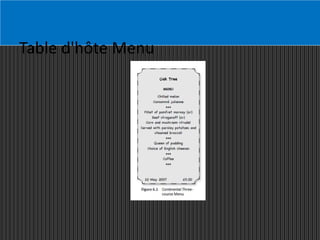
Table d'hôte Menu
Types of Menu
À la Carte Menu
The key characteristics of this type of menu are as follows:
 Extensive choice of dishes within each course/category
 Each dish is priced separately
 Dishes are cooked as per order
 Each dish has a waiting time
 Customers are billed according to the order placed
 Short description is mentioned under each dish
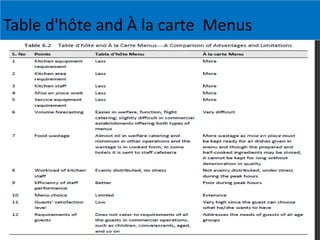
Table d'hôte and À la carte Menus
Other types of Menu
 Plat du jour
 Carte du jour
 Cyclic Menu
Plat du jour
• It means specialty of the day. Chefs make a few
special dishes which are normally the main course;
however, other courses, such as fish, sweets, and so
on, may also be included depending on the
geographical location of the restaurant.
• These special dishes can be introduced for every
meal, every day, every week according to catering
policy of the restaurant.
 Pricing of these dishes is higher than prices quoted
for other dishes of the same category in an a la
carte menu. This is because it is the chef’s special.
Special dishes are communicated to guest in many
ways- in the form of inserts, tent cards, display on
boards, and so on.
Plat du jour
 Advantages
 It acts as an effective sales tool.
 It adds up to the image of the restaurant.
 It reflects the skill of the chef and motivates him
and his staff to introduce new recipes.
 It gives an edge over the competitor since this menu
introduces very special dishes that are exclusive to
the restaurant.
Plat du jour
 Limitations
 If unsold. It results in food wastage since specialty
dishes call for ingredients that are either not used
in preparation of regular dishes of the menu or are
treated differently.
 In French it means card of the day. It refers to all
menus of the day, combining a la carte, table d’ hote,
and plate du jour menus.
• It is a series of table d’ hote menus for a set period
of time, say for four weeks, which are repeated for a
particular period, say for six months. After six
months, a new set of menus will be prepared.
• The length of the cyclic menu depends on season of
year, availability of ingredients, and catering policy
of the establishment. After a certain period, a new
set of menu is prepared.
• The consumers pay for the meals either in advance
or at the end of the month
Cyclic menus
• Advantages
– Effective cost control
– Stocking of unnecessary goods is avoided
– Does not need more of storage area for perishables as
the can be procured daily.
– Food wastage is almost nil
– Easy to plan the production schedule
– Labour requirement can be well planned
– Fewer cooking equipment required.
– Limitations
– Consumers have no choice but to but to take what is
offered
French Classical Courses
1. Appetizer ( Hors d’oeuvre)
2. Soup ( Potage)
3. Eggs/Pastas ( Oeufs/Farineux)
4. Fish ( Poisson)
5. Entrée
6. Joint ( Relevé)
7. Sorbet
8. Roast ( Rôti)
9. Vegetables ( Légumes)
French Classical Courses
10.Sweets ( Entremets)
11.Cheese/ Savoury ( Fromage/ Savoureux)
12.Fruits ( Dessert)
13.Coffee ( café)
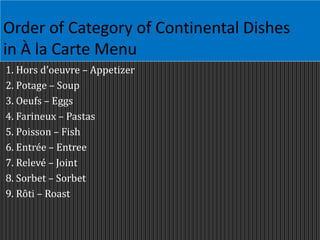
Order of Category of Continental Dishes
in À la Carte Menu
1. Hors d’oeuvre – Appetizer
2. Potage – Soup
3. Oeufs – Eggs
4. Farineux – Pastas
5. Poisson – Fish
6. Entrée – Entree
7. Relevé – Joint
8. Sorbet – Sorbet
9. Rôti – Roast
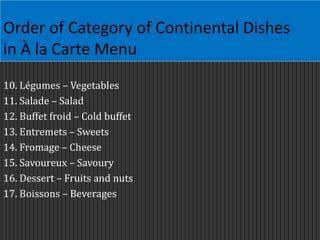
Order of Category of Continental Dishes
in À la Carte Menu
10. Légumes – Vegetables
11. Salade – Salad
12. Buffet froid – Cold buffet
13. Entremets – Sweets
14. Fromage – Cheese
15. Savoureux – Savoury
16. Dessert – Fruits and nuts
17. Boissons – Beverages
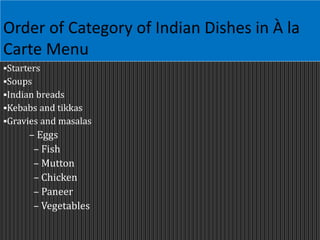
Order of Category of Indian Dishes in À la
Carte Menu
Starters
Soups
Indian breads
Kebabs and tikkas
Gravies and masalas
– Eggs
– Fish
– Mutton
– Chicken
– Paneer
– Vegetables
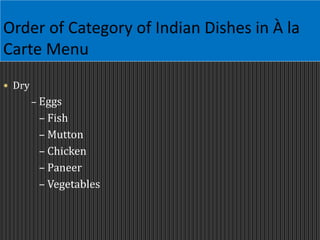
Order of Category of Indian Dishes in À la
Carte Menu
 Dry
– Eggs
– Fish
– Mutton
– Chicken
– Paneer
– Vegetables
Order of Category of Indian Dishes in À la
Carte Menu
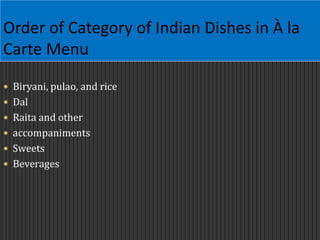
 Biryani, pulao, and rice
 Dal
 Raita and other
 accompaniments
 Sweets
 Beverages
Points to Remember
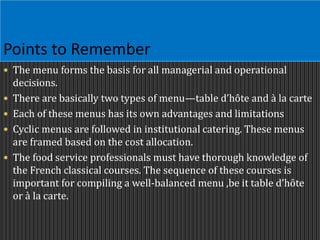
 The menu forms the basis for all managerial and operational
decisions.
 There are basically two types of menu—table d’hôte and à la carte
 Each of these menus has its own advantages and limitations
 Cyclic menus are followed in institutional catering. These menus
are framed based on the cost allocation.
 The food service professionals must have thorough knowledge of
the French classical courses. The sequence of these courses is
important for compiling a well-balanced menu ,be it table d’hôte
or à la carte.

Harshulkareer 1menu

  • 1.
  • 2.
    Menu At the endof the class, you will be able to  Know the meaning and functions of menu  understand the basic types of menu, and their features  know the sequence of French classical menu  know the sequence of French classical courses in à la carte menu  design Indian à la carte menu
  • 3.
    Menu  A menuis a list of dishes available for sale in a food service outlet or that can be served at a meal
  • 4.
    Menu  Every sectorof the food and beverage (F&B) industry, whether operating for commercial or welfare purpose, large or small, uses a menu. It not only informs the guests what the available dishes are, but also helps the operator know what he/she is going to prepare.
  • 5.
    Menu  The menuis the basis upon which all managerial and operational activities of the food and beverage operations depend.
  • 6.
    Functions of Menu Basis for operations  Communication device  Effective sales tool  Image builder
  • 7.
    Types of Menu Menus offered by various food service establishments come under the following two categories: 1. Table d’hôte menu 2. À la carte menu
  • 8.
    Table d’hôte menu Thekey characteristics of this type of menu are as follows:  Set number of courses  Limited choice within each course or amongst courses  Set price for all courses  Food prepared beforehand and available at a set time Types of Menu
  • 9.
  • 10.
    Types of Menu Àla Carte Menu The key characteristics of this type of menu are as follows:  Extensive choice of dishes within each course/category  Each dish is priced separately  Dishes are cooked as per order  Each dish has a waiting time  Customers are billed according to the order placed  Short description is mentioned under each dish
  • 11.
    Table d'hôte andÀ la carte Menus
  • 12.
    Other types ofMenu  Plat du jour  Carte du jour  Cyclic Menu
  • 13.
    Plat du jour •It means specialty of the day. Chefs make a few special dishes which are normally the main course; however, other courses, such as fish, sweets, and so on, may also be included depending on the geographical location of the restaurant. • These special dishes can be introduced for every meal, every day, every week according to catering policy of the restaurant.
  • 14.
     Pricing ofthese dishes is higher than prices quoted for other dishes of the same category in an a la carte menu. This is because it is the chef’s special. Special dishes are communicated to guest in many ways- in the form of inserts, tent cards, display on boards, and so on.
  • 15.
    Plat du jour Advantages  It acts as an effective sales tool.  It adds up to the image of the restaurant.  It reflects the skill of the chef and motivates him and his staff to introduce new recipes.  It gives an edge over the competitor since this menu introduces very special dishes that are exclusive to the restaurant.
  • 16.
    Plat du jour Limitations  If unsold. It results in food wastage since specialty dishes call for ingredients that are either not used in preparation of regular dishes of the menu or are treated differently.
  • 17.
     In Frenchit means card of the day. It refers to all menus of the day, combining a la carte, table d’ hote, and plate du jour menus.
  • 18.
    • It isa series of table d’ hote menus for a set period of time, say for four weeks, which are repeated for a particular period, say for six months. After six months, a new set of menus will be prepared. • The length of the cyclic menu depends on season of year, availability of ingredients, and catering policy of the establishment. After a certain period, a new set of menu is prepared. • The consumers pay for the meals either in advance or at the end of the month
  • 19.
    Cyclic menus • Advantages –Effective cost control – Stocking of unnecessary goods is avoided – Does not need more of storage area for perishables as the can be procured daily. – Food wastage is almost nil – Easy to plan the production schedule – Labour requirement can be well planned – Fewer cooking equipment required. – Limitations – Consumers have no choice but to but to take what is offered
  • 20.
    French Classical Courses 1.Appetizer ( Hors d’oeuvre) 2. Soup ( Potage) 3. Eggs/Pastas ( Oeufs/Farineux) 4. Fish ( Poisson) 5. Entrée 6. Joint ( Relevé) 7. Sorbet 8. Roast ( Rôti) 9. Vegetables ( Légumes)
  • 21.
    French Classical Courses 10.Sweets( Entremets) 11.Cheese/ Savoury ( Fromage/ Savoureux) 12.Fruits ( Dessert) 13.Coffee ( café)
  • 22.
    Order of Categoryof Continental Dishes in À la Carte Menu 1. Hors d’oeuvre – Appetizer 2. Potage – Soup 3. Oeufs – Eggs 4. Farineux – Pastas 5. Poisson – Fish 6. Entrée – Entree 7. Relevé – Joint 8. Sorbet – Sorbet 9. Rôti – Roast
  • 23.
    Order of Categoryof Continental Dishes in À la Carte Menu 10. Légumes – Vegetables 11. Salade – Salad 12. Buffet froid – Cold buffet 13. Entremets – Sweets 14. Fromage – Cheese 15. Savoureux – Savoury 16. Dessert – Fruits and nuts 17. Boissons – Beverages
  • 24.
    Order of Categoryof Indian Dishes in À la Carte Menu Starters Soups Indian breads Kebabs and tikkas Gravies and masalas – Eggs – Fish – Mutton – Chicken – Paneer – Vegetables
  • 25.
    Order of Categoryof Indian Dishes in À la Carte Menu  Dry – Eggs – Fish – Mutton – Chicken – Paneer – Vegetables
  • 26.
    Order of Categoryof Indian Dishes in À la Carte Menu  Biryani, pulao, and rice  Dal  Raita and other  accompaniments  Sweets  Beverages
  • 27.
    Points to Remember The menu forms the basis for all managerial and operational decisions.  There are basically two types of menu—table d’hôte and à la carte  Each of these menus has its own advantages and limitations  Cyclic menus are followed in institutional catering. These menus are framed based on the cost allocation.  The food service professionals must have thorough knowledge of the French classical courses. The sequence of these courses is important for compiling a well-balanced menu ,be it table d’hôte or à la carte.