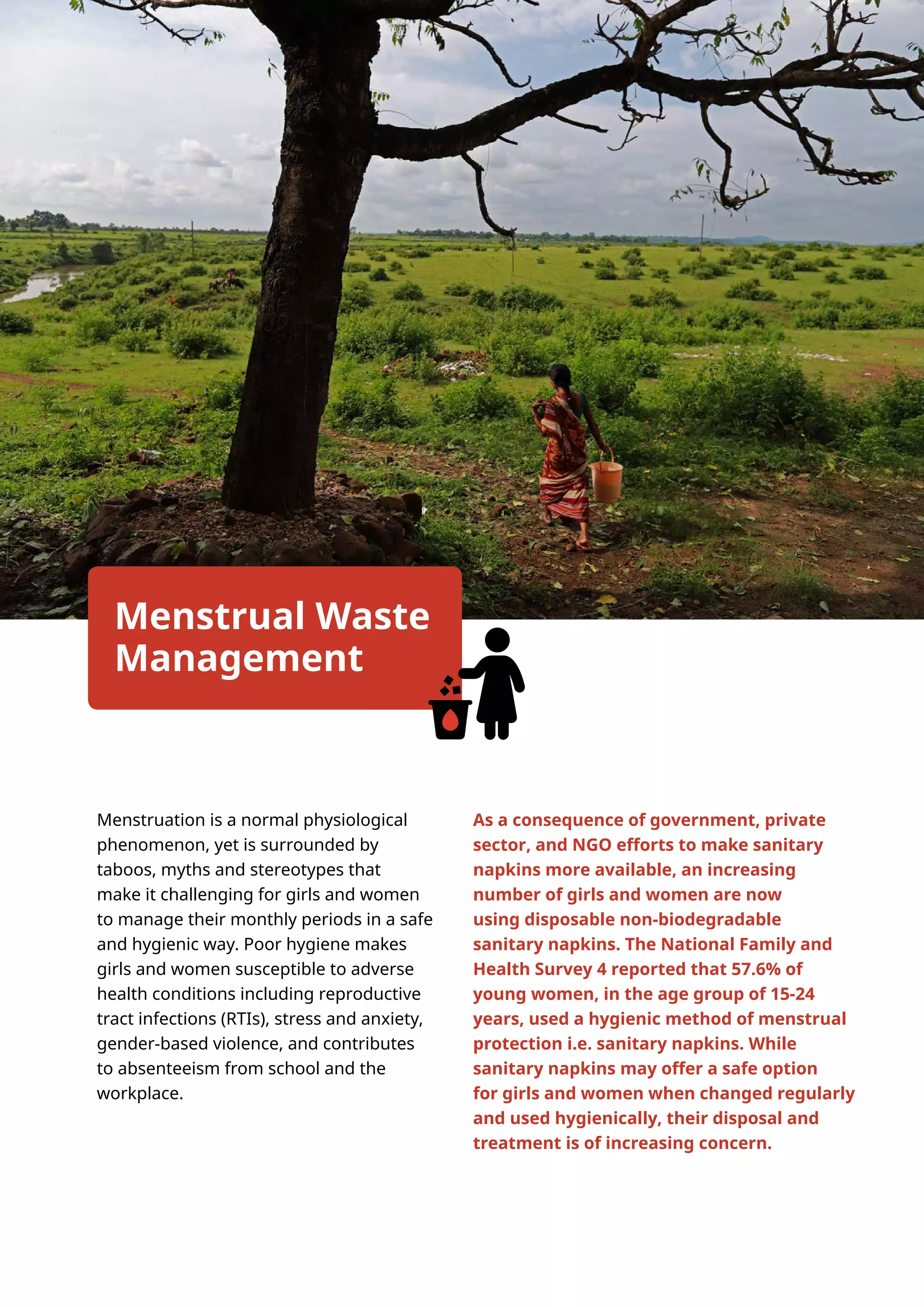
WaterAid/AninditoMukherjee
Menstruation is a normal physiological
phenomenon, yet is surrounded by
taboos, myths and stereotypes that
make it challenging for girls and women
to manage their monthly periods in a safe
and hygienic way. Poor hygiene makes
girls and women susceptible to adverse
health conditions including reproductive
tract infections (RTIs), stress and anxiety,
gender-based violence, and contributes
to absenteeism from school and the
workplace.
As a consequence of government, private
sector, and NGO efforts to make sanitary
napkins more available, an increasing
number of girls and women are now
using disposable non-biodegradable
sanitary napkins. The National Family and
Health Survey 4 reported that 57.6% of
young women, in the age group of 15-24
years, used a hygienic method of menstrual
protection i.e. sanitary napkins. While
sanitary napkins may offer a safe option
for girls and women when changed regularly
and used hygienically, their disposal and
treatment is of increasing concern.
Menstrual Waste
Management
Menstrual waste refers to blood, bodily
tissues, and used menstrual absorbents,
including cloth, disposable sanitary napkins
and other materials used to capture or
absorb blood during menstruation. An
estimated 36% of the female population of
reproductive age in India are using sanitary
napkins, producing one billion used pads per
month.
Menstrual waste management is
a concern and must be addressed
•	 Rural India and many urban areas (e.g.,
slums, small and medium towns) lacks
routine waste collection mechanisms. Used
menstrual products (cloth and sanitary
napkins) are often discarded in open fields
and water bodies (ponds, lakes, rivers,
streams), buried, or burned in the open.
•	 Anecdotal evidence suggest that when girls
lack disposal facilities, they may use pads
for a longer duration than recommended
resulting in unhygienic use. This in turn,
places them at risk for infections.
Figure 1: Estimated waste load calculation in India (Developed
by Menstrual Health Alliance India)
•	 Most sanitary pad varieties used are made
of cellulose, super absorbent polymers
(SAP), plastic covering, and adhesives/
glue; many of these components do not
decompose easily and remain in the
environment (polluting soil and water
sources).
•	 When sanitary pads, particularly those with
SAP, are burned (in the open, in burning
chambers, or low quality incinerators), they
release toxic chemicals (dioxins and furans
that are known carcinogens) that are
harmful for health.
•	 Most incinerators lack certification that
they meet emission standards set by the
Central Pollution Control Board. Low-
cost incinerators typically burn at low
temperatures and lack mechanisms to
control release of the toxic emissions (that
are carcinogenic). These incinerators are
potential health hazards for girls, students,
school staff, and community members who
use the incinerator or live in close proximity
to these machines.
Menstrual waste load in India
The figure below presents a snapshot of what menstrual waste is and its classification.
A universally agreed way to effectively and safely deal with menstrual waste does not exist in
India. However, menstrual waste management solutions should aim to tackle waste through the
following approaches:
Figure 2: Definition and classification of menstrual waste in India
Table 1: Menstrual waste management approaches and solutions
In order to identify the menstrual waste
management solutions, it is imperative to
understand the type of menstrual hygiene
products used and the implications for waste
management (the Informed Product Choice
Brief provides more detailed information).
Menstrual waste
Blood and used
menstrual absorbents,
including cloth,
disposable sanitary
napkins, tampons,
and other substances
or materials
Classification of menstrual waste
The Solid Waste Rules (2016)
consider menstrual waste as solid
waste and define it as Sanitary
Waste Rules specify responsibilities
of the waste generator, local
authorities and gram panchayats
and producers of sanitary products
Safe management of menstrual
waste
Series of steps, treatment and
disposal of used absorbents in a
manner that does not cause harm
to girls and women (the user) and to
the environment (in terms of land,
air and water sources)
Approaches for
menstrual waste
management Purpose Potential solutions
Reduce waste
volume
Lessen the amount of waste that
is generated and that has to be
managed
Alternative menstrual hygiene products:
reusable menstrual hygiene products
such as reusable pads and menstrual cups
Sterilise waste Make menstrual waste less
hazardous through treatments
that make them inert and
pathogen free
• Chemical treatments
• Autoclaving technologies
Change the
physical nature
of waste
Make waste easier and safer to
handle, reduce waste volume by
changing the very structure of
waste
• Incineration
• Deep burial and Composting
• Recycling
Potential solutions for
menstrual waste management
Here we briefly provide key considerations
for incinerators and deep burial, composting
solutions.
WaterAid/AninditoMukherjee
a. Incinerators
Incineration uses combustion to make waste
less harmful (sterilises waste), reduce the
volume of waste, and change the nature
of waste from solids to ash that can more
easily be disposed of.i
When incineration is
carried out properly, waste is converted into
relatively harmless gases and incombustible
solid waste (e.g., ash), and permissible gases
from incineration are released into the
atmosphere (after gas cleaning or emission
control measures). Residue ash from proper
incineration can be collected and disposed of
in designated ash pits or controlled landfills
without any major risk. However, when
incineration occurs in unsafe conditions
(e.g., waste is not appropriately segregated,
combustion occurs in a poorly constructed
incinerator with low burning temperature, no
emission control features), toxic compounds
can be present in the unburned waste, and
hazardous gases can be released into the air.
Despite the range of incinerator facilities available
and used in the country, specific standards and
guidelines for incinerator use for menstrual waste
do not exist. However, recommendations for the
use of large and small scale incinerators for bio-
medical waste do offer important and relevant
guidance for incinerator use in institutional
and community settings. The World Health
Organization has issued guidelines for safe
incineration of bio-medical or health care wasteii
,
and suggests that small-scale incinerators should
have certain features to ensure safe incinerationiii
.
Good planning, adherence to standards for
both incinerator design and emissions, technical
oversight, and continual supportive supervision of
incinerator systems are essential to ensuring safe
incinerationiv
. Table 2 highlights considerations
for small scale incinerators used in institutional
settings (schools, residential schools and hostels
for girls, and anganwadis) and community and
public toilets.
Type and composition
of product disposed
•	 Identify the types of products typically used and discarded in the setting
as they may have to be segregated before incineration:
•	 Sanitary pads made of cellulose without any SAP, and those with SAP
•	 Cloth pads of various textiles (cotton, synthetics) and other materials
Volume of product
disposed on a daily
and weekly basis
Estimate:
•	 The number of menstruating girls who will likely use and dispose
sanitary pads
•	 The average number of sanitary pads that will be disposed in the
incinerator per day. This will enable choice of the right incinerator that
can deal with these waste volumes on a daily or weekly basis
Settings for use •	 Education settings (schools, Ashramshalas, KGBV, girls hostel)
•	 Community settings (community toilet complexes)
•	 Public settings (public toilets)
•	 Health care facilities
•	 Anganwadis
•	 Child care institutions
Placement of
incinerator
•	 Incinerators to not be placed in closed rooms or toilet blocks where the
risk of emissions being released into the room is high
•	 If placed inside a room, the vent stack/outlet pipe of appropriate length
to lead outside the room (to an appropriate height), and away from
where people collect or pass by
Minimum and
maximum burning
temperatures
•	 The maximum burning to be considered to ensure complete combustion.
The maximum burning temperature has implications for placement of
incinerator and its handling by a trained caretaker to ensure safety of
users and caretakers
•	 Minimum temperatures to be reviewed carefully to ensure that complete
combustion takes places with measures in place to control for toxic
emissions
Adherence to the
Central Pollution
Control Board
Standards for
emissions and
ambient air quality
•	 Before procuring and installing incinerators, Government agencies
to ensure that the State Pollution Control Board has reviewed the
incinerator and has certified it as safe for use
•	 Ideally emissions from the incinerator should be tested in a government
accredited laboratory and confirmed to be within limits. Certification to
be provided.
Operation and
Maintenance
•	 Incinerators to be maintained well to ensure efficient functioning
•	 Designated caretaker to be identified and well trained to operate the
incinerator, with necessary safety equipment
•	 Segregation of menstrual waste from other waste to be ensured for
efficient functioning
•	 Monitoring use of incinerators to be done on regular basis
IEC •	 IEC materials to clearly display instruction for safe and appropriate
disposal of used menstrual products and on incinerator use. For
instance, clear instructions on disposing used materials in a separate
dustbin
•	 Clear instructions for maintenance must be displayed
Table 2: Core considerations for State Departments for incinerator use
b. Deep burial and composting
solutions
Biomedical Waste Management Rules
(2016) provides guidelines for deep burial
of biomedical waste that can be adapted for
menstrual waste. An adapted protocol for
deep burial has been developed in by NEERI
and Menstrual Health Alliance India. This
protocol is currently being piloted before
finalisation.
1. Deep burial suitable for compostable
sanitary pads and regular disposable
sanitary pads without SAP. Evidence
lacking on the suitability of this solution for
sanitary pads with SAP.
2. The deep burial pit should be of a depth of
1.5-2m, and with a width and breadth of
50-100cms each. The pit should only be half
filled with waste, then covered with lime
(10 cms), before filling the rest of the pit
with soil.
3. The pit can be an above ground pit,
constructed of brick or cement.
4. Inside the pit, each layer of used pads
should be 10 cms. Over this, a 10 cm layer
of soil is to be added.
5. When constructing the pit (below or above
ground), care should be taken that the
water table is at least 10 meters below the
lower level of the pit. The pit should also be
constructed away from water sources.
6. Deep burial pits should be protected
from animals and rodents using covers of
galvanised iron or wire meshes.
7. Soil and leachate testing to be done when
deep burial pits are piloted in any site to
test for the toxicity of soil and any leachate
post degradation of waste in the pit.
Figure 3 shows the deep burial pit prototype
currently being tested.
Composting is a form of waste disposal
whereby organic waste decomposes naturally
under oxygen rich conditions. While little
is known about the composting of used
menstrual absorbents, experts suggest that
reusable cotton pads and disposable sanitary
napkins made of napkins without SAP and
those made of natural fibres or materials
can be composted, following composting
procedures outlined in the Solid Waste Rules
(2016). Regular compost pits, bio-digesters,
vermi-composting been suggested as
possible composting solutions by experts.
Considerations for deep burial and
composting:
• Deep burial and composting pits must be
designed according to established guidance
on this matter (e.g., Solid Waste Rules,
Biomedical Waste Rules).
• Sanitary pads and other menstrual waste
products must be segregated from other
waste before disposal in deep burial or
composting pit.
• Organic materials (e.g., kitchen waste,
soil) may have to be added to facilitate
decomposition in the case of composting.
• Used sanitary pads may have to be
processed further (e.g., shedding, separation
of cellulosic content from plastic) before
disposal in deep burial or composting pit.
• Selection of an appropriate site for
composting, keeping in mind soil quality
and permeability, and distance from water
source and water table.
• The deep burial and composting site must
be protected from animals and rodents.
Figure 3: Illustrative Deep burial pit for menstrual waste products developed by NEERI,
based on the deep burial protocol in the Biomedical Waste Management Rules 2016
i
PATH and JSI. The Incinerator Guidebook: A practical guide for selecting, purchasing, installing, operating and
maintaining small-scale incinerators in low-resource settings
ii
World Health Organization (WHO). Policy Paper: Safe Health Care Waste Management. Geneva: WHO; 2004.
Available at: http://www.who.int/immunization_safety/publications/waste_management/en/HCWM_policy_paper_E.
pdf. Accessed December 2016.
iii
Batterman S. Assessment of Small-Scale Incinerators for Health Care Waste. Ann Arbor: University of Michigan,
Environmental Health Sciences; 2004. On consultancy for WHO
iv
PATH and JSI. The Incinerator Guidebook: A practical guide for selecting, purchasing, installing, operating and
maintaining small-scale incinerators in low-resource settings
• Construction and maintenance of deep
burial and composting pits must be done
under supervision, with careful thought to
design and implementation. A monitoring
system must be in place.
• The location of the deep burial site shall
be authorised by the prescribed authority
i.e. CPCB/ SPCB or District Pollution Control
Board Office.
Contact Arundati Muralidharan (ArundatiMuralidharan@wateraid.org) for further information on deep burial design
Menstrual Waste
Management
September 2019
All photographs: WaterAid/ Anindito Mukherjee

Menstrual Waste Management

  • 1.
    WaterAid/AninditoMukherjee Menstruation is anormal physiological phenomenon, yet is surrounded by taboos, myths and stereotypes that make it challenging for girls and women to manage their monthly periods in a safe and hygienic way. Poor hygiene makes girls and women susceptible to adverse health conditions including reproductive tract infections (RTIs), stress and anxiety, gender-based violence, and contributes to absenteeism from school and the workplace. As a consequence of government, private sector, and NGO efforts to make sanitary napkins more available, an increasing number of girls and women are now using disposable non-biodegradable sanitary napkins. The National Family and Health Survey 4 reported that 57.6% of young women, in the age group of 15-24 years, used a hygienic method of menstrual protection i.e. sanitary napkins. While sanitary napkins may offer a safe option for girls and women when changed regularly and used hygienically, their disposal and treatment is of increasing concern. Menstrual Waste Management
  • 2.
    Menstrual waste refersto blood, bodily tissues, and used menstrual absorbents, including cloth, disposable sanitary napkins and other materials used to capture or absorb blood during menstruation. An estimated 36% of the female population of reproductive age in India are using sanitary napkins, producing one billion used pads per month. Menstrual waste management is a concern and must be addressed • Rural India and many urban areas (e.g., slums, small and medium towns) lacks routine waste collection mechanisms. Used menstrual products (cloth and sanitary napkins) are often discarded in open fields and water bodies (ponds, lakes, rivers, streams), buried, or burned in the open. • Anecdotal evidence suggest that when girls lack disposal facilities, they may use pads for a longer duration than recommended resulting in unhygienic use. This in turn, places them at risk for infections. Figure 1: Estimated waste load calculation in India (Developed by Menstrual Health Alliance India) • Most sanitary pad varieties used are made of cellulose, super absorbent polymers (SAP), plastic covering, and adhesives/ glue; many of these components do not decompose easily and remain in the environment (polluting soil and water sources). • When sanitary pads, particularly those with SAP, are burned (in the open, in burning chambers, or low quality incinerators), they release toxic chemicals (dioxins and furans that are known carcinogens) that are harmful for health. • Most incinerators lack certification that they meet emission standards set by the Central Pollution Control Board. Low- cost incinerators typically burn at low temperatures and lack mechanisms to control release of the toxic emissions (that are carcinogenic). These incinerators are potential health hazards for girls, students, school staff, and community members who use the incinerator or live in close proximity to these machines. Menstrual waste load in India
  • 3.
    The figure belowpresents a snapshot of what menstrual waste is and its classification. A universally agreed way to effectively and safely deal with menstrual waste does not exist in India. However, menstrual waste management solutions should aim to tackle waste through the following approaches: Figure 2: Definition and classification of menstrual waste in India Table 1: Menstrual waste management approaches and solutions In order to identify the menstrual waste management solutions, it is imperative to understand the type of menstrual hygiene products used and the implications for waste management (the Informed Product Choice Brief provides more detailed information). Menstrual waste Blood and used menstrual absorbents, including cloth, disposable sanitary napkins, tampons, and other substances or materials Classification of menstrual waste The Solid Waste Rules (2016) consider menstrual waste as solid waste and define it as Sanitary Waste Rules specify responsibilities of the waste generator, local authorities and gram panchayats and producers of sanitary products Safe management of menstrual waste Series of steps, treatment and disposal of used absorbents in a manner that does not cause harm to girls and women (the user) and to the environment (in terms of land, air and water sources) Approaches for menstrual waste management Purpose Potential solutions Reduce waste volume Lessen the amount of waste that is generated and that has to be managed Alternative menstrual hygiene products: reusable menstrual hygiene products such as reusable pads and menstrual cups Sterilise waste Make menstrual waste less hazardous through treatments that make them inert and pathogen free • Chemical treatments • Autoclaving technologies Change the physical nature of waste Make waste easier and safer to handle, reduce waste volume by changing the very structure of waste • Incineration • Deep burial and Composting • Recycling Potential solutions for menstrual waste management Here we briefly provide key considerations for incinerators and deep burial, composting solutions.
  • 4.
    WaterAid/AninditoMukherjee a. Incinerators Incineration usescombustion to make waste less harmful (sterilises waste), reduce the volume of waste, and change the nature of waste from solids to ash that can more easily be disposed of.i When incineration is carried out properly, waste is converted into relatively harmless gases and incombustible solid waste (e.g., ash), and permissible gases from incineration are released into the atmosphere (after gas cleaning or emission control measures). Residue ash from proper incineration can be collected and disposed of in designated ash pits or controlled landfills without any major risk. However, when incineration occurs in unsafe conditions (e.g., waste is not appropriately segregated, combustion occurs in a poorly constructed incinerator with low burning temperature, no emission control features), toxic compounds can be present in the unburned waste, and hazardous gases can be released into the air. Despite the range of incinerator facilities available and used in the country, specific standards and guidelines for incinerator use for menstrual waste do not exist. However, recommendations for the use of large and small scale incinerators for bio- medical waste do offer important and relevant guidance for incinerator use in institutional and community settings. The World Health Organization has issued guidelines for safe incineration of bio-medical or health care wasteii , and suggests that small-scale incinerators should have certain features to ensure safe incinerationiii . Good planning, adherence to standards for both incinerator design and emissions, technical oversight, and continual supportive supervision of incinerator systems are essential to ensuring safe incinerationiv . Table 2 highlights considerations for small scale incinerators used in institutional settings (schools, residential schools and hostels for girls, and anganwadis) and community and public toilets.
  • 5.
    Type and composition ofproduct disposed • Identify the types of products typically used and discarded in the setting as they may have to be segregated before incineration: • Sanitary pads made of cellulose without any SAP, and those with SAP • Cloth pads of various textiles (cotton, synthetics) and other materials Volume of product disposed on a daily and weekly basis Estimate: • The number of menstruating girls who will likely use and dispose sanitary pads • The average number of sanitary pads that will be disposed in the incinerator per day. This will enable choice of the right incinerator that can deal with these waste volumes on a daily or weekly basis Settings for use • Education settings (schools, Ashramshalas, KGBV, girls hostel) • Community settings (community toilet complexes) • Public settings (public toilets) • Health care facilities • Anganwadis • Child care institutions Placement of incinerator • Incinerators to not be placed in closed rooms or toilet blocks where the risk of emissions being released into the room is high • If placed inside a room, the vent stack/outlet pipe of appropriate length to lead outside the room (to an appropriate height), and away from where people collect or pass by Minimum and maximum burning temperatures • The maximum burning to be considered to ensure complete combustion. The maximum burning temperature has implications for placement of incinerator and its handling by a trained caretaker to ensure safety of users and caretakers • Minimum temperatures to be reviewed carefully to ensure that complete combustion takes places with measures in place to control for toxic emissions Adherence to the Central Pollution Control Board Standards for emissions and ambient air quality • Before procuring and installing incinerators, Government agencies to ensure that the State Pollution Control Board has reviewed the incinerator and has certified it as safe for use • Ideally emissions from the incinerator should be tested in a government accredited laboratory and confirmed to be within limits. Certification to be provided. Operation and Maintenance • Incinerators to be maintained well to ensure efficient functioning • Designated caretaker to be identified and well trained to operate the incinerator, with necessary safety equipment • Segregation of menstrual waste from other waste to be ensured for efficient functioning • Monitoring use of incinerators to be done on regular basis IEC • IEC materials to clearly display instruction for safe and appropriate disposal of used menstrual products and on incinerator use. For instance, clear instructions on disposing used materials in a separate dustbin • Clear instructions for maintenance must be displayed Table 2: Core considerations for State Departments for incinerator use
  • 6.
    b. Deep burialand composting solutions Biomedical Waste Management Rules (2016) provides guidelines for deep burial of biomedical waste that can be adapted for menstrual waste. An adapted protocol for deep burial has been developed in by NEERI and Menstrual Health Alliance India. This protocol is currently being piloted before finalisation. 1. Deep burial suitable for compostable sanitary pads and regular disposable sanitary pads without SAP. Evidence lacking on the suitability of this solution for sanitary pads with SAP. 2. The deep burial pit should be of a depth of 1.5-2m, and with a width and breadth of 50-100cms each. The pit should only be half filled with waste, then covered with lime (10 cms), before filling the rest of the pit with soil. 3. The pit can be an above ground pit, constructed of brick or cement. 4. Inside the pit, each layer of used pads should be 10 cms. Over this, a 10 cm layer of soil is to be added. 5. When constructing the pit (below or above ground), care should be taken that the water table is at least 10 meters below the lower level of the pit. The pit should also be constructed away from water sources. 6. Deep burial pits should be protected from animals and rodents using covers of galvanised iron or wire meshes. 7. Soil and leachate testing to be done when deep burial pits are piloted in any site to test for the toxicity of soil and any leachate post degradation of waste in the pit. Figure 3 shows the deep burial pit prototype currently being tested. Composting is a form of waste disposal whereby organic waste decomposes naturally under oxygen rich conditions. While little is known about the composting of used menstrual absorbents, experts suggest that reusable cotton pads and disposable sanitary napkins made of napkins without SAP and those made of natural fibres or materials can be composted, following composting procedures outlined in the Solid Waste Rules (2016). Regular compost pits, bio-digesters, vermi-composting been suggested as possible composting solutions by experts. Considerations for deep burial and composting: • Deep burial and composting pits must be designed according to established guidance on this matter (e.g., Solid Waste Rules, Biomedical Waste Rules). • Sanitary pads and other menstrual waste products must be segregated from other waste before disposal in deep burial or composting pit. • Organic materials (e.g., kitchen waste, soil) may have to be added to facilitate decomposition in the case of composting. • Used sanitary pads may have to be processed further (e.g., shedding, separation of cellulosic content from plastic) before disposal in deep burial or composting pit. • Selection of an appropriate site for composting, keeping in mind soil quality and permeability, and distance from water source and water table. • The deep burial and composting site must be protected from animals and rodents.
  • 7.
    Figure 3: IllustrativeDeep burial pit for menstrual waste products developed by NEERI, based on the deep burial protocol in the Biomedical Waste Management Rules 2016 i PATH and JSI. The Incinerator Guidebook: A practical guide for selecting, purchasing, installing, operating and maintaining small-scale incinerators in low-resource settings ii World Health Organization (WHO). Policy Paper: Safe Health Care Waste Management. Geneva: WHO; 2004. Available at: http://www.who.int/immunization_safety/publications/waste_management/en/HCWM_policy_paper_E. pdf. Accessed December 2016. iii Batterman S. Assessment of Small-Scale Incinerators for Health Care Waste. Ann Arbor: University of Michigan, Environmental Health Sciences; 2004. On consultancy for WHO iv PATH and JSI. The Incinerator Guidebook: A practical guide for selecting, purchasing, installing, operating and maintaining small-scale incinerators in low-resource settings • Construction and maintenance of deep burial and composting pits must be done under supervision, with careful thought to design and implementation. A monitoring system must be in place. • The location of the deep burial site shall be authorised by the prescribed authority i.e. CPCB/ SPCB or District Pollution Control Board Office. Contact Arundati Muralidharan (ArundatiMuralidharan@wateraid.org) for further information on deep burial design
  • 8.
    Menstrual Waste Management September 2019 Allphotographs: WaterAid/ Anindito Mukherjee