Research and Development
Terminology
 Research – refers to the advancement
of knowledge
 Development – refers to the
application of knowledge
 Market Research – refers to the
process of gathering, recording, and
analyzing data about consumer needs
and wants and the products, processes,
and services they use
Invention vs. Innovation
 Invention: A new product, system, or
process that has never existed before,
created by study and experimentation.
 Innovation: An improvement of an
existing technological product, system,
or method of doing something.
Market Research
• Purpose – help companies make better
decisions, create a business plan, launch a new
product or service, fine tune existing products
and services, or expand into new markets.
• What information is needed in order to solve
the problem?
• Basic Steps –
– Define the research problem
– Select and establish research design
– Collect and analyze data
– Make Decisions
Patent Applications
Just the Frequently Asked
Questions
What is a patent?
A patent is a legally binding
contract between an inventor,
an owner (who may be the
same person) and the people
of the U.S. represented by the
U.S. Office of Patents and
Trademarks.
Who is involved in obtaining a
patent?
The Inventor/The Owner
The Patent Attorney
The Patent Examiner (U.S.
Citizens)
Patents limit competition.
Patents are a teaching tool.
Patents demonstrate capability.
Patents protect intellectual property.
Why would I want to obtain
a patent?
Brief Introduction
Technical Description
Legal Statements
What are the main parts of a
Patent?
Abstract:
Specification:
Claims:
Do I need to build my invention
to obtain a patent?
No
Do I need to have every last detail
of my idea fleshed-out and
documented to apply for a patent?
No
If I have an idea I want to patent,
but I am not prepared today to file
an application, am I out-of-luck?
No
If I publish a paper about my
invention, or sell my invention,
prior to applying for a patent,
do I forfeit my
opportunity
to do so?
No
But you only have one calendar year from
any one of the above events to file.
If I have a patent, and I improve on
my idea, is my improvement
automatically covered by the
original patent?
No
But a ‘Continuation in Part’
application or a new application
may be filed any time prior to the
date the original patent issues.
Are U.S. patents recognized by
other countries?
Yes and No
U.S. Patents forbid the development,
marketing and/or sale of items
under U.S. Patent protection
within the U.S., unless an individual is
licensed by the owner of the patent.
Are there foreign patents, and can I
apply for one if I want to patent my
invention in other countries?
Yes
Foreign patent applications are:
• extremely expensive
• usually more difficult to satisfy
• subject to similar, but different
restrictions and criteria.
What should I do if I want to apply
for Patent Protection?
• Evaluate the cost.
• Evaluate the merit of the idea.
• Write a letter to the U.S. Office of Patents
and Trademarks.
• Identify and retain a Patent Attorney.
• Develop the Application.
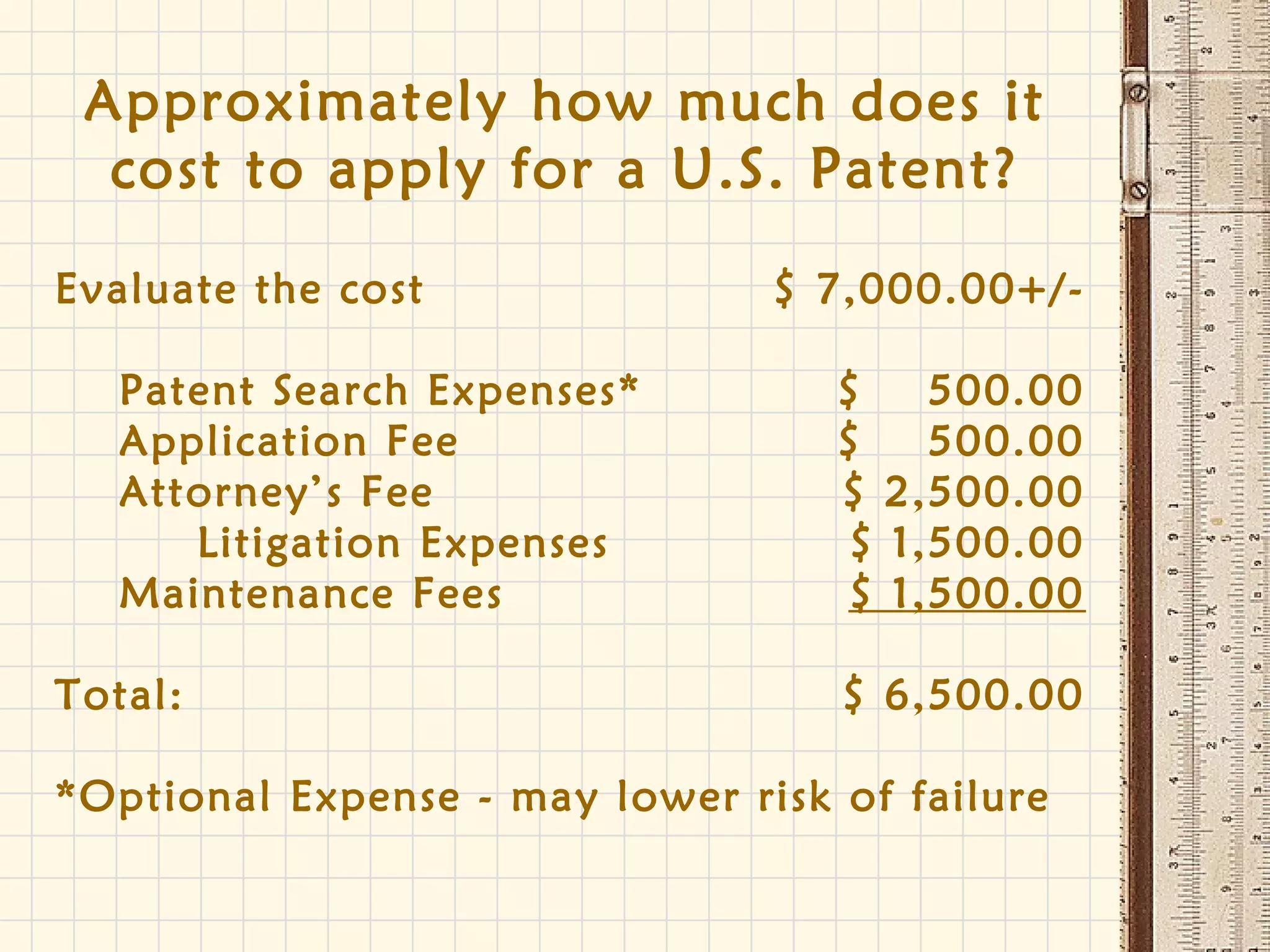
Approximately how much does it
cost to apply for a U.S. Patent?
Evaluate the cost $ 7,000.00+/-
Patent Search Expenses* $ 500.00
Application Fee $ 500.00
Attorney’s Fee $ 2,500.00
Litigation Expenses $ 1,500.00
Maintenance Fees $ 1,500.00
Total: $ 6,500.00
*Optional Expense - may lower risk of failure
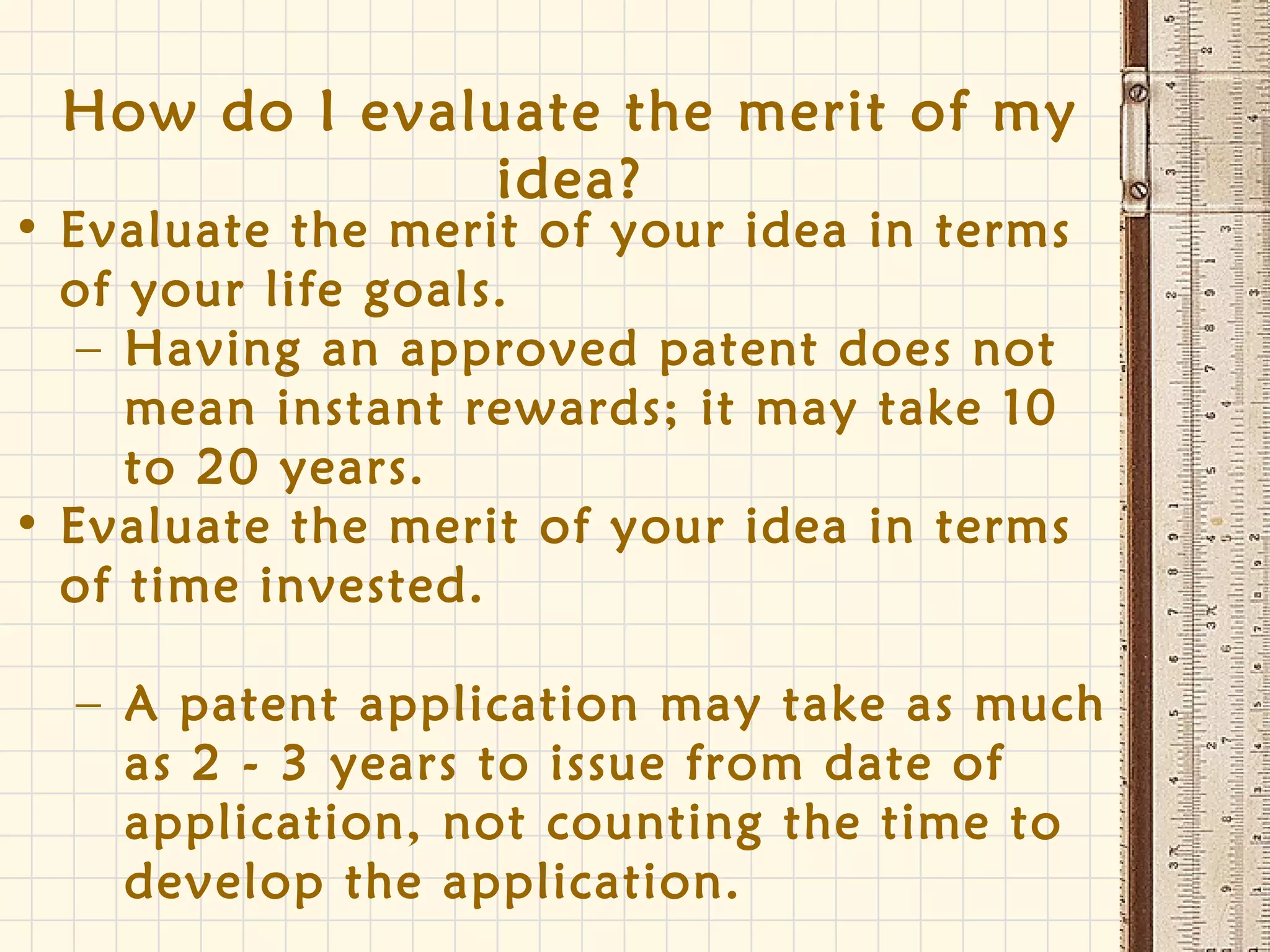
How do I evaluate the merit of my
idea?
• Evaluate the merit of your idea in terms
of your life goals.
– Having an approved patent does not
mean instant rewards; it may take 10
to 20 years.
• Evaluate the merit of your idea in terms
of time invested.
– A patent application may take as much
as 2 - 3 years to issue from date of
application, not counting the time to
develop the application.
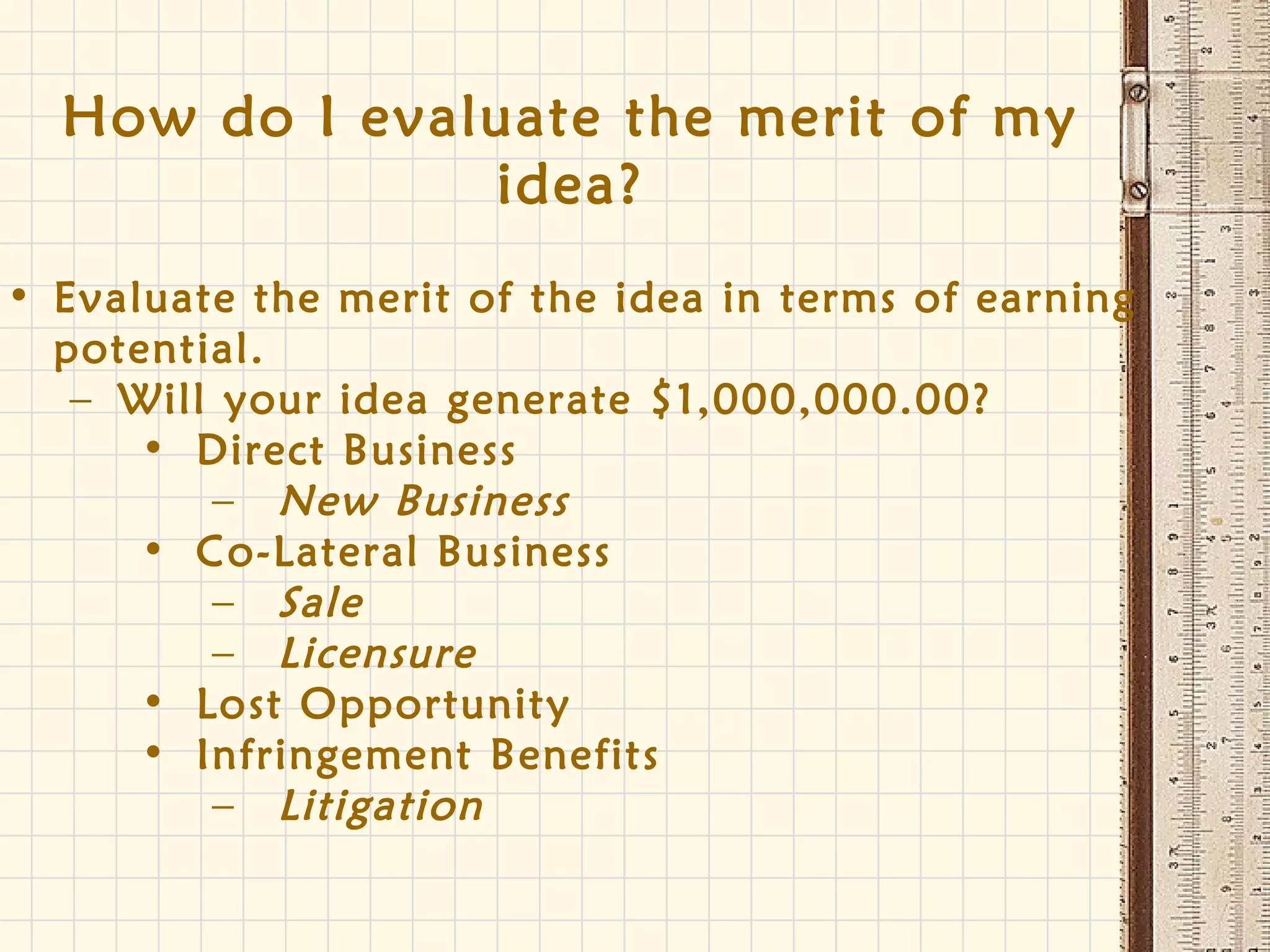
How do I evaluate the merit of my
idea?
• Evaluate the merit of the idea in terms of earning
potential.
– Will your idea generate $1,000,000.00?
• Direct Business
– New Business
• Co-Lateral Business
– Sale
– Licensure
• Lost Opportunity
• Infringement Benefits
– Litigation
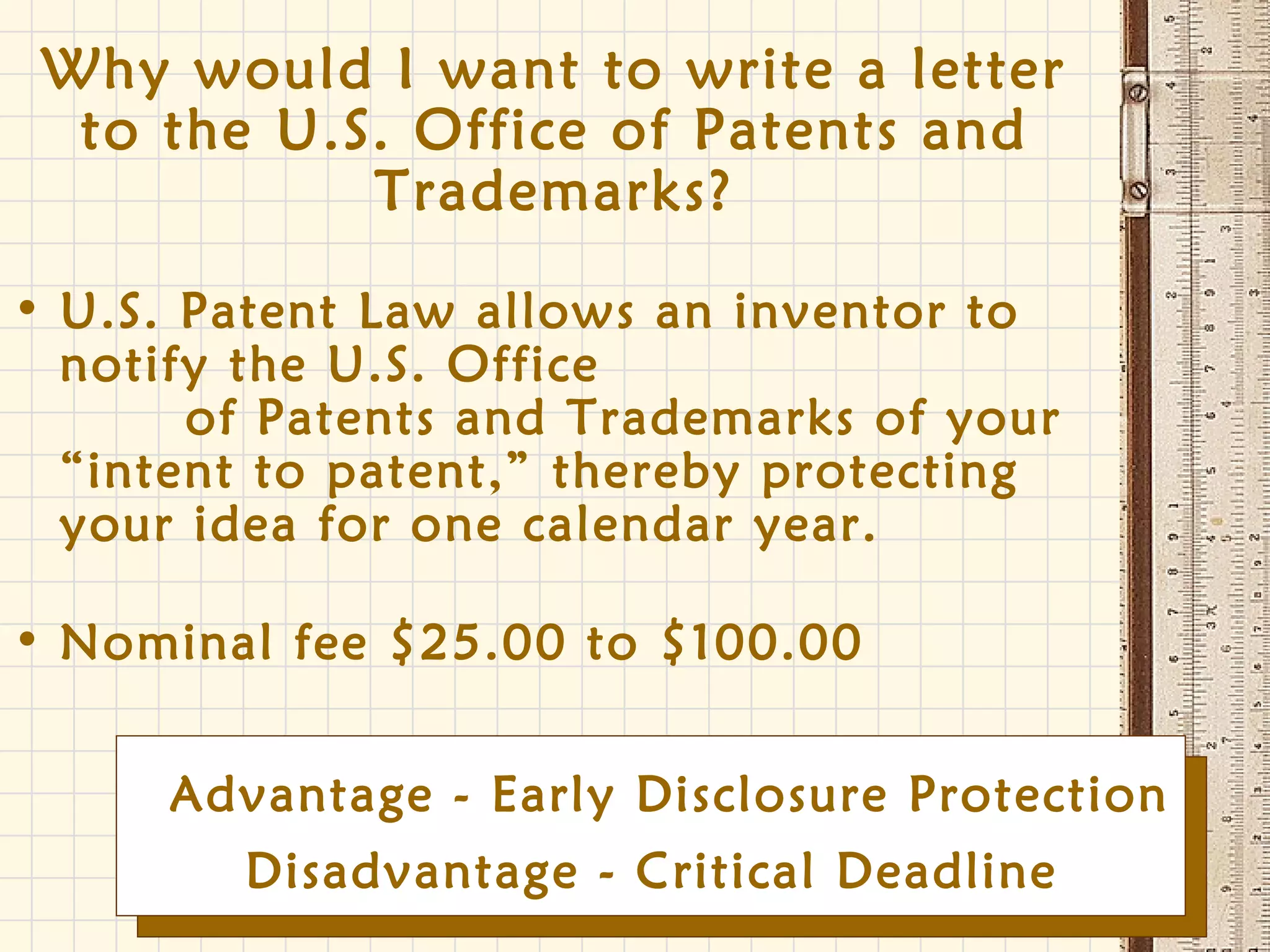
Why would I want to write a letter
to the U.S. Office of Patents and
Trademarks?
• U.S. Patent Law allows an inventor to
notify the U.S. Office
of Patents and Trademarks of your
“intent to patent,” thereby protecting
your idea for one calendar year.
• Nominal fee $25.00 to $100.00
Disadvantage - Critical Deadline
Advantage - Early Disclosure Protection
Why should I contact a Patent
Attorney?
• It is possible to apply for a patent without
an attorney, but the risk of failure is very
high.
• He/She is your representative to the U.S.
Office of Patents and Trademarks.
• He/She is your counsel for interpreting the
law.
• He/She is your technical “sounding board”
and strategist.
– A Patent Attorney has a Degree in
Engineering
and in law.
What do I need to develop my
Patent Application?
• A credible, patentable and valuable
idea
– Not obvious to “someone of
ordinary skill in the art.”
– Not already published or on the
market.
What should I do if I want to apply
for Patent Protection?
• Evaluate the cost. $7,000.00 +/-
• Evaluate the merit of the idea. Risks vs. Value
• Write a letter to the U.S. Office Protection
of Patents and Trademarks.
• Identify and retain a Patent Attorney. Help!
• Develop the Application. WORK!

Research development

  • 1.
  • 2.
    Terminology  Research –refers to the advancement of knowledge  Development – refers to the application of knowledge  Market Research – refers to the process of gathering, recording, and analyzing data about consumer needs and wants and the products, processes, and services they use
  • 3.
    Invention vs. Innovation Invention: A new product, system, or process that has never existed before, created by study and experimentation.  Innovation: An improvement of an existing technological product, system, or method of doing something.
  • 4.
    Market Research • Purpose– help companies make better decisions, create a business plan, launch a new product or service, fine tune existing products and services, or expand into new markets. • What information is needed in order to solve the problem? • Basic Steps – – Define the research problem – Select and establish research design – Collect and analyze data – Make Decisions
  • 6.
    Patent Applications Just theFrequently Asked Questions
  • 7.
    What is apatent? A patent is a legally binding contract between an inventor, an owner (who may be the same person) and the people of the U.S. represented by the U.S. Office of Patents and Trademarks.
  • 8.
    Who is involvedin obtaining a patent? The Inventor/The Owner The Patent Attorney The Patent Examiner (U.S. Citizens)
  • 9.
    Patents limit competition. Patentsare a teaching tool. Patents demonstrate capability. Patents protect intellectual property. Why would I want to obtain a patent?
  • 10.
    Brief Introduction Technical Description LegalStatements What are the main parts of a Patent? Abstract: Specification: Claims:
  • 11.
    Do I needto build my invention to obtain a patent? No
  • 12.
    Do I needto have every last detail of my idea fleshed-out and documented to apply for a patent? No
  • 13.
    If I havean idea I want to patent, but I am not prepared today to file an application, am I out-of-luck? No
  • 14.
    If I publisha paper about my invention, or sell my invention, prior to applying for a patent, do I forfeit my opportunity to do so? No But you only have one calendar year from any one of the above events to file.
  • 15.
    If I havea patent, and I improve on my idea, is my improvement automatically covered by the original patent? No But a ‘Continuation in Part’ application or a new application may be filed any time prior to the date the original patent issues.
  • 16.
    Are U.S. patentsrecognized by other countries? Yes and No U.S. Patents forbid the development, marketing and/or sale of items under U.S. Patent protection within the U.S., unless an individual is licensed by the owner of the patent.
  • 17.
    Are there foreignpatents, and can I apply for one if I want to patent my invention in other countries? Yes Foreign patent applications are: • extremely expensive • usually more difficult to satisfy • subject to similar, but different restrictions and criteria.
  • 18.
    What should Ido if I want to apply for Patent Protection? • Evaluate the cost. • Evaluate the merit of the idea. • Write a letter to the U.S. Office of Patents and Trademarks. • Identify and retain a Patent Attorney. • Develop the Application.
  • 19.
    Approximately how muchdoes it cost to apply for a U.S. Patent? Evaluate the cost $ 7,000.00+/- Patent Search Expenses* $ 500.00 Application Fee $ 500.00 Attorney’s Fee $ 2,500.00 Litigation Expenses $ 1,500.00 Maintenance Fees $ 1,500.00 Total: $ 6,500.00 *Optional Expense - may lower risk of failure
  • 20.
    How do Ievaluate the merit of my idea? • Evaluate the merit of your idea in terms of your life goals. – Having an approved patent does not mean instant rewards; it may take 10 to 20 years. • Evaluate the merit of your idea in terms of time invested. – A patent application may take as much as 2 - 3 years to issue from date of application, not counting the time to develop the application.
  • 21.
    How do Ievaluate the merit of my idea? • Evaluate the merit of the idea in terms of earning potential. – Will your idea generate $1,000,000.00? • Direct Business – New Business • Co-Lateral Business – Sale – Licensure • Lost Opportunity • Infringement Benefits – Litigation
  • 22.
    Why would Iwant to write a letter to the U.S. Office of Patents and Trademarks? • U.S. Patent Law allows an inventor to notify the U.S. Office of Patents and Trademarks of your “intent to patent,” thereby protecting your idea for one calendar year. • Nominal fee $25.00 to $100.00 Disadvantage - Critical Deadline Advantage - Early Disclosure Protection
  • 23.
    Why should Icontact a Patent Attorney? • It is possible to apply for a patent without an attorney, but the risk of failure is very high. • He/She is your representative to the U.S. Office of Patents and Trademarks. • He/She is your counsel for interpreting the law. • He/She is your technical “sounding board” and strategist. – A Patent Attorney has a Degree in Engineering and in law.
  • 24.
    What do Ineed to develop my Patent Application? • A credible, patentable and valuable idea – Not obvious to “someone of ordinary skill in the art.” – Not already published or on the market.
  • 25.
    What should Ido if I want to apply for Patent Protection? • Evaluate the cost. $7,000.00 +/- • Evaluate the merit of the idea. Risks vs. Value • Write a letter to the U.S. Office Protection of Patents and Trademarks. • Identify and retain a Patent Attorney. Help! • Develop the Application. WORK!

Editor's Notes

  • #3 Definitions: Research: The systematic study of materials and sources in order to establish facts and reach new conclusions. Development: To change the form of something through a succession of states or stages, each of which is preparatory to the next. The successive changes are undertaken to improve the quality of or refine the resulting object or software. Market Research: The activity of gathering information about consumers’ needs and preferences.
  • #4 RTK AutoSteer helps farmers reduce fuel costs, decrease driver fatigue, and eliminate overlap. Pictured here are GPS system antennas roof-mounted on a farming tractor and the touch screen controls for the GPS guidance system installed in the cockpit.
  • #5 A list of questions that can be answered through market research are: What information is needed in order to solve the problem? What is happening in the market? What are the trends? Who are the competitors? How do consumers talk about the products in the market? What do they want to see? What do they like or dislike? Which needs are most important? Are the needs being met by current products?
  • #6 For purposes of this course, students will not be expected to complete a full market research survey and formulate their findings in a formal paper. However, they are expected to be able to discuss how their solution to their problem may be either an invention or innovation and how it may or may not work in the market place.