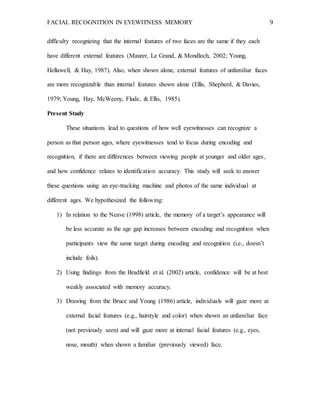
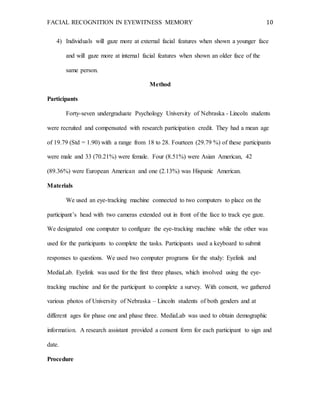
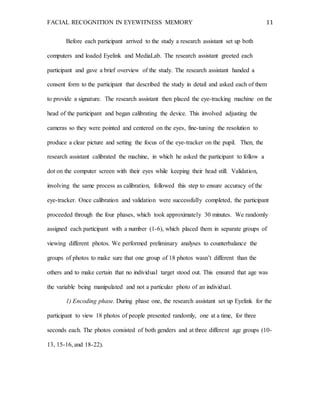
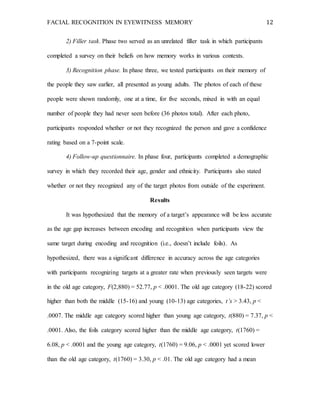
The study examined how facial recognition accuracy is affected when significant time passes between encoding a face and recognizing it later. Participants viewed photos of individuals at different ages and later did a recognition task. The study found that memory of a target's appearance is less accurate as the age gap increases between encoding and recognition. Confidence was found to be a weak predictor of memory accuracy. No relationships were observed between gaze times on external and internal facial features based on familiarity or age differences of the faces. Future research could explore how gaze time on specific facial features relates to memory accuracy.