Membrane Bioreactor Technology: Opportunities and ChallengesBy Sami Rehman (Process Engineer) at Albion Water Ltd
ContentsMembrane Bioreactor (MBR) systems process outline Reasons for using MBR as an alternative to Activated SludgeChallenges to address: e.g. membrane fouling and stabilityLatest Research Further Work Summary
MBR: The ProcessCombination of membrane technology in a bioreactor and a biological stage => led to three generic types of MBRFirst type = separation and retention of solidsSecond type = bubble-less aeration within the bioreactorThird type = extraction of priority organic pollutants from industrial wastewaters
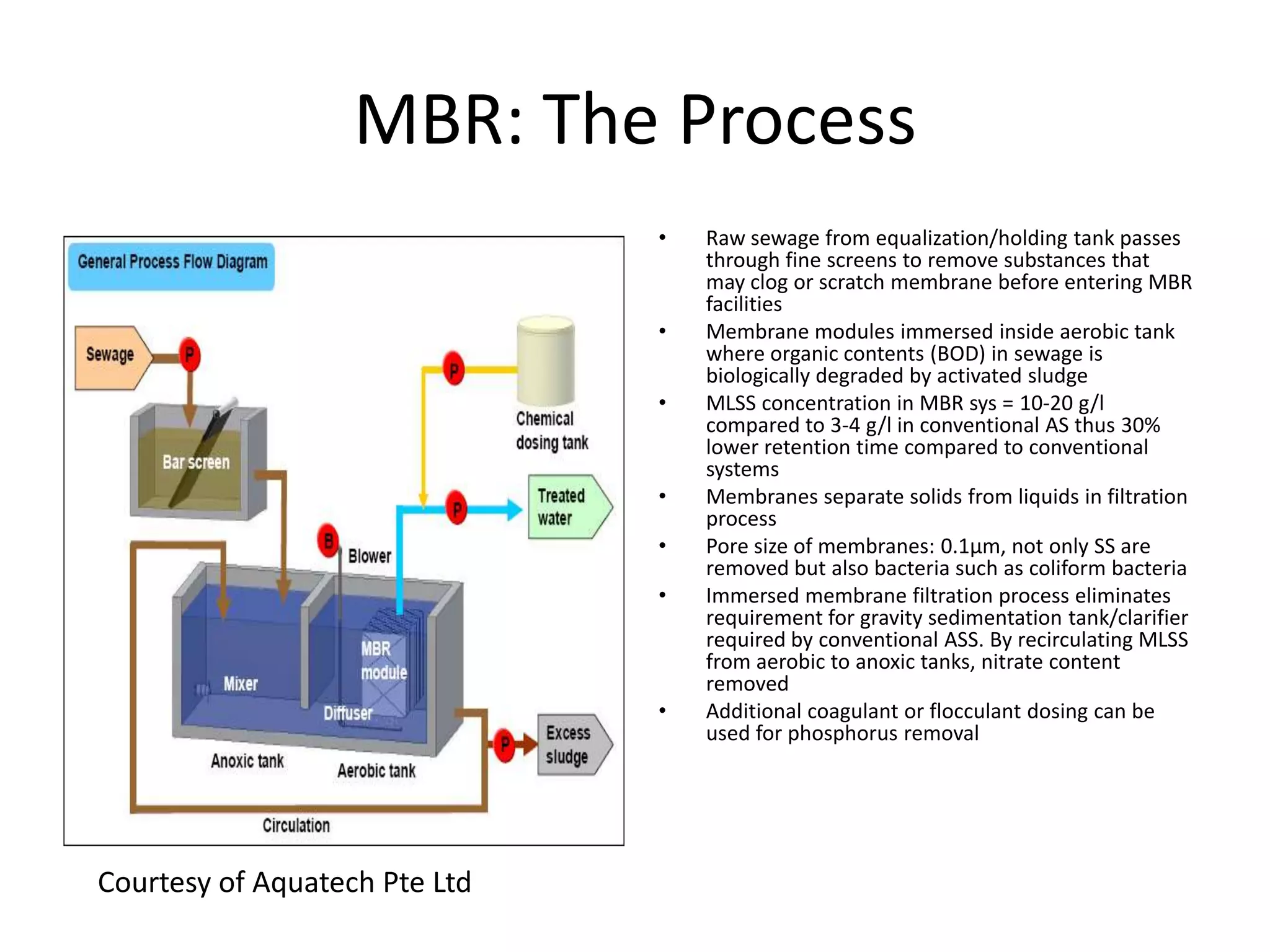
MBR: The ProcessRaw sewage from equalization/holding tank passes through fine screens to remove substances that may clog or scratch membrane before entering MBR facilitiesMembrane modules immersed inside aerobic tank where organic contents (BOD) in sewage is biologically degraded by activated sludgeMLSS concentration in MBR sys = 10-20 g/l compared to 3-4 g/l in conventional AS thus 30% lower retention time compared to conventional systemsMembranes separate solids from liquids in filtration process Pore size of membranes: 0.1µm, not only SS are removed but also bacteria such as coliform bacteriaImmersed membrane filtration process eliminates requirement for gravity sedimentation tank/clarifier required by conventional ASS. By recirculating MLSS from aerobic to anoxic tanks, nitrate content removedAdditional coagulant or flocculant dosing can be used for phosphorus removal Courtesy of Aquatech Pte Ltd
MBR ConfigurationsTwo Types: External and Internal External – Mixed liquor filtered under pressure in specific membrane moduleInternal or Submerged – Filtration in an aerated basin by suction to remove effluent
External & Submerged MBR Systems
Issues: Membrane FoulingExternal modules can avoid fouling by carrying out tangential filtration especially when effluent is concentratedThere may be a higher cost – this is justified!Necessary in such cases that shear stress on bioflocs is controlled, external membranes have high shear stress due to high recycle flow ratios
Why MBR over activated sludge?Traditional secondary clarifier replaced by membrane module. This module is more compact and quality of rejected water depends on changes in sludge settling velocitiesMBR allows the biomass concentrations to be higher than for traditional plants (20-30 g/l)
Latest ResearchCombination of MBR and NF/RO membranes for indirect potable water reuse applications (Abdulhakeem Ali Alturkiet al., 2010)Membrane bioreactor in water treatment (G. Wen et al., 2010)Novel Anaerobic MBR technology for low cost methane production: pilot wastewater project 2010 proved a success at Ken’s Foods WWTP in MA, USA
Further Work More indepth study of membranes: MBR or integrated/combined systems approach eg MBR + NF/RO Need to study membrane fouling further – establish better understanding for fouling process, identify which materials under what conditions (T, P and pH) will foul the least to optimize system design
Summary MBR presents an attractive alternative to conventional activated sludge (CAS) in treating wastewaterMBR is a more robust technology with a small footprint and produces a higher quality effluent due to high removal efficiencies as a result of high retention time compared with CAS MBR can meet the increasingly stringent requirements for discharge of treated effluent placed on WWTP operators by environmental bodies like EAResearch suggests that MBR has a lot of potential and is poised to be the next generation to wastewater treatment

Membrane Bioreactor Technology

  • 1.
    Membrane Bioreactor Technology:Opportunities and ChallengesBy Sami Rehman (Process Engineer) at Albion Water Ltd
  • 2.
    ContentsMembrane Bioreactor (MBR)systems process outline Reasons for using MBR as an alternative to Activated SludgeChallenges to address: e.g. membrane fouling and stabilityLatest Research Further Work Summary
  • 3.
    MBR: The ProcessCombinationof membrane technology in a bioreactor and a biological stage => led to three generic types of MBRFirst type = separation and retention of solidsSecond type = bubble-less aeration within the bioreactorThird type = extraction of priority organic pollutants from industrial wastewaters
  • 4.
    MBR: The ProcessRawsewage from equalization/holding tank passes through fine screens to remove substances that may clog or scratch membrane before entering MBR facilitiesMembrane modules immersed inside aerobic tank where organic contents (BOD) in sewage is biologically degraded by activated sludgeMLSS concentration in MBR sys = 10-20 g/l compared to 3-4 g/l in conventional AS thus 30% lower retention time compared to conventional systemsMembranes separate solids from liquids in filtration process Pore size of membranes: 0.1µm, not only SS are removed but also bacteria such as coliform bacteriaImmersed membrane filtration process eliminates requirement for gravity sedimentation tank/clarifier required by conventional ASS. By recirculating MLSS from aerobic to anoxic tanks, nitrate content removedAdditional coagulant or flocculant dosing can be used for phosphorus removal Courtesy of Aquatech Pte Ltd
  • 5.
    MBR ConfigurationsTwo Types:External and Internal External – Mixed liquor filtered under pressure in specific membrane moduleInternal or Submerged – Filtration in an aerated basin by suction to remove effluent
  • 6.
  • 7.
    Issues: Membrane FoulingExternalmodules can avoid fouling by carrying out tangential filtration especially when effluent is concentratedThere may be a higher cost – this is justified!Necessary in such cases that shear stress on bioflocs is controlled, external membranes have high shear stress due to high recycle flow ratios
  • 8.
    Why MBR overactivated sludge?Traditional secondary clarifier replaced by membrane module. This module is more compact and quality of rejected water depends on changes in sludge settling velocitiesMBR allows the biomass concentrations to be higher than for traditional plants (20-30 g/l)
  • 9.
    Latest ResearchCombination ofMBR and NF/RO membranes for indirect potable water reuse applications (Abdulhakeem Ali Alturkiet al., 2010)Membrane bioreactor in water treatment (G. Wen et al., 2010)Novel Anaerobic MBR technology for low cost methane production: pilot wastewater project 2010 proved a success at Ken’s Foods WWTP in MA, USA
  • 10.
    Further Work Moreindepth study of membranes: MBR or integrated/combined systems approach eg MBR + NF/RO Need to study membrane fouling further – establish better understanding for fouling process, identify which materials under what conditions (T, P and pH) will foul the least to optimize system design
  • 11.
    Summary MBR presentsan attractive alternative to conventional activated sludge (CAS) in treating wastewaterMBR is a more robust technology with a small footprint and produces a higher quality effluent due to high removal efficiencies as a result of high retention time compared with CAS MBR can meet the increasingly stringent requirements for discharge of treated effluent placed on WWTP operators by environmental bodies like EAResearch suggests that MBR has a lot of potential and is poised to be the next generation to wastewater treatment