Warm-up
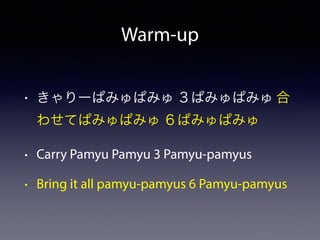
• きゃりーぱみゅぱみゅ 3ぱみゅぱみゅ合
わせてぱみゅぱみゅ 6ぱみゅぱみゅ
• Carry Pamyu Pamyu 3 Pamyu-pamyus
• Bring it all pamyu-pamyus 6 Pamyu-pamyus
8.
Chunking: E.g.
• 語のかたまりに区切ること
•The girl pushed in front of the bus escaped with
minor injuries.
• [[The girl][pushed in front of the bus]][[escaped][with
minor injuries]].
• The girl / pushed in front of the bus/escaped / with
minor injuries.
Exercise
• 仲間はずれはどれ?
• a)athlete, athletic, privacy, private
• b) for example, come with me, He was
there, in ad-vance
15.
Exercise
• 仲間はずれはどれ?
• a)ath-lete, ath-let-ic, pri-va-cy, pri-vate
•
●-●, ●-●-●, ●-●-●, ●-●
• b) for ex-am-ple, come with me
•
● ● ● ●, ● ● ●
• He was there, in ad-vance
•
● ● ●, ● ● ●
16.
音韻システムの獲得
• Read thisaloud:
• She went to the station to meet her father.
•
● ● ● ● ● ● ● ● ● ●
!
• From two to two to two two
•
● ● ● ● ● ● ●
• fルmトゥータトゥータトゥートゥー
• 「2時2分前から2時2分過ぎまで」
• 弱くなる単語: 機能語
•冠詞: a, an, the
• 人称代名詞: I, my, me, he, she, theyなど
• 関係代名詞: which, who, that:
• This is a book which used to be very popular.
• some(スm), any(エn)
• 助動詞・be動詞: can, must, should
• 前置詞: in, on, at, for, from
• 接続詞: and, but, that
19.
• 強くなる単語: 内容語
•名詞: book, computer, happiness
• 形容詞: hot, happy, difficult, wonderful
• 動詞: love, marry, divorce
• 副詞: quickly, easily, happily
• 数詞: one, three, fifteen, hundred
• 指示代名詞: this, that, these, those
• 疑問詞: what, which, who, when, where
• Which book are you talking about?
20.
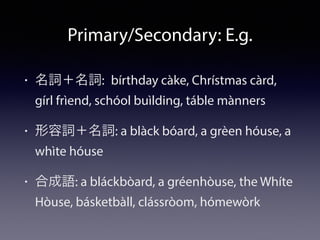
Primary/Secondary: E.g.
• 名詞+名詞:bírthday càke, Chrístmas càrd,
gírl frìend, schóol buìlding, táble mànners
• 形容詞+名詞: a blàck bóard, a grèen hóuse, a
whìte hóuse
• 合成語: a bláckbòard, a gréenhòuse, the Whíte
Hòuse, básketbàll, clássròom, hómewòrk
21.
音韻システムの獲得
• [ ] inand out; bacon and butter
• [ ] man and wife; cup and saucer
• [ ] bread and butter; They walked and walked.
• [ ] I want money and happiness.
22.
音韻システムの獲得
• /ə/(schwa); 口のどこも力まない母音
•[ənd] in and out; bacon and butter (弱形1)
• [ən] man and wife; cup and saucer (弱形2)
• [n] bread and butter; They walked and walked. (弱形3)
• [ænd] I want money and happiness. (強形)
23.
音韻システムの獲得
• I likedogs. What animals do you like? Look at
those dogs! What lovely dogs! [ ]
• Do you like dogs? What did you say? Spiky,
behave! [ ]
• I like dogs / and Mom likes cats. [ ]
24.
音韻システムの獲得
• I likedogs. What animals do you like? Look at
those dogs! What lovely dogs! [下降調: 平叙, Wh
疑問, 命令, 感嘆]
• Do you like dogs? What did you say? Spiky,
behave! [上昇調: Yes-No疑問, 確認, 呼びかけ]
• I like dogs / and Mom likes cats. [下降上昇調: 並
列, 補足]
音韻システムの獲得
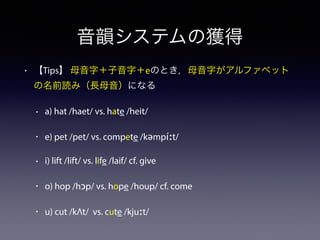
• 【Tips】 母音字+子音字+eのとき,母音字がアルファベット
の名前読み(長母音)になる
•a) hat /haet/ vs. hate /heit/
• e) pet /pet/ vs. compete /kəmpíːt/
• i) lift /lift/ vs. life /laif/ cf. give
• o) hop /hɔp/ vs. hope /houp/ cf. come
• u) cut /kΛt/ vs. cute /kjuːt/
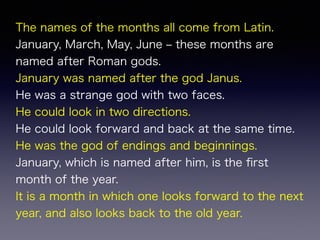
The names ofthe months all come from Latin.
January, March, May, June ‒ these months are
named after Roman gods.
January was named after the god Janus.
He was a strange god with two faces.
He could look in two directions.
He could look forward and back at the same time.
He was the god of endings and beginnings.
January, which is named after him, is the first
month of the year.
It is a month in which one looks forward to the next
year, and also looks back to the old year.
38.
The names ofthe months all come from Latin.
January, March, May, June ‒ these months are
named after Roman gods.
January was named after the god Janus.
He was a strange god with two faces.
He could look in two directions.
He could look forward and back at the same time.
He was the god of endings and beginnings.
January, which is named after him, is the first
month of the year.
It is a month in which one looks forward to the next
year, and also looks back to the old year.
39.
• The namesof …
• January, March, May, June …
• January was named …
• He was a …
• He could look in …
• He could look …
• He was the …
• January, which is …
• It is a month …
• and also …


![Chunking: E.g.
• 語のかたまりに区切ること
• The girl pushed in front of the bus escaped with
minor injuries.
• [[The girl][pushed in front of the bus]][[escaped][with
minor injuries]].
• The girl / pushed in front of the bus/escaped / with
minor injuries.](https://image.slidesharecdn.com/mel201406047key-140629075805-phpapp01/85/Mel20140604-7key-8-320.jpg)



![音韻システムの獲得
• [ ] in and out; bacon and butter
• [ ] man and wife; cup and saucer
• [ ] bread and butter; They walked and walked.
• [ ] I want money and happiness.](https://image.slidesharecdn.com/mel201406047key-140629075805-phpapp01/85/Mel20140604-7key-21-320.jpg)
![音韻システムの獲得
• /ə/(schwa); 口のどこも力まない母音
• [ənd] in and out; bacon and butter (弱形1)
• [ən] man and wife; cup and saucer (弱形2)
• [n] bread and butter; They walked and walked. (弱形3)
• [ænd] I want money and happiness. (強形)](https://image.slidesharecdn.com/mel201406047key-140629075805-phpapp01/85/Mel20140604-7key-22-320.jpg)
![音韻システムの獲得
• I like dogs. What animals do you like? Look at
those dogs! What lovely dogs! [ ]
• Do you like dogs? What did you say? Spiky,
behave! [ ]
• I like dogs / and Mom likes cats. [ ]](https://image.slidesharecdn.com/mel201406047key-140629075805-phpapp01/85/Mel20140604-7key-23-320.jpg)
![音韻システムの獲得
• I like dogs. What animals do you like? Look at
those dogs! What lovely dogs! [下降調: 平叙, Wh
疑問, 命令, 感嘆]
• Do you like dogs? What did you say? Spiky,
behave! [上昇調: Yes-No疑問, 確認, 呼びかけ]
• I like dogs / and Mom likes cats. [下降上昇調: 並
列, 補足]](https://image.slidesharecdn.com/mel201406047key-140629075805-phpapp01/85/Mel20140604-7key-24-320.jpg)
![音韻システムの獲得
• [z]: cars, rose, says, zoo, easy, hesitate, ...
• 歯茎摩擦音(alveolar fricative)
• 継続音:息の続く限り言える「ずー」
• [dz]: cards, roads, sides, heads, bird’s eye
• 歯茎破擦音(alveolar affricate)
• 瞬間的開放:息をはじきだすように、「 子市」の
「ず」、通例語末](https://image.slidesharecdn.com/mel201406047key-140629075805-phpapp01/85/Mel20140604-7key-25-320.jpg)