COST EFFECTIVENESS
ANALYSIS: GNRH
AGONIST VS ANTAGONIST
kasr al ainy school of Medicine
Cairo University
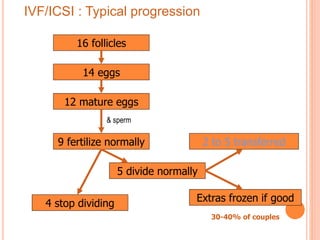
16 follicles
12 mature eggs
14 eggs
Extras frozen if good
2 to 5 transferred9 fertilize normally
5 divide normally
30-40% of couples
4 stop dividing
& sperm
IVF/ICSI : Typical progression
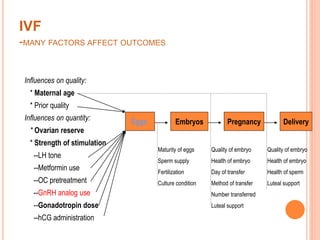
DeliveryPregnancyEmbryosEggs
Influences on quality:
* Maternal age
* Prior quality
Influences on quantity:
* Ovarian reserve
* Strength of stimulation
--LH tone
--Metformin use
--OC pretreatment
--GnRH analog use
--Gonadotropin dose
--hCG administration
Maturity of eggs
Sperm supply
Fertilization
Culture condition
Quality of embryo
Health of embryo
Day of transfer
Method of transfer
Number transferred
Luteal support
Quality of embryo
Health of embryo
Health of sperm
Luteal support
IVF
-MANY FACTORS AFFECT OUTCOMES
HOW TO MAKE DECISION ABOUT
DRUG
+
2008
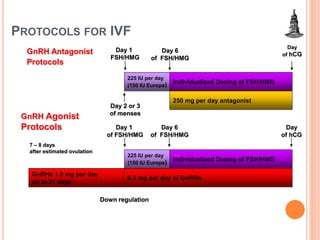
PROTOCOLS FOR IVF
GnRH Antagonist
Protocols
GnRH Agonist
Protocols
225 IU per day
(150 IU Europe)
Individualized Dosing of FSH/HMG
250 mg per day antagonist
Individualized Dosing of FSH/HMG
GnRHa 1.0 mg per day
up to 21 days
0.5 mg per day of GnRHa
225 IU per day
(150 IU Europe)
Day 6
of FSH/HMG
Day
of hCG
Day 1
of FSH/HMG
Day 6
of FSH/HMG
Day
of hCG
7 – 8 days
after estimated ovulation
Down regulation
Day 2 or 3
of menses
Day 1
FSH/HMG
AIM OF THIS TALK
 To conduct cost effectiveness analysis between
GnRH agonist vs antagonist in IVF/ICSI cycles
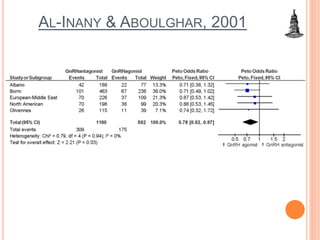
AL-INANY & ABOULGHAR, 2001
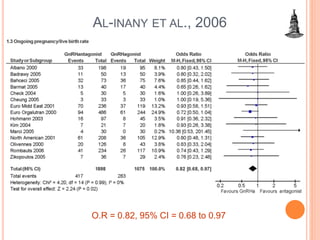
AL-INANY ET AL., 2006
O.R = 0.82, 95% CI = 0.68 to 0.97
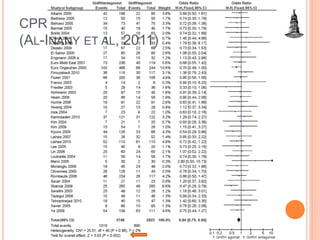
CPR
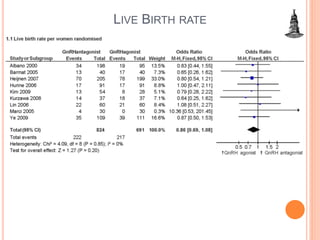
(AL-INANY ET AL, 2011)
LIVE BIRTH RATE
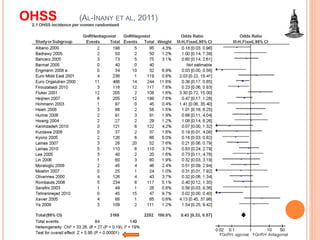
OHSS (AL-INANY ET AL, 2011)
OHSS
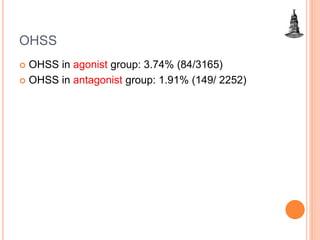
 OHSS in agonist group: 3.74% (84/3165)
 OHSS in antagonist group: 1.91% (149/ 2252)
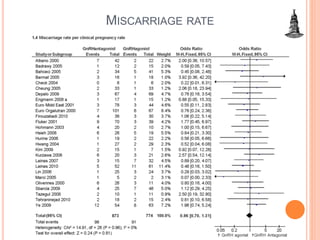
MISCARRIAGE RATE
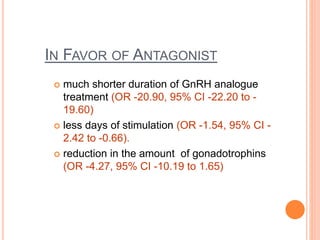
IN FAVOR OF ANTAGONIST
 much shorter duration of GnRH analogue
treatment (OR -20.90, 95% CI -22.20 to -
19.60)
 less days of stimulation (OR -1.54, 95% CI -
2.42 to -0.66).
 reduction in the amount of gonadotrophins
(OR -4.27, 95% CI -10.19 to 1.65)
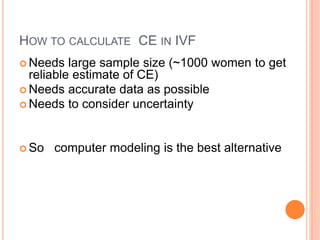
HOW TO CALCULATE CE IN IVF
 Needs large sample size (~1000 women to get
reliable estimate of CE)
 Needs accurate data as possible
 Needs to consider uncertainty
 So computer modeling is the best alternative
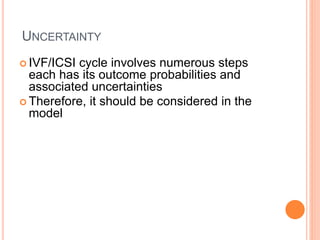
UNCERTAINTY
 IVF/ICSI cycle involves numerous steps
each has its outcome probabilities and
associated uncertainties
 Therefore, it should be considered in the
model
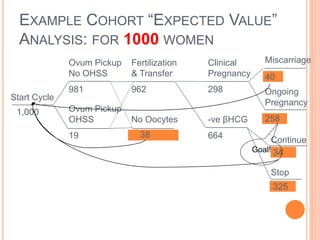
EXAMPLE COHORT “EXPECTED VALUE”
ANALYSIS: FOR 1000 WOMEN
Start Cycle
1,000
Ovum Pickup
No OHSS
Ovum Pickup
OHSS
981
19
Fertilization
& Transfer
No Oocytes
38
962
Clinical
Pregnancy
-ve βHCG
298
664
Ongoing
Pregnancy
Miscarriage
40
258
325
34
Continue
Stop
Goal!
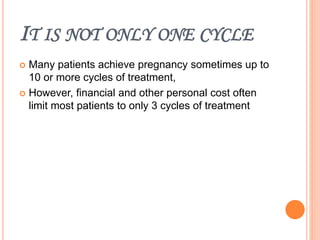
IT IS NOT ONLY ONE CYCLE
 Many patients achieve pregnancy sometimes up to
10 or more cycles of treatment,
 However, financial and other personal cost often
limit most patients to only 3 cycles of treatment
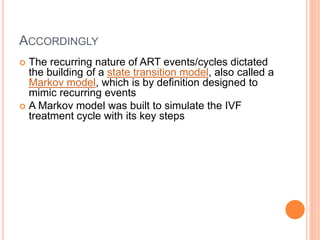
ACCORDINGLY
 The recurring nature of ART events/cycles dictated
the building of a state transition model, also called a
Markov model, which is by definition designed to
mimic recurring events
 A Markov model was built to simulate the IVF
treatment cycle with its key steps
ANALYTICAL METHODS
 Monte Carlo micro simulation were used to
examine the potential impact of assumptions and
other uncertainties represented in the model
 Monte Carlo simulation, can incorporate all
parameter uncertainties
 TreeAge Pro software was used to model and
analyze our problem
Miscarriage
p_miscar_
Start Cycle
Pregnancy
#
Ongoing Pregnancy
Clinical Pregnancy
p_clin_preg_
continue
#
Start Cycle
stop
t_discon_nomed[ _stage]
Stop IVF
-ve bHCG
#
Fertilization &
Embryo Transfer
#
No Oocytes
p_cancel_
Start Cycle
Ovum Pickup
No OHSS
#
Miscarriage
p_miscar
Start Cycle
Pregnancy
#
Ongoing Pregnancy
Clinical Pregnancy
p_clin_preg_
continue
#
Start Cycle
stop
t_discon_nomed[ _stage]
Stop IVF
-ve bHCG
#
Fertilization &
Embryo Transfer
#
No Oocytes
p_cancel_
Start Cycle
Ovum Pickup
OHSS
p_OHSS
Start Cycle
1
Ongoing Pregnancy
0
Stop IVF
0
Agonist
Miscarriage
p_miscar_
Start Cycle
Pregnancy
#
Ongoing Pregnancy
Clinical Pregnancy
p_clin_preg
continue
#
Start Cycle
stop
t_discon_nomed[ _stage]
Stop IVF
-ve bHCG
#
Fertilization &
Embryo Transfer
#
No Oocytes
p_cancel_
Start Cycle
Ovum Pickup
No OHSS
#
Miscarriage
p_miscar
Start Cycle
Pregnancy
#
Ongoing Pregnancy
Clinical Pregnancy
p_clin_preg
continue
#
Start Cycle
stop
t_discon_nomed[ _stage]
Stop IVF
-ve bHCG
#
Fertilization &
Embryo Transfer
#
No Oocytes
p_cancelG
Start Cycle
Ovum Pickup
OHSS
p_OHSS
Start Cycle
1
Ongoing Pregnancy
0
Stop IVF
0
antagonist
Start cycle
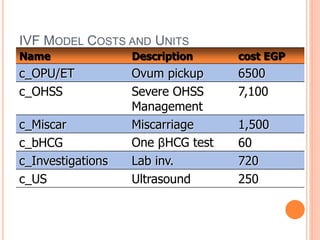
IVF MODEL COSTS AND UNITS
Name Description cost EGP
c_OPU/ET Ovum pickup 6500
c_OHSS Severe OHSS
Management
7,100
c_Miscar Miscarriage 1,500
c_bHCG One βHCG test 60
c_Investigations Lab inv. 720
c_US Ultrasound 250
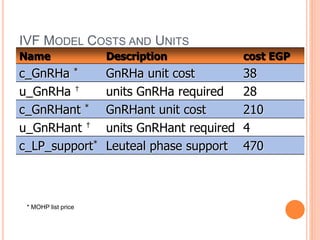
IVF MODEL COSTS AND UNITS
Name Description cost EGP
c_GnRHa * GnRHa unit cost 38
u_GnRHa † units GnRHa required 28
c_GnRHant * GnRHant unit cost 210
u_GnRHant † units GnRHant required 4
c_LP_support* Leuteal phase support 470
* MOHP list price
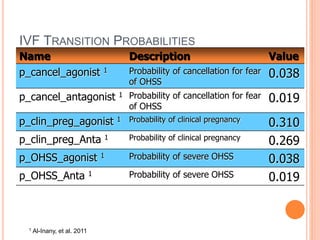
IVF TRANSITION PROBABILITIES
Name Description Value
p_cancel_agonist 1 Probability of cancellation for fear
of OHSS
0.038
p_cancel_antagonist 1 Probability of cancellation for fear
of OHSS
0.019
p_clin_preg_agonist 1 Probability of clinical pregnancy
0.310
p_clin_preg_Anta 1 Probability of clinical pregnancy
0.269
p_OHSS_agonist 1 Probability of severe OHSS 0.038
p_OHSS_Anta 1 Probability of severe OHSS 0.019
1 Al-Inany, et al. 2011
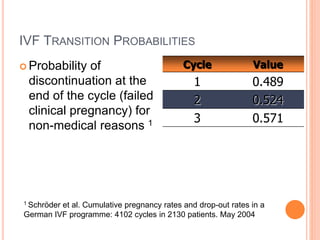
IVF TRANSITION PROBABILITIES
 Probability of
discontinuation at the
end of the cycle (failed
clinical pregnancy) for
non-medical reasons 1
Cycle Value
1 0.489
2 0.524
3 0.571
1 Schröder et al. Cumulative pregnancy rates and drop-out rates in a
German IVF programme: 4102 cycles in 2130 patients. May 2004
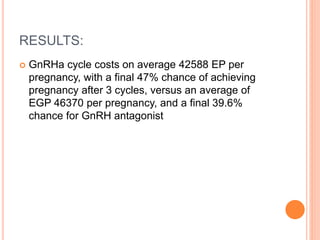
RESULTS:
 GnRHa cycle costs on average 42588 EP per
pregnancy, with a final 47% chance of achieving
pregnancy after 3 cycles, versus an average of
EGP 46370 per pregnancy, and a final 39.6%
chance for GnRH antagonist
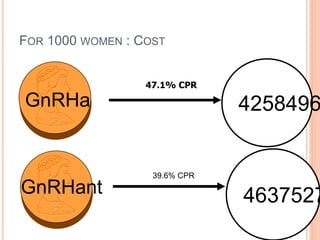
FOR 1000 WOMEN : COST
GnRHa 4258496
4637527GnRHant
47.1% CPR
39.6% CPR
FURTHER ANALYSES
Incremental Cost = 379031
Incremental Effectiveness =
7.5%
ICER=5,053,746 (account for more
than 118 cycles)
SO OUR CONCLUSION:
 Based on Cochrane meta-analysis GnRH agonist
seems to be more cost effective than GnRH
antagonist
THANK YOU
Dr. Hesham Al-Inany MD, PhD
e-mail : kaainih@yahoo.com

GnRH costeffectiveness

  • 1.
    COST EFFECTIVENESS ANALYSIS: GNRH AGONISTVS ANTAGONIST kasr al ainy school of Medicine Cairo University
  • 2.
    16 follicles 12 matureeggs 14 eggs Extras frozen if good 2 to 5 transferred9 fertilize normally 5 divide normally 30-40% of couples 4 stop dividing & sperm IVF/ICSI : Typical progression
  • 3.
    DeliveryPregnancyEmbryosEggs Influences on quality: *Maternal age * Prior quality Influences on quantity: * Ovarian reserve * Strength of stimulation --LH tone --Metformin use --OC pretreatment --GnRH analog use --Gonadotropin dose --hCG administration Maturity of eggs Sperm supply Fertilization Culture condition Quality of embryo Health of embryo Day of transfer Method of transfer Number transferred Luteal support Quality of embryo Health of embryo Health of sperm Luteal support IVF -MANY FACTORS AFFECT OUTCOMES
  • 4.
    HOW TO MAKEDECISION ABOUT DRUG +
  • 5.
  • 6.
    PROTOCOLS FOR IVF GnRHAntagonist Protocols GnRH Agonist Protocols 225 IU per day (150 IU Europe) Individualized Dosing of FSH/HMG 250 mg per day antagonist Individualized Dosing of FSH/HMG GnRHa 1.0 mg per day up to 21 days 0.5 mg per day of GnRHa 225 IU per day (150 IU Europe) Day 6 of FSH/HMG Day of hCG Day 1 of FSH/HMG Day 6 of FSH/HMG Day of hCG 7 – 8 days after estimated ovulation Down regulation Day 2 or 3 of menses Day 1 FSH/HMG
  • 7.
    AIM OF THISTALK  To conduct cost effectiveness analysis between GnRH agonist vs antagonist in IVF/ICSI cycles
  • 8.
  • 9.
    AL-INANY ET AL.,2006 O.R = 0.82, 95% CI = 0.68 to 0.97
  • 10.
  • 11.
  • 12.
  • 13.
    OHSS  OHSS inagonist group: 3.74% (84/3165)  OHSS in antagonist group: 1.91% (149/ 2252)
  • 14.
  • 15.
    IN FAVOR OFANTAGONIST  much shorter duration of GnRH analogue treatment (OR -20.90, 95% CI -22.20 to - 19.60)  less days of stimulation (OR -1.54, 95% CI - 2.42 to -0.66).  reduction in the amount of gonadotrophins (OR -4.27, 95% CI -10.19 to 1.65)
  • 16.
    HOW TO CALCULATECE IN IVF  Needs large sample size (~1000 women to get reliable estimate of CE)  Needs accurate data as possible  Needs to consider uncertainty  So computer modeling is the best alternative
  • 17.
    UNCERTAINTY  IVF/ICSI cycleinvolves numerous steps each has its outcome probabilities and associated uncertainties  Therefore, it should be considered in the model
  • 18.
    EXAMPLE COHORT “EXPECTEDVALUE” ANALYSIS: FOR 1000 WOMEN Start Cycle 1,000 Ovum Pickup No OHSS Ovum Pickup OHSS 981 19 Fertilization & Transfer No Oocytes 38 962 Clinical Pregnancy -ve βHCG 298 664 Ongoing Pregnancy Miscarriage 40 258 325 34 Continue Stop Goal!
  • 19.
    IT IS NOTONLY ONE CYCLE  Many patients achieve pregnancy sometimes up to 10 or more cycles of treatment,  However, financial and other personal cost often limit most patients to only 3 cycles of treatment
  • 20.
    ACCORDINGLY  The recurringnature of ART events/cycles dictated the building of a state transition model, also called a Markov model, which is by definition designed to mimic recurring events  A Markov model was built to simulate the IVF treatment cycle with its key steps
  • 21.
    ANALYTICAL METHODS  MonteCarlo micro simulation were used to examine the potential impact of assumptions and other uncertainties represented in the model  Monte Carlo simulation, can incorporate all parameter uncertainties  TreeAge Pro software was used to model and analyze our problem
  • 22.
    Miscarriage p_miscar_ Start Cycle Pregnancy # Ongoing Pregnancy ClinicalPregnancy p_clin_preg_ continue # Start Cycle stop t_discon_nomed[ _stage] Stop IVF -ve bHCG # Fertilization & Embryo Transfer # No Oocytes p_cancel_ Start Cycle Ovum Pickup No OHSS # Miscarriage p_miscar Start Cycle Pregnancy # Ongoing Pregnancy Clinical Pregnancy p_clin_preg_ continue # Start Cycle stop t_discon_nomed[ _stage] Stop IVF -ve bHCG # Fertilization & Embryo Transfer # No Oocytes p_cancel_ Start Cycle Ovum Pickup OHSS p_OHSS Start Cycle 1 Ongoing Pregnancy 0 Stop IVF 0 Agonist Miscarriage p_miscar_ Start Cycle Pregnancy # Ongoing Pregnancy Clinical Pregnancy p_clin_preg continue # Start Cycle stop t_discon_nomed[ _stage] Stop IVF -ve bHCG # Fertilization & Embryo Transfer # No Oocytes p_cancel_ Start Cycle Ovum Pickup No OHSS # Miscarriage p_miscar Start Cycle Pregnancy # Ongoing Pregnancy Clinical Pregnancy p_clin_preg continue # Start Cycle stop t_discon_nomed[ _stage] Stop IVF -ve bHCG # Fertilization & Embryo Transfer # No Oocytes p_cancelG Start Cycle Ovum Pickup OHSS p_OHSS Start Cycle 1 Ongoing Pregnancy 0 Stop IVF 0 antagonist Start cycle
  • 23.
    IVF MODEL COSTSAND UNITS Name Description cost EGP c_OPU/ET Ovum pickup 6500 c_OHSS Severe OHSS Management 7,100 c_Miscar Miscarriage 1,500 c_bHCG One βHCG test 60 c_Investigations Lab inv. 720 c_US Ultrasound 250
  • 24.
    IVF MODEL COSTSAND UNITS Name Description cost EGP c_GnRHa * GnRHa unit cost 38 u_GnRHa † units GnRHa required 28 c_GnRHant * GnRHant unit cost 210 u_GnRHant † units GnRHant required 4 c_LP_support* Leuteal phase support 470 * MOHP list price
  • 25.
    IVF TRANSITION PROBABILITIES NameDescription Value p_cancel_agonist 1 Probability of cancellation for fear of OHSS 0.038 p_cancel_antagonist 1 Probability of cancellation for fear of OHSS 0.019 p_clin_preg_agonist 1 Probability of clinical pregnancy 0.310 p_clin_preg_Anta 1 Probability of clinical pregnancy 0.269 p_OHSS_agonist 1 Probability of severe OHSS 0.038 p_OHSS_Anta 1 Probability of severe OHSS 0.019 1 Al-Inany, et al. 2011
  • 26.
    IVF TRANSITION PROBABILITIES Probability of discontinuation at the end of the cycle (failed clinical pregnancy) for non-medical reasons 1 Cycle Value 1 0.489 2 0.524 3 0.571 1 Schröder et al. Cumulative pregnancy rates and drop-out rates in a German IVF programme: 4102 cycles in 2130 patients. May 2004
  • 27.
    RESULTS:  GnRHa cyclecosts on average 42588 EP per pregnancy, with a final 47% chance of achieving pregnancy after 3 cycles, versus an average of EGP 46370 per pregnancy, and a final 39.6% chance for GnRH antagonist
  • 28.
    FOR 1000 WOMEN: COST GnRHa 4258496 4637527GnRHant 47.1% CPR 39.6% CPR
  • 29.
    FURTHER ANALYSES Incremental Cost= 379031 Incremental Effectiveness = 7.5% ICER=5,053,746 (account for more than 118 cycles)
  • 30.
    SO OUR CONCLUSION: Based on Cochrane meta-analysis GnRH agonist seems to be more cost effective than GnRH antagonist
  • 31.
    THANK YOU Dr. HeshamAl-Inany MD, PhD e-mail : kaainih@yahoo.com