Lekha Rajiv
300667208
 Introducing the family
 Special need of the child
 The Family
 Childcare adaptations
 Causes and characteristics
 Diagnosis andTreatment
 Agencies in the GTA
 Bibliography
 Family of five.Three children and parents.
 New toToronto. Immigrants from China.
 Primary Language spoken at home is
Cantonese.
 Lily, the child in the childcare centre is 4 years
old. She has a severe hearing impairment.
 Parents have two other children, one boy
aged six and other baby girl aged six months.
 Lily is suffering from severe hearing impairment.
 What is a hearing impairment?: “Hearing
impairment means that a child has lost some
hearing in one or both ears. Hearing
impairments are described according to how
much hearing has been lost. Loss is usually
explained as mild, moderate, moderate to
severe, severe, or profound.”
 What is Severe hearing impairment?: “The child
will not hear any normal conversation and only a
few sounds of few speech.”
 Parents can enrol themselves in the LINC/ESL
program for new-comers to Canada to enrich
their English skills and help them get jobs.
 The LINC program also provides childcare
services for students enrolled.
 The children can be taken to the Early Learning
Centre which is free of cost.The ELC provides
children with various means to play and interact.
 Parents can go to employment services such as
Woodgreen to register and attempt to find
employment.
Physical environment:
 Seat the child close for good visibility.
 Child must experience residual hearing.
 Ask an audiologist or parents how close a
speaker must be in order for the child to hear.
 There can be signboards and signs in the
classroom for the child’s easy access.
Teaching strategies:
 Speak at normal speed and volume
 Speak to the child facing them during circle time.
Don’t speak with back turned.
 Use normal vocabulary and sentence structure.
 The teacher can use signs, visual cues, and
gestures to convey messages to the children.
 The teacher could try to learn a few words of
Cantonese to ensure better communication.
Teaching strategies cont.:
 The strategy of reinforcement by rewarding
children for good behavior and deeds is also useful.
 The teacher can also model actions and behaviors
for the child.
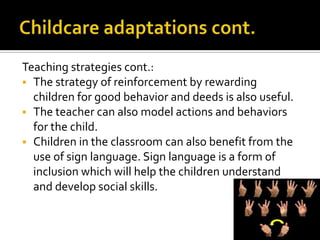
 Children in the classroom can also benefit from the
use of sign language. Sign language is a form of
inclusion which will help the children understand
and develop social skills.
 Three types of causes or forms of hearing loss:
Conductive, Sensory, and Neural.
 Approximately 20 in 10,000 children are born with
hearing loss.
 People with hearing loss will experience:
i. Pain in one or both ears
ii. Dizziness or vertigo
iii. Ringing in the ears
iv. Pressure or fullness in both ears.
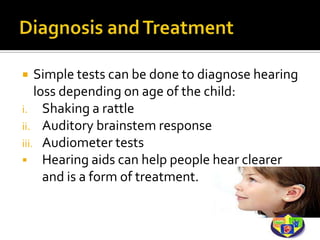
 Simple tests can be done to diagnose hearing
loss depending on age of the child:
i. Shaking a rattle
ii. Auditory brainstem response
iii. Audiometer tests
 Hearing aids can help people hear clearer
and is a form of treatment.
 Bob Rumball:
i. Centre where people with hearing impairments can
learn language and culture in the province of ON and the
GTA area at large.
ii. Offers free drop-in programs for parents and guardians.
They also offer services in other languages and
translation services. It will be useful for Lily’s parents.
iii. American Sign Language courses offered for free.
iv. A phone support system is also offered.
v. Offer counseling, parenting workshops, and advocacy
services.
vi. http://www2.bobrumball.org/
 Canadian Hearing Society: Helps to promote
independence of deaf and hard of hearing people. Also
provides counseling, training, advocacy, educational
support, etc. http://www.chs.ca/
 Voice of Hearing Impaired Children:This group advocates
deaf or hard of hearing children to study together with
hearing children. http://www.voicefordeafkids.com/
 The Canadian Hard of Hearing Association: Works with
professionals, service providers and the government. It is
run by and for people with hearing impairments. It
attempts to eliminate isolation, indignation, and
frustration by assisting in increasing self-esteem and
confidence and total integration into society
http://www.chha.ca/chha/
 http://connectability.ca/2011/10/05/hearing-
impairments/
 http://www.chha.ca/chha/
 http://www.voicefordeafkids.com/
 http://www.chs.ca/
 http://www2.bobrumball.org/
 Google Images
Lekha Rajiv
300667208

Meeting the needs_of_children_and_families_-_part_1

  • 1.
  • 2.
     Introducing thefamily  Special need of the child  The Family  Childcare adaptations  Causes and characteristics  Diagnosis andTreatment  Agencies in the GTA  Bibliography
  • 3.
     Family offive.Three children and parents.  New toToronto. Immigrants from China.  Primary Language spoken at home is Cantonese.  Lily, the child in the childcare centre is 4 years old. She has a severe hearing impairment.  Parents have two other children, one boy aged six and other baby girl aged six months.
  • 4.
     Lily issuffering from severe hearing impairment.  What is a hearing impairment?: “Hearing impairment means that a child has lost some hearing in one or both ears. Hearing impairments are described according to how much hearing has been lost. Loss is usually explained as mild, moderate, moderate to severe, severe, or profound.”  What is Severe hearing impairment?: “The child will not hear any normal conversation and only a few sounds of few speech.”
  • 5.
     Parents canenrol themselves in the LINC/ESL program for new-comers to Canada to enrich their English skills and help them get jobs.  The LINC program also provides childcare services for students enrolled.  The children can be taken to the Early Learning Centre which is free of cost.The ELC provides children with various means to play and interact.  Parents can go to employment services such as Woodgreen to register and attempt to find employment.
  • 6.
    Physical environment:  Seatthe child close for good visibility.  Child must experience residual hearing.  Ask an audiologist or parents how close a speaker must be in order for the child to hear.  There can be signboards and signs in the classroom for the child’s easy access.
  • 7.
    Teaching strategies:  Speakat normal speed and volume  Speak to the child facing them during circle time. Don’t speak with back turned.  Use normal vocabulary and sentence structure.  The teacher can use signs, visual cues, and gestures to convey messages to the children.  The teacher could try to learn a few words of Cantonese to ensure better communication.
  • 8.
    Teaching strategies cont.: The strategy of reinforcement by rewarding children for good behavior and deeds is also useful.  The teacher can also model actions and behaviors for the child.  Children in the classroom can also benefit from the use of sign language. Sign language is a form of inclusion which will help the children understand and develop social skills.
  • 9.
     Three typesof causes or forms of hearing loss: Conductive, Sensory, and Neural.  Approximately 20 in 10,000 children are born with hearing loss.  People with hearing loss will experience: i. Pain in one or both ears ii. Dizziness or vertigo iii. Ringing in the ears iv. Pressure or fullness in both ears.
  • 10.
     Simple testscan be done to diagnose hearing loss depending on age of the child: i. Shaking a rattle ii. Auditory brainstem response iii. Audiometer tests  Hearing aids can help people hear clearer and is a form of treatment.
  • 11.
     Bob Rumball: i.Centre where people with hearing impairments can learn language and culture in the province of ON and the GTA area at large. ii. Offers free drop-in programs for parents and guardians. They also offer services in other languages and translation services. It will be useful for Lily’s parents. iii. American Sign Language courses offered for free. iv. A phone support system is also offered. v. Offer counseling, parenting workshops, and advocacy services. vi. http://www2.bobrumball.org/
  • 12.
     Canadian HearingSociety: Helps to promote independence of deaf and hard of hearing people. Also provides counseling, training, advocacy, educational support, etc. http://www.chs.ca/  Voice of Hearing Impaired Children:This group advocates deaf or hard of hearing children to study together with hearing children. http://www.voicefordeafkids.com/  The Canadian Hard of Hearing Association: Works with professionals, service providers and the government. It is run by and for people with hearing impairments. It attempts to eliminate isolation, indignation, and frustration by assisting in increasing self-esteem and confidence and total integration into society http://www.chha.ca/chha/
  • 13.
     http://connectability.ca/2011/10/05/hearing- impairments/  http://www.chha.ca/chha/ http://www.voicefordeafkids.com/  http://www.chs.ca/  http://www2.bobrumball.org/  Google Images
  • 14.

Editor's Notes

  • #4 In the case study, there is a family of five people which includes three children and the parents. The parents have one six year old boy, four year old lily who has a hearing impairment, and a six month old baby girl. The language spoken primarily at home is Cantonese.
  • #5 Severe Hearing impairment: source: http://connectability.ca/2011/10/05/hearing-impairments/
  • #6 Source: http://www.woodgreen.org/ http://www.servicecanada.gc.ca/eng/goc/linc.shtml
  • #11 Shaking a rattle and observing response of the child is a form of behavioral observation audiometryAuditory brainstem response - testing which measures electrical activity in the brain in response to sound. Audiometer tests: Audiometer is a machine that produces sounds such as beeps and whistles. Hearing the sounds help to pinpoint hearing loss. Source: http://connectability.ca/2011/10/05/hearing-impairments/
  • #12 Bob Rumball is one of the best services in the GTA. It is also the most useful for Lily and her family because they provide translator service and services in other languages. Source: http://www2.bobrumball.org/content/3/Centre http://www2.bobrumball.org/content/1/Foundation
  • #13 Source: http://connectability.ca/2011/10/05/hearing-impairments/
  • #15 Reflection: Through this assignment, I learned how to solve case studies. I like how the case study I got included things from all over the course. The case study included and recognized the diversity, inclusion, accepting differences, the role of the ECE as an advocate for children with special needs, etc. I have learnt that the ECE can find out and pass information to parents about services available to them. I was also able to learned how to meet the needs of the children with special needs through physical environment and teaching strategies such as modelling and reinforcement. I have also learnt the importance of making modifications based on developmentally appropriate programs. As an ECE and as an individual, I have the responsibility to help parents and children, wherever they come from, to attain their goals and wishes. I will help people from all parts of the world, diverse cultures, religions, geography, etc. I will emphasize on multiculturalism and advocate understanding and knowledge about the needs and concerns of children with special needs.