GTP: Answer for mdg6

 By: Nisali, Brandon, Jenina,
             Bayan
Connections between Maternal
  health and child mortality
Maternal healthcare and child mortality has a direct
correlation. Explain the connections between a pregnant
women’s health and the chances of her child’s survival?
A direct correlation between maternal healthcare and child
mortality is that babies whose mothers have died during
childbirth have a much greater chances of dying in their first year
than those mothers remain alive.
    Pregnant mothers in developing countries have a very low
amount of facilities and nutrition. In many countries the water is
unpurified and contain infectious germs that can effect a growing
fetus as much as the pregnant mother. Malnutrition of the mother
could also affect the growth of a baby. The lack of nutrition can
lead to a very small newborn, to whom if not given enough
nutrition, could die within a day’s or week’s span.
    Therefore if a mother is not given the necessities needed
during pregnancy, her child would have to live an unhealthy life
or not survive at all.
Question
•   Compare and contrast the factors that contribute to maternal health and child
    mortality rates in each of the countries involved in our circle. Is there a pattern?
•   Romania – A piece of data painting to the need for improvement in the system
    indicates that only 60% of pregnant woman consulted a doctor in their first
    trimester. Romania has had a mostly downward trend.
•   Canada –Even though our health care is up to its best standards, we are still
    not able to save babies whose growth has been interfered by different reasons
    All though women in Canada had better care than most countries, many women
    in the country are not careful enough during pregnancy.
•   Kenya – After declaring independence in the 1960’s, child mortality in Kenya fell
    rapidly. Many children were dying due unknown diseases. After further
    research, it was notified as aids/HIV, but it wasn’t proven. The maternal health
    care wasn’t any better as well. A downward pattern for sure.
•   Latvia – has had an interesting pattern. The child mortality has had an
    increasing form. The child care has been pretty good, and there haven't been to
    many major statistics showing a downward trend. But the Maternal health care
    hasn’t been up to par. 30% of women haven't been successful giving birth, and
    that’s a scary amount. The trend is even here.
Today’s World
                        Today’s World
How is child mortality and maternal health affecting today's world and
our ability to achieve the UN millennium goals?

Child mortality and maternal health affect today’s world by causing a huge
drop in the population of many developing countries. Over 1/2 million women
die during pregnancy and childbirth every year. In developing countries,
children are 12 times more likely to die before the age of 5. Due to the
following factors: poor water quality, inadequate sanitation, malnutrition,
diseases, pregnant mothers suffer from lack of necessities.
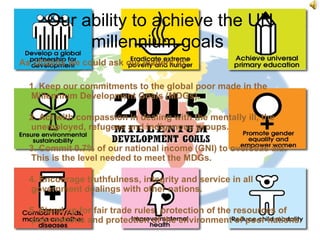
Our ability to achieve the UN
           millennium goals
As citizens we could ask our leaders to:

  1. Keep our commitments to the global poor made in the
  Millennium Development Goals (MDGs).

  2. Act with compassion in dealing with the mentally ill, the
  unemployed, refugees and indigenous groups.

  3. Commit 0.7% of our national income (GNI) to overseas aid.
  This is the level needed to meet the MDGs.

  4. Encourage truthfulness, integrity and service in all
  government dealings with other nations.

  5. Stand up for fair trade rules, protection of the resources of
  poor nations and protection of the environment of poor nations.
Our Goal
•    What can your country do, as global citizens, to ensure that these
     goals are met by 2015?
    1. Contribute funds to projects which provide immediate improvement -
     things like clean water, midwife training or breastfeeding education.
     2. Intercede for communities and countries, praying specifically and
     consistently
     3. Sponsor a child so that s/he can receive an education and health care
     4. Talk with our friends about the issues
     5. Give our time and expertise to an overseas aid agency by volunteering
     here or overseas
     6. Find out about poverty issues - the causes and the current situation.
     7. Live our lives more simply so that our we can save money to help people
     who are not as lucky and healthy as we are.
      8. Speak out on poverty and injustice issues, e.g. sign the Micah Call,
     speak to your local MP about poverty issues.
Conclusion


Thank you for watching
   our presentation.

Maternal health answer

  • 1.
    GTP: Answer formdg6 By: Nisali, Brandon, Jenina, Bayan
  • 2.
    Connections between Maternal health and child mortality Maternal healthcare and child mortality has a direct correlation. Explain the connections between a pregnant women’s health and the chances of her child’s survival? A direct correlation between maternal healthcare and child mortality is that babies whose mothers have died during childbirth have a much greater chances of dying in their first year than those mothers remain alive. Pregnant mothers in developing countries have a very low amount of facilities and nutrition. In many countries the water is unpurified and contain infectious germs that can effect a growing fetus as much as the pregnant mother. Malnutrition of the mother could also affect the growth of a baby. The lack of nutrition can lead to a very small newborn, to whom if not given enough nutrition, could die within a day’s or week’s span. Therefore if a mother is not given the necessities needed during pregnancy, her child would have to live an unhealthy life or not survive at all.
  • 3.
    Question • Compare and contrast the factors that contribute to maternal health and child mortality rates in each of the countries involved in our circle. Is there a pattern? • Romania – A piece of data painting to the need for improvement in the system indicates that only 60% of pregnant woman consulted a doctor in their first trimester. Romania has had a mostly downward trend. • Canada –Even though our health care is up to its best standards, we are still not able to save babies whose growth has been interfered by different reasons All though women in Canada had better care than most countries, many women in the country are not careful enough during pregnancy. • Kenya – After declaring independence in the 1960’s, child mortality in Kenya fell rapidly. Many children were dying due unknown diseases. After further research, it was notified as aids/HIV, but it wasn’t proven. The maternal health care wasn’t any better as well. A downward pattern for sure. • Latvia – has had an interesting pattern. The child mortality has had an increasing form. The child care has been pretty good, and there haven't been to many major statistics showing a downward trend. But the Maternal health care hasn’t been up to par. 30% of women haven't been successful giving birth, and that’s a scary amount. The trend is even here.
  • 4.
    Today’s World Today’s World How is child mortality and maternal health affecting today's world and our ability to achieve the UN millennium goals? Child mortality and maternal health affect today’s world by causing a huge drop in the population of many developing countries. Over 1/2 million women die during pregnancy and childbirth every year. In developing countries, children are 12 times more likely to die before the age of 5. Due to the following factors: poor water quality, inadequate sanitation, malnutrition, diseases, pregnant mothers suffer from lack of necessities.
  • 5.
    Our ability toachieve the UN millennium goals As citizens we could ask our leaders to: 1. Keep our commitments to the global poor made in the Millennium Development Goals (MDGs). 2. Act with compassion in dealing with the mentally ill, the unemployed, refugees and indigenous groups. 3. Commit 0.7% of our national income (GNI) to overseas aid. This is the level needed to meet the MDGs. 4. Encourage truthfulness, integrity and service in all government dealings with other nations. 5. Stand up for fair trade rules, protection of the resources of poor nations and protection of the environment of poor nations.
  • 6.
    Our Goal • What can your country do, as global citizens, to ensure that these goals are met by 2015? 1. Contribute funds to projects which provide immediate improvement - things like clean water, midwife training or breastfeeding education. 2. Intercede for communities and countries, praying specifically and consistently 3. Sponsor a child so that s/he can receive an education and health care 4. Talk with our friends about the issues 5. Give our time and expertise to an overseas aid agency by volunteering here or overseas 6. Find out about poverty issues - the causes and the current situation. 7. Live our lives more simply so that our we can save money to help people who are not as lucky and healthy as we are. 8. Speak out on poverty and injustice issues, e.g. sign the Micah Call, speak to your local MP about poverty issues.
  • 7.
    Conclusion Thank you forwatching our presentation.