Fetal Alcohol Syndrome Research, Prevention, Resources & SupportCase Study # 9ECE 233
SIMON & THOMASCase Study # 9 	“Simon and his brother Thomas (3 year old twins) have recently been diagnosed with Fetal alcohol syndrome. The boy’s foster parents have moved into the Toronto area from North Bay and are in the process of adopting the twins. The confide in you (an ECE in the junior preschool room) that they are feeling a bit overwhelmed by the diagnosis and the move to the big city. Both boys show signs of cognitive delay and have difficulty with impulse control. The parents as your advice on services in the Toronto area.”
Needs of the FamilySpecific requirements/support for the family in Scenario # 9The family requires Information & support regarding Fetal alcohol syndrome.The family will require some information about the city of Toronto and surrounding areas.The whole family would will benefit from the opportunity to acquaint themselves with families going through similar circumstances. Therefore, they will require support groups/ family assistance centres in their area and would need to be referred to them.The whole family also needs to know that they can trust the childcare centre and staff.
Facts & Statistics Fetal Alcohol Syndrome in Canada/Aboardhttp://www.fasarizona.com/CitizenNov2001.htmFetal Alcohol Syndrome was first diagnosed in 1973
“In 1999, Fetal Alcohol Awareness day was created in the United States and observed around the world with a moment of silence at 9:09am.”
The awareness colour of FAS is blue.
In the United states alone, up to 40,000  infants are born with FAS each year. In Canada, 20 out of every 10,000 infants are born with FAS.
FAS is 100% PREVENTABLE!Signs & Symptoms of FASPhysical, social/emotional & cognitive indicatorsKidshealth.orgLow Birth WeightUnusually small head circumference Organ dysfunction Poor coordination/fine motor skills – Developmental delay Lack of imagination or curiosityLearning difficulties, including poor memory, inability to understand concepts such as time and money, poor language comprehension, poor problem-solving skillsfacial abnormalitiesepilepsy
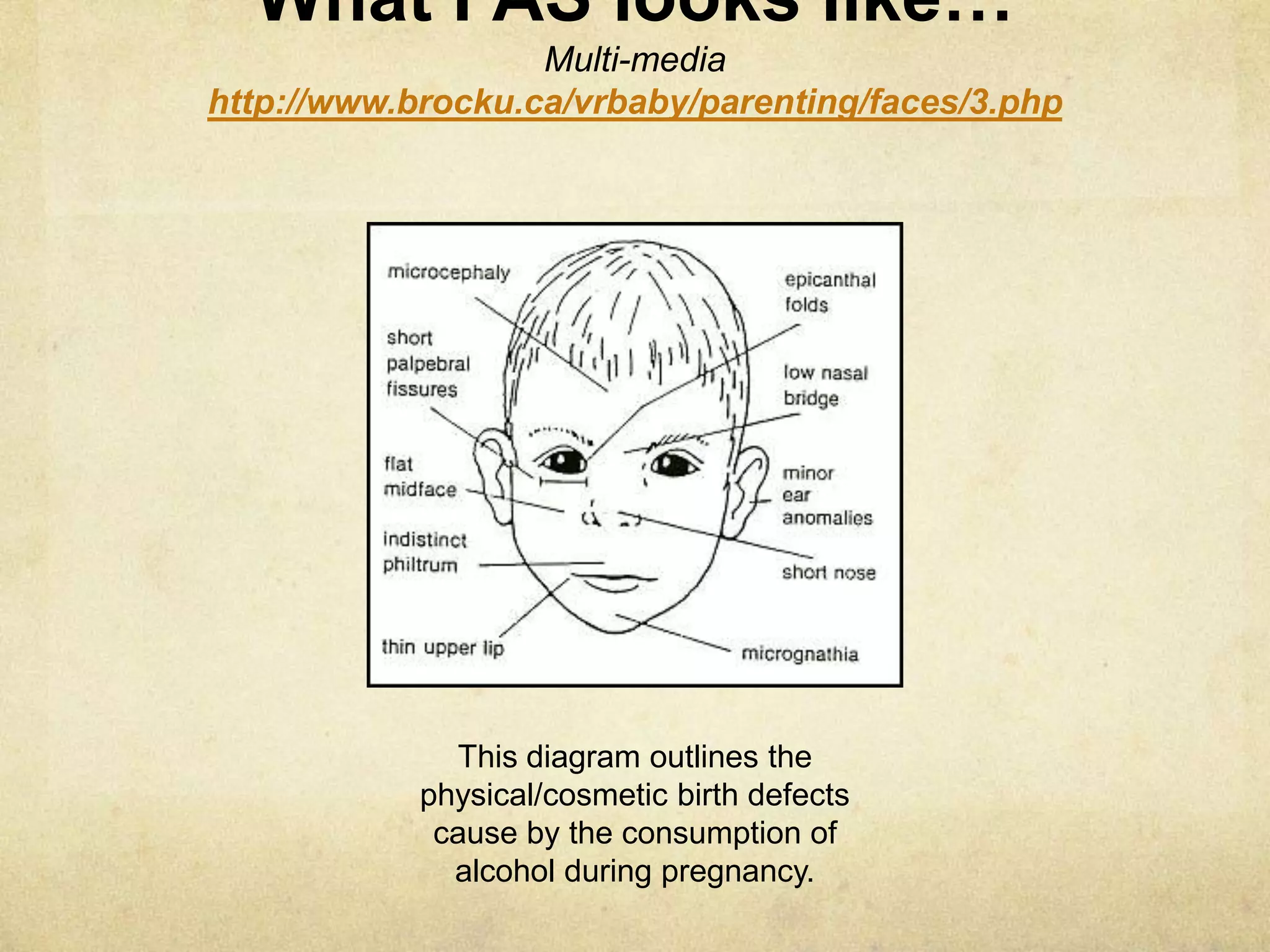
What FAS looks like…Multi-mediahttp://www.brocku.ca/vrbaby/parenting/faces/3.phpThis diagram outlines the physical/cosmetic birth defects cause by the consumption of alcohol during pregnancy.
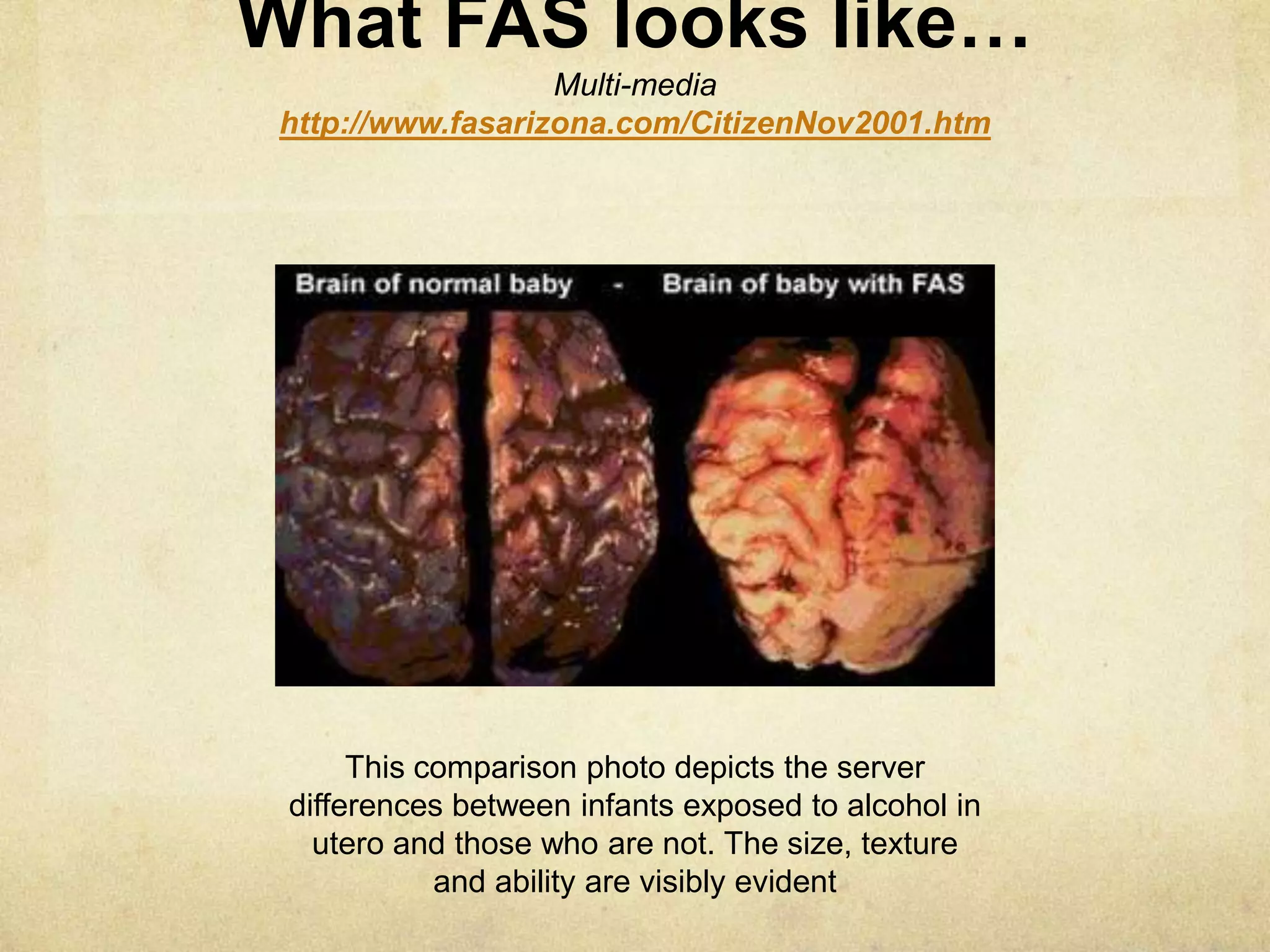
What FAS looks like…Multi-mediahttp://www.fasarizona.com/CitizenNov2001.htmThis comparison photo depicts the server differences between infants exposed to alcohol in utero and those who are not. The size, texture and ability are visibly evident
Fetal Alcohol Syndrome WorldToronto Homestead Locationhttp://www.fasworld.com/aboutfasd.aspThe fetal alcohol syndrome resource centre Canada is located in Scarborough Ontario. FAS World is an international support network.FAS World Canada was founded in 1999 by the parents of a young girl with FAS as a means of providing  support for themselves and other parents dealing with the difficulties associated with FAS.Monthly support group meetings are held at the Scarborough location for parents, early childhood educators and professionals in other related fields.
Supporting the FamilyMethods for providing sensitive support to families/childrenRefer family to the FAS World Scarborough location in order to locate further support for both the adopted twins and their new guardians.
Provide an open door policy to the guardians of Simon and Thomas in order to create a comfortable environment for whole family.
Hold regular meetings with the family in order to keep them consistently updated on E.C.E observations and modifications being made to ensure inclusion.   Modification to the Physical Environment & Teaching StrategyEducational Methods of support for Simon & Thomashttp://www.bced.gov.bc.ca/specialed/fas/charstu.htmCreate individual learning plan/make continuous observations of twins within the classroom setting.
Collaborate with all E.C.E staff and family in order to ensure that inclusion takes place and that the twins ate receiving the support that is required while at child care.

Fetal Alcohol Syndrome Slides

  • 1.
    Fetal Alcohol SyndromeResearch, Prevention, Resources & SupportCase Study # 9ECE 233
  • 2.
    SIMON & THOMASCaseStudy # 9 “Simon and his brother Thomas (3 year old twins) have recently been diagnosed with Fetal alcohol syndrome. The boy’s foster parents have moved into the Toronto area from North Bay and are in the process of adopting the twins. The confide in you (an ECE in the junior preschool room) that they are feeling a bit overwhelmed by the diagnosis and the move to the big city. Both boys show signs of cognitive delay and have difficulty with impulse control. The parents as your advice on services in the Toronto area.”
  • 3.
    Needs of theFamilySpecific requirements/support for the family in Scenario # 9The family requires Information & support regarding Fetal alcohol syndrome.The family will require some information about the city of Toronto and surrounding areas.The whole family would will benefit from the opportunity to acquaint themselves with families going through similar circumstances. Therefore, they will require support groups/ family assistance centres in their area and would need to be referred to them.The whole family also needs to know that they can trust the childcare centre and staff.
  • 4.
    Facts & StatisticsFetal Alcohol Syndrome in Canada/Aboardhttp://www.fasarizona.com/CitizenNov2001.htmFetal Alcohol Syndrome was first diagnosed in 1973
  • 5.
    “In 1999, FetalAlcohol Awareness day was created in the United States and observed around the world with a moment of silence at 9:09am.”
  • 6.
    The awareness colourof FAS is blue.
  • 7.
    In the Unitedstates alone, up to 40,000 infants are born with FAS each year. In Canada, 20 out of every 10,000 infants are born with FAS.
  • 8.
    FAS is 100%PREVENTABLE!Signs & Symptoms of FASPhysical, social/emotional & cognitive indicatorsKidshealth.orgLow Birth WeightUnusually small head circumference Organ dysfunction Poor coordination/fine motor skills – Developmental delay Lack of imagination or curiosityLearning difficulties, including poor memory, inability to understand concepts such as time and money, poor language comprehension, poor problem-solving skillsfacial abnormalitiesepilepsy
  • 9.
    What FAS lookslike…Multi-mediahttp://www.brocku.ca/vrbaby/parenting/faces/3.phpThis diagram outlines the physical/cosmetic birth defects cause by the consumption of alcohol during pregnancy.
  • 10.
    What FAS lookslike…Multi-mediahttp://www.fasarizona.com/CitizenNov2001.htmThis comparison photo depicts the server differences between infants exposed to alcohol in utero and those who are not. The size, texture and ability are visibly evident
  • 11.
    Fetal Alcohol SyndromeWorldToronto Homestead Locationhttp://www.fasworld.com/aboutfasd.aspThe fetal alcohol syndrome resource centre Canada is located in Scarborough Ontario. FAS World is an international support network.FAS World Canada was founded in 1999 by the parents of a young girl with FAS as a means of providing support for themselves and other parents dealing with the difficulties associated with FAS.Monthly support group meetings are held at the Scarborough location for parents, early childhood educators and professionals in other related fields.
  • 12.
    Supporting the FamilyMethodsfor providing sensitive support to families/childrenRefer family to the FAS World Scarborough location in order to locate further support for both the adopted twins and their new guardians.
  • 13.
    Provide an opendoor policy to the guardians of Simon and Thomas in order to create a comfortable environment for whole family.
  • 14.
    Hold regular meetingswith the family in order to keep them consistently updated on E.C.E observations and modifications being made to ensure inclusion. Modification to the Physical Environment & Teaching StrategyEducational Methods of support for Simon & Thomashttp://www.bced.gov.bc.ca/specialed/fas/charstu.htmCreate individual learning plan/make continuous observations of twins within the classroom setting.
  • 15.
    Collaborate with allE.C.E staff and family in order to ensure that inclusion takes place and that the twins ate receiving the support that is required while at child care.
  • 16.
    Keep a constantdaily schedule that is predictable and stable.
  • 17.
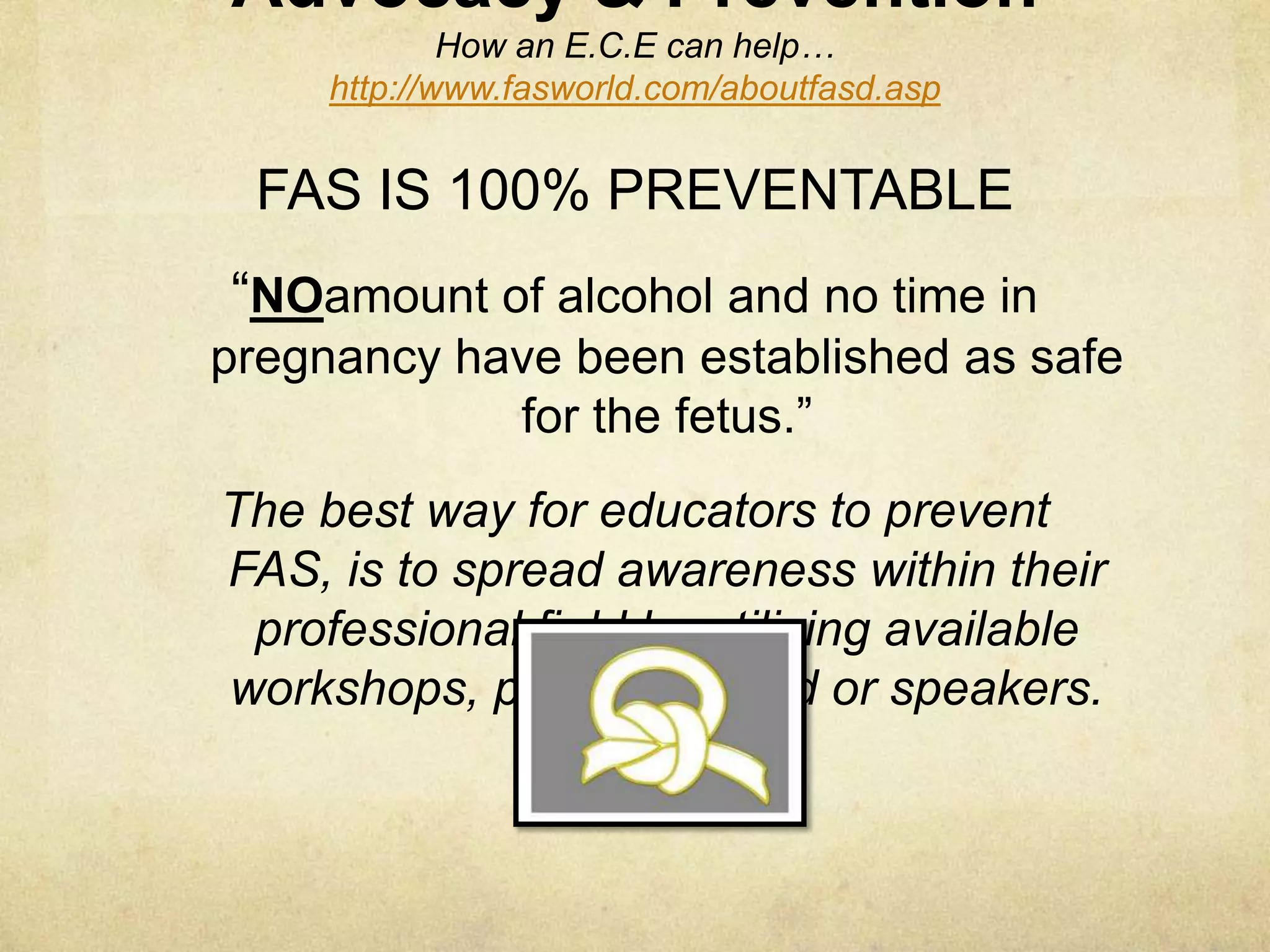
    Provide a quietspot for time alone when desired. Advocacy & PreventionHow an E.C.E can help…http://www.fasworld.com/aboutfasd.aspFAS IS 100% PREVENTABLE“NOamount of alcohol and no time in pregnancy have been established as safe for the fetus.”The best way for educators to prevent FAS, is to spread awareness within their professional field by utilizing available workshops, pamphlets and or speakers. FAS KNOTThis symbol was created as a sign of FAS awareness and can be purchased for $3.00
  • 18.
    Poetry as AdvocacyWrittenby a parent experiencing FAS -FASLink“Don’t Ask my Child to Fly” –Bruce RitchieDon't ask my child to fly,for he has not wings. Don't ask my child to see the glint on the eagle's beak,for his vision has been diminished.Don't ask my child to remain calm amid the din,for her ability to screen out the noises has been taken away.Don't ask my child to be careful with "strangers",for he is affectionate with everyone and prey for the unscrupulous.Don't ask my child to "settle down",for the clock which works for you and I, does not exist for her.Don't ask my child to not play with the toys of others,for he has no concept of property.Don’t ask my child to remember you tomorrow,although you met today.Don't ask my child to heal your wounds,for her hands cannot hold a scalpel or sutures.Don't ask my child to meet the challenges set by society,for you have denied her the tools.Don't ask my child to forgive you for standing idly by,while he was in trouble in his mother's womb,for he will,but He may not.
  • 19.
    From the Mouthsof BabesVideo created on the topic of FAS & Original AnimotoFetal Alcohol Syndrome Video
  • 20.
    THANK YOUYOU HAVEBEEN A WONDERFUL AUDIENCE
  • 21.
    SOURCES CITEDThe followingwebsites were consulted for this assignment:http://www.bced.gov.bc.ca/specialed/fas/
  • 22.
  • 23.
  • 24.

Editor's Notes

  • #2 The following research Project is intended to explain the signs, symptoms and important information regarding fetal alcohol syndrome and the ways in which an early childhood educator might assist a guardian in dealing with this debilitating syndrome in a constructive, respectful and sympathetic manner. I will introduce the family and case number nine in a sensitive way, explain the needs of the family as well as signs and symptoms as well as research surrounding the syndrome in Canada and abroad and simple prevention methods of this syndrome. Finally, I will end the slide show with poetry written by a father who’s adopted child was diagnosed with fetal alcohol syndrome and went on to attend University at an honours level. I have also included a link to a very inspirational video regarding fetal alcohol, which I thought was an appropriate way to wrap up on the formal presentation. Works Cited at the end of the slide show.
  • #3 Above is the number nine case study that I chose to research for ECE 233.
  • #4 After reviewing the fictional situation of case nine, I have determined the following: Although the family has been given a formal diagnosis of fetal alcohol syndrome, they might require further information or the support of families in similar situations within their local community. They will also require the links to resource centres in their local community and they will need to be made very aware of the fact that the early childhood educations that they have entrusted with their twins will not be judgmental of the situation and are there to assist them in anyway that they can. Their situation will remain confidential and only those who are permitted to will have access to their children’s information as to avoid unwanted attention and misunderstanding from other families attending the child care centre. The early childhood educators will also work collaboratively with the guardians of the twins and one another in order to modify programming in appropriate and constructive manner so that the twins can continue to be part of an inclusive classroom setting, despite their diagnosis. They might also require an informal introduction to the city of Toronto as they have just moved from North Bay to a large city while dealing with a very difficult diagnosis.
  • #5 “First diagnosed in 1973, FAS is widely accepted in scientific and medical realms. Children and adults can be diagnosed fairly easily based in part on facial features.”http://www.fasarizona.com/CitizenNov2001.htmFetal Alcohol Syndrome awareness day is September 9th and the support colour is blue. The day was created in 1999 to honour all children born with this debilitating thief of a syndrome. http://fasday.com/Locating Canadian statistics proved to be particularly difficult as I researched information for this project, but I was able to easily locate American statistics. This could be due to the fact that many cases of FAS go unreported often because of an absence of facial abnormalities. However, I was able to locate the following information from the FAS World website:“In Canada, 20 out of every 10,000 births will have Fetal Alcohol Syndrome, and another 100 will have Alcohol-related Neurodevelopment Disorder, fetal alcohol syndrome is the largest incidence of any major birth defect in the industrialized world.There are also about 3 million people with FASD in theU.S., and 300,000 in Canada, the majority undiagnosed."http://www.fasworld.com/aboutfasd.asp The awareness colour of FAS is blue.In the United States alone, up to 40,000 infants are born with FAS each year. FAS is 100% PREVENTABLE!
  • #6 According to all resources I sought out during this research process, the signs and symptoms of the unbelievably unfair syndrome can include the following:“low birth weightsmall head circumference-developmental delay-organ dysfunction-facial abnormalities, including smaller eye openings, flattened cheekbones, and indistinct philtrum (an underdeveloped groove between the nose and the upper lip)-epilepsy-poor coordination/fine motor skills-poor socialization skills, such as difficulty building and maintaining friendships and relating to groups-lack of imagination or curiosity-learning difficulties, including poor memory, inability to understand concepts such as time and money, poor language comprehension, poor problem-solving skills-behavioral problems, including hyperactivity, inability to concentrate, social withdrawal, stubbornness, impulsiveness, and anxiety”Kidshealth.org  The kids health resource website on fetal alcohol syndrome, also states that these issues in behaviour and processing issues can increase in their prevalence as children diagnosed with fetal alcohol syndrome as they grow into adulthood and can lead to serious instability for these individuals. This instability can include the inability to hold a job, live on one’s own, and even problems with the law and mental illness into old age.    
  • #7 The above diagram represents the facial disfigurement that is often associated with children born and diagnosed with fetal alcohol syndrome.http://www.brocku.ca/vrbaby/parenting/faces/3.phpThe facial abnormalities that often accompany fetal alcohol syndrome can include, a thin upper lip, a noticeably short nose, a smaller head circumference than a typically developing child and a flat philtrum that is very indicative of this syndrome.  
  • #8 The above photo is an actual comparison of the differences between a infant born with fetal alcohol syndrome and the brain of a typically developing infant born without fetal alcohol syndrome of fetal alcohol exposure. http://www.fasarizona.com/CitizenNov2001.htmThis particular comparison was created by “Edward Riley, a scientist at San Diego State University, who has conducted studies on this particular subject and is currently researching the life long struggles of children born with the syndrome.Riley also made public the latest research on the subject and on how alcohol exposure in the womb can actually create holes in a brain that is still developing. It can also produce a drastically smaller brain that is without vital parts.”  
  • #9 FASworld Canada250 Scarborough Golf Club RoadToronto, ON   M1J 3G8416-264-8000 Voiceinfo@fasworld.com All about the agency:“FAS World is a non- profit organization and was founded in 1999 Bonnie Buxton and Brian Philcox that speaks out on behalf of those dealing with this difficult disease and fights for the understanding of children who are struggling to live among a society who rarely understand this syndrome.”FAS Goals include (What they do):-“To build public awareness of the high incidence of FAS in Canada and around the world.-To educate the public on the high cost to taxpayers that medical treatment of FAS-To encourage new policies and programs for families living with this disease-To provide local, national and international support groups for parents and children of FAS.- To provide professional organizations with workshops, speakers and or presentations for employees regarding FAS in an effort to spread awareness of this 100% preventable syndrome-Guidelines for starting your own community FAS support group can be found on the organizations website. -FAS World also provides families who need medical attention with direction and support in locating local resources. ““Both Brian and Bonnie run a monthly parent support group (professionals and other caregivers are always welcome) in Toronto and respond to calls from parents and caregivers of individuals with FAS.”Population served:This particular location of FAS World serves Scarborough and GTA, however FAS World is an international support service with locations all over the world and resources for all people regardless of finances and other social situations.Cost of the resource: FAS World offers free resources to families living with FAS. Workshops, interactive information sessions and even linking to other support services for FAS. “The FASD Learning Series offers free education opportunities tailored to meet the unique needs of individuals and family members/caregivers affected by FASD.” The most recent workshop to take place was a videoconference from Alberta to Ontario at no cost to participants on March 23rd 2011. Some of the larger workshops have been held at locations such as the royal York Hotel in Toronto and have carried a registration fee to attendees of up to $150 dollars with meals for participants included. However, these conferences are all voluntary and other resources are always available at no cost to those who seek them. FAS World relies heavily on donations and anyone who wishes to can make contributions directly to the organization from the website. Referral Process:There is no referral process that has been obviously stated, FAS World is open to anyone who seeks advice, resource consulting and or support. The Toronto location is open to anyone in the community who seeks assistance from FAS World.For more information please visit: http://www.fasworld.com/aboutus.asp 
  • #10 As a professional early childhood educator, I would ensure that this situation was treated with the utmost respect for the entire family. I would take it upon myself to research the resources available within my community in order to provide the family with the best support system as possible. Within the child care centre I would also work to create an open door policy environment for the family who has come to me for assistance during a very difficult time and begin to bring in information for everyone at the centre as not to single out the one family. Lastly I would begin to find ways to modify my teaching strategies as well as our physical environment to better suit the twins and ensure inclusion in taking place; this would be done with a collaborative effort between myself, other staff and the family in order to keep everyone involved updated on the twins progress and or needs, as not to compromise their growth and the family’s ability to deal with this debilitating disease.
  • #11 According to http://www.bced.gov.bc.ca/specialed/fas/charstu.htm children with FAS can have multiple learning disorders and a difficult time understanding relationships such as cause and effect and often revert from large group activities. However, as an early childhood educator, there are several things that I can proactively due to help ensure success for the twins within their current environment. These include creating a calm environment and stable daily class schedule in order to allow for easier transitions (As with all children) and less chance of confusion or discomfort. I can modify the physical environment by providing a ‘cozy corner’ with sensory stimulation for relaxation and or desired alone time. I can also keep daily observations, utilizing time sampling or even a running record to watch for triggers of certain behaviours in order to avoid situations that cause sudden upset and or confusion. Meeting on a regular basis with the family and other E.C.E staff would also be a practical strategy as constant collaboration would be necessary in this situation for the benefit of everyone involved. This would also include the creation of two individual learning plans (that are shared with family and all involved E.C.E staff) for the twins as they move through the child care and into a school aged setting so that we can set and attain realistic goals for both boys without placing too much stress on the children involved with our expectations of them as typically developing children.
  • #12 Fetal alcohol syndrome is 100% preventable if a mother does not drink during pregnancy. According to the FAS World website, “No amount of alcohol and no time in pregnancy have been established as safe for the fetus”Early childhood educators and those working in a closely related profession can help to spread awareness and increase prevention of FAS by holding workshops, and utilizing local resources like speakers and sharing gathered information with those in the community.The symbol at the bottom of the slide is known as the FAS knot and has been turned into a pendant that can be purchased and worn as a symbol of awareness.The following information regarding the knot was found on the FAS World website: “This piece of knotted cord was designed in memory of Abel Dorris, 1968-1991, whose brief and poignant life resulted in the groundbreaking 1989 book about Fetal Alcohol Syndrome, "The Broken Cord," written by his father, Michael Dorris, 1945-1997. The cord might refer to the umbilical cord.”
  • #13 The above poem was written by a father who’s adopted son was diagnosed with Fetal alcohol syndrome at an early age and with the appropriate support, went on to attend University at an advanced level. Although he still deals with everyday struggles that to a typically developed adult male might seem monumental, he continues to strive for his personal best and has made his father very proud. The poem was discovered on the following website:I decided to include this poem because I feel that poems and other un-conventional means of expressing this difficult syndrome, might be useful for those struggling to come to terms with the disease.
  • #14 I have included this link to a video created as an advocacy piece in order to represent the prevalence and the growing awareness of fetal alcohol syndrome.