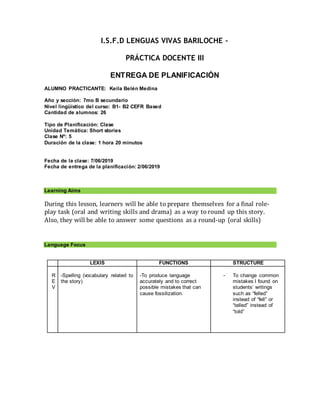
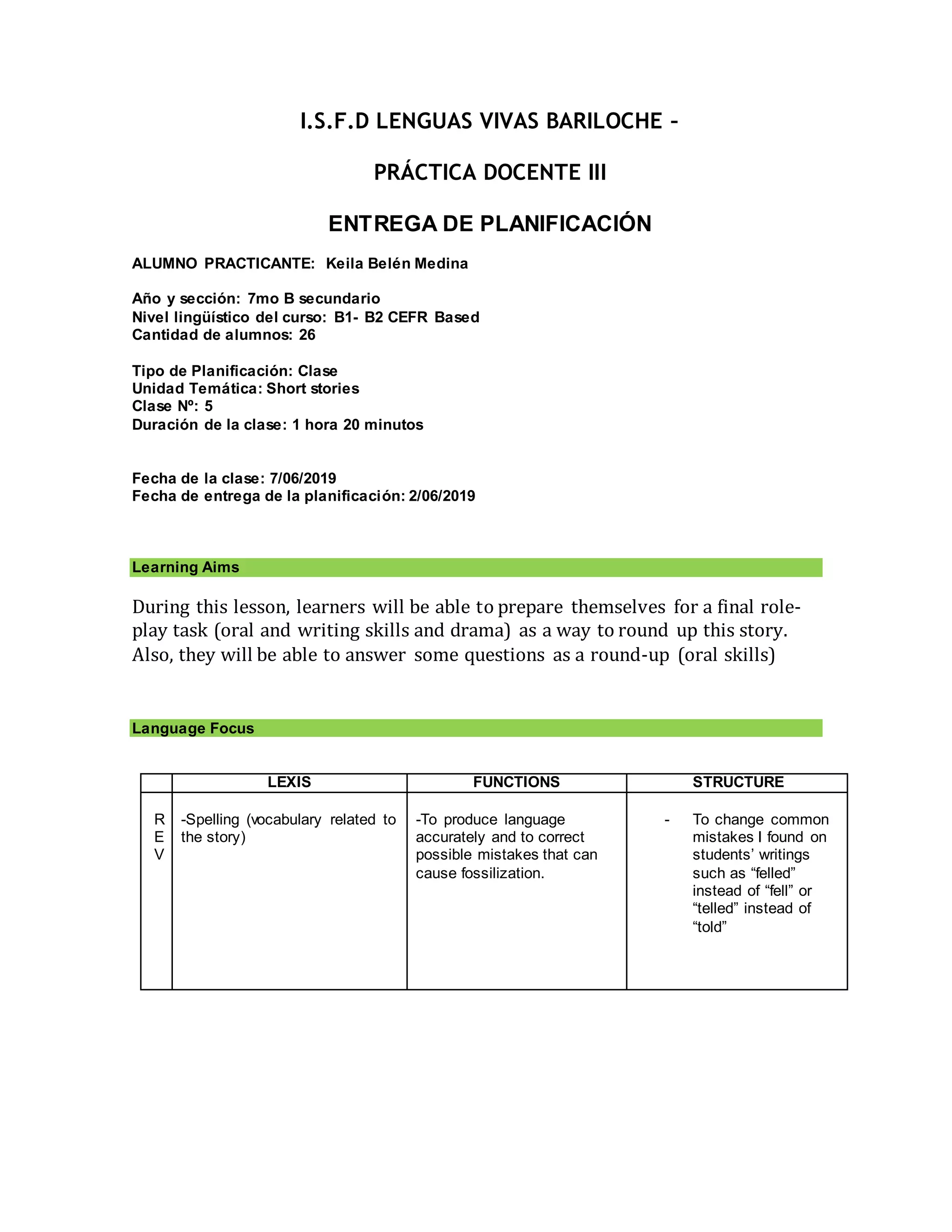
I.S.F.D LENGUAS VIVAS BARILOCHE –
PRÁCTICA DOCENTE III
ENTREGA DE PLANIFICACIÓN
ALUMNO PRACTICANTE: Keila Belén Medina
Año y sección: 7mo B secundario
Nivel lingüístico del curso: B1- B2 CEFR Based
Cantidad de alumnos: 26
Tipo de Planificación: Clase
Unidad Temática: Short stories
Clase Nº: 5
Duración de la clase: 1 hora 20 minutos
Fecha de la clase: 7/06/2019
Fecha de entrega de la planificación: 2/06/2019
Learning Aims
During this lesson, learners will be able to prepare themselves for a final role-
play task (oral and writing skills and drama) as a way to round up this story.
Also, they will be able to answer some questions as a round-up (oral skills)
Language Focus
LEXIS FUNCTIONS STRUCTURE
R
E
V
-Spelling (vocabulary related to
the story)
-To produce language
accurately and to correct
possible mistakes that can
cause fossilization.
- To change common
mistakes I found on
students’ writings
such as “felled”
instead of “fell” or
“telled” instead of
“told”
N
E
W
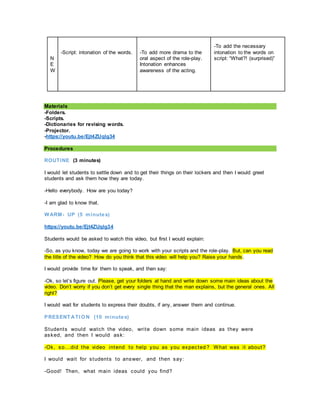
-Script: intonation of the words. -To add more drama to the
oral aspect of the role-play.
Intonation enhances
awareness of the acting.
-To add the necessary
intonation to the words on
script: “What?! (surprised)”
Materials
-Folders.
-Scripts.
-Dictionaries for revising words.
-Projector.
-https://youtu.be/Ejt4ZUqlg34
Procedures
ROUTINE (3 minutes)
I would let students to settle down and to get their things on their lockers and then I would greet
students and ask them how they are today.
-Hello everybody. How are you today?
-I am glad to know that.
WARM- UP (5 minutes)
https://youtu.be/Ejt4ZUqlg34
Students would be asked to watch this video, but first I would explain:
-So, as you know, today we are going to work with your scripts and the role-play. But, can you read
the title of the video? How do you think that this video will help you? Raise your hands.
I would provide time for them to speak, and then say:
-Ok, so let’s figure out. Please, get your folders at hand and write down some main ideas about the
video. Don’t worry if you don’t get every single thing that the man explains, but the general ones. All
right?
I would wait for students to express their doubts, if any, answer them and continue.
PRESENT ATI ON (10 minutes)
Students would watch the video, write down some main ideas as they were
asked, and then I would ask:
-Ok, so...did the video intend to help you as you expected ? What was it about?
I would wait for students to answer, and then say:
-Good! Then, what main ideas could you find?
I would wait for their answers and write them. I expect some ideas like: communication, memorizing
vs acting out, etc.
-Great! So, now look at your scripts...
DEVELOP M ENT (PRACTI CE and PRODUCTI ON)
Activity 1: Practising and revising the script
Timing: 15 minutes
Scaffolding highlighted
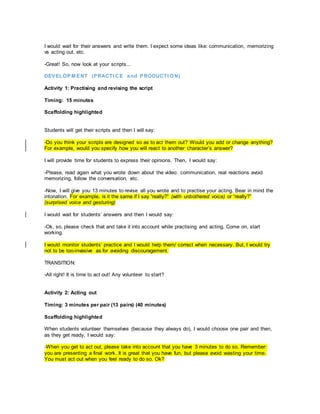
Students will get their scripts and then I will say:
-Do you think your scripts are designed so as to act them out? Would you add or change anything?
For example, would you specify how you will react to another character’s answer?
I will provide time for students to express their opinions. Then, I would say:
-Please, read again what you wrote down about the video: communication, real reactions avoid
memorizing, follow the conversation, etc.
-Now, I will give you 13 minutes to revise all you wrote and to practise your acting. Bear in mind the
intonation. For example, is it the same if I say “really?” (with unbothered voice) or “really?”
(surprised voice and gesturing)
I would wait for students’ answers and then I would say:
-Ok, so, please check that and take it into account while practising and acting. Come on, start
working.
I would monitor students’ practice and I would help them/ correct when necessary. But, I would try
not to be too-invasive as for avoiding discouragement.
TRANSITION:
-All right! It is time to act out! Any volunteer to start?
Activity 2: Acting out
Timing: 3 minutes per pair (13 pairs) (40 minutes)
Scaffolding highlighted
When students volunteer themselves (because they always do), I would choose one pair and then,
as they get ready, I would say:
-When you get to act out, please take into account that you have 3 minutes to do so. Remember:
you are presenting a final work. It is great that you have fun, but please avoid wasting your time.
You must act out when you feel ready to do so. Ok?
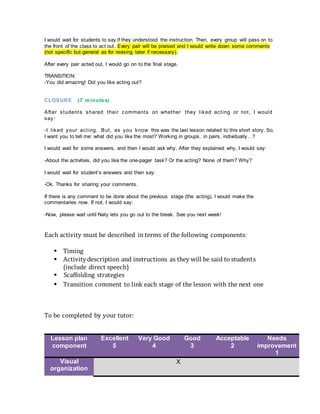
I would wait for students to say if they understood the instruction. Then, every group will pass on to
the front of the class to act out. Every pair will be praised and I would write down some comments
(not specific but general as for revising later if necessary).
After every pair acted out, I would go on to the final stage.
TRANSITION:
-You did amazing! Did you like acting out?
CLOSURE (7 minutes)
After students shared their comments on whether they liked acting or not, I would
say:
-I liked your acting. But, as you know this was the last lesson related to this short story. So,
I want you to tell me: what did you like the most? Working in groups, in pairs, individually…?
I would wait for some answers, and then I would ask why. After they explained why, I would say:
-About the activities, did you like the one-pager task? Or the acting? None of them? Why?
I would wait for student’s answers and then say:
-Ok. Thanks for sharing your comments.
If there is any comment to be done about the previous stage (the acting), I would make the
commentaries now. If not, I would say:
-Now, please wait until Naty lets you go out to the break. See you next week!
Each activity must be described in terms of the following components:
 Timing
 Activitydescription and instructions as they will be said to students
(include direct speech)
 Scaffolding strategies
 Transition comment to link each stage of the lesson with the next one
To be completed by your tutor:
Lesson plan
component
Excellent
5
Very Good
4
Good
3
Acceptable
2
Needs
improvement
1
Visual
organization
X
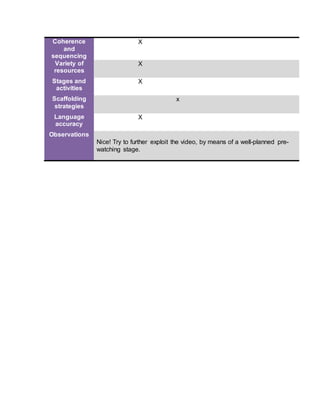
Coherence
and
sequencing
X
Variety of
resources
X
Stages and
activities
X
Scaffolding
strategies
x
Language
accuracy
X
Observations
Nice! Try to further exploit the video, by means of a well-planned pre-
watching stage.

Medina pd iii - lesson plan- lesson 5 - passed

  • 1.
    I.S.F.D LENGUAS VIVASBARILOCHE – PRÁCTICA DOCENTE III ENTREGA DE PLANIFICACIÓN ALUMNO PRACTICANTE: Keila Belén Medina Año y sección: 7mo B secundario Nivel lingüístico del curso: B1- B2 CEFR Based Cantidad de alumnos: 26 Tipo de Planificación: Clase Unidad Temática: Short stories Clase Nº: 5 Duración de la clase: 1 hora 20 minutos Fecha de la clase: 7/06/2019 Fecha de entrega de la planificación: 2/06/2019 Learning Aims During this lesson, learners will be able to prepare themselves for a final role- play task (oral and writing skills and drama) as a way to round up this story. Also, they will be able to answer some questions as a round-up (oral skills) Language Focus LEXIS FUNCTIONS STRUCTURE R E V -Spelling (vocabulary related to the story) -To produce language accurately and to correct possible mistakes that can cause fossilization. - To change common mistakes I found on students’ writings such as “felled” instead of “fell” or “telled” instead of “told”
  • 2.
    N E W -Script: intonation ofthe words. -To add more drama to the oral aspect of the role-play. Intonation enhances awareness of the acting. -To add the necessary intonation to the words on script: “What?! (surprised)” Materials -Folders. -Scripts. -Dictionaries for revising words. -Projector. -https://youtu.be/Ejt4ZUqlg34 Procedures ROUTINE (3 minutes) I would let students to settle down and to get their things on their lockers and then I would greet students and ask them how they are today. -Hello everybody. How are you today? -I am glad to know that. WARM- UP (5 minutes) https://youtu.be/Ejt4ZUqlg34 Students would be asked to watch this video, but first I would explain: -So, as you know, today we are going to work with your scripts and the role-play. But, can you read the title of the video? How do you think that this video will help you? Raise your hands. I would provide time for them to speak, and then say: -Ok, so let’s figure out. Please, get your folders at hand and write down some main ideas about the video. Don’t worry if you don’t get every single thing that the man explains, but the general ones. All right? I would wait for students to express their doubts, if any, answer them and continue. PRESENT ATI ON (10 minutes) Students would watch the video, write down some main ideas as they were asked, and then I would ask: -Ok, so...did the video intend to help you as you expected ? What was it about? I would wait for students to answer, and then say: -Good! Then, what main ideas could you find?
  • 3.
    I would waitfor their answers and write them. I expect some ideas like: communication, memorizing vs acting out, etc. -Great! So, now look at your scripts... DEVELOP M ENT (PRACTI CE and PRODUCTI ON) Activity 1: Practising and revising the script Timing: 15 minutes Scaffolding highlighted Students will get their scripts and then I will say: -Do you think your scripts are designed so as to act them out? Would you add or change anything? For example, would you specify how you will react to another character’s answer? I will provide time for students to express their opinions. Then, I would say: -Please, read again what you wrote down about the video: communication, real reactions avoid memorizing, follow the conversation, etc. -Now, I will give you 13 minutes to revise all you wrote and to practise your acting. Bear in mind the intonation. For example, is it the same if I say “really?” (with unbothered voice) or “really?” (surprised voice and gesturing) I would wait for students’ answers and then I would say: -Ok, so, please check that and take it into account while practising and acting. Come on, start working. I would monitor students’ practice and I would help them/ correct when necessary. But, I would try not to be too-invasive as for avoiding discouragement. TRANSITION: -All right! It is time to act out! Any volunteer to start? Activity 2: Acting out Timing: 3 minutes per pair (13 pairs) (40 minutes) Scaffolding highlighted When students volunteer themselves (because they always do), I would choose one pair and then, as they get ready, I would say: -When you get to act out, please take into account that you have 3 minutes to do so. Remember: you are presenting a final work. It is great that you have fun, but please avoid wasting your time. You must act out when you feel ready to do so. Ok?
  • 4.
    I would waitfor students to say if they understood the instruction. Then, every group will pass on to the front of the class to act out. Every pair will be praised and I would write down some comments (not specific but general as for revising later if necessary). After every pair acted out, I would go on to the final stage. TRANSITION: -You did amazing! Did you like acting out? CLOSURE (7 minutes) After students shared their comments on whether they liked acting or not, I would say: -I liked your acting. But, as you know this was the last lesson related to this short story. So, I want you to tell me: what did you like the most? Working in groups, in pairs, individually…? I would wait for some answers, and then I would ask why. After they explained why, I would say: -About the activities, did you like the one-pager task? Or the acting? None of them? Why? I would wait for student’s answers and then say: -Ok. Thanks for sharing your comments. If there is any comment to be done about the previous stage (the acting), I would make the commentaries now. If not, I would say: -Now, please wait until Naty lets you go out to the break. See you next week! Each activity must be described in terms of the following components:  Timing  Activitydescription and instructions as they will be said to students (include direct speech)  Scaffolding strategies  Transition comment to link each stage of the lesson with the next one To be completed by your tutor: Lesson plan component Excellent 5 Very Good 4 Good 3 Acceptable 2 Needs improvement 1 Visual organization X
  • 5.